What Teachings and Public Acts of the Post-Vatican II Papal Claimants Are Relevant to the Crisis?
Short Answer
The post-Vatican II crisis cannot adequately be explained as a collection of local abuses committed against the wishes of otherwise traditional popes.
From Angelo Giuseppe Roncalli (John XXIII) to Robert Francis Prevost (Leo XIV) there is a documented institutional succession:
the Council was convoked and given its new orientation;
its contested principles were promulgated;
the Roman Mass and sacramental rites were extensively reconstructed;
conciliar ecclesiology was translated into a new Code of Canon Law
and a new universal Catechism;
ecumenical and interreligious practices previously regarded with grave suspicion became papally sponsored programmes;
and later claimants continued, defended and extended the same trajectory.
The sequence is remarkably coherent:
John XXIII opened the programme.
Paul VI legislated its fundamental transformation.
John Paul I pledged continuity.
John Paul II universalised and codified it.
Benedict XVI defended it through a “hermeneutic of reform.”
Francis pushed several of its principles to conclusions that made the underlying rupture still harder to disguise.
Leo XIV has explicitly pledged to continue along the same Vatican II, synodal and interreligious path.
That does not prove that every one of these men secretly intended to destroy Catholicism. Nor does it require such a theory. The relevant question is public and theological:
what did they teach, approve, promulgate and impose while claiming the authority of the Roman Pontiff?
This distinction is essential. The governing FAQ method requires us to document actual statements and actions, distinguish public acts from conjectured motives, compare them with the pre-Vatican II Magisterium, and then follow the ecclesiological consequences without either exaggerating or retreating from what the evidence establishes.
If the Catholic Church is indefectible—if she cannot officially transform the Faith entrusted to her into a different religion—then sustained doctrinal, liturgical and sacramental rupture originating from men claiming her supreme authority eventually raises a question far more serious than whether particular “popes” were imprudent:
Were these men really possessing and exercising Catholic papal authority at all?
That is where the evidence concerning the postconciliar papal claimants becomes directly relevant to the sedevacantist argument.
Why This Question Matters
A single imprudent gesture can be misunderstood. An ambiguous sermon may admit an orthodox interpretation. Even a pope can sin grievously, govern badly, appoint corrupt men or make disastrous prudential judgments without thereby ceasing to be pope.
But that is not the phenomenon under examination here.
The postconciliar transformation extends across doctrine, worship, sacraments, canon law, catechesis, ecclesiology, missionary purpose and relations with false religions.
It occurred over more than six decades and through successive authorities who repeatedly described themselves as implementing Vatican II. That cumulative character is decisive.
The question is therefore not
whether John Paul II once made an embarrassing gesture,
whether Francis once used an unfortunate phrase,
or whether a parish priest somewhere celebrated an abusive Mass.
It is whether a body claiming to be the Catholic hierarchy systematically used what it claimed was Catholic authority to construct and perpetuate a religious order substantially different from the one that existed before Vatican II.
If that is established, the crisis ceases to look like a rebellion against Rome. It begins to look like a transformation carried out through the apparent machinery of Rome itself.
The Catholic Standard That Came Before
Before judging the later claimants, the doctrinal baseline must be clear.
Pope Pius IX condemned the proposition that liberty of conscience and worship should be proclaimed as an inherent right in every well-ordered society.
Pope Leo XIII likewise distinguished legitimate toleration from the idea that every man possesses an unrestricted natural right publicly to profess whatever religion he chooses. At the same time, traditional Catholic teaching never justified forced interior belief: faith cannot simply be produced by coercion. The dispute is therefore not about whether consciences may be forced, but about whether religious error possesses a positive civil right grounded in human dignity.
Pope Pius XI taught that genuine Christian unity could not be constructed by treating separated religious bodies as parallel participants in a federation. The proper road was their return to the one Church of Christ. In Quas Primas, he likewise insisted that Christ possesses kingship not merely over individuals but over societies and states.
Pope Pius XII described membership in Christ's Mystical Body in terms of baptism, profession of the true Faith and remaining within ecclesiastical unity. He also stressed the visible unity of the same faith, rites, sacrifice and government.
St Pius X's Pascendi Dominici Gregis condemned Modernism not simply as enthusiasm for modern conveniences, but as a theological method capable of making dogma, religious consciousness and ecclesiastical formulations evolve with changing human experience.
In the liturgical sphere, Pius XII taught that regulation of the sacred liturgy belonged to ecclesiastical authority while simultaneously condemning antiquarian attempts to reconstruct worship simply because an older form was supposedly more primitive. His 1947 constitution Sacramentum Ordinis also identified the sacramental matter and form of Holy Orders then used by the Roman Church.
These teachings form the background against which Vatican II and the subsequent programme must be judged.
John XXIII — Angelo Giuseppe Roncalli
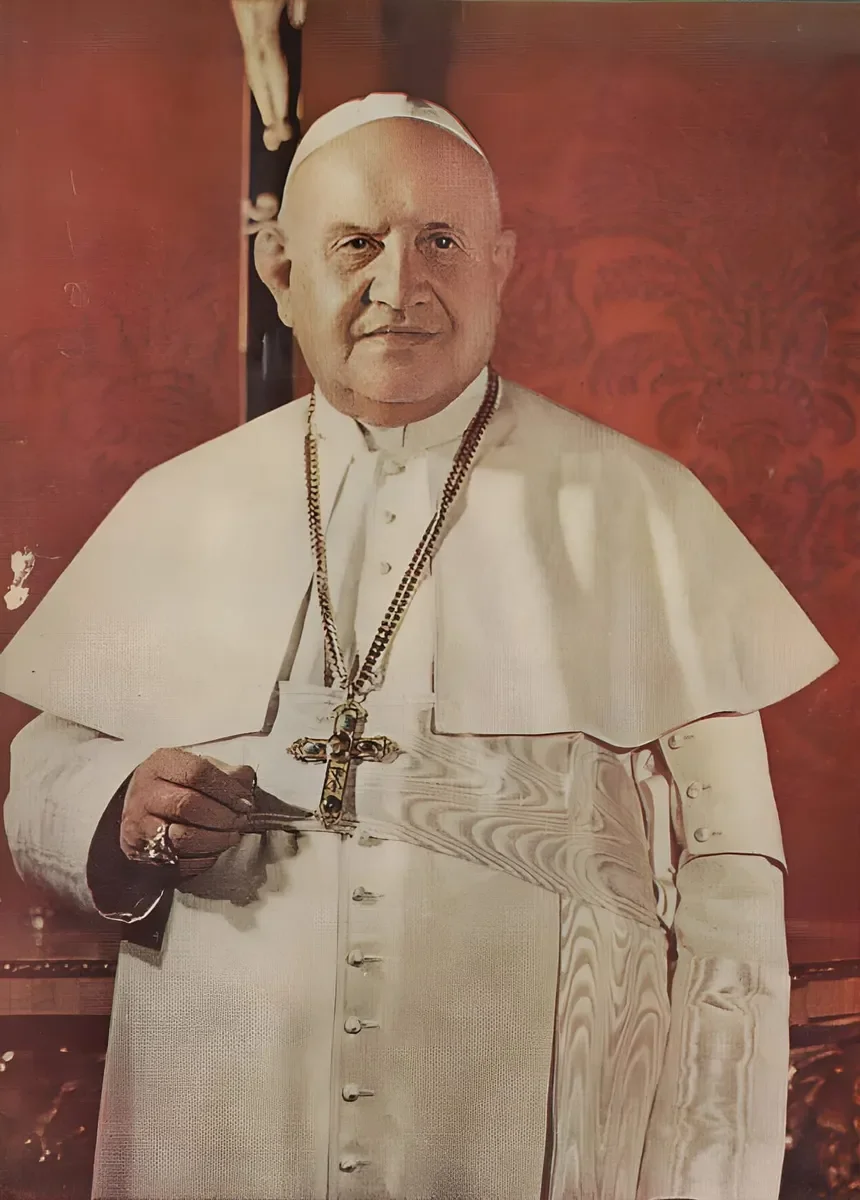
John XXIII — Angelo Giuseppe Roncalli (1881–1963) — Elected in 1958, Roncalli convoked the Second Vatican Council, established the Secretariat for Promoting Christian Unity, and initiated revision of the Code of Canon Law. Although he died before the Council’s most controversial documents were promulgated, his pontificate opened the institutional and pastoral programme that his successors would develop into the postconciliar order.
The Council Begins
Angelo Giuseppe Roncalli, elected John XXIII in 1958, did not live to promulgate Lumen Gentium, Unitatis Redintegratio, Nostra Aetate or Dignitatis Humanae. He died on 3 June 1963. It would therefore be historically inaccurate to blame him personally for documents promulgated after his death.
Nevertheless, his role was foundational.
On 25 January 1959, Roncalli announced three linked projects:
a Roman synod,
an ecumenical council
and revision of the Code of Canon Law.
The eventual transformation of theology, worship and law thus did not begin accidentally after the Council; revision of the Church's legislative order was envisaged from the project's beginning.
In 1960 he established the Secretariat for Promoting Christian Unity. Vatican documentation itself presents this as the institutional beginning of a new formal Catholic commitment to the ecumenical movement.
When Vatican II opened on 11 October 1962, John XXIII deliberately preferred a predominantly pastoral mode of presenting doctrine rather than a council chiefly structured around new condemnations. That choice by itself was not heresy. It nevertheless proved enormously consequential because the Council that followed introduced formulations and orientations whose compatibility with earlier teaching would become the central controversy of the postconciliar period.
His 1963 encyclical Pacem in Terris also spoke of a right to worship God according to the “right dictates” of conscience and publicly to profess one's religion. Read carefully, the qualification concerning right conscience prevents this sentence from simply being equated with unlimited indifferentism. Yet it unmistakably anticipates the vocabulary of personal religious rights that Dignitatis Humanae would develop two years later.
Roncalli had been ordained priest in 1904 and consecrated bishop in 1925, long before the postconciliar rites. Whatever judgment one reaches concerning his pontificate, the later sacramental-validity problem created by Paul VI's revised Holy Orders does not apply to Roncalli's own orders.
The extensive allegations found in some traditionalist literature concerning secret affiliations, Communism, Freemasonry or the 1958 conclave should not carry this article's argument. Some are difficult to establish; others depend upon disputed testimony. They are unnecessary.
The documented case is already substantial:
Roncalli convoked the Council, created the ecumenical machinery, initiated the canonical revision and set the pastoral orientation from which the postconciliar programme proceeded.
He opened the door. His successors walked through it.
Paul VI — Giovanni Battista Montini
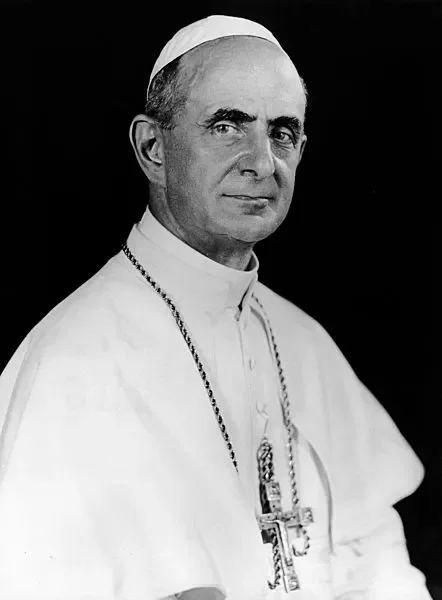
Paul VI — Giovanni Battista Montini (1897–1978) — Elected in 1963, Montini completed Vatican II and became its principal implementer. Under his authority the Novus Ordo Missae was promulgated, new Eucharistic Prayers introduced, the rites of Holy Orders and episcopal consecration revised, and other sacramental rites reformed. His pontificate transformed conciliar principles into the ordinary worship, sacramental practice, and institutional life of the post-Vatican II establishment.
The Great Implementer
If John XXIII initiated the conciliar project, Giovanni Battista Montini—Paul VI—made the postconciliar transformation concrete.
This distinction matters enormously. Vatican II did not merely produce books that theologians subsequently misused. Under Paul VI, its principles were translated into universal legislation, worship and sacramental practice.
Paul VI promulgated the central disputed conciliar documents, including Lumen Gentium, Unitatis Redintegratio, Nostra Aetate and Dignitatis Humanae. The ecumenical movement, religious liberty, the new ecclesiology and the altered relationship with non-Christian religions therefore cannot simply be dismissed as the later “spirit of Vatican II.” They appear in texts officially promulgated under the authority Montini claimed.
The Roman Mass Was Reconstructed
The decisive liturgical act came with Paul VI's apostolic constitution Missale Romanum of 3 April 1969.
Paul VI himself described the Eucharistic Prayer as the location of the “major innovation.” He added three new Eucharistic Prayers alongside the ancient Roman Canon, standardised the institution narrative, removed Mysterium fidei from within the traditional words over the chalice and made it introduce a congregational acclamation instead. He ordered significant simplification of the rite and explicitly acknowledged substantial modifications extending through the Mass and liturgical calendar.
The importance of this evidence cannot be overstated. The Novus Ordo was not invented by rogue priests after Vatican II. It came through an apostolic constitution bearing Paul VI's claimed supreme authority.
Nor is it accurate to frame the question merely as Latin versus vernacular.
The issue concerns the theological expression of the Roman rite: sacrifice, priesthood, offering, propitiation, the Offertory, the Canon, the distinction between priest and people, and the relationship between Catholic worship and ecumenical adaptation.
Paul VI's constitution itself expressly recalled St Pius V's 1570 Missal and then ordered the new legislation to take effect notwithstanding contrary constitutions and ordinances of predecessors.
That is more precise than saying merely that Paul VI “violated Quo Primum.”
Pius V clearly intended the Roman Missal he promulgated to serve enduring liturgical unity, and Paul VI unquestionably replaced that inherited liturgical order with a massively revised missal. But it is not theologically sufficient to argue that one pope can make all future disciplinary liturgical legislation absolutely unreformable merely by using perpetual legal language.
The stronger argument is different:
What kind of liturgical transformation could the Catholic Church legitimately impose universally without compromising her Faith and indefectibility?
That question reaches far beyond the legal wording of Quo Primum.
Holy Orders and the Sacraments Were Changed
The liturgical transformation did not stop with the Mass.
On 18 June 1968, Pontificalis Romani Recognitio approved new rites for ordaining deacons, priests and bishops. Paul VI expressly changed texts and ceremonies and established new sacramental forms, including a new form for episcopal consecration. The document itself contrasts the reform with Pius XII's earlier Sacramentum Ordinis.
Paul VI subsequently promulgated a revised rite and formula of Confirmation in 1971 and a revised rite of Anointing of the Sick in 1972.
This is the origin of one of the gravest questions in the entire crisis. The historical fact is indisputable:
the central rites by which priests and bishops are ordained were substantially revised.
Whether those revised rites are certainly valid is a separate theological question that must be decided according to Catholic sacramental theology—matter, form, minister and intention—not merely from the fact that they were changed. But because the episcopate transmits Holy Orders, an invalid episcopal rite would have consequences propagating through succeeding generations of clergy.
That is why the 1968 reform cannot be treated as an aesthetic controversy.
Paul VI's Importance
Montini therefore occupies a uniquely consequential place in the postconciliar sequence. Under him:
Vatican II became law, worship and sacramental structure.
The transformation was no longer a proposal. It had become the official programme of the organisation claiming to be the Catholic Church.
John Paul I — Albino Luciani
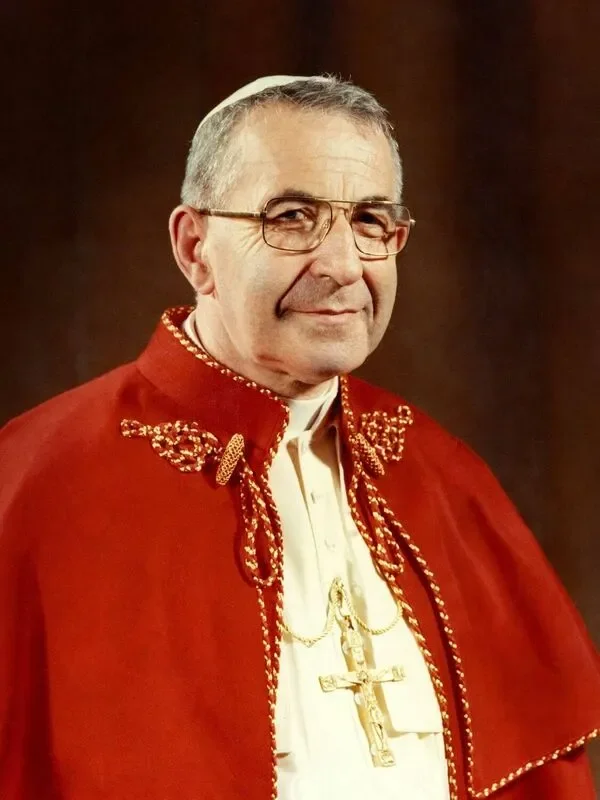
John Paul I — Albino Luciani (1912–1978) — Elected in August 1978, Luciani reigned for only 33 days, leaving little time to establish a distinctive programme of his own. He nevertheless publicly committed himself to continuing the implementation of Vatican II, including its ecumenical orientation, and therefore represented continuity rather than a reversal of the postconciliar direction established under John XXIII and Paul VI.
A Brief Pontificate, but Not a Different Direction
Albino Luciani, John Paul I, reigned only thirty-three days in 1978. He did not have sufficient time to construct another major stage comparable with Paul VI's liturgical reform or John Paul II's canonical codification.
His significance is therefore chiefly one of continuity. In his first Urbi et Orbi address, Luciani explicitly committed himself to continuing the implementation of Vatican II and the ecumenical work inherited from his predecessors.
His short pontificate provides little basis for attributing to him a distinctive system of doctrinal innovations. It would therefore be artificial to manufacture a long catalogue merely to make him resemble the others.
But neither did he interrupt the postconciliar programme. He accepted it and publicly pledged to continue it.
Luciani had been ordained priest in 1935 and consecrated bishop in 1958, so his own orders came from the traditional pre-1968 rites.
John Paul II — Karol Józef Wojtyła
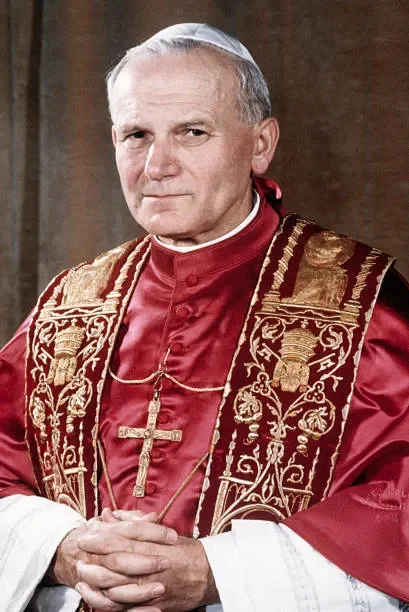
John Paul II — Karol Józef Wojtyła (1920–2005) — Elected in 1978, Wojtyła became one of the principal architects of the mature postconciliar system. Under his authority the 1983 Code of Canon Law and 1992 Catechism were promulgated, while ecumenical and interreligious activity expanded dramatically, most visibly at Assisi in 1986. His pontificate helped institutionalise Vatican II in law, catechesis, missionary practice and the public religious life of the postconciliar establishment.
From Conciliar Programme to Universal System
With Karol Józef Wojtyła, John Paul II, the postconciliar project entered another stage.
Paul VI had reconstructed much of the liturgical and sacramental order. Wojtyła helped codify, universalise and symbolically embody the new ecclesiology.
He was not an outsider reluctantly inheriting Vatican II. He had participated at the Council as a bishop, and later described Vatican II as the “constant reference point” of his pastoral activity. His 1992 constitution promulgating the new Catechism explicitly presented the Catechism as part of the renewal begun by Vatican II.
The 1983 Code of Canon Law
John Paul II promulgated the new Code of Canon Law on 25 January 1983.
The accompanying constitution could scarcely be clearer about its purpose. Wojtyła said the Code was, in an important sense, an effort to translate conciliar ecclesiology into canonical language. He specifically identified the “People of God,” communion ecclesiology, collegiality, lay participation and ecumenism among the elements characterising this conciliar ecclesiology.
That statement alone demolishes one common explanation of the crisis.
The 1983 Code was not a later departure from Vatican II. Its promulgator said the opposite: it was designed to institutionalise Vatican II.
The 1992 Catechism
The same pattern appears with the Catechism of the Catholic Church.
Fidei Depositum explicitly calls it a Catechism “prepared following the Second Vatican Ecumenical Council.” John Paul II placed it alongside the liturgical renewal and new canonical codification as part of the wider renewal of ecclesial life desired and begun by the Council.
Thus by the early 1990s three enormous pillars of ordinary Catholic life had been remade:
liturgy → law → catechesis.
To describe what followed merely as abuses by disobedient progressives is increasingly impossible.
Inter-religious World Day of Prayer, Assisi 1986
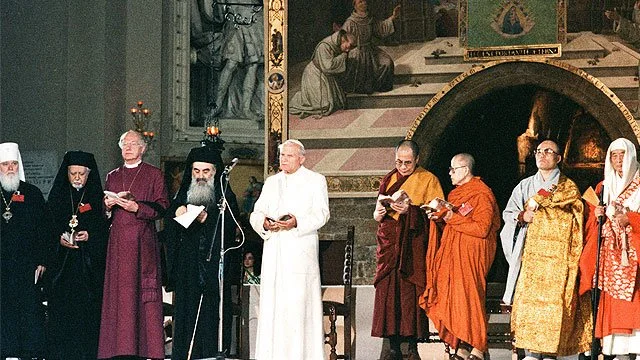
World Day of Prayer for Peace, Assisi — 27 October 1986 — At the invitation of John Paul II, representatives of Protestant sects, Eastern Orthodox bodies, and numerous non-Christian religions gathered at Assisi to pray for peace according to their respective beliefs and rites. Although John Paul II denied that the event constituted syncretism, Assisi became one of the defining symbols of the post-Vatican II interreligious programme: the man claiming the Roman See publicly convened adherents of false religions and separated religious bodies for religious acts within one coordinated event. From the standpoint of traditional Catholic teaching on the unity of the Church and relations with false religions, the event marked a striking departure from the pre-Vatican II approach exemplified by Pius XI’s Mortalium Animos.
The World Day of Prayer for Peace at Assisi on 27 October 1986 became the emblematic public act of John Paul II's interreligious programme.
Accuracy is important. John Paul II did not organise one syncretistic liturgical service in which everyone recited the same prayer. He expressly denied seeking religious consensus, and participants prayed according to their different religions in separate places before reassembling. But that qualification does not remove the traditional Catholic objection.
The Roman claimant had invited representatives of false religions to Assisi specifically to pray according to their own religious rites as a contribution to world peace. John Paul II described the gathering of religions for prayer as itself significant and spoke of diverse religions expressing mankind's search for the Absolute.
Compare that symbolism with Pius XI's warnings in Mortalium Animos against Catholic participation in religious congresses that obscure the unique supernatural unity of Christ's Church, and the rupture cannot simply be dismissed as a question of tone.
Assisi was not a parish abuse. It was papally conceived.
Kissing of the Quran
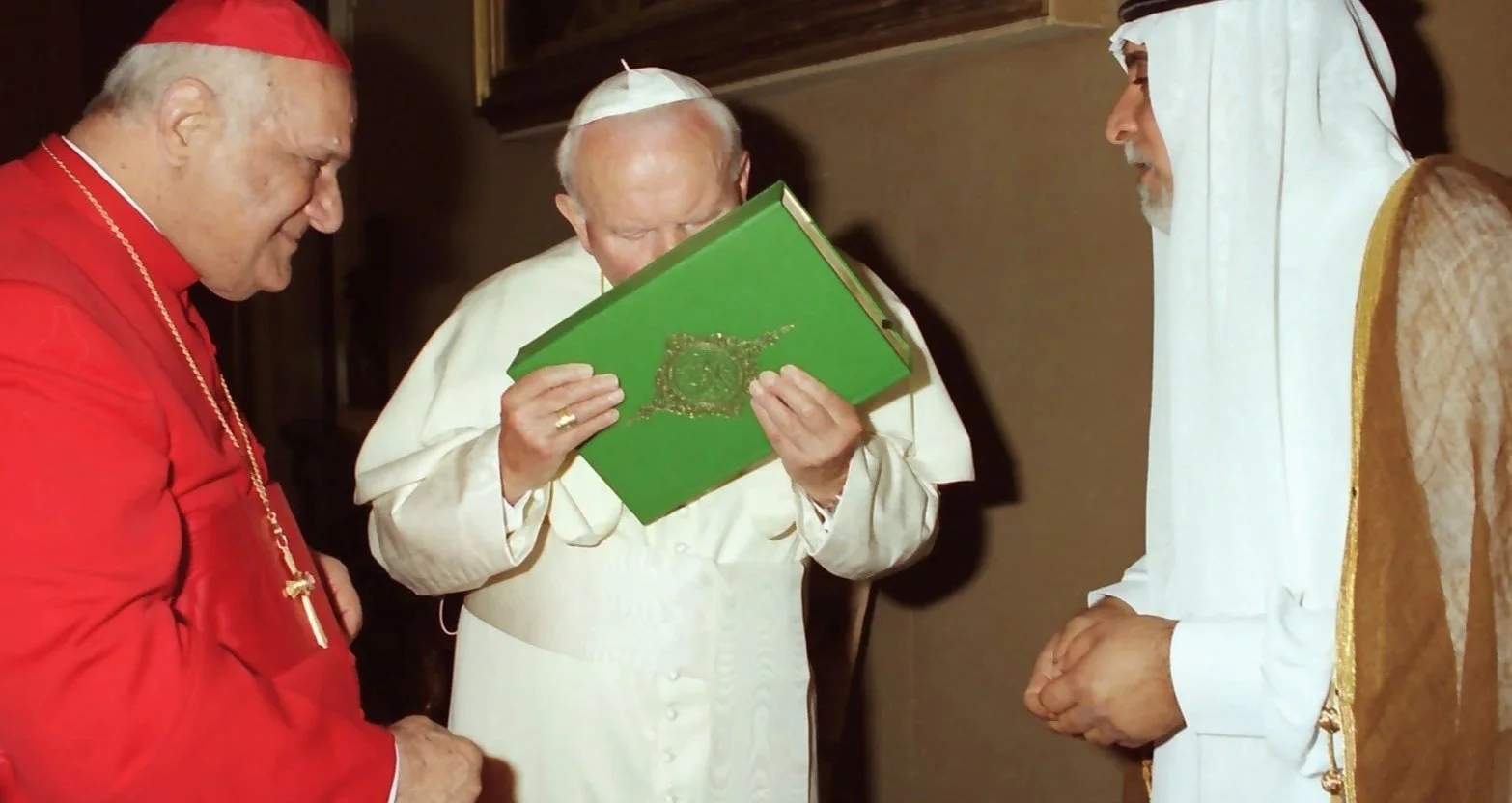
John Paul II and the Quran — 14 May 1999. During a meeting with an Iraqi delegation at the Vatican, John Paul II was photographed holding and bowing toward a copy of the Quran. Chaldean Catholic Patriarch Raphael I Bidawid, who was present, later stated that John Paul II kissed the Quran as a sign of respect. The gesture became one of the most controversial symbols of the post-Vatican II interreligious programme, raising the question of how public reverence for a text that rejects central Christian doctrines can be reconciled with the traditional Catholic duty to profess the one true Faith without ambiguity.
Another frequently cited incident occurred on 14 May 1999, when John Paul II received an Iraqi delegation.
Chaldean Catholic Patriarch Raphael I Bidawid, who said he was present, subsequently told FIDES that the book was the Quran and that John Paul II bowed and kissed it as a sign of respect.
The proper evidentiary formulation is therefore:
There is substantial eyewitness evidence that John Paul II publicly kissed a Quran, although the surviving photograph alone is not conclusive and no Vatican doctrinal document formally records the gesture as an act of teaching.
This distinction does not make the event irrelevant. A papal claimant's public reverence towards a book that explicitly rejects central Christian dogmas—above all the divinity of Christ in the Catholic sense and the Crucifixion—has obvious symbolic significance.
But the case against the postconciliar system should not depend upon one photograph. The 1983 Code, the 1992 Catechism and Assisi are far stronger institutional evidence.
Mission and Ecumenism
John Paul II did not simply abolish missionary activity or formally teach that Christ is unnecessary. Redemptoris Missio, for example, repeatedly affirms Christ's unique salvific role.
The problem is that traditional missionary theology now operated simultaneously with an increasingly expansive ecumenical and interreligious framework in which separated communities could be spoken of positively as means through which grace operates and non-Christian religions were treated as partners in religious dialogue.
John Paul II's pontificate therefore represents not the abandonment of Vatican II but its normalisation as the ordinary global religion of the Vatican establishment.
Wojtyła himself had been ordained priest in 1946 and consecrated bishop in 1958, both before Paul VI's revised rites.
Benedict XVI — Joseph Alois Ratzinger
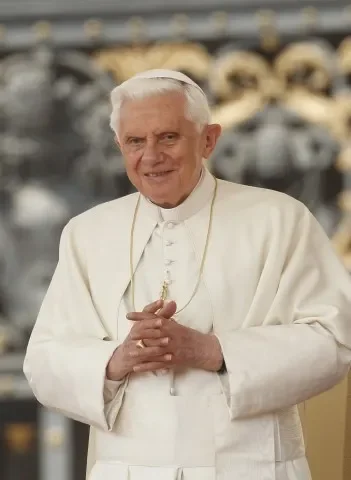
Benedict XVI — Joseph Alois Ratzinger (1927–2022) — Elected in 2005, Ratzinger presented himself as a conservative interpreter of Vatican II rather than its repudiator. He defended a “hermeneutic of reform,” widened access to the traditional Roman Mass through Summorum Pontificum, yet continued the postconciliar ecumenical and interreligious programme through prayer in Istanbul’s Blue Mosque, common prayer with Protestants and Eastern Orthodox, and the Assisi gathering of 2011. His pontificate sought to reconcile the postconciliar settlement with tradition rather than restore the pre-Vatican II order.
The Conservative Face of the Conciliar Settlement
Joseph Alois Ratzinger, Benedict XVI, occupies an unusual position in the history of the postconciliar crisis. To many Catholics troubled by the direction of the institution under John Paul II—and still more when contrasted retrospectively with Francis—Ratzinger appeared to represent a return toward tradition. He wrote critically about liturgical experimentation, spoke forcefully about relativism, encouraged greater reverence in worship, permitted much wider use of the traditional Roman Missal, and repeatedly insisted that Vatican II had to be interpreted in continuity with the Church's past.
These differences were real.
But they should not obscure the more important fact:
Benedict did not repudiate Vatican II, the new ecclesiology, the ecumenical programme, the doctrine of religious liberty, the interreligious orientation, the new Mass, or the postconciliar sacramental order. He attempted to reconcile them with tradition.
That distinction is fundamental. Benedict's solution to the crisis was not:
Vatican II introduced errors that must be rejected and the preconciliar order restored.
It was substantially:
Vatican II was correctly understood only when interpreted as reform within continuity.
This makes Benedict particularly important for the TCF argument. His pontificate represents perhaps the most intellectually sophisticated attempt to prove that the postconciliar religion could be reconciled with what preceded it.
The question is whether the propositions themselves permit that reconciliation.
From the Beginning: A Determination to Implement Vatican II
Any interpretation of Benedict as a pope preparing to reverse Vatican II is difficult to reconcile with his own first major statement after his election.
On 20 April 2005, only a day after his election, Ratzinger expressly declared his determination to continue putting the Second Vatican Council into practice. He described John Paul II's interpretation of Vatican II as an authoritative application of the Gospel to the contemporary world and adopted his predecessor's image of the Council as a “compass” for the new millennium. Vatican
He simultaneously made ecumenism one of the priorities of his new pontificate. He spoke of working tirelessly for the “full and visible unity” of Christ's followers and promised to continue the dialogue begun by his predecessors with other religions and civilisations. Vatican
This was therefore not merely something Benedict drifted into later.
Continuation of Vatican II, ecumenism and interreligious dialogue was declared at the outset of his pontificate.
The difference between Benedict and more progressive postconciliar figures concerned principally how the Council should be understood and implemented, not whether its fundamental programme should be abandoned.
The “Hermeneutic of Reform”
Benedict's most famous attempt to solve the Vatican II problem came in his address to the Roman Curia on 22 December 2005.
He contrasted what he called a “hermeneutic of discontinuity and rupture” with a “hermeneutic of reform”—renewal within the continuity of the one Church. He argued that much postconciliar confusion resulted from interpreting Vatican II as though it represented a break with everything preceding it. Vatican
This distinction contains an important truth: genuine Catholic doctrinal development cannot constitute a rupture with revealed truth.
But Benedict's formula does not itself prove that Vatican II actually satisfies that principle.
A hermeneutic is a method of interpretation. It cannot make two incompatible propositions compatible merely by calling their relationship “reform.”
The question must still be asked proposition by proposition:
What did the earlier Magisterium teach? What did Vatican II teach? Can both propositions actually be affirmed in the same sense?
This becomes especially important when Benedict discusses religious liberty.
Religious Liberty: “Correction” Yet Somehow Continuity
In the same 2005 address Benedict confronted one of Vatican II's most disputed doctrines directly.
He acknowledged that the Council had been required to establish a new relationship between the Church and the modern state, including the freedom of citizens to practise their religion. He even conceded that, in certain respects, apparent discontinuity had occurred and that earlier historical decisions had effectively been reconsidered. Vatican
Benedict's defence was that the underlying principles remained continuous even though their historical applications had changed.
This is a crucial admission. It is very different from saying:
“The Catholic Church always taught exactly what Dignitatis Humanae teaches.”
Instead, the defence depends upon distinguishing permanent principles from supposedly contingent historical judgments.
But that classification is precisely what must be proved. If Pius IX and Leo XIII merely made temporary prudential judgments concerning nineteenth-century political circumstances, Benedict's solution may be possible.
If, however, they taught permanent principles concerning:
the objective rights of truth;
the duties of civil society toward the true religion;
the Social Kingship of Christ;
and the absence of an unrestricted natural right publicly to propagate religious error,
then the later religious-liberty doctrine cannot be reconciled merely by assigning the older teaching to a changeable historical category.
Thus Benedict's “hermeneutic of reform” does not resolve the controversy. It identifies where the controversy lies.
Were the previous teachings merely historical applications—or Catholic doctrine?
Summorum Pontificum: Restoration—or Reconciliation?
Benedict's most celebrated act among traditional Catholics was unquestionably Summorum Pontificum, issued on 7 July 2007.
It removed many practical restrictions surrounding celebration according to the 1962 Roman Missal and affirmed that this Missal had never juridically been abrogated. Thousands of Catholics subsequently regained access to the traditional Roman liturgy. Vatican
That practical benefit should not be minimised.
But Benedict's theological explanation is equally important.
He did not declare that Paul VI's Novus Ordo represented an illegitimate rupture which had displaced the authentic Roman Mass.
Instead, he said that:
the Missal of Paul VI remained the ordinary expression of the Church's lex orandi;
the earlier Missal constituted its extraordinary expression;
the two were not separate rites;
they were two usages of the one Roman rite;
and they could even be “mutually enriching.” Vatican
Thus Summorum Pontificum did not reverse Paul VI's liturgical settlement.
It attempted to reconcile the traditional Roman Mass with it.
That becomes the central theological problem.
If the Novus Ordo merely represents another legitimate liturgical form expressing the same Catholic theology, Benedict's “two forms” explanation can stand.
If, however, the Pauline rite embodies substantial theological shifts concerning sacrifice, priesthood, offering, liturgical orientation and ecumenical adaptation, simply declaring both missals expressions of the same lex orandi does not remove those differences.
The law of prayer cannot simultaneously express incompatible laws of belief.
Benedict's approach therefore alleviated the persecution of the traditional Mass while preserving the theological legitimacy of the postconciliar liturgical revolution.
He moderated the settlement. He did not repudiate it.
Prayer in the Blue Mosque
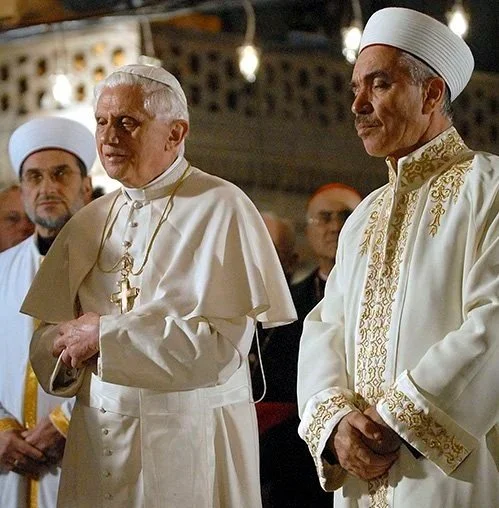
Benedict XVI in Istanbul’s Blue Mosque, 30 November 2006 — Standing beside a Muslim religious leader near the mihrab, Benedict engaged in prayerful recollection and later said that he had addressed “the one Lord of Heaven and earth.” Whatever his intention, the public image conveyed interreligious parity and fraternity—precisely the kind of religious ambiguity traditional Catholic teaching had sought to avoid.
One of the clearest examples of Benedict's continued adherence to the new interreligious orientation occurred during his journey to Turkey.
On 30 November 2006, Benedict entered Istanbul's Sultan Ahmed Mosque—the Blue Mosque.
Inside the mosque, he stood in silent recollection beside the Muslim religious authority near the mihrab, the architectural niche indicating the direction of Mecca.
It has sometimes been argued that Benedict simply stood respectfully and did not actually pray.
His own subsequent account settles the matter.
At his general audience of 6 December 2006, Benedict described the visit as unexpectedly important and said that, during the moments of recollection in the mosque, he had addressed “the one Lord of Heaven and earth.” He expressly situated the experience within the context of interreligious dialogue. Vatican
The necessary distinction should be preserved.
Benedict did not recite the Islamic shahada, perform the prescribed Muslim salat, or formally profess Islam.
But neither was this an ordinary diplomatic inspection of a historical building.
The claimant to the Roman See knowingly entered an active mosque, stood beside an Islamic religious authority in a position oriented toward Mecca, engaged in prayer there, and afterwards publicly described his action as prayer.
From the standpoint of traditional Catholic discipline this was extraordinarily significant.
The 1917 Code sharply restricted communicatio in sacris—religious participation with non-Catholics—and distinguished mere passive presence for a grave external reason from active participation in non-Catholic religious worship. Canon 1258 prohibited Catholics from active participation in non-Catholic sacred rites. Commentary on the Code of Canon Law.
The Blue Mosque episode therefore illustrates something considerably deeper than politeness toward Muslims.
It embodies the postconciliar conviction that highly visible interreligious religious gestures can themselves serve fraternity and peace.
With the Eastern Orthodox at Constantinople
The same journey produced another important example.
On 30 November 2006, Benedict attended the Divine Liturgy of St John Chrysostom celebrated in the Patriarchal Church of St George in Constantinople with Ecumenical Patriarch Bartholomew I.
Benedict did not receive Orthodox Communion, and that distinction matters.
Eastern Orthodox bodies also cannot simply be equated with Protestant sects. They retain apostolic sacramental rites and, according to Catholic theology, possess valid Holy Orders and a valid Eucharist where the necessary conditions are present.
Nevertheless, they remain separated from the Catholic Church and reject, among other things, Catholic teaching concerning the jurisdiction and primacy of the Roman Pontiff.
Yet Benedict described the occasion in ecclesiological language of fraternity between himself and Bartholomew and participated publicly in the Orthodox liturgical setting. Vatican
The two men then signed a Common Declaration describing their encounter as one of prayer and dialogue and renewing their commitment to move toward what they called the restoration of “full communion.” Vatican
Here again one sees the postconciliar ecclesiological vocabulary at work.
The older Catholic missionary framework stressed the return of separated Christians to the Catholic Church.
The postconciliar framework more commonly speaks of two ecclesial bodies already possessing a real though incomplete communion and journeying toward its fullness.
That shift is not simply one of politeness. It concerns the nature, boundaries and unity of the Church herself.
Benedict did not reverse it. He articulated it with theological sophistication.
Ecumenical Prayer with Protestants at Erfurt
The same principle appeared even more clearly during Benedict's 2011 visit to Germany.
On 23 September 2011, Benedict took part in an officially designated “Ecumenical Prayer Service” at the former Augustinian monastery in Erfurt, where Martin Luther had once lived.
The symbolism was extraordinary.
Luther rejected papal authority, denied Catholic teaching concerning the Mass and priesthood, rejected important elements of sacramental theology and became the principal historical figure in the religious revolt that fractured Western Christendom.
Yet the monastery associated with him became the setting for common prayer between the Roman claimant and representatives of the Protestant bodies descended from the Reformation.
In his address Benedict explicitly said that “we gather in prayer as Christians” and situated the gathering within Christ's prayer for unity. Vatican
Benedict certainly did not declare Lutheran doctrines true.
Nor did he deny that grave theological divisions remained.
The issue lies instead in the changed ecclesiological framework.
Pius XI's Mortalium Animos had warned against ecumenical arrangements that presented separated Christian bodies as though they were parallel participants in constructing Christian unity. The traditional Catholic objective was their conversion and return to the one Church.
The postconciliar approach increasingly makes common prayer itself an instrument of ecumenical convergence.
Erfurt was therefore not an accidental breach of Benedict's programme. It was an expression of it.
Assisi 2011: The Programme Continued
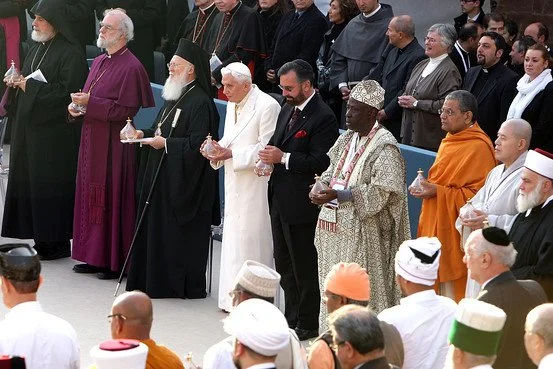
Benedict XVI at Assisi — 27 October 2011 — Benedict XVI stands among representatives of separated religious bodies and non-Christian religions during the interreligious gathering commemorating John Paul II’s 1986 Assisi meeting. The choice of Assisi is especially striking: St Francis did not treat contradictory religions as parallel paths to God; he crossed into Muslim territory during the Fifth Crusade and preached Christ before Sultan al-Kamil, seeking conversion rather than religious convergence. From a traditional Catholic perspective, invoking the saint of Assisi for an event centred on interreligious fraternity reverses the missionary logic of his own life: Francis went to non-Christians to proclaim Christ, not to present their religions alongside the Catholic Faith as complementary expressions of a common spiritual search.
Any claim that Benedict fundamentally rejected John Paul II's interreligious programme must confront Assisi 2011.
On 27 October 2011, twenty-five years after John Paul II's controversial gathering, Benedict again brought representatives of numerous religious traditions to Assisi for the Day of Reflection, Dialogue and Prayer for Peace and Justice in the World, under the title Pilgrims of Truth, Pilgrims of Peace. Vatican
Benedict knew the objections raised against Assisi 1986. He therefore modified the format.
There was no attempt to construct one common syncretistic liturgy, and Benedict explicitly rejected religious relativism. The different participants were not presented as though their doctrines were equally true.
Those qualifications should be stated. They do not eliminate the underlying principle.
Benedict nevertheless deliberately summoned representatives of separated Eastern bodies, Protestant groups and non-Christian religions to Assisi within a specifically religious framework devoted to peace.
At the conclusion, he described the participants as having engaged in fraternal dialogue, deepened their friendship, and come together in “silence and prayer.” Vatican
This is highly significant. Benedict did not say that John Paul II had crossed a theological boundary in 1986 that Catholicism must never cross again.
He commemorated the event. He repeated its central idea in a more carefully controlled form.
The difference between John Paul II and Benedict was therefore primarily one of presentation and theological caution, not a return to the pre-Vatican II approach.
Assisi survived. The interreligious principle survived. The postconciliar programme survived.
The Beatification of John Paul II
Benedict's relationship to John Paul II provides still more direct evidence.
On 1 May 2011, Benedict personally presided over the beatification of Karol Wojtyła.
He stated publicly that after John Paul II's death he himself had wanted the cause to proceed with unusual speed, while respecting the canonical procedures, and he formally proclaimed his predecessor blessed. Vatican
This has considerable institutional significance.
John Paul II's pontificate had given the postconciliar programme some of its most characteristic manifestations:
the 1983 Code of Canon Law;
Assisi 1986;
the 1992 Catechism;
extensive ecumenical activity;
unprecedented interreligious gestures;
and the global consolidation of Vatican II as the ordinary framework of Catholic institutional life.
Benedict did not treat this legacy as something requiring repudiation.
He publicly elevated its principal architect to ecclesiastical veneration.
Beatification does not mean that Benedict necessarily endorsed every prudential act John Paul II ever performed, nor should the precise theological status of postconciliar beatifications and canonisations simply be assumed in an article devoted to another question.
But historically the message is unmistakable:
Benedict regarded John Paul II's pontificate as fundamentally worthy of honour, not as a disastrous deviation from Catholic tradition.
The beatification is therefore another piece of evidence against portraying Benedict as the man who tried to dismantle the postconciliar system.
Ratzinger's Theology and the Resurrection Question
The controversy surrounding Benedict is not confined to his public interreligious acts.
Long before becoming Benedict XVI, Joseph Ratzinger had emerged as one of the leading theologians of the postconciliar era. His theological method was very different from the neo-scholastic framework dominant before Vatican II and often sought to reinterpret inherited formulations through biblical, historical, personalist and existential categories.
His 1968 Introduction to Christianity contains passages concerning the resurrection of the body that have consequently attracted serious criticism.
In discussing the Creed's profession of the resurrection of the flesh, Ratzinger argued that the essential biblical conception should not be reduced simply to a mechanical restoration of body and soul after an interval. He wrote in a way that distinguished the resurrection of the person from what he regarded as an overly crude conception of the reanimation of a physical body. Critics have seized especially upon passages in which he says that the heart of resurrection faith does not consist simply in “the restoration of bodies,” and that St Paul teaches the resurrection of persons rather than merely “physical bodies.”
Those formulations are undeniably capable of causing alarm because Catholic dogma affirms a real resurrection of the body, not merely the continued existence or spiritual survival of the human personality.
The traditional doctrine is not metaphorical. The same human beings who die will truly rise.
At the same time, accuracy requires acknowledging the rest of Ratzinger's position.
He did not teach simply that matter or bodily existence disappears into a purely spiritual survival. His broader treatment insists upon the unity of the human person, and in later writings and public teaching he stated much more explicitly that Christ's tomb was empty, that His dead body was not abandoned to corruption, and that matter itself is destined for resurrection and eternity.
In 2011, Benedict explicitly said that the empty tomb shows that Christ did not leave His body behind to corruption and that His matter was assumed into a new condition of life. Vatican
For that reason, it would be too crude to write simply:
“Ratzinger denied the resurrection of the body.”
A stronger and more defensible criticism is that his 1968 formulations reinterpreted a concrete dogmatic formula through a conceptual framework capable of obscuring the straightforward Catholic meaning, and therefore exemplify the wider theological method at issue in the Nouvelle Théologie and postconciliar era.
That question belongs directly to the Modernist controversy:
When inherited Catholic formulas are reinterpreted through new philosophical categories, has their meaning been deepened—or altered?
The answer must be established from the full texts, not merely from an isolated quotation.
Benedict's Ecumenism Was Not an Accidental Side Issue
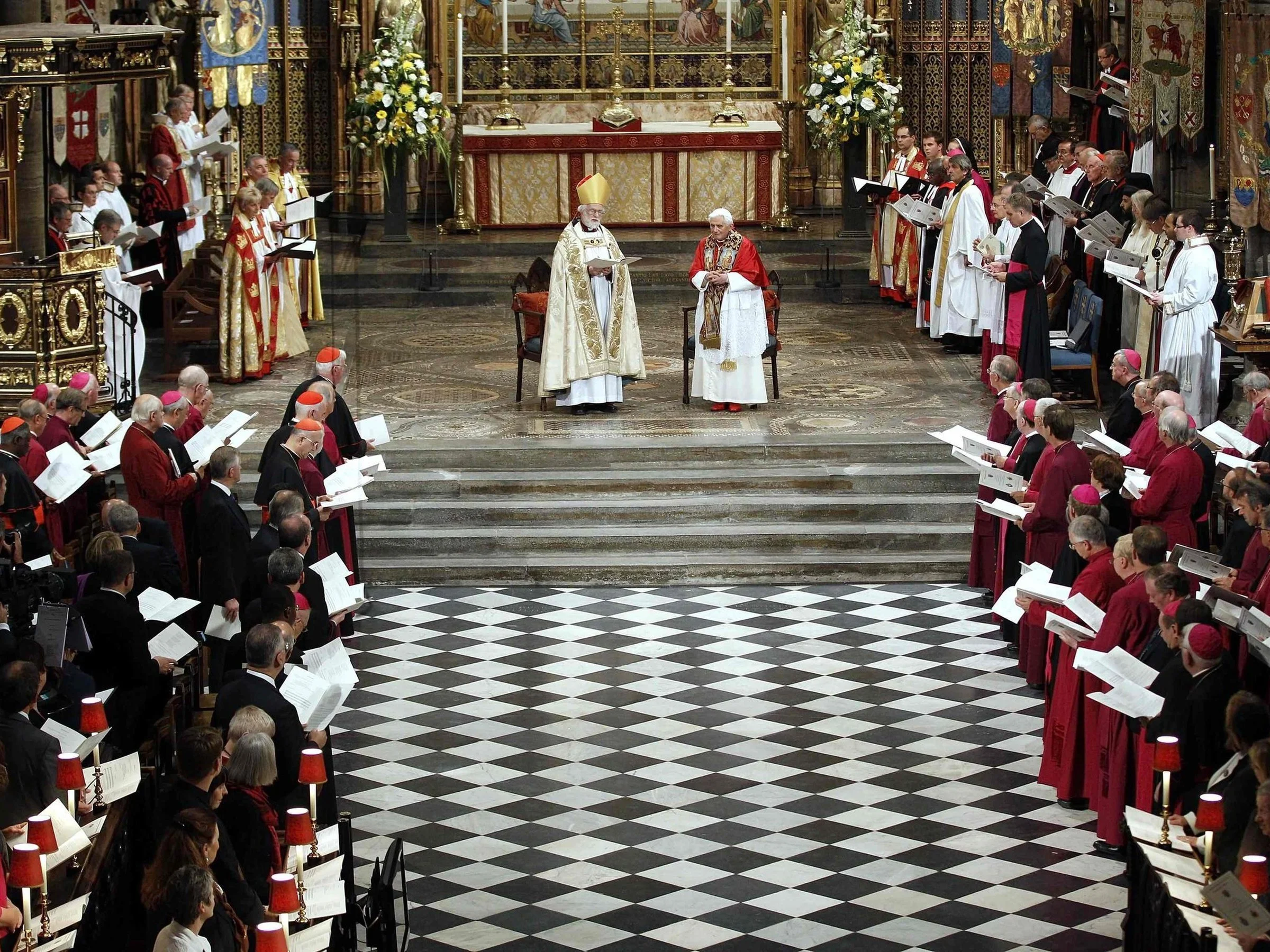
Benedict XVI and Anglican Archbishop Rowan Williams at Westminster Abbey — 17 September 2010 — Benedict XVI and Rowan Williams, Archbishop of Canterbury, jointly led an ecumenical evening prayer service in Westminster Abbey during Benedict’s state visit to Britain. The image captures the post-Vatican II ecumenical model in practice: the claimant to the Roman See and the head of the Anglican Communion standing together in a shared act of prayer despite continuing divisions over papal authority, Holy Orders, the Mass, and other doctrines. From a traditional Catholic perspective, the public symbolism risks presenting separated religious bodies as parallel Christian communities journeying together toward unity, rather than emphasising the necessity of return to the one Catholic Church.
Taken separately, defenders can qualify each episode.
The Blue Mosque was not Islamic salat.
The Orthodox Divine Liturgy did not include Benedict receiving Communion.
The Erfurt service did not declare Protestant doctrine true.
Assisi 2011 was carefully constructed to avoid the most obvious appearance of syncretism.
Each qualification is correct.
But the cumulative pattern remains.
Benedict himself declared ecumenical unity a priority upon assuming office. He continued the dialogue with non-Christian religions. He prayed inside a mosque. He joined Eastern Orthodox religious observances. He participated in formal common prayer with Protestants. He reconvened the world's religions at Assisi. He beatified John Paul II. And throughout these activities he continued to defend Vatican II.
What looks ambiguous when considered as a collection of isolated diplomatic gestures becomes considerably clearer when viewed as an integrated programme.
Benedict did not consider the postconciliar ecumenical and interreligious orientation itself erroneous.
His concern was to conduct it without relativism and to explain it in a manner he believed compatible with Catholic tradition.
That is precisely why his pontificate presents such an important theological test.
If the traditional prohibitions and doctrines were merely crude historical applications capable of being substantially revised, Benedict's project might constitute legitimate development.
If those earlier principles concerned the intrinsic unity of the Church, the nature of religious profession and the danger of communicatio in sacris, then Benedict's more refined style does not remove the rupture.
His Episcopal Consecration and the 1968 Rite
Ratzinger's personal sacramental chronology is also important.
He was ordained a priest on 29 June 1951, well before Paul VI's postconciliar revision of Holy Orders.
But Paul VI appointed him Archbishop of Munich and Freising in March 1977, and Ratzinger received episcopal consecration on 28 May 1977. Vatican
His episcopal consecration therefore occurred under the post-1968 episcopal rite promulgated by Paul VI.
That places Benedict in a different sacramental category from:
John XXIII;
Paul VI;
John Paul I;
and John Paul II,
all of whom had received episcopal consecration under the older rite.
This fact does not by itself prove Ratzinger was not a bishop.
The validity of the 1968 rite must first be established or disproved from Catholic sacramental theology, examining its matter, form, minister and intention.
But the consequence is unmistakable.
If the revised episcopal rite is valid, Ratzinger's episcopal orders present no problem on that ground. If it is invalid, then Ratzinger was never validly consecrated a bishop, with obvious consequences for the ecclesiastical claims subsequently made for him.
That is why the validity of Paul VI's revised rite cannot be dismissed as an obscure liturgical dispute.
By Benedict's generation, it touches the claimant to the Roman See himself.
Benedict Did Not Restore the Pre-Vatican II Church
This cumulative record permits a more precise judgment of Benedict XVI.
He was plainly different from Francis.
He was more liturgically conservative. He possessed a far deeper familiarity with Catholic theological tradition. He criticised relativism, opposed crude religious indifferentism, defended the divinity and uniqueness of Christ, encouraged Eucharistic reverence, and gave traditional Catholics considerably greater freedom to celebrate the older Roman Mass.
Those facts should be acknowledged rather than suppressed.
They make the conclusion more significant, not less.
Even Benedict XVI—the postconciliar claimant most closely associated with “tradition”—did not reject the fundamental Vatican II settlement.
He explicitly committed himself to implementing Vatican II.
He defended Dignitatis Humanae through his hermeneutic of reform.
He treated the Novus Ordo and traditional Mass as two expressions of one Roman lex orandi.
He continued common prayer and ecumenical engagement with Protestants and the Eastern Orthodox.
He prayed in a mosque.
He renewed the Assisi programme.
He accelerated and completed John Paul II's beatification.
And he regarded these things not as betrayals of Catholicism but as manifestations of Catholicism correctly understood after the Council.
This is why Benedict cannot simply be inserted into a narrative in which a fundamentally traditional Church was temporarily hijacked by progressives while conservative popes attempted to restore it.
His pontificate demonstrates something more complicated—and more serious.
Benedict attempted to reconcile the postconciliar system with tradition rather than repudiate the postconciliar system in the name of tradition.
His “hermeneutic of reform” was the intellectual expression of that project.
Summorum Pontificum was its liturgical expression.
His ecumenical and interreligious acts were its practical expression.
And therein lies the decisive question.
If Vatican II, the new religious-liberty doctrine, postconciliar ecumenism, interreligious prayer and the transformed liturgical order are genuinely compatible with what the Catholic Church taught and practised beforehand, Benedict's project deserves to succeed.
But continuity cannot be manufactured by interpretation where the propositions themselves contradict.
A Catholic cannot resolve contradiction simply by calling it reform.
That is why Benedict XVI ultimately strengthens rather than weakens the case for examining the postconciliar crisis at the level of doctrine, indefectibility and authority.
His pontificate demonstrates that the problem did not depend upon Francis's personality, John Paul II's dramatic gestures or Paul VI's liturgical radicalism.
Even its most intellectually conservative defender remained committed to the same conciliar foundation.
The style changed. The programme remained.
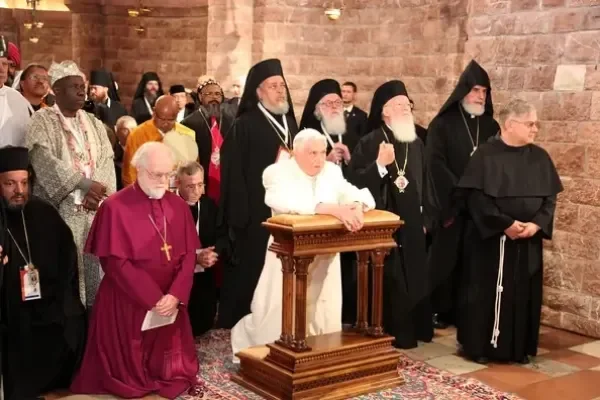
Benedict XVI at Assisi — 27 October 2011 — Benedict XVI, together with Rowan Williams, Archbishop of Canterbury (in red), Eastern Orthodox clergy and representatives of other religions, pauses in prayer before the crypt of St Francis of Assisi during the interreligious gathering marking the twenty-fifth anniversary of John Paul II’s 1986 Assisi meeting. The event continued the post-Vatican II practice of bringing adherents of different religions together for coordinated religious observance and reflection.
Francis — Jorge Mario Bergoglio
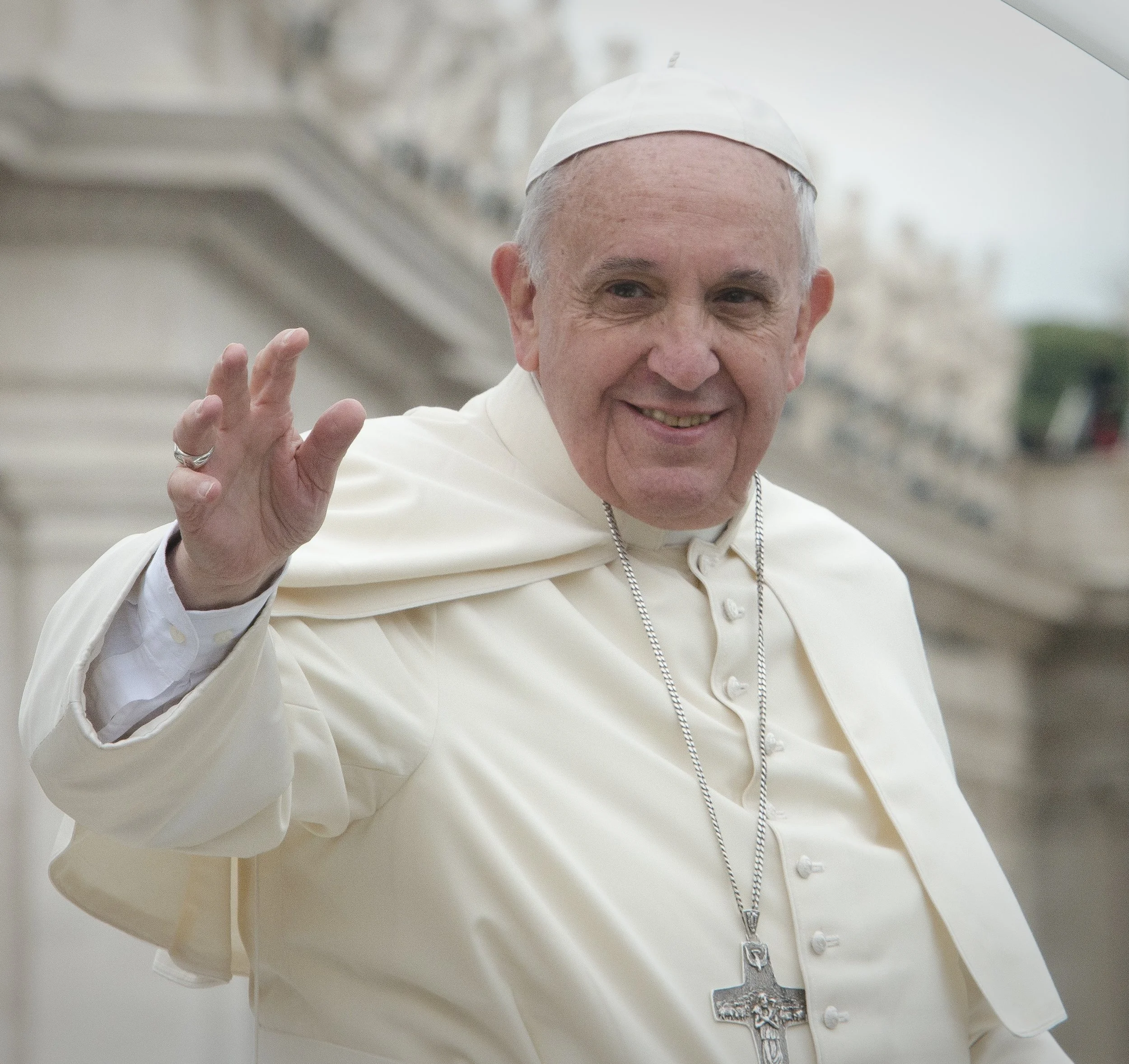
Francis — Jorge Mario Bergoglio (1936–2025) — Elected in 2013, Bergoglio pushed the postconciliar programme into increasingly explicit moral, ecumenical, liturgical and interreligious applications. His pontificate included Amoris Laetitia, the positive reassessment of Martin Luther and the Reformation, the Abu Dhabi declaration, the Pachamama scandal, Traditionis Custodes, Fiducia Supplicans, and the 2024 statement that “all religions are paths to God.” His reign made the doctrinal and religious trajectory of the post-Vatican II establishment harder to present merely as unfortunate implementation or isolated abuse.
When the Postconciliar Logic Became Increasingly Explicit
With Jorge Mario Bergoglio, the trajectory accelerated.
Francis did not invent Vatican II. What makes his pontificate so revealing is how frequently he carried already-established postconciliar principles into forms that were difficult to reconcile with earlier Catholic categories.
Amoris Laetitia
The controversy surrounding Amoris Laetitia concerned whether persons living more uxorio in objectively adulterous second unions could, in some circumstances, receive the sacraments without committing to continence.
The Buenos Aires bishops issued criteria allowing such sacramental access in certain complex cases. Francis responded in writing that their interpretation was excellent and that there were “no other interpretations.”
The controversy therefore cannot be dismissed merely by saying opponents misunderstood Amoris Laetitia. Francis publicly endorsed an application that altered the previous sacramental discipline in a way critics argue cannot be separated from the underlying doctrine concerning adultery, repentance and worthy reception of Holy Communion.
Whether this is formally a doctrinal contradiction or an impermissible disciplinary development requires its own detailed treatment. But the authorised change is real.
Martin Luther and Justification
Francis's treatment of Martin Luther provides another revealing example of the postconciliar reinterpretation of the Protestant revolt.
During his return flight from Armenia on 26 June 2016, Francis was asked whether Luther should be rehabilitated. He replied:
“I think that Martin Luther’s intentions were not mistaken; he was a reformer.”
He then added that Catholics, Lutherans and Protestants were now in agreement on justification and that on this point Luther “was not mistaken.”
That formulation is remarkable because justification was one of the central doctrinal disputes of the Reformation, and the Council of Trent expressly rejected the Protestant understanding of sola fide when it excluded the interior renewal and cooperation with grace required by Catholic doctrine.
The problem is not simply that Francis spoke favourably of Luther as a historical figure. Later that year, at Lund, he joined Lutherans in common prayer and praised certain “spiritual and theological gifts” associated with the Reformation.
A single spontaneous remark might be dismissed as imprecise. Taken together, however, the statements reflect the broader post-Vatican II ecumenical shift:
from condemning Luther’s doctrinal revolt and calling separated Christians back to the Catholic Church, to presenting Luther as a reformer whose central religious insight can be positively received.
Abu Dhabi - Document on Human Fraternity.

On 4 February 2019, Francis and Grand Imam Ahmad al-Tayyeb signed the Abu Dhabi Document on Human Fraternity.
Among its propositions is the statement that the pluralism and diversity of religions, together with colour, sex, race and language, are willed by God in His wisdom.
Defenders have attempted to interpret “willed” as God's merely permissive will: God permits false religions to exist just as He permits many other evils without positively willing their errors.
That distinction is orthodox in itself. But the wording of the document does not make that distinction. It places religious plurality grammatically in the same series as realities positively rooted in creation such as sex and race, and derives from this divine willing a right to religious diversity.
At minimum, the statement is gravely ambiguous. Read according to its natural sense, it goes substantially further.
The Pachamama Scandal
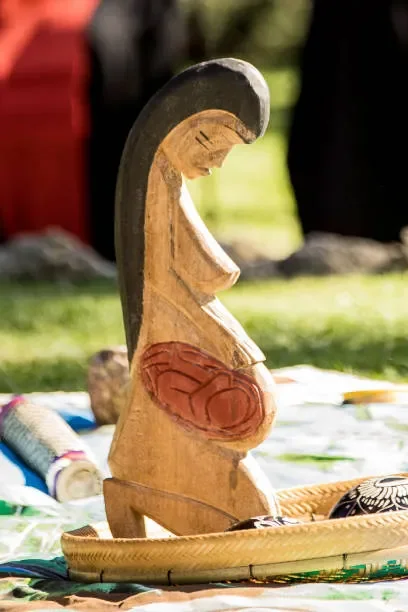
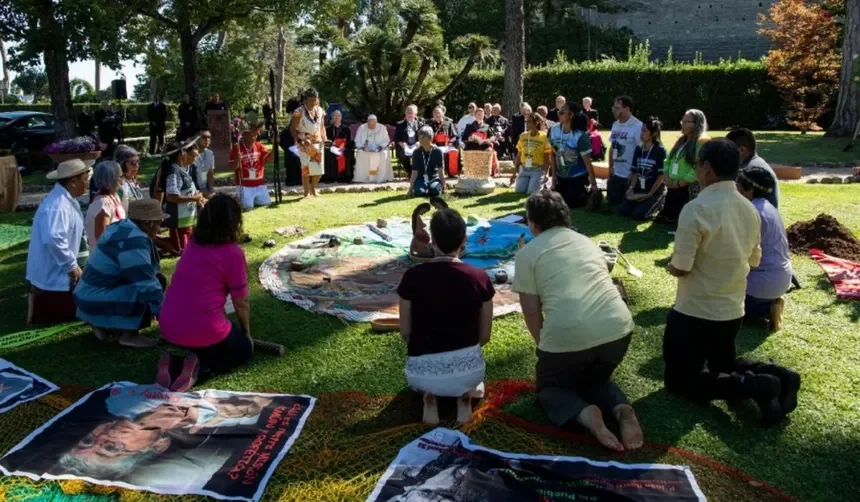
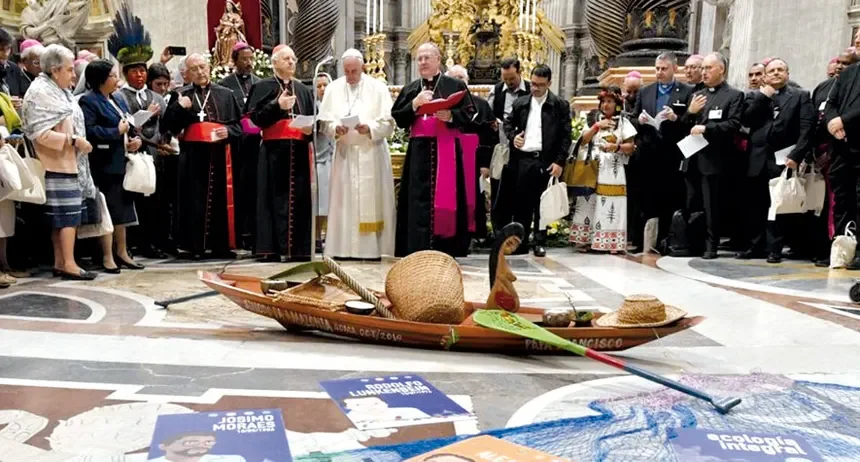
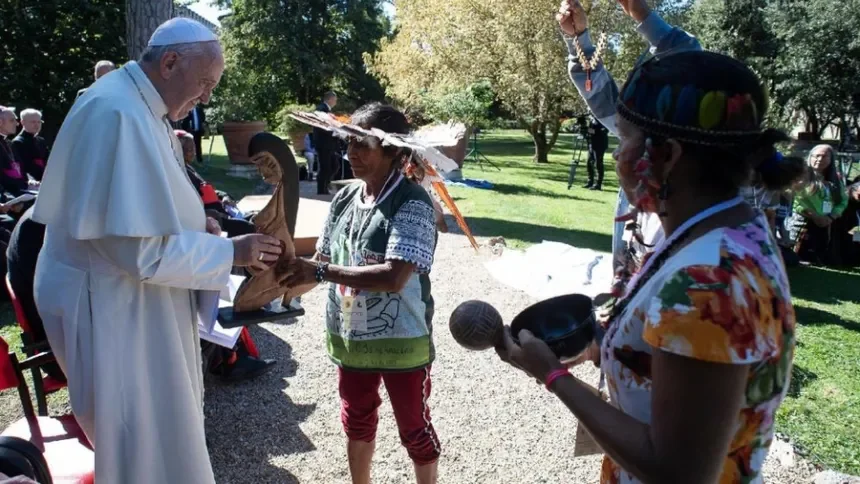
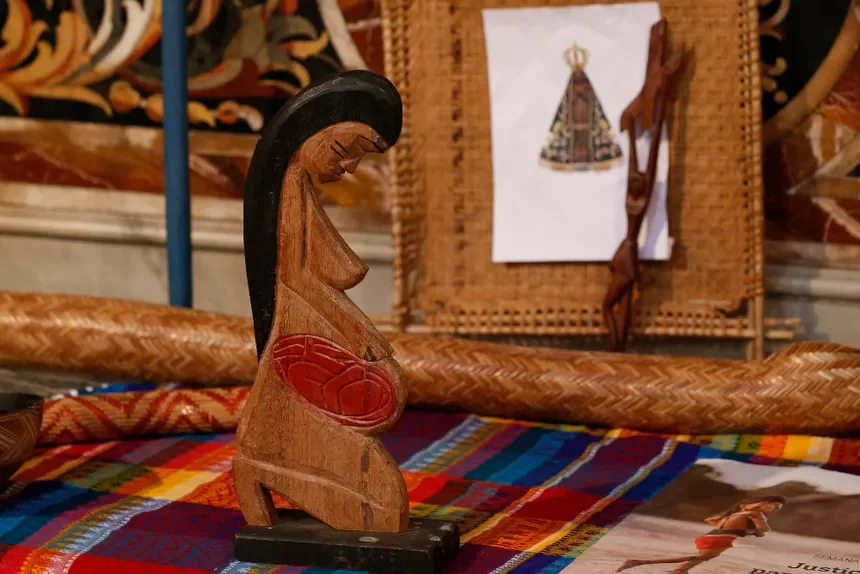

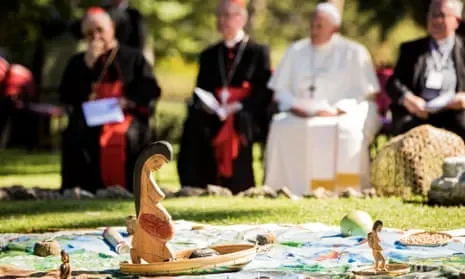
The 2019 Amazon Synod produced one of the most disturbing public episodes of Francis's pontificate. It was not merely a case of indigenous artwork being displayed somewhere in Rome.
Francis himself, together with cardinals, bishops, clergy and indigenous representatives, participated in a religious ceremony in the Vatican Gardens on 4 October 2019 in which the controversial wooden female figures later explicitly called “Pachamama” by Francis occupied a central place.
The Holy See's own press office described the event as a “prayer ceremony” held in Francis's presence. Vatican News reported that it included prayers, indigenous songs, symbolic gestures and the planting of a tree, with Francis concluding the event by praying the Our Father. Other Vatican reporting subsequently acknowledged that the wooden Pachamama figures had been at the centre of the ceremony. Vatican Press
Video and photographic evidence show participants kneeling and bowing around the arrangement containing the figures. Francis remained present throughout the ceremony and was personally presented with one of the wooden images. Several cardinals and bishops were likewise present. Critics including Bishop Athanasius Schneider and a subsequent group of Catholic clergy and scholars therefore did not object merely to an ambiguous museum display; they judged the event to have constituted religious veneration of a pagan symbol incompatible with the First Commandment. LifeSite
The controversy then moved from the Vatican Gardens into the sacred precincts themselves. On 7 October 2019, one of the wooden figures was brought into St Peter's Basilica, positioned before the main altar during a ceremony involving Francis and Synod participants, and afterwards carried in procession toward the Synod Hall. These Last Days Ministries
The figures were subsequently kept in the nearby church of Santa Maria in Traspontina. After several were removed from the church and thrown into the Tiber, Francis addressed the Synod on 25 October and referred to them explicitly as the “statues of the pachamama.” He said they had been present “without idolatrous intentions,” apologised to those offended by their removal and announced that they had been recovered. He even mentioned the possibility, proposed by the Carabinieri commander, of displaying them during the Synod's closing Mass. Vatican News
That statement is particularly important. It eliminates the argument that the association of the statues with Pachamama was merely an invention of hostile traditionalists. Francis himself used the name.
At the closing Mass in St Peter's Basilica on 27 October, the recovered wooden statues were apparently not placed on the altar. Instead, an indigenous woman brought forward a bowl containing soil and plants during the offertory; Francis received it and it was subsequently placed on the altar during the Mass. Vatican News confirms that an indigenous woman presented Francis with a plant during the closing liturgy, while contemporary critics connected the vessel and its symbolism with the ritual objects used during the preceding Amazonian ceremonies. Vatican News
Here precision is necessary. It would be stronger to write that a ritual bowl associated by contemporary critics with the Pachamama ceremonies was placed on the altar, rather than state as an established fact that the wooden Pachamama idol itself was placed on the high altar during the closing Mass. The wooden image had, however, already been brought inside St Peter's and positioned before the main altar earlier in the Synod. Novus Ordo Watch
Nor does the theological gravity of the affair depend upon proving Francis's secret interior intention. Francis insisted that there had been no idolatrous intention. That claim concerns subjective intention; it does not settle the objective character of the actions.
The observable facts remain:
figures associated with an indigenous Mother-Earth religious tradition were placed at the centre of a Vatican prayer ceremony;
participants bowed and knelt around them;
Francis and members of the hierarchy took part;
Francis received and blessed one of the figures;
the image was subsequently brought into St Peter's Basilica;
related objects appeared in ecclesiastical ceremonies;
and Francis later publicly defended the figures and called them “pachamama.” Vatican Press
From the standpoint of traditional Catholic theology, therefore, the question is not adequately answered by saying that Francis personally intended no idolatry. Catholic opposition to pagan religious rites has always concerned external religious acts as well as interior belief. The First Commandment requires that religious worship be rendered to God alone; public acts capable of treating the religious symbols of a false cult with veneration are consequently grave in themselves, particularly when performed or permitted by men claiming the highest authority in the Church.
The Pachamama affair is therefore much more serious than an unfortunate piece of “inculturation.” It illustrates the extent to which the postconciliar theology of interreligious encounter can blur boundaries that the pre-Vatican II Church guarded with extraordinary seriousness.
And the location intensified the scandal. What began with a religious ceremony involving the figures in the Vatican Gardens proceeded to their presence inside St Peter's Basilica, a procession involving the Synod, their installation in a Catholic church, Francis's public defence of them after their removal, and finally the placement of a related Amazonian offering on the altar during the closing Mass.
Whatever judgment is ultimately made concerning subjective culpability, these were public religious acts performed at the heart of the institution claiming to be the Roman Catholic Church.
Traditionis Custodes
If Benedict tried to reconcile the traditional and reformed missals as two expressions of the one Roman rite, Francis reversed his practical accommodation.
Traditionis Custodes of 16 July 2021 declared that the liturgical books of Paul VI and John Paul II constituted the “unique expression of the lex orandi of the Roman Rite” and required groups using the older Missal not to deny the validity and legitimacy of the postconciliar reform.
This is extraordinarily important. The Novus Ordo was no longer merely presented as permissible. Acceptance of its legitimacy was made an ecclesial criterion for those attached to the traditional liturgy.
Fiducia Supplicans
In 2021, the Congregation for the Doctrine of the Faith, with Francis's assent, answered “Negative” to whether the Church possesses the power to bless same-sex unions. It explained that God cannot bless sin and that such unions could not be legitimate objects of an ecclesial blessing.
Two years later, Fiducia Supplicans, personally approved by Francis, expressly announced an “innovative contribution” and permitted non-liturgical blessings of same-sex couples and couples in irregular unions, while insisting that the blessing did not validate their union or alter Catholic marriage doctrine.
The distinction between blessing persons and legitimising their sexual relationship is the defence. The objection is that the object now presented for blessing is precisely the couple, and that the document deliberately broadened the earlier official understanding after the 2021 Responsum had stated that same-sex unions could not be blessed.
Whatever final theological classification is given, this was not an invented media controversy. The development appears in the official texts themselves.
Singapore: “All Religions Are Paths to God”
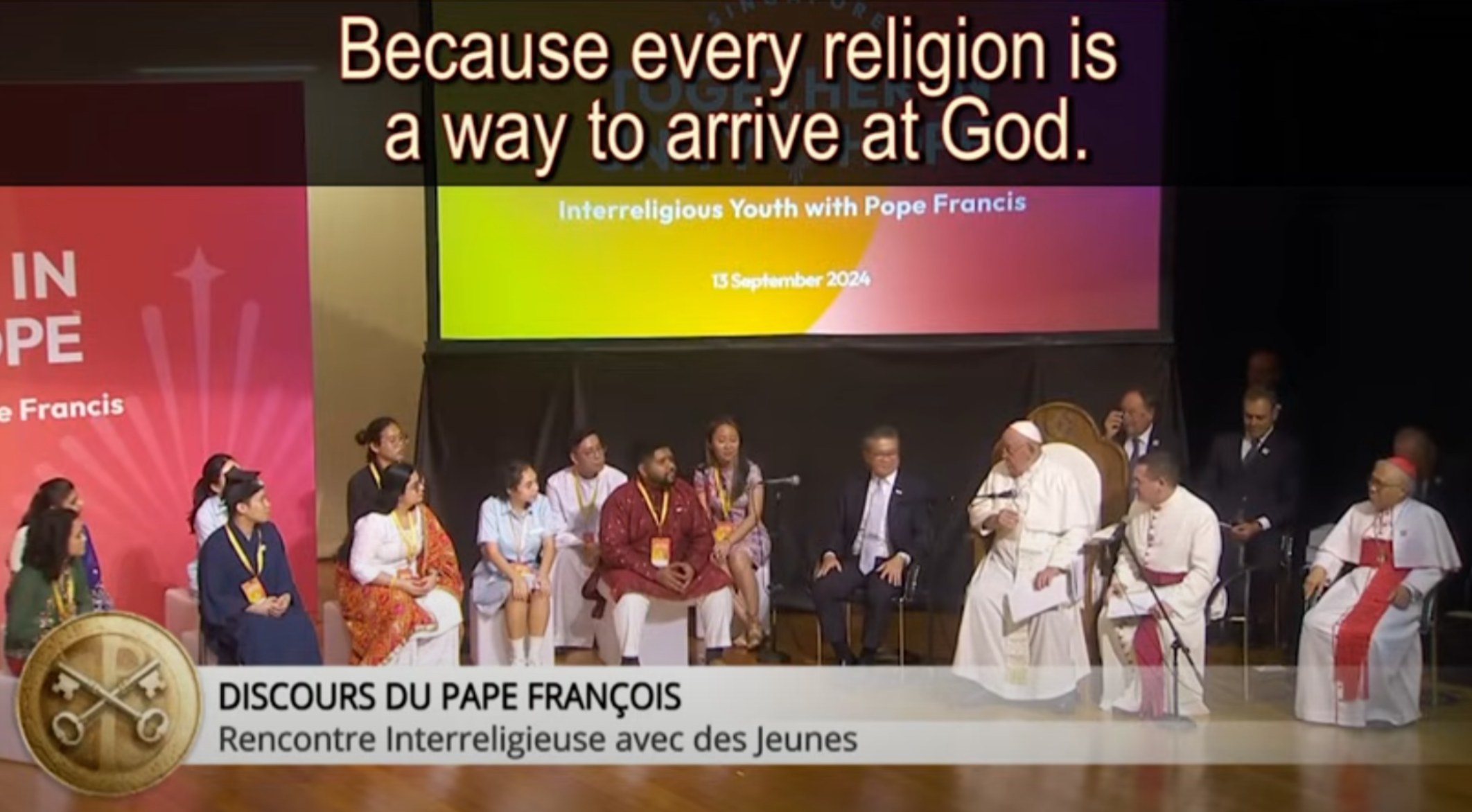
Francis made his Singapore statement on 13 September 2024. Speaking to young people at an interreligious gathering, he warned against saying one's religion is true and another's false, and stated:
“All religions are paths to God.
They are like different languages that express the divine.
But God is for everyone, and therefore, we are all God’s children.
There is only one God, and religions are like languages, paths to reach God.
Some Sikh, some Muslim, some Hindu, some Christian.”
This is among the clearest statements in the entire postconciliar record.
Taken in its ordinary meaning, it cannot be squared with the Catholic claim
that Christ is uniquely the Way to the Father,
that supernatural faith has determinate revealed content,
and that false religions containing denials of revealed truth cannot as such constitute parallel salvific “paths to God.”
These statements were a public papal address, delivered during an apostolic journey and subsequently published by the Holy See. At this point, “interreligious dialogue” had moved beyond merely tolerating non-Catholics, treating them respectfully or cooperating on temporal matters.
A claimant to the Roman See had publicly described all religions as paths to God. That proposition must be confronted, not explained away through euphemism.
Leo XIV — Robert Francis Prevost
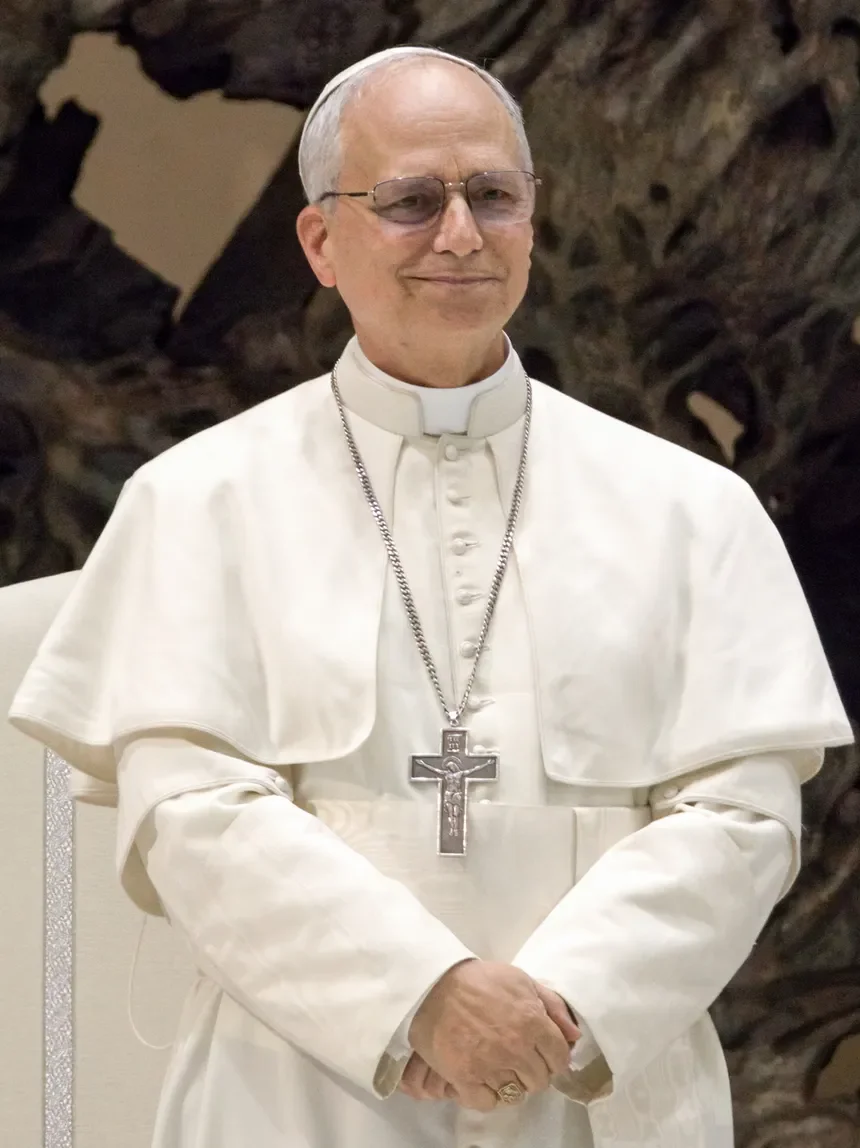
Leo XIV — Robert Francis Prevost (born 1955) — Elected in 2025, Prevost has so far presented his pontificate as a continuation rather than a reversal of the postconciliar programme. He has explicitly renewed commitment to the path opened by Vatican II, emphasising synodality, ecumenism and interreligious dialogue, while continuing the institutional trajectory inherited from his predecessors. His election therefore represents continuity with the Vatican II settlement rather than a return to the preconciliar Catholic order.
Continuation, Not Correction
Robert Francis Prevost, elected Leo XIV on 8 May 2025, provides an important contemporary test. If Francis represented an aberration—a temporary distortion of Vatican II that the institution was preparing to correct—Leo XIV offered an opportunity for that correction. So far that is not what the documentary record shows.
Two days after the beginning of his pontificate, Leo XIV told the College of Cardinals that he wished to renew “our complete commitment” to the path the universal Church had followed for decades in the wake of Vatican II. Among the principles he specifically identified were collegiality, synodality and dialogue with the contemporary world. He declared himself called to continue along that same path.
That statement is difficult to misunderstand. Leo XIV did not inherit the conciliar programme reluctantly. He publicly adopted it.
Synodality
His first addresses repeatedly described the Church as synodal, and he continues repeatedly to present the “synodal vocation of the whole Church” as something continuing to unfold.
On 7 October 2026, opening a meeting marking ten years since Amoris Laetitia, Leo expressly declared that
the Church had continued along the path indicated by Vatican II
and treated Francis's synodal family process and Amoris Laetitia as stages within that continuing journey.
This is current evidence, not speculation about what Leo XIV might eventually do.
Nostra Aetate and Interreligious Religion
On 28 October 2025, Leo XIV commemorated the sixtieth anniversary of Nostra Aetate, calling it a “ground-breaking document” and presenting sixty years of interreligious dialogue as a tree that had grown and borne fruit in friendship, cooperation and peace.
The following year, on 28 September 2026, speaking to representatives of various religions in Metz, he
described a shared responsibility of “men and women of faith,”
spoke of religions as “guardians of life,”
and treated those sincerely seeking truth, goodness and beauty as companions on the journey.
Whatever differences of tone exist between Francis and Leo XIV, the institutional direction has not been reversed. It has been reaffirmed.
The 1995 Pachamama Evidence
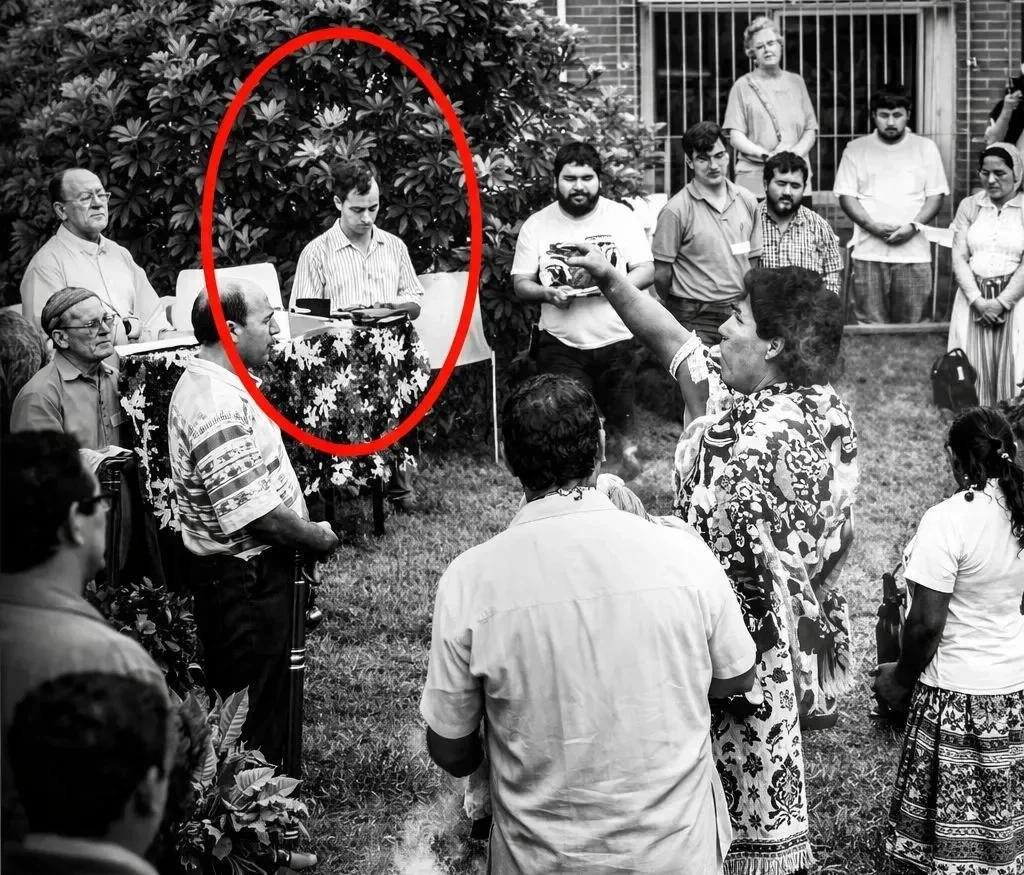
Robert Francis Prevost at a 1995 Pachamama Rite — LifeSiteNews identifies the circled participant as then-Augustinian priest Robert Prevost, later Leo XIV, attending the IV Simposio-Taller “Lectura de San Agustín desde América Latina” in São Paulo, Brazil (23–28 January 1995). The symposium’s published proceedings caption the scene “Celebration of the Rite of Pachamama (Mother Earth)”, describing it as an agricultural rite of the South-Andean cultures of Peru and Bolivia. The photograph documents Prevost’s presence among the participants at a ceremony explicitly identified by its organisers as a Pachamama rite. lifesitenews.com
A separate allegation concerns Prevost's attendance at an Augustinian gathering in Brazil in 1995.
Photographs reproduced in 2026 from the published proceedings of an Augustinian ecological-theology symposium appear to show Prevost kneeling among participants in a ceremony whose original caption identifies it as a rite of Pachamama or “Mother Earth.” Traditionalist researchers and former Augustinians have identified Prevost in the photographs.
This evidence warrants careful wording. Prevost was not a newly ordained “young priest” at the time. He was approximately thirty-nine years old and had been a priest for more than a decade.
The photographs constitute potentially significant evidence of visible participation or presence at the ceremony.
They cannot, by themselves, establish that Prevost internally adored a pagan deity or intended idolatry. The public theological case against Leo XIV does not need that claim in any event. His official speeches since 2025 provide substantially stronger evidence of his commitment to the postconciliar programme.
His Orders
Prevost was ordained priest in 1982 and consecrated bishop in 2014. Both events therefore took place long after the introduction of the postconciliar rites.
Unlike John XXIII, Paul VI, John Paul I or John Paul II, Leo XIV's entire clerical sacramental lineage as priest and bishop is directly implicated if the revised rites of Holy Orders are ultimately shown to be invalid.
That makes the separate Holy Orders question especially consequential for his claim.
Who Actually Changed What?
The chronology helps expose how cumulative the process was.
| Claimant | Principal Institutional Contribution | Why It Matters |
|---|---|---|
| John XXIII — Angelo Roncalli | Convoked Vatican II; established Christian Unity Secretariat; initiated revision of Canon Law | Created the institutional and pastoral framework from which the postconciliar programme developed. |
| Paul VI — Giovanni Montini | Promulgated central Vatican II documents; introduced new Roman Missal; revised Eucharistic Prayers; changed rites of Holy Orders, episcopal consecration, Confirmation and Anointing | Turned conciliar principles into universal worship and sacramental legislation. |
| John Paul I — Albino Luciani | Publicly pledged continuation | Brief reign, but no repudiation of programme. |
| John Paul II — Karol Wojtyła | 1983 Code; 1992 Catechism; Assisi; global ecumenical/interreligious programme | Translated Vatican II into ordinary law, catechesis and international religious practice. |
| Benedict XVI — Joseph Ratzinger | “Hermeneutic of reform”; defended Vatican II religious liberty; Summorum Pontificum “two forms”; prayer in the Blue Mosque; Orthodox and Protestant common prayer; Assisi 2011; beatification of John Paul II | Presented himself as a conservative interpreter of Vatican II while continuing its ecumenical and interreligious programme rather than restoring the preconciliar order. |
| Francis — Jorge Bergoglio | Amoris Laetitia; positive reassessment of Luther and Reformation ecumenism; Abu Dhabi; Pachamama; Traditionis Custodes; Fiducia Supplicans; “All religions are paths to God” | Extended postconciliar principles into increasingly explicit moral, ecumenical, liturgical and interreligious applications. |
| Leo XIV — Robert Prevost | Explicit Vatican II commitment; synodality; continued Nostra Aetate, ecumenical and interreligious trajectory; continuation of Amoris Laetitia process | Demonstrates that the programme did not end with Francis. It remains consciously institutional in 2026. |
Seen in isolation, individual controversies can be explained away.
Seen chronologically, a system emerges.
The St Gallen Group
The St Gallen group belongs in this history, but it must neither be ignored nor inflated beyond what the evidence establishes.
Beginning in the 1990s, a private group of senior churchmen met periodically in St Gallen, Switzerland. Reported regular participants included figures such as Cardinal Carlo Maria Martini, Cardinal Godfried Danneels, Cardinal Walter Kasper, Cardinal Karl Lehmann and Cardinal Cormac Murphy-O'Connor, with Bishop Ivo Fürer associated with organising the meetings. Membership descriptions vary somewhat between accounts, so it is better understood as a private network than as an organisation possessing a public constitution and fixed membership roll.
Danneels later jokingly described the group as a “mafia.” The term is significant because it came from a participant, but it should not be transformed into evidence that the group was literally a criminal conspiracy.
Its discussions reflected a recognisably reformist agenda:
decentralisation and collegiality,
sexual and marriage questions,
Church government
and the direction the papacy should take after John Paul II.
Evidence from accounts surrounding the 2005 conclave indicates that members regarded Jorge Bergoglio as a significant alternative to Joseph Ratzinger. Former members and associated reformist cardinals again favoured Bergoglio in the period surrounding the 2013 conclave.
Some early reporting about a coordinated “Team Bergoglio” went further, alleging that votes had been canvassed after obtaining Bergoglio's prior consent. Austen Ivereigh subsequently corrected the claim that Bergoglio had been approached for and given such consent beforehand. That correction matters.
Canonically, John Paul II's Universi Dominici Gregis prohibits binding pacts, agreements, promises or commitments concerning conclave votes and attaches an excommunication to violations. But the same paragraph expressly says that the law does not forbid the exchange of views concerning the election during a vacancy of the See.
Therefore:
The existence of St Gallen is historically relevant evidence of organised private networking among high-ranking reformist prelates. It helps explain ideological and personnel continuity. It does not, merely by existing or by favouring Bergoglio, prove that the 2013 conclave was canonically invalid.
A specific prohibited act and its juridical consequences would have to be established.
Is This Really One Postconciliar Programme?
The cumulative evidence gives a clear answer. The personalities differed enormously. Paul VI was not John Paul II. Benedict XVI was not Francis. Francis was not Leo XIV. Their temperaments, theological styles and methods of government differed considerably.
Yet beneath those differences lies a remarkable continuity of direction.
None of the later claimants repudiated Vatican II.
None restored the preconciliar doctrine of ecumenism as expressed by Mortalium Animos.
None restored the preconciliar understanding of the Catholic confessional state as though Dignitatis Humanae had introduced an error.
None repudiated Paul VI’s reformed sacramental rites.
None declared the Novus Ordo an illegitimate rupture in Roman worship.
None reversed the new ecclesiology.
None returned Catholic relations with false religions to the pre-Assisi model.
Benedict XVI is particularly important because he demonstrates that the programme did not depend upon a radical personality or openly progressive style.
Ratzinger criticised relativism, encouraged greater liturgical reverence and restored practical access to the traditional Mass. Yet he simultaneously defended Vatican II’s religious-liberty settlement, described the traditional and new missals as two forms of one Roman rite, prayed inside Istanbul’s Blue Mosque, participated in religious observances with Eastern Orthodox and Protestant leaders, reconvened representatives of the world’s religions at Assisi in 2011, and personally beatified John Paul II.
His project was therefore not the repudiation of the postconciliar settlement but its reconciliation with tradition through a “hermeneutic of reform.”
Francis subsequently made the same trajectory still more explicit. Martin Luther could be described as a genuine reformer who, according to Francis, “was not mistaken” regarding justification. The Reformation could be commemorated through common prayer with Lutherans. Religious diversity could be described as willed by God. Pachamama figures could enter Vatican religious ceremonies. The traditional Roman liturgy could be restricted through Traditionis Custodes. Same-sex couples could receive newly authorised blessings under Fiducia Supplicans. And eventually Francis could publicly declare that “all religions are paths to God.”
Leo XIV has so far not reversed this direction. He has expressly renewed commitment to the path opened by Vatican II and continued its synodal and interreligious programme.
Seen individually, particular controversies can sometimes be explained away as bad wording, pastoral gestures, diplomatic encounters or unfortunate symbolism.
Seen chronologically, however, the cumulative pattern is much harder to dismiss.
John XXIII initiated the conciliar programme.
Paul VI legislated its fundamental transformation in worship and sacramental rites.
John Paul II codified it in law and catechesis and gave it dramatic interreligious expression.
Benedict XVI attempted to demonstrate its continuity with tradition.
Francis pushed several of its principles into still more explicit applications.
Leo XIV has pledged to continue the same conciliar path.
The personalities changed. The rhetorical style changed. The programme did not.
That is why the expression postconciliar religion is analytically useful.
It does not mean that every element contained within the postconciliar system is false or non-Catholic. It retains Scripture, Catholic terminology, the Trinity, Christ, the saints, the sacraments by name, dioceses, parishes, clerical titles, historic buildings and vast quantities of genuinely Catholic material.
The question is whether the religious system as an integrated whole remains the same religion when its worship, ecclesiology, ecumenism, understanding of religious liberty, missionary orientation, canon law, catechesis and sacramental structures have undergone the documented transformation examined throughout this article.
That is a much more serious question than whether particular reforms were aesthetically unfortunate or pastorally imprudent.
Is It Modernism?
“Modernist” should not be used merely as an insult. St Pius X described a theological system in which inherited dogmatic formulations could be reinterpreted in relation to changing religious consciousness, historical circumstances and modern intellectual categories. The central danger was not necessarily the explicit statement, “Catholic doctrine is false.” It was the possibility that Catholic words could remain while their conceptual content evolved.
That framework is highly relevant to the postconciliar crisis. The familiar pattern is not generally:
Yesterday the Church taught X. Today we solemnly condemn X and teach Y.
It is more often:
The old teaching remains true, but it must now be understood through a new framework in which its practical and sometimes conceptual consequences are profoundly altered.
Benedict's treatment of religious liberty illustrates the method particularly well. Earlier condemnations are classified largely as historically contingent decisions; Vatican II is then presented as correcting those decisions while preserving a deeper continuity.
The traditionalist objection is that this technique can make apparent contradiction disappear simply by relocating the earlier doctrine into a lower, changeable category. If earlier popes were actually teaching permanent doctrine, however, the manoeuvre fails.
Truth can develop in expression and implication. It cannot develop into its opposite.
How Would Traditional Catholic Theology Classify These Acts?
Not every scandalous act described in this article is technically heresy.
Traditional Catholic theology distinguishes carefully between
heresy,
doctrinal error,
religious indifferentism,
forbidden religious participation,
scandal,
sacrilege,
idolatry
and imprudent discipline.
It also distinguishes the objective character of an act or proposition from the subjective guilt of the person responsible.
A proposition may be materially heretical—objectively contrary to revealed Catholic doctrine—without this article thereby proving that the speaker possessed the pertinacity required for formal heresy. Likewise, an external act may constitute objectively grave matter without our being able to determine whether the individual possessed the knowledge and deliberate consent required for mortal sin.
Those distinctions do not lessen the seriousness of the acts. They allow them to be judged according to the categories actually used by the pre-Vatican II Church.
“All Religions Are Paths to God”
Francis's statement that “all religions are paths to God,” understood according to its ordinary meaning, is among the clearest doctrinal problems in the postconciliar record.
Catholic revelation does not teach that Christianity, Islam, Hinduism, Sikhism and other religions are alternative religious paths by which men approach God on substantially equal terms.
Christ is uniquely the Way to the Father,
supernatural faith requires assent to revealed truth,
and false religions necessarily contain propositions incompatible with that revelation.
If Francis's statement means that false religions as religions constitute genuine salvific paths to God, the proposition is materially heretical.
Whether Francis was thereby a formal heretic requires the additional question of pertinacity and belongs to the separate theological analysis of public heresy, Church membership and ecclesiastical office.
Abu Dhabi and Religious Pluralism
The Abu Dhabi declaration's statement that the diversity of religions is “willed by God” similarly requires distinction. God can certainly permit false religions to exist without positively willing their errors. If that is all the statement means, an orthodox interpretation is possible.
If, however, it means that God positively wills contradictory religions as religions,
then the proposition is incompatible with Catholic revelation.
The difficulty is that the document places religious diversity alongside such positively created realities as sex, race and language. The resulting ambiguity is therefore grave rather than merely verbal.
Luther and Justification
Francis's statement that Martin Luther “was not mistaken” regarding justification must likewise be judged against the Council of Trent. Trent definitively rejected the Protestant doctrine of sola fide where it excludes the interior renewal, dispositions and cooperation with grace required by Catholic teaching.
Therefore, if Francis meant that Luther's doctrine precisely as condemned by Trent was correct,
the proposition would contradict defined Catholic doctrine and be heretical.
If he intended only to say that certain propositions concerning the priority of grace can be stated in a Catholic sense, the remark was instead dangerously imprecise.
What cannot be maintained is that Trent correctly condemned Luther's doctrine while Luther simultaneously “was not mistaken” concerning precisely the doctrine Trent condemned, if both propositions are understood in the same sense.
Common Religious Worship with Non-Catholics
The pre-Vatican II Church also maintained much stricter principles concerning religious participation with non-Catholics.
Canon 1258 of the 1917 Code of Canon Law prohibited Catholics from actively participating in non-Catholic sacred rites. Passive presence could sometimes be tolerated for a grave civil or social reason where there was no danger of scandal or loss of faith.
Pius XI's Mortalium Animos likewise warned against ecumenical religious gatherings capable of obscuring the unique identity and necessity of the Catholic Church.
That traditional standard is directly relevant to:
John Paul II's Assisi gatherings;
Benedict XVI's common prayer with Protestants;
his religious participation alongside Eastern Orthodox clergy;
his prayer inside Istanbul's Blue Mosque;
Francis's Lutheran ecumenical services;
and the wider postconciliar interreligious programme.
The individual cases are not identical. Benedict did not perform Islamic salat in the Blue Mosque, nor did he receive Communion at an Orthodox liturgy. Nevertheless, where genuine active participation in non-Catholic religious worship occurs, traditional theology places it within the category of forbidden communicatio in sacris.
Where an individual act does not technically satisfy that canonical category, the related dangers of religious indifferentism and scandal remain.
Assisi, the Blue Mosque and Religious Indifferentism
Some of the most striking acts in this chronology are therefore better classified as grave scandal or manifestations of religious indifferentism than simply labelled “heresy.”
Scandal in Catholic moral theology does not merely mean causing outrage. It concerns conduct that becomes an occasion for another person's spiritual harm or sin.
That principle has particular force when the person acting claims the Roman See.
When a claimant to the papacy publicly gathers adherents of contradictory religions for religious purposes, prays inside a mosque beside an Islamic religious authority, or participates in highly visible ecumenical worship, the external message matters independently of his private intention.
Such acts can suggest that Catholicism and false religions are parallel or complementary approaches to God.
From the standpoint of traditional Catholic teaching, that is precisely the religious ambiguity the Church formerly took great care to avoid.
The Quran Incident
John Paul II's reported kissing of the Quran is not by itself an act of heresy. The problem is one of public religious reverence and scandal.
The Quran contains explicit denials of central Christian revelation. A claimant to the papacy publicly venerating such a book can therefore communicate respect not merely for Muslims as persons but for a religious text containing propositions contrary to the Faith.
The relevant question is not whether John Paul II secretly became Muslim. It is what the visible gesture communicated to Catholics and non-Catholics.
Pachamama: Idolatry, Sacrilege and Scandal
The Pachamama episode belongs to an even more serious moral category.
Idolatry is gravely contrary to the First Commandment. If religious worship is knowingly rendered to a false deity, the act is objectively idolatrous. Introducing pagan worship into a Catholic sacred place would additionally involve grave sacrilege.
The available photographs and videos do not, by themselves, establish the interior intention of every participant at the Vatican Gardens ceremony.
For that reason, the strongest formulation is not simply:
Francis committed idolatry.
It is:
If the religious actions performed around the Pachamama figures constituted worship directed toward a pagan deity, those actions were objectively idolatrous. Francis's participation, approval and subsequent defence of the figures created an extraordinarily grave public scandal irrespective of whether his own subjective intention to worship a pagan deity can be proved.
One does not need to read Francis's soul to judge the external religious significance of the event.
Amoris Laetitia
The controversy surrounding Amoris Laetitia concerns both doctrine and sacramental discipline. If persons knowingly continuing sexual relations in an objectively adulterous union are admitted to Holy Communion without repentance and a firm purpose of amendment, the practice conflicts with traditional Catholic principles concerning adultery, mortal sin, repentance and worthy reception of the Eucharist.
It is therefore too imprecise merely to write:
Amoris Laetitia is heresy.
The stronger question is whether the authorised sacramental discipline necessarily presupposes or communicates doctrinal propositions incompatible with Catholic moral teaching.
That is a more exact—and ultimately more serious—argument.
Fiducia Supplicans
The document Fiducia Supplicans expressly denies that its blessings redefine marriage or legitimise homosexual relationships. It therefore should not simply be described as formally teaching that homosexual acts are morally good.
The traditional Catholic objection remains grave because the object publicly presented for blessing is the couple, including couples whose relationship is structured around sexual conduct condemned by divine law.
The immediate theological categories are therefore grave scandal, dangerous doctrinal ambiguity and a radical alteration of previous pastoral and sacramental practice.
Whether a specific proposition in the document constitutes formal heresy must be demonstrated separately.
Paul VI's Liturgical and Sacramental Reforms
The reconstruction of the Mass and sacramental rites belongs to another category again. Liturgical change as such is not heresy. The Church possesses authority to regulate her rites.
The deeper question is whether Christ's indefectible Church could universally promulgate:
a liturgy harmful to the Faith;
a rite expressing defective sacramental theology;
or an invalid sacramental form.
If such defects are actually demonstrated, the issue ceases to be merely liturgical. It becomes an argument concerning indefectibility and authority.
That is why the validity of the 1968 rites of Holy Orders must be demonstrated through Catholic sacramental theology rather than settled merely by attaching the word “heresy” to them.
Summary
| Public Teaching or Act | Traditional Catholic Classification at Issue |
|---|---|
| “All religions are paths to God” | Materially heretical if false religions as such are asserted to be genuine salvific paths |
| Abu Dhabi: religious diversity “willed by God” | Heterodox/heretical if positive divine willing of false religions is intended; potentially orthodox if only God's permissive will is meant |
| Luther “was not mistaken” on justification | Heretical if it affirms the doctrine of justification condemned by Trent |
| Active common worship with non-Catholics | Traditionally prohibited communicatio in sacris; potentially grave matter against the Faith |
| Assisi and similar interreligious gatherings | Danger of religious indifferentism and grave scandal; individual acts require specific classification |
| Prayer in the Blue Mosque | Not Islamic worship as such; grave danger of scandal and indifferentist religious symbolism |
| Public reverence toward the Quran | Not itself heresy; potentially grave scandal and inappropriate religious reverence toward a false religious text |
| Pachamama worship, if worship of a pagan deity occurred | Idolatry; grave matter against the First Commandment; sacrilege where sacred places are profaned |
| Amoris Laetitia sacramental implementation | Gravely problematic discipline with doctrinal implications |
| Fiducia Supplicans | Grave scandal and doctrinal ambiguity; formal heresy requires identification of a precise heretical proposition |
| New Mass and revised sacramental rites | Liturgical/sacramental question involving orthodoxy, validity and indefectibility rather than simply “heresy” |
These distinctions make the cumulative argument stronger.
The relevant question is not merely whether an act appears shocking. It is:
What precisely was taught or done?
How would the pre-Vatican II Church classify that proposition or act?
Was it heretical, scandalous, indifferentist, sacrilegious, idolatrous, canonically forbidden or merely disciplinary?
And if such acts were public, repeated and officially defended, what does that imply for Catholic membership and ecclesiastical authority?
That is the point at which this historical survey connects directly to the later questions of public heresy, Church membership, office, jurisdiction and the papacy.
Ignorance, Error or Evil Intent?
Here the evidence sets a firm boundary.
The external record can establish what these men said and did.
It cannot ordinarily establish the secret condition of their consciences.
It is therefore too narrow to say that there are only two possibilities: either they were ignorant or they were consciously evil.
Human motives can include theological error, ideological conviction, misplaced pastoral zeal, intellectual pride, negligence, accommodation to contemporary culture, genuine but mistaken belief that old formulations required correction, culpable blindness, bad faith—or combinations of these.
God alone judges the interior forum. But that does not make the objective evidence irrelevant.
A physician who sincerely administers poison rather than medicine does not turn poison into medicine by possessing benevolent intentions. Similarly, if a claimant to Catholic authority publicly teaches a proposition incompatible with the Faith or imposes a religious order the Church could not impose, the theological consequences do not disappear merely because he believed himself to be helping the Church.
For the papal-office question, objective public profession and public exercise of claimed authority are therefore much more important than amateur psychological diagnosis.
What About the Claim That the New Religion Is “Void of Sacraments”?
This requires an important qualification. It is legitimate—and necessary—to investigate whether Paul VI's new rites of Holy Orders are certainly valid.
But “the Novus Ordo religion is void of sacraments” is too broad a proposition unless each sacramental claim has first been demonstrated.
Baptism, for example, does not require a priest for validity in cases of necessity.
Matrimony in the Latin Church is ordinarily effected by the spouses themselves, subject to canonical form and other requirements.
Even within a sedevacantist analysis, therefore, one cannot simply say that every sacrament associated with every person in the postconciliar establishment is automatically null.
The real sacramental chain is more precise.
Paul VI replaced the rites used for ordaining priests and consecrating bishops in 1968.
If the new episcopal form were invalid, bishops consecrated only in that rite would not possess episcopal orders.
If men lacking episcopal orders then attempted to ordain priests, those priestly ordinations would fail.
Without valid priests, there could be no valid Eucharistic consecration, sacramental absolution or priestly Anointing.
That is potentially catastrophic. But the first premise—invalidity of the new rite—must actually be proved.
The chronological distinction is also useful:
John XXIII, Paul VI, John Paul I and John Paul II received episcopal consecration before the 1968 reform.
Benedict XVI was consecrated bishop in 1977.
Francis was consecrated bishop in 1992.
Leo XIV was consecrated bishop in 2014.
Thus the validity question grows more consequential as the postconciliar succession advances. It deserves its own article precisely because it is too important to settle by assertion.
Go to FAQ: Are Priestly Ordinations and Episcopal Consecrations According to the 1968 Rites Certainly Valid?
From Rome to the Parish: This Was Not Merely a Handful of Men
The crisis also cannot be reduced to the seven papal claimants personally.
Once new rites are promulgated from Rome, seminaries teach them.
Once a Code of Canon Law is promulgated, dioceses govern according to it.
Once a universal Catechism is promulgated, bishops, priests, schools and catechists transmit it.
Once ecumenism and interreligious dialogue become institutional priorities, episcopal conferences, dioceses, religious orders, missionaries and parishes reproduce them.
The postconciliar transformation therefore necessarily penetrated the hierarchy from the Roman centre down through ordinary ecclesiastical life.
But another distinction must be maintained. It does not follow that every parish priest, missionary, religious sister or lay catechist consciously set out to replace Catholicism. Many were born decades after Vatican II and were trained in no other system. Some undoubtedly believe sincerely that the religion they received is simply Catholicism. Others perceive serious difficulties but attempt to resolve them through a hermeneutic of continuity.
Individual culpability cannot be inferred merely from institutional participation.
The more serious claim is objective:
A worldwide ecclesiastical apparatus inherited Catholic buildings, names, sees, schools, parishes, seminaries and administrative structures while teaching and practising the postconciliar religious system through them.
This is why physical possession cannot resolve the theological question.
A cathedral does not make a doctrine Catholic.
An episcopal palace does not make a bishop Catholic.
A Roman collar does not make an error Catholic.
And occupation of the Vatican cannot make contradictions in Faith become developments of doctrine.
The Strongest Objection: “The Church Has Had Bad Popes Before”
She certainly has. Catholic history contains less then 10 out of 260 popes who were morally corrupt, weak, political and disastrous administrators. That fact refutes any simplistic argument that personal wickedness alone makes a pontificate impossible. But it does not answer the present problem.
A personally immoral pope committing adultery does not thereby promulgate adultery as the universal sacramental discipline of the Church.
A politically foolish pope does not thereby reconstruct the Roman Mass.
A negligent pope does not necessarily promulgate an ecclesiology contrary to his predecessors and incorporate it into universal canon law.
The contemporary crisis concerns the apparent use of universal ecclesiastical authority itself to promulgate doctrine, liturgy, sacramental rites and disciplines alleged to be incompatible with the previously received Faith.
That introduces indefectibility.
If the Church can officially give the faithful
a false doctrine of religious unity,
a harmful universal liturgy,
invalid sacramental rites
or a counterfeit understanding of herself,
then Catholic claims concerning her indefectibility and teaching authority become extremely difficult to preserve.
The traditional Catholic solution therefore cannot simply be:
The Church defected, but we resist her.
If Christ's Church is indefectible, another possibility must be investigated:
The institution visibly occupying many Catholic structures may not possess the Catholic authority it claims.
That is the doorway to the sedevacantist thesis.
Go to FAQ: Have There Been Wicked or Corrupt Popes Before?
From Public Heresy to Papal Authority
The sedevacantist argument should not be caricatured as:
Vatican II was bad → therefore no pope.
The argument is cumulative.
Catholic doctrine cannot contradict itself.
Christ's Church is indefectible.
She cannot authoritatively transform herself into a false religion.
Public heresy is incompatible with full visible membership in the Church.
Ecclesiastical jurisdiction presupposes the relevant relationship to the Church.
Therefore persistent public profession of a non-Catholic faith by one claiming the supreme office raises the question whether the claimant can actually possess that office.
Traditional theologians disagree about several steps in hypothetical papal-heresy scenarios, particularly the relationship between heresy, loss of office, declaration and ecclesiastical recognition.
Those disagreements must be treated honestly. But they do not justify ignoring the underlying problem.
If the men claiming to be popes have in fact been the principal guarantors of a substantially transformed religious system, then repeatedly replying “the Pope cannot be judged” does not answer the antecedent question:
Is the man in question actually pope?
The office cannot be used as proof of the claimant when the claimant's public teaching is precisely what has placed possession of the office in dispute.
What We Can and Cannot Conclude
What We Can Conclude
The postconciliar transformation was extensively authorised from the upper hierarchy, not merely produced by uncontrolled parish abuses.
John XXIII initiated the conciliar, ecumenical and canonical programme; Paul VI transformed worship and sacramental rites; John Paul II translated conciliar principles into universal law and catechesis; Benedict XVI defended the conciliar settlement; Francis extended it; and Leo XIV has explicitly committed himself to continuing it.
Assisi, the revised Code, the new Catechism, Abu Dhabi, Traditionis Custodes, Fiducia Supplicans, Francis's Singapore statement and Leo XIV's continuing interreligious and synodal programme are public documented facts.
There are serious cases in which postconciliar propositions cannot merely be presumed compatible with the earlier Magisterium.
The cumulative phenomenon is substantial enough that indefectibility and papal authority must be examined, not avoided.
The St Gallen network really existed and high-ranking reformist prelates privately coordinated and discussed the future direction of the institution; this is relevant historical context.
The 1968 reconstruction of Holy Orders is a fact, and its validity has immense downstream consequences if the traditional critique succeeds.
What We Cannot Conclude Merely From This Evidence
We cannot know the interior motives or eternal guilt of the claimants.
A photograph or public scandal does not by itself prove subjective idolatry.
The existence of the St Gallen group does not by itself invalidate either the 2005 or 2013 conclave.
Novelty alone does not prove sacramental invalidity.
Not every postconciliar priest or layman can simply be presumed formally heretical or deliberately complicit.
It has not been demonstrated merely by this chronological survey that every sacrament celebrated throughout the postconciliar establishment is invalid.
The word antipope should be the conclusion of the ecclesiological argument, not a substitute for making it.
These qualifications do not weaken the case.
They remove weak arguments so that the serious ones cannot be dismissed with them.
Conclusion
From John XXIII to Leo XIV, the documentary record does not reveal seven unrelated pontificates accidentally producing six decades of similar confusion. It reveals a continuous institutional programme developed through successive stages.
Angelo Roncalli opened the Council and constructed its first ecumenical machinery.
Giovanni Battista Montini promulgated its disputed principles and transformed the Roman liturgy and sacramental rites.
Albino Luciani pledged continuation.
Karol Wojtyła translated conciliar ecclesiology into a new Code of Canon Law, promulgated the postconciliar Catechism and made Assisi the worldwide symbol of the new interreligious orientation.
Joseph Ratzinger is particularly revealing because he cannot easily be dismissed as a reckless progressive. He criticised relativism, favoured greater liturgical continuity and widened access to the traditional Mass. Yet he
defended Vatican II,
defended its religious-liberty settlement,
prayed in a mosque beside a Muslim religious leader,
joined Orthodox and Protestant religious observances,
renewed Assisi,
beatified John Paul II
and explicitly sought to reconcile the postconciliar order with tradition rather than overturn it.
Benedict’s pontificate therefore demonstrates that the crisis cannot be explained merely by the excesses of liberal personalities. Even the postconciliar claimant most associated with conservative theology and traditional liturgy remained committed to the conciliar foundation.
Jorge Bergoglio then carried that foundation into increasingly explicit applications:
the sacramental consequences of Amoris Laetitia;
praise for Martin Luther as a reformer who, according to Francis, “was not mistaken” concerning justification;
ecumenical commemoration of the Reformation;
the Abu Dhabi declaration;
the Pachamama scandal;
suppression of Benedict’s traditional-liturgical settlement through Traditionis Custodes; Fiducia Supplicans;
and finally the public declaration that “all religions are paths to God.”
Robert Prevost has not announced a return to the pre-Vatican II doctrinal and religious order. On the contrary, as Leo XIV he has explicitly renewed commitment to the path opened by Vatican II and continued its synodal and interreligious orientation.
The pattern therefore cannot reasonably be reduced to isolated mistakes, unfortunate personalities or unauthorised abuses.
The style changes from claimant to claimant. The underlying direction remains.
John Paul II expressed it dramatically.
Benedict attempted to reconcile it intellectually with tradition.
Francis pushed some of its implications with far less restraint.
Leo XIV has pledged continuity.
No secret conspiracy is necessary to establish this chronology.
The programme is public.
Its documents are public.
Its rites are public.
Its canon law is public.
Its catechism is public.
Its ecumenical services are public.
Its interreligious ceremonies are public.
Its speeches are public.
And successive claimants themselves repeatedly identified Vatican II as the source, compass or continuing path of the programme they were implementing.
The theological question is therefore unavoidable.
If these developments represent legitimate Catholic doctrine, worship and discipline, then they must be genuinely reconcilable with the Magisterium, sacramental theology, ecclesiology and religious practice that preceded Vatican II without changing the meaning of the earlier doctrine.
If they cannot be reconciled—if genuine contradiction and religious rupture are established—then the answer cannot be that Christ’s indefectible Church taught one religion for centuries and subsequently used her universal authority to impose another.
That would solve the Vatican II problem only by destroying the Catholic doctrine of the Church.
The alternative is far more serious: the men responsible for imposing the postconciliar system did not possess the Catholic authority they claimed.
On that conclusion, they were not true Catholic popes who somehow transformed Christ’s Church into a false religion. They were claimants to the papacy whose apparent authority enabled a substantially altered postconciliar religious system to occupy enormous portions of the Catholic Church’s inherited institutional infrastructure without thereby becoming the Catholic Church herself.
That conclusion cannot be established merely by anger, scandalous photographs, rumours or speculation about secret motives.
It must be demonstrated through Catholic doctrine concerning indefectibility, public heresy, Church membership, ecclesiastical office, jurisdiction, sacramental validity and papal authority.
But the public record examined in this article explains why that investigation is unavoidable. The deepest scandal of the postconciliar crisis is not simply that churches were altered, Latin disappeared, disciplines weakened or individual clerics behaved badly.
It is that millions of souls could reasonably believe that they were receiving the unchanged Catholic Faith because the transformed religion came to them through Catholic buildings, Catholic titles, Catholic institutions and men claiming Catholic authority.
Yet institutional possession does not make contradiction Catholic.
A cathedral cannot make false doctrine true.
A Roman collar cannot transform religious indifferentism into the missionary Faith of the Apostles.
And occupation of the Vatican cannot make principles condemned yesterday become Catholic truth today.
If the Faith itself has been substantially changed beneath the outward appearance of institutional continuity, then preservation of the Catholic Faith requires distinguishing Christ’s indefectible Church from those who merely claim to speak with her authority.
Christ promised that His Church would not fail. Therefore, if genuine doctrinal and religious rupture has been demonstrated, the answer cannot ultimately be the defection of the Catholic Church. It must be sought in the question of authority.
Primary Sources
Pius IX, Quanta Cura (1864) — earlier teaching relevant to religious liberty.
Leo XIII, Libertas Praestantissimum (1888) — liberty, truth, toleration and the duties of civil society.
St Pius X, Pascendi Dominici Gregis (1907) — authoritative analysis and condemnation of Modernism.
Pius XI, Mortalium Animos (1928) — Christian unity and the ecumenical question.
Pius XII, Mystici Corporis Christi (1943) — membership and visible unity of Christ's Mystical Body.
Pius XII, Sacramentum Ordinis (1947) — traditional Roman matter and form of Holy Orders.
John XXIII, Announcement of Council and Revision of Canon Law (1959).
John XXIII, Pacem in Terris (1963).
Second Vatican Council, Unitatis Redintegratio (1964).
Second Vatican Council, Lumen Gentium (1964).
Second Vatican Council, Nostra Aetate (1965).
Second Vatican Council, Dignitatis Humanae (1965).
Paul VI, Pontificalis Romani Recognitio (1968) — revised Holy Orders.
Paul VI, Missale Romanum (1969) — promulgation of the revised Roman Missal.
John Paul II, Sacrae Disciplinae Leges (1983) — promulgation of the 1983 Code.
John Paul II, Assisi Address (1986).
John Paul II, Fidei Depositum (1992) — promulgation of the Catechism.
Benedict XVI, Address to the Roman Curia (2005) — hermeneutic of reform and religious liberty.
Benedict XVI, Summorum Pontificum (2007).
Francis, Abu Dhabi Document on Human Fraternity (2019).
Francis, Traditionis Custodes (2021).
Dicastery for the Doctrine of the Faith, Fiducia Supplicans (2023), approved by Francis.
Francis, Singapore Interreligious Address (13 September 2024).
Leo XIV, Address to the College of Cardinals (10 May 2025).
Leo XIV, Sixtieth Anniversary of Nostra Aetate (28 October 2025).
Leo XIV, Interreligious Address at Metz (28 September 2026).
Leo XIV, Tenth Anniversary of Amoris Laetitia (7 October 2026).
Further Reading
The Novus Ordo Watch dossiers you supplied for each claimant are useful as research indexes to statements, photographs, historical incidents and primary documents, but they should remain secondary material rather than the foundation of the argument.
The same applies to the WM Review material, the Hutton Gibson booklets, Chiesa Viva, Tradition in Action and similar traditionalist sources. They can identify evidence worthy of investigation; wherever a Vatican document, liturgical book, eyewitness testimony or other primary record exists, that evidence should take precedence.
This is particularly important for allegations concerning secret societies, conclave manipulation, personal occult symbolism or hidden motives. A documentary case for rupture is too important to weaken by treating disputed allegations as though they possessed the same evidentiary standing as Missale Romanum, the 1983 Code, Assisi, Abu Dhabi or Francis's Singapore address.
Related Questions
Can Catholic Doctrine Change?
Did Vatican II Contradict Previous Catholic Teaching?
Are Priests Ordained and Bishops Consecrated in the New Rites from 1968 Certainly Valid?
Can a Public Heretic Remain a Member of the Catholic Church?
Can a Heretic Possess Ecclesiastical Office and Jurisdiction?
Can a Heretical Pope Lose—or Never Possess—the Papal Office?
Does Sedevacantism Contradict the Indefectibility and Visibility of the Church?
How Can We Know Where the Catholic Church Is During the Present Crisis?