Have There Been Wicked or Corrupt Popes Before?
Short Answer
Yes. Catholic history includes a small number of popes whose personal lives, political conduct or administration of the Church were gravely scandalous. Catholics have no reason to conceal this. Popes such as Stephen VI, John XII, Benedict IX and Alexander VI are among the most notorious examples. Their actions sometimes brought shame upon the papal office and caused real harm to the Church.
Yet this must be kept in perspective. Pope Pius XII, whose pontificate ended on 9 October 1958, is identified by the Holy See's historical list as the 260th Pope of the Catholic Church. Against that succession extending across nearly two thousand years, the pontificates commonly remembered for extraordinary personal corruption form a remarkably small minority.
More importantly, moral corruption is not the same thing as doctrinal defection. A pope can commit grave sins without thereby ceasing to profess the Catholic Faith. Papal infallibility has never meant that every pope will be holy, prudent, courageous or free from every erroneous private opinion.
The First Vatican Council defined something much more precise: when the Roman Pontiff teaches ex cathedra as shepherd and teacher of all Christians and definitively binds the universal Church on faith or morals, he is preserved from error by divine assistance.
There is, however, an important historical qualification. It would be too broad to say that no pope before 1958 ever made a doctrinally troublesome statement or caused confusion.
Pope Honorius I was condemned after his death in connection with the Monothelite controversy;
Pope John XXII publicly advanced an erroneous theological opinion concerning the Beatific Vision before withdrawing it; and
the cases of Liberius and Vigilius have also been debated for centuries.
What these cases do not show is a pope imposing heresy upon the universal Church as a definitive doctrine of the Catholic Faith. That distinction is crucial.
The history of the papacy should also not be viewed principally through its worst occupants. It includes an extraordinary succession of martyrs, confessors, reformers, Doctors and saints:
St Clement I,
St Leo the Great,
St Gregory the Great,
St Gregory VII,
St Pius V and
St Pius X,
among many others. Their courage, doctrine, pastoral charity and personal sanctity remain an inspiration to Catholics. Pope Pius XII solemnly canonised St Pius X in 1954, praising him as a shepherd who loved Christ by feeding Christ's flock with truth and grace.
Why This Question Matters
The existence of corrupt popes is often raised whenever Catholics question the doctrinal conduct of a claimant to the papacy:
“The Church has had terrible popes before. Alexander VI was immoral. John XII was scandalous. Why should doctrinal problems today be any different? Just recognise the pope and wait for a better one.”
There is an important truth inside this objection:
personal sin does not automatically destroy ecclesiastical office.
A pope does not cease to be pope merely because he is vain, greedy, cowardly, adulterous, politically ruthless, negligent or even guilty of other grave sins. But from that true principle another conclusion does not follow:
Because a morally wicked man can remain pope,
therefore a man who publicly defects from the Catholic Faith must also remain pope.
Those are two different theological questions. This distinction becomes especially important when considering the post-Vatican II crisis. The serious traditional Catholic argument is not simply:
“These men behaved badly; therefore they cannot be popes.”
It concerns something fundamentally different:
Can a man who publicly departs from the Catholic Faith remain a member of the Church and simultaneously possess supreme authority over that Church?
That question must be treated separately. For the present article, the first task is to understand what history actually demonstrates about the so-called “bad popes.”
What the Catholic Church Teaches
Christ Did Not Promise That Every Pope Would Be Personally Holy
Christ established the papacy, but He did not abolish human free will. St Peter himself demonstrates the distinction.
Christ promised:
“Thou art Peter; and upon this rock I will build my church, and the gates of hell shall not prevail against it.” — Matthew 16:18–19
Yet the same Peter denied Christ three times during the Passion.
Later, St Paul could rebuke Peter for conduct which endangered the clarity of Christian practice.
The divine office given to Peter did not transform Peter into a man incapable of sin, weakness or imprudence. Christ nevertheless prayed particularly for Peter:
“I have prayed for thee, that thy faith fail not: and thou, being once converted, confirm thy brethren.” — Luke 22:32
Pope Leo XIII cited this passage in Satis Cognitum (1896) precisely when explaining Peter's divinely established role as defender of the Church's faith. The distinction is therefore already visible in Scripture:
a man may be personally weak while possessing an office established by Christ.
Papal Infallibility Is Not Papal Impeccability
The First Vatican Council (1869–1870) did not teach that popes cannot sin. Nor did it teach that every remark, sermon, letter, disciplinary decision, political judgment or private theological opinion of a pope is infallible.
Pastor Aeternus (1870) defined that the Roman Pontiff enjoys infallibility when, exercising his office as supreme pastor and teacher of all Christians, he definitively teaches a doctrine of faith or morals to be held by the universal Church.
This is a divine protection attached to the exercise of the teaching office under specified conditions.
It is not personal inspiration.
It is not omniscience.
It is not impeccability.
It is not a promise that every pope will govern wisely.
A pope can therefore be a sinner without the dogma of papal infallibility being affected in the slightest.
The Church Contains Sinners
Pope Pius XII stated this principle with exceptional clarity in Mystici Corporis Christi (1943).
He rejected the idea that Christ's Mystical Body on earth consists only of exceptionally holy people. He then explained:
“not every sin, however grave it may be” severs a person from the Church.
He immediately distinguished such sins from schism, heresy and apostasy, which do sever ecclesiastical unity by their nature. This distinction is indispensable.
A pope guilty of adultery is a sinful Catholic.
A pope guilty of avarice is a sinful Catholic.
A pope guilty of political cruelty may be a profoundly scandalous Catholic.
But heresy concerns the supernatural virtue and profession of faith itself.
The theological categories cannot simply be collapsed into one another.
St Leo the Great: The Office Remains Greater Than an Unworthy Man
St Leo the Great (c. AD 400–461) expressed the distinction memorably in his sermon for the anniversary of his accession to the Roman See.
Speaking of St Peter's continuing dignity in his successors, he wrote that Peter's dignity:
“does not fail even in an unworthy heir.” — St Leo the Great, Sermon III on the Anniversary of His Accession, ch. 4.
That is an important traditional principle. The papacy derives its authority from Christ, not from the personal virtue of whichever man occupies the chair. An unworthy successor does not make Christ's institution unworthy.
The Early Church Looked to Roman Succession as a Guardian of Apostolic Faith
St Irenaeus of Lyons (c. AD 130–202), writing around AD 180 in Against Heresies, III.3.2–3, appealed to the succession of the bishops of Rome as a public historical witness to the apostolic Faith transmitted from Peter and Paul.
His argument was not that every individual Roman bishop possessed heroic personal sanctity. His point was that
the apostolic Faith was publicly transmitted through a visible succession rather than reinvented by later heretics.
This is particularly relevant here. The historical significance of the papacy is not that every pope was a saint. It is that through centuries containing saints, mediocre men, weak men and occasionally scandalous men,
the Catholic Faith itself remained recognisably the same Faith.
Historical and Theological Evidence
How Many “Bad Popes” Were There?
There is no theological or canonical category called a “bad pope,” so an exact numerical count is impossible. Does political nepotism qualify? Cowardice? Sexual immorality? Simony? Administrative incompetence? Failure to reform corruption? Excessive involvement in dynastic politics? Different historians would produce different lists.
What can safely be said is that the notorious cases constitute a small minority when placed against the 260 pontificates recognised through Pius XII.
Four examples illustrate the point.
| Pope | Principal Scandal | What the Case Shows |
|---|---|---|
|
Stephen VI/VII (896–897) |
The notorious Cadaver Synod, in which the corpse of Pope Formosus was exhumed and placed on trial | A shocking abuse of papal and judicial power, but not the promulgation of a new heretical doctrine for the universal Church |
|
John XII (955–964) |
Gross personal immorality, warfare and involvement in violent factional politics | Personal corruption and scandal do not by themselves constitute doctrinal defection by the papal teaching office |
|
Benedict IX (1032–1044 and disputed later restorations) |
Dissolute conduct and extraordinary political chaos surrounding his possession and loss of the papal office | His pontificate was deeply disgraceful, but the scandal was not the universal imposition of heresy upon the Church |
|
Alexander VI (1492–1503) |
Sexual misconduct, nepotism, political ambition and serious abuses connected with ecclesiastical office | His moral corruption was grave, but it must be distinguished from using the papal Magisterium to teach doctrinal error to the universal Church |
There is no need to soften these cases. Indeed, Catholic historians did not do so.
The Catholic Encyclopedia's discussion of Alexander VI explicitly defended the principle that Church historians should not conceal the faults of ecclesiastical ministers. At the same time, it observed that the supernatural treasures and authority entrusted to the Church do not depend upon the personal morality of her officers.
That is precisely the correct Catholic attitude:
neither whitewash history nor confuse the sins of churchmen with the doctrine of the Church.
The Difficult Cases: Did Any Pope Ever Teach Error?
Here greater precision is necessary. The simple assertion that “no pope before Vatican II ever taught anything erroneous” cannot be sustained historically.
Several cases need to be distinguished carefully.
Pope Honorius I
Pope Honorius I (625–638) is the most important case. During the Monothelite controversy, Honorius corresponded with Patriarch Sergius of Constantinople and favoured suppressing discussion concerning one or two “operations” or wills in Christ.
More than forty years after Honorius's death, the Third Council of Constantinople (680–681) condemned him by name alongside the principal figures involved in the controversy. His condemnation was accepted by Pope Leo II, who faulted Honorius for failing to preserve the purity of apostolic teaching and for allowing error to be fostered through negligence.
Catholic theologians subsequently debated exactly how Honorius's fault should be classified. Nevertheless, the case does not refute papal infallibility.
The Catholic Encyclopedia, after examining the controversy at considerable length, concludes that Honorius's failure did not constitute an ex cathedra definition. His fault lay rather in failing to authoritatively proclaim and defend the Church's orthodox teaching when circumstances demanded it.
The lesson is therefore more subtle than either side sometimes allows:
Honorius shows that a pope can fail gravely in safeguarding doctrinal clarity. He does not show that a pope can define heresy for the universal Church and thereby make it Catholic doctrine.
Pope Liberius
Pope Liberius (352–366) was exiled by the Arian emperor Constantius II because of his support for St Athanasius and the Nicene Faith.
Ancient evidence concerning what happened during his exile is disputed. Some sources maintain that under imperial pressure he condemned Athanasius or signed an ambiguous creed; other evidence has been used to defend him.
The Catholic Encyclopedia acknowledges the controversy while noting that, even assuming the disputed actions occurred, Liberius acted under severe coercion and did not make an infallible definition for the universal Church. After his return, he again acted vigorously in defence of orthodoxy.
Thus Liberius is a disputed historical case, not evidence that the Church formally taught Arianism.
Pope Vigilius
Pope Vigilius (537–555) became caught in the extremely complex dispute over the Three Chapters and was subjected to immense pressure from Emperor Justinian.
His policy vacillated, and his conduct was at times weak and politically compromised. Yet the historical record also shows that he resisted Monophysitism and eventually accepted the doctrinal settlement of the Second Council of Constantinople.
Again, weakness and vacillation are not the same thing as defining heresy.
Pope John XXII
Pope John XXII (1316–1334) provides perhaps the clearest example of a pope publicly advancing an erroneous personal theological opinion.
In sermons he argued that the souls of the blessed did not enjoy the Beatific Vision until after the General Judgment. The view provoked strong opposition from theologians. Importantly, John XXII himself stated that the Holy See had not definitively decided the matter, allowed theological discussion to continue, appointed a commission to study the Fathers, and before his death withdrew his former position and professed the contrary doctrine. His successor, Benedict XII, later solemnly defined the doctrine concerning the immediate Beatific Vision.
John XXII therefore demonstrates something Catholics should freely admit:
a pope may advance an erroneous non-definitive theological opinion.
He does not demonstrate that a pope can bind the universal Church to heresy as Catholic dogma.
The Crucial Distinction
The historical evidence can therefore be summarised as follows:
| Situation | Possible in a True Pope? | Historical Examples |
|---|---|---|
| Personal mortal sin | Yes | Alexander VI, John XII |
| Scandalous administration or political conduct | Yes | Stephen VI, Benedict IX |
| Cowardice or doctrinal negligence | Yes | Honorius I is the principal disputed example |
| Erroneous private or non-definitive theological opinion | Yes | John XXII |
| Vacillation under pressure | Yes | Liberius and Vigilius are relevant disputed cases |
| Defining heresy ex cathedra for the universal Church | No, according to Catholic doctrine | No accepted historical example |
| The Church herself becoming the authoritative teacher of false religion | Incompatible with indefectibility | No precedent can establish such a possibility |
This is the distinction that discussions of “bad popes” often miss.
What Did the Holy Ghost Actually Protect?
It would be inaccurate to say that the Holy Ghost prevented every pope from ever causing confusion.
Honorius and John XXII alone show why that formulation should be avoided. The Catholic claim is stronger in one sense and narrower in another.
The Holy Ghost does not continuously inspire every papal decision.
He does not guarantee that every pope will be intelligent.
He does not prevent cowardice.
He does not prevent administrative disasters.
He does not prevent mortal sin.
He does not make every private theological opinion correct.
But Christ did promise supernatural assistance to His Church.
Pope Pius XII explained in Mystici Corporis Christi that the gifts bestowed by Christ upon His Church:
“prevent her from ever teaching false doctrine”
and enable her pastors to guide souls toward salvation.
Likewise, Vatican I described the “indefectible charism of truth and faith” divinely bestowed upon Peter and his successors so that Christ's flock would be kept from the poisonous food of error and nourished with heavenly doctrine.
This provides a more accurate formulation:
Divine assistance did not necessarily prevent every bad pope from saying something foolish, ambiguous or even erroneous in a non-definitive context.
It prevented the Church founded by Christ from becoming the authoritative teacher of heresy.
That is an enormously important distinction.
Moral Corruption Is Not the Same as Public Defection from the Faith
This distinction becomes even sharper in traditional Catholic ecclesiology.
Pius XII taught in Mystici Corporis Christi that even grave sinners can remain members of the Church, whereas heresy, schism and apostasy sever ecclesiastical unity.
The 1917 Code of Canon Law, Canon 188 §4, likewise treated public defection from the Catholic Faith as fundamentally different from ordinary misconduct: an ecclesiastical office held by a cleric became vacant ipso facto through public defection from the Faith.
Care is needed here. Canon 188 §4 does not by itself settle every disputed theological question about precisely how the law would apply to the Roman Pontiff, who has no earthly superior.
That question was discussed by theologians long before Vatican II.
St Robert Bellarmine (1542–1621), in De Romano Pontifice, Book II, chapter 30, surveyed five opinions concerning a hypothetical heretical pope.
His own conclusion was that a manifest heretic could not remain head of the Church because he would no longer remain a member of the Church.
Other approved theologians differed concerning the precise mechanism by which loss of office would occur. Bellarmine's treatment is therefore highly important traditional theology, but the exact mechanism should not be presented as though Vatican I had defined it as dogma.
This is the proper context for the sedevacantist question.
The argument is not:
wicked man → cannot be pope.
It is:
public defection from the Catholic Faith → consequences for membership in the Church → consequences for the capacity to possess ecclesiastical office.
That is a very different argument.
The Other Side of Papal History: The Holy Popes
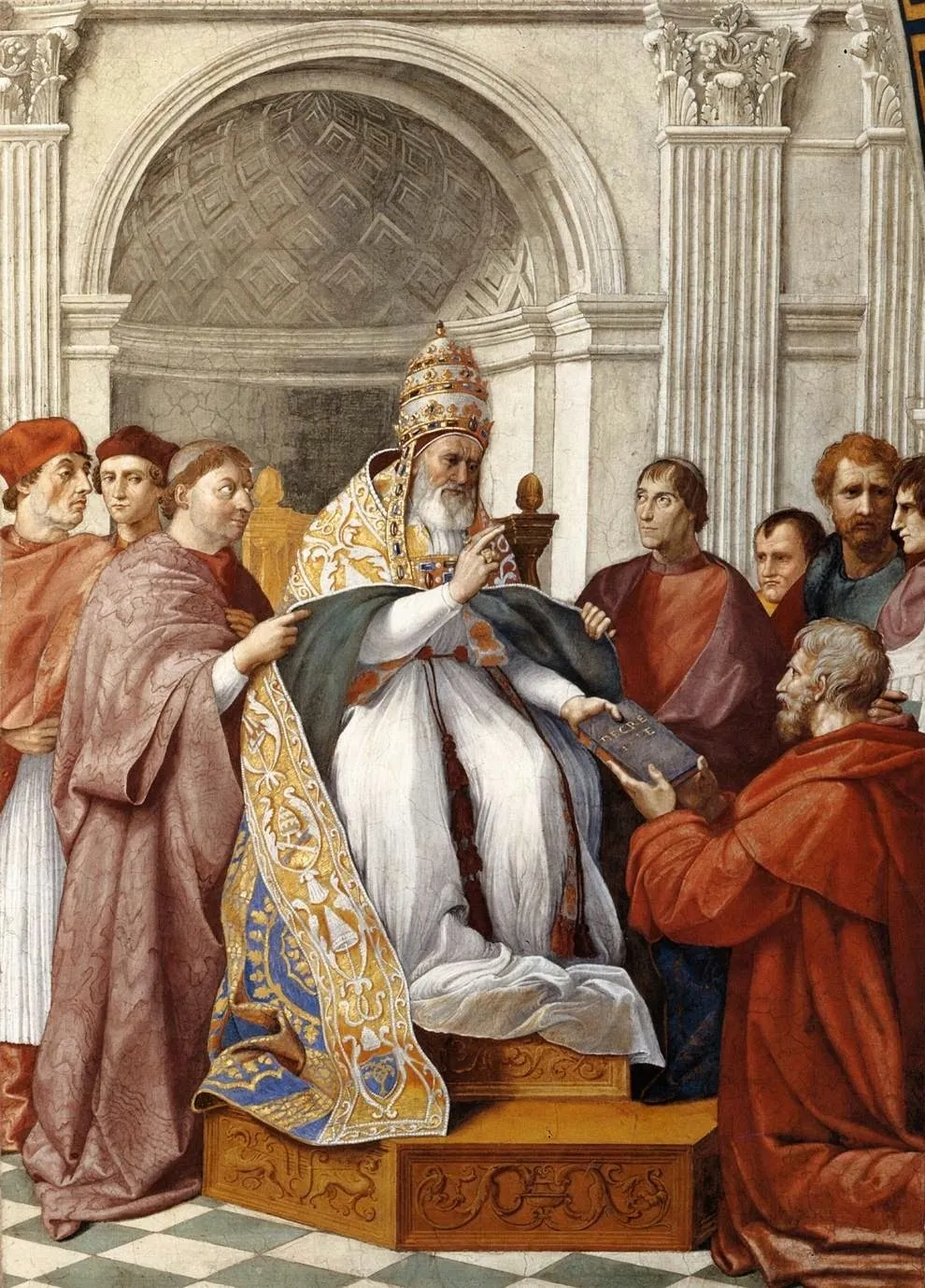
Pope St Gregory the Great (c. 540–604), Pope and Doctor of the Church. Among the many saintly successors of St Peter, Gregory exemplified the papacy at its highest: doctrinal fidelity, pastoral charity, personal holiness and service to Christ's flock.
It is easy to make papal history appear grotesque by selecting John XII, Benedict IX and Alexander VI and stopping there. That would be as historically distorted as pretending those men never existed.
The papal succession also contains an extraordinary company of holy shepherds.
St Clement I, one of the earliest successors of St Peter, belongs to the apostolic age. His ancient letter to the Corinthians bears witness to Roman concern for ecclesiastical unity while men who had personally known the Apostles were still living.
St Leo the Great (440–461) defended Catholic Christology during one of the greatest doctrinal controversies of antiquity. His famous Tome to Flavian played an important role at the Council of Chalcedon, and the Church honours him as a Doctor.
St Gregory the Great (590–604) combined extraordinary pastoral responsibility with personal austerity, theological writing, care for the poor and missionary zeal. His Pastoral Rule became one of the classic texts on the obligations of bishops and priests.
St Gregory VII (1073–1085) endured exile and immense political opposition while attempting to reform clerical corruption and defend the liberty of the Church.
St Pius V (1566–1572) applied the reforms of the Council of Trent, promoted doctrinal and liturgical uniformity, reformed ecclesiastical life and left a lasting imprint upon Catholic worship.
And St Pius X (1903–1914) defended the Faith against Modernism, promoted sound catechesis, encouraged frequent Holy Communion and sought to restore Christian life in a rapidly secularising world.
Pius XII solemnly enrolled Pius X among the saints in 1954. In the address following the canonisation, Pius XII portrayed him as a shepherd who loved Christ precisely by feeding Christ's flock with truth, the Eucharist, charity and courageous pastoral care.
These men demonstrate the positive side of the papacy.
The Catholic does not merely say:
“God somehow tolerated bad popes.”
He can also say:
“God repeatedly raised up extraordinarily holy popes whose teaching, courage and example strengthened the Church for generations.”
Their encyclicals, sermons, reforms and personal virtues remain a spiritual treasury from which Catholics can still learn.
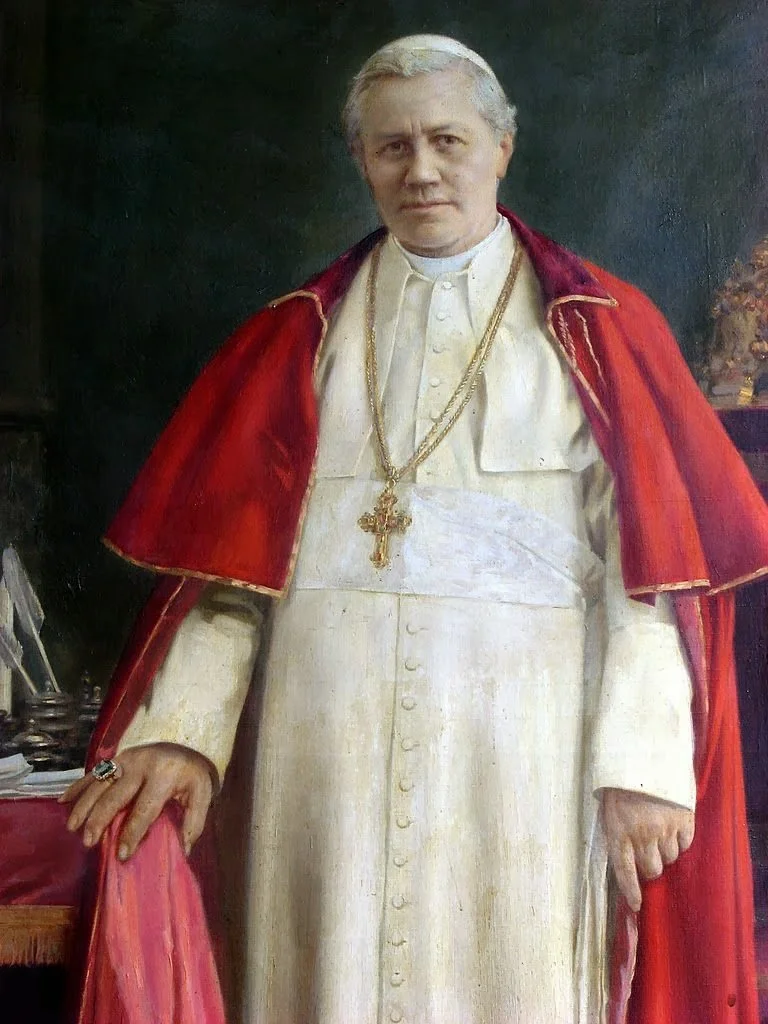
Pope St Pius X (1835–1914). The history of the papacy is not principally the story of its few scandalous occupants, but of shepherds such as St Pius X whose teaching, courage and personal holiness strengthened generations of Catholics.
The Main Objection
A well-informed Catholic might reply:
“But you have just admitted that Honorius was condemned and John XXII taught an erroneous opinion. Vatican I only guarantees infallibility in limited circumstances. Therefore, even if modern popes have taught serious errors, that would merely make them mistaken or bad popes. History proves that a pope can teach error and remain pope.”
This is a much stronger objection than simply appealing to Alexander VI's immorality. It deserves a serious answer.
Response
The first part should be conceded.
Yes, Catholic history demonstrates that a pope can err outside the conditions of infallibility.
John XXII is sufficient to prove that point. It also demonstrates that a pope can govern badly, tolerate confusion, fail to suppress error adequately or behave scandalously. But the conclusion does not automatically follow.
One must next ask what sort of error is involved, how it is expressed, what authority is attached to it, whether it is persistent, whether it contradicts a truth already definitively taught, and whether it amounts to public defection from the Catholic Faith.
A private sermon advancing a disputed theological opinion is not identical to the universal promulgation of a new doctrinal principle.
Failure to condemn an ambiguous formula is not identical to requiring the entire Church to accept religious error.
A pope's personal adultery is not identical to his public profession of heresy.
An imprudent diplomatic decision is not identical to officially replacing Catholic worship with something intrinsically harmful to faith.
Historical precedents must therefore be compared like with like.
The existence of John XXII does not establish that anything whatsoever may be taught by a legitimate pope.
The existence of Alexander VI does not prove that public defection from the Faith has no consequences.
And the condemnation of Honorius does not demonstrate that the Catholic Church can authoritatively become the teacher of a false religion.
The postconciliar question therefore cannot be decided merely by saying:
“There have always been bad popes.”
The actual doctrines, laws, rites and public acts in question must be compared with the Catholic Faith already received. That analysis belongs principally in the related articles on the Church's indefectibility, papal infallibility, Church membership, public heresy and the doctrinal changes associated with Vatican II.
What We Can and Cannot Conclude
What Catholic Doctrine Establishes
A pope can commit grave personal sins.
The Church's holiness does not require every member—or every holder of ecclesiastical office—to be personally holy.
Papal infallibility is not papal impeccability.
Christ endowed His Church with divine assistance so that she cannot become the authoritative teacher of false doctrine.
Heresy, apostasy and schism must be distinguished from ordinary moral sin.
What History Establishes
There have been genuinely scandalous popes. There have also been popes who acted weakly or imprudently during doctrinal controversies.
Honorius I was formally condemned after death in connection with the Monothelite controversy. John XXII publicly advanced an erroneous non-definitive theological opinion and later withdrew it.
The controversies concerning Liberius and Vigilius are historically complex and should not be simplified into slogans.
No accepted historical example establishes a pope defining heresy ex cathedra and binding the universal Church to believe it as Catholic doctrine.
What Is a Theological Conclusion Rather Than a Defined Dogma
Approved theologians before Vatican II discussed what would happen if a pope personally became a manifest heretic.
St Robert Bellarmine's position that a manifest heretic would cease to be pope is of major importance to the traditional sedevacantist argument.
The precise juridical mechanism, however, was not defined by an ecumenical council or pope before Vatican II, and pre-Vatican II theologians differed over aspects of the question.
What We Should Not Conclude
We should not conclude that every historical accusation made against a pope is true.
We should not call every bad decision “heresy.”
We should not treat every theological error as an ex cathedra definition.
We should not suppose that personal immorality automatically removes ecclesiastical office.
But neither should we conclude that because Alexander VI could remain pope while living scandalously, public abandonment of the Catholic Faith would have no consequences for ecclesiastical membership or office.
Those are different questions.
Conclusion
Yes, there have been wicked and corrupt popes. Catholics should say so without embarrassment.
Stephen VI's treatment of the corpse of Formosus was grotesque. John XII's life caused scandal. Benedict IX brought disgrace upon the papacy. Alexander VI placed family ambition and personal vice where sanctity should have been.
Yet these men represent a small and notorious minority across the 260 pontificates recognised through Pope Pius XII, who died in 1958.
More importantly, their wickedness did not transform Catholic doctrine.
And here the historical claim must be expressed carefully: there were popes who caused doctrinal confusion, and there were popes who expressed erroneous or dangerously ambiguous positions outside definitive teaching.
But the Church did not receive their errors as a new Catholic Faith.
No historical “bad pope” provides a precedent for the Roman Church solemnly redefining revealed truth so that yesterday's condemned error becomes today's Catholic doctrine.
That is where the distinction lies.
The Holy Ghost was never promised to the pope so that every occupant of Peter's chair would become a saint. Divine assistance was given so that Christ's Church would remain Christ's Church, preserving His revealed Faith until the end of time.
And history should not leave us thinking chiefly of the Borgias.
Alongside a handful of deeply unworthy pontiffs stand generations of faithful pastors and an extraordinary company of saints: Clement, Leo, Gregory, Gregory VII, Pius V, Pius X and many others. They suffered, taught, reformed, prayed, defended the Faith and sometimes died for it.
Their lives demonstrate what the papacy is supposed to be:
not personal grandeur, but the service of Christ's truth and the salvation of souls.
The next question is therefore not merely whether a pope can be personally wicked. History proves that he can.
The deeper question is:
What happens when a claimant to the papacy publicly departs from the Catholic Faith itself?
That requires the separate principles concerning heresy, membership in the Church and ecclesiastical office.
Primary Sources
Matthew 16:18–19 — Christ's promise concerning Peter and the Church.
Luke 22:31–32 with traditional patristic commentary — Christ's special prayer for Peter's faith and commission to strengthen his brethren.
St Irenaeus of Lyons — Against Heresies III.3 — c. AD 180; Roman succession and preservation of apostolic teaching.
St Leo the Great — Sermon on the Anniversary of His Accession ch. 4 — fifth-century Latin text concerning Peter's dignity in an unworthy successor.
First Vatican Council — Pastor Aeternus 18 July 1870 — primacy and the definition of papal infallibility.
Pope Leo XIII — Satis Cognitum 29 June 1896 — the unity of the Church and Peter's role in preserving the Faith.
Pope Pius XII — Mystici Corporis Christi 29 June 1943 — Church membership, sinful members, heresy and the divine assistance given to the Church.
1917 Code of Canon Law — Canon 188 §4 — public defection from the Catholic Faith and ecclesiastical office.
St Robert Bellarmine, De Romano Pontifice, Book II, chapter 30. English translation of the relevant chapter
Pope Pius XII — Address following the Canonisation of St Pius X 31 May 1954
Further Reading
Catholic Encyclopedia — Pope Honorius I — detailed treatment of the Honorius controversy and his condemnation.
Catholic Encyclopedia — Pope Liberius — examination of the disputed Arian-period evidence.
Catholic Encyclopedia — Pope Vigilius — the Three Chapters controversy and imperial pressure.
Catholic Encyclopedia — Pope John XXII — the Beatific Vision controversy and withdrawal of his personal opinion.
Catholic Encyclopedia — Pope John XII
Catholic Encyclopedia — Pope Benedict IX
Catholic Encyclopedia — Pope Alexander VI
Catholic Encyclopedia — Pope Stephen VI/VII
Related Questions
Who Leads Governs and Protects the Catholic Church?
Can the Catholic Church Ever Fail or Teach Heresy?
What Does It Mean to Be a Member of the Catholic Church?
What Happens to a Person Who Becomes a Formal Heretic?
What Is Papal Infallibility and What Does It Actually Protect?
Can a Pope Be a Heretic and Remain Pope?
What Is the Difference Between a Bad Pope and a Heretical Claimant?
Can the Catholic Church Teach Error in Faith and Morals?