How Should Catholics Evaluate the Post-Vatican II Papal Claimants?
Short Answer
Catholics should evaluate the post-Vatican II papal claimants according to the Catholic doctrine of the papacy itself.
The question is not whether these men were personally likeable, intelligent, sincere, devout, politically conservative, morally admirable in some respects, or capable of saying many orthodox things. Nor is the decisive question whether each one ever pronounced a formally heretical sentence while satisfying the technical conditions for an ex cathedra definition.
The real question is far more fundamental.
The Roman Pontiff is supposed to be
the visible principle of Catholic unity,
the supreme teacher of the Faith,
the guardian of the apostolic deposit,
the supreme legislator of the Church,
and the pastor whose office exists to protect the flock from religious error.
Vatican I taught that the successors of St Peter possess a divinely assisted “gift of truth and never-failing faith” so that Christ's flock may be kept from the poisonous food of error.
Yet from Paul VI onward, men claiming that very office have used its supposed authority to promulgate, defend, institutionalise and progressively develop the Vatican II settlement:
religious liberty,
ecumenism,
the new ecclesiology,
interreligious dialogue,
a radically altered liturgical order,
sacramental sharing with non-Catholics,
new universal disciplines,
and practices which previous Catholic authorities had explicitly rejected.
Paul VI promulgated the conciliar documents and the new Roman Missal;
John Paul II declared the postconciliar ecumenical commitment irreversible and convoked the unprecedented Assisi interreligious gathering;
Benedict XVI consciously defended the new settlement even while admitting that areas of discontinuity had emerged;
Francis advanced it further; and
Leo XIV has explicitly pledged to continue the path followed since Vatican II. Vatican
This is not adequately explained by saying that Catholics have simply endured a series of “bad popes.”
A bad pope may be personally sinful.
He may be weak, imprudent, corrupt, cowardly or negligent.
Catholic history provides examples.
But personal wickedness is one thing; using the claimed teaching, legislative and liturgical authority of the Roman Church to direct Catholics systematically toward propositions and practices incompatible with the religion previously taught by that Church is something altogether different.
If the doctrinal comparisons established elsewhere in this FAQ are correct, the post-Vatican II crisis therefore becomes an authority problem.
Either Christ's Church can officially give the faithful a substantially altered religion through the very authorities instituted to preserve the Faith,
or those responsible for imposing that religion cannot possess the Catholic authority they claim.
The principles already established in Part 3 point toward the latter explanation.
Why This Question Matters
The papacy was not instituted so that Catholics would have a dangerous religious authority whom they must continually correct by consulting older books.
Christ did not establish the successor of Peter as the Church's supreme teacher and then require ordinary Catholics to determine whether that teacher has contradicted his predecessors before deciding whether they may safely follow him.
Nor did He constitute the Apostolic See as the centre of ecclesiastical communion while intending that generations of Catholics might preserve the Faith only by habitually resisting its teachings, legislation, liturgical reforms and pastoral directions.
That would invert the purpose of the papacy.
Leo XIII described the Church's visible unity as requiring
one Faith,
publicly professed,
under the authority Christ established.
He insisted that the Church's role is to preserve Christian doctrine “in its integrity and purity”, while the Roman See bears a unique responsibility for defending the truth of faith. Vatican
Vatican I was still more explicit:
the Holy Ghost was promised to Peter's successors not so that they might introduce new revelation, but so that they might faithfully guard and expound the apostolic deposit. The purpose of the Petrine office is to preserve the Church in unity and protect the faithful from error.
This is why the postconciliar question cannot finally be reduced to complaints about Latin, altar rails, traditional vestments, confusing sermons, or individual abuses. If the crisis reaches Catholic doctrine, universal worship, ecclesiastical law and the ordinary direction given to souls by men claiming supreme authority, then the Catholic doctrine of authority itself demands an explanation.
The more seriously one takes the papacy, the harder it becomes simply to say, “They are the popes, but we must resist what they teach and do.”
The Principles Already Established in Part 3
Part 3 has already dealt with the theological questions surrounding a heretical claimant to ecclesiastical office: heresy and pertinacity, material and formal heresy, internal and external acts, public profession of faith, Church membership, jurisdiction, loss of office, the role of a declaration, Bellarmine and the other classical theologians, and objections based upon universal peaceful acceptance.
Those arguments should not be repeated here. For the present article, only their principal conclusions need to be recalled. Baptism alone does not exhaust visible Church membership.
Pius XII taught that members of the Church are those who
are baptised,
profess the true Faith,
and have not separated themselves from ecclesiastical unity;
he immediately distinguished ordinary grave sin from heresy, apostasy and schism, which sever the visible unity of the Mystical Body. Vatican
The 1917 Code likewise required Catholics publicly to profess their Faith when silence or conduct would imply its denial, and defined the heretic as a baptised Christian who pertinaciously denies or doubts a truth requiring divine and Catholic faith. canonlaw.info
This distinction is essential. A Catholic does not cease to belong to the Church merely because he commits adultery, theft, sacrilege, cowardice or some other mortal sin. Otherwise the Church's visible membership would change invisibly every time a man fell in or out of sanctifying grace.
Heresy is different because it attacks the public profession of the Faith by which the Church exists as a visible society.
That principle cannot suddenly cease to apply when the person under examination wears white.
A Bad Pope Is Not the Same Thing as a Pope Publicly Directing the Church Away From Her Faith
The appeal to “bad popes in history” is one of the most common responses to the present crisis, but it confuses two fundamentally different problems.
Catholic theology has never taught that the Roman Pontiff must be personally holy.
Peter himself sinned.
Several legitimate popes governed badly.
Others displayed deplorable personal conduct.
None of this disproves the papacy because papal authority does not guarantee personal sanctity.
But suppose a claimant does something qualitatively different.
Suppose he claims supreme doctrinal authority while teaching or approving principles incompatible with earlier Catholic doctrine.
Suppose he employs supreme jurisdiction to impose universal legislation that Catholics believe they must resist for the protection of their Faith.
Suppose he promulgates or approves public worship that Catholic clergy and laity regard as doctrinally dangerous.
Suppose this is not an isolated mistake but becomes a continuous religious programme inherited, defended and developed by successive claimants for more than six decades.
At that point the analogy with a Renaissance pope's mistresses, nepotism or financial corruption has collapsed.
Pius XII expressly teaches why.
Not every grave sin severs a man from the visible Body of the Church;
heresy, schism and apostasy do. Vatican
The sedevacantist argument does not therefore depend upon proving that the postconciliar claimants were more personally sinful than Alexander VI. It asks whether their external profession and exercise of claimed ecclesiastical authority are compatible with the Catholic Faith whose guardians they claim to be.
That is a different question entirely.
What Catholic Doctrine Requires of Papal Authority
The Catholic understanding of the papacy creates a series of expectations that cannot simply be discarded once they become inconvenient.
The Roman Pontiff possesses supreme jurisdiction precisely in order to govern the Catholic Church as Christ founded her.
His teaching authority exists to guard revelation.
His universal legislation exists for the supernatural welfare of the Church.
His regulation of worship cannot become an official school of impiety.
His office makes him a principle of unity in the true Faith, not the institutional source of religious mutation.
Vatican I speaks with extraordinary force. The See of Peter is presented as remaining unblemished in the Faith, while the divinely bestowed assistance of the Petrine office exists so that “the whole flock of Christ” may be protected against error.
The same principle extends beyond solemn dogmatic definitions. Nobody claims that every prudential papal decision is infallible. A pope can appoint an incompetent bishop, misjudge a political situation, choose an ineffective administrative policy, or express an imprecise personal opinion. But indefectibility would become almost meaningless if the Catholic Church could nevertheless use her supreme universal authority to establish a religious order dangerous to faith and morals.
Pius VI condemned precisely the suggestion that the Church, governed by the Spirit of God, might establish or approve a discipline that is spiritually dangerous or harmful. In The Same Sense
The Council of Trent similarly anathematised the proposition that ceremonies employed by the Catholic Church in the Mass could be incentives to impiety rather than aids to piety.
These texts do not mean that every churchman will always celebrate reverently, that every local rule is perfect, or that liturgical discipline can never change.
They do mean something immensely important:
the Church herself cannot become the authoritative manufacturer of spiritual poison.
That principle must remain true in 1970, 1983, 2019 and 2026 just as surely as it was true in 1562 and 1794.
The Postconciliar Claimants Did Not Merely Inherit Vatican II
It is sometimes suggested that the later claimants were unfortunate prisoners of a council already completed, as though they merely inherited an ecclesiastical crisis whose direction they could not control.
The documentary record does not support that explanation.
Paul VI did not merely inherit Vatican II. He continued it after John XXIII's death, promulgated its constitutions, decrees and declarations, declared them to be observed by the faithful, and subsequently promulgated the revised Roman Missal. His 1969 apostolic constitution explicitly connected the new Missal with the Council and described extensive modifications to the inherited Roman liturgical order. Vatican
John Paul II did not merely tolerate conciliar ecumenism. In Ut Unum Sint he said that the Church had committed herself “irrevocably” to the ecumenical path of Vatican II. Under his authority the 1983 Code incorporated forms of sacramental sharing with non-Catholics, and in 1986 he personally convoked representatives of Christian bodies and non-Christian religions to Assisi for a World Day of Prayer for Peace. Vatican
Benedict XVI is especially significant because he is frequently invoked as evidence that Vatican II can be safely interpreted within tradition. Yet in his celebrated 2005 address to the Roman Curia, while arguing for continuity at the level of principle, he acknowledged that on the Council's treatment of the modern state, religious liberty and other religions, “some kind of discontinuity might emerge.” He said a “new definition” of the relationship between the Church and the modern state was required and defended Vatican II's adoption of religious freedom as the recovery of a deeper Christian patrimony. Vatican
He later commemorated John Paul II's Assisi initiative and convened another interreligious gathering there in 2011. Vatican
Francis went further. In the 2019 Abu Dhabi document signed with the Grand Imam of Al-Azhar, he placed the “pluralism and the diversity of religions” among realities said to be willed by God in His wisdom and derived from this the right to freedom of belief. Vatican Press
In 2023 the declaration Fiducia Supplicans, issued by the Dicastery for the Doctrine of the Faith under his authority, authorised blessings of same-sex couples under specified conditions while denying that these blessings constitute marriage rites. Vatican
Nor did this trajectory end with Francis.
Only two days after his election, Leo XIV told the College of Cardinals that he wished to renew “our complete commitment” to the path followed by the universal Church for decades in the wake of Vatican II, specifically highlighting collegiality, synodality and dialogue with the contemporary world. Vatican
He subsequently committed himself to continuing ecumenical and interreligious dialogue. Vatican Press
Most strikingly, a September 2026 Vatican note on the sixtieth anniversary of Nostra Aetate—personally approved by Leo XIV and ordered by him to be published—describes the conciliar declaration as having marked a “profound change” in the Church's understanding and expression of her relationship with other religions. Its historical section is explicitly entitled “Post-Conciliar Developments: a Continuity enriched by successive Popes.” Vatican
That document is unusually useful because it confirms precisely what traditional Catholics have long argued historically:
the interreligious programme was not an accidental abuse imposed upon Vatican II from outside. It developed through successive pontificates and is consciously defended today as a continuing postconciliar trajectory.
The dispute concerns whether that trajectory is Catholic.
The Documentary Pattern
| Claimant | Public Participation in the Postconciliar Programme | Why It Matters |
|---|---|---|
| Paul VI | Promulgated the principal disputed Vatican II texts; ordered conciliar enactments to be observed; promulgated the new Roman Missal | The transformation entered the Church through claimed supreme authority, not merely local rebellion |
| John Paul II | 1983 Code; Assisi 1986; Ut Unum Sint; described ecumenical commitment as irrevocable | What had been conciliar principle became universal law and papal practice |
| Benedict XVI | Defended Vatican II's religious liberty; acknowledged elements of discontinuity; renewed Assisi-style interreligious engagement | The problem cannot simply be attributed to an uncontrolled “spirit of Vatican II” |
| Francis | Abu Dhabi declaration; extensive interreligious programme; Fiducia Supplicans and synodal developments | Postconciliar principles were extended into further doctrine and discipline |
| Leo XIV | Explicitly renewed commitment to the Vatican II path; continued ecumenical and interreligious programme; personally approved the 2026 Nostra Aetate anniversary note | The postconciliar programme remains consciously institutional, not a closed historical episode |
John Paul I's thirty-three-day pontificate presents a different evidentiary situation. It would be careless to pretend that the same extensive public record can be assembled for him. His particular claim must therefore be considered according to the ecclesiological and electoral principles discussed in Part 3 rather than by artificially attributing to him decades of later acts.
That qualification strengthens rather than weakens the argument. A serious case should not pretend that the evidence against every claimant is identical.
Ecumenism Provides One of the Clearest Tests
Few comparisons expose the problem more directly than the change in the official treatment of ecumenism.
In 1928 Pius XI confronted movements seeking Christian unity through interdenominational cooperation. His answer in Mortalium Animos was unequivocal. The Apostolic See “cannot on any terms take part” in such assemblies, and Catholics could not support them. Christian unity, he taught, is accomplished by the return to the one true Church of those separated from her. Vatican
Vatican II's Unitatis Redintegratio presents a fundamentally different practical orientation. It praises the modern ecumenical movement, urges Catholics to participate actively in it, recommends dialogue, cooperation and—under approved circumstances—common prayer with separated Christians. Vatican
John Paul II later called this conciliar commitment irreversible. Vatican
One may attempt to harmonise these texts by emphasising qualifications. Unitatis Redintegratio does not say doctrinal differences are irrelevant, and John Paul II did not formally deny that Catholic unity is necessary. Those facts should be acknowledged.
But they do not remove the contradiction in practical ecclesiology that must be explained.
Pius XI says that the Holy See cannot participate in the movement because doing so lends countenance to a false conception of Christian unity. Vatican II directs Catholics toward precisely an ecumenical movement of dialogue, cooperation and common prayer, and subsequent claimants made that programme a defining feature of their pontificates.
These are not merely different tones. They represent different answers to the question: How should Catholics seek the religious unity of separated Christians?
Before Vatican II, the answer centred upon conversion and return to the Catholic Church.
After Vatican II, an ecumenical process involving separated ecclesial bodies became an ecclesiastical obligation.
The burden lies upon the defender of continuity to show how those positions express the same doctrine without altering the meaning of either.
Religious Liberty Presents the Same Problem in Another Form
The comparison between Pius IX and Dignitatis Humanae must be made with care because careless polemic can exaggerate it.
Pius IX did not teach that unbelievers may always be physically coerced into accepting Catholicism. Catholic doctrine had long distinguished between forcing an act of faith—which is illegitimate—and tolerating public religious error for sufficiently grave reasons.
The disputed question concerns something different:
whether false religious practice possesses, by reason of human dignity itself, a natural civil right to public exercise.
In Quanta Cura, Pius IX condemned the proposition that the best condition of society is one in which government recognises no duty to restrain violations of the Catholic religion except insofar as public peace requires, and he attacked the broader doctrine that liberty of conscience and worship is an inherent right which ought to receive legal protection in well-ordered societies. Vatican
Dignitatis Humanae, by contrast, declares that every human person possesses a right to religious freedom grounded in human dignity, that this right continues even when a person fails in his duty to seek and adhere to religious truth, that religious communities possess rights of public worship and propagation, and that this freedom should be recognised in constitutional law, subject principally to the requirements of public order. Vatican
The later document insists that it leaves traditional Catholic doctrine untouched.
But merely asserting continuity does not establish it.
The earlier framework spoke of the true religion's objective claims, the duties of societies toward God, and the toleration of religious error when the common good required it.
The conciliar framework treats civil immunity for public religious activity as a right inherent in the human person, possessed even by those who fail to fulfil their obligation toward religious truth.
That change is not adequately described as the abandonment of medieval police methods. It concerns the theological basis upon which public religious error is permitted.
Benedict XVI himself recognised that the Council had to formulate a new relationship between the Church, the modern state and religious liberty, even while arguing that the result represented a deeper continuity. Vatican
The disagreement, therefore, is not imaginary. It is over whether Benedict's proposed deeper continuity actually succeeds.
From Prohibition of Interreligious Religious Activity to the “Spirit of Assisi”
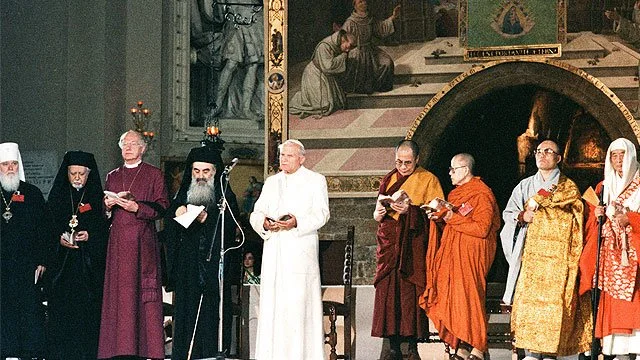
Pope John Paul II at the World Day of Prayer for Peace, Assisi, 27 October 1986. Representatives of Protestant and schismatic bodies, together with adherents of numerous non-Christian religions, were invited to Assisi to pray for peace according to their respective religious traditions. The gathering became one of the most striking symbols of the post-Vatican II approach to ecumenism and interreligious activity and was later repeatedly invoked as embodying the “spirit of Assisi.”
The same cumulative development appears in relations with non-Christian religions.
Traditional Catholic teaching certainly commands justice and charity toward non-Catholics.
It condemns coercing a man into Christian faith.
Catholics may cooperate with non-Catholics in legitimate temporal goods.
Recognising these principles does not require treating false religions themselves as positive religious partners in mankind's approach to God.
Paul VI’s Vatican II 1965 document Nostra Aetate began a different orientation, speaking positively of elements in non-Christian religions and calling Catholics to dialogue and collaboration with their adherents. Vatican Press
John Paul II gave this orientation its most dramatic public expression at Assisi in 1986. Representatives of world religions gathered at his invitation for a day specifically centred upon prayer for peace. John Paul II himself explained that the various religions could and should contribute to peace and subsequently urged continuation of the “spirit of Assisi.” Vatican
Benedict XVI carefully denied religious relativism, but he did not repudiate Assisi. He praised his predecessor's initiative, commemorated it and convened a new gathering in 2011. Vatican
Francis incorporated interreligious fraternity still more deeply into his programme.
Leo XIV has now expressly continued that trajectory, and his 2026 encyclical invoked the “spirit of Assisi” positively. Vatican
The contemporary Vatican itself now calls this a development extending through successive pontificates. Vatican
Here again the issue cannot reasonably be dismissed as a few overenthusiastic diocesan ecumenists acting against Rome. Rome led it.
The Problem Becomes More Serious Because These Men Claim to Be the Magisterium
If these developments came from a handful of dissenting theologians, the theological solution would be simple: condemn the theologians and adhere to the Church.
If they came from disobedient bishops, the solution would likewise be straightforward: obey Rome rather than rebellious bishops.
But the Catholic crisis after Vatican II is peculiar precisely because the authority traditionally invoked against doctrinal innovation has itself apparently become the vehicle of the innovation.
That fact changes everything.
A Catholic is not supposed to relate to the Roman Magisterium as a constitutional lawyer relates to potentially unlawful government regulations—checking every act against earlier precedent before deciding whether compliance is safe.
The Magisterium exists to be a proximate rule of Faith.
Pius XI described the Church's teaching authority as the divinely established means by which revealed doctrine remains intact and reaches men securely. Vatican
Vatican I described Peter's successors as the men through whom the flock would be preserved from poisonous error.
If ordinary Catholics must instead conclude:
the claimant is pope;
he officially teaches this;
his predecessors taught something incompatible;
therefore I must reject his teaching in order to remain Catholic,
then something has gone catastrophically wrong with the proposed explanation.
The problem is not cured by repeating that only ex cathedra definitions are infallible. Papal infallibility has precise limits, but Catholic indefectibility is not exhausted by the rare exercise of extraordinary papal definition. Otherwise a true pope could theoretically dismantle Catholic religion everywhere outside a solemn definition while the promise of Christ remained technically untouched.
Traditional Catholic ecclesiology never understood the papacy so minimally.
Universal Discipline Makes the Difficulty Still Harder
The same problem appears in ecclesiastical law.
The 1983 Code permits, under prescribed circumstances, Catholics to receive certain sacraments from non-Catholic ministers and permits Catholic ministers to administer certain sacraments to members of Eastern churches not in full communion with Rome and, in grave circumstances, to other non-Catholic Christians. Vatican Press
Whatever qualifications accompany those provisions, this is universal ecclesiastical legislation.
That matters because the Church's disciplinary indefectibility cannot simply be separated from her doctrinal indefectibility. Pius VI's Auctorem Fidei condemned the proposition that Church-approved discipline could be spiritually dangerous or harmful. In The Same Sense
The issue is therefore not whether every church law is maximally prudent. Clearly it need not be. The issue is whether the universal Church can establish disciplines which positively embody or promote a false ecclesiology or religious indifferentism.
If Catholics believe that a universal law promulgated by the supposed Roman Pontiff must be resisted because adherence would endanger Catholic faith, that judgment creates an ecclesiological problem before it creates a canonical one.
The same principle applies to the liturgical transformation.
Paul VI did not merely allow a group of experimental priests to compose local alternatives. He promulgated a new Roman Missal by apostolic constitution and explicitly linked it to the conciliar reform. Vatican
This article need not repeat the separate arguments over the theology or validity of the new rites. Those belong elsewhere in the FAQ.
The relevant point here is narrower.
If the new liturgical order is indeed doctrinally harmful in the ways established in the dedicated liturgical articles, then its promulgation by a true supreme authority creates a problem for Catholic indefectibility.
One cannot simultaneously maintain that the Catholic Church cannot give her children harmful worship and that the Catholic Church did exactly that, but Catholics may solve the contradiction by privately refusing what she gave them.
This Was Not an Accidental or Unnoticed Transformation
At this point an understandable question arises: perhaps these men did not realise what they were doing.
Subjective ignorance is possible in individual cases. Human beings can be intellectually inconsistent. They may convince themselves that contradictory principles are harmonious. Ideological commitments can blind educated men as easily as uneducated ones.
What cannot plausibly be maintained, however, is that the postconciliar claimants were unaware that they were pursuing a major religious transformation.
They repeatedly said so.
Paul VI promulgated the Council precisely as an authoritative programme for the Church and formally ordered its enactments to be observed. Vatican
John Paul II called the ecumenical path irrevocable. Vatican
Benedict XVI openly discussed the changed relationship between the Church, the modern state, religious liberty and other religions and defended the Council's new formulation as legitimate development. Vatican
Leo XIV has renewed complete commitment to the path followed since Vatican II. Vatican
The September 2026 Vatican note approved by him explicitly calls Nostra Aetate a “profound change” and treats the subsequent programme as a succession of postconciliar developments carried forward by popes from Paul VI to Leo XIV. Vatican
Therefore the proposition that these men simply failed to notice that Catholic religious life was changing is untenable.
They may have believed the changes to be legitimate.
They may have convinced themselves that novelty represented development.
They may have regarded earlier formulations as historically conditioned.
They may have believed that fidelity to the Church required transformation rather than preservation.
But those are explanations of why they pursued the programme, not evidence that no programme existed.
Nor should the theological argument rest upon assigning individual moral motives such as pride, ambition, cowardice, ideological zeal or arrogance. Any of those may have existed in particular cases; God alone judges the full interior culpability of each soul.
The public ecclesiological question is stronger because it requires no speculation about conscience.
They publicly did these things and publicly defended them.
Public Profession Matters More Than Private Motive
This distinction becomes especially important when applying the principles of Part 3.
Heresy is not the same thing as making an accidental theological error. Canon 1325 of the 1917 Code includes pertinacity in its definition. canonlaw.info
The theological discussion concerning how pertinacity is established, whether a declaration is necessary in a particular case, and how loss of office occurs has already been treated in Part 3 and need not be reproduced here.
But neither may pertinacity be transformed into an impossible psychological test.
The Church is a visible society. Visible membership turns upon externally discernible profession, not an inaccessible examination of the soul.
That is why Pius XII's formulation concerns those who profess the true Faith. Vatican
When a theological novelty appears once in an interview, one may reasonably ask whether the speaker misspoke. When it
appears repeatedly in formal documents,
universal legislation,
papally convoked religious events,
catechesis,
diplomatic policy
and decades of institutional implementation,
the situation is qualitatively different.
When objections are raised and the same programme is nevertheless defended by successive claimants, codified, taught and expanded, it becomes increasingly implausible to classify the entire phenomenon as an inadvertent slip of expression.
Again, this does not permit Catholics to claim knowledge of a man's hidden conscience.
It permits them to evaluate his public religious profession and acts.
And public profession is precisely what visible ecclesiology requires them to evaluate.
The Strongest Objection: “But They All Say They Are Preserving Tradition”
The strongest response is not that the postconciliar claimants deny Catholic identity. They plainly do not. They call themselves Catholic. They profess belief in the Trinity, Incarnation, Resurrection, sacraments, episcopacy and papacy. They quote earlier popes. They invoke Scripture and Tradition. They repeatedly insist that Vatican II is compatible with Catholic teaching.
That fact deserves full weight.
The problem is that verbal professions of continuity cannot resolve objective doctrinal contradiction.
A man can sincerely believe that two propositions are compatible when they are not.
Theological continuity is established by comparing propositions, not by counting assertions of continuity.
Benedict XVI offered perhaps the most sophisticated version of the continuity argument. Yet his own analysis conceded that new definitions and apparent discontinuities emerged in the Church's treatment of religious liberty and the modern state. Vatican
The question is therefore not whether Benedict wanted continuity. The question is whether the theological reconciliation he proposed actually preserves the earlier doctrine without changing its meaning. The same principle applies throughout the crisis.
Calling ecumenism a development does not make Mortalium Animos say what Unitatis Redintegratio says.
Calling religious liberty a rediscovery of ancient Christian principle does not by itself reconcile Dignitatis Humanae with Quanta Cura.
Calling Assisi non-syncretistic does not answer whether the preconciliar Church would have regarded papal sponsorship of parallel religious prayer by adherents of false religions as compatible with Catholic religious unity.
The propositions and actions must be examined.
Continuity is a conclusion to be demonstrated, not a slogan capable of replacing the demonstration.
“No Ex Cathedra Heresy” Does Not Solve the Problem
Another objection insists that no postconciliar claimant has formally defined heresy ex cathedra. Therefore, the argument goes, papal infallibility remains untouched. Even granting the premise for the sake of argument, it does not answer the real objection.
The claim being examined is not simply:
A postconciliar pope pronounced a false solemn definition.
It is:
Men claiming the supreme teaching and governing authority of the Catholic Church have employed that authority over decades to establish and perpetuate a religious system containing doctrines, disciplines, worship and pastoral principles incompatible with the Catholic religion previously taught by the Church.
Those are different claims.
If the only divine protection promised to the Church were protection against the extremely rare event of an explicitly ex cathedra heretical definition, the pope could theoretically teach grave error habitually through encyclicals, approve harmful universal legislation, promulgate corrupting worship and direct the entire Catholic world into false religious practice—provided he avoided the technical formula necessary for an extraordinary definition.
Such a theory might preserve a very narrow proposition concerning ex cathedra infallibility. It would not preserve the Catholic doctrine of the Church.
Vatican I's description of the Petrine office as protecting the flock from poisonous error would become almost unintelligible.
Recognise-and-Resist Solves One Problem by Creating Another
The position commonly called recognise-and-resist attempts to hold together two judgments which increasingly pull in opposite directions.
Its adherents recognise the post-Vatican II claimant as the true Roman Pontiff, successor of St Peter and visible head of the Catholic Church,
while simultaneously resisting substantial portions of what he and his predecessors have taught, legislated, promulgated or encouraged since Vatican II.
In practical terms, the position says:
he is the Pope, but Catholics may have to resist him in order to remain Catholic.
This is not merely the ordinary Catholic principle that an inferior may sometimes refuse an unjust command. Catholic theology has never taught that obedience is blind or that a pope's every private judgment is infallible. A pope might command something unlawful in a particular circumstance; he may make a poor prudential judgment; he may be corrected for personal misconduct; and theologians have long discussed exceptional cases in which resistance to an individual act of authority might be legitimate.
Recognise-and-resist goes much further.
Its difficulty is that resistance has become not exceptional but structural. The Catholic faithful are effectively required to judge for themselves whether the supposed Roman Pontiff's teachings accord with Tradition, whether his universal legislation may safely be followed, whether his authorised liturgy faithfully expresses Catholic doctrine, whether his ecumenical and interreligious programme should be accepted, and whether his directions concerning the life of the universal Church ought to be obeyed. Where the answer is judged to be no, Catholics are told to retain the traditional Faith against the practical religious direction of the man they simultaneously acknowledge as its supreme guardian.
This creates an ecclesiological contradiction.
Leo XIII taught that Christ established in His Church not only unity of faith but unity of government, and that Christians are consequently bound to be subject and obedient to the authority established over them. He described the Roman Pontiff as possessing supreme authority over the Christian commonwealth and insisted that communion with the See of Peter is a public criterion of Catholic unity. In Sapientiae Christianae, he likewise taught that unity of minds in the Church requires submission and obedience to the Roman Pontiff rather than a selective adherence in which papal authority is accepted only when the individual Catholic independently judges it compatible with his own reading of Tradition.
This does not mean that every refusal to obey a pope is schism. The distinction is important. Canon 1325 §2 of the 1917 Code defines a schismatic as one who refuses submission to the Supreme Pontiff or refuses communion with the members of the Church subject to him. A Catholic may therefore resist a particular unlawful act without denying the pope's authority as such.
But recognise-and-resist presents a far more serious problem when resistance becomes habitual, universal and religious in character.
The claimant remains pope, yet his universal liturgical legislation may supposedly have to be rejected.
He remains the supreme teacher of Christians, yet Catholics may supposedly have to oppose his ordinary teaching repeatedly in order to preserve the Faith.
He remains the supreme legislator of the Church, yet legislation affecting the universal Church may supposedly embody principles which faithful Catholics must resist.
He remains the visible principle of ecclesiastical unity, yet his programme of ecumenism, interreligious activity, synodality and postconciliar ecclesiology may supposedly have to be rejected in order to remain faithful to the Catholic religion that existed before his pontificate.
At that point the issue is no longer whether Catholics may occasionally resist an abuse of authority. The question becomes whether the supposed pope is actually functioning as the Catholic Church teaches that the pope must function at all.
Are Recognise-and-Resist Catholics?
Many who hold the recognise-and-resist position sincerely intend to profess the traditional Catholic Faith, adhere to the traditional Mass and sacraments, reject modernist errors, and preserve what the Church taught before Vatican II. One should therefore not casually declare every individual holding this position formally schismatic or outside the Church. The objective theological problem must be distinguished from the subjective culpability of individual Catholics, just as elsewhere in this FAQ material and formal responsibility are carefully distinguished.
The more precise question is whether recognise-and-resist, considered as an ecclesiological system, is compatible with the traditional Catholic doctrine of the papacy.
That is much harder to defend. If the man recognised by the recognise-and-resist Catholic really is the Roman Pontiff, then he possesses the supreme jurisdiction which Christ conferred upon Peter and his successors. He is not simply an elected administrator whom Catholics may accept ceremonially while maintaining a standing veto over his religious government. The Roman Pontiff is the Church's supreme pastor and teacher, and submission to him belongs to the visible unity of the Catholic Church. Leo XIII teaches precisely this connection between unity of faith, unity of government and obedience to the Roman See.
Consequently, if resistance develops into an effective refusal of submission to a true Roman Pontiff as supreme ecclesiastical authority, the problem is no longer merely disobedience. It approaches the very definition of schism.
This is the dilemma recognise-and-resist cannot escape merely by repeating, “We recognise him as pope.” Recognition in words does not settle the matter if the practical relationship is one of systematic non-submission.
A man cannot indefinitely be treated as the true supreme rule of ecclesiastical government while his teaching, legislation, worship and religious programme are treated as though they possess authority only when individual traditional Catholics decide they conform to an earlier standard. That reduces the pope from the Church's proximate governing authority to a claimant whose acts are perpetually subject to private ratification.
The sheep become the tribunal of the shepherd.
The Other Possibility Changes the Question Entirely
Suppose, however, that the postconciliar claimant is not the Roman Pontiff. The situation then becomes fundamentally different.
Catholics owe submission to the Roman Pontiff, not to every man who claims to be the Roman Pontiff. Canon 1325 itself presupposes this distinction: schism consists in refusing submission to the Supreme Pontiff. It cannot be schismatic merely to refuse submission to an antipope, because an antipope possesses no papal authority to which Catholics owe submission.
History itself makes the distinction unavoidable. During disputed papal elections, the theological question has always been who actually possesses the office, not whether every claimant must be obeyed until an individual Catholic receives some extraordinary revelation to the contrary.
If the sedevacantist argument is correct—if a claimant publicly defects from the Catholic Faith in a manner incompatible with visible Church membership—then St Robert Bellarmine supplies the underlying ecclesiological principle.
A manifest heretic, he argues, cannot be pope because he cannot be the head of a body of which he is not a member. Bellarmine therefore concludes that the manifestly heretical pope ceases to be pope and head just as he ceases to be a member of the Church.
On that premise, the appropriate Catholic response is not:
Recognise him as pope but resist him as though he were not.
It is:
Reject his claim to the papal office because he does not possess it.
That does not mean automatically rejecting every objectively true proposition the claimant happens to utter. An antipope could recite the Nicene Creed correctly, condemn murder correctly, or repeat genuine Catholic doctrine. Truth does not become false because an illegitimate claimant says it.
What Catholics reject is his claim to teach, command, legislate or bind the Church as Roman Pontiff.
Nor does the word antipope necessarily imply that the man knowingly committed fraud. Historically, an antipope is fundamentally a false claimant to the Roman See. Whether a particular claimant sincerely believed himself pope is a separate question of subjective intention.
The Recognise-and-Resist Dilemma
The issue can therefore be stated with unusual clarity.
If the claimant really is pope, Catholics owe him the submission which Catholic doctrine attaches to the Roman Pontiff. Occasional resistance to a particular unjust command is conceivable; a permanent religious system in which Catholics routinely reject his universal teaching, law, worship and ecclesiastical direction is something altogether different. If that practical resistance becomes a refusal of his supreme authority as such, it tends toward the schism defined by Catholic theology and canon law.
If the claimant is not pope, there is no reason to “recognise” him at all. His supposed papal Magisterium is not papal Magisterium. His universal legislation possesses no papal authority. His claim to bind the Church fails with his claim to the office. If his exclusion from office follows from manifest public heresy, the deeper reason is that he cannot be the visible head of the Catholic Church while publicly standing outside her visible profession of Faith.
Recognise-and-resist attempts to occupy the narrow space between these alternatives:
He possesses the authority, but we must systematically refuse what that authority gives us.
That may appear moderate because it avoids the psychological shock of concluding that the Holy See is vacant. Theologically, however, it creates a far more radical reconstruction of Catholic ecclesiology. Instead of questioning the claimant, it effectively questions the reliability and practical function of the papacy itself.
Sedevacantism takes the opposite route. It does not solve the crisis by diminishing papal authority. It begins with the traditional Catholic doctrine
that the papacy is real, supreme, visible and divinely constituted;
that the Roman Pontiff is genuinely the Church's supreme teacher and governor;
and that the Church cannot require her children to preserve Catholic Faith by maintaining permanent resistance to the religious authority Christ established precisely to safeguard that Faith.
It then asks the unavoidable question:
If Catholics must systematically resist this claimant's doctrine, worship, laws and religious programme in order to remain faithful to the Catholic religion, is the problem really that Catholics must learn how to resist the Pope—or that the man being resisted is not the Pope at all?
That is the issue recognise-and-resist ultimately cannot avoid.
But What About the Visibility of the Church?
This objection deserves seriousness.
The Catholic Church is visible and indefectible.
She cannot disappear into an invisible collection of private believers.
Apostolic succession, sacraments, legitimate authority and visible unity belong to her constitution.
Yet visibility cannot mean simply identifying whoever occupies the Vatican and declaring his religious programme Catholic by definition.
Leo XIII explained that the Church's visibility includes the external profession of one Faith, sacramental worship and visible government. Vatican
Buildings alone are not the Church. Neither are legal corporations, episcopal palaces, historic diocesan boundaries, clerical clothing or possession of St Peter's Basilica. Those things are extraordinarily important signs of institutional continuity. They cannot be dismissed.
But institutional possession does not answer the theological question if the Faith publicly professed through those institutions has substantially changed.
The Catholic Church is visible precisely as a visible society professing the Catholic Faith.
Consequently, the argument cannot be:
They occupy Catholic institutions, therefore whatever religion they officially promulgate must necessarily be Catholic.
That makes physical and juridical possession the rule of Faith. Nor may the sedevacantist simply say:
They teach error, therefore nothing further needs examination.
Part 3 exists precisely because the relationship between public heresy, membership, jurisdiction, election and office requires theological analysis.
But once those principles have been established, institutional appearances cannot be permitted to override them.
The Question of Indefectibility Forces a Choice
Eventually the argument reaches a fork from which there is no comfortable escape.
Christ founded an indefectible Church.
That Church cannot cease to be the Church of Christ.
She cannot lose the Faith as a Church.
She cannot become the authorised teacher of a false religion.
She cannot universally impose upon her children a religious order which positively leads them away from Catholic Faith and worship.
The Roman See has a special divinely established role in preserving that indefectibility. Vatican I's language about the never-failing faith of Peter's See and protection of the flock from poisonous error is not ornamental rhetoric.
Now apply those principles to the historical record.
If Vatican II and its subsequent implementation are fundamentally compatible with traditional Catholicism, then the sedevacantist conclusion loses its principal premise.
But
if the preceding articles in this FAQ have demonstrated real contradiction in matters such as religious liberty, ecumenism and ecclesiology;
if the liturgical articles establish grave doctrinal defects in the authorised reforms;
if universal law embodies ecclesiological principles incompatible with earlier Catholic discipline;
and if successive papal claimants knowingly maintained and extended this religious settlement, then the problem can no longer be described as a few papal mistakes.
The propositions become:
The Catholic Church is indefectible.
Her supreme authority exists to preserve Faith and unity.
The Church cannot universally impose a false or harmful religion.
Yet the postconciliar authorities have imposed and defended a religious system which, on the evidence already established, departs substantially from traditional Catholic Faith and practice.
If all four propositions are retained, the conclusion concerns the alleged authority of the men responsible.
That is why sedevacantism arises. Not because Catholics despise the papacy. Because they refuse to redefine it.
What We Can and Cannot Conclude
What We Can Conclude
The public record establishes that the postconciliar transformation cannot reasonably be attributed simply to local abuses, rebellious theologians or an uncontrolled “spirit of Vatican II.” Successive claimants to the papacy themselves promulgated, institutionalised, defended and extended the conciliar programme.
It also establishes that the programme was conscious. The claimants repeatedly identified Vatican II as the foundation of a new ecclesial direction and deliberately continued it. The present claimant, Leo XIV, has expressly committed himself to that inherited path, and a 2026 document published with his approval describes Nostra Aetate as marking a profound change whose postconciliar development continued through successive pontificates. Vatican
If the doctrinal articles elsewhere in this FAQ establish that central elements of that programme contradict the previous Catholic Magisterium, the resulting problem necessarily reaches papal authority and indefectibility.
It is also legitimate to conclude that the ordinary “bad pope” analogy is insufficient. Personal vice does not constitute the same ecclesiological problem as public departure from the Faith combined with the universal exercise of teaching, legislative and liturgical authority.
Finally, Part 3's doctrine concerning public profession, Church membership and office is not an optional appendix to the Vatican II controversy. Once objective public departure from Catholic Faith is established, those principles must be applied.
What We Cannot Conclude
We cannot know the complete interior culpability of John XXIII, Paul VI, John Paul I, John Paul II, Benedict XVI, Francis, Leo XIV or any other claimant. God alone judges the conscience. Historical evidence may establish planning, awareness, persistence and deliberate institutional action; it does not grant access to the internal forum.
Nor should every claimant be treated as though the documentary evidence were identical. John Paul I's exceptionally short tenure is an obvious example.
This article also does not establish that every statement made after Vatican II is false, that every postconciliar cleric is formally heretical, or that every sacrament celebrated under the new order is thereby invalid. Those are separate theological questions.
Finally, this article does not repeat every dispute concerning declaration, loss of office, universal peaceful acceptance or the exact canonical mechanism by which a heretical claimant fails to possess or loses office. Those questions belong to Part 3.
What it establishes is the factual bridge between the Vatican II rupture and those theological principles: the postconciliar claimants were not passive spectators to the construction of the new religious order.
They were its principal authoritative agents.
Conclusion
Catholics should therefore judge the post-Vatican II papal claimants by the Catholic doctrine of the papacy, not modify the Catholic doctrine of the papacy in order to accommodate the claimants.
A true Roman Pontiff is not merely a man who has received enough votes from cardinals, wears white, occupies the Vatican and appears in the Annuario Pontificio.
He is the successor of Peter, the visible head of the Church, the supreme pastor, guardian of the deposit of Faith, teacher of Christian truth and principle of ecclesiastical unity.
That is precisely why the events since Vatican II are so grave.
The problem is not that several popes committed sins. Popes have sinned before.
The problem is not that one pope misspoke. Popes have spoken imprudently before.
The problem is that a succession of men claiming the supreme authority of Christ's Church has used that claimed authority to establish, defend and continually develop a postconciliar religious system substantially different from what preceded it in doctrine, worship, ecclesiology, ecumenism, relations with false religions, Church-state teaching and universal discipline.
The present claimant has not repudiated that trajectory. He has explicitly renewed it. Vatican
Calling this merely an unfortunate series of errors no longer explains the evidence. Nor does appealing indefinitely to good intentions. Men may sincerely believe that they are improving Christianity while objectively departing from it.
The Catholic theological question concerns
not merely what they intended,
but what they publicly taught, legislated, authorised and professed.
And neither can Catholics preserve the papacy by reducing it to an office whose occupant may systematically teach, govern and worship in ways which the faithful must resist in order to preserve Catholicism.
That empties papal authority in order to save the papal claimant.
The sedevacantist conclusion proceeds in the opposite direction.
It preserves the Catholic doctrine of the papacy and concludes that men whose public religious profession and authoritative programme are incompatible with that doctrine cannot possess the authority they claim.
This is a severe conclusion. But the gravity of a conclusion does not make it false.
If Part 3 has correctly established the relationship between public heresy, visible Church membership and ecclesiastical office, and if the preceding Vatican II articles have correctly demonstrated genuine doctrinal and religious rupture, then Catholics cannot stop at the comfortable observation that the postconciliar claimants have governed badly.
The evidence demands the harder question:
Could the Catholic Church herself have done these things?
If the answer demanded by Catholic indefectibility is no, then the next conclusion concerns not the indefectibility of the Church, but the authority of the men who claimed to govern her.
Primary Sources
First Vatican Council, Pastor Aeternus (1870) — the divinely assisted teaching office of Peter and his successors, the preservation of the Apostolic See and the purpose of protecting Christ's flock from error. Read Pastor Aeternus
Leo XIII, Satis Cognitum (1896) — the visible unity of the Church, unity of Faith, papal authority and the duty of the Church to preserve doctrine in purity. Read Satis Cognitum
Pius VI, Auctorem Fidei (1794), proposition 78 — rejects the proposition that Church-established discipline may be dangerous or harmful to the faithful. Read the relevant text of Auctorem Fidei
Council of Trent, Session XXII (1562) — the sacrificial nature of the Mass and the Church's liturgical rites as aids rather than incentives to impiety. Read Session XXII of Trent
Pius XI, Mortalium Animos (1928) — Catholic unity, ecumenical assemblies and the conversion of those separated from the Church. Read Mortalium Animos
Pius XII, Mystici Corporis Christi (1943) — visible Church membership, profession of the true Faith, and the distinction between personal sin and heresy, schism or apostasy. Read Mystici Corporis Christi
1917 Code of Canon Law, canon 1325 — public profession of faith and the canonical definition of heresy, apostasy and schism. Read Canon 1325
Pius IX, Quanta Cura (1864) — preconciliar teaching concerning religious liberty, religious error and civil society. Read Quanta Cura
Second Vatican Council, Dignitatis Humanae (1965) — the conciliar doctrine of a civil right to religious freedom grounded in human dignity. Read Dignitatis Humanae
Second Vatican Council, Unitatis Redintegratio (1964) — the postconciliar programme of ecumenical participation, dialogue, cooperation and approved common prayer. Read Unitatis Redintegratio
Second Vatican Council, Nostra Aetate (1965) — relations with non-Christian religions. Read Nostra Aetate
Paul VI, Missale Romanum (1969) — promulgation and explanation of the new Roman Missal. Read Missale Romanum
1983 Code of Canon Law, canon 844 — universal legislation concerning sacramental sharing with non-Catholics. Read Canon 844
John Paul II, Ut Unum Sint (1995) — the claimed irrevocable commitment of the Catholic Church to postconciliar ecumenism. Read Ut Unum Sint
John Paul II, Assisi addresses (1986) — primary evidence concerning the World Day of Prayer for Peace and the “spirit of Assisi.” Read John Paul II's Assisi address
Benedict XVI, Address to the Roman Curia (22 December 2005) — his continuity thesis and discussion of discontinuity, religious liberty and the Council's relationship with the modern state. Read Benedict XVI's 2005 address
Francis and Ahmad al-Tayyeb, Document on Human Fraternity (2019) — religious pluralism, freedom of belief and interreligious fraternity. Read the Abu Dhabi document
Dicastery for the Doctrine of the Faith, Fiducia Supplicans (2023) — blessings of couples in irregular situations and same-sex couples. Read Fiducia Supplicans
Leo XIV, Address to the College of Cardinals (10 May 2025) — explicit commitment to continue the post-Vatican II trajectory. Read Leo XIV's address
Dicasteries for the Doctrine of the Faith, Christian Unity and Interreligious Dialogue, A Journey of Hope (2026) — describes Nostra Aetate as a profound change and the subsequent programme as a development through successive popes; personally approved and ordered published by Leo XIV. Read A Journey of Hope
Further Reading
The following secondary resources are useful particularly for assembling objections, theological authorities and documentary leads. They should remain subordinate to the primary Catholic sources used above.
Answering the Objections to the Sedevacantist Position — especially useful on membership, eligibility for office, public heresy and common objections. Read the CMRI article
Pope Pius XII: After 50 Years — useful for contrasting the traditional Catholic understanding of the papacy with the contemporary crisis. Read the article
The Theological Errors of the Second Vatican Council — a broad resource collection identifying doctrinal areas requiring primary-source comparison. Read the resource collection
St Robert Bellarmine, De Romano Pontifice, Book II, chapter 30 — the classical discussion of a manifestly heretical pope and membership in the Church. Read Bellarmine's text
The traditional-priest jurisdiction material supplied with this commission is more directly relevant to the separate question of how Catholic sacramental ministry continues during the crisis and should therefore be cross-linked there rather than expanded in this article. cmri.org
Related Questions
This article should cross-link principally to Part 3, especially the articles dealing with:
Can a Pope Become a Public Heretic?
Does Public Heresy Separate a Man From Membership in the Catholic Church?
Can a Public Heretic Possess Ecclesiastical Office and Jurisdiction?
Must the Church First Declare a Heretical Pope Deposed?
Does Universal Peaceful Acceptance Guarantee That a Papal Claimant Is Valid?
Can Catholics Recognise a Pope While Systematically Resisting His Teaching and Laws?
How Can the Catholic Church Remain Visible During a Prolonged Vacancy of the Holy See?
What Is Sedevacantism, and Why Do Traditional Catholics Consider It Necessary?