Are Priestly Ordinations and Episcopal Consecrations According to the 1968 Rites Certainly Valid?
Short Answer
No. From the traditional Catholic perspective examined here, priests and bishops produced through the post-1968 Roman rites cannot simply be presumed to possess certainly valid Holy Orders. The gravest problem concerns the new rite of episcopal consecration, where the evidence gives rise at minimum to a positive and prudent doubt and provides substantial grounds for the stronger conclusion that the new essential form is probably invalid.
The issue is not simply that an ancient ceremony was changed. Catholic doctrine does not teach that every liturgical alteration invalidates a sacrament. The decisive question is whether the revised rite preserved the sacramental sign Christ instituted.
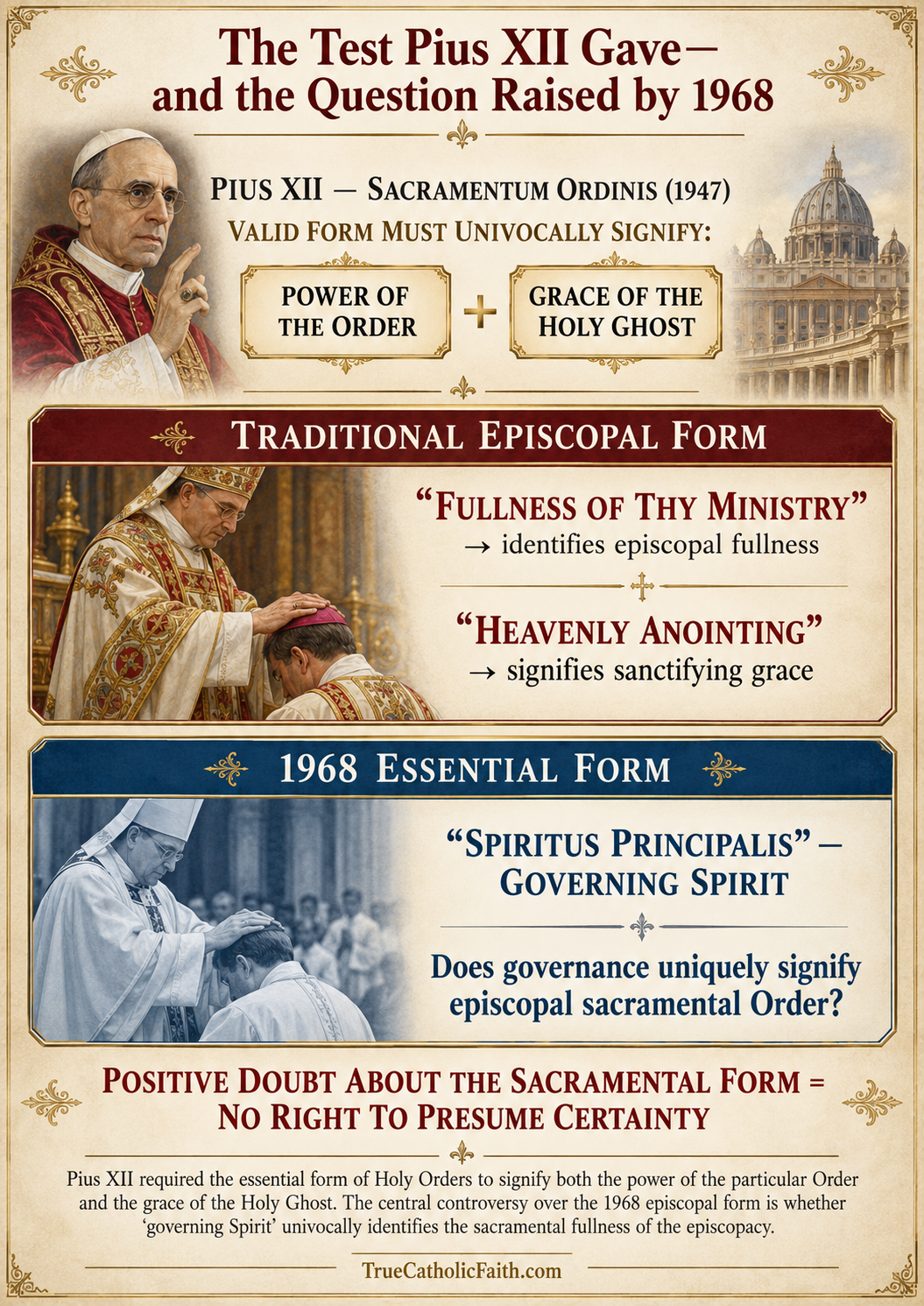
Pope Pius XII provided the controlling principle only twenty-one years before the reform. In Sacramentum Ordinis of 1947 he declared that the essential form of Holy Orders must determine the laying on of hands and univocally signify two sacramental effects:
the power of the Order being conferred
and the grace of the Holy Ghost.
For episcopal consecration, Pius XII identified as essential an unquestionably valid Roman formula explicitly asking God to complete in His priest “the fullness of Thy ministry” and sanctify him with heavenly anointing.
In 1968 Paul VI completely replaced that form with another whose central expression is Spiritus principalis—the “governing Spirit.” Paul VI himself repeated Pius XII's rule that the form must clearly signify the power of Order and the grace of the Holy Ghost.
That creates the central question:
Where, in Paul VI's new essential formula, is the sacramental power of episcopal Order—the fullness of the priesthood—univocally signified?
The new words unquestionably invoke divine power and the Holy Ghost. The difficulty concerns which Order they signify. “Governing Spirit” naturally expresses rule, leadership or authority, yet Catholic theology distinguishes the sacramental power of Order from the power of jurisdiction or governance. St Thomas Aquinas explicitly makes that distinction.
The problem becomes more serious because substantially equivalent “governing Spirit” terminology appears in Eastern liturgical contexts where episcopal Order is not being conferred at all. That makes it difficult to maintain that the expression, considered as the determinant of the sacramental sign, uniquely signifies episcopal consecration.
The revised priestly rite presents a somewhat different question. Its essential form was altered but continues explicitly to ask God to bestow the dignity of the priesthood, the Spirit of holiness and the ministry of the second rank. The intrinsic case for invalidity is therefore less decisive than with episcopal consecration. Nevertheless, the radical reconstruction of Holy Orders creates a separate positive doubt, and the episcopal problem frequently decides the priestly question upstream: a man who is not a valid bishop cannot validly ordain anyone, even if he uses an otherwise valid priestly formula.
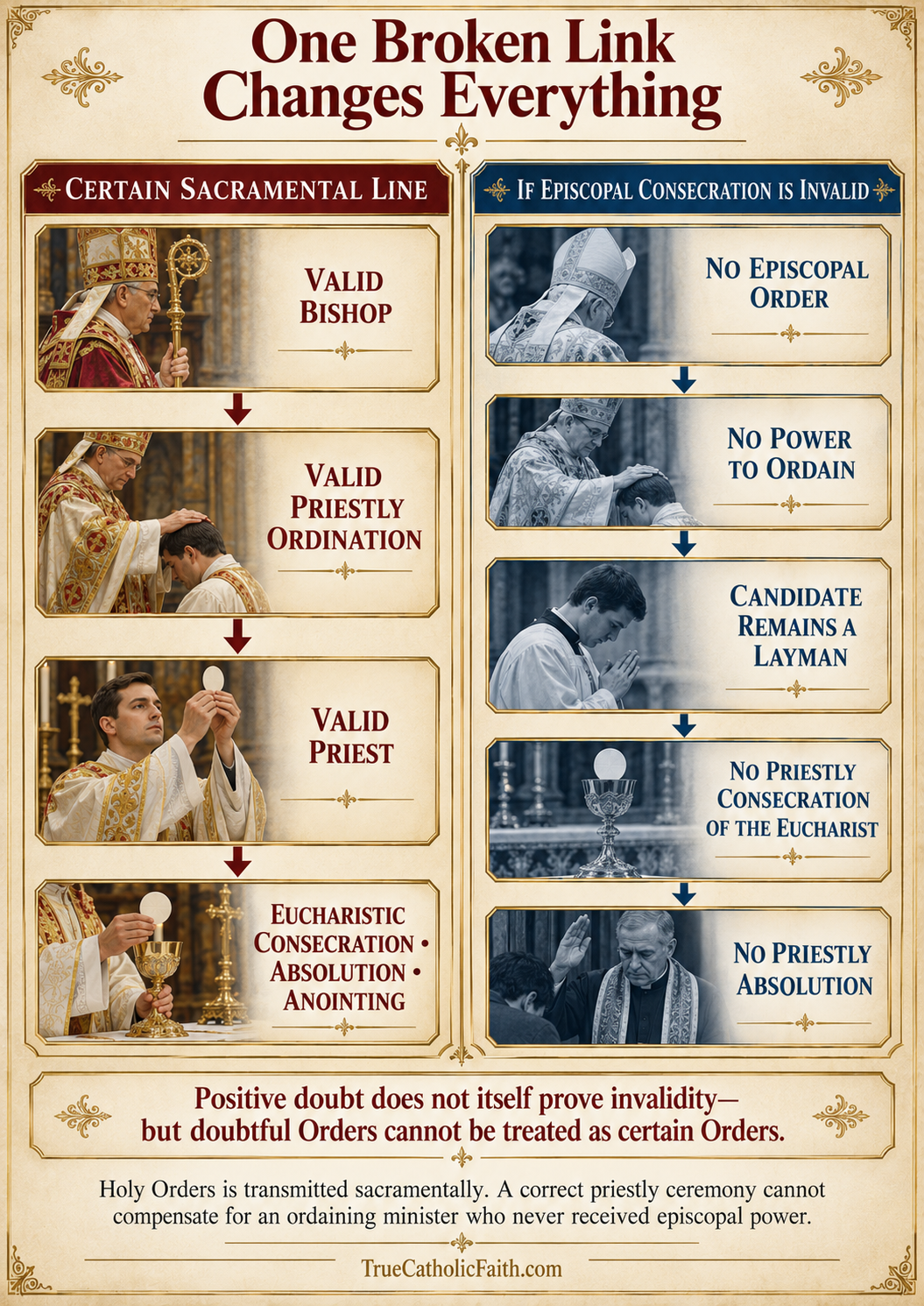
If such an ordination is actually null, the consequences are not symbolic.
The man remains sacramentally a layman. He cannot consecrate the Eucharist. He cannot exercise priestly sacramental absolution. When he attempts Mass, the bread remains bread and the wine remains wine; no Eucharistic Sacrifice is effected by him.
The question therefore concerns not liturgical taste, but the continued existence of the sacramental priesthood itself.
Why This Question Matters
Most Catholics encounter the priesthood through visible things: a Roman collar, vestments, a parish appointment, the celebration of Mass, the hearing of confessions, the title “Father,” or a bishop's mitre and crozier. Yet none of those things creates Holy Orders.
The Council of Trent teaches
that Christ instituted a visible New Testament priesthood
possessing the power of consecrating and offering His true Body and Blood
and of forgiving and retaining sins.
Bishops, successors of the Apostles within the hierarchy, stand above priests and possess the power to ordain the Church's ministers.
Holy Orders therefore lies upstream from much of Catholic sacramental life.
If a man is not truly a priest, his sincerity cannot consecrate the Eucharist.
If a man is not truly a bishop, his intention cannot create priests.
If an entire episcopal lineage depends upon an invalid form, the defect does not remain with one consecration. It propagates.
The logic is simple:
VALID BISHOP → VALID PRIESTLY ORDINATION → VALID PRIEST → VALID EUCHARISTIC CONSECRATION
But:
INVALID BISHOP → NO EPISCOPAL POWER TO ORDAIN → INVALID PRIESTLY ORDINATION → NO PRIESTLY CHARACTER
This is why the episcopal question is more serious than a debate about an obscure Latin expression. A defect at the episcopal level can reproduce itself through generations of clergy.
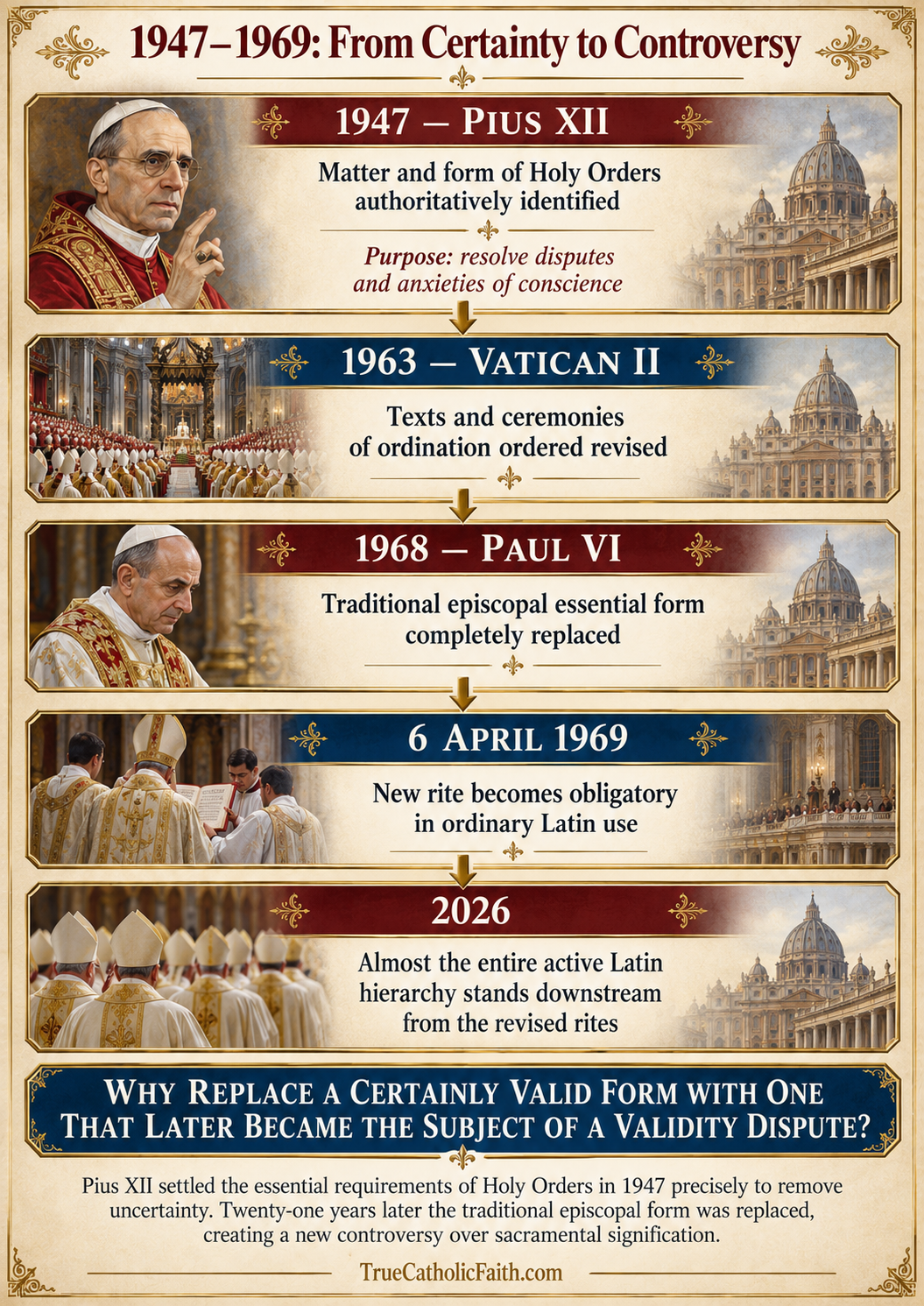
Almost six decades have now passed since the new rites became obligatory in the Latin Church on 6 April 1969. Most active priests and bishops in the ordinary Latin hierarchy therefore stand chronologically downstream from the 1968 reform.
If the reform is sacramentally defective, time magnifies rather than resolves the problem.
What the Catholic Church Teaches About Valid Holy Orders
Before examining the new rites, the Catholic standard must first be established independently of them.
Holy Orders is not merely an ecclesiastical appointment. Trent teaches that through the sacrament an indelible character is impressed and that bishops possess real sacramental powers which men of inferior rank do not possess.
Catholic sacramental theology traditionally examines four requirements relevant here:
matter, form, minister and intention.
These must not be confused.
Matter
Pius XII declared in Sacramentum Ordinis that the matter of diaconate, priesthood and episcopacy is the appropriate imposition of hands. He did this precisely to resolve longstanding questions concerning which ceremonies belonged to the substance of the sacrament.
This immediately corrects one weak argument sometimes made against the postconciliar rites.
The traditional presentation of the chalice and paten was extraordinarily expressive of Catholic sacrificial priesthood, but Pius XII expressly determined that the traditio instrumentorum was not intrinsically required for validity. The Church had always recognised Greek ordinations lacking that ceremony.
The 1968 rites retained the laying on of hands. The strongest objection to them is therefore not defective matter.
Form
The form consists in the essential words which determine what the laying on of hands signifies.
This is decisive because the gesture itself does not uniquely specify a sacrament. Leo XIII made precisely this point in Apostolicae Curae: the imposition of hands does not by itself signify one determinate sacred Order and is used in different sacramental contexts. The form must therefore determine its sacramental meaning.
Pius XII made the rule even more explicit in 1947. The words must determine the matter in such a way that they univocally signify:
the power of the Order and
the grace of the Holy Ghost.
These are two distinct requirements.
Invoking the Holy Ghost is not enough. The form must also tell us which sacramental Order is being conferred.
Minister
Priestly Order must be conferred by someone possessing the episcopal power required to ordain.
St Thomas teaches that episcopal consecration gives a power by which the bishop performs sacred actions unavailable to a simple priest, and specifically treats the bishop as the minister who confers Holy Orders.
This means that correct words spoken by the wrong minister cannot produce a priest.
If a man attempting to ordain is sacramentally a layman, the ceremony is ineffective even if every word of the old Roman Pontifical is pronounced perfectly.
Intention
The minister must intend to do what the Church does.
This does not require personal holiness or even orthodox private belief. Traditional Catholic theology has always distinguished the minister's personal spiritual condition from the objective sacramental power conferred by Holy Orders.
Consequently, there is no need to construct speculative theories about the private intentions of twentieth-century reformers.
The objective sacramental sign is sufficient to raise the central question.
What the Traditional Roman Rite Actually Required
The Rite Was Ancient, but Historically Developed
The traditional Roman Pontifical was not dictated word for word by Christ and handed unchanged to the Apostles. Its ceremonies developed organically through the ancient sacramentaries and Roman liturgical books. By the later Middle Ages, the material was gathered into increasingly standardised pontificals. Clement VIII issued an authoritative Roman edition in 1596, followed by subsequent authorised revisions under later popes.
This historical fact matters because it prevents an inaccurate argument. The Catholic position is not:
“No pope could ever alter a single word of the Roman ordination ceremonies.”
Popes did alter them. The actual Catholic restriction is the one stated by Pius XII:
The Church has no power over the substance of the sacraments instituted by Christ.
Thus, ecclesiastical ceremonies may change.
The sacramental sign cannot cease to signify what Christ instituted.
That distinction is essential.
Pius XII Settled the Essential Matter and Form in 1947
Before 1947 theologians had debated which elements within the elaborate ordination rites were strictly required for validity. Pius XII explains that these disputes had produced doubts and anxieties in particular cases, and that the Holy See had repeatedly been asked to settle the matter definitively.
His purpose was therefore remarkably practical:
remove uncertainty concerning valid Holy Orders.
For priestly ordination he identified the laying on of hands as the matter and the portion of the consecratory prayer asking God to grant the candidate the dignity of the priesthood, renew in him the Spirit of holiness and confer the office of the second rank as the essential form.
For episcopal consecration he identified the laying on of hands as the matter and the words containing the petition:
ministerii tui summam
—the fullness or completion of the sacred ministry—together with the petition for heavenly sanctifying anointing.
The significance is obvious. The traditional episcopal form expressed both required sacramental effects:
POWER OF ORDER → the fullness of the sacred ministry;
GRACE OF THE HOLY GHOST → heavenly sanctification and anointing.
The formula did not merely indicate that the candidate would rule a church. It signified the sacred fullness being conferred upon him.
No Catholic disputed its validity.
What Changed in 1968?
Vatican II ordered that both the ceremonies and texts of ordination be revised. Paul VI implemented this directive in Pontificalis Romani on 18 June 1968, promulgating new rites for deacons, priests and bishops.
The Sacred Congregation of Rites subsequently decreed that either the traditional or revised rites could be used temporarily, but that after 6 April 1969 only the new rites were to be used within the ordinary Latin structure.
Paul VI explained that material had been added, removed or changed in order to restore texts according to ancient documents, make expressions clearer and express sacramental effects more effectively.
This was therefore neither an accidental development nor an unauthorised local experiment. It was a deliberate reconstruction of the Roman rites of Holy Orders.
More significantly, Paul VI expressly cited Pius XII's Sacramentum Ordinis and repeated its governing principle: the form must signify the power of Order and the grace of the Holy Ghost.
The revised rite can therefore be judged by the very criterion its promulgator acknowledged.
What Changed in Priestly Ordination?
The essential matter—the laying on of hands—remained.
The essential priestly form was revised, but it retained important traditional signification. Paul VI's new form still asks Almighty God to give the candidates:
the dignity of the priesthood,
the Spirit of holiness, and
the ministry of the second rank.
This fact must be acknowledged.
It would weaken the traditional argument to claim that the revised form contains no explicit reference to priesthood. It does.
The broader ceremony, however, was extensively rewritten. The inherited Roman rite had surrounded the ordination with particularly explicit sacrificial symbolism, including the presentation of the chalice and paten and a direct declaration concerning the priest's power to offer sacrifice. The revised rite recast much of that ceremonial language.
This is theologically significant, but the distinction established by Pius XII prevents us from making the presentation of the instruments carry more sacramental weight than Catholic doctrine permits.
The strongest conclusion regarding the presbyteral rite considered in isolation is therefore more cautious than the conclusion regarding episcopal consecration.
There are substantial reasons for concern and positive sacramental doubt.
But the intrinsic argument from the essential form alone is less decisive because the revised form still names priesthood itself.
The episcopal reform is fundamentally different.
The New Episcopal Form: The Central Problem
Paul VI completely replaced the essential episcopal form identified by Pius XII.
The new words ask God to pour upon the elect the power which comes from Him, the:
Spiritum principalem
the “governing Spirit,” given to Christ and transmitted by Him to the Apostles who established the Church throughout the world. The difficulty can be stated in one sentence:
The new form certainly invokes supernatural power and the Spirit; where does it univocally signify the sacramental power of episcopal Order?
This question becomes even more striking when Paul VI's own document is examined as a whole. Immediately before defining the new form, Pontificalis Romani describes episcopal consecration using traditional and extremely explicit expressions. It says episcopal consecration confers the fullness of the Sacrament of Order and recalls the traditional descriptions high priesthood and the fullness of the sacred ministry.
Paul VI therefore knew precisely how to express the sacramental reality:
FULLNESS OF THE SACRAMENT OF ORDER
HIGH PRIESTHOOD
FULLNESS OF THE SACRED MINISTRY
Yet none of those expressions appears in the new essential form itself. Instead the form employs:
“governing Spirit.”
That omission cannot simply be dismissed as stylistic when Pius XII had required the essential form itself to signify the power of the Order univocally.
Order Is Not the Same Thing as Governance
This is one of the most important traditional theological distinctions in the entire controversy.
St Thomas Aquinas distinguishes the power of Order from the power of jurisdiction. A priest may possess sacramental power but lack jurisdiction to exercise certain acts lawfully over particular subjects. Conversely, jurisdiction concerns governance and ecclesiastical authority rather than the sacramental character itself.
The distinction immediately exposes the problem with relying upon “governing” language to signify episcopal consecration.
A man may govern without thereby receiving episcopal Order.
An abbot governs a monastery.
A religious superior governs his community.
A priest may be given jurisdiction.
A bishop may be elevated to a higher ecclesiastical office without being consecrated bishop a second time.
Consequently:
Governance is appropriate to a bishop, but governance is not what makes a bishop a bishop sacramentally.
The sacramental question therefore cannot be answered merely by saying that Spiritus principalis denotes the Spirit fitting for someone who governs.
Pius XII required signification of the power of Order, not merely the aptitude to rule.
The Eastern-Rite Defence
The principal defence of the 1968 formula appeals to Eastern Christianity.
Paul VI stated that the new episcopal prayer derived from the Apostolic Tradition attributed to Hippolytus and that substantial portions of it survive in Coptic and West Syrian ordination rites.
At first sight this is powerful.
Pius XII himself used Eastern practice when determining that the Latin presentation of the instruments was not intrinsically necessary for Holy Orders. If the same essential formula used by Paul VI were unquestionably established as the sacramental form of a certainly valid Eastern episcopal rite, that would constitute strong evidence in its favour.
But that is not quite the evidence available.
The relevant Eastern episcopal prayers are considerably longer than Paul VI's short essential formula and contain additional episcopal context and functions. The argument therefore cannot simply be:
“Similar words appear in an Eastern consecration, therefore Paul VI's isolated essential form is certainly valid.”
Similarity is not identity. More importantly, equivalent “governing Spirit” terminology occurs in Coptic liturgical ceremonies in which episcopal Order is not being conferred—for example, in the blessing or installation of an abbot and in connection with elevation to metropolitan rank. Comparative liturgical studies have documented these uses.
This fact has enormous relevance when measured against Pius XII's requirement. If the expression can appropriately be used when an abbot receives no episcopal consecration, then the expression itself cannot uniquely mean:
“Receive the fullness of episcopal Order.”
If the terminology can also appear when a man who is already a bishop receives a higher ecclesiastical rank, it likewise cannot by itself identify the conferral of episcopal sacramental power.
This does not prove that the phrase is meaningless.
It proves the opposite.
It has several possible ecclesiastical meanings.
That is precisely the difficulty when the required criterion is univocal signification.
“But the Spirit Is the Spirit Given to the Apostles”
The strongest answer is that the new form does not merely mention a governing Spirit. It associates that Spirit with Christ and the Apostles who founded the Church. Since bishops succeed the Apostles, surely the apostolic reference sufficiently determines the episcopal meaning. This objection deserves to be taken seriously.
Yet the Apostles received numerous powers and gifts.
They preached.
They governed.
They exercised jurisdiction.
They founded churches.
They taught authoritatively.
They received extraordinary charisms.
They administered sacraments.
They possessed sacred Orders.
Consequently, identifying a Spirit as apostolic establishes an apostolic context, but it does not necessarily identify the particular sacramental power being conferred.
The same distinction returns:
apostolic mission and governance are not identical with
the sacramental fullness of episcopal Order.
Pius XII did not require the form merely to suggest that the recipient would continue the Apostles' work. He required that it signify the power of the Order.
The traditional form did this directly through the petition for the fullness of the sacred ministry.
The revised formula does not employ an equivalent explicit expression.
Can the Rest of the Prayer Save the Form?
Another serious defence appeals to the entire consecratory prayer.
Later portions speak more explicitly of episcopal functions, shepherding and high-priestly ministry. Surely, it is argued, one cannot take the short essential passage in isolation from the ceremony in which it occurs.
Context unquestionably matters when words are interpreted. But this defence creates its own difficulty.
Paul VI formally identified a specific group of words as essential and required for validity. Those words must therefore bear the sacramental determination necessary to make the laying on of hands signify episcopal consecration.
If one must move outside those essential words in order to discover what Order they confer, then the essential form itself begins to look less than univocal.
This is where Leo XIII's treatment of Anglican Orders becomes especially instructive.
The Anglican ordinal contained other prayers and an obviously clerical ceremony. Leo XIII nevertheless examined whether the sacramental form itself adequately signified the sacred priesthood being conferred. He rejected the argument that surrounding material could simply compensate for what the form failed properly to signify.
The cases are not identical, and they should not be presented as though they were. But the Catholic principle is the same:
The form has to do real sacramental work.
The external knowledge that “this is a bishop's ceremony” cannot automatically substitute for sacramental signification.
Leo XIII and the Anglican Parallel
The importance of Apostolicae Curae lies not in creating a simplistic equation:
Anglican rite = Paul VI rite.
That would overstate the argument. The value lies in Leo XIII's method.
He teaches that the imposition of hands is intrinsically indeterminate. He then asks whether the accompanying words signify the specific sacred Order and its grace. In the Anglican priestly form, the words “Receive the Holy Ghost” were insufficient because they did not definitely signify priesthood and its sacrificial power.
This establishes an important Catholic principle:
An invocation of the Holy Ghost is not automatically a valid sacramental form for Holy Orders.
One must still know:
Which Order is being conferred?
That question bears directly upon Spiritus principalis.
The phrase may invoke the Holy Ghost.
It may signify leadership.
It may invoke an apostolic gift.
But the validity issue remains whether it univocally signifies episcopal Order.
The Historical Irony: Pius XII Had Just Removed the Doubt
There is another aspect of the history that deserves more attention.
Pius XII explains why he intervened in 1947. Centuries of liturgical development had created theological disputes about which portions of the Roman ordination rites were essential. These questions caused uncertainty in particular cases and anxieties of conscience. The Holy See was repeatedly asked for a definitive determination.
Pius XII answered.
Matter was identified.
Form was identified.
The sacramental effects that must be signified were identified.
The controversy was settled.
Then, only twenty-one years later, the episcopal form he had identified was completely abandoned.
The result was not greater sacramental certainty.
It was a new controversy over whether the replacement form adequately signifies the episcopacy at all.
That historical sequence raises a serious prudential question even before one reaches a judgment of invalidity:
Why exchange an unquestionably valid form, explicitly identified by the Holy See to prevent sacramental doubt, for a reconstructed form whose precise sacramental signification became controversial?
Holy Orders is not an area in which uncertainty is a harmless side effect.
Why Was the Rite Changed?
The reason should not be invented or attributed to secret intentions. The official explanation is sufficient.
Vatican II ordered revision of the ordination rites. Paul VI explained that the texts and ceremonies had been altered in order to restore material from ancient sources, achieve greater clarity and express sacramental effects better.
The revised episcopal prayer was closely associated with the ancient text traditionally attributed to Hippolytus. But even here a distinction is necessary.
Ancient does not automatically mean safer.
The traditional Roman rite possessed something more important than a modern claim to archaeological antiquity:
certain validity through continuous ecclesiastical use.
Modern scholarship has also become considerably less confident that the Apostolic Tradition can simply be identified as the work of Hippolytus of Rome from the early third century. Its authorship, compilation and provenance are now treated as more complex than the straightforward attribution commonly made during the twentieth-century Liturgical Movement.
That scholarly development does not prove the 1968 rite invalid. It does, however, weaken the idea that the Church simply recovered an unquestionably authentic Roman apostolic text. The prudential contrast remains striking:
CERTAINLY VALID, LIVING ROMAN FORM was replaced by
A RECONSTRUCTED ANCIENT FORM WHOSE PRECISE HISTORY IS DISPUTED
and the result generated a controversy over sacramental validity.
Why take that risk?
Why the Priestly Rite Must Be Considered Separately
A strong case should not pretend that the presbyteral and episcopal problems are identical. They are not.
Paul VI's new priestly form retains explicit references to:
priestly dignity,
the Spirit of holiness, and
the second rank of ministry.
Consequently, Pius XII's requirement that the Order being conferred be signified is much easier to identify in the revised presbyteral form than in the revised episcopal form.
This does not mean that the priestly reform is theologically unimportant. The surrounding rite underwent extensive reconstruction, and traditional Catholic concerns about the cumulative weakening of sacrificial terminology deserve examination.
But validity and theological quality are different questions.
The stronger sacramental argument is this:
Even if one were prepared to defend the revised priestly form considered by itself, no priestly formula can compensate for an invalid episcopal minister.
Suppose a certainly valid bishop uses the revised priestly rite. The question concerns the revised presbyteral form.
Suppose instead that a man consecrated only through the disputed 1968 episcopal rite attempts to ordain a priest.
Now the problem exists before the priestly prayer even begins.
If he is not a bishop, he cannot ordain.
Even if he uses the traditional Roman priestly form word for word, nothing can supply the episcopal power he lacks.
This makes the episcopal controversy the critical upstream issue.
Sacramental Certainty: Why “Probably Valid” Is Not Enough
Catholic moral theology does not treat sacramental validity as an ordinary academic probability contest.
A sacrament either occurs or it does not.
The approved pre-Vatican II moral tradition consequently requires the safer course where there is a serious positive doubt concerning sacramental validity and certain means are available. McHugh and Callan state the principle explicitly: when validity or invalidity of a sacrament is in question, religion requires that the sacrament not be exposed unnecessarily to the danger of nullity.
This distinction is essential.
A doubtful sacrament is not automatically an invalid sacrament.
But neither may a positively doubtful sacrament simply be treated as though its validity were certain.
Suppose a man has only a trivial, groundless scruple about an ordination. Catholic theology does not require endless reordination.
But suppose the doubt is objective and positive—arising from the actual sacramental form, from authoritative Catholic principles governing that form, and from a genuine question as to whether the power of Order is sufficiently signified.
That is different.
Where Holy Orders is at stake, the safer course protects not merely one sacramental act but every later act dependent upon that ordination.
This is why traditional Catholic practice has resorted to conditional ordination or consecration when a real positive doubt exists.
The purpose is not humiliation. It is certainty.
The Consequences of an Invalid Episcopate
The implications should be stated without melodrama, but also without euphemism.
If an episcopal consecration is actually invalid, the recipient does not receive episcopal sacramental power.
He may wear a mitre.
He may possess canonical documents.
He may occupy a cathedral.
He may sincerely believe he is a bishop.
None of those things creates the sacramental power of Order.
If such a man then attempts to ordain another man to the priesthood, the defect propagates.
The candidate does not become a priest merely because an ordination ceremony has taken place. And if that man later attempts to celebrate Mass, the consequences are exactly those demanded by Catholic Eucharistic doctrine.
He lacks priestly power.
He cannot consecrate.
The bread remains bread.
The wine remains wine.
No transubstantiation is effected by him.
No Eucharistic Sacrifice is effected by him.
Likewise, a layman cannot exercise the priestly power of sacramental absolution simply because he pronounces the formula of absolution.
Jurisdiction cannot manufacture Holy Orders. The distinction established by St Thomas is relevant again: jurisdiction governs the use of sacramental power; it is not a substitute for the sacramental power itself.
Where the ordination is doubtful rather than certainly invalid, a more precise formulation is required. One cannot declare as an established fact that every attempted consecration certainly remained bread and wine.
But neither can the faithful possess the moral certainty ordinarily required for the Eucharist and absolution.
That itself is extraordinarily serious.
The Problem Multiplies With Every Generation
An isolated doubtful ordination affects one man's ministry.
A doubtful episcopal consecration potentially affects generations.
Consider the sequence:
DOUBTFUL EPISCOPAL CONSECRATION
↓
DOUBTFUL BISHOP
↓
EVERY PRIEST HE ORDAINS BECOMES DOUBTFUL
↓
EVERY BISHOP HE CONSECRATES EXTENDS THE SAME PROBLEM
↓
EVERY LATER EUCHARISTIC CONSECRATION AND ABSOLUTION DEPENDENT UPON THOSE ORDERS IS AFFECTED
This is why the passage of nearly sixty years matters. When the new rite was first introduced, large numbers of bishops had themselves received the traditional consecration before 1968.
As those bishops died, retired or ceased ordaining, an ever greater proportion of the ordinary Latin hierarchy depended entirely upon the post-1968 episcopal rite.
The controversy therefore becomes more consequential with each generation.
What This Means for Present Novus Ordo Clergy
It would be inaccurate simply to say:
“Everyone under eighty is invalidly ordained.”
Age is not a sacramental criterion. A priest ordained in 1990 with an unquestionably valid traditional rite by an unquestionably valid bishop would not become doubtful because of his age.
Eastern Catholic clergy must likewise be examined according to their own approved rites rather than automatically subjected to the Latin 1968 argument.
Nevertheless, there is an important demographic reality.
The revised rites became obligatory in the Latin structure after 6 April 1969. A man ordained a diocesan priest before then would ordinarily have already been in his twenties. In 2026 he would generally therefore be in his early eighties or older.
Consequently, almost the entire active ordinary Latin clergy today belongs chronologically to the post-1968 sacramental generation. But the correct investigation is not:
How old is he? It is:
By which rite was he ordained?
Who ordained him?
By which rite was that bishop consecrated?
Where does that episcopal lineage ultimately derive its sacramental certainty?
This same principle applies even to priests who celebrate the traditional Latin Mass.
A traditional liturgy does not retroactively create Holy Orders. If the priest was ordained by a man who was never validly consecrated bishop, celebrating the old Mass cannot repair the defect.
Francis and Leo XIV
The consequences reach particularly important postconciliar claimants to the papacy.
Jorge Mario Bergoglio, later Francis, was ordained a priest on 13 December 1969, after the revised rites had become obligatory in the Latin Church, and received episcopal ordination on 27 June 1992.
Robert Francis Prevost, Leo XIV, was ordained a priest on 19 June 1982 and received episcopal ordination on 12 December 2014.
Both therefore stand wholly within the post-1968 sacramental period in respect of their priestly and episcopal Orders. Under the analysis developed in this article, one cannot simply assume that either possessed certainly valid Holy Orders merely because the postconciliar hierarchy recognised those ceremonies.
If the revised priestly form is invalid, their priestly ordinations fail directly.
If the revised episcopal rite is invalid, their episcopal consecrations fail irrespective of the priestly question.
From the stronger traditional sedevacantist conclusion regarding the 1968 rites, they therefore cannot simply be treated as certainly ordained Catholic priests and bishops.
A qualification is necessary, however.
Absence of episcopal consecration by itself does not constitute the complete theological case for sedevacantism.
Historically, a man could in principle be elected to the Roman See before receiving episcopal consecration and would then have to receive the necessary Orders. The wider sedevacantist case concerns Catholic membership, public heresy, eligibility for ecclesiastical office, jurisdiction, indefectibility and the Church's universal profession of faith.
The Holy Orders question is therefore not the whole case. It is an additional and exceptionally grave problem.
The Strongest Objection: “The Church Approved the Rite”
At this point the strongest objection arises. If Paul VI was a true Roman Pontiff exercising the authority of the Catholic Church, how could a rite promulgated by him for the universal Latin Church be invalid?
Catholic indefectibility is not optional.
Christ's Church cannot cease to be His Church.
She cannot lose the sacramental means necessary for her divine mission.
Surely, therefore, the very fact that the new rite was promulgated by what appeared to be the supreme authority of the Church provides overwhelming evidence of validity.
This objection has real force. Indeed, it is much stronger than merely asserting that “the words seem Catholic enough.” But notice what happens if it is used as the primary proof.
The argument becomes:
Paul VI certainly possessed Catholic authority.
Therefore: the rite must certainly be valid.
Therefore: any evidence that the form is defective must somehow be mistaken.
But whether the postconciliar hierarchy possesses the authority claimed is itself one of the central questions arising from the wider Vatican II crisis.
To presume that authority in order to settle the sacramental evidence risks circular reasoning. The correct Catholic method must first ask what the Church herself taught concerning sacramental validity.
Pius XII supplies the criterion.
Leo XIII shows how it is applied.
Trent supplies the doctrine of Holy Orders.
St Thomas distinguishes Order from jurisdiction.
Only after the sacramental analysis has been made should the consequences for ecclesiastical authority be considered.
Response: Indefectibility Makes the Problem More Serious, Not Less
If the 1968 episcopal rite were shown to be substantially defective, Catholic indefectibility would not possess the magical power to make inadequate matter or form valid. No ecclesiastical authority can change what belongs to the divinely instituted substance of a sacrament.
Pius XII explicitly says so. The consequence would therefore not be:
“The Catholic Church destroyed the episcopacy.”
That conclusion would itself contradict indefectibility. Instead the traditional sedevacantist reasoning is:
THE CATHOLIC CHURCH IS INDEFECTIBLE
↓
SHE CANNOT UNIVERSALLY DESTROY THE SACRAMENTAL HIERARCHY INSTITUTED BY CHRIST
↓
IF A BODY CLAIMING HER AUTHORITY UNIVERSALLY IMPOSED A SUBSTANTIALLY INVALID RITE
↓
THE AUTHORITY OF THAT BODY MUST ITSELF BE EXAMINED
This is precisely why the validity question cannot be isolated from the wider postconciliar crisis. The issue ultimately reaches ecclesiology.
If the rite is valid, one major sedevacantist argument fails.
If the rite is substantially invalid, the problem rebounds upon those who imposed it.
Indefectibility therefore does not make the sacramental question irrelevant.
It makes the answer more consequential.
Why the Case for the 1968 Episcopal Rite Is Strongly Troubling
The cumulative argument can now be stated without relying upon any modern polemical personality.
Pius XII taught that the form must univocally signify the power of Order and the grace of the Holy Ghost. His traditional episcopal form expressly signified the fullness of the sacred ministry.
Paul VI replaced it completely. Paul VI's own doctrinal introduction describes episcopal consecration as the fullness of the Sacrament of Order, the high priesthood, and the fullness of the sacred ministry.
Yet the essential formula selected immediately afterward contains none of these explicit expressions. Its central term is instead “governing Spirit.”
Catholic theology distinguishes governance from sacramental Order. Equivalent governing-Spirit terminology appears in Eastern ceremonies where episcopal Order is not being conferred.
The Eastern episcopal rites invoked as parallels employ larger consecratory prayers and cannot simply be reduced to identity with Paul VI's short essential form.
The reference to the Apostles establishes an apostolic context but does not necessarily distinguish episcopal sacramental power from apostolic governance, teaching or mission.
The attempt to rescue the essential words through surrounding passages raises the further problem that Paul VI himself identified those particular words as the portion required for validity.
The traditional form was certainly valid.
The replacement generated precisely the kind of question Pius XII had sought to eliminate.
The result is more than a negative scruple.
It is an objective positive doubt grounded in Catholic sacramental principles.
And once positive doubt exists in a matter so grave, traditional Catholic moral theology does not permit one simply to behave as though certainty existed.
What We Can and Cannot Conclude
What We Can Conclude
We can conclude with certainty that Christ instituted Holy Orders and that the Church possesses no power to alter the divinely instituted substance of the sacrament.
We can conclude that the laying on of hands is the essential matter identified by Pius XII for the relevant degrees of Holy Orders and that the 1968 reform retained this matter.
We can conclude that the form must signify both the grace of the Holy Ghost and the specific power of Order conferred.
We can conclude that the old Roman episcopal form identified by Pius XII explicitly signified the fullness of the sacred ministry.
We can conclude that Paul VI completely replaced that essential episcopal form in 1968.
We can conclude that the new form invokes Spiritus principalis and identifies that Spirit with the gift transmitted to the Apostles, but does not explicitly name episcopacy, high priesthood, fullness of priesthood or fullness of the sacred ministry.
We can conclude that Catholic theology distinguishes sacramental Order from jurisdiction and governance.
We can conclude that governing-Spirit terminology is not exclusive to episcopal consecration in Eastern liturgical usage.
We can therefore conclude that there exists a serious positive theological doubt about whether the new episcopal form satisfies Pius XII's requirement of univocal signification.
And when the evidence is assessed cumulatively, there are substantial grounds for the stronger traditional judgment that invalidity is more probable than validity.
What We Cannot Conclude
We cannot conclude that every change to an ordination ceremony makes the sacrament invalid.
We cannot claim that Clement VIII or any other pope rendered every word of the Roman Pontifical absolutely immutable.
We cannot claim that removal of the presentation of chalice and paten by itself invalidates priestly ordination; Pius XII explicitly prevents that conclusion.
We cannot honestly say that Paul VI's priestly form contains no reference to priesthood. It does.
We cannot say that every Catholic priest younger than eighty is automatically invalid. Actual rite and episcopal lineage must be examined.
We cannot indiscriminately apply the Latin 1968 controversy to Eastern Catholic Orders.
We cannot prove the private intentions of the reformers merely from the objective form they produced.
Nor should positive doubt be rhetorically transformed into absolute metaphysical certainty. The proper conclusion is stronger precisely because it is more exact:
The 1968 episcopal rite cannot safely be treated as certainly valid under the sacramental principles articulated by the pre-Vatican II Church; the evidence establishes a positive and prudent doubt, and the cumulative defect-of-form argument gives substantial grounds for judging the rite probably invalid.
Conclusion
The controversy over the 1968 rites of Holy Orders is not fundamentally a dispute between people who like old ceremonies and people who prefer new ones.
It concerns a sacrament instituted by Christ.
The Catholic Church possesses authority over liturgical ceremonies. She does not possess authority to change the substance of the sacraments.
Pius XII stated that principle plainly and, in 1947, identified the essential matter and form of Holy Orders precisely to bring long-running controversies and anxieties of conscience to an end. His standard could hardly be clearer. The form must univocally signify the power of the Order and the grace of the Holy Ghost. The traditional episcopal form satisfied that standard openly. It asked God to complete in His priest the fullness of the sacred ministry and to sanctify him by heavenly anointing.
Twenty-one years later that unquestionably valid form was abolished.
Paul VI's own constitution still described episcopal consecration in traditional terms as the fullness of the Sacrament of Order, the high priesthood, and the fullness of the sacred ministry. Yet when it came to identifying the words required for validity, those explicit concepts disappeared. In their place stood the request for Spiritus principalis—the governing Spirit.
That matters because government is not the same thing as sacramental Order.
St Thomas distinguishes them.
The traditional Catholic theological system distinguishes them.
And Eastern liturgical evidence demonstrates that governing-Spirit terminology can be used when no episcopal consecration is taking place.
The appeal to the Apostles strengthens the ecclesiastical context but does not eliminate the distinction, because the Apostles possessed powers of teaching, government, mission and jurisdiction as well as sacred Orders.
The appeal to the surrounding prayer likewise does not fully resolve the problem, because Paul VI himself designated a particular passage as the words essential for validity. If those words require other, nonessential passages to tell us which Order they confer, the claim that they univocally signify episcopal Order becomes correspondingly more difficult.
None of this means that the invalidity of the new rite can be demonstrated as effortlessly as the invalidity of a baptism performed without water or without the Trinitarian form.
But Catholic moral theology does not require absolute mathematical demonstration of nullity before a positive sacramental doubt becomes practically decisive.
The faithful require certain sacraments.
A “probably valid” bishop is not an adequate foundation for the transmission of apostolic succession.
A “probably valid” priesthood is not an adequate foundation for the Holy Eucharist.
A “probably valid” absolution is not something upon which a Catholic should be expected to risk the state of his soul when certainly valid sacraments are available.
And because episcopal Order is transmitted from bishop to bishop, the problem compounds with time.
If the 1968 episcopal consecration is actually invalid, a man who receives only that ceremony remains without episcopal sacramental power.
He cannot confer priestly Orders.
The men he purports to ordain remain laymen sacramentally.
Their sincerity, learning, vestments, ecclesiastical appointments and canonical recognition cannot create a priestly character which the sacrament failed to confer.
At a purported Mass celebrated by such a man, bread remains bread and wine remains wine. No priestly Eucharistic consecration occurs. No Sacrifice of the Mass is effected by him. In the confessional, he cannot supply a priestly power of absolution which he never received.
Where the Orders are merely doubtful rather than certainly null, the conclusion must be phrased more carefully: the Real Presence and absolution cannot be treated as sacramentally certain.
That is already grave enough.
Almost the entire active ordinary Novus Ordo clergy now stands downstream from the post-1968 rites.
Francis was ordained a priest in December 1969 and consecrated bishop in 1992;
Leo XIV was ordained in 1982 and consecrated bishop in 2014.
Under the traditional conclusion that the revised episcopal rite is invalid, their episcopal status cannot simply be assumed; under the stronger criticism of both revised rites, their priestly Orders likewise become part of the question.
The ultimate implication reaches beyond liturgy into ecclesiology. If Christ's Church is indefectible, she cannot universally extinguish the sacramental hierarchy He instituted.
If a body occupying the historic Catholic structures promulgated a rite which does precisely that, the proper Catholic conclusion cannot be that Christ's Church herself defected.
The question must instead return to authority.
Who promulgated the new system?
Could that authority truly be the authority of the indefectible Catholic Church?
Those questions belong to the larger sedevacantist argument.
But the sacramental problem comes first. And judged according to the very standards laid down by Trent, Leo XIII, Pius XII, St Thomas and traditional Catholic moral theology, the faithful have strong reason not to entrust the Eucharist, absolution and apostolic succession to the assumption that the radically reconstructed 1968 episcopal rite is “probably good enough.”
The traditional rite offered certainty.
The reform replaced that certainty with controversy.
Where the sacraments instituted by Christ are concerned, that is a risk Catholics have no obligation to take.
Primary Sources
Council of Trent, Session XXIII — Doctrine and Canons on the Sacrament of Order (1563) — establishes the New Testament priesthood, priestly sacrificial power, the sacramental character of Orders and the hierarchical superiority and ordaining power of bishops.
Pope Leo XIII, Apostolicae Curae (1896) — establishes the importance of adequate sacramental form in Holy Orders and explains why the imposition of hands must be determined by words signifying the particular sacred Order and its grace. Read Apostolicae Curae
Pope Pius XII, Sacramentum Ordinis (1947) — the principal pre-Vatican II authority governing this question: identifies the matter and form of Holy Orders and requires that the form univocally signify the power of Order and grace of the Holy Ghost. Read Sacramentum Ordinis
St Thomas Aquinas, Summa Theologiae, Supplement, qq. 19–20, 38–40 — useful for the distinction between Order and jurisdiction, the bishop's ordaining power and the transmission of sacred Orders.
Paul VI, Pontificalis Romani (1968) — the primary postconciliar text against which the pre-Vatican II principles must be tested; defines the revised essential forms for diaconate, priesthood and episcopacy. Read Pontificalis Romani
Sacred Congregation of Rites, Decree promulgating the revised Orders (15 August 1968) — establishes the transition and the mandatory use of the revised rite after 6 April 1969.
Further Reading
Roman Catechism, Part II — Holy Orders — traditional catechetical treatment of the priesthood, sacrificial power and hierarchy.
St Thomas Aquinas, Summa Theologiae, Supplement, qq. 34–40 — sacramental Order, its ministers and episcopal power.
Henry Davis, S.J., Moral and Pastoral Theology — approved pre-Vatican II treatment of sacramental administration and moral certainty.
Dominic Prümmer, O.P., Manuale Theologiae Moralis — traditional moral principles concerning the sacraments and the obligation to follow the safer course where validity is positively doubtful.
Benedict Merkelbach, O.P., Summa Theologiae Moralis — detailed approved treatment of sacramental morality and doubtful validity.
John A. McHugh, O.P. & Charles J. Callan, O.P., Moral Theology — explicitly explains the safer-course principle where sacramental validity is seriously doubtful.
Related Questions
What Is the Sacrament of Holy Orders?
What Makes a Sacrament Valid?
What Is Apostolic Succession, and Can It Be Broken?
Can a Doubtful Priest Validly Consecrate the Eucharist or Absolve Sins?
Can the Catholic Church Promulgate an Invalid Sacramental Rite?
How Can Catholics Determine Whether a Traditional Priest or Bishop Has Certainly Valid Orders?
How Does the Question of Holy Orders Affect the Claims of Francis and Leo XIV?
If the Postconciliar Hierarchy Is Sacramentally Doubtful, What Does That Mean for the Indefectibility of the Church?