How Did the 1983 Code and the New Catechism Embed Vatican II Into Catholic Life?
Short Answer
Vatican II did not remain a collection of sixteen documents sitting on a shelf in Rome. During the decades after the Council, its principles were progressively incorporated into the structures by which ordinary Catholics were governed, taught and formed. Two instruments were especially important:
the 1983 Code of Canon Law, which replaced the 1917 Code governing the Latin Church,
and the Catechism of the Catholic Church, promulgated in 1992.
This relationship was not invented afterwards by traditionalist critics. John Paul II explicitly described the new Code as an effort to translate Vatican II's ecclesiology into canonical language and said that it should correspond to the Church's nature “especially as it is proposed by the magisterium of the Second Vatican Council.”
Nine years later, in Fidei Depositum, he presented the new Catechism as another major instrument of the renewal “desired and begun by the Second Vatican Council,” following the reform of the liturgy and the new codification of canon law.
The significance is considerable. Ideas that had first appeared in conciliar documents concerning the Church, episcopal collegiality, relations with non-Catholic Christians, religious liberty and the religious status of those outside visible Catholic unity were no longer confined to theological debate. They were progressively written into universal law and universal catechesis.
The sequence therefore becomes difficult to dismiss as mere postconciliar abuse:
Vatican II → papal interpretation and implementation → 1983 Code → 1992 Catechism → episcopal, diocesan and parish life.
That does not prove that every postconciliar abuse was mandated by Vatican II, nor does every difference between the two Codes constitute doctrinal contradiction. It does establish something more fundamental: many of the characteristic changes of postconciliar Catholic life were officially institutionalised, not merely improvised by disobedient priests or progressive theologians.
Why This Question Matters
One of the most common explanations of the Catholic crisis since the 1960s is that Vatican II itself was essentially sound but was subsequently distorted. According to this account, the Council's teachings were orthodox, while liberal theologians, rebellious clergy and an amorphous “spirit of Vatican II” produced the rupture that Catholics later experienced in parishes, seminaries, schools and religious life.
That explanation encounters a serious historical difficulty.
The authorities who implemented Vatican II did not describe the subsequent canonical and catechetical reconstruction as a correction of abuses committed against the Council. They repeatedly presented it as the implementation of the Council itself.
The 1983 Code is particularly important because canon law is not theological journalism or an experimental pastoral programme. It establishes the juridical order according to which bishops govern dioceses, priests administer sacraments, marriages are judged, ecclesiastical offices function, Catholics relate juridically to non-Catholics, and the rights and obligations of the faithful are determined.
Likewise, a universal catechism is not a private theological textbook. John Paul II called the Catechism of the Catholic Church a “sure norm for teaching the faith” and an authoritative reference for the preparation of local catechisms.
If recognisably conciliar principles appear in both instruments, therefore, the historical argument changes. The issue is no longer simply whether some parish priest exaggerated Vatican II. The question becomes whether the postconciliar authorities themselves transformed the Council's theological orientations into the ordinary governing and teaching structures of Catholic life.
To answer that, we must first establish what preceded them.
The Pre-Vatican II Canonical Baseline
The 1917 Codex Iuris Canonici, promulgated by Benedict XV, was the first comprehensive codification of Latin canon law. It did not create Catholic ecclesiology from nothing; rather, it juridically expressed a theology of the Church, hierarchy, membership, sacraments and marriage that had developed through centuries of Catholic teaching and canonical tradition.
Its approach to ecclesial identity was concrete. Canon 87 stated that baptism constituted a person in the Church of Christ, while recognising that an obstacle affecting the bond of ecclesiastical communion could impede the exercise of rights.
Pius XII supplied an even clearer doctrinal formulation in Mystici Corporis Christi in 1943. Those actually to be numbered among the members of the Church, he taught, were those who had been baptised, professed the true Faith, and had neither separated themselves from the body nor been excluded by legitimate authority. Those divided in faith or government could not live in the unity of that one body.
This did not mean that every non-Catholic was personally guilty of formal heresy, still less that God could not operate by grace upon those outside visible membership. Traditional theology carefully distinguished objective separation from subjective guilt and recognised baptism of desire, invincible ignorance and extraordinary operations of grace.
But its visible ecclesiology possessed relatively sharp boundaries. A Protestant might be validly baptised, possess supernatural faith in some truths and receive actual grace, but Protestantism as a separated religious body was not thereby treated as a partial institutional manifestation of Christ's Church.
Pius XI's Mortalium Animos therefore presented Christian reunion as the return of those separated from the one true Church, rather than as separated ecclesial bodies jointly progressing toward a fuller communion that already existed imperfectly among them.
This baseline becomes important when the vocabulary of Vatican II and the 1983 Code is considered.
From Vatican II to a New Canonical Architecture
There is unusually direct evidence concerning the relationship between Vatican II and the 1983 Code because John Paul II explained it when promulgating the Code in Sacrae Disciplinae Leges on 25 January 1983.
He recalled that John XXIII had announced the revision of canon law on the same day in 1959 that he announced the Roman Synod and the future Council. The canonical revision was subsequently delayed until the Council could establish the principles according to which the reform should proceed. The official introduction to the Code likewise explains that substantive revision commenced only after the Council because the reform was to be conducted according to conciliar decisions and principles.
John Paul II then made the connection unmistakable. The new Code, he explained, corresponded to the nature of the Church “especially as it is proposed by the magisterium of the Second Vatican Council.” More strikingly, he described it as a major effort to translate conciliar ecclesiology into canonical language, singling out Lumen Gentium and Gaudium et Spes as particularly important.
That statement supplies a key interpretative principle.
When characteristic Vatican II concepts reappear in the 1983 Code, it is historically inadequate to treat the resemblance as accidental. The legislator himself identified conciliar ecclesiology as the Code's governing theological model.
From Membership to “Full Communion”
One of the clearest examples appears at the very beginning of Book II, significantly entitled The People of God.
Canon 204 §1 describes the Christian faithful as those incorporated into Christ through baptism and thereby constituted as the People of God. Canon 204 §2 then states that the Church constituted and organised as a society in this world “subsists in the Catholic Church” governed by the successor of Peter and bishops in communion with him.
The wording unmistakably reflects Lumen Gentium 8.
Canon 205 then explains who are fully in the communion of the Catholic Church: the baptised who are joined to Christ within her visible structure by profession of faith, the sacraments and ecclesiastical governance.
The word fully matters because the conciliar ecclesiology underlying it recognises a real but imperfect communion possessed by other baptised Christians.
Unitatis Redintegratio 3 says that those validly baptised outside Catholic unity are in “some communion,” although imperfect, with the Catholic Church. It goes further: separated Churches and ecclesial communities are said to possess elements of sanctification and truth, and the Council teaches that the Spirit of Christ can use such communities as “means of salvation.”
This is not simply a charitable statement that a Protestant can receive grace despite his separation from the Church. The conciliar text assigns a positive role in the mystery of salvation to the separated communities as such.
That distinction is fundamental.
Traditional Catholic theology readily recognised that Scripture read by a Protestant remains the inspired Word of God, that valid baptism administered outside the Church can produce grace, and that individuals outside visible membership can be acted upon by God. What requires comparison is the further ecclesiological proposition that separated religious communities themselves possess a salvific ecclesial function.
The 1983 Code does not reproduce every theological proposition of Unitatis Redintegratio. It does, however, build the conciliar framework of degrees of communion into its basic description of the Christian faithful.
The later Catechism would make the theological implication explicit.
Episcopal Government: Canonical Mission and Conciliar Collegiality
Another significant comparison concerns the origin and exercise of episcopal authority.
The 1917 Code distinguished the power of order from the power of jurisdiction with unusual precision.
Canon 108 §3 stated that by divine institution the sacred hierarchy consisted, with respect to orders, of bishops, priests and ministers; with respect to jurisdiction, of the supreme pontificate and the subordinate episcopate. Canon 109 then stated that men were constituted in grades of the power of order by sacred ordination, whereas — apart from the supreme pontificate obtained following legitimate election and acceptance — the other grades of jurisdiction were received through canonical mission.
The conceptual architecture is clear. Episcopal consecration and jurisdiction were intimately related, but they were not simply identical. Consecration conferred episcopal order; the actual jurisdiction by which a bishop governed subjects came through canonical mission.
Vatican II reformulated the matter.
Lumen Gentium 21 teaches that episcopal consecration confers, together with the office of sanctifying, the offices or munera of teaching and governing, while specifying that these can be exercised only in hierarchical communion with the head and members of the episcopal college. Lumen Gentium 22 further states that membership in the episcopal body comes through sacramental consecration together with hierarchical communion.
Canon 375 of the 1983 Code reproduces this architecture almost directly. Bishops succeed the Apostles by divine institution and through episcopal consecration receive not only the sanctifying function but also the functions of teaching and governing, although these can be exercised only in hierarchical communion with the head and members of the college.
Care is needed here. It would be too crude to claim that Vatican II simply abolished canonical mission or taught that every consecrated bishop possesses immediately exercisable jurisdiction over subjects merely because he has been consecrated.
The Council's own Nota Explicativa Praevia qualifies its terminology. It explains that the word munera rather than fully exercisable potestates was deliberately used and that a further canonical or juridical determination is required before the power is ready for exercise.
Nevertheless, a genuine theological and juridical recasting has occurred.
The 1917 Code begins with the distinction between order and jurisdiction and expressly says that jurisdiction below the papacy comes by canonical mission. The conciliar and 1983 architecture begins instead with episcopal consecration conferring the three munera of sanctifying, teaching and governing, whose exercise is conditioned by hierarchical communion and juridical determination.
This becomes particularly important when read alongside Vatican II's theology of the episcopal college, episcopal conferences and the later development of synodality. The change is therefore not adequately described as a few altered administrative rules. It reflects a different way of organising the theology of episcopal government — one John Paul II expressly identified as conciliar ecclesiology translated into law.
Canon 731 §2 and Canon 844: From Reconciliation Before the Sacraments to Authorised Sacramental Sharing
The contrast is even more visible in sacramental discipline.
Canon 731 §2 of the 1917 Code established as its general rule that the sacraments were not to be administered to heretics or schismatics, even when they requested them in good faith, unless they first rejected their errors and were reconciled with the Church.
Preconciliar moral and canonical practice contained narrowly defined emergency questions, particularly involving dying non-Catholics, so this should not be caricatured as though Catholic theology had never confronted exceptional cases. But the governing juridical principle was unmistakable: sacramental communion normally presupposed ecclesial communion.
The 1983 Code retains that principle in Canon 844 §1 — Catholic ministers normally administer the sacraments to Catholic faithful, and Catholics normally receive them from Catholic ministers — but then establishes substantial exceptions in the law itself.
A Catholic who cannot approach a Catholic minister may, when necessity or genuine spiritual advantage warrants it and the danger of indifferentism is avoided, receive Penance, Eucharist and Anointing from certain non-Catholic ministers whose sacraments are considered valid. Catholic ministers may likewise administer these sacraments to members of Eastern Churches not in full communion who spontaneously request them and are properly disposed. In danger of death or another grave necessity, the law extends the possibility to other non-Catholic Christians who manifest Catholic faith concerning the sacrament and satisfy the stated conditions.
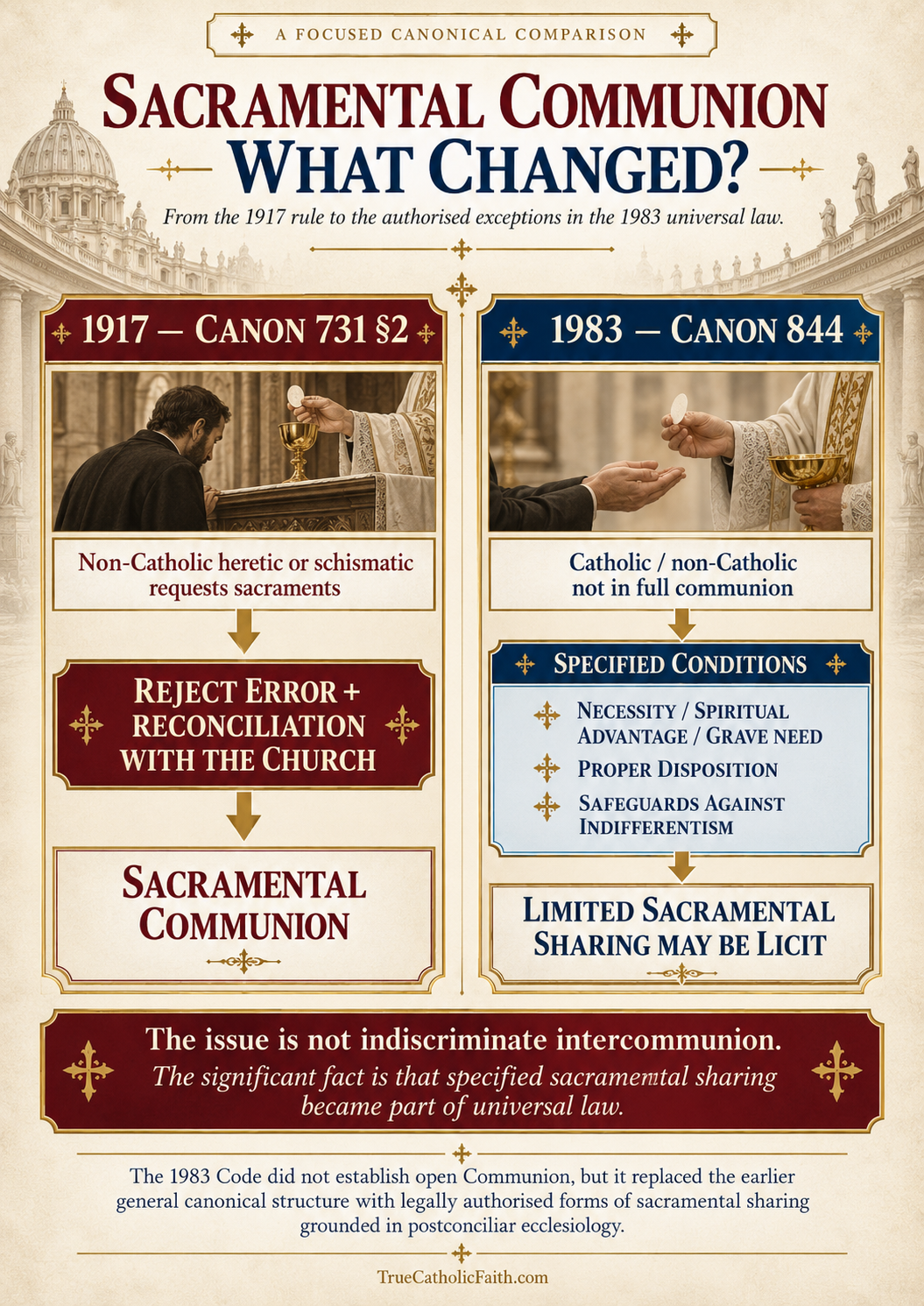
This is authorised sacramental sharing.
It is not therefore sufficient to answer every instance of postconciliar intercommunion by saying that Catholics were disobeying Church law. Some forms certainly are abuses. Canon 844 does not authorise indiscriminate open Communion.
But other forms are expressly contemplated by the universal law.
The theological background is again Vatican II. Unitatis Redintegratio had described validly baptised non-Catholics as existing in imperfect communion with the Catholic Church and had recognised sacramental and liturgical realities existing outside her visible boundaries.
The sequence is therefore documentary:
Vatican II develops an ecclesiology of imperfect communion → the revised Code incorporates that ecclesiology → sacramental sharing becomes licit in specified circumstances.
Whatever theological judgment is ultimately made concerning that development, it cannot accurately be dismissed as merely an abuse of Vatican II.
Heresy, Schism and Defection Did Not Simply Disappear
The evidence must not be overstated in the opposite direction. The 1983 Code did not abolish the concepts of heresy, apostasy or schism.
Canon 751 still defines heresy as obstinate denial or doubt of a truth requiring divine and Catholic faith; apostasy as total repudiation of the Christian faith; and schism as refusal of submission to the Supreme Pontiff or communion with those subject to him. Canon 1364 continues to attach latae sententiae excommunication to apostasy, heresy and schism.
The significant shift therefore lies elsewhere.
The same canonical system that retains the traditional categories simultaneously speaks of Christians outside Catholic unity as lacking full communion, and Canon 844 creates authorised sacramental relations with certain of them. This corresponds to Vatican II's proposition that validly baptised non-Catholics possess a real, though imperfect, communion with the Catholic Church.
A further illustration concerns formal defection. The original 1983 Code exempted Catholics who had defected from the Church “by a formal act” from certain marriage-law requirements concerning canonical form, disparity of cult and mixed marriages. The Holy See eventually found the concept pastorally and juridically difficult to apply. Benedict XVI's Omnium in Mentem removed the formal-defection clauses in 2009.
A 2006 clarification had explained that genuine formal defection required more than removal from a civil register: it involved rupture of the bonds of faith, sacraments and ecclesiastical governance and therefore presupposed apostasy, heresy or schism.
This episode demonstrates why precise distinctions are essential. Postconciliar law did not teach that heresy had become irrelevant or that a person could reject Catholic doctrine while remaining fully united with the Church.
What changed was the larger ecclesiological framework in which visible separation was described and administered.
Marriage: From the 1917 Hierarchy of Ends to the 1983 “Partnership of the Whole of Life”
Marriage supplies another important example because the difference can be read directly in the two Codes.
Canon 1013 §1 of the 1917 Code stated that:
the primary end of marriage was the procreation and education of children, while its secondary ends were mutual assistance and the remedy of concupiscence.
The hierarchy was explicit.
During the Council, Gaudium et Spes approached marriage through a more personalist vocabulary of covenant, conjugal love, mutual self-giving and communion of life. It continued to affirm procreation and education, but it did not reproduce the juridical formulation of primary and secondary ends.
Canon 1055 of the 1983 Code follows this conciliar structure. Marriage is defined as a covenant establishing a “partnership of the whole of life”, ordered by its nature both to the good of the spouses and to the procreation and education of offspring. The older language ranking primary and secondary ends disappears.
This does not mean that the new Code teaches that procreation is irrelevant. It plainly does not. Nor does it deny indissolubility: Canon 1056 expressly reaffirms unity and indissolubility as essential properties of marriage.
The question is subtler. A centuries-old juridical formulation that expressly subordinated other marital purposes to procreation was replaced by a personalist formulation in which the good of the spouses and procreation and education of children are presented together as natural orientations of the marital covenant.
That is a genuine conceptual change, even if defenders of the revision argue that it represents enrichment rather than contradiction.
The postconciliar Catechism repeats the 1983 formulation almost verbatim, showing how the new canonical vocabulary became the ordinary catechetical vocabulary of Catholic marriage.
Canon 1095 and the Expansion of Psychological Incapacity
More controversial still is Canon 1095.
It declares incapable of contracting marriage those who lack sufficient use of reason, those who suffer from a grave defect of discretion of judgment concerning essential matrimonial rights and duties, and those who cannot assume the essential obligations of marriage because of causes of a psychic nature.
It would be historically inaccurate to claim that the Catholic Church before Vatican II believed mental incapacity could never invalidate matrimonial consent. That principle long predated the 1983 Code, and canonical jurisprudence had been developing more sophisticated analyses of psychological incapacity before the new Code was promulgated. Scholarly histories of Canon 1095 therefore correctly observe that its underlying principle was not created ex nihilo in 1983.
But its explicit codification was significant.
The categories of grave defect of discretion of judgment and inability to assume essential marital obligations for psychic causes created a far more developed canonical framework for psychological incapacity than the 1917 Code had expressly contained.
That development coincided with an extraordinary growth in matrimonial nullity cases.
The chronology matters. The increase cannot honestly be blamed solely on the 1983 Code because the explosion had already begun during the 1970s, aided in the United States by new procedural norms and developing tribunal jurisprudence. Contemporary reports placed U.S. declarations of nullity at only a few hundred annually in the late 1960s but above 31,000 by 1979. Exact early totals differ slightly according to the series being counted, but the magnitude of the increase is beyond dispute.
The Holy See itself later acknowledged that nullity cases had “increased enormously” in preceding decades. Presenting data for 2002, a Vatican statement reported 46,092 affirmative first-instance decisions worldwide, of which 30,968 were in North America. Among the explanations it offered were secularisation, greater recourse by divorced Catholics to tribunals and the development of psychological knowledge concerning consent.
The breadth of psychological grounds also produced concern within the postconciliar hierarchy itself. John Paul II repeatedly warned Roman Rota judges against confusing marital difficulty with genuine incapacity. Benedict XVI later recalled John Paul II's insistence that incapacity requires a serious anomaly substantially affecting the capacity to understand or will.
This is an important qualification. The argument should not be:
Canon 1095 invented divorce and called it annulment.
That claim is too crude and historically indefensible. The stronger argument is that the postconciliar period saw a profound transformation of matrimonial jurisprudence and procedure, that psychological incapacity became a major explicit canonical category, and that the practical number of declarations of nullity increased by orders of magnitude compared with preconciliar practice.
For ordinary Catholics, the pastoral consequence was substantial. A declaration of nullity ceased to be an exceedingly unusual phenomenon and became an established feature of diocesan life in many Western countries.
That transformation cannot be dismissed simply as a rogue parish priest misunderstanding Vatican II.
The Catechism Completed What the Code Had Begun
If the 1983 Code gave the conciliar settlement a juridical structure, the Catechism of the Catholic Church gave it a comprehensive catechetical structure.
Here again the connection with Vatican II is explicit rather than inferred. John Paul II's apostolic constitution Fidei Depositum, dated 11 October 1992, described the Catechism as having been prepared following the Second Vatican Council. He placed it directly within the work of conciliar renewal, writing that after the liturgical renewal and the new codification of canon law, the Catechism would make an important contribution to the renewal of the whole life of the Church “desired and begun by the Second Vatican Council.”
The sequence could scarcely be clearer:
COUNCIL
→ LITURGICAL REFORM
→ NEW CODE OF CANON LAW
→ NEW UNIVERSAL CATECHISM
The Catechism therefore allows us to see which conciliar teachings were not regarded as provisional experiments or unfortunate ambiguities but were deliberately transmitted to subsequent generations as normative Catholic teaching.
Several examples are particularly important.
Ecumenism and the “Means of Salvation”
Paragraph 819 of the Catechism repeats one of the most consequential propositions of Unitatis Redintegratio.
It teaches that many elements of sanctification and truth exist outside the visible confines of the Catholic Church, including Scripture, grace, faith, hope, charity and other gifts of the Holy Ghost. It then says that Christ's Spirit uses separated Churches and ecclesial communities as means of salvation, while stating that their salvific efficacy ultimately derives from the fullness of grace and truth entrusted to the Catholic Church.
This language must be compared carefully with the preconciliar baseline.
Pius XI taught in Mortalium Animos that Christian unity was to be achieved through the return of those separated from the one Church of Christ. He rejected the conception of Christ's Church as effectively composed of separated Christian communions holding mutually incompatible doctrines.
The postconciliar Catechism does not say that all Christian denominations are equally true. It does not deny that Catholicism possesses the fullness. It does not deny the duty of unity. But it does affirm something more than the older formulation: separated ecclesial communities can themselves be used by the Spirit of Christ as means of salvation.
Whatever attempted reconciliation is proposed, that proposition cannot simply be erased by saying that Vatican II was misinterpreted. The Catechism deliberately repeats it nearly three decades after the Council.
It had become part of the ordinary catechetical system.
Other Religions
The same pattern appears in the Catechism's treatment of non-Christian religions.
Paragraph 841, taking its language from Lumen Gentium 16, says that the plan of salvation also includes those acknowledging the Creator, with Muslims placed first among them, and states that they profess the faith of Abraham and “together with us adore the one, merciful God.”
The following paragraphs develop the theme of bonds uniting humanity and of truth and goodness found outside Christianity. Again, precision is essential. The Catechism does not teach that Islam or Hinduism is simply another salvific covenant equivalent to Christianity. It continues to confess Christ and to teach the necessity of the Church.
Indeed, paragraphs 846–848 retain the formula “Outside the Church there is no salvation,” explaining that all salvation comes from Christ through His Body, the Church. They add the familiar qualification concerning persons who through no fault of their own do not know Christ or His Church yet seek God sincerely under the influence of grace.
The difficulty is therefore not solved by selecting one isolated paragraph. The theological question concerns the whole synthesis: the necessity of the Church is retained, while the salvific significance of separated Christian communities and the positive religious elements of non-Christian religions are articulated in ways characteristic of Vatican II.
Nostra Aetate had said that the Church rejects nothing true and holy in non-Christian religions, regards certain elements in them with sincere reverence, and urges dialogue and collaboration with their followers.
The Catechism makes this orientation part of universal Catholic formation.
Religious Liberty Becomes Catechetical Doctrine
Religious liberty provides another especially important example.
Before Vatican II, Leo XIII taught that civil society itself possessed duties toward the true religion. In Immortale Dei he rejected the proposition that the State should regard all religions as possessing equal standing simply because public order remains undisturbed, while acknowledging that rulers may tolerate false worship for sufficiently serious reasons.
In Libertas, Leo XIII likewise distinguished genuine liberty from an alleged natural right to religious error. He taught that unconditional liberty of worship could not be treated simply as a natural right, though toleration might be justified by the common good.
Vatican II's Dignitatis Humanae introduced a different juridical formulation. It declared that the human person possesses a right to religious freedom founded in human dignity, understood as immunity from coercion whereby a person is not to be prevented, within due limits, from acting according to conscience in religious matters privately or publicly, individually or corporately. It further said that this right should receive recognition in the constitutional order of society.
The Catechism does not retreat from this.
Paragraphs 2104–2109 first affirm man's duty to seek and embrace religious truth. They then teach that nobody should be forced to act against conscience or restrained from acting according to conscience in religious matters within due limits, and explicitly call this a natural right of the human person to civil liberty that should be recognised within the juridical order of society.
The Catechism simultaneously says that religious liberty is not a moral right to error.
That qualification matters. But it does not restore the earlier framework unchanged. The traditional toleration model and the postconciliar natural-right model are not simply identical formulations.
A serious continuity argument must therefore demonstrate how Leo XIII's insistence that false worship possesses no unconditional natural right can be reconciled with Dignitatis Humanae and the Catechism's assertion of a natural civil right to religious immunity, including for those who fail in their duty to embrace religious truth.
Merely calling both positions “religious freedom” settles nothing. The propositions themselves must be compared.
From Council Documents to Ordinary Catholic Life
This is where the combined effect of the Code and Catechism becomes most important.
Most Catholics do not read conciliar constitutions in Latin. They do not study the Acta Synodalia, theological commission debates or canonical schemas. Their experience of Catholicism comes through parish worship, marriage preparation, diocesan tribunals, catechesis, ecumenical activity, schools, sacramental discipline and the teaching of clergy.
The reforms translated conciliar principles into precisely those channels.
A Catholic preparing for marriage encountered a legal definition derived from the personalist language of Vatican II.
A divorced Catholic could encounter a tribunal operating under the psychological-incapacity provisions of Canon 1095.
A bishop administering his diocese operated within a canonical system constructed around the conciliar theology of episcopal munera, hierarchical communion and episcopal collegiality.
Relations with Orthodox and Protestant Christians were governed by laws allowing forms of sacramental sharing that the 1917 Code had framed very differently.
Catechists teaching the nature of the Church used the vocabulary of the People of God, full and imperfect communion, elements of sanctification outside visible Catholic boundaries and separated communities as means of salvation.
Religious liberty was taught through the principles of Dignitatis Humanae. Relations with Muslims and other religions were presented through Nostra Aetate and Lumen Gentium.
Not every parish handled these matters identically. Not every excess was authorised. Some practices unquestionably went beyond the texts themselves. But the direction of travel was not invented at parish level. The legal and catechetical foundations had already been supplied from above.
That fact greatly weakens the proposition that the transformation of Catholic life after Vatican II consisted principally of disobedient local implementation.
“But These Were Only Disciplinary Changes”
This is perhaps the strongest objection. Canon law is mutable. The Church changed disciplinary laws long before Vatican II. Medieval law was not identical to the 1917 Code, and the 1917 Code itself did not freeze ecclesiastical discipline forever. Different rules concerning sacramental administration or matrimonial procedure therefore do not automatically establish doctrinal rupture.
That objection is correct as far as it goes. A change in canon law does not by itself equal a change in dogma. But it does not follow that canon law is theologically neutral.
John Paul II specifically stated that the 1983 Code was intended to translate Vatican II's ecclesiology into canonical terms. Canon 844's sacramental-sharing provisions therefore cannot be considered apart from the Council's theology of imperfect communion. Canon 375 cannot be considered apart from Lumen Gentium's doctrine of episcopal consecration and collegiality. Canon 204's description of the Church cannot be considered apart from subsistit in. The marriage canons cannot be considered apart from Gaudium et Spes.
The same applies to the Catechism. A catechism is explicitly doctrinal. When it teaches separated Churches and communities as means of salvation, religious liberty as a natural civil right, and the conciliar framework concerning non-Christian religions, one is no longer discussing merely a procedural regulation governing ecclesiastical paperwork.
The correct distinction is therefore:
Some changes are disciplinary.
Some changes juridically express theological principles.
Some catechetical teachings are directly doctrinal.
The task is to identify which is which rather than using the word discipline to dissolve every doctrinal question.
“But the Code and Catechism Also Contain Traditional Teaching”
They certainly do. The 1983 Code affirms the indissolubility of marriage, defines heresy, punishes apostasy and schism, acknowledges papal authority and insists upon Catholic faith.
The Catechism teaches the Trinity, Incarnation, Real Presence, seven sacraments, necessity of grace, reality of mortal sin, judgment, heaven and hell, Marian doctrine, apostolic succession and much traditional moral teaching. It expressly retains the proposition that outside the Church there is no salvation.
That fact must be acknowledged. The postconciliar transformation was not accomplished by deleting every Catholic proposition and replacing it with its explicit opposite.
The central question is whether new principles were inserted alongside inherited Catholic doctrines in a way that altered the resulting theological system.
A counterfeit currency does not become convincing by replacing every word and symbol on the original note. Its credibility depends precisely upon retaining enough external continuity to be accepted.
That analogy must not itself substitute for theological proof. But it illustrates why the presence of extensive traditional material does not settle the controversy.
The relevant test remains proposition by proposition:
What was taught before?
What was introduced at Vatican II?
What was placed into universal law?
What was subsequently placed into universal catechesis?
How were these principles then applied?
And are the resulting propositions compatible with the earlier doctrine without changing its meaning?
Why “It Was Merely Abuse” Is No Longer an Adequate Explanation
There were genuine abuses after Vatican II.
Priests improvised liturgies that even the reformed books did not permit.
Some clergy preached universal salvation or religious indifferentism more radically than Vatican II itself.
Communion was sometimes distributed in circumstances not authorised by Canon 844.
Tribunal practice sometimes interpreted psychological incapacity so broadly that even postconciliar popes intervened to demand greater rigour.
Those things should be called abuses where the evidence warrants it. But the category cannot explain everything.
It cannot explain Sacrae Disciplinae Leges, because the Pope promulgating the new Code explicitly described it as a canonical translation of conciliar ecclesiology.
It cannot explain Canon 844, because sacramental sharing under specified circumstances appears in the universal law itself.
It cannot explain the language of full and imperfect communion, because that framework appears in Vatican II, the Code and the Catechism.
It cannot explain the phrase “means of salvation”, because it appears in Unitatis Redintegratio and is deliberately repeated in the Catechism.
It cannot explain the postconciliar doctrine of religious liberty, because Dignitatis Humanae teaches it and the Catechism subsequently reproduces it.
And it cannot explain why Fidei Depositum explicitly places the Catechism alongside liturgical reform and canonical recodification as instruments of the renewal initiated by Vatican II.
At that point, the historical sequence is institutional rather than accidental.
What We Can and Cannot Conclude
What We Can Conclude
The documentary evidence establishes that the postconciliar authorities themselves understood the 1983 Code as an instrument for translating Vatican II's ecclesiology into the juridical life of the Latin Church.
It also establishes that John Paul II understood the 1992 Catechism as another major instrument of the renewal begun by Vatican II, following the liturgical and canonical reforms.
The new Code juridically incorporated significant conciliar categories involving the People of God, hierarchical communion, episcopal government, relations with non-Catholic Christians, sacramental sharing and marriage.
The Catechism subsequently made the conciliar theological framework concerning ecumenism, separated Christian communities, non-Christian religions and religious liberty part of ordinary universal catechesis.
The enormous increase in matrimonial nullity cases was real, although its beginning preceded the promulgation of the 1983 Code and cannot honestly be attributed solely to Canon 1095. The new Code nevertheless codified a developed framework of psychological incapacity that became extremely important in subsequent matrimonial jurisprudence.
Most importantly, these facts demonstrate that a substantial part of the postconciliar transformation cannot be explained merely as unauthorised abuse.
What We Cannot Conclude
The evidence does not establish that every difference between the 1917 and 1983 Codes is doctrinally erroneous. Canon law contains large areas of mutable discipline.
It does not establish that every annulment granted under Canon 1095 was false, nor that psychological incapacity can never invalidate consent.
It does not prove that every instance of postconciliar sacramental sharing was licit; Canon 844 itself establishes restrictive conditions.
Nor does the existence of new canonical and catechetical formulations, standing alone, prove every broader theological conclusion concerning the identity or authority of the postconciliar hierarchy.
Those questions require comparison with the Church's prior Magisterium and ultimately with Catholic doctrines concerning indefectibility and ecclesiastical authority.
But what the evidence does remove is the easy escape route. One cannot reasonably maintain that Vatican II remained orthodox on paper while an entirely unrelated revolution was imposed against it from below. The official documents themselves describe a different historical process.
Conclusion
The 1983 Code and the 1992 Catechism are among the strongest pieces of evidence for understanding what Vatican II actually became.
Had the Council been followed only by scattered experiments, unauthorised ecumenical services, eccentric theologians and rebellious priests, the argument that Catholicism had suffered from a disastrous misimplementation would possess considerable force.
That is not the history recorded in the official documents. Vatican II supplied the theological principles. Subsequent papal teaching interpreted and developed them. The revised Code translated important parts of the conciliar ecclesiology into universal law. The Catechism consolidated the resulting theological system into a universal reference text for Catholic teaching. Bishops, tribunals, seminaries, schools, catechists and parishes then operated within the structures those instruments established.
The resulting chain is therefore not:
VATICAN II → DISOBEDIENCE → ABUSE.
The documentary record requires us to examine something considerably more serious:
VATICAN II
↓
PAPAL INTERPRETATION AND AUTHORISED REFORM
↓
1983 CODE OF CANON LAW
↓
1992 CATECHISM
↓
DIOCESAN AND PARISH IMPLEMENTATION
↓
A NEW ORDINARY PATTERN OF CATHOLIC LIFE
The decisive theological question is therefore not whether every postconciliar abuse was commanded by Vatican II. Clearly, many were not.
The question is whether the authorised transformation itself remained compatible with what the Catholic Church had previously taught concerning her unity, membership, sacraments, hierarchy, marriage, religious liberty and relationship with those outside her visible communion.
Where the answer is continuity, that continuity should be acknowledged. Where the change is merely disciplinary, it should not be inflated into heresy. But where the earlier and later propositions cannot be reconciled without changing the meaning of the earlier doctrine, the problem reaches beyond pastoral prudence.
It reaches the identity and indefectibility of the Church herself. For if the Catholic Church cannot teach a different religion to one generation from that which she taught to another, and if an apparently Catholic hierarchy used universal law and universal catechesis to institutionalise principles incompatible with the previous Magisterium, then the question can no longer be confined to whether Vatican II was “badly implemented.”
The question becomes one of authority:
Could the indefectible Catholic Church herself have promulgated such a transformation as her own universal law, doctrine and religious life?
That question leads directly into the next stage of the crisis: the relationship between doctrinal rupture, indefectibility, Church membership, ecclesiastical office and the claims of the postconciliar hierarchy.
Primary Sources
Benedict XV, 1917 Code of Canon Law — especially Canons 87, 108–109, 731 §2 and 1013, establishing the preconciliar canonical baseline for ecclesial personality, hierarchy, sacramental discipline and the ends of marriage.
Pius XI, Mortalium Animos (1928) — essential preconciliar treatment of Christian unity, membership and the return of separated Christians to the one Church. Mortalium Animos — Vatican text
Leo XIII, Immortale Dei (1885) — traditional Catholic doctrine concerning the duties of civil society toward God and the true religion. Immortale Dei — Vatican text
Leo XIII, Libertas Praestantissimum (1888) — traditional treatment of genuine liberty, religious worship and toleration. Libertas — Vatican text
Pius XII, Mystici Corporis Christi (1943) — particularly important for the traditional doctrine concerning visible membership of the Mystical Body. Mystici Corporis Christi — Vatican text
Second Vatican Council, Lumen Gentium (1964) — especially §§8, 14–16 and 21–22 concerning the Church, communion, episcopal consecration and collegiality. Lumen Gentium — Vatican text
Second Vatican Council, Unitatis Redintegratio (1964) — particularly §3 concerning imperfect communion, separated Churches and communities, and “means of salvation.” Unitatis Redintegratio — Vatican text
Second Vatican Council, Dignitatis Humanae (1965) — especially §2 concerning the right to religious liberty founded upon human dignity. Dignitatis Humanae — Vatican text
Second Vatican Council, Nostra Aetate (1965) — relations with non-Christian religions. Nostra Aetate — Vatican text
John Paul II, Sacrae Disciplinae Leges (1983) — the decisive primary source establishing the intended relationship between Vatican II and the revised Code. Sacrae Disciplinae Leges — Vatican text
1983 Code of Canon Law — particularly Canons 204–205, 375, 751, 844, 1055 and 1095. 1983 Code of Canon Law — Vatican archive
John Paul II, Fidei Depositum (1992) — apostolic constitution promulgating the Catechism and explicitly placing it within the renewal initiated by Vatican II. Fidei Depositum — Vatican text
Catechism of the Catholic Church — especially §§819, 839–848, 1601 and 2104–2109. Catechism of the Catholic Church — Vatican text
Further Reading
Edward N. Peters, trans., The 1917 or Pio-Benedictine Code of Canon Law — English translation useful for direct comparison with the 1983 Code.
Wernz-Vidal, Ius Canonicum — important preconciliar canonical reference for the constitution, membership and government of the Church.
Cardinal Pietro Gasparri and the Fontes Codicis Iuris Canonici — invaluable for tracing the magisterial and canonical sources behind the 1917 Code.
Romano Amerio, Iota Unum — broad study of theological, institutional and disciplinary transformation after Vatican II.
Michael Davies, The Second Vatican Council and Religious Liberty — useful secondary treatment of the religious-liberty controversy, to be checked against the primary magisterial texts.
Related Questions
Did Vatican II Change the Catholic Doctrine of the Church?
Did Vatican II Change Catholic Teaching About Christian Unity and Ecumenism?
Did Vatican II Change Catholic Teaching About Non-Christian Religions and Salvation?
Did Vatican II Reverse Catholic Teaching on Religious Liberty?
Did Vatican II Change the Catholic Understanding of Bishops and Collegiality?
Can Catholic Doctrine Change?
Can the Catholic Church Give the Faithful Harmful Laws or False Universal Discipline?
If Vatican II Created a New Religion, What Does That Mean for Catholic Authority?