What Are Material Heresy, Formal Heresy and Pertinacity?
Short Answer
Material heresy is objective error against a truth of divine and Catholic faith without the knowing and wilful rejection that constitutes heresy in the full or formal sense. A person may therefore say or believe something objectively heretical while being unaware that it contradicts Catholic dogma, misunderstanding what the Church teaches, or remaining genuinely willing to accept the Church’s teaching once it is correctly known. Traditional theology therefore distinguishes the error itself from the culpable act of adhering to that error.
Formal heresy exists when the objective error is joined to pertinacity: the person knowingly and voluntarily denies or positively doubts a truth which he knows the Church proposes for belief as divinely revealed. The 1917 Code of Canon Law accordingly defines a heretic as one who, after baptism and while retaining the Christian name, pertinaciously denies or doubts a truth to be believed with divine and Catholic faith.
Pertinacity does not necessarily mean that someone has repeated the error for months, has received two formal warnings, or has shouted defiance at ecclesiastical authority. Traditional moral theology explains that pertinacity is fundamentally a quality of the will: the person knowingly chooses to maintain an error against the Catholic rule of faith. Warnings, repeated statements and refusal of correction may provide powerful external evidence of pertinacity, but they are not in every case what creates it.
At the same time, Catholics must not pretend to see directly into another person’s conscience. We can identify an objectively heretical proposition; we can observe words, writings and actions; and the Church’s external forum can make juridical judgments and employ legal presumptions. But the exact degree of a person’s interior knowledge, freedom and guilt before God is not ordinarily visible to us directly.
Public facts and interior culpability must therefore be distinguished without pretending that the external forum is incapable of judging anything at all.
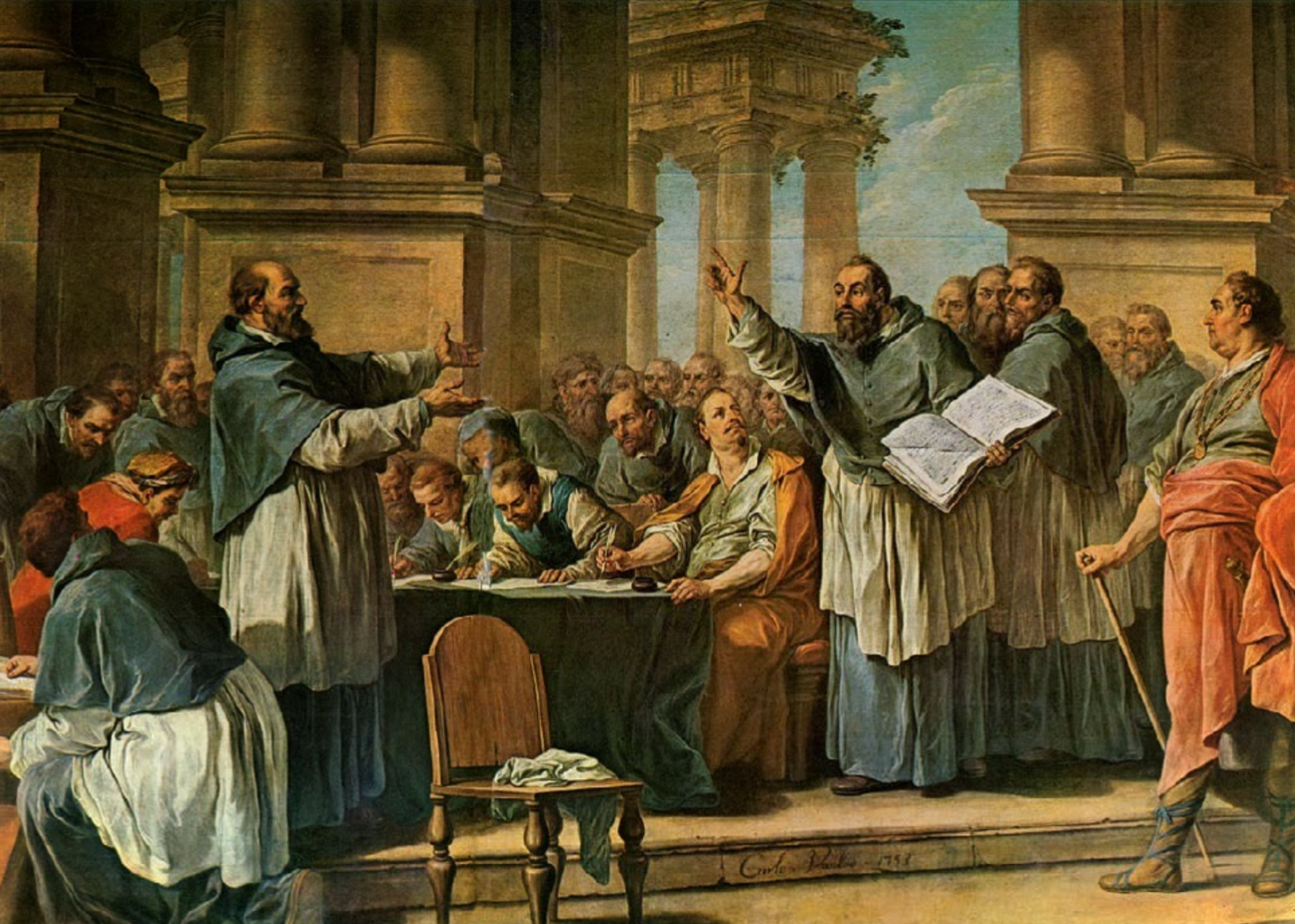
St Augustine Disputing with the Donatists, Charles-André van Loo, 1753. The Church distinguishes mere doctrinal error from obstinate adherence to error: pertinacity, not error alone, constitutes formal heresy.
Why This Question Matters
The distinction is essential because the word heretic is often used far too loosely. A person who accidentally states a false doctrine is not thereby proved to be a formal heretic. A poorly catechised Catholic who misunderstands the Trinity, the Eucharist or papal infallibility may be objectively wrong without knowingly rejecting the Catholic Faith. Conversely, someone may use polished theological language while knowingly refusing a doctrine precisely because the Church teaches it.
Confusing these situations produces two opposite errors.
One error declares practically everyone who utters a false proposition to be a formal heretic.
The opposite error claims that formal heresy can never be recognised unless God reveals the person’s soul to us directly.
Traditional Catholic theology accepts neither extreme. It distinguishes the objective error, the interior act of the will, the external profession of the error, and the canonical judgment made in the external forum.
This distinction becomes especially important when later questions concern Church membership, canonical penalties, ecclesiastical office and public defection from the Faith. Those consequences should not be decided by blurring the definitions at the beginning.
For the basic definition of heresy itself, see the related FAQ What Is Heresy?
What the Catholic Church Teaches
Faith Involves Both Intellect and Will
Catholic faith is not merely possessing correct religious information. At the First Vatican Council (1869–1870), Dei Filius taught that supernatural faith involves submission of both intellect and will to God revealing. We believe revealed truths because of the authority of God, who can neither deceive nor be deceived.
St Thomas Aquinas similarly explains that faith involves the will moving the intellect to assent. Heresy therefore cannot be understood merely as accidentally having a mistaken idea. It concerns the manner in which a Christian chooses what he will accept as belonging to Christ’s teaching.
That distinction between what the intellect holds and how the will adheres to it lies behind the traditional distinction between material and formal heresy.
The Object Must Actually Concern the Faith
Not every false religious opinion constitutes heresy in the strict sense. Canon 1323 §1 of the 1917 Code states that those things are to be believed with divine and Catholic faith which are contained in the written or transmitted Word of God and are proposed by the Church, whether by solemn judgment or by her ordinary and universal Magisterium, as divinely revealed.
Canon 1325 §2 then states that after baptism a person retaining the Christian name is a heretic if he pertinaciously denies or doubts one of these truths.
There are therefore at least two distinct questions:
Is the proposition objectively contrary to divine and Catholic faith?
and
Does the person pertinaciously adhere to that error?
The first concerns principally the object of belief.
The second concerns the person’s disposition toward the rule of faith.
These questions must not be collapsed into one.
What Is Material Heresy?
Material heresy exists when a proposition or belief is objectively contrary to Catholic dogma but the person holding it lacks the pertinacious rejection necessary for formal heresy.
The term material does not mean unimportant. The proposition may concern an extremely serious doctrine. “Material” means that the matter of heresy is present—the erroneous proposition—but the complete subjective element that makes the person formally heretical is absent.
The pre–Vatican II moral theologians Fr John A. McHugh, O.P., and Fr Charles J. Callan, O.P., in their Moral Theology, explain that those who adhere to an error through ignorance are not formally heretical if they remain willing to accept the truth when it becomes known to them. They explicitly distinguish such a case from pertinacious rejection.
A simple example would be a poorly instructed Catholic who says:
“I thought the Church taught that Christ had only one will.”
That proposition would contradict Catholic Christological dogma. But if, upon being shown the Church’s teaching that Christ possesses both a divine and a human will, the person replies:
“I did not know that. Of course I accept what the Church teaches,”
the earlier error did not manifest pertinacious rejection of Catholic authority. The error was real. Formal heresy was not thereby established.
Material Heresy Does Not Necessarily Mean Complete Innocence
This requires an important qualification. Someone can be wrong through inculpable ignorance, but someone can also be wrong because he negligently failed to learn what he was obliged to know.
McHugh and Callan distinguish these cases. Material error resulting from invincible ignorance may be entirely without personal sin. Error caused by culpable ignorance may itself involve sin according to the degree of negligence—yet it does not automatically become the specific sin of formal heresy unless the knowing and wilful rejection characteristic of heresy is present.
This prevents another common mistake:
material heresy ≠ necessarily morally blameless
but also:
culpable ignorance ≠ automatically formal heresy
A person may be guilty of laziness, negligence, intellectual pride or failure to learn his Faith without yet having knowingly chosen to reject a dogma precisely against the Church’s teaching.
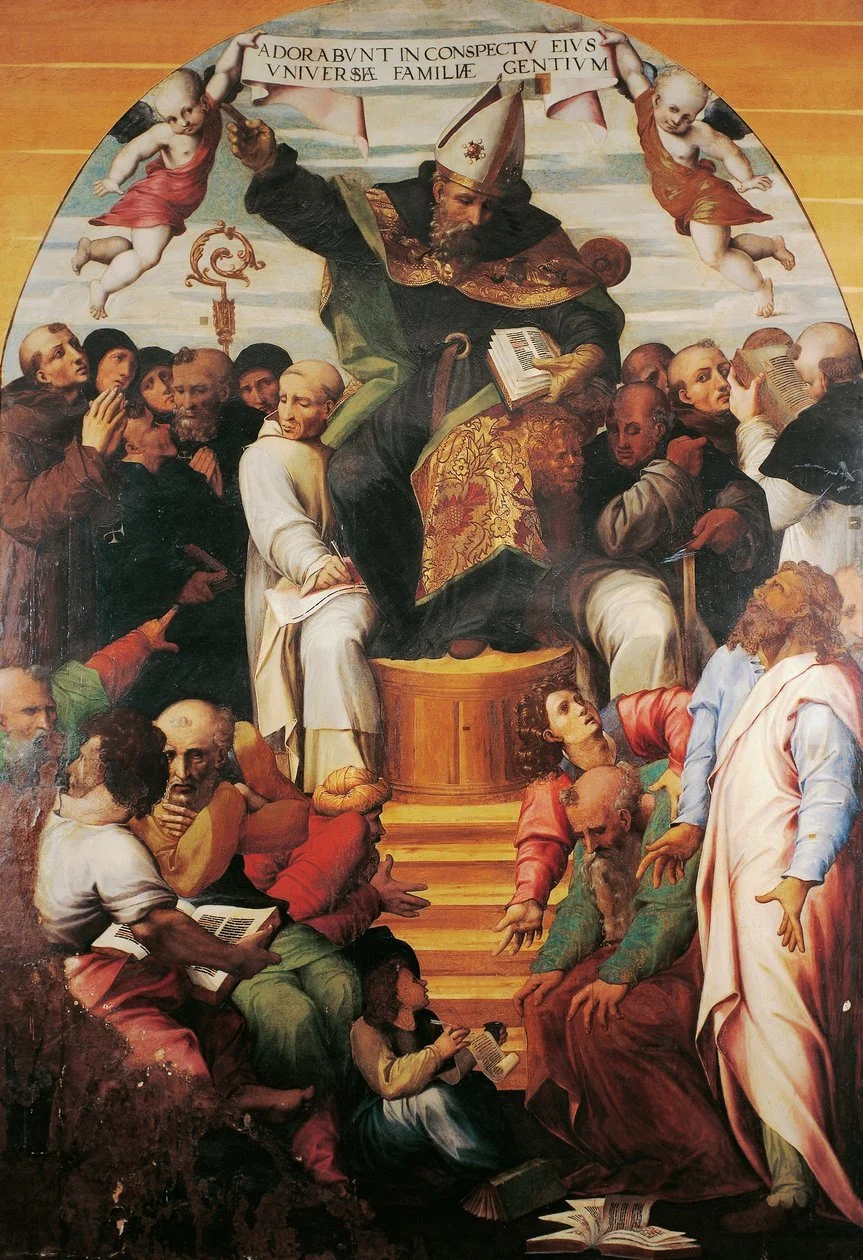
Marco Cardisco, St Augustine in Glory Disputing with Heretics (16th century). St Augustine defended the Catholic Faith against doctrinal error while distinguishing mere mistake from the obstinate adherence that gives heresy its formal character.
Ignorance and Culpability
Traditional moral theology distinguishes different forms and degrees of ignorance.
Inculpable or invincible ignorance is ignorance that the person could not reasonably have overcome under the circumstances.
Culpable or vincible ignorance is ignorance that could and should have been overcome by reasonable diligence.
There can also be more serious forms of negligent or deliberately cultivated ignorance.
Canon 2202 §1 of the 1917 Code provides the corresponding canonical principle: a violation of an unknown law is not imputable when the ignorance is inculpable; where the ignorance is culpable, imputability is diminished according to the degree of culpability. Canon 2202 §3 extends the same principles to inadvertence and error.
The critical point is that culpability is not all-or-nothing.
A person could therefore be:
objectively mistaken and entirely innocent;
objectively mistaken and culpably negligent;
or objectively mistaken and knowingly pertinacious.
Only the last situation necessarily possesses the formal character of heresy in the strict theological sense.
What Is Formal Heresy?
Formal heresy adds something to the objective error: a knowing and voluntary rejection of Catholic faith.
The classic pre–Vatican II Catholic Encyclopedia expresses the distinction by explaining that material heresy lacks the decisive intervention of the will, whereas formal heresy occurs when the will freely adheres to what has been recognised as contrary to the Church’s divine teaching authority.
McHugh and Callan likewise state that formal heresy requires that the person know his belief is opposed to divine revelation or Catholic faith and nevertheless voluntarily consent to the error.
Thus the crucial issue is not merely:
“Does this person hold a false proposition?”
but:
“What is his attitude toward the Catholic rule of faith once the conflict is known?”
A Catholic may initially misunderstand a doctrine. If he remains fundamentally disposed to say:
“Whatever the Catholic Church truly teaches as revealed by God, I accept,”
his mistake may remain material. If instead the position becomes:
“I understand that the Church definitively teaches this as revealed by God, but I refuse to believe it,”
the situation is radically different. The person is no longer merely mistaken about what the Church teaches. He is choosing another rule of belief over the authority by which Catholic faith is received.
What Is Pertinacity?
Pertinacity is the obstinate or deliberate adherence of the will to heretical error against the recognised rule of Catholic faith.
Canon 1325 uses the word pertinaciter—pertinaciously—as an essential part of the definition of a heretic. The idea is already clearly present in the Fathers.
St Augustine of Hippo (AD 354–430), Letter 43 (AD 397), 1, distinguishes those who have inherited false opinions but sincerely seek the truth and are ready to be corrected from those who defend error with obstinate resistance. He says that persons in the former category are not to be counted as heretics merely because their opinions are false.
St Thomas Aquinas later invokes this Augustinian principle in Summa Theologiae, II-II, q. 11, a. 2. He distinguishes erroneous opinions from heresy properly so called precisely by the presence of obstinate adherence against the judgment of the Church.
Pertinacity Does Not Necessarily Mean Long Duration
This is one of the most important distinctions in the entire subject. The ordinary English word persistent can suggest something continuing for a long time. But theological pertinacity does not necessarily require months or years of resistance.
McHugh and Callan explicitly explain that formal heresy does not require the person to remain in error for a long period or even necessarily to reject repeated admonitions. The decisive point is voluntary consent to an error recognised as contrary to the Faith.
Consequently, duration can provide evidence of pertinacity, but duration is not its essence.
Theologically:
pertinacity means firmness of wilful opposition, not simply elapsed time.
Must Someone First Receive Two Warnings?
Not as an absolute condition for the interior sin of formal heresy. The confusion frequently arises from Titus 3:10–11, where St Paul tells Titus to avoid a heretic after the first and second admonition.
Warnings have obvious importance. They may establish that the person has been confronted with Catholic teaching and has nevertheless continued to reject it. They can therefore become powerful evidence of pertinacity. But the admonitions should not be converted into a mechanical rule:
no two warnings = no possible formal heresy.
McHugh and Callan expressly reject such a requirement as intrinsic to formal heresy.
The 1917 Code itself also distinguishes the existence of heresy from particular subsequent canonical procedures. Canon 2314 imposed excommunication ipso facto upon heretics, while other penalties mentioned in the same canon followed unsuccessful admonition. The existence of admonitions and the existence of the underlying delict were therefore not simply identical questions.
Warnings are consequently best understood as potentially important evidence and canonical procedure, not as the metaphysical ingredient that creates pertinacity in every conceivable case.
Internal and External Heresy Are Different Distinctions
Another common mistake is to identify:
material = internal
and
formal = external or public.
That is incorrect. Material versus formal concerns principally the presence or absence of the knowing, wilful element. Internal versus external concerns whether the heresy remains within the person or is manifested outwardly.
McHugh and Callan explicitly distinguish these categories. Heresy is internal when confined to the mind and external when manifested through words, signs, acts or circumstances. External heresy may itself be occult or public, and either material or formal.
A useful summary is:
| Distinction | Principal Question |
|---|---|
| Material / Formal | Is pertinacious consent of the will present? |
| Internal / External | Has the belief been manifested outwardly? |
| Occult / Public | How widely or openly has the external act become known? |
| Sin / Canonical Delict | Are we speaking about guilt before God or an externally imputable violation governed by ecclesiastical law? |
These categories intersect, but they are not interchangeable.
External Manifestation and the Canonical Crime of Heresy
Canon law necessarily operates in the external forum. Canon 2195 §1 of the 1917 Code defines an ecclesiastical delict as an external and morally imputable violation of law to which a canonical sanction is attached. Therefore a purely interior act, however sinful before God, is not by that fact alone an external canonical crime.
External manifestation may occur through:
words;
written publications;
formal declarations;
significant actions;
membership or adherence where relevant;
or other circumstances that clearly manifest the person's profession of error.
Canon 2197 further distinguished an offence as public, notorious in law, notorious in fact, or occult according to its external circumstances and degree of manifestation. This distinction is extremely important when discussing ecclesiastical consequences.
A theologian may be discussing the sin of heresy before God.
A canonist may be discussing the delict of heresy before the Church.
They are related, but not identical questions.
Can the External Forum Judge Pertinacity?
Yes—but not by reading souls. This point requires precision because two opposite exaggerations are common.
One argument says:
“Pertinacity is interior. Therefore nobody except God can ever judge whether someone is a heretic.”
That goes too far.
Canon law routinely judges human acts according to objective evidence. Canon 2200 §2 of the 1917 Code states that once an external violation of law has been established, deliberate will is presumed in the external forum until the contrary is proved.
That is a juridical presumption, not supernatural knowledge of the soul. The other extreme says:
“Because somebody publicly stated an erroneous proposition, I know with absolute certainty everything about his conscience and guilt before God.”
That also goes too far. The external forum asks what can reasonably and juridically be established from outward facts. God alone directly comprehends the complete interior state of the soul. These truths are perfectly compatible.
The Limits on Judging the Internal Forum
Sacred Scripture itself warns against pretending to possess God's direct knowledge of another person's interior counsels. St Paul writes in 1 Corinthians 4:5 that the Lord will manifest “the counsels of the hearts.”
This does not mean Christians may never judge external conduct or doctrinal propositions. St Paul himself commanded ecclesiastical judgments and warned repeatedly against false teachers. The distinction is between:
judging an objective proposition or external act
and
claiming direct knowledge of the person's complete interior guilt before God.
We can therefore say with certainty:
“That proposition contradicts a defined Catholic dogma.”
We may sometimes also reasonably conclude from sufficiently clear circumstances:
“This person's continued external profession manifests pertinacious rejection in the external forum.”
But we should be more cautious about statements such as:
“I know precisely how much grace this person resisted, exactly what he understood internally, and the precise degree of his guilt before God.”
Those are different claims.
Canonical Presumption Is Not Omniscience
Canon 2200 is particularly valuable because it avoids both extremes. Once an external violation has been established, the external forum does not have to pretend that human intention is forever unknowable.
It may employ evidence and legal presumptions. But the canon also says that the presumption stands until the contrary is proved.
In other words, the presumption is juridical and rebuttable. The Church does not claim thereby to possess the divine scrutiny of consciences.
How Is Pertinacity Manifested Externally?
No single mechanical formula covers every case. Relevant indications can include a person's clarity of knowledge, the precision with which the Catholic doctrine has been presented to him, his own description of what he understands, repeated public teaching of the contrary proposition, explicit refusal of the Church's authority, rejection of correction and continued defence of the condemned error.
An isolated sentence may be ambiguous.
A person may misspeak.
He may use a technical term incorrectly.
A quotation may be taken out of context.
He may not understand what proposition has actually been defined.
These possibilities must be considered. But as the evidence accumulates, reasonable doubt may diminish. Thus external manifestation does not give direct vision of the conscience, but neither does the invisibility of the conscience make rational or canonical judgment impossible.
A Simple Summary
| Situation | Objective Error? | Pertinacity Established? | Formal Heresy? |
|---|---|---|---|
| Person unknowingly repeats a proposition contrary to dogma and readily accepts correction | Yes | No | No |
| Person is badly instructed and culpably neglects learning the Faith | Possibly | Not necessarily | Not necessarily |
| Person knows the Church teaches a doctrine as revealed but voluntarily rejects it | Yes | Yes | Yes |
| Person privately makes that knowing rejection | Yes | Yes | Interior formal heresy; not by that fact alone an external delict |
| Person externally professes the error but genuinely lacks knowledge of its opposition to Catholic faith | Yes | Not necessarily | Material externally manifested error |
| Person publicly and knowingly rejects a recognised dogma and persists in that rejection | Yes | Strong external evidence of pertinacity | Formal heresy may be established in the external forum according to the applicable principles |
The central distinction is therefore:
material error = the contradiction is present
formal heresy = the contradiction is joined to knowing and wilful pertinacity
The Main Objection
A serious objection can be stated this way:
If pertinacity belongs to the will, and nobody can see another person's soul, then we can never legitimately call anyone a formal heretic. At most we can say that his words are materially heretical.
There is an important truth within this objection. Human beings do not directly inspect another person's conscience, and accusations of heresy must not be based upon speculation about hidden motives. But the conclusion does not follow.
Human beings constantly make moral and juridical judgments from external evidence. Courts distinguish accidental acts from deliberate ones. Ecclesiastical authority distinguishes mistakes from deliberate violations. Catholic theology itself distinguishes an interior sin from an externally manifested delict precisely because external evidence is capable of juridical evaluation.
The 1917 Code makes this explicit by defining delicts as external and morally imputable acts and then establishing a rebuttable presumption concerning deliberate will once an external violation is established. Thus the proper conclusion is neither:
“We can read his soul.”
nor:
“We can never know anything about pertinacity.”
It is:
Pertinacity is an interior quality of the will that may become sufficiently manifested through external words and actions to permit a moral or juridical judgment, while the ultimate judgment of the soul belongs to God.
What We Can and Cannot Conclude
Established Catholic principle: heresy in the strict sense requires opposition to divine and Catholic faith together with pertinacity. Canon 1325 §2 expressly includes pertinacity in its definition.
Established theological distinction: material and formal heresy distinguish objective doctrinal error from the knowing and wilful adherence that gives the act its fully heretical character. Pre–Vatican II theological sources employ this distinction explicitly.
Established canonical principle: a canonical delict must be external and morally imputable. External violation and interior guilt therefore cannot simply be treated as identical concepts.
Established canonical principle: the external forum may employ a rebuttable presumption of deliberate will once an external violation has been established. Therefore canonical judgment does not require supernatural access to the conscience.
What cannot automatically be concluded: one erroneous sentence does not by itself establish formal heresy. Ignorance, misunderstanding, context and willingness to accept correction may be relevant.
What also cannot automatically be concluded: because someone claims ignorance, culpability necessarily disappears. Ignorance itself may be culpable, and external circumstances may make such a claim more or less credible.
What need not be concluded here: the precise consequences that different forms of heresy have for visible Church membership, ecclesiastical office or the papacy. Those questions require additional theological and canonical principles concerning publicity, manifest defection, membership and office and should be treated separately rather than smuggled into the definition of pertinacity.
Conclusion
The traditional Catholic distinction is precise.
Material heresy concerns objective doctrinal error without the knowing and wilful pertinacity that makes heresy formal.
Formal heresy exists when a baptised Christian knowingly and voluntarily denies or doubts a truth he recognises as belonging to divine and Catholic faith.
Pertinacity is the decisive element of the will. It does not necessarily mean long duration, rage, repeated warnings or a particular emotional disposition. It means knowingly setting one's judgment against the Catholic rule of faith.
Ignorance therefore matters. Inculpable ignorance can remove personal guilt; culpable ignorance may itself be sinful without necessarily constituting formal heresy. Conversely, once the truth and the Church's teaching are sufficiently known, deliberate refusal can constitute pertinacity even without a prolonged period of resistance.
Finally, interior culpability and external manifestation must be distinguished without separating them unrealistically. God alone sees the heart immediately. Yet the Church's external forum legitimately judges external acts from evidence and may employ juridical presumptions. Catholics should therefore avoid both rash accusations and the equally erroneous claim that public heresy can never be recognised because human beings cannot read souls.
This distinction prepares the way for the next questions:
how does heresy affect membership in the Church, and what consequences can public heresy have for ecclesiastical office?
Primary Sources
Sacred Scripture
Titus 3:10–11 — St Paul's instruction concerning admonition and the heretic. Read Titus 3
1 Corinthians 4:3–5 — the distinction between human judgment and God's ultimate manifestation of the counsels of hearts. Read 1 Corinthians 4
First Vatican Council (1869–1870), Dei Filius, Chapter III, On Faith — faith as supernatural assent rendered to God revealing. Read Dei Filius
1917 Code of Canon Law, Canons 1323 and 1325 — truths to be believed with divine and Catholic faith and the canonical definition of heresy. Read the 1917 Code text
1917 Code of Canon Law, Canons 2195–2203 — external delict, imputability, juridical presumption, ignorance and error. Read the relevant canons
1917 Code of Canon Law, Canon 2314 — canonical penalties associated with apostasy, heresy and schism and the distinct role of admonitions in subsequent penalties. Read Canon 2314
St Augustine of Hippo (AD 354–430), Letter 43 (AD 397), 1 — false opinions inherited or held without obstinate resistance are distinguished from heresy properly so called. Read Letter 43
St Thomas Aquinas (c. AD 1225–1274), Summa Theologiae, II-II, q. 11, aa. 1–2 — heresy as a corruption of Christian faith involving the will and obstinate adherence. Read Summa Theologiae II-II q.11
Further Reading
John A. McHugh, O.P., and Charles J. Callan, O.P., Moral Theology: A Complete Course Based on St. Thomas Aquinas and the Best Modern Authorities, revised by Edward P. Farrell, O.P., 1958, §§826–832. This pre–Vatican II manual gives particularly clear treatment of material and formal heresy, pertinacity, ignorance and internal versus external heresy. Read McHugh and Callan's Moral Theology
The Catholic Encyclopedia, “Heresy.” Particularly useful for the classical distinction between material error, formal heresy and pertinacity. Read the article on Heresy
Related Questions
What Is Heresy?
What Is Apostasy?
What Is Schism?
What Does It Mean to Be a Member of the Catholic Church?
Can a Heretic Remain a Member of the Catholic Church?
Can a Pope Become a Heretic?
What Happens If a Pope Publicly Defects from the Catholic Faith?
Can Catholics Judge That Someone Is a Heretic?