What Is Excommunication, and Can It Occur Automatically?
Short Answer
Excommunication is an ecclesiastical censure: a canonical penalty by which a person is excluded from certain aspects of communion with the faithful and deprived of specified ecclesiastical rights until the censure is removed.
It is a serious spiritual punishment, but it is not identical with damnation, loss of baptism, invalidity of Holy Orders, heresy, or even necessarily loss of membership in the Catholic Church.
Yes, excommunication can occur automatically.
Traditional canon law distinguishes a penalty imposed by a competent ecclesiastical authority after judgment — ferendae sententiae — from a penalty incurred by the commission of the offence itself — latae sententiae or ipso facto.
Under the 1917 Code of Canon Law, apostasy, heresy and schism carried an ipso facto excommunication reserved to the Holy See. A later declaration could officially establish that the penalty had been incurred and make its external consequences enforceable, but the declaration did not create a latae sententiae penalty that had already arisen from the offence itself.
This becomes especially important in considering public heresy and the papal office.
Excommunication, exclusion from Church membership, and loss of office must not be confused. St Robert Bellarmine and a substantial line of pre-Vatican II theologians and canonists taught that a Roman Pontiff who became a manifest heretic would cease to be a member of the Church and therefore could no longer remain her visible head.
Bellarmine wrote that such a man “ceases by himself to be Pope and head.”
On this view, no ecclesiastical superior has to depose a true Pope; rather, manifest defection from the Faith itself produces the loss, while any subsequent declaration merely recognises the fact.
This distinction is central to the sedevacantist explanation of the present crisis. The argument is not simply: “these men were excommunicated, therefore they were not Popes.”
The stronger traditional argument is:
if a purported Roman Pontiff publicly and pertinaciously defects from the Catholic Faith, manifest heresy is incompatible with membership in the Church; one who is not a member cannot remain the head; and therefore the papal office is lost by the fact of manifest defection rather than by a superior jurisdiction judging and deposing the Pope.
Whether this principle applies to a particular post-Vatican II claimant must then be established from his objectively documented public teaching and acts, not from speculation about his private thoughts.
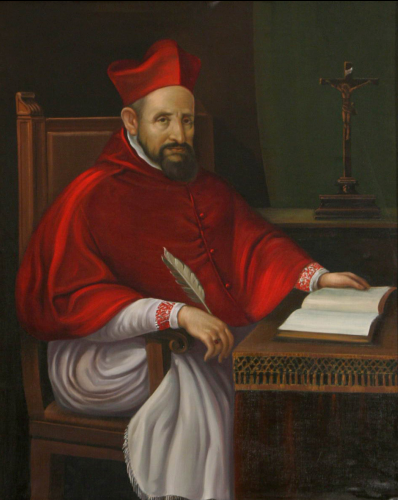
St Robert Bellarmine (1542–1621), Cardinal, Doctor of the Church and one of the principal theologians to examine the question of a manifestly heretical pope. Bellarmine taught that a manifest heretic could not remain a member and head of the Catholic Church.
Why This Question Matters
Excommunication is frequently misunderstood in two opposite directions.
One error treats excommunication as though nothing happens until a bishop or Pope publicly announces: “You are excommunicated.” That is false where the law itself attaches a latae sententiae penalty to an offence.
The opposite error treats every serious theological error as though it instantly means that a person is formally heretical, excommunicated, outside the Church and deprived of every ecclesiastical office. That is also too crude.
The Church's traditional law and theology require several distinctions:
error is not necessarily heresy;
material heresy is not necessarily formal heresy;
heresy is not identical with excommunication;
excommunication is not identical with loss of Church membership;
loss of Church membership is not simply the same juridical question as deprivation of an ordinary ecclesiastical office;
and the exceptional question of a manifestly heretical Roman Pontiff involves theological principles concerning the constitution of the Church in addition to ordinary penal law.
These distinctions become indispensable when considering the post-Vatican II crisis. If men publicly presented to the whole Church as Roman Pontiffs have themselves promulgated doctrines contrary to the previously defined Catholic Faith, the question cannot be dismissed merely by saying, “No authority has formally excommunicated them.”
Traditional Catholic law itself recognises penalties incurred without a prior declaratory sentence, while traditional ecclesiology raises the still deeper question of whether someone publicly separated from the profession of the Catholic Faith can continue to be a member — still less the visible head — of the Catholic Church.
What the Catholic Church Teaches
What Is Excommunication?
Excommunication belongs to the Church's penal law. It is a censure imposed for grave ecclesiastical offences with the purpose of bringing the offender to repentance.
The 1917 Code treated excommunication as a canonical censure with definite juridical effects. It could restrict participation in the sacraments, public worship, ecclesiastical acts, offices and other rights according to the provisions of the law.
But an excommunicated person does not thereby cease to be baptized. Nor does excommunication erase the sacramental character of Baptism, Confirmation or Holy Orders. A validly ordained priest who becomes excommunicated does not cease merely for that reason to be a priest sacramentally.
This is another reason why validity and liceity must remain distinct.
An excommunicated priest may be forbidden to exercise his orders. That does not necessarily mean every sacramental act he attempts is invalid. The precise consequences depend upon the sacrament, the law and the circumstances.
Excommunication Is a Genuine Spiritual Penalty
Pope Pius VI addressed an error remarkably relevant to this subject in Auctorem Fidei (1794).
The Synod of Pistoia had suggested that ipso facto censures without prior personal examination amounted essentially to threats without actual effect. Pius VI condemned the proposition that such sentences possessed no real force as false, rash, pernicious, injurious to the Church's power and erroneous.
Thus the traditional Church explicitly rejected the notion that an automatic ecclesiastical penalty is unreal until somebody later pronounces it.
Latae Sententiae and Ferendae Sententiae
The distinction is fundamental.
| Type of Penalty | How It Occurs | Is a Prior Sentence Necessary? |
|---|---|---|
| Latae sententiae | Incurred by the commission of the offence itself when the conditions of the law are fulfilled | No |
| Ferendae sententiae | Imposed by a competent ecclesiastical superior or judge | Yes |
| Declaratory sentence concerning a latae sententiae penalty | Officially establishes that an already prescribed automatic penalty has been incurred | It recognises the penalty; it does not ordinarily create it |
The standard English commentary on the 1917 Code by Rev. Stanislaus Woywod explains that some penalties are incurred “by the very fact of committing the crime”, while others must be imposed by competent ecclesiastical authority.
Canon 2232 then makes an especially important distinction. A latae sententiae penalty binds an offender conscious of his offence ipso facto. Before a declaratory sentence, however, its observance in the external forum may not always be enforceable, especially where the offence is not notorious. Once a declaratory sentence is issued, the penalty is treated as effective from the moment the offence was committed.
Therefore:
commission of the delict → automatic penalty incurred → possible later declaration
rather than:
commission of the delict → no penalty → judicial declaration → penalty begins
That distinction is essential.
Heresy and Automatic Excommunication
Canon 1325 §2 of the 1917 Code defines a heretic as one who, after Baptism and while retaining the Christian name,
pertinaciously denies or doubts a truth that must be believed with divine and Catholic faith.
The word pertinaciously is important. A Catholic who innocently repeats an erroneous proposition without knowing that it contradicts a revealed dogma is not therefore automatically a formal heretic. Neither is every theological mistake a heresy.
The traditional distinctions treated more fully in What Is Heresy? and What Are Material Heresy, Formal Heresy and Pertinacity? remain applicable.
Canon 2314, however, prescribed an ipso facto excommunication for apostates, heretics and schismatics. Woywod accordingly places “all apostates from the Christian faith, and all heretics and schismatics” among the excommunications incurred ipso facto.
This means that, where a person truly commits the canonical delict of heresy with the required imputability, the censure does not depend upon somebody first pronouncing it.
Nevertheless, one should use the common expression “he excommunicated himself” with care.
Strictly speaking, a heretic does not invent or impose a penalty upon himself. Rather:
the Church established the law → the person voluntarily commits the offence → the penalty prescribed by law is incurred automatically.
“Self-excommunication” is therefore convenient shorthand, but “incurred an ipso facto excommunication” is canonically more exact.
Declared and Undeclared Excommunication
An automatic excommunication can therefore exist without having been publicly declared.
This does not mean declaration is useless. A declaration can:
establish juridically in the external forum that the offence occurred;
remove uncertainty;
make the penalty publicly enforceable;
protect the faithful from scandal;
determine canonical consequences;
establish the fact for future ecclesiastical acts.
Canon 2232 expressly recognised this distinction. Before declaration, certain external consequences might not be demanded unless the offence was notorious. But where the public welfare required it, the competent superior was obliged to make a declaration.
Thus:
undeclared does not mean nonexistent.
At the same time:
automatic does not mean that every private individual may casually pronounce somebody guilty of the canonical crime.
The objective proposition taught, the person's knowledge, pertinacity, external manifestation, notoriety and the applicable canonical rules all have to be distinguished.
Sacred Scripture and the Early Church
The principle that a heretic may separate himself from ecclesiastical unity by his own act has deep biblical and patristic roots.
St Paul instructs St Titus:
“A man that is an heretic, after the first and second admonition, avoid: knowing that he that is such an one, is subverted, and sinneth, being condemned by his own judgment.” Titus 3:10–11
The text is significant because St Paul does not describe heresy merely as an external punishment inflicted upon somebody from outside. The pertinacious heretic is, in an important sense,
“condemned by his own judgment.”
St Jerome
St Jerome (c. AD 347–420), commenting on Titus 3:10–11, explains that “Heretics bring sentence upon themselves” because by their own choice they withdraw from the Church.
This does not mean that ecclesiastical authority becomes unnecessary. The Church possesses judicial authority and can investigate, declare, condemn and punish heresy.
Rather, the point is that heresy itself is a voluntary rupture of the profession of the Catholic Faith. The Church's subsequent judgment may recognise and juridically establish a rupture that the heretic has already caused by his own public defection.
This patristic principle becomes particularly important in St Robert Bellarmine's treatment of a heretical Pope.
Excommunication Is Not the Same as Non-Membership
This distinction is one of the most important in the entire subject. It is inaccurate simply to reason:
excommunicated → therefore not a member of the Church.
The theological question of Church membership is not reducible to the canonical censure of excommunication.
Pope Pius XII gave an especially clear statement in Mystici Corporis Christi (1943). He taught that members of the Church are those who have been baptized, profess the true Faith, and have neither separated themselves from the unity of the Body nor been excluded by legitimate authority for grave offences. He then explained that not every grave sin severs a person from the Church “as does schism or heresy or apostasy.”
There are therefore two conceptually different ways in which visible unity can be lost:
separation by one's own public defection, particularly through heresy, apostasy or schism;
and
exclusion by legitimate ecclesiastical authority.
They may coincide, but they are not identical. This distinction resolves much confusion concerning a manifest heretic.
The essential sedevacantist argument concerning a heretical claimant to the papacy does not have to depend exclusively upon the canonical censure of excommunication.
The deeper question is:
Can a manifest non-member of the Catholic Church simultaneously remain the visible head of that Church?
St Robert Bellarmine answered: No.
St Robert Bellarmine and the Manifestly Heretical Pope
St Robert Bellarmine (1542–1621), Doctor of the Church and one of Catholic theology's greatest authorities on the Roman Pontiff, treated this exact hypothetical problem in De Romano Pontifice, Book II, chapter 30. Bellarmine considered five opinions concerning what would happen if a Pope became a heretic.
He rejected the position attributed to Cajetan that a manifestly heretical Pope would remain Pope until deposed by the Church. His fundamental reason is ecclesiological.
A man cannot remain the head of a body of which he is no longer a member.
Bellarmine therefore concluded that the manifestly heretical Pope:
“ceases by himself to be Pope and head.”
This is crucial. Bellarmine did not propose that a council possesses jurisdiction over a reigning Roman Pontiff and can judicially remove him as his superior.
His reasoning proceeds in the opposite direction:
manifest heresy → loss of membership in the Church → impossibility of remaining her visible head → loss of papal office → thereafter the Church can recognise and act upon the fact
Bellarmine explicitly distinguished the occult heretic from the manifest heretic. He held that an occult heretic remains externally joined to the Church and therefore would not, merely by hidden interior heresy, cease to hold the papal office. His conclusion concerns manifest heresy. That distinction is indispensable.
“The First See Is Judged by No One”
Canon 1556 of the 1917 Code states:
“The first see is judged by no one.”
At first sight this creates a difficulty. If nobody possesses jurisdiction over the Pope, who could declare him a heretic and remove him? Bellarmine's answer is essentially that nobody deposes a true Pope by exercising superior jurisdiction over him.
If manifest heresy itself causes the man to cease belonging to the Church, he has consequently ceased to be capable of remaining its head. Any subsequent ecclesiastical recognition concerns the fact that the loss has already taken place; it is not an inferior tribunal exercising superior jurisdiction over a reigning Pope.
This is why the principle:
“The Pope cannot be judged”
does not entail:
“Therefore a Pope could openly abandon the Catholic Faith and nevertheless remain Pope forever because nobody possesses authority to depose him.”
The former is a traditional canonical principle. The latter does not follow from it.
Wernz-Vidal and the Later Canonical Tradition
Bellarmine's teaching was not an isolated speculation that disappeared from Catholic theology. The distinguished Jesuit canonist Franz Xaver Wernz (1842–1914), whose Ius Canonicum was subsequently continued and edited by Pedro Vidal, examined the same opinions.
Wernz-Vidal taught that where heresy becomes notorious and openly manifested, the Roman Pontiff would lose jurisdiction by the fact itself and before a declaratory sentence. They regarded Bellarmine's position as the more approved and more common opinion.
The reasoning is again not essentially penal:
one who has publicly ceased to be a member of the visible Church cannot continue to be the head of that visible Church.
The same principle appears in several important pre-Vatican II canonists and theologians.
Vermeersch-Creusen
Arthur Vermeersch, S.J. (1858–1936) and Joseph Creusen, S.J., in their Epitome Iuris Canonici, stated that according to the more common teaching, if a Roman Pontiff fell into manifest heresy, he would fall from power ipso facto without a declaratory sentence, precisely because one who is no longer a member cannot retain the headship of the Church.
Cardinal Billot
Cardinal Louis Billot, S.J. (1846–1931) likewise treated notorious heresy as incompatible with continued possession of the pontifical power, because the person would have cast himself outside the visible Body of the Church.
Matthaeus Conte a Coronata
The canonist Matthaeus Conte a Coronata, O.F.M. Cap. (1889–1951) taught that a Roman Pontiff openly professing heresy would, by divine law, fall from office without a condemnatory sentence and, in his formulation, even without a declaratory sentence.
Edward F. Regatillo
The Spanish Jesuit canonist Eduardo Regatillo, S.J. (1882–1975) similarly described ipso facto loss of papal office through public heresy as the more common teaching, basing it upon the impossibility of a non-member remaining head of the Church.
These authorities should not be misrepresented. Their opinion concerning the precise mechanism by which a heretical Pope loses office was theological and canonical teaching, not a solemnly defined dogma. Earlier theologians such as Cajetan and John of St Thomas developed a different mechanism involving an antecedent ecclesiastical declaration.
But the existence of that dispute actually establishes an important point:
traditional Catholic theology did not universally hold that a manifestly heretical Pope must remain Pope indefinitely simply because no earthly superior can depose him.
Excommunication and Loss of Office Must Still Be Distinguished
Here an important precision is necessary. Canon 2314 imposed ipso facto excommunication upon apostates, heretics and schismatics. But the same canon provided additional penalties concerning ecclesiastical offices after admonition and failure to amend. Woywod's commentary notes that deprivation of benefice, dignity, office or other ecclesiastical position was to be imposed after repeated admonition under Canon 2314 §1(2).
Therefore one should not argue simplistically: Canon 2314 automatically excommunicates every heretic; therefore Canon 2314 itself automatically removes every heretic from every ecclesiastical office.
That does not accurately represent the canonical structure. The argument concerning a manifestly heretical Roman Pontiff is different.
Bellarmine, Wernz-Vidal, Billot, Coronata, Vermeersch and Regatillo base the conclusion fundamentally upon the divine constitution of the Church and the incompatibility between manifest non-membership and headship, not simply upon the ordinary canonical penalty for heresy.
That is the stronger and more exact argument.
How This Relates to the Post-Vatican II Crisis
This brings us directly to the controversy that has confronted Catholics since Vatican II. The sedevacantist argument observes that the problem after Vatican II is not merely that individual clerics privately entertained theological errors.
The allegation is much more serious: men publicly recognised as Roman Pontiffs have, through official documents, public teaching and highly visible acts,
promulgated, defended or endorsed propositions and practices that contradict previously established Catholic doctrine, including positions that had already been expressly rejected or condemned by earlier Popes and by the Church.
Of particular importance is Modernism, condemned by Pope St Pius X as “the synthesis of all heresies,” because it attacks not merely one isolated doctrine but the very foundations by which Catholic dogma is known, preserved and transmitted.
Because such acts are public, repeated and in many cases directed to the universal Church, the issue cannot simply be dismissed as an occult fault known only to God.
The relevant question becomes:
If a claimant to the Roman Pontificate publicly manifests adherence to propositions incompatible with divine and Catholic faith, and the external evidence establishes pertinacious defection, can he remain a member — and therefore the head — of the Catholic Church?
Under the Bellarmine-Wernz theological position, the answer is no.
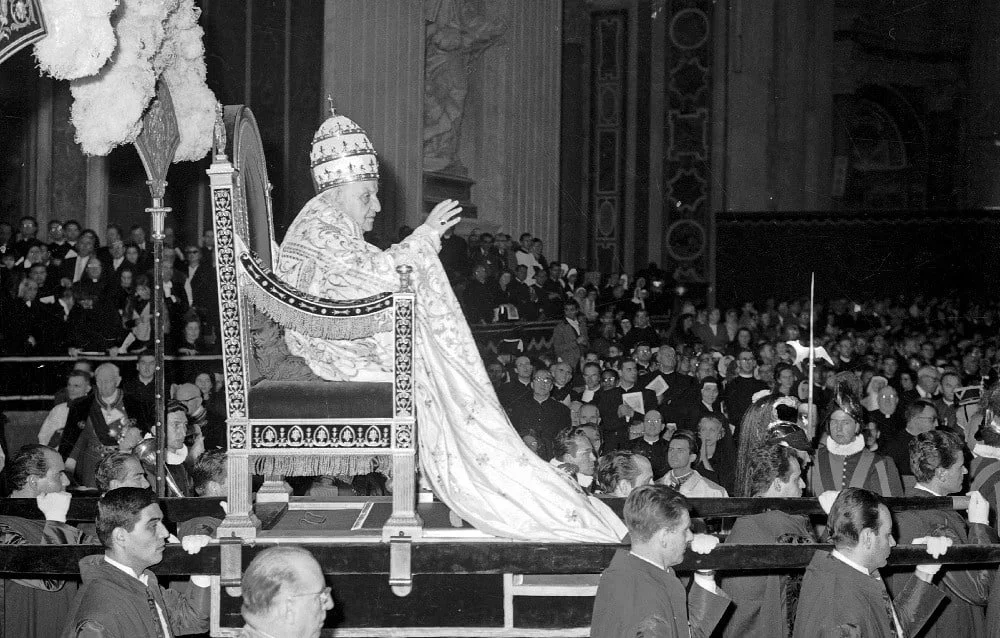
Angelo Giuseppe Roncalli (“Pope John XXIII”) at the opening of the Second Vatican Council in St Peter’s Basilica, Rome, on 11 October 1962. He had first announced his intention to convene an ecumenical council on 25 January 1959 and died on 3 June 1963, before the Council was completed.
The Argument Does Not Require a Superior to “Excommunicate the Pope”
This is the point often missed. The argument is not:
some bishop must prosecute the Pope;
a tribunal must convict him;
somebody must excommunicate him;
a council must depose him;
only then does the papal office become vacant.
That would immediately confront the traditional principle that the First See is judged by no one. The Bellarmine argument is instead:
a true Pope must be a member of the Catholic Church;
the profession of the true Faith is a condition of visible Church membership;
manifest formal heresy separates a person from the visible unity of the Church;
therefore a manifest heretic cannot remain the Church's visible head;
the loss follows from the fact of manifest defection;
any subsequent authoritative declaration would recognise or establish publicly that the fact occurred rather than exercise superior jurisdiction over a true Pope.
This is why the absence of a formal sentence does not by itself answer the sedevacantist argument.
Public Teaching Is Especially Significant
A distinction must nevertheless be retained between:
private theological error;
an ambiguous statement;
material error arising through ignorance;
an isolated imprudent remark;
and
persistent public profession or authoritative promulgation of a proposition contrary to a truth of divine and Catholic faith.
The last category is the relevant one. For example, Vatican II's Dignitatis Humanae explicitly declares that the human person possesses a right to religious freedom, founded upon human dignity, and says that this immunity continues even for those who fail in their obligation to seek and adhere to religious truth, within the limits of public order. Those are the Council's own words and concepts, not merely a traditionalist characterisation of them.
The separate doctrinal question is whether that teaching can be reconciled with the previous Catholic Magisterium concerning the rights of truth, the duties of civil society toward the true religion and the limits of religious toleration. That case should be established in the dedicated article rather than assumed here.
The same method should be followed concerning ecumenism, religious indifferentism, ecclesiology and other disputed postconciliar teachings:
first establish the traditional Catholic doctrine;
then quote the later text exactly;
then determine whether the relationship is continuity, legitimate development, ambiguity, error or contradiction;
and only then ask what consequences follow for the person publicly promulgating it.
This prevents “heresy” from becoming merely a polemical label.
What About Pertinacity?
A serious objection immediately arises. Even if a statement is objectively heretical, how can anyone know whether the person is pertinacious? The answer requires the distinction between the internal forum and the external forum.
No human being can directly see another person's soul. Only God knows interior culpability with perfect certainty. But ecclesiastical society necessarily operates through externally knowable facts. Otherwise no public offence could ever be judged unless the offender confessed his interior intentions.
Pertinacity can therefore be manifested externally by circumstances such as:
knowing that a doctrine is taught by the Church;
nevertheless publicly denying it;
repeating the denial;
defending it after objection or correction;
promulgating it authoritatively;
refusing to withdraw it;
continuing to act consistently upon it.
Formal warnings can provide especially strong evidence, but the proposition “there can never be formal heresy until two canonical warnings have been delivered” should not be confused with the biblical and canonical role of admonition.
The question in the external forum is whether the person's public conduct sufficiently manifests obstinate adherence to the contrary proposition. This is why each alleged case must be examined carefully rather than decided merely by attaching the word “heretic” to someone.
Does a Formal Declaration Make No Difference?
It makes a considerable difference — but not necessarily the difference sometimes alleged. A declaration could provide the Church with:
juridical certainty;
an authoritative determination of the facts;
an end to practical doubt;
a basis for subsequent canonical acts;
protection against competing private judgments;
restoration of visible order.
Wernz-Vidal therefore did not regard a declaration as pointless. Their analysis distinguished between a declaration that causes the Pope to lose authority and one that recognises that manifest heresy has already brought about the loss.
In ordinary circumstances, Catholics should naturally desire the Church's competent authority to resolve disputed canonical facts.
The extraordinary difficulty of the present controversy is precisely that the sedevacantist thesis concerns a crisis in which the normal authorities who would resolve such questions are themselves implicated in the disputed ecclesiastical structure. That difficulty does not, however, change the underlying theological principles.
The Main Objection
The strongest objection can be stated as follows:
“Individual Catholics have no authority to judge or depose the Pope.
No council has formally pronounced the post-Vatican II Popes heretics, and the First See is judged by no one.
Therefore, regardless of how troubling their statements may appear, Catholics must continue to recognise them as true Popes until the Church formally declares otherwise.”
This objection correctly emphasises several truths.
Private Catholics possess no jurisdiction to impose canonical penalties upon the Roman Pontiff.
Individual Catholics cannot convene themselves into an ecclesiastical tribunal.
Private judgment cannot replace the divinely constituted teaching and governing authority of the Church.
And Catholics should never accuse a Pope of heresy casually.
But those truths do not establish the conclusion.
Response
The argument confuses causing a juridical fact with recognising an objective fact. No Catholic layman has authority to depose a Pope.
But a Catholic does not need ecclesiastical jurisdiction to recognise that a publicly expressed proposition contradicts a defined dogma where the contradiction is objectively demonstrable.
Likewise, the Bellarmine position specifically avoids placing a council above a true Pope. The Church does not depose the Roman Pontiff as his superior. Rather, manifest defection from the Catholic Faith means that the man has already ceased to be capable of remaining the head of the Church.
The principle can be summarised:
The Church does not make the manifest heretic a non-member by judicial sentence; rather, his manifest defection from the Faith is the reason he cannot remain a member.
And therefore:
The Church does not need superior jurisdiction over a reigning Pope in order for manifest heresy to be incompatible with continued papal office.
That is precisely why Bellarmine's position was attractive to later theologians and canonists: it preserves simultaneously the truth that the Roman Pontiff has no earthly superior and the truth that
a manifest non-Catholic cannot be the visible head of the Catholic Church.
A Necessary Qualification About the Present Crisis
None of this means that one can begin with the conclusion that every post-Vatican II claimant was a formal heretic and then work backwards. For each disputed teaching or act, the proper order is:
traditional doctrine → exact later proposition → objective comparison → public manifestation → evidence of pertinacity → theological and canonical consequence.
Furthermore, Modernism is a technical theological term condemned especially by St Pius X. It should not simply be used as a synonym for “a Pope I think was bad.”
Where a particular claimant is alleged to have professed Modernism or heresy, the relevant doctrines and public acts should be documented.
The sedevacantist conclusion should stand upon public evidence, not conjecture about hidden motives or secret interior beliefs.
Excommunication, Membership and Office — A Simple Summary
| Question | Governing Principle |
|---|---|
| What is excommunication? | An ecclesiastical censure with specified canonical effects |
| Can it occur automatically? | Yes. A latae sententiae penalty is incurred by the offence itself when the legal conditions are fulfilled |
| Must it first be publicly declared? | No, not for the penalty to be incurred; declaration may be necessary for particular external effects or juridical certainty |
| Was heresy automatically excommunicated under the 1917 Code? | Yes, Canon 2314 imposed ipso facto excommunication upon heretics, apostates and schismatics |
| Does every doctrinal error make someone a formal heretic? | No. Heresy requires denial or doubt of a truth of divine and Catholic faith together with pertinacity |
| Is excommunication identical with non-membership? | No |
| Can heresy itself affect Church membership? | Yes. Traditional Catholic teaching holds that manifest heresy is incompatible with visible membership in the Church |
| Can the Pope be judged by an earthly superior? | No. Canon 1556 states that the First See is judged by no one |
| What did Bellarmine conclude about a manifestly heretical Pope? | That he ceases by himself to be Pope because he ceases to be a member of the Church |
| Was Bellarmine's precise mechanism solemnly defined? | No. It was an influential theological position later regarded by important canonists as the more common or approved opinion |
| Does the absence of a formal declaration automatically defeat the sedevacantist case? | No. Under the Bellarmine-Wernz analysis, a declaration recognises manifest defection and loss rather than causing it |
| May anyone casually declare a Pope a heretic? | No. The objective doctrine, public facts, pertinacity and theological consequences must be demonstrated carefully |
Common Objection: “But Doesn't Universal Recognition Prove He Must Be Pope?”
Another objection argues that because the post-Vatican II claimants have been publicly recognised by bishops and Catholics throughout the world, their papal status cannot subsequently be questioned.
The theological doctrine of universal peaceful acceptance deserves a separate article because it involves questions concerning the certainty of papal elections, the Church's indefectibility and what genuinely counts as peaceful universal adherence.
For present purposes, however, it cannot simply be invoked as a slogan while ignoring the logically prior question.
If Catholic doctrine establishes that a manifest heretic cannot remain a member and head of the Church, then one must first determine whether the alleged universal acceptance possesses the theological characteristics required when the very controversy concerns public defection from the Faith.
See: Can Universal Peaceful Acceptance Prove That a Man Is Pope?
What We Can and Cannot Conclude
What Catholic Doctrine and Law Establish
Excommunication is a real ecclesiastical censure. The Church possesses authority to attach penalties that are incurred ipso facto.
The 1917 Code imposed ipso facto excommunication for heresy, apostasy and schism. A latae sententiae penalty does not depend for its existence upon a later declaratory sentence, although a declaration can have important effects in the external forum.
Pope Pius XII taught that heresy, schism and apostasy are of their nature capable of severing a person from the unity of the Mystical Body. The Roman See cannot be judicially subjected to an earthly superior: the First See is judged by no one.
Strong and Historically Important Theological Teaching
St Robert Bellarmine taught that a manifestly heretical Pope ceases by himself to be Pope and head, because he has ceased to be a member of the Church.
Wernz-Vidal, Billot, Vermeersch-Creusen, Coronata, Regatillo and other approved theologians and canonists defended substantially the same conclusion, often describing it as the more common or more approved opinion.
What Was Theologically Disputed
The exact mechanism by which the Church would establish and act upon the manifest heresy of a Roman Pontiff was not solemnly defined.
Cajetan, John of St Thomas and others proposed a different mechanism involving ecclesiastical warning or declaration.
Therefore one should not falsely present every detail of Bellarmine's fifth opinion as though Vatican I had defined it.
What Must Be Established Separately
Whether a specific post-Vatican II claimant became a manifest formal heretic must be established from evidence.
One must identify:
the Catholic dogma involved;
the claimant's actual words or acts;
their objective contradiction, if any;
their public character;
and sufficient evidence of pertinacity.
A person's secret culpability before God is not available to human judgment.
What Is Not Necessary
It is not necessary to prove that a claimant secretly intended to destroy the Church.
It is not necessary to prove a conspiracy.
It is not necessary to establish hidden membership in Modernist organisations.
It is not necessary to know the person's interior thoughts.
The theological question can and should stand upon public doctrine, public acts and traditional Catholic principles.
Conclusion
Yes, excommunication can occur automatically.
Traditional Catholic canon law expressly recognised latae sententiae or ipso facto penalties. Under Canon 2314 of the 1917 Code, the canonical delict of heresy carried an automatic excommunication. Canon 2232 further confirms that such a penalty binds by the offence itself even before a declaratory sentence, while distinguishing the penalty's existence from its full enforcement in the external forum.
But the present crisis requires a deeper distinction.
Excommunication is a canonical penalty. Manifest heresy concerns the profession of the Faith and therefore membership in the visible Church. Loss of papal office concerns whether one who has ceased to be a member can continue to be the Church's head.
St Robert Bellarmine's answer was that he cannot.
Thus the traditional argument concerning a manifestly heretical claimant to the Roman Pontificate is not that private Catholics somehow judge and depose a Pope. Nor is it merely that Canon 2314 mechanically removes him from office.
It is that:
a Roman Pontiff must belong to the Catholic Church;
manifest formal heresy is incompatible with membership in the Catholic Church;
therefore
a man who manifestly defects from the Catholic Faith cannot simultaneously remain the visible head of the Catholic Church.
The fact that “the First See is judged by no one” does not overturn this principle. On Bellarmine's analysis, it helps explain it. Since nobody possesses jurisdiction to depose a true Pope, loss through manifest heresy occurs by the fact of the man's own public defection, rather than through a superior tribunal exercising power over the Roman Pontiff.
This is why the absence of a formal excommunication or declaration is not by itself an answer to the sedevacantist case. The real questions are more fundamental:
What is the Catholic Faith?
Was a dogma publicly denied or contradicted?
Was that defection manifest and pertinacious?
Can someone who publicly defects from the Faith remain a member of the Church?
And finally:
Can someone who is not a member of the Catholic Church nevertheless remain its visible head?
Bellarmine and an important line of pre-Vatican II Catholic theology answered the final question unequivocally: no.
The purpose of examining these matters, however, is not merely to identify canonical penalties or ecclesiastical abnormalities. It is to preserve the Catholic Faith received from Christ through His Church, to reject what contradicts that Faith, and to remain united to Christ through true faith, charity, the sacraments and perseverance unto salvation.
Primary Sources
Holy Scripture — Titus 3:10–11. St Paul commands that the pertinacious heretic be avoided and describes him as condemned by his own judgment. Titus 3 with traditional commentary
1917 Code of Canon Law, Canon 1325 §2. Traditional canonical definition of heretic, apostate and schismatic. Canon 1325 text
1917 Code of Canon Law, Canons 2232 and 2314. On latae sententiae penalties and the ipso facto excommunication attached to apostasy, heresy and schism. 1917 Code resources and original Latin texts
Pope Pius VI, Auctorem Fidei (1794), propositions 46–47. Condemns the proposition that ipso facto censures are merely threats without actual effect. Text of Auctorem Fidei propositions
Pope Pius XII, Mystici Corporis Christi (29 June 1943), nn. 22–23. On membership in the Catholic Church and the severing effects of heresy, apostasy and schism. Official Vatican text
St Robert Bellarmine, De Romano Pontifice, Book II, chapter 30. Bellarmine's treatment of the manifestly heretical Pope and the five theological opinions. English text of Book II chapter 30
St Jerome (c. AD 347–420), Commentary on Titus, on Titus 3:10–11. On the heretic bringing judgment upon himself by withdrawing from the Church. Titus 3 patristic commentary
1917 Code of Canon Law, Canon 1556. “The first see is judged by no one.” 1917 Code canonical index
Second Vatican Council, Dignitatis Humanae (7 December 1965), n. 2. Primary postconciliar text relevant to the separate examination of religious liberty. Official Vatican text
Further Reading
Franz Xaver Wernz and Pedro Vidal, Ius Canonicum, vol. II, n. 453. Detailed treatment of papal heresy and the principal theological opinions. A useful overview and bibliographical discussion is available here. Canonical overview of the Wernz-Vidal treatment
Arthur Vermeersch, S.J. and Joseph Creusen, S.J., Epitome Iuris Canonici, vol. I, 7th ed. (1949), n. 340.
Matthaeus Conte a Coronata, O.F.M. Cap., Institutiones Iuris Canonici, vol. I (1950).
Cardinal Louis Billot, S.J., De Ecclesia Christi (1927).
Eduardo Regatillo, S.J., Institutiones Iuris Canonici, vol. I (1956).
These authorities are useful particularly because they demonstrate that the relationship between manifest heresy, Church membership and papal office was discussed within approved Catholic theology long before Vatican II.
Related Questions
What Is Heresy?
Explains the precise Catholic meaning of heresy and its distinction from theological error.
What Are Material Heresy, Formal Heresy and Pertinacity?
Examines ignorance, culpability, obstinacy, external manifestation and the limits of judging another person's internal forum.
What Is Apostasy?
Explains total abandonment of the Christian Faith and how it differs from individual heresy.
What Is Schism?
Explains refusal of submission to the legitimate Roman Pontiff or communion with those subject to him and distinguishes schism from heresy.
Can a Heretic Be a Member of the Catholic Church?
Examines the visible bonds of Church membership and the teaching of Pius XII and traditional theologians.
Can a Pope Become a Heretic?
Examines the traditional theological opinions of Bellarmine, Cajetan, John of St Thomas, Wernz-Vidal and others.
Can a Heretical Pope Lose His Office Automatically?
Develops in detail the distinction between deposition by an ecclesiastical superior and ipso facto loss through manifest defection from the Faith.
Can Universal Peaceful Acceptance Prove That a Man Is Pope?
Examines one of the principal objections raised against the sedevacantist conclusion and the precise conditions traditionally required for universal peaceful acceptance.