What Is Schism?
Short Answer
Schism is the deliberate breaking of ecclesiastical unity by refusing submission to the legitimate Roman Pontiff or by refusing ecclesiastical communion with the members of the Church who are subject to him.
The 1917 Code of Canon Law gives the traditional definition in Canon 1325 §2: after defining heresy and apostasy, it calls a person schismatic if he refuses submission to the Supreme Pontiff or refuses communion with the members of the Church subject to him. The canon therefore distinguishes schism from heresy.
Heresy is directed immediately against the unity of faith;
schism is directed immediately against the unity of government and ecclesiastical communion.
This distinction matters. A person can theoretically retain Catholic doctrine while separating himself from the Church's lawful government. Conversely, heresy ordinarily also destroys ecclesiastical unity, so heresy and schism frequently occur together. But they are not the same sin.
Nor is every act of disagreement or disobedience automatically schism. St Thomas Aquinas explains that schism involves a wilful separation from the unity of the Church, and particularly a rebellious refusal of ecclesiastical subjection. A Catholic who disobeys a particular command has not thereby necessarily denied the authority from which that command proceeds.
Finally, the definition presupposes a legitimate Roman Pontiff. A dispute concerning whether a particular claimant actually possesses the papal office is logically different from denying that Catholics owe submission to a true Pope. This distinction became especially evident during the Western Schism, when Catholics disputed which claimant was Pope while continuing to affirm that the true successor of St Peter must be obeyed.
Why This Question Matters
The word schism is often used loosely. It can be applied rhetorically to anyone who criticises ecclesiastical authorities, refuses a particular command, attends an independent chapel, questions a claimant to ecclesiastical office, or becomes separated administratively from another group of Catholics.
Traditional Catholic theology is considerably more precise.
Schism is not simply disagreement.
It is not simply disobedience.
It is not simply being excommunicated.
It is not identical with heresy.
And a dispute concerning who actually possesses ecclesiastical authority is not necessarily the same thing as refusing the authority itself.
These distinctions are especially important during an ecclesiastical crisis. If the term schism is used carelessly, the very doctrine intended to safeguard the Church's visible unity can instead become a slogan applied without regard to the conditions traditionally required for schism.
What the Catholic Church Teaches
Sacred Scripture
Christ did not establish Christianity as a collection of independent believers united only by invisible faith. He established one visible Church possessing teaching authority, sacramental worship and government.
Our Lord speaks of “one fold and one shepherd” in John 10:16.
St Paul exhorts the Corinthians:
“that there be no schisms among you” — 1 Corinthians 1:10.
He similarly commands Christians to preserve “the unity of the Spirit in the bond of peace,” immediately connecting this with one body, one Spirit, one Lord, one faith and one baptism in Ephesians 4:3–5.
These passages do not by themselves give the later technical canonical definition of schism. They establish the underlying reality: Christ wills His Church to possess a real and visible unity.
That unity has both an internal doctrinal element—one Faith—and an external social element—communion under legitimate ecclesiastical authority.
Peter as the Visible Principle of Unity
Christ established St Peter as the visible foundation and shepherd of His Church.
He gave Peter the keys of the Kingdom,
commanded him to strengthen his brethren, and
entrusted to him the feeding of His sheep.
Pope Leo XIII explains in Satis Cognitum (1896) that Peter was established as the principle of cohesion of the Church and that this authority continues in his successors.
Leo XIII teaches that the government instituted in Peter belongs to the constitution of the Church itself and must therefore continue in the Roman Pontiffs.
The papacy is consequently not an optional administrative arrangement added centuries later. Unity with the legitimate successor of Peter belongs to the visible constitution Christ gave His Church. Schism therefore attacks something Christ Himself established.
The 1917 Code of Canon Law
Canon 1325 §2 of the 1917 Code distinguishes three different departures:
| Departure | What Is Rejected | Traditional Meaning |
|---|---|---|
| Heresy | A truth to be believed with divine and Catholic faith | Obstinate denial or doubt of revealed Catholic dogma after baptism |
| Apostasy | Christianity itself | Total abandonment of the Christian Faith |
| Schism | Ecclesiastical subjection or communion | Refusal of submission to the Roman Pontiff or communion with those subject to him |
The Latin text of Canon 1325 §2 defines the schismatic as one who refuses subjection to the Supreme Pontiff or refuses communion with members of the Church subject to him.
The distinction is therefore canonical as well as theological.
St Thomas Aquinas
St Thomas Aquinas (c. 1225–1274) treats schism specifically in the Summa Theologiae, II-II, q.39.
He explains that schism is directly opposed to ecclesiastical unity. That unity consists in two related realities:
the communion of the Church's members with one another, and
their subordination to the Church's one visible head under Christ.
He consequently describes schismatics as those who refuse submission to the Sovereign Pontiff and communion with those acknowledging his supremacy. This gives us the two dimensions found again in Canon 1325:
vertical unity: legitimate ecclesiastical government;
horizontal unity: communion among those united under that government.
Both belong to the visible unity of the Church.
Schism Is Not the Same Thing as Heresy
This is one of the most important distinctions.
St Thomas explicitly distinguishes the two.
Heresy is directly opposed to faith.
Schism is directly opposed to ecclesiastical unity.
A person could therefore hypothetically profess every Catholic dogma while nevertheless refusing the lawful government of the Church.
St Thomas cites St Augustine for the distinction between one who separates from Catholic communion and one who embraces a different faith. He also cites St Jerome's observation that heresy corrupts doctrine whereas schism separates from the Church.
Nevertheless, the two frequently become connected. A schismatic group often eventually develops doctrinal arguments to justify its separation. Conversely, a heretic who rejects the Church's teaching authority thereby also ruptures ecclesiastical unity.
Thus:
heresy ≠ schism
but
heresy and schism can coexist in the same person or body.
This is why the Church has traditionally spoken together of apostates, heretics and schismatics, while nevertheless defining them separately.
Schism Is Not Mere Disobedience
This point is essential. Suppose a Catholic refuses a particular command given by an ecclesiastical superior.
He may be wrong.
He may even commit a serious sin of disobedience.
But this does not necessarily mean that he has become a schismatic.
St Thomas answers this directly. Schism involves rebellious disobedience in which a person obstinately rejects the Church's judgment or intends separation from ecclesiastical unity. Ordinary sins of disobedience do not necessarily contain this element.
Traditional theologian Fr Sylvester Joseph Hunter, S.J. (1829–1896) expressed the distinction similarly in Outlines of Dogmatic Theology: refusal of a particular ecclesiastical law or command does not constitute schism unless it amounts to repudiating subjection to legitimate ecclesiastical authority itself. The WM Review article correctly highlights this distinction.
The question is therefore not merely:
“Did this person disobey?”
The deeper question is:
“Does this action amount to a rejection of the Church's legitimate authority or a deliberate withdrawal from her communion?”
That is a much more demanding test.
The Early Church Understood Unity as Visible
St Ignatius of Antioch
St Ignatius of Antioch (c. AD 35–107), writing on his way to martyrdom, repeatedly insists upon visible unity around legitimate ecclesiastical authority.
In his Letter to the Smyrnaeans (c. AD 107), chapter 8, he instructs Christians to remain united with their bishop and famously connects the visible congregation with the Catholic Church.
His teaching is important because it comes from the generation immediately following the Apostles. Christianity is already presented not merely as agreement upon ideas but as a visibly ordered society possessing bishops, priests, deacons, sacraments and ecclesiastical communion.
St Cyprian of Carthage
St Cyprian of Carthage (c. AD 200–258) wrote On the Unity of the Catholic Church around AD 251 during the Novatian schism.
His entire argument presupposes that the Church established by Christ possesses a unity that Christians may not lawfully tear apart.
Cyprian appeals to Christ's words concerning one flock and one shepherd, and to St Paul's command that there be no schisms among Christians.
He also gives several striking biblical figures of ecclesiastical unity.
Biblical Foreshadowing and Fulfilment
The Fathers did not see Church unity as an abstract administrative convenience. They saw it foreshadowed in Scripture.
The Seamless Garment of Christ
At the Crucifixion Christ's garment was woven in one piece and was therefore not divided. St Cyprian interprets the seamless garment of Christ as a figure of the indivisible unity of Christ's Church. The symbolism is powerful:
Christ's undivided garment → Christ's undivided Mystical Body
The Church may suffer conflict within her membership, but the unity Christ established is not something Christians are free to recreate according to their own preferences.
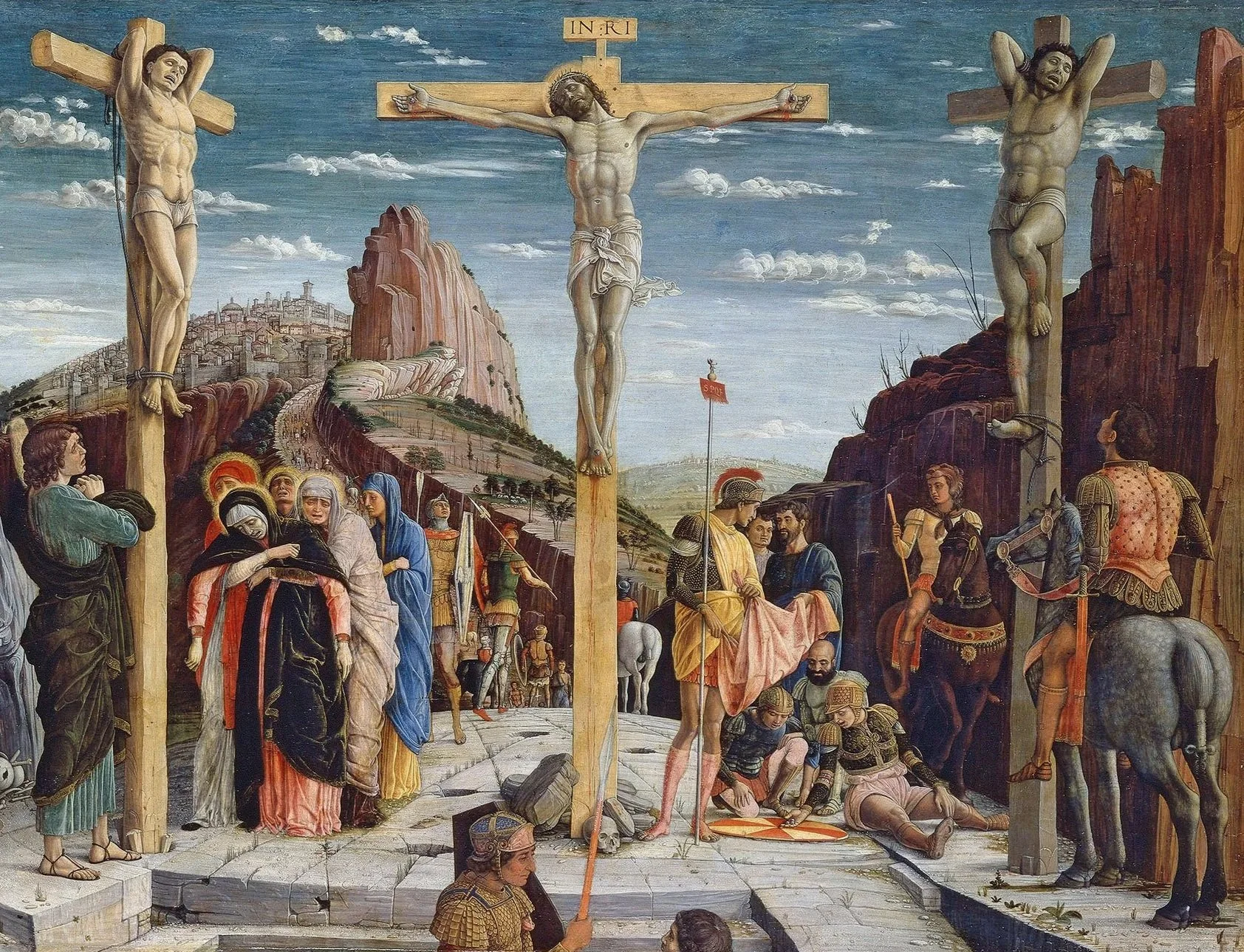
Andrea Mantegna, The Crucifixion (c. 1457–1460). Beneath the Cross, Roman soldiers cast lots for Christ’s seamless tunic. The undivided garment of Christ was understood by the Fathers as an image of the unity of His Church—a unity that schism seeks to rupture.
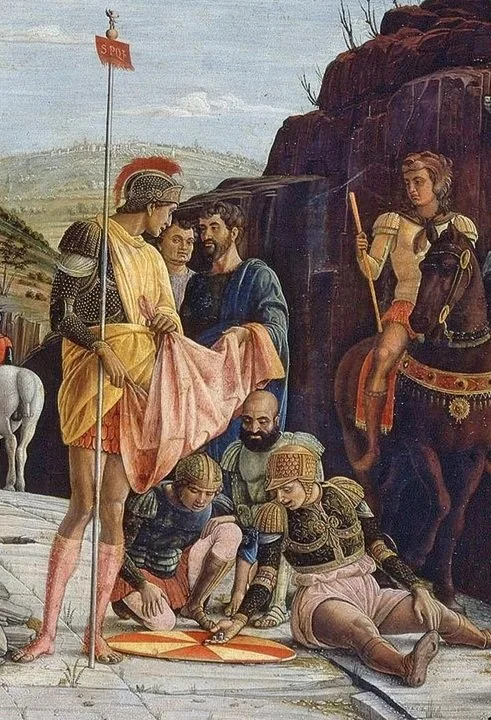
Roman soldiers cast lots for Christ’s seamless tunic.
The Passover Lamb Eaten in One House
St Cyprian also appeals to the command that the Paschal lamb be eaten within one house. The Passover lamb itself prefigures Christ, the true Paschal Lamb. Cyprian draws an additional ecclesial lesson from the single household:
one Paschal lamb → one saving household → one communion in Christ
This does not mean that every detail of the Exodus is a technical prediction of later canon law. It is a patristic theological interpretation illustrating the Church's unity.
Rahab's House
St Cyprian similarly interprets the house of Rahab, within which those seeking deliverance had to remain, as a figure of the Church. Again the principle is:
one divinely appointed place of deliverance → the unity of God's saving people
These examples show that for the Fathers the visible unity of the Church was rooted deeply in their reading of salvation history.
Korah's Rebellion
Another important Old Testament example appears in Numbers 16, where Korah and his followers rebel against the authority established by God through Moses and Aaron.
St Thomas himself invokes Korah when discussing schism. He does not teach that Moses is simply a one-to-one type of every later ecclesiastical superior. Rather, the episode illustrates the gravity of rebellion against divinely constituted religious authority.
Thus the biblical progression may be summarised:
divinely constituted authority in Israel → Christ establishes His Church → Peter receives a unique governing office → ecclesiastical unity continues around legitimate authority
The New Covenant fulfilment is greater because Christ Himself is the invisible Head of the Church, while establishing visible shepherds through whom His Church is governed.
Pope Leo XIII on Unity of Government
Pope Leo XIII's Satis Cognitum (29 June 1896) is among the clearest pre–Vatican II treatments of this subject. Leo teaches that Christ willed the Church to be one not merely in belief but also in government and communion.
Peter and his successors serve as the visible principle and centre of this unity.
Leo therefore explains that bishops deliberately separating themselves from Peter and his legitimate successors cease to participate in the Church's governing unity. He draws heavily upon the Fathers, including St Cyprian, St Jerome, St Optatus and St Irenaeus.
This makes clear why schism is fundamentally ecclesiological.
The sin does not consist merely in being unfriendly toward Rome.
It concerns rejection of the structure of unity established by Christ.
Pope Pius XII and Membership in the Church
Pope Pius XII clarified the consequence in Mystici Corporis Christi (29 June 1943). He teaches that those divided “in faith or government” cannot be living in the unity of Christ's Mystical Body.
This distinction corresponds closely to:
division in faith → heresy
and
division in government → schism.
Pius XII also distinguishes those who separate themselves from ecclesiastical unity from those excluded by legitimate ecclesiastical authority. That distinction leads to another question.
Schism Is Not the Same Thing as Excommunication
Schism is an offence against ecclesiastical unity.
Excommunication is an ecclesiastical censure or penalty.
They are therefore related but not identical. Under Canon 2314 §1 of the 1917 Code, apostates, heretics and schismatics incurred ipso facto excommunication. But conceptually:
the schism is the offence;
the excommunication is the canonical consequence.
Other offences can also result in excommunication without being schism. Likewise, traditional canonical theology distinguished different effects and categories of excommunication. One should therefore not simply use schismatic, heretic, apostate and excommunicated as interchangeable words.
The traditional theological explanation is that the schismatic separates himself from Catholic communion through his own public rupture, whereas excommunication involves exclusion imposed through ecclesiastical law or judgment.
Does Schism Remove a Person from Membership in the Church?
Traditional Catholic teaching answers yes in the case of public schism properly so called.
The Roman Catechism, promulgated following the Council of Trent, lists heretics and schismatics among those excluded from the Church because they have separated themselves from her. It compares them to deserters who remain subject to the authority of the army they abandoned even though they no longer belong to it as members.
This distinction is important. Being outside the Church's membership does not mean that the Church ceases to possess every jurisdictional relation toward the separated person.
Nor does it mean that baptism disappears.
The baptismal character remains.
But the visible bond required for membership has been ruptured.
Pre–Vatican II theologian Mgr Gerardus Van Noort (1861–1946) accordingly regarded it as certain that a public formal schismatic is not a member of the Church. Questions concerning persons who are externally associated with schismatic bodies but act without personal culpability involve further theological distinctions regarding material and formal schism.
The safest principle is therefore not to pretend that we can see every person's conscience. We can identify an external rupture.
Judgment concerning an individual's subjective guilt before God requires additional facts that may not be available to us.
What About the Western Schism?
The so-called Western Schism of 1378–1417 provides an important clarification. At different points there were two and eventually three papal claimants, each supported by Catholics sincerely convinced that their claimant was the legitimate successor of St Peter.
Were all Catholics following the wrong claimant therefore formal schismatics?
Not necessarily.
Why?
Because the dispute concerned primarily a question of fact:
Who is actually the Pope?
The competing parties did not necessarily reject the papacy. On the contrary, they accepted that there must be a legitimate Roman Pontiff and wished to submit to him. Their disagreement concerned which claimant actually possessed the office.
The pre–Vatican II theologian Fr Joachim Salaverri, S.J. (1892–1979) argued precisely this point: the Western Schism did not necessarily constitute formal schism properly so called because those involved sought to identify and obey the legitimate Pope rather than repudiate papal authority.
This historical example establishes an important distinction:
rejecting the authority of the true Pope
is not identical to
disputing whether a particular man actually is the true Pope.
Does Questioning a Papal Claimant Automatically Make Someone Schismatic?
No—not merely by definition.
Canon 1325 says that schism consists in refusing submission to the Supreme Pontiff. That presupposes that the person in question actually possesses that office. Consequently there are two logically separate questions:
Does the papal office exist and must Catholics submit to the legitimate Roman Pontiff?
Does this particular claimant actually possess that office?
A person who answers the first question yes, but disputes the second, is not thereby denying papal authority as such.
This does not by itself prove that his conclusion about the claimant is correct.
He may have made a serious factual or theological mistake. But the accusation of schism cannot simply assume the very fact under dispute. The Western Schism demonstrates why.
A Catholic could mistakenly support the wrong claimant while sincerely intending submission to whoever was truly Pope. Conversely, a man could correctly identify the Pope but nevertheless refuse in principle to acknowledge his governing authority; that would pose the genuine problem of schism. The distinction therefore concerns the object of the will:
“I recognise that Christ established a Pope and I intend to submit to the true Pope, but I believe this claimant lacks the office”
is fundamentally different from:
“I know this man is the legitimate Pope, but I reject his right to govern me.”
The second proposition expresses the essential principle of schism. The first raises a separate question concerning the factual and theological grounds for denying the claimant's title.
How This Relates to Sedevacantism
This distinction is important in evaluating the traditional sedevacantist argument. The sedevacantist argument is not, in its own terms:
“There is a true Pope but Catholics are free to reject his authority.”
It is:
“Christ established the papacy and every Catholic must submit to a legitimate Roman Pontiff; however, a person who publicly defects from the Catholic Faith cannot simultaneously possess the office whose function is to teach and govern that Faith.”
Whether that argument succeeds must be examined separately under the traditional doctrines concerning heresy, Church membership, ecclesiastical office, papal election, loss of office and indefectibility.
But merely labelling the position schismatic does not answer those questions. The logical order matters. One must first establish:
that the claimant is in fact the legitimate Roman Pontiff.
Only then can refusal of the submission owed specifically to him be invoked as evidence of schism. It does not, by itself, establish sedevacantism.
It establishes that the accusation of schism cannot be used circularly as a substitute for resolving the prior question of authority.
Can Someone Be Materially but Not Formally Schismatic?
Traditional theologians used distinctions similar to those employed in discussing heresy. A person may externally belong to a body separated from Catholic communion without personally possessing the deliberate intention or culpability characteristic of formal schism.
For example, someone born generations after a historical separation may never have personally chosen the original act of rebellion. This concerns the distinction between the objective external condition and the subjective culpability of the individual.
The two should not be confused. One may be able to determine that a community is objectively separated from Catholic communion while being unable to determine the guilt of every individual raised within it. This is another reason theological terminology must be used carefully.
The Main Objection
A common objection is:
“Anyone who refuses obedience to the person publicly recognised as Pope is necessarily a schismatic. Therefore questioning or rejecting that claimant proves schism automatically.”
At first sight this appears to follow directly from Canon 1325. But it overlooks a premise contained within the canon itself.
The canon speaks of refusing submission to the Supreme Pontiff. The title of the claimant must therefore already be established.
If the controversy itself concerns whether a claimant validly possesses the papal office, simply repeating that Catholics must obey the Pope does not resolve the dispute. The same logical problem would have existed during the Western Schism. Each side could have accused the other:
“You reject the Pope.”
But that accusation could not settle the matter because the very question under dispute was:
“Which claimant is the Pope?”
Response
Catholic doctrine unquestionably requires submission to the legitimate Roman Pontiff. This is not optional.
Christ instituted the Petrine office as a principle of visible unity, and deliberate rejection of that authority constitutes schism. But Catholic theology also distinguishes the office from a claimant to the office.
A Catholic cannot lawfully reject papal authority itself.
Yet determining whether a particular person possesses that authority can, in extraordinary circumstances, involve a question of fact or law.
Thus two opposite errors must be avoided. The first says:
“Because papal claimants can be disputed, Catholics owe no real obedience to a Pope.”
That destroys the Catholic doctrine of papal jurisdiction.
The second says:
“Anyone who disputes a papal claimant is automatically schismatic, even when the very existence of his title is the question being argued.”
That turns the definition of schism into circular reasoning. Traditional Catholic theology permits neither shortcut.
What We Can and Cannot Conclude
Established Catholic doctrine: Christ established one visible Church possessing unity of faith, government and communion.
Established Catholic doctrine: the Roman Pontiff, as successor of St Peter, is the visible principle of the Church's governmental unity.
Traditional canonical definition: schism consists in refusing submission to the Supreme Pontiff or refusing communion with members of the Church subject to him.
Established theological distinction: heresy is directly opposed to faith; schism is directly opposed to ecclesiastical unity.
Established theological distinction: not every individual act of disobedience constitutes schism.
Traditional teaching on membership: public schism properly so called separates a person from the visible communion of the Church.
Canonical consequence under the 1917 Code: apostasy, heresy and schism incurred ipso facto excommunication under Canon 2314 §1.
Important distinction: schism and excommunication are related but are not identical concepts.
Historical and theological principle illustrated by the Western Schism: uncertainty concerning which claimant possesses papal authority is not necessarily equivalent to rejection of papal authority itself.
Theological conclusion relevant to the present crisis: denying that a particular claimant possesses the papacy is not, merely by definition, identical with refusing submission to a Pope. The merits of that conclusion depend upon the separate evidence concerning the claimant's title.
What cannot be concluded merely from external disagreement: the subjective guilt, bad faith or interior intention of every person involved.
Conclusion
Schism is a grave sin against the visible unity Christ gave His Church. It is not simply disagreement, criticism or isolated disobedience.
Traditional Catholic theology defines it as a deliberate rupture of ecclesiastical communion—particularly refusal of submission to the legitimate Roman Pontiff or refusal of communion with those subject to him.
Scripture insists that Christ's Church is one. The Fathers saw this unity prefigured in the one house of salvation, the one Paschal communion and the seamless garment of Christ. Christ established Peter as a visible principle of that unity; the successors of Peter therefore possess a genuine authority to which Catholics owe submission.
But theological precision is essential.
Heresy attacks faith.
Schism attacks ecclesiastical unity.
Excommunication is a canonical penalty.
Disobedience is not automatically schism.
And disputing who actually possesses the papal office is not logically identical to repudiating the papal office itself.
The Catholic response to ecclesiastical crisis must therefore avoid both rebellion and careless accusations of rebellion. The principle remains simple:
recognise the Church Christ founded → profess her Faith → remain within her communion → submit to her legitimate authority → reject whatever truly separates a soul from the unity of Christ's Mystical Body.
The next necessary question is therefore not merely, “Who is disobedient?”, but more fundamentally:
Who possesses legitimate authority in Christ's Church, and what happens when public heresy appears to conflict with the possession of ecclesiastical office?
Primary Sources
John 10 — one fold and one shepherd. John 10
1 Corinthians 1 — St Paul's condemnation of schisms among Christians. 1 Corinthians 1
Ephesians 4 — one Body, one Spirit, one Lord, one Faith and one Baptism. Ephesians 4
1917 Code of Canon Law, Canon 1325 §2 — definition of heresy, apostasy and schism. 1917 Code — Canon 1325
1917 Code of Canon Law, Canon 2314 — penalties applying to apostates, heretics and schismatics. 1917 Code — Canon 2314
St Thomas Aquinas, Summa Theologiae, II-II, q.39, especially a.1 — nature of schism and distinction from heresy. St Thomas Aquinas — Summa Theologiae II-II q.39
St Ignatius of Antioch (c. AD 35–107), Letter to the Smyrnaeans (c. AD 107), 8–9 — visible unity with ecclesiastical authority. St Ignatius — Letter to the Smyrnaeans
St Cyprian of Carthage (c. AD 200–258), On the Unity of the Catholic Church (c. AD 251) — visible unity of Christ's Church and scriptural figures of that unity. St Cyprian — On the Unity of the Church
Pope Leo XIII, Satis Cognitum (29 June 1896) — unity of the Church and the Petrine principle of government. Leo XIII — Satis Cognitum
Pope Pius XII, Mystici Corporis Christi (29 June 1943), especially §§22–23 — visible membership and division in faith or government. Pius XII — Mystici Corporis Christi
Catechism of the Council of Trent, Part I, Article IX — persons excluded from visible membership of the Church. Roman Catechism — Article IX
Further Reading
Mgr Gerardus Van Noort, Dogmatic Theology, Vol. II: Christ's Church, especially the treatment of Church membership, heresy and schism.
Fr Sylvester Joseph Hunter, S.J., Outlines of Dogmatic Theology, especially the sections treating the Church's visible government and the distinction between disobedience and schism.
Fr Joachim Salaverri, S.J., Sacrae Theologiae Summa, Vol. IB, on Church membership and the Western Schism.
The WM Review, “Membership of the Church – Schism & Excommunication.” This is a useful modern synthesis of several relevant pre–Vatican II authorities, particularly concerning public schism, Church membership, excommunication, doubtful authority and the Western Schism. Its conclusions should be evaluated through the traditional sources it cites rather than treated as an independent doctrinal authority. Membership of the Church – Schism & Excommunication
Related Questions
What Is Heresy?
What Is Apostasy?
What Does It Mean to Be a Member of the Catholic Church?
Why Did Christ Establish the Papacy?
What Authority Did Christ Give to His Church?
What Does “Outside the Church There Is No Salvation” Mean?
Can a Heretic Remain a Member of the Catholic Church?
Can the Catholic Church Be Without a Pope?