Did Vatican II Change Catholic Teaching on Episcopal Collegiality and the Government of the Church?
Short Answer
Vatican II introduced a substantially new theological framework for understanding the episcopate and the government of the universal Church.
Traditional Catholic teaching certainly recognised that bishops succeed the Apostles, possess true ordinary authority in their dioceses, assemble in councils, cooperate with one another, and—when united with and dependent upon the Roman Pontiff—can participate in governing and teaching the universal Church.
The controversy therefore is not whether bishops may act together. The deeper question is:
Where does episcopal governing authority come from, and what is the subject of supreme authority over the universal Church?
Before Vatican II, Catholic teaching distinguished clearly between the power of Orders, received sacramentally, and the power of jurisdiction, which a bishop receives through legitimate canonical mission under the Roman Pontiff.
Pius XII stated the principle explicitly: the power of Orders comes through the sacrament, while episcopal jurisdiction reaches bishops through the Successor of Peter.
Vatican II's Lumen Gentium, however, taught that episcopal consecration itself confers not merely sanctification but also the munera—functions or offices—of teaching and governing, although these can be exercised only in hierarchical communion. It further taught that the episcopal college, always with and never without the Roman Pontiff as its head, is “also the subject of supreme and full power over the universal Church.”
The Council's Nota Explicativa Praevia attempted to delimit this teaching carefully. It explained that munera does not mean immediately exercisable potestates: a further canonical or juridical determination is required. It also insisted that the episcopal college never exists independently of its head and that the Pope retains his complete supreme authority.
These qualifications matter. Vatican II did not abolish papal primacy and did not teach conciliarism. Nevertheless, its doctrine does more than restate the traditional practice of bishops cooperating under the Pope. It establishes a sacramental-collegial conception of episcopal authority and identifies the episcopal college with its head as another subject of supreme and full power over the universal Church.
That conception subsequently entered postconciliar canon law, episcopal conferences, the permanent Synod of Bishops and, eventually, the theology of synodality.
The question therefore reaches beyond administrative reform:
Did Vatican II legitimately develop Catholic teaching about episcopal government—or did it alter the traditional constitution of ecclesiastical authority?
That question matters profoundly because the constitution of the Church is not something the Church is free to reinvent.
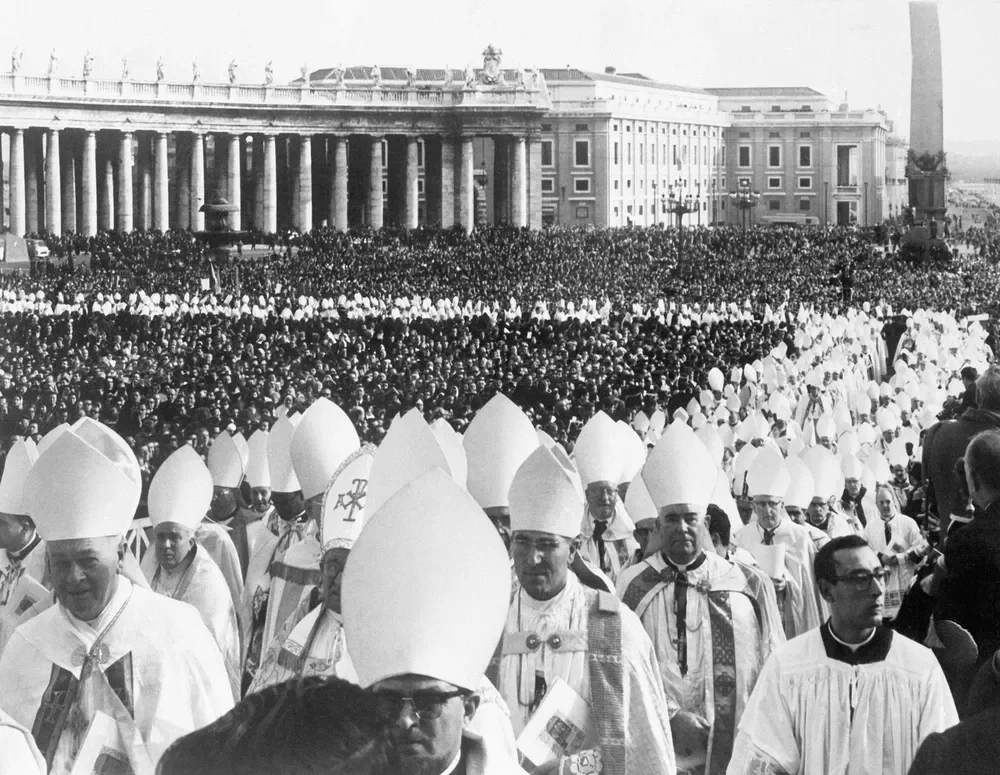
Council Fathers at Vatican II. Bishops process through St Peter’s Square on 15 September 1965 for the opening of the fourth and final session of the Second Vatican Council. The Council’s debates over episcopal collegiality and the relationship between the bishops and the Roman Pontiff became central to its new formulation of the Church’s hierarchical government.
Why This Question Matters
At first sight, “episcopal collegiality” may sound like an obscure dispute about how bishops hold meetings. It is not.
The controversy concerns the divinely constituted government of the Catholic Church.
Christ did not merely leave Christians a body of doctrines. He founded a visible Church possessing divinely instituted authority. The questions therefore include:
What authority did Christ give Peter?
What authority belongs to the Apostles and their successors?
What does episcopal consecration confer?
What requires canonical mission?
From where does a diocesan bishop obtain jurisdiction?
Does the episcopate collectively possess supreme jurisdiction over the universal Church?
Is there one subject of supreme ecclesiastical power or, in some sense, two?
What precisely is the relationship between the Pope and the episcopal college?
These are constitutional questions. And unlike purely human organisations, the Catholic Church cannot simply redesign her constitution according to changing theories of governance.
What the Catholic Church Taught Before Vatican II
Christ Established Peter as the Visible Head
Christ told St Peter:
“Thou art Peter; and upon this rock I will build my church.” — Matthew 16:18
He entrusted Peter with the keys of the kingdom:
“And I will give to thee the keys of the kingdom of heaven.” Matthew 16:19
And after the Resurrection Christ commanded him:
“Feed my lambs… Feed my sheep.” — John 21:15–17
Catholic theology did not understand these passages as merely granting Peter a place of honour. They establish jurisdiction.
Leo XIII explained in Satis Cognitum that Peter's primacy necessarily entails the authority “of commanding, forbidding, and judging”—that is, jurisdiction. He further taught that this supreme authority continues in Peter's successors.
Vatican I: Supreme Jurisdiction Belongs to the Roman Pontiff
The First Vatican Council solemnly defined that the Roman Pontiff possesses:
full power;
supreme power;
ordinary power;
immediate jurisdiction;
over the whole Church, including every pastor and faithful Christian.
It explicitly rejected the theory that the Pope possesses merely supervision or direction. His jurisdiction is immediate over all particular Churches, all pastors and all faithful. Yet Vatican I did not turn bishops into papal employees. It simultaneously affirmed their true episcopal jurisdiction.
Bishops are genuine pastors who govern the flocks assigned to them with ordinary and immediate authority. Thus the traditional structure was not:
POPE → powerless episcopal delegates
but:
CHRIST
↓
PETER / ROMAN PONTIFF — SUPREME UNIVERSAL JURISDICTION
↓
BISHOPS — TRUE ORDINARY PASTORS OF PARTICULAR CHURCHES
The Pope's supreme jurisdiction strengthens rather than destroys legitimate episcopal authority.
Bishops Are True Successors of the Apostles
Leo XIII explicitly rejected the idea that bishops are merely vicars of the Pope. In Satis Cognitum he taught that because bishops succeed the Apostles they possess true ordinary authority and belong necessarily to the divine constitution of the Church. But Leo XIII immediately added a decisive qualification.
The Apostles received nothing apart from Peter, whereas Peter received certain powers apart from the Apostles. Bishops separated from Peter consequently lose the right and power of governing. This gives us an important distinction:
EPISCOPAL AUTHORITY IS REAL
but
EPISCOPAL AUTHORITY IS NOT INDEPENDENT OF PETRINE AUTHORITY.
There is therefore nothing intrinsically un-Catholic about episcopal cooperation, councils or collective episcopal action. The controversy surrounding Vatican II concerns something more precise.
Orders and Jurisdiction: The Crucial Traditional Distinction
Before Vatican II, Catholic theology distinguished two hierarchies:
Hierarchy of Orders
Concerned principally with sacramental power.
Hierarchy of Jurisdiction
Concerned with governing the Church. A man can possess valid episcopal consecration without possessing legitimate jurisdiction.
This distinction is indispensable. A validly consecrated schismatic bishop, for example, may possess episcopal sacramental power while possessing no legitimate authority to govern the Catholic Church. Sacramental consecration and canonical authority therefore cannot simply be identified.
Pius XII States the Principle Explicitly
This point becomes especially important because Pius XII addressed it shortly before Vatican II. In Ad Sinarum Gentem (1954), he distinguished the two hierarchies and taught:
“the power of jurisdiction… flows to the Bishops… only through the Successor of St. Peter”
while the power of Orders comes through the Sacrament of Holy Orders. He had already stated in Mystici Corporis Christi (1943) that bishops possess ordinary jurisdiction which they receive directly from the Roman Pontiff.
And in Ad Apostolorum Principis (1958), condemning illicit episcopal appointments in China, Pius XII repeated the doctrine: bishops exercise true ordinary jurisdiction, but receive it from the Supreme Pontiff. This gives us a remarkably clear preconciliar baseline:
EPISCOPAL CONSECRATION → sacramental power / hierarchy of Orders
CANONICAL MISSION UNDER THE ROMAN PONTIFF → jurisdiction / authority to govern a flock
That distinction becomes central when we reach Lumen Gentium.
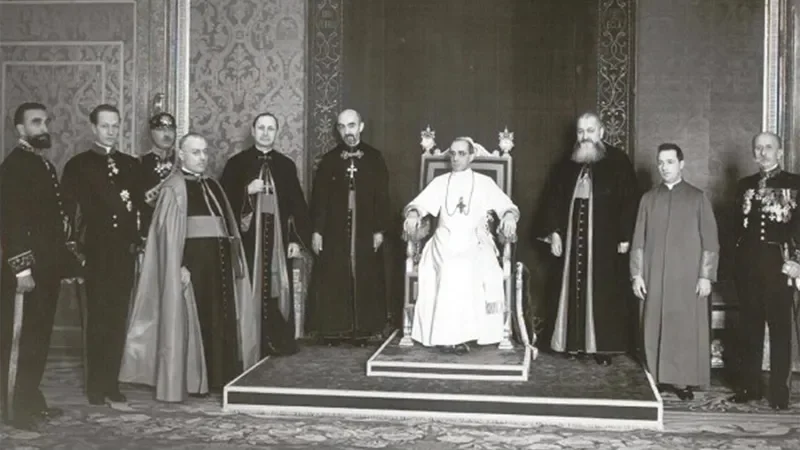
Pope Pius XII, whose preconciliar teaching provides an important baseline for the controversy over episcopal jurisdiction. Pius XII distinguished the sacramental power of Orders from the power of jurisdiction and taught that episcopal jurisdiction reaches bishops through the Successor of St Peter.
What Vatican II Taught
Lumen Gentium 21: Consecration Confers the Munus of Governing
Vatican II taught:
“Episcopal consecration, together with the office of sanctifying, also confers the office of teaching and of governing…” — Lumen Gentium 21.
The Latin uses:
munera docendi et regendi
—the functions or offices of teaching and governing. This represents an important shift in theological formulation. The traditional framework emphasised:
consecration → Orders
and
canonical mission → jurisdiction.
Vatican II instead roots the episcopal munera of sanctifying, teaching and governing in episcopal consecration itself. But that is not the entire teaching.
The Nota Praevia: A Crucial Qualification
The Council Fathers were conscious that this formulation raised serious questions. The Nota Explicativa Praevia attached to Lumen Gentium therefore explained exactly what was—and was not—being claimed. It states that episcopal consecration gives an:
“ontological participation in the sacred functions [munera]”
but deliberately uses munera rather than potestates—powers. Why? Because actual governing power requires something additional. The Note explains:
“for this power to be fully ready to act, there must be a further canonical or juridical determination through the hierarchical authority.”
This distinction is essential. Vatican II therefore does not straightforwardly teach:
Consecration alone → immediately exercisable jurisdiction.
Its position is more subtle:
EPISCOPAL CONSECRATION
↓
ONTOLOGICAL PARTICIPATION IN THE MUNERA OF SANCTIFYING, TEACHING AND GOVERNING
↓
CANONICAL/JURIDICAL DETERMINATION
↓
POWER BECOMES CONCRETELY EXERCISABLE
This qualification prevents us from claiming that Vatican II simply abolished canonical mission. It did not.
But Has the Theology Nevertheless Changed?
Yes—at least at the level of theological framework. Pius XII had said:
Orders come sacramentally; jurisdiction comes through the Roman Pontiff.
Vatican II says:
Consecration itself confers an ontological participation in the episcopal functions of teaching and governing, while canonical determination is necessary for the resulting power to become exercisable.
Those are not simply identical formulations. The continuity argument responds that Vatican II has merely distinguished:
ontological possession of the episcopal munus
from
juridical determination permitting its exercise.
On that interpretation, Pius XII was describing the juridically exercisable jurisdiction of a bishop, whereas Vatican II penetrated more deeply into its sacramental foundation. That is the strongest continuity explanation. But it raises a serious question:
If governing authority traditionally reaches the bishop through canonical mission from the supreme authority, in what meaningful sense is the governing munus already conferred sacramentally before that jurisdiction is received?
The Nota Praevia does not eliminate this question. It formalises it.
Lumen Gentium 22: The Episcopal College
Vatican II then moves from the individual bishop to the episcopate collectively. It teaches that a man becomes a member of the episcopal body through:
episcopal consecration + hierarchical communion with the head and members of the body.
The Council then states:
“the college or body of bishops has no authority unless it is understood together with the Roman Pontiff… as its head.”
This is an important safeguard. Vatican II explicitly affirms that the Pope retains:
“full, supreme and universal power over the Church”
and may always exercise that authority freely. So Vatican II does not teach:
POPE + BISHOPS = parliamentary government
or:
EPISCOPAL COLLEGE > POPE
or:
COUNCIL > POPE.
Such descriptions would misrepresent the document. But Lumen Gentium then makes the proposition that generated the deeper controversy.
“Also the Subject of Supreme and Full Power”
The Council states:
“The order of bishops… is also the subject of supreme and full power over the universal Church”
provided the episcopal body is understood together with its head, the Roman Pontiff, and never without him. That word “also” matters. We now have:
Roman Pontiff individually
full + supreme + universal power
and
Roman Pontiff together with the episcopal college
supreme + full power over the universal Church
The Nota Praevia addresses precisely this difficulty. It explains that the distinction is not:
POPE
versus
BISHOPS
but:
POPE ALONE
versus
POPE + BISHOPS.
Thus the college cannot act against the Pope.
It cannot act without the Pope.
It cannot summon itself into supreme action.
Its head remains the Roman Pontiff.
The Pope retains his complete primatial authority. Nevertheless, Vatican II expressly describes the episcopal college with its head as “also” a subject of supreme and full power.
That is the doctrinal novelty requiring examination.
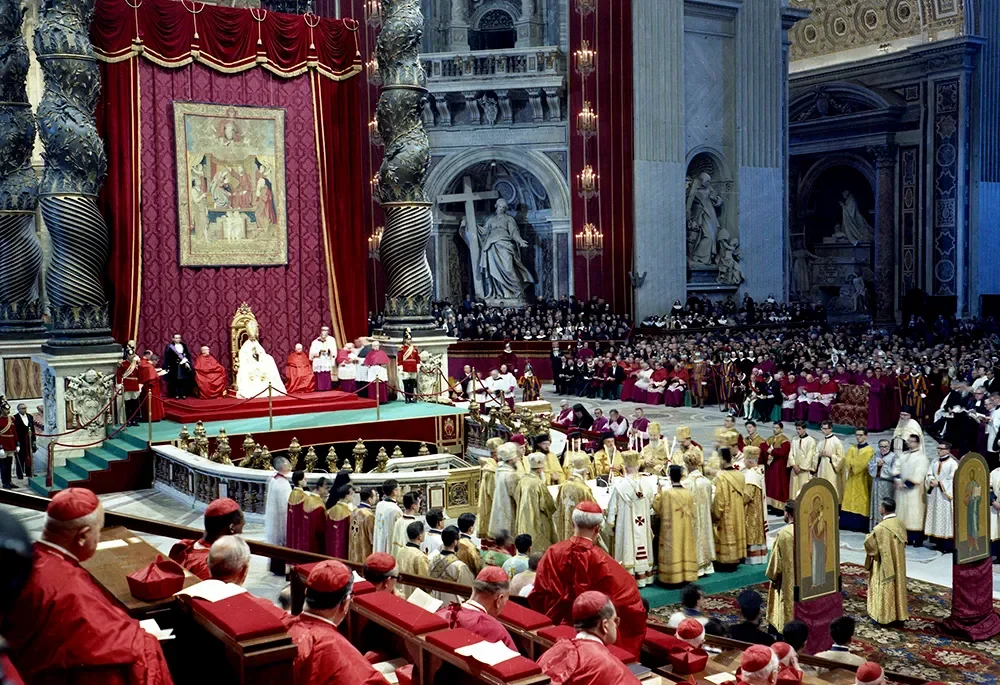
Paul VI presides during the Second Vatican Council. Vatican II's doctrine of episcopal collegiality did not formally place the college above the Roman Pontiff: the Council maintained the Pope's full, supreme and universal power while teaching that the episcopal college, necessarily with the Pope as its head, is also a subject of supreme and full power over the universal Church.
Is There One Supreme Power or Two?
The problem can be represented simply:
Traditional emphasis
ROMAN PONTIFF
Supreme universal jurisdiction
↓
Bishops possess true ordinary jurisdiction over the flocks canonically committed to them.
Vatican II framework
ROMAN PONTIFF ALONE
Supreme + full + universal power
AND
ROMAN PONTIFF + EPISCOPAL COLLEGE
Also subject of supreme + full power
The Nota Praevia attempts to prevent these from becoming two competing supreme authorities. Because the Pope necessarily belongs to the college as its head, the two subjects are never independent competitors. But a theological question remains:
Can there properly be two subjects possessing the same supreme and full authority—one individual and one corporate—even when the corporate subject necessarily contains the individual subject?
That is considerably more than a dispute about bishops cooperating.
Leo XIII Provides an Important Preconciliar Comparison
Leo XIII recognised that the Apostles possessed collective authority with Peter. But his formulation strongly emphasised that nothing was granted to the Apostles independently of Peter and that Peter remains the source and principle of ecclesiastical unity.
He also rejected any conception in which the bishops collectively could become an authority upon which Peter depended. This makes the precise Vatican II innovation easier to identify.
It is not:
Bishops can participate collectively in governing the Church.
That was already Catholic. It is the theological construction of the episcopate as a permanently existing college, constituted sacramentally and described with its head as itself a subject of supreme and full universal power.
Ecumenical Councils Do Not Require Vatican II's Collegial Theory
Catholics had held ecumenical councils for many centuries before Vatican II. Therefore:
“Bishops can exercise authority collectively in an ecumenical council”
does not prove Vatican II's specific doctrine of collegiality.
Traditionally an ecumenical council exercises authority because it is united with and confirmed by the Roman Pontiff. Vatican II itself retains this requirement: no council is ecumenical without papal confirmation or acceptance. The disputed question is therefore not the existence of councils.
It concerns the underlying theological subject possessing supreme authority.
Council → Implementation → Consequence
The significance of collegiality becomes clearer when we follow what happened after Vatican II.
1. Lumen Gentium
Episcopal consecration gives participation in the munera of teaching and governing. The episcopate constitutes a college. The college with its head is “also” a subject of supreme and full universal power.
↓
2. Christus Dominus
The Council applied this ecclesiology institutionally. It encouraged bishops to act collectively and gave particular prominence to episcopal conferences. It described bishops as exercising their episcopal office, received through episcopal consecration, in communion with and under the authority of the Supreme Pontiff.
↓
3. Permanent Synod of Bishops
Paul VI established the Synod of Bishops in 1965. His Apostolica Sollicitudo explicitly connected it with increased episcopal participation in concern for the universal Church. The Synod remained directly subject to the Pope and ordinarily advisory, although Paul VI provided that it could receive decision-making power from him.
↓
4. Episcopal Conferences
After Vatican II, episcopal conferences became permanent and increasingly important structures. John Paul II later acknowledged both their dramatic development and theological questions concerning their relationship with individual diocesan bishops. His Apostolos Suos described episcopal conferences as concrete applications of the collegial spirit while carefully distinguishing them from the episcopal college itself.
↓
5. Synodality
The development did not end with collegiality. The International Theological Commission stated in 2018:
“Vatican II's teaching on the sacramentality of the episcopate and on collegiality is a basic theological premise for a correct and complete theology of synodality.”
Francis's Episcopalis Communio likewise described the Synod of Bishops as one of the particularly valuable fruits of Vatican II and presented it as a manifestation of episcopal communion “with and under Peter.” The historical trajectory is therefore documented:
VATICAN II
↓
SACRAMENTALITY OF EPISCOPATE
↓
COLLEGIALITY
↓
EPISCOPAL CONFERENCES + SYNOD OF BISHOPS
↓
DEVELOPING THEOLOGY OF SYNODALITY
This is not merely a later abuse imposed upon an unrelated Council. Postconciliar authorities themselves trace the development back to Vatican II.
Did Collegiality Destroy Papal Primacy?
No. That claim would go beyond the evidence. Lumen Gentium explicitly affirms:
the Pope's primacy;
his supreme universal authority;
his freedom to exercise that authority;
the dependence of collegial action upon him;
his authority to summon and confirm councils.
The Nota Praevia was deliberately formulated to exclude interpretations threatening papal supremacy. Therefore the strongest traditional criticism is not:
Vatican II abolished the papacy.
It did not. The question is more exact:
Did Vatican II preserve the traditional words concerning papal primacy while simultaneously introducing a new sacramental-collegial conception of episcopal authority that altered the traditional theology of Church government?
That is the issue the documentary evidence requires us to examine.
The Strongest Continuity Argument
A defender of Vatican II can construct a serious argument. It runs approximately as follows.
First
The episcopal college does not exist independently of the Pope. The Pope is intrinsically its head.
Second
The Pope retains full, supreme and universal jurisdiction independently.
Third
The bishops collectively cannot exercise supreme authority without papal consent.
Fourth
Consecration gives only the ontological munus of government—not immediately exercisable jurisdiction. Canonical mission remains necessary.
Fifth
Therefore Pius XII and Vatican II concern different aspects of the same reality:
Pius XII: juridical source of exercisable episcopal jurisdiction.
Vatican II: sacramental foundation of episcopal ministry.
Sixth
Consequently collegiality represents a legitimate theological development rather than a contradiction. This is substantially stronger than simply saying:
“Vatican II must be traditional because it was a council.”
The argument deserves to be answered on its own terms.
Response: The Difficulty Remains
The Nota Praevia certainly prevents the crude interpretation that consecration alone supplies immediately exercisable jurisdiction. But it does not make the preconciliar and conciliar formulations identical.
Pius XII's distinction is clear:
ORDERS → sacramental consecration
JURISDICTION → through the Roman Pontiff.
Vatican II introduces:
CONSECRATION → ontological participation in sanctifying + teaching + governing munera
followed by:
CANONICAL DETERMINATION → makes governing power concretely exercisable.
The theological location of the governing function has therefore moved. The question becomes whether canonical mission causes jurisdiction or merely determines the exercise of a governing reality already received sacramentally.
That is not an insignificant verbal distinction. It concerns the source of ecclesiastical government.
The Second Difficulty: The Subject of Supreme Power
An even larger difficulty arises with Lumen Gentium 22. The preconciliar Magisterium unquestionably recognised the authority of bishops acting collectively with the Pope. But Vatican II formulates the matter ontologically:
the episcopal college with its head is also the subject of supreme and full power over the universal Church.
The Nota Praevia ensures that this subject can never exist or act independently of the Pope. But it does not erase the proposition.
The Council still identifies:
POPE ALONE
and
POPE-WITH-COLLEGE
as distinguishable subjects of supreme and full ecclesiastical power. That formulation requires justification against the earlier doctrine of the Roman Pontiff's singular supreme jurisdiction.
Why the Nota Praevia Is Historically Significant
The existence of the explanatory note itself does not prove heresy. Nor does controversy during a council prove that its final teaching is false. But the Nota Praevia is important evidence because it shows exactly where clarification was considered necessary.
Its language repeatedly protects:
papal freedom;
papal supremacy;
canonical determination;
juridical structure;
the impossibility of an episcopal college acting without its head.
Those safeguards tell us where the theological pressure points lay. They should therefore be incorporated into the analysis rather than ignored.
From Collegiality to Synodality
This development is especially important when Vatican II is considered as part of the wider postconciliar transformation. Collegiality did not remain an abstract paragraph in Lumen Gentium. It produced or strengthened a different governing culture.
The postconciliar system increasingly emphasised:
communion
↓
college
↓
episcopal conference
↓
Synod of Bishops
↓
synodality
The International Theological Commission expressly describes Vatican II's doctrine of episcopal sacramentality and collegiality as a theological foundation of synodality. That does not mean every contemporary synodal practice was commanded explicitly by Vatican II. It means the development cannot simply be dismissed as having nothing to do with Vatican II. There is an identifiable theological genealogy.
A Significant Postconciliar Tension
Interestingly, the postconciliar system itself eventually had to place limits upon collective episcopal structures. John Paul II's Apostolos Suos insisted that episcopal conferences are not themselves the episcopal college and cannot replace the authority of individual diocesan bishops. It acknowledged questions about their theological and juridical status and warned against their improperly substituting themselves for individual bishops.
That qualification is important. It shows that even within postconciliar ecclesiology, the expansion of collective structures created questions about the relationship between:
POPE
COLLEGE
EPISCOPAL CONFERENCE
INDIVIDUAL BISHOP
The solution was not to abandon collegiality but to distinguish its different manifestations more carefully.
Does This Help Establish the Wider Postconciliar Rupture?
Yes, but with necessary precision. Collegiality should not be treated in isolation. Placed beside other Vatican II changes examined throughout this FAQ series, a larger pattern emerges:
religious liberty
ecumenism
Church membership
subsistit in
non-Christian religions
apostolic succession
canonical mission
collegiality
synodality
mission and conversion
liturgical reform
Each subject requires its own documentary demonstration. No single one should simply be assumed to prove an entirely new religion. But collectively they raise the larger question:
Did Vatican II merely modernise Catholic terminology, or did it introduce a different theological framework for understanding the Church, her authority, her unity, her relationship with non-Catholics and her supernatural mission?
Collegiality is one important component of that cumulative case.
Institutional Continuity Versus Doctrinal Continuity
After Vatican II the visible structures remained. There was still:
a Vatican;
a claimant to the papacy;
bishops;
dioceses;
cathedrals;
canon law;
episcopal conferences;
Roman congregations and dicasteries;
Catholic schools;
Catholic universities;
seminaries;
parishes.
Institutional continuity is therefore undeniable. But institutional continuity does not by itself settle the theological question. The Catholic claim concerns continuity of:
Faith
doctrine
sacraments
ecclesiology
government
mission
legitimate authority.
If the constitution of ecclesiastical authority itself has been substantially reconceived, continued possession of episcopal sees does not answer whether the same Catholic ecclesiology continues to be professed within them. That distinction is essential to the wider sedevacantist argument.
Why This Eventually Reaches Sedevacantism
The argument must be made carefully. It is not:
Vatican II discussed collegiality
↓
therefore no pope.
That would be an enormous non sequitur. The proper sequence is:
Christ established the constitution of His Church
↓
The Church cannot alter her divinely instituted constitution
↓
The traditional Magisterium establishes the relationship between papal primacy, episcopal jurisdiction and canonical mission
↓
Vatican II introduced a sacramental-collegial framework requiring comparison with that doctrine
↓
If that framework can be reconciled with previous teaching, legitimate development remains possible
↓
If an actual contradiction concerning the divine constitution of the Church is demonstrated, the problem is doctrinal rather than merely administrative
↓
An indefectible Church cannot authoritatively impose upon the universal Church a false ecclesiology contrary to her divine constitution
↓
The authority responsible for promulgating such teaching must then be examined
↓
That reaches the question of papal authority
↓
and therefore eventually the sedevacantist thesis.
This is why collegiality matters. It is not merely about how bishops hold meetings. It concerns what the Church is and where Christ placed authority within her.
Main Objection
“Vatican II Explicitly Preserved Papal Primacy, So There Cannot Be a Rupture”
This is the strongest objection. Lumen Gentium expressly teaches that:
the Pope possesses full, supreme and universal power;
he may always exercise that power freely;
the college possesses no authority without him;
collegial power cannot be exercised without his consent;
the Pope summons, directs and confirms collegial action.
Therefore, it is argued, Vatican II cannot reasonably be accused of replacing papal monarchy with episcopal democracy. That conclusion is correct as far as it goes. But it does not resolve the actual question. The issue is not whether Vatican II denied every proposition taught by Vatican I. It plainly did not.
The question is whether it simultaneously introduced additional propositions about:
the sacramental origin of the governing munus; and
the episcopal college as another subject of supreme and full power;
which substantially altered the previous theological account of ecclesiastical jurisdiction.
One doctrine can preserve earlier terminology while introducing a new conceptual framework around it. Therefore the correct comparison must concern the propositions themselves.
What We Can and Cannot Conclude
What We Can Conclude
Traditional Catholicism distinguished Orders from jurisdiction. Episcopal consecration and legitimate authority to govern are not identical.
Pius XII taught explicitly that episcopal jurisdiction reaches bishops through the Roman Pontiff. This is documented directly in his preconciliar Magisterium.
Vatican II deliberately reformulated the theology. Lumen Gentium teaches that episcopal consecration confers an ontological participation in the munera of sanctifying, teaching and governing.
Vatican II did not teach that consecration alone supplies immediately exercisable jurisdiction. The Nota Praevia explicitly requires further canonical or juridical determination.
Vatican II taught that the episcopal college with the Pope as head is “also” a subject of supreme and full power over the universal Church. That proposition is explicit.
Vatican II simultaneously preserved strong affirmations of papal primacy. Therefore it would be inaccurate to say simply that Vatican II abolished papal supremacy.
Collegiality was subsequently institutionalised. The permanent Synod of Bishops, strengthened episcopal conferences and subsequent theology of synodality were consciously connected by postconciliar authorities with Vatican II's ecclesiology.
The resulting framework differs substantially in formulation and conceptual structure from the preconciliar presentation.
The central theological question is whether that difference constitutes legitimate development or doctrinal rupture.
What We Cannot Conclude From This Article Alone
We cannot conclude merely from the word collegiality that Vatican II formally taught conciliarism. It did not.
We cannot say that Vatican II made the episcopal college superior to the Pope. It did not.
We cannot say that episcopal conferences themselves possess the supreme authority of the universal episcopal college. Postconciliar teaching explicitly rejects that identification.
Nor does this issue by itself prove sedevacantism. That conclusion requires additional premises concerning:
indefectibility;
Magisterial authority;
public heresy;
Church membership;
ecclesiastical office;
jurisdiction;
papal election;
loss or non-acquisition of office;
universal peaceful acceptance.
Those questions must be addressed separately. But neither should the problem be reduced to administrative reform. The theological change is real and identifiable.
Conclusion
Vatican II did change the Catholic theological framework used to explain episcopal authority and the government of the universal Church.
Before the Council, particularly in the teaching of Pius XII, the distinction was sharply expressed:
episcopal consecration → Orders
while
canonical mission under the Roman Pontiff → jurisdiction.
Vatican II instead taught that episcopal consecration itself confers an ontological participation in the munera of sanctifying, teaching and governing, while requiring subsequent hierarchical and juridical determination before governing power becomes exercisable.
It then went further. Lumen Gentium described the episcopal college, necessarily including and subordinated to the Roman Pontiff as its head, as “also the subject of supreme and full power over the universal Church.”
The Council carefully protected papal primacy. Therefore the issue should not be caricatured as Vatican II replacing the Pope with a parliament of bishops. The deeper change is the emergence of a sacramental-collegial ecclesiology of government alongside the traditional doctrine of papal primacy. That conception did not remain theoretical. It passed from:
Vatican II
↓
collegiality
↓
permanent Synod of Bishops
↓
episcopal conferences
↓
1983 canonical structures
↓
contemporary synodality.
Postconciliar authorities themselves identify that genealogy. The ultimate theological question is therefore unavoidable:
Can this conception be demonstrated to be a homogeneous development of the constitution Christ gave His Church, or does it represent a substantial alteration in the Catholic doctrine of ecclesiastical government?
If the former can be demonstrated, collegiality is legitimate development.
If the latter is demonstrated, the consequences extend far beyond administrative preference.
For the Catholic Church is indefectible. She cannot receive one divine constitution from Christ and later authoritatively replace it with another. And once that principle is recognised, the question necessarily moves from collegiality to authority:
If a substantially altered ecclesiology was authoritatively imposed upon the structures claiming to be the Catholic Church, what does that imply about the authority of those who imposed it?
That is where the collegiality controversy ultimately intersects with the wider theological case for sedevacantism.
Primary Sources
Holy Scripture — Matthew 16:18–19; Luke 22:31–32; John 21:15–17 — Petrine foundation, keys and pastoral commission.
First Vatican Council, Pastor Aeternus (1870) — Defines the Roman Pontiff's full, supreme, ordinary and immediate jurisdiction throughout the universal Church.
Vatican I — Pastor Aeternus
Leo XIII, Satis Cognitum (1896) — Explains papal primacy, episcopal authority and the dependence of episcopal government upon communion with Peter.
Leo XIII — Satis Cognitum
Pius XII, Mystici Corporis Christi (1943) — States that bishops possess ordinary jurisdiction received from the Supreme Pontiff.
Pius XII — Mystici Corporis Christi
Pius XII, Ad Sinarum Gentem (1954) — Distinguishes the hierarchy of Orders from jurisdiction and teaches that episcopal jurisdiction reaches bishops through the Successor of Peter.
Pius XII — Ad Sinarum Gentem
Pius XII, Ad Apostolorum Principis (1958) — Reaffirms the source of episcopal jurisdiction in the context of illicit episcopal appointments.
Pius XII — Ad Apostolorum Principis
Second Vatican Council, Lumen Gentium 18–27 and Nota Explicativa Praevia (1964) — Principal conciliar teaching concerning sacramentality of episcopacy, episcopal munera, collegiality and supreme authority.
Vatican II — Lumen Gentium and Nota Praevia
Second Vatican Council, Christus Dominus (1965) — Applies conciliar episcopal theology to episcopal government, cooperation and conferences.
Vatican II — Christus Dominus
Paul VI, Apostolica Sollicitudo (1965) — Establishes the permanent Synod of Bishops following Vatican II.
Paul VI — Apostolica Sollicitudo
John Paul II, Apostolos Suos (1998) — Explains the theological and juridical nature of episcopal conferences and their relationship with collegiality.
John Paul II — Apostolos Suos
International Theological Commission, Synodality in the Life and Mission of the Church (2018) — Explicitly identifies Vatican II's teaching on episcopal sacramentality and collegiality as a theological premise of synodality.
International Theological Commission — Synodality in the Life and Mission of the Church
Francis, Episcopalis Communio (2018) — Develops the Synod of Bishops within the postconciliar conception of episcopal communion.
Episcopalis Communio
Further Reading
St Robert Bellarmine, De Romano Pontifice — Classical treatment of papal primacy and ecclesiastical authority.
Cardinal Louis Billot, De Ecclesia Christi — Detailed preconciliar theological treatment of the Church's constitution, episcopate and jurisdiction.
Mgr G. Van Noort, Dogmatic Theology: Christ's Church — Useful preconciliar synthesis of hierarchy, jurisdiction, apostolic succession and papal primacy.
Cardinal Alfredo Ottaviani, ecclesiological writings and conciliar interventions — Important for understanding the concerns surrounding collegiality during Vatican II.
Fr Ralph Wiltgen, The Rhine Flows into the Tiber — Secondary historical account of the debates and factions during Vatican II; useful as history rather than Magisterial authority.
Related Questions
Did Vatican II Change the Catholic Understanding of Apostolic Succession?
Did Vatican II Change the Nature of the Catholic Church?
What Does “Subsists In” Mean?
Did Vatican II Change the Role of Bishops and Episcopal Conferences?
What Is Synodality, and Where Did It Come From?
Can Catholic Doctrine Change?
Can the Catholic Church Authoritatively Teach Error?
Can a Public Heretic Hold Ecclesiastical Office?
Can a Heretic Be Pope?
Why Do Sedevacantists Believe the Papal See Is Vacant?