What Did Vatican II Change About the Nature of the Church?
Short Answer
Vatican II introduced a substantial change in the theological framework by which the Church of Christ, her visible boundaries, her membership, and her relationship with separated Christians are understood.
Before Vatican II, the traditional Catholic doctrine was expressed with remarkable clarity:
The Mystical Body of Christ is the Roman Catholic Church.
Christ founded one visible Church, united in:
one Faith;
one sacramental life;
one government;
one visible communion;
submission to the legitimate hierarchy culminating in the Roman Pontiff.
Catholic truths, valid Baptism, Scripture, and even valid sacraments could exist materially outside the Church because separated Christians had retained things originating from her. But this did not make their separated religious societies constituent parts of the Church of Christ.
Pius XII reaffirmed this shortly before Vatican II when he condemned those who questioned the doctrine that:
“the Mystical Body of Christ and the Roman Catholic Church are one and the same thing.”
Vatican II introduced a different ecclesiological vocabulary and structure. Lumen Gentium taught that the Church of Christ:
“subsists in the Catholic Church”
while “elements of sanctification and truth” exist outside her visible structure. The Council further taught that:
non-Catholic Christians are in imperfect communion with the Catholic Church;
numerous ecclesial elements exist outside her visible boundaries;
separated bodies may be called Churches and ecclesial communities;
their religious actions can engender grace;
the Holy Ghost uses separated Churches and communities “as means of salvation”;
the Church is prominently presented as the People of God;
humanity is described as belonging or being related to this People of God “in various ways.”
The postconciliar authorities subsequently explained that the Church of Christ can be described as “present and operative” in separated Churches and ecclesial communities. The issue therefore goes far beyond replacing one Latin verb. The ecclesiological structure has changed:
from a sharply delimited visible Church outside which Catholic elements may accidentally remain
to:
a communion ecclesiology in which elements of the Church, degrees of communion, ecclesial realities, and salvific functions extend beyond the visible boundaries of the Catholic Church.
That change supplied the theological foundation for the new ecumenism and became one of the principal building blocks of the post-Vatican II religious system.
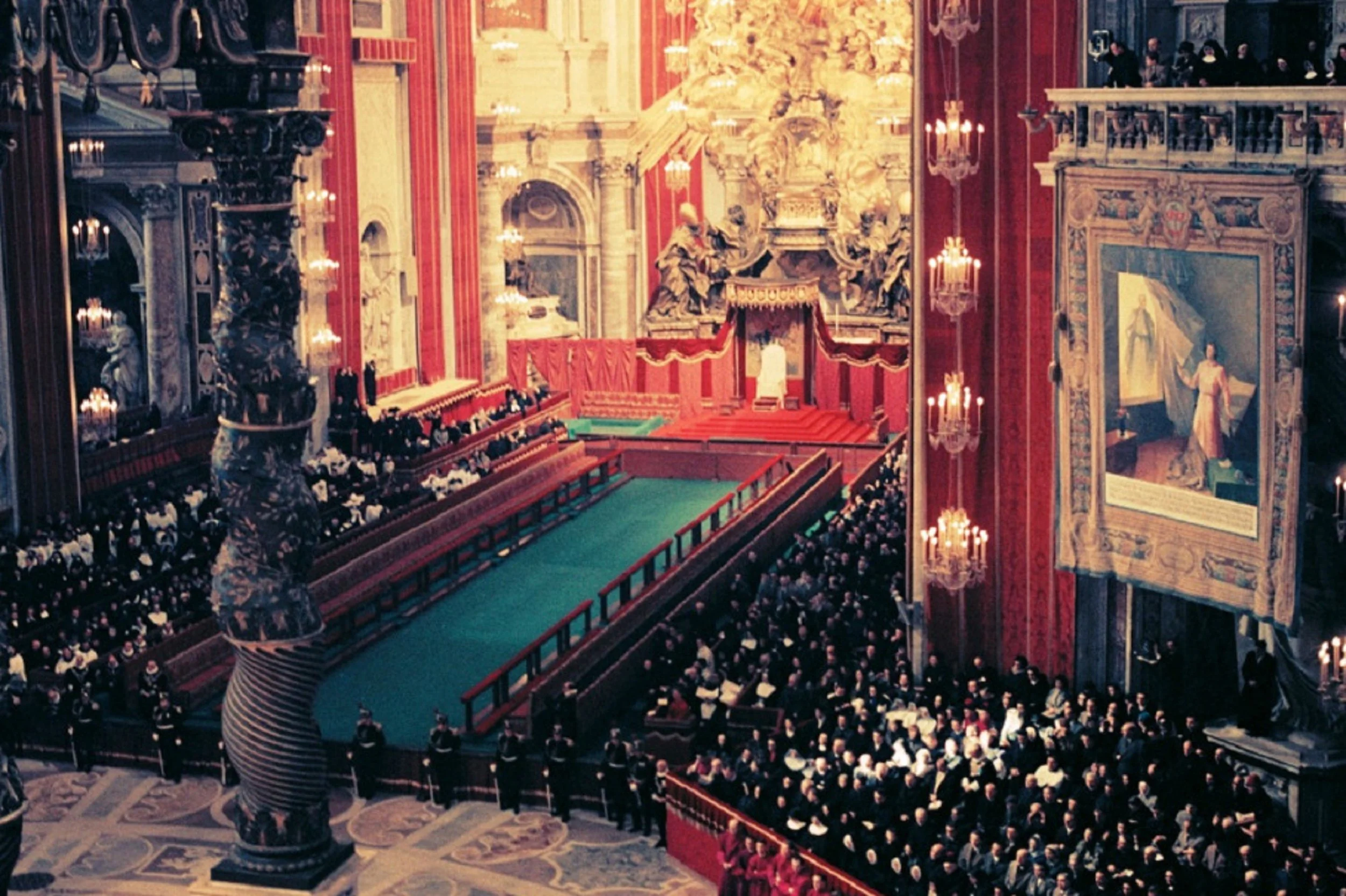
The Second Vatican Council (1962–1965) assembled thousands of bishops in St Peter's Basilica. Its Constitution Lumen Gentium introduced the formulation that the Church of Christ “subsists in” the Catholic Church, while its other documents developed a new ecclesiological language concerning separated Christians, ecumenism and non-Christian religions.
Why This Question Matters
Before asking whether Vatican II changed Catholic teaching about religious liberty, ecumenism, non-Christian religions, missionary activity, or Church government, a more fundamental question must be answered:
What is the Church?
Everything else depends upon it.
If Christ founded one visible society, then Christian unity means belonging to that society.
If heresy and schism remove a person from that visible unity, then separated Christian denominations cannot simultaneously constitute alternative realizations of Christ's Church.
If, however, the Church is conceived principally as a communion possessing different degrees of realization, with ecclesial elements and salvific realities extending beyond visible Catholic unity, then an entirely different theology becomes possible.
That theology permits concepts such as:
imperfect communion;
sister Churches;
separated Churches;
ecclesial communities;
ecumenical dialogue;
common prayer;
degrees of belonging;
elements of the Church outside the Church;
separated communities as means of salvation.
This is why ecclesiology is foundational. Change the conception of the Church and one changes the conceptual framework governing almost everything else.
Christ Founded One Church
Our Lord said to St Peter:
“Thou art Peter; and upon this rock I will build my church.” — Matthew 16:18
Not:
my churches.
St Paul likewise teaches:
“One body and one Spirit... one Lord, one faith, one baptism.” — Ephesians 4:4–5
The Church therefore possesses unity by divine constitution. It is not a federation constructed by human agreement. Nor is it an invisible collection of believers scattered among mutually contradictory denominations. Christ established a visible kingdom, sheepfold and society.
The unity He gave it includes:
unity of Faith;
unity of worship;
unity of sacramental communion;
unity of government.
The Early Church: Unity Is Visible
The Fathers repeatedly treated separation from visible ecclesiastical unity as something objective and serious.
St Cyprian of Carthage wrote in the third century:
“The Church is one.”
His famous image was the seamless unity of Christ's Body. A branch cut from the tree cannot live independently. A stream separated from its fountain dries up.
St Augustine likewise insisted against the Donatists that agreement about Christ the Head was insufficient if one refused communion with Christ's Body, the Church.
This patristic understanding is important. The ancient Church did not conceive the Church of Christ as a spiritual reality partially instantiated in mutually separated ecclesiastical societies.
There was:
the Church
and there were:
those separated from her unity.
St Robert Bellarmine and the Visible Church
The classical Catholic theology of the Counter-Reformation expressed the same principle with great precision.
St Robert Bellarmine described the Church as a visible society united by:
profession of the same Christian Faith;
participation in the same sacraments;
submission to legitimate pastors;
especially the Roman Pontiff.
The visibility of the Church was essential to Catholic apologetics against Protestant theories of an invisible Church.
The true Church could be identified.
She possessed visible marks.
She possessed visible government.
She possessed visible membership.
This traditional visibility is crucial when assessing Vatican II's later communion ecclesiology.
Leo XIII: Christ Did Not Establish Several Christian Communities
Pope Leo XIII's 1896 encyclical Satis Cognitum is one of the clearest pre-Vatican II explanations of the Church's nature. Leo XIII states that Christ did not establish:
“a Church to embrace several communities similar in nature, but in themselves distinct.”
That proposition deserves particular attention. The Church is not composed of separated Christian communities. She is:
one in essence;
one in doctrine;
one in government;
one in communion.
Leo XIII cites St Cyprian:
“There is one God, and one Christ; and His Church is one and the faith is one.”
The Pope then explains that dispersed members separated from one another cannot form one living body under Christ. The Church's unity is therefore not merely mystical or invisible.
It is socially and ecclesiastically concrete.
Unity of Faith Is Essential
Leo XIII emphasizes that unity requires one Faith. Christ did not establish a Church whose members could legitimately profess contradictory doctrines. St Paul commanded Christians to:
“speak the same thing”
and to avoid divisions.
Therefore doctrinal unity is not merely an ideal toward which separated Christian communities gradually advance. It belongs to the constitution of the Church herself.
This principle will become extremely important when we compare traditional ecclesiology with the postconciliar notion of Christians possessing varying degrees of communion with the Church despite serious doctrinal disagreement.
Unity of Government Is Also Essential
The Church is not united only by common spiritual sentiments. Leo XIII explains that Christ established a visible authority. The bishops govern particular Churches. The Roman Pontiff, as successor of St Peter, possesses supreme jurisdiction over the universal Church.
Thus ecclesiastical communion is visible and juridical.
One cannot simply reject the divinely established government of the Church while remaining fully within the unity Christ instituted. This is why traditional Catholic theology treated schism as separation from ecclesiastical unity.
Pius XI: The Church Is Not a Federation of Christian Communities
In Mortalium Animos (1928), Pius XI confronted the developing ecumenical movement. He rejected the conception of Christ's Church as a federation composed of distinct Christian communities. He explicitly criticized the idea that the Church could be:
“a Federation, composed of various communities of Christians.”
Why?
Because Christ established one visible Church.
That Church continues to exist.
She has not disappeared.
She has not been fragmented into denominational pieces requiring reconstruction.
Pius XI therefore insisted that Christian unity is achieved through the return of separated Christians to the one true Church. This is extremely important because Vatican II would later adopt a framework involving:
separated Churches;
ecclesial communities;
imperfect communion;
restoration of unity;
ecumenical dialogue.
The contrast is not superficial. It begins with the nature of the Church herself.
Pius XII: The Mystical Body Is the Catholic Church
The pre-conciliar doctrine reaches exceptional clarity in Pius XII's 1943 encyclical Mystici Corporis Christi.
Pius XII identifies the Mystical Body of Christ with the Catholic Church. He explains that only those are actually to be counted as members of the Church who:
have been baptized;
profess the true Faith;
have not separated themselves from the unity of the Body;
have not been legitimately excluded.
This provides a clear visible conception of membership.
A baptized heretic may retain Baptism.
He may retain Scripture.
He may retain certain doctrines.
But separation from the profession of the true Faith prevents him from remaining a living member of the Church's visible unity.
Heresy and Schism Matter Ecclesiologically
Pius XII states:
those divided in faith or government cannot live within the unity of Christ's Body.
He also identifies:
heresy;
schism;
apostasy
as sins which, by their nature, sever a person from the Body of the Church. This is not merely disciplinary language. It follows from what the Church is.
If unity of Faith and government belongs to the Church's constitution, then public rejection of either destroys visible membership.
This traditional framework provides the necessary baseline for evaluating Vatican II.
Humani Generis: An Extraordinary Pre-Conciliar Warning
Seven years after Mystici Corporis and only twelve years before Vatican II opened, Pius XII returned to the subject in Humani Generis.
He warned that some theologians:
“say they are not bound by the doctrine... which teaches that the Mystical Body of Christ and the Roman Catholic Church are one and the same thing.”
This is highly significant. Pius XII did not treat the identification as obsolete theological vocabulary. He defended it against contemporary theological tendencies.
In the same paragraph he criticized those who reduced the necessity of belonging to the true Church for salvation to an empty formula. Thus immediately before Vatican II, the papal magisterium was defending two connected principles:
The Mystical Body of Christ = the Roman Catholic Church.
and:
Belonging to the true Church is necessary for salvation.
That makes the subsequent change in vocabulary particularly important.
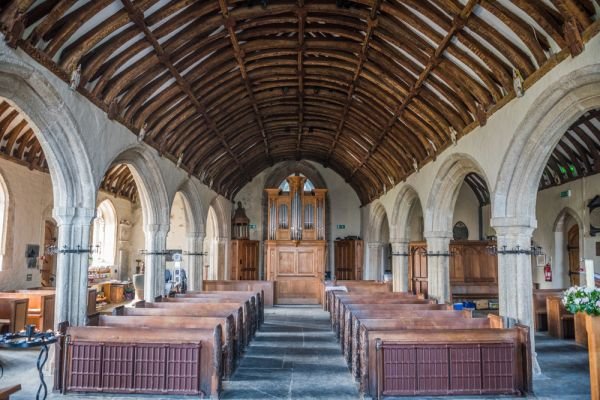
The nave as the Ark of Salvation. The word nave derives from the Latin navis, meaning “ship.” Traditional church architecture often made this symbolism strikingly visible: looking upward, the timbered roof could resemble the ribs and hull of an upturned vessel. The image recalls Noah's Ark as a figure of the one Church carrying the faithful safely through the waters of this world—a symbolism recognised in traditional Catholic explanations of church architecture.
Enter Lumen Gentium
Vatican II's Dogmatic Constitution on the Church, Lumen Gentium, was promulgated in 1964. Its famous paragraph 8 states that the Church constituted and organized in this world as a society:
“subsists in the Catholic Church.”
The Latin is:
subsistit in.
This replaced the simpler identification:
est — is.
The Council immediately adds that outside the Catholic Church's visible structure are found:
“many elements of sanctification and of truth.”
This formulation became one of the most debated sentences of Vatican II.
“Is” and “Subsists In”
The controversy should not be oversimplified. It would be inaccurate simply to claim:
“Subsists in means that the Church of Christ is not the Catholic Church.”
Postconciliar authorities explicitly reject that interpretation. The 2007 Congregation for the Doctrine of the Faith stated that subsistit in indicates the continuing historical existence of the one Church of Christ in the Catholic Church. It insisted that the expression:
“does not change the doctrine on the Church.”
It also insisted that subsistit in can properly be predicated only of the Catholic Church. That is the strongest official continuity interpretation. It must be taken seriously. But the same document explains why subsistit in was used. The new expression permits the affirmation that the Church of Christ is:
“present and operative”
in Churches and ecclesial communities not in full communion with Catholicism because elements of sanctification and truth exist within them.
This is precisely where the deeper change appears.
The Real Issue Is Larger Than One Verb
The controversy is therefore not solved by arguing about the dictionary definition of subsistit. The real question is:
What ecclesiology does the new expression permit and accompany?
Before Vatican II:
The Church of Christ is the Catholic Church.
Catholic things may exist outside her because they have been retained by separated Christians.
After Vatican II:
The Church of Christ subsists in the Catholic Church, while elements belonging to the Church exist beyond her visible boundaries and establish real ecclesial relationships with separated communities.
The new framework is therefore broader than the word subsistit itself.
Elements of Sanctification and Truth
What are these elements?
They include things such as:
Sacred Scripture;
Baptism;
faith in Christ;
prayer;
grace;
theological virtues;
spiritual gifts;
valid sacraments in some separated bodies.
There is nothing inherently novel about recognizing that these things can exist materially outside Catholic communion. The Church always knew that a Protestant could possess valid Baptism. She always knew that Eastern schismatics could possess valid Orders and Eucharist.
The novelty lies elsewhere. The conciliar framework increasingly treats these elements as establishing ecclesial relationships outside the visible boundaries of Catholicism.
This is a much more consequential proposition.
Catholic Elements Versus Ecclesial Communities
This distinction must never be lost. Consider valid Baptism administered in a Protestant denomination. Traditional theology can say:
The Baptism is valid because Christ instituted Baptism and the Protestant minister has performed what Christ requires.
The validity does not come from Protestantism. It survives despite separation from Catholic unity. Likewise Scripture remains God's Word because it belongs to divine revelation. Protestantism does not make Scripture inspired.
The traditional approach therefore distinguishes:
Catholic goods retained outside the Church
from:
the separated religious society possessing them.
Vatican II begins moving positive ecclesiological significance from the retained elements toward the separated communities themselves.
That is where the change becomes substantial.
Unitatis Redintegratio Makes the Development Explicit
The Vatican II’s Decree on Ecumenism, Unitatis Redintegratio, explains that baptized non-Catholic Christians are:
“in communion with the Catholic Church even though this communion is imperfect.”
This is already a significant change of category. The older framework principally distinguished:
membership / non-membership.
The newer framework introduces:
full communion / imperfect communion.
The boundary has become gradated.
Outside the “Visible Boundaries”
Unitatis Redintegratio says that many elements which build up and give life to the Church:
“can exist outside the visible boundaries of the Catholic Church.”
It lists:
the written Word of God;
the life of grace;
faith;
hope;
charity;
gifts of the Holy Ghost;
visible ecclesial elements.
These belong by right to the one Church of Christ. Again, a continuity interpretation is possible:
These things are Catholic in origin and ultimately lead toward Catholic unity.
But Vatican II does not stop there.
Separated Worship Can “Engender a Life of Grace”
The Vatican II Council states that separated Christians perform many liturgical actions.
These actions:
“can truly engender a life of grace.”
and may provide access to:
“the community of salvation.”
This already represents a much more positive theological assessment of religious life within separated communities than the older polemical framework normally employed.
But the next sentence is even more important.
Separated Communities “as Such”
Unitatis Redintegratio states:
“the separated Churches and Communities as such”
have not been deprived of significance and importance in the mystery of salvation. Then comes the crucial statement:
“the Spirit of Christ has not refrained from using them as means of salvation.”
This proposition deserves extremely careful attention. The Council is no longer speaking merely of:
Baptism.
Or:
Scripture.
Or:
a particular Catholic doctrine retained by Protestants.
It speaks of:
“Churches and Communities as such.”
And says they are used as:
“means of salvation.”
That is a major ecclesiological development.
Compare the Two Propositions
Traditional proposition
A Protestant may possess valid Baptism, inspired Scripture and certain revealed truths. God may use those objectively Catholic goods to give grace and lead him toward the Catholic Church.
Conciliar proposition
The separated ecclesial community as such, despite its defects, possesses significance within the mystery of salvation and is used by the Spirit of Christ as a means of salvation.
These propositions are related. But they are not identical. The theological subject has changed:
from Catholic elements surviving in separation
to:
the separated ecclesial body possessing positive salvific significance.
That is one of the most important changes introduced by Vatican II.
“Fully Incorporated” Versus Membership
Lumen Gentium 14 describes Catholics as those who are:
“fully incorporated”
into the society of the Church. They are united through:
profession of Faith;
sacraments;
ecclesiastical government;
communion.
This retains much of the traditional visible structure. But notice the new conceptual environment.
If Catholics are fully incorporated, while baptized non-Catholics possess imperfect communion, ecclesial belonging increasingly appears as a spectrum. The old binary categories have not disappeared completely.
But they have been overlaid by a communion model.
The “People of God”
Another major feature of Lumen Gentium is its prominent presentation of the Church as the:
People of God.
The expression itself is unquestionably biblical. It would therefore be wrong to suggest that calling the Church the People of God is intrinsically erroneous. The question is not whether the phrase is Catholic. It is.
The question is how the Council uses it within its broader ecclesiology. Chapter II precedes the detailed treatment of the hierarchy. The Church is presented as the messianic People called together by God. This people possesses:
a common dignity;
a common baptismal vocation;
participation in Christ's priestly, prophetic and kingly functions;
a universal mission.
The emphasis is significant.
From Mystical Body to People of God?
It would be inaccurate to say Vatican II abolished the Mystical Body doctrine. It did not. Lumen Gentium repeatedly employs the image of Christ's Body.
The issue is one of theological architecture. Before Vatican II, Mystici Corporis provided the dominant papal framework:
one visible Mystical Body identified with the Roman Catholic Church.
Vatican II places extraordinary emphasis upon:
the People of God
and then describes different relationships to that People. This makes it easier to speak about persons outside full Catholic communion as nevertheless possessing various forms of relationship to the Church.
The significance becomes obvious in Lumen Gentium 13–16.
“Related in Various Ways”
Lumen Gentium teaches that all men are called to the catholic unity of the People of God.
It then says that there:
“belong to or are related to it in various ways”
the Catholic faithful,
other believers in Christ,
and ultimately mankind more broadly because all are called to salvation.
This is an extraordinarily expansive ecclesiological framework. It does not say everyone is a member of the Catholic Church. That distinction must be preserved. But it does establish a series of relationships extending outward from full Catholic incorporation.
The Church's boundaries are increasingly described relationally rather than simply juridically.
Non-Catholic Christians Are “Joined” to the Church
Lumen Gentium 15 describes non-Catholic Christians positively.
They:
honour Scripture;
believe in Christ;
possess Baptism;
may possess other sacraments;
may possess episcopacy;
may celebrate a valid Eucharist;
may honour the Mother of God;
share prayer and spiritual benefits.
The Council then says that in some real way they are:
joined with Catholics in the Holy Ghost.
Again, many of the individual facts are traditional. The cumulative ecclesiological interpretation is new.
Eastern Orthodox Churches
The change becomes particularly evident with the Eastern Orthodox. Traditional Catholic theology certainly recognized:
valid episcopal Orders;
valid priesthood;
valid Eucharist;
valid sacraments.
But validity did not eliminate schism. A validly ordained bishop outside communion with Rome remained separated from Catholic unity.
Postconciliar ecclesiology increasingly speaks of such bodies as:
true particular Churches
despite lacking full communion with Rome. Dominus Iesus later explicitly confirmed this description. It said that because of apostolic succession and a valid Eucharist, separated Eastern bodies are:
“true particular Churches.”
And therefore:
“the Church of Christ is present and operative also in these Churches.”
This is an extremely important postconciliar development.
Protestant Communities
Post-Reformation communities lacking valid episcopacy and Eucharist are not, according to Dominus Iesus, Churches “in the proper sense.”
They are called:
ecclesial communities.
Nevertheless, their baptized members are said to possess a real though imperfect communion with the Church. Their communities also participate in the broader postconciliar economy of ecclesial elements.
Thus the new ecclesiology establishes a graded structure:
Catholic Church
Fullness / full communion.
Eastern separated Churches
True particular Churches, though lacking full communion.
Protestant bodies
Ecclesial communities containing elements of Christ's Church.
This is substantially different from the simpler pre-conciliar visible-membership framework.
The Strongest Continuity Explanation
The strongest defender of Vatican II would say:
Nothing essential changed.
The Catholic Church remains uniquely the Church of Christ. Subsistit in applies only to Catholicism. Separated communities possess no independent salvific power. Everything genuinely Christian within them derives from the Catholic fullness. Their elements naturally tend toward Catholic unity.
The Council merely developed a more precise vocabulary capable of acknowledging realities everyone already knew:
Orthodox sacraments are valid;
Protestant Baptism can be valid;
Scripture remains inspired outside Catholic hands;
grace can operate in non-Catholics.
The 2007 CDF explicitly said the doctrine had not changed.
This is the strongest continuity argument and should not be caricatured.
Why the Continuity Explanation Is Not Sufficient
The difficulty is that the pre-conciliar popes already knew all those facts.
Leo XIII knew Eastern Orders could be valid.
Pius XI knew non-Catholics retained Christian beliefs.
Pius XII knew valid Baptism existed outside Catholic unity.
Yet they still taught within a markedly different ecclesiological framework.
Pius XII did not conclude:
therefore separated communities are means of salvation.
Pius XI did not conclude:
therefore Christian denominations participate imperfectly in one ecclesial communion.
Leo XIII did not conclude:
therefore the Church of Christ is present and operative in separated Churches.
On the contrary,
Leo XIII explicitly rejected the conception of Christ's Church as embracing several distinct Christian communities.
Pius XI rejected the federation model and demanded return.
Pius XII reaffirmed that the Mystical Body and Roman Catholic Church are one and the same thing.
The facts were known.
The theological interpretation of those facts changed.
That is the central issue.
The Critical Shift: From Elements to Communities
This development can be represented precisely.
Stage One — Traditional Catholicism
Catholic elements exist outside visible Catholic unity. Example: Valid Baptism administered by a Protestant. The element remains Catholic in origin and orientation.
↓
Stage Two — Vatican II
Those elements establish real but imperfect ecclesial communion.
↓
Stage Three
Separated Churches and communities “as such” possess significance within the mystery of salvation.
↓
Stage Four
The Spirit of Christ uses them as “means of salvation.”
↓
Stage Five — Postconciliar Clarification
The Church of Christ is described as “present and operative” in separated Churches and ecclesial communities.
This is not merely a new adjective.
It is a development in the conception of where ecclesial reality exists.
“Churches and Ecclesial Communities”
Terminology matters because terminology expresses theology. Before Vatican II, Catholic documents normally spoke of:
heretics;
schismatics;
separated Christians;
dissident bodies;
sects.
Vatican II institutionalized language such as:
separated brethren;
Churches;
ecclesial communities;
imperfect communion;
elements of sanctification;
dialogue;
restoration of unity.
The issue is not that charity required Catholics to use insulting language. Charity toward separated Christians is obligatory. The question is whether the terminology reflects a changed ecclesiological status.
In the conciliar texts, clearly it does.
The Church's Unity: Possessed or Wounded?
Traditional Catholic teaching emphasized:
The Church is one.
Her unity cannot be destroyed. Individuals and communities separate from her. The postconciliar framework retains the claim that the Catholic Church has not lost her unity. Dominus Iesus explicitly insists upon this. Yet postconciliar theology simultaneously speaks of Christian division as a wound and of the restoration of full unity among Christians.
This produces a tension. If the Church herself remains perfectly one, what precisely is being restored? The postconciliar answer is:
full communion among all baptized Christians.
That answer depends upon the new communion ecclesiology.
Why This Change Produced the New Ecumenism
Once the new ecclesiology is accepted, Vatican II's ecumenism follows logically.
If Protestant Christians possess imperfect communion;
if Eastern schismatic bodies are true particular Churches;
if Protestant communities possess genuine ecclesial elements;
if the Spirit uses separated communities as means of salvation;
then the Catholic relationship with them changes.
The older paradigm:
Return to the Catholic Church.
The newer paradigm:
Move from imperfect toward full communion.
That is why Lumen Gentium and Unitatis Redintegratio must be read together. Ecumenism is not merely a new pastoral tactic.
It rests upon the new ecclesiology.
Conversion Versus Full Communion
The difference can be expressed simply.
Traditional
A Protestant possesses certain Christian truths. Those truths should lead him to recognize the Catholic Church and convert.
Postconciliar
A Protestant is already incorporated into Christ through Baptism and possesses imperfect communion with the Catholic Church. Ecumenical dialogue seeks the eventual achievement of full communion. The destination may appear similar. The theological starting point is not.
And changing the starting point changes the entire relationship.
The Salvation Question
The same development affects Extra Ecclesiam Nulla Salus. Traditional Catholicism teaches:
Outside the Church there is no salvation.
This does not mean every person visibly outside Catholic membership is automatically damned. God can operate through grace in extraordinary ways. But salvation remains through Christ and His Church. The new ecclesiology introduces a more complex structure.
Separated communities themselves can function as:
means of salvation
because elements belonging to Christ's Church operate within them. Thus salvation outside visible Catholic membership is increasingly described not simply as grace overcoming separation, but as grace working through ecclesial structures existing outside full Catholic communion.
That is a substantial conceptual change.
The Church's Boundaries Have Become Permeable
Traditional ecclesiology certainly recognized complicated cases.
Catechumens.
Excommunicates.
Material heretics.
Invincible ignorance.
Desire for Baptism.
None of this made the Church invisible.
The postconciliar framework, however, increasingly describes ecclesial reality extending beyond visible Catholic boundaries. Hence the Church becomes simultaneously:
visibly identifiable in her fullness with Catholicism
and:
present through ecclesial elements beyond Catholicism.
That dual structure is characteristic of postconciliar communion ecclesiology.
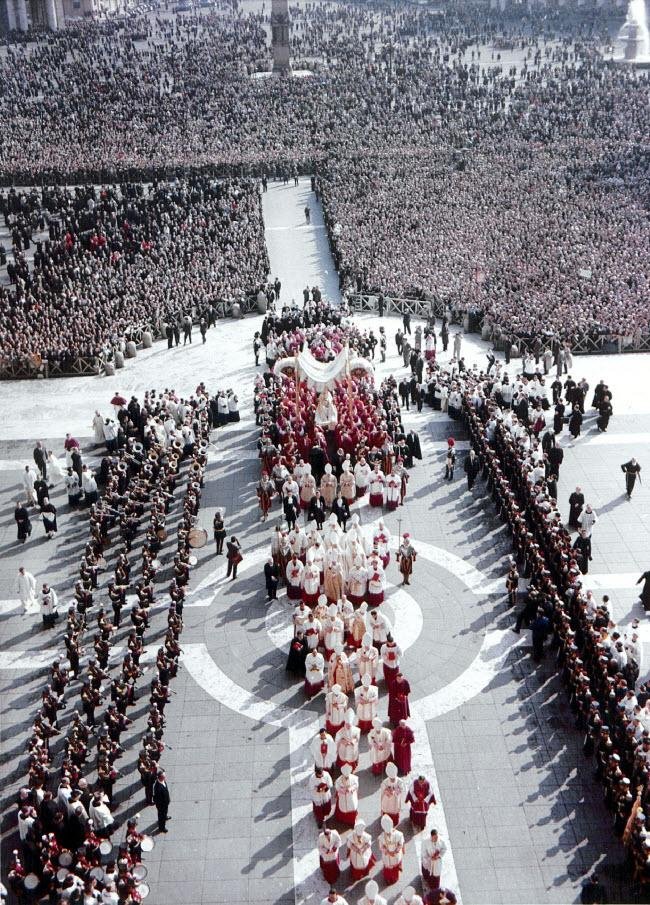
Pope John XXIII and the solemn opening of the Second Vatican Council, 11 October 1962. John XXIII maintained that the Council was not intended to introduce a new deposit of faith, but to present the Church's teaching in a manner adapted to the modern age. The decisive question is therefore whether the resulting formulations preserved the meaning of the earlier doctrine.
Does This Mean Vatican II Explicitly Taught an “Invisible Church”?
No. That would be inaccurate. Vatican II repeatedly affirms the visible, hierarchical nature of the Catholic Church. It affirms:
bishops;
sacraments;
papal authority;
visible ecclesiastical structure.
The change is subtler. The visible Catholic Church remains the locus of fullness.
But the ecclesial reality of Christ's Church is no longer described as terminating simply at her visible boundaries. Instead, aspects of that reality extend into separated Christian bodies.
This is why “communion ecclesiology” is the more accurate description.
Was This Merely Development of Doctrine?
A legitimate development clarifies what was previously contained implicitly in revelation without reversing what was previously taught. Therefore the crucial test is not:
Did Vatican II use new words?
The Church has always developed theological vocabulary. The proper question is:
Can the new propositions be reconciled with the determinate content of the earlier propositions without changing their meaning?
Consider:
Pius XII
The Mystical Body of Christ and Roman Catholic Church are one and the same thing.
Vatican II / postconciliar ecclesiology
The Church of Christ subsists in the Catholic Church, while ecclesial elements exist outside her visible structure and the Church of Christ can be described as present and operative in separated Churches.
Or:
Pius XI
Those separated from the Church must return to the one true Church.
Vatican II
Separated communities possess imperfect communion and are used by the Spirit as means of salvation.
The burden of proof therefore lies upon the claim that these are simply identical propositions expressed more precisely.
The Postconciliar Authorities Themselves Recognized the Difficulty
The repeated need for official clarification is significant. Dominus Iesus in 2000 insisted that the Church of Christ does not subsist equally in multiple denominations. The CDF's 2007 Responses again insisted that Vatican II had not changed Catholic doctrine.
Why were such clarifications necessary? Because the conciliar vocabulary had generated widespread interpretations in which the Catholic Church appeared merely one realization of a broader Church of Christ. The official response rejected that extreme interpretation. But in doing so it retained the intermediate framework:
subsistit in;
elements outside visible boundaries;
true particular Churches outside full communion;
ecclesial communities;
imperfect communion;
Church of Christ “present and operative” beyond full Catholic communion.
Thus the clarifications restrict the new ecclesiology. They do not restore the pre-conciliar formulation in its former simplicity.
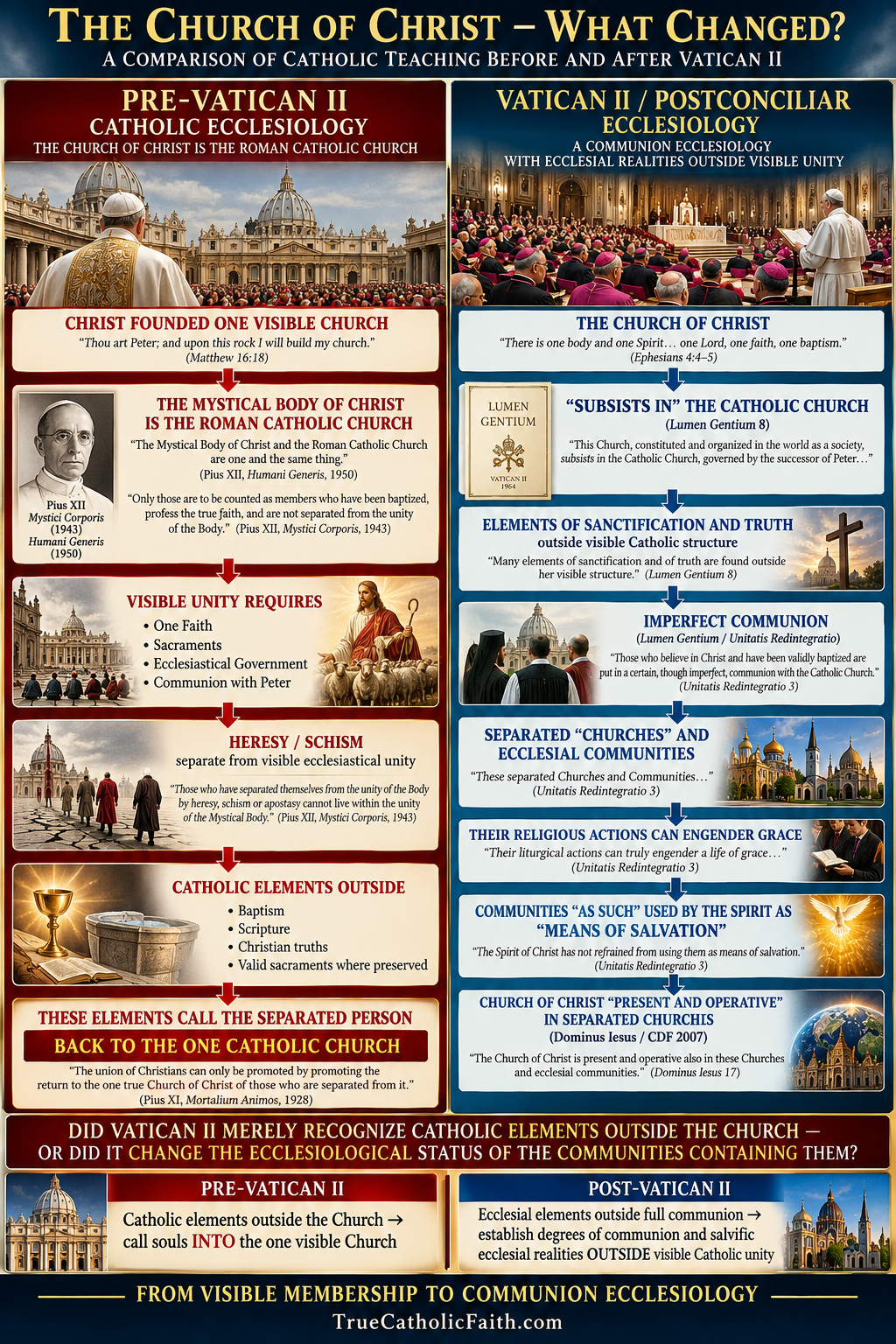
Council → Development → Consequence
The development can now be traced.
PRE-VATICAN II
One visible Mystical Body
↓
Identical with Roman Catholic Church
↓
Membership through Baptism, true Faith and ecclesiastical communion
↓
Heresy and schism sever visible membership
↓
Catholic elements may survive outside but call souls back to Catholic unity
VATICAN II
Church of Christ “subsists in” Catholic Church
↓
Elements of sanctification and truth outside visible structure
↓
Imperfect communion
↓
Separated Churches and ecclesial communities
↓
Separated communities “as such” significant in mystery of salvation
↓
Used by Spirit as “means of salvation”
POSTCONCILIAR DEVELOPMENT
Eastern separated bodies called “true particular Churches”
↓
Church of Christ “present and operative” in separated Churches
↓
Communion ecclesiology becomes normative
↓
Ecumenism seeks movement from imperfect to full communion
PRACTICAL CONSEQUENCE
Return language recedes
↓
Conversion increasingly becomes “full communion”
↓
Dialogue replaces unilateral reunion as dominant method
↓
Separated bodies treated as genuine ecclesial partners
↓
Catholic identity becomes increasingly expressed through degrees of communion
This is a coherent theological development.
Does This Help Explain the Emergence of a New Religion?
This question must be handled carefully. One article cannot by itself prove that the entire postconciliar system constitutes a new religion. That case is cumulative.
But ecclesiology is foundational. A religion's understanding of itself determines its relationship with everyone outside itself. Pre-Vatican II Catholicism understood itself as:
the one visible Church founded by Jesus Christ, into which mankind was called to enter.
Postconciliar Catholicism increasingly understands itself as:
the Church in which Christ's Church subsists in fullness, while genuine ecclesial realities and varying degrees of communion extend beyond its visible boundaries.
That difference generates different approaches to:
Protestants;
Eastern Orthodox;
missionary activity;
conversion;
common prayer;
ecumenism;
salvation;
Church membership.
This is therefore not an isolated technical dispute over Latin terminology. It concerns the Catholic Church's understanding of her own identity.
A Different Religious Posture
The practical contrast is striking. The pre-conciliar Church approached separated Christians with the message:
You possess some Christian truths, but Christ calls you into the one Church He founded.
The postconciliar approach increasingly says:
You already participate in Christ's Church through Baptism and ecclesial elements; let us journey through dialogue toward fuller communion.
The first is principally missionary and incorporative.
The second is principally ecumenical and relational.
That difference flows from ecclesiology.
The Indefectibility Problem
This leads to a much deeper theological difficulty. The Catholic Church is indefectible.
Christ promised:
“The gates of hell shall not prevail against it.” — Matthew 16:18
The Church cannot cease to be the Church Christ founded. She cannot become substantially different in her divinely constituted nature. Therefore, if Vatican II actually introduced an ecclesiology incompatible with the previous magisterium, the problem cannot simply be solved by saying:
“Catholic doctrine changed.”
Catholic doctrine concerning the constitution of the Church cannot reverse itself. The question then becomes one of authority.
Could the true Catholic Church promulgate a substantially altered doctrine about her own identity?
Could legitimate Catholic authority transform the visible Church into a communion framework previously excluded by papal teaching?
These questions lead directly into the later FAQ articles concerning:
indefectibility;
magisterial authority;
heresy;
Church membership;
loss of ecclesiastical office;
the Vatican II claim to authority.
They should not be prejudged here. But neither should the implications be concealed.
The Strongest Objection
The strongest objection can be stated as follows:
Vatican II did not deny that the Catholic Church is the one Church of Christ. Subsistit in actually emphasizes her unique permanence. Everything outside Catholic unity that is genuinely Christian belongs ultimately to Catholicism. Imperfect communion merely describes the objective effects of valid Baptism and other Christian realities. The Council therefore developed traditional doctrine without contradicting it.
This argument explains part of the evidence. It correctly prevents an exaggerated reading in which Vatican II supposedly says all denominations are equally the Church. But it does not explain adequately why pre-conciliar popes, who already knew that Baptism, Scripture, grace and valid sacraments could exist outside visible Catholic unity, did not draw the ecclesiological conclusions Vatican II drew.
The novelty is not recognition of the elements.
The novelty is the ecclesiological status assigned to the communities containing them.
That is the critical point.
The Decisive Distinction
Everything can finally be reduced to one distinction.
Traditional Catholic Principle
Something belonging to the Church may be possessed outside the Church without making the separated religious society itself part of the Church's salvific structure.
Postconciliar Principle
Elements belonging to the Church establish real though imperfect ecclesial communion and allow separated Churches and communities themselves to possess significance and function within the mystery of salvation.
That is the conceptual transition. Once recognized, much of the postconciliar transformation becomes easier to understand.
What We Can and Cannot Conclude
We Can Conclude
Vatican II substantially changed the theological framework used to describe the boundaries of the Church.
The pre-conciliar magisterium identified the Mystical Body of Christ directly with the Roman Catholic Church.
Vatican II deliberately employed subsistit in while recognizing elements of sanctification and truth outside visible Catholic structure.
The Council developed a theology of imperfect communion.
It assigned positive ecclesial and salvific significance to separated Churches and communities “as such.”
The postconciliar authorities subsequently taught that the Church of Christ is “present and operative” in separated Churches.
These developments provided the doctrinal architecture required for the new ecumenism.
They represent more than a change of pastoral tone.
They concern the nature, boundaries and salvific operation of the Church herself.
We Cannot Conclude Merely From These Texts
that Vatican II explicitly said all Christian denominations are equally the Church of Christ;
that subsistit in officially means the Church of Christ exists equally in several Churches;
that Vatican II abolished the visible Church;
that every use of “People of God” is erroneous;
or that recognizing valid Baptism and other Christian elements outside visible Catholic communion is itself a doctrinal innovation.
The argument does not require those exaggerations.
The real rupture case is stronger and more precise.
Conclusion
The evidence reveals a substantial transformation in ecclesiology. Before Vatican II, the papal magisterium taught with remarkable clarity:
Christ founded one visible Church.
That Church is the Roman Catholic Church.
The Mystical Body of Christ and the Roman Catholic Church are one and the same thing.
Unity requires unity of Faith and government.
Heresy and schism separate men from that visible unity.
Christian truths and sacraments may survive among separated Christians, but those elements call them back to the Church from which separation occurred.
Vatican II did not openly discard all of these propositions. Instead, it reconstructed the framework surrounding them.
The Church of Christ now: “subsists in” the Catholic Church.
Beyond her visible structure exist: elements of sanctification and truth.
Separated Christians possess: imperfect communion.
Separated religious bodies become: Churches and ecclesial communities.
Their religious actions can: engender grace.
Those communities “as such” possess significance within the mystery of salvation.
And the Holy Ghost uses them: “as means of salvation.”
The postconciliar authorities subsequently say that the Church of Christ is: “present and operative” in separated Churches.
The cumulative movement is unmistakable:
ONE VISIBLE CHURCH
↓
ELEMENTS OUTSIDE HER
↓
IMPERFECT COMMUNION
↓
SEPARATED CHURCHES AND ECCLESIAL COMMUNITIES
↓
MEANS OF SALVATION
↓
CHURCH OF CHRIST “PRESENT AND OPERATIVE” OUTSIDE FULL CATHOLIC COMMUNION
This is considerably more than a vocabulary update. The Catholic elements outside the Church were known long before Vatican II.
What changed was the theological interpretation placed upon them.
The older theology said:
These are goods belonging to the Catholic Church which have survived outside her visible unity and should lead separated Christians back into that unity.
The new ecclesiology increasingly says:
These elements create genuine ecclesial relationships outside full Catholic unity, so that separated communities themselves participate—deficiently but really—in the salvific reality of Christ's Church.
That distinction changes the entire religious landscape. Once it is accepted:
return becomes full communion;
conversion becomes ecumenical journey;
separated sects become Churches and ecclesial communities;
external Catholic elements become foundations of ecclesial communion;
and:
the exclusive visible identification of Christ's Mystical Body with Roman Catholicism gives way to a communion ecclesiology whose realities extend beyond visible Catholic boundaries.
This article alone does not establish every component of the wider thesis that Vatican II opened the way to a new religion. But it establishes something fundamental.
Vatican II changed the framework by which the postconciliar religion understands what the Church herself is.
And once a religious body substantially changes its understanding of:
its own identity,
its own boundaries,
who belongs to it,
where Christ's Church operates,
and:
how religious bodies separated from it participate in salvation,
the change cannot reasonably be dismissed as merely pastoral. It concerns the very constitution of the Church. That is why the ecclesiological revolution of Vatican II belongs near the beginning of the case. The subsequent changes in:
ecumenism;
religious liberty;
non-Christian religions;
missionary activity;
collegiality;
synodality;
liturgy
did not arise independently. They fit within the altered ecclesiological world Vatican II created. And that eventually forces the most serious question of all:
If the Catholic Church is indefectible, could she herself replace the ecclesiology taught by Leo XIII, Pius XI and Pius XII with a substantially different communion ecclesiology?
That question leads beyond Vatican II's documents to the crisis of authority which followed them.
Primary Sources
Holy Scripture
Matthew 16:18–19
Matthew 18:17
John 10:16
John 17:20–23
Acts 2:41–47
1 Corinthians 1:10
1 Corinthians 12:12–27
Ephesians 1:22–23
Ephesians 4:4–5
Ephesians 5:23–32
Fathers of the Church
St Ignatius of Antioch, Letter to the Smyrnaeans, c. AD 107
St Irenaeus, Against Heresies, c. AD 180
St Cyprian of Carthage, On the Unity of the Catholic Church, c. AD 251
St Augustine, writings against the Donatists, early fifth century
Pre-Vatican II Magisterium
First Vatican Council, Pastor Aeternus (1870)
Leo XIII, Satis Cognitum (1896)
Pius XI, Mortalium Animos (1928)
Pius XII, Mystici Corporis Christi (1943)
Pius XII, Humani Generis (1950)
Vatican II
Lumen Gentium, especially §§8, 9, 13–16
Unitatis Redintegratio, especially §§1–4, 14–23
Postconciliar Interpretive Documents
Congregation for the Doctrine of the Faith, Mysterium Ecclesiae (1973)
Congregation for the Doctrine of the Faith, Dominus Iesus (2000), especially §§16–17
Congregation for the Doctrine of the Faith, Responses to Some Questions Regarding Certain Aspects of the Doctrine on the Church (2007)
Further Reading
For the traditional Catholic and sedevacantist critique, consult relevant studies from CMRI and Novus Ordo Watch alongside the primary documents.
The primary documents should remain decisive.
The strongest argument is not that critics call Vatican II a rupture.
It is that the propositions of Leo XIII, Pius XI and Pius XII can be placed directly beside Lumen Gentium, Unitatis Redintegratio, Dominus Iesus and the 2007 CDF clarification, allowing the reader to judge whether the later communion ecclesiology represents merely a legitimate clarification or a substantial change in the conception of the Church.
Related Questions
Did Vatican II Change Catholic Teaching on Christian Unity and Ecumenism?
What Is Collegiality, and Why Was It Controversial?
Did Vatican II Change the Catholic Understanding of Apostolic Succession?
What Are Episcopal Conferences and Synodality?
What Does “Outside the Church There Is No Salvation” Mean?
Who Is a Member of the Catholic Church?
Does Heresy Separate a Person From the Church?
What Does Subsistit In Mean?
Can Catholic Doctrine Change?
Is the Catholic Church Indefectible?
Could a Pope Publicly Depart From the Catholic Faith?
Did Vatican II Open the Way to a New Religion?
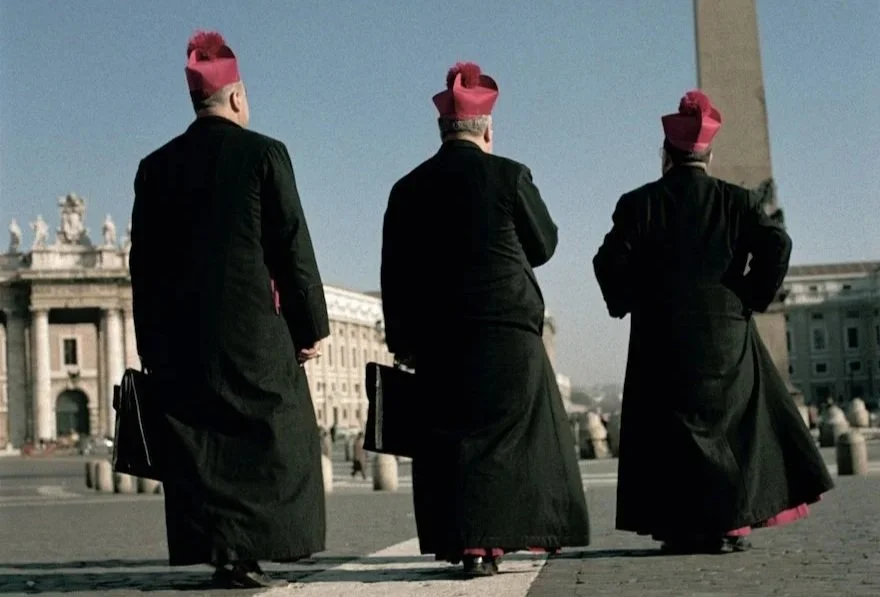
Council Fathers leaving St Peter's during Vatican II, photographed by Lothar Wolleh between 1963 and 1965. The significance of the Council's ecclesiology became progressively clearer in its postconciliar interpretation and implementation—from subsistit in and “elements of sanctification and truth” to separated Christian communities as “means of salvation” and later teaching concerning salvific elements within non-Christian religious traditions.