What Are Episcopal Conferences and Synodality, and How Do They Compare With Traditional Catholic Governance?
Short Answer
The Catholic Church has always used councils, synods, consultation and cooperation among bishops. These things are not innovations of Vatican II. Nor does Catholic government mean that a pope or diocesan bishop should govern without advice.
The deeper question is where governing authority resides by divine constitution.
Traditional Catholic doctrine presents the Church as a divinely constituted hierarchical society. The Roman Pontiff possesses supreme, full, ordinary and immediate jurisdiction over the universal Church. Individual bishops are true pastors possessing ordinary jurisdiction over the particular flocks entrusted to them, but their jurisdiction is subordinate to the Roman Pontiff and, according to the explicit teaching of Pius XII, reaches them through him.
Vatican II retained papal primacy and the authority of individual diocesan bishops. It did not formally replace hierarchical government with democracy. Yet it introduced a significantly expanded doctrine of episcopal collegiality, describing the episcopal college, always with and never without the Roman Pontiff, as also a subject of “supreme and full power” over the universal Church. Christus Dominus then promoted episcopal conferences throughout the Church.
Paul VI established the permanent Synod of Bishops in 1965. The 1983 Code incorporated conciliar collegiality into canon law. Later postconciliar theology developed the broader concept of synodality, extending participation beyond bishops to the whole “People of God” through listening, consultation, discernment and co-responsibility at local, regional and universal levels.
The resulting development can therefore be traced:
PAPAL PRIMACY + INDIVIDUAL EPISCOPAL JURISDICTION
↓
VATICAN II: EPISCOPAL COLLEGIALITY
↓
EPISCOPAL CONFERENCES + SYNOD OF BISHOPS
↓
POSTCONCILIAR “COMMUNION” ECCLESIOLOGY
↓
SYNODALITY OF THE WHOLE “PEOPLE OF GOD”
↓
THE “SYNODAL CHURCH”
The decisive question is not whether Catholics may consult one another. They always have. It is whether this development has altered the operative conception of the Church's divinely constituted government—moving from a clearly hierarchical structure centred upon papal and diocesan jurisdiction toward a model increasingly described through collegiality, participation, co-responsibility, communal discernment and synodality.
That question must be answered from the documents themselves.
Why This Question Matters
“Synodality” has become one of the defining concepts of postconciliar ecclesiology. It is easy, however, to misunderstand the controversy. The traditional objection is not:
Bishops should never meet together.
Nor is it:
Lay Catholics should never be consulted.
Nor:
The Pope must personally decide every administrative matter in every diocese.
Catholic history contains provincial councils, plenary councils, diocesan synods, consistories, cathedral chapters, theological commissions and many other forms of consultation and common deliberation. The real issue concerns authority.
Who possesses jurisdiction in the Church?
Where does a bishop receive his jurisdiction?
Does a national episcopal conference constitute another governing level between the bishop and the Roman Pontiff?
Does the episcopal body possess a universal governing power distinct from the Pope's supreme jurisdiction?
What theological role belongs to consultation of the faithful?
And when modern documents describe synodality as an “essential” or “constitutive” dimension of the Church, are they simply giving a new name to ancient Catholic practices—or expressing a substantially different conception of the Church herself?
These questions belong to the wider examination of whether Vatican II merely changed administrative techniques or introduced ecclesiological principles that subsequently transformed the way Catholic authority itself was understood.
What the Catholic Church Traditionally Taught
Christ Established a Hierarchical Church
Christ did not constitute His Church as a democracy whose authority originates in the consent of its members. He chose the Apostles and conferred authority upon them.
To Peter in particular He said:
“Thou art Peter; and upon this rock I will build my church.” — Matthew 16:18
He entrusted Peter with the keys:
“I will give to thee the keys of the kingdom of heaven.” — Matthew 16:19
And after the Resurrection:
“Feed my lambs… Feed my sheep.” — John 21:15–17
The Apostles likewise possessed real ecclesiastical authority, and bishops succeed them as pastors of the Church.
Catholic ecclesiology therefore contains both:
PAPAL PRIMACY and EPISCOPAL AUTHORITY
The question is how these authorities are related.
Vatican I: Supreme Jurisdiction Belongs to the Roman Pontiff
The First Vatican Council defined the Roman Pontiff's primacy in unmistakably jurisdictional terms. Pastor Aeternus teaches that the Pope possesses:
full • supreme • ordinary • immediate
jurisdiction throughout the Church. It further teaches that pastors and faithful, individually and collectively, owe him hierarchical subordination and true obedience in matters not only of faith and morals but also of Church discipline and government.
At the same time, Vatican I expressly protects the proper authority of bishops. Papal primacy does not destroy their ordinary and immediate episcopal jurisdiction over their own flocks; rather, according to the Council, that episcopal authority is affirmed, strengthened and defended by the supreme pastor.
This is important. Traditional Catholic ecclesiology is therefore not:
POPE OR BISHOPS
It is:
POPE AS SUPREME PASTOR
↓
BISHOPS AS TRUE PASTORS OF THEIR PARTICULAR FLOCKS
The bishop is not merely a branch manager carrying out instructions from Rome. But neither does a collection of bishops constitute an authority independent of, parallel to, or superior to the Roman Pontiff.
Leo XIII: Bishops Possess Real but Subordinate Authority
Leo XIII explained the relationship with particular clarity in Satis Cognitum. He taught that bishops belong to the essential constitution of the Church and exercise a real authority of their own. They are not simply vicars of the Pope. But he simultaneously insisted that episcopal authority remains subordinate to the Roman Pontiff. Leo therefore distinguished:
ROMAN PONTIFF
Supreme
Universal
Independent
from:
DIOCESAN BISHOP
Ordinary pastor
Real jurisdiction
Limited to his flock
Subordinate to the Roman Pontiff
Leo explicitly rejected the idea that bishops considered collectively could escape the subordination binding them individually. That point becomes particularly important when examining Vatican II's doctrine of episcopal collegiality.
Orders and Jurisdiction Are Not the Same Thing
Traditional Catholic theology distinguished two hierarchies or powers:
POWER OF ORDERS and POWER OF JURISDICTION
Episcopal consecration gives the bishop the sacramental power of his order. It does not, by itself, assign him a diocese or give him jurisdiction over a particular flock.
Pius XII stated the distinction explicitly in Ad Sinarum Gentem in 1954. He taught that the hierarchy of Orders comes through Holy Orders, whereas the power of jurisdiction, conferred directly by divine right upon the Supreme Pontiff, reaches bishops through the Successor of Peter. Four years later, confronting illicit episcopal appointments in communist China, Pius XII repeated the doctrine in Ad Apostolorum Principis:
bishops not appointed or confirmed by the Apostolic See possessed no jurisdiction merely because they had been episcopally consecrated. He again taught that episcopal jurisdiction comes through the Roman Pontiff.
This gives us an important preconciliar baseline:
EPISCOPAL CONSECRATION
↓
POWER OF ORDERS
while:
CANONICAL MISSION THROUGH THE ROMAN PONTIFF
↓
EPISCOPAL JURISDICTION OVER A FLOCK
That distinction should be kept in mind throughout everything that follows.
Councils and Synods Existed Long Before Vatican II
None of this means bishops historically acted in isolation. They met in:
diocesan synods;
provincial councils;
plenary councils;
patriarchal synods;
ecumenical councils.
The Council of Jerusalem in Acts 15 provides an obvious apostolic precedent for common deliberation. Catholic government has therefore always contained both personal authority and conciliar activity. But the existence of councils does not itself establish modern synodality.
An ecumenical council derives its binding ecclesiastical authority within the constitution of the Church and under the Roman Pontiff. Leo XIII observed that councils require papal authority and confirmation and cannot constitute an authority superior to Peter's successor. Consequently:
Council ≠ modern synodality merely because both involve meetings and consultation.
We must examine the theology attached to them.
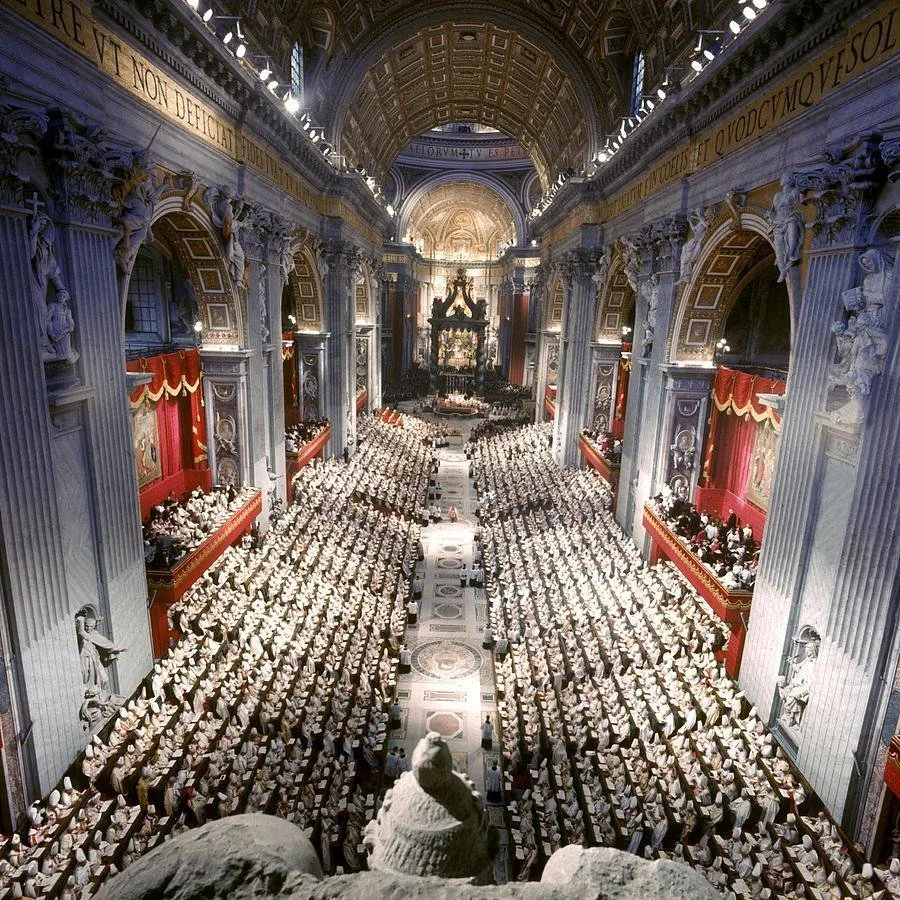
Bishops from throughout the world gathered at the Second Vatican Council in St. Peter's Basilica. Vatican II's teaching on the episcopate, particularly Lumen Gentium 22, gave new prominence to episcopal collegiality while formally reaffirming the Roman Pontiff's supreme and universal authority.
Vatican II and the New Emphasis on Collegiality
Lumen Gentium 22
Vatican II's decisive development appears in Chapter III of Lumen Gentium. The Council teaches that the order of bishops succeeds the apostolic college and states that the episcopal body, provided it is understood together with the Roman Pontiff and never without him, is also a subject of:
“supreme and full power over the universal Church.”
It simultaneously insists that the Pope retains his own full, supreme and universal power and remains free to exercise it.
This qualification is essential. It would therefore be inaccurate to claim:
Vatican II abolished papal primacy. It did not.
Nor does Lumen Gentium teach:
The bishops can govern the universal Church independently of the Pope.
It expressly denies that. The question is subtler.
One Supreme Subject or Two?
Before Vatican II, the ordinary presentation placed unmistakable emphasis upon one supreme jurisdictional head, the Roman Pontiff. The bishops possessed real ordinary jurisdiction over their own flocks and could participate in universal government through an ecumenical council united to and dependent upon the Pope.
Lumen Gentium, however, explicitly describes the episcopal college with its head as itself possessing supreme and full power over the universal Church. This immediately generated questions during Vatican II about whether the formulation suggested two subjects of supreme power:
THE POPE and THE COLLEGE OF BISHOPS WITH THE POPE
The Nota Explicativa Praevia—the Preliminary Explanatory Note attached to Lumen Gentium—was intended to regulate interpretation of Chapter III and protect papal primacy. The resulting formula therefore cannot legitimately be reduced to conciliarism. Nevertheless, something important had changed in ecclesiological emphasis and formulation.
The concept of the episcopal college as a permanent theological subject became central to the subsequent development of postconciliar governance. That is where episcopal conferences and synodality enter the picture.
Vatican II Promotes Episcopal Conferences
What Is an Episcopal Conference?
An episcopal conference is a permanent association of bishops, ordinarily organised nationally or regionally, through which bishops cooperate on matters affecting their territory. Examples include national conferences covering the bishops of a particular country. Such cooperation itself presents no theological difficulty.
The significant development is the ecclesiological and canonical status attributed to these bodies.
Christus Dominus 37–38
Vatican II strongly promoted episcopal conferences. Christus Dominus declared that bishops increasingly needed common action and ordered that bishops of the same nation or region should form associations meeting at stated times. It described an episcopal conference as an assembly in which bishops:
“jointly exercise their pastoral office”
for the greater good of the Church, particularly through forms of apostolate adapted to contemporary circumstances. This institutionalised a level of episcopal cooperation that would become a normal feature of postconciliar Catholic government.
Why Episcopal Conferences Became Controversial
The issue is not cooperation. The problem arises if a conference begins functioning as though it constitutes an intermediate ecclesiastical authority between:
THE ROMAN PONTIFF and THE INDIVIDUAL DIOCESAN BISHOP
Traditional Catholic government places the individual diocesan bishop in direct jurisdictional relationship to his own flock while remaining subordinate to the Roman Pontiff. A national episcopal bureaucracy can potentially alter this practical relationship:
ROME
↓
EPISCOPAL CONFERENCE
↓
DIOCESAN BISHOP
↓
DIOCESE
Yet the conference is not itself a divinely instituted hierarchical degree comparable to pope or diocesan bishop.
That distinction became important enough that John Paul II addressed it specifically in the 1998 motu proprio Apostolos Suos. The document defended episcopal collegiality but also imposed limits upon the doctrinal authority of episcopal conferences and reiterated that individual bishops remain teachers and pastors of their own particular Churches. It simultaneously repeated the postconciliar doctrine that the episcopal body possesses supreme power when acting collegially with its head, the Roman Pontiff.
The need for such clarification demonstrates the tension inherent in institutionalising collegiality.
Paul VI Creates the Synod of Bishops
An even clearer institutional development occurred while Vatican II was still meeting. On 15 September 1965 Paul VI issued Apostolica Sollicitudo, establishing the Synod of Bishops as a permanent institution for the universal Church. Paul VI explicitly explained that the purpose was closer cooperation between the Roman Pontiff and the bishops and “greater and more effective participation” by bishops in his concern for the universal Church. Importantly, however, the new Synod remained:
“directly and immediately subject to Our power.”
It therefore did not constitute an independent universal government alongside the papacy. Again we encounter the same pattern:
greater collective episcopal participation
combined with:
formal preservation of papal supremacy.
This distinction must be retained if the history is to be represented accurately.
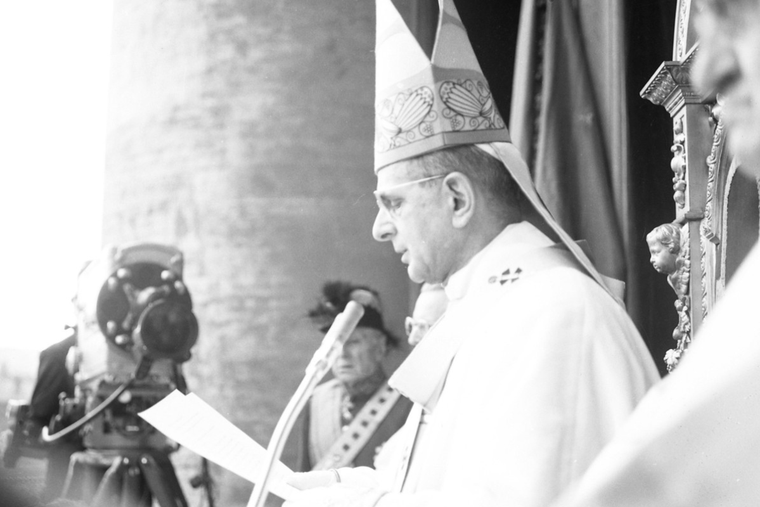
Pope Paul VI addresses bishops and cardinals during a meeting of the Synod of Bishops in the Sistine Chapel, Vatican City, 1971. Paul VI had established the permanent Synod of Bishops in 1965 through Apostolica Sollicitudo, describing it as a means of closer cooperation between the Roman Pontiff and the bishops while placing the new institution directly and immediately under papal authority.
The 1983 Code Institutionalises the New Ecclesiology
The ecclesiological developments of Vatican II did not remain confined to conciliar documents. They entered the postconciliar canonical structure. Canon 336 of the 1983 Code states that the College of Bishops, with the Supreme Pontiff as its head and never without him, is:
“also the subject of supreme and full power over the universal Church.”
This directly codifies the formulation of Lumen Gentium 22. The 1983 Code also gives extensive canonical structure to episcopal conferences, the Synod of Bishops, presbyteral councils, pastoral councils and other consultative organs.
The significance is cumulative. What began as Vatican II's theology of collegiality increasingly became part of the ordinary institutional life of the postconciliar Church.
From Collegiality to Synodality
This is where the historical development becomes especially important. The modern concept of synodality should not simply be projected backwards as though Catholic theology had always described the constitution of the Church in precisely these terms.
The International Theological Commission's 2018 document Synodality in the Life and Mission of the Church makes a striking admission. It calls “synodality” a neologism in recent theological and canonical literature. It further acknowledges:
the term and concept of synodality are not explicitly found in the teaching of Vatican II.
Yet the same document argues that synodality lies at the heart of Vatican II's ecclesiological renewal and identifies the Council's doctrines of:
the People of God;
episcopal collegiality;
sacramentality of the episcopate;
communion;
participation of the baptised
as the foundations from which modern synodality developed. That is exceptionally important evidence. It allows the development to be traced without speculation:
VATICAN II
↓
PEOPLE OF GOD + EPISCOPAL COLLEGIALITY
↓
POSTCONCILIAR COMMUNION ECCLESIOLOGY
↓
EXPANDED PARTICIPATORY STRUCTURES
↓
THE THEOLOGY OF SYNODALITY
The connection is acknowledged by postconciliar theology itself.
What Does “Synodality” Now Mean?
Modern synodality extends considerably beyond bishops meeting in councils. The 2018 International Theological Commission describes synodality as the particular modus vivendi et operandi—way of living and operating—of the Church as the People of God. It involves the participation of the whole People of God in:
listening;
dialogue;
consultation;
communal discernment;
participation;
co-responsibility;
mission.
It operates at:
LOCAL
↓
REGIONAL
↓
UNIVERSAL
levels.
The document goes so far as to describe synodality as an:
“essential dimension of the Church.”
It also says that the whole Church is a “subject” and that everyone within the Church is a “subject.” This is considerably more than saying:
“Bishops sometimes hold synods.”
Synodality is being proposed as a theological description of how the Church herself exists and operates.
Collegiality and Synodality Are Not Identical
The postconciliar documents themselves distinguish them.
COLLEGIALITY primarily concerns the bishops and their relationship with one another and the Bishop of Rome.
SYNODALITY is broader and involves the entire People of God.
The International Theological Commission explains that collegiality is one specific manifestation of ecclesial synodality through episcopal ministry. We therefore obtain a progression:
EPISCOPAL COLLEGIALITY
↓
EPISCOPAL CONFERENCES
↓
SYNOD OF BISHOPS
↓
COMMUNION ECCLESIOLOGY
↓
SENSUS FIDEI / SENSUS FIDELIUM
↓
PARTICIPATION OF THE WHOLE PEOPLE OF GOD
↓
SYNODAL CHURCH
This is why synodality cannot adequately be examined without first understanding Vatican II's doctrine of collegiality.
What Is the Sensus Fidelium?
Catholic tradition recognises that the Church as a whole cannot defect from the Faith. The faithful therefore possess what theology calls the sensus fidei—a supernatural instinct or connaturality with revealed truth produced by Faith and the gifts of the Holy Ghost.
This does not mean that Catholic doctrine is determined by opinion polls. The faithful receive and profess the apostolic Faith. They do not create revelation.
The distinction becomes important when the sensus fidelium is incorporated into structures of consultation and communal discernment. The International Theological Commission's 2014 document on the sensus fidei itself treats the concept extensively, while later synodal theology connects it with participation of the faithful in ecclesial discernment. The theological question therefore becomes:
Is the faithful's supernatural reception of revealed truth being preserved—or transformed into a participatory mechanism affecting the formulation and governance of Church teaching?
Those are not the same thing.
Synodality Does Not Formally Abolish Hierarchy
Precision is essential here. Official postconciliar synodal theology expressly denies that synodality means parliamentary democracy. The 2018 International Theological Commission distinguishes between:
decision-making
through consultation and common discernment, and:
decision-taking
which remains the responsibility of the competent pastor. In a diocese, the bishop remains the one who ultimately takes the decision. Consequently it would be inaccurate to say:
“Synodality formally teaches that laypeople govern the Church democratically.”
That is not what the official texts say. But this does not settle the deeper question. The relevant issue is whether an ecclesiology organised increasingly around collective discernment, co-responsibility, consultation and participation alters the practical and theological conception of hierarchical authority even while retaining the formal statement that the final juridical decision belongs to the bishop or pope.
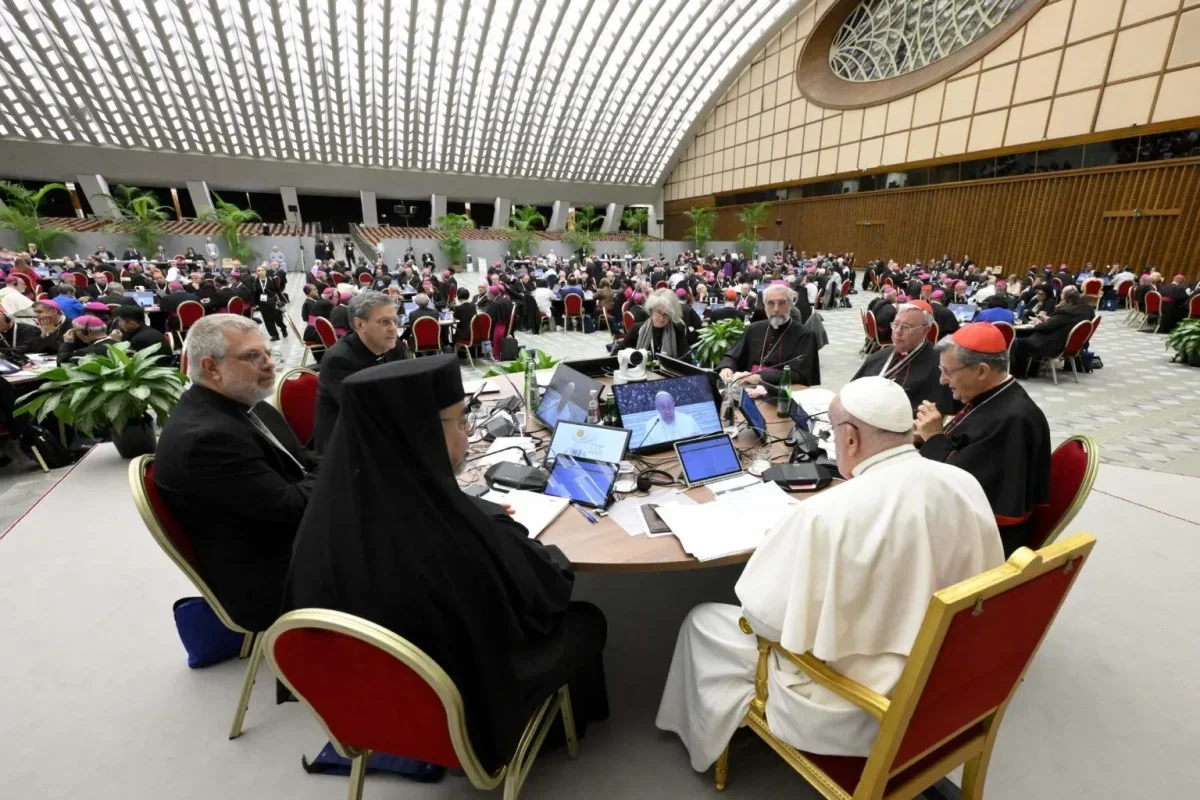
Pope Francis participates in the Synod on Synodality in the Paul VI Audience Hall at the Vatican. Unlike an assembly composed exclusively of bishops, the 2023–2024 Synod brought bishops together with priests, religious and lay members around common tables as participants in a process centred on listening, dialogue and communal discernment—an institutional expression of the postconciliar development toward the “synodal Church.”
Francis and the “Synodal Church”
The development became particularly explicit under Francis. In Evangelii Gaudium he called for greater decentralisation and said that the juridical status of episcopal conferences had not yet been sufficiently developed to recognise them as subjects possessing specific competencies, including “genuine doctrinal authority.” He connected this directly with Vatican II's desire that episcopal conferences contribute to the concrete realisation of the “collegial spirit.”
This is significant. The trajectory is no longer merely:
bishops cooperate practically
but potentially:
EPISCOPAL CONFERENCES AS SUBJECTS POSSESSING DOCTRINAL AUTHORITY
The development therefore concerns ecclesiology, not merely administrative convenience.
Synodality as the Framework for Hierarchical Ministry
Postconciliar synodality eventually goes further still. The International Theological Commission cites Francis's statement that synodality provides:
“the most appropriate framework for understanding the hierarchical ministry itself.”
It describes Vatican II's teaching on episcopal sacramentality and collegiality as a basic theological premise for a complete theology of synodality. This reverses the perspective from which the question is often approached.
Synodality is no longer merely something hierarchical authority occasionally uses. It becomes a framework within which hierarchical ministry itself is interpreted.
That is a substantial ecclesiological development.
Council → Implementation → Consequence
The historical sequence can now be stated with reasonable precision.
1. Pre-Vatican II Baseline
The Church is hierarchically constituted. The Roman Pontiff possesses supreme universal jurisdiction. Each diocesan bishop possesses ordinary jurisdiction over the flock entrusted to him. Episcopal jurisdiction is distinguished from sacramental consecration and, according to Pius XII, comes to bishops through the Roman Pontiff.
2. Vatican II
Lumen Gentium emphasises the episcopal college as a permanent theological reality and calls the college with its papal head another subject of supreme and full power over the universal Church. Christus Dominus promotes episcopal conferences. The Council's “People of God” and communion ecclesiology supplies additional premises for later synodality.
3. Immediate Implementation
Paul VI establishes the permanent Synod of Bishops in 1965. Episcopal conferences become ordinary institutions throughout the Church.
4. Canonical Institutionalisation
The 1983 Code incorporates episcopal collegiality and the new structures into universal canon law.
5. Theological Expansion
Collegiality develops within a broader theology of:
communion • People of God • participation • co-responsibility • sensus fidelium
6. Synodality
Postconciliar theology describes synodality as an essential dimension and ordinary way of operating of the Church.
7. Further Development
Synodality expands from episcopal cooperation toward participation and discernment involving the entire People of God at every ecclesiastical level.
This sequence is not merely alleged by traditionalist critics. The 2018 International Theological Commission itself describes modern synodality as something that matured from Vatican II's ecclesiology and acknowledges both the novelty of the terminology and its conciliar foundations.
Is This Simply a Recovery of Ancient Catholic Practice?
This is one of the strongest arguments in defence of synodality.
The early Church certainly held councils.
Eastern Catholic Churches historically possessed strong synodal structures.
Bishops frequently deliberated collectively.
The Council of Jerusalem demonstrates apostolic consultation.
Therefore, defenders argue, Vatican II and modern synodality recover something ancient that excessive Roman centralisation had obscured. There is truth in the historical premise.
Synods themselves are unquestionably ancient.
But the conclusion does not automatically follow. The question is not:
Did ancient Catholics hold synods?
They did. The question is:
Did Catholic tradition understand “synodality” in the modern postconciliar sense as an essential constitutive dimension involving the entire People of God in structured communal discernment at every level of ecclesial life?
The 2018 International Theological Commission itself acknowledges that “synodality” in this theological sense is recent terminology and that the concept is not explicitly present in Vatican II, while arguing that it matured from conciliar ecclesiology.
Ancient synods therefore cannot simply be identified with the modern theology without demonstrating that the underlying conception of authority is the same.
Consultation Is Not the Problem
This distinction is indispensable.
A pope may consult bishops.
A bishop may consult priests.
Pastors may consult lay Catholics.
Experts may advise ecclesiastical superiors.
Councils may debate before decisions are made.
None of this contradicts Catholic hierarchy. Indeed, prudent government ordinarily requires consultation. The theological difficulty appears when consultation is transformed into a principle according to which collective participation becomes constitutive of how ecclesiastical authority itself is conceived and exercised.
Therefore:
CONSULTATION does not necessarily imply:
COLLEGIAL GOVERNMENT and neither necessarily implies:
SYNODAL ECCLESIOLOGY The categories must not be confused.
Has Synodality Decentralised Catholic Authority?
There is substantial evidence that decentralisation is one objective of the postconciliar development. Francis explicitly stated in Evangelii Gaudium that both the papacy and central structures required “pastoral conversion,” and complained that Vatican II's aspiration concerning episcopal conferences had not been fully realised. He specifically contemplated episcopal conferences as subjects possessing genuine doctrinal authority.
This raises a serious question from traditional ecclesiology. If doctrinal authority becomes attached increasingly to:
national episcopal conferences
and ecclesial discernment increasingly operates through:
local → regional → continental → universal
processes, then the practical structure of authority begins to look substantially different from the simpler preconciliar schema:
ROMAN PONTIFF
↓
DIOCESAN BISHOP
↓
CLERGY AND FAITHFUL
The offices of pope and bishop remain.
The institutional buildings remain.
The episcopal sees remain.
The terminology remains.
But the operative ecclesiology surrounding those offices has changed considerably. That distinction between institutional continuity and ecclesiological continuity is crucial.
Does Synodality Democratise the Church?
Not formally. The official documents repeatedly deny a parliamentary understanding of the Church and continue to reserve final decisions to hierarchical authority. It would therefore be an exaggeration to describe official synodality simply as “Catholic democracy.” Yet the democratic analogy arises for understandable reasons.
Modern synodal vocabulary emphasises:
listening;
participation;
representation;
consultation;
inclusion;
dialogue;
co-responsibility;
communal discernment;
decentralisation.
The traditional vocabulary of ecclesiastical government placed much greater emphasis upon:
jurisdiction;
teaching authority;
obedience;
canonical mission;
hierarchy;
papal primacy;
episcopal government;
preservation of the deposit of Faith.
Vocabulary alone does not prove doctrinal contradiction. But vocabulary reflects conceptual priorities. The important question is whether the new language merely supplements the traditional constitution or gradually reconceptualises it.
A Significant Change in Ecclesiological Vocabulary
The progression can be illustrated simply:
| Traditional Emphasis | Postconciliar Emphasis |
|---|---|
| Hierarchical society | People of God / communion |
| Papal primacy | Primacy within collegiality |
| Individual episcopal jurisdiction | Episcopal college |
| Diocese | Local Church |
| Canonical mission | Sacramental episcopate + hierarchical communion |
| Provincial/plenary councils | Episcopal conferences |
| Consultation | Participation |
| Teaching Church / learning Church | Sensus fidelium |
| Hierarchical government | Co-responsibility |
| Authority deciding after consultation | Communal discernment |
| Councils and synods as institutions | Synodality as an essential dimension |
| Universal Church governed hierarchically | Synodal Church operating locally, regionally and universally |
Not every expression in the right-hand column is intrinsically incompatible with Catholic doctrine. That is not the argument. The point is that taken cumulatively, they reveal a changed conceptual framework.
The Key Distinction: Structures Versus Ecclesiology
This brings us to the central question. A Catholic institution can retain the same external structure while the theology by which that structure is understood changes. Thus the continued existence of:
the papacy;
bishops;
dioceses;
parishes;
episcopal sees;
canon law;
Roman congregations or dicasteries;
councils;
synods
does not by itself demonstrate continuity of ecclesiology. The correct comparison is:
INSTITUTIONAL CONTINUITY versus CONTINUITY OF THE THEOLOGY OF AUTHORITY
The postconciliar system unquestionably retained pope and bishops. The issue is whether their authority continued to be understood according to precisely the same theological structure—or whether Vatican II introduced principles that progressively reconfigured that structure around collegiality, communion and ultimately synodality.
Is Synodality an Abuse of Vatican II?
No adequate historical account can simply blame the “spirit of Vatican II.” There undoubtedly have been practices carried out in the name of synodality that go beyond official doctrine. Those must be identified as abuses where appropriate.
But synodality itself cannot reasonably be dismissed as an unauthorised distortion of Vatican II.
The official postconciliar theological explanation explicitly traces it to Vatican II. The International Theological Commission identifies:
People of God + episcopal sacramentality + collegiality + communion
as the theological foundations from which synodality developed.
Paul VI institutionalised the Synod of Bishops.
The 1983 Code institutionalised collegial structures.
John Paul II regulated episcopal conferences.
Francis explicitly sought further development of their authority and promoted synodality as a governing ecclesiological principle.
Whatever judgment is ultimately made about its compatibility with traditional Catholic ecclesiology, the historical development is official and systemic, not merely an accidental collection of abuses.
Main Objection
“Nothing Essential Changed—The Pope and Bishops Still Possess the Same Authority”
The strongest defence argues that there is no contradiction.
Vatican II explicitly affirmed papal primacy.
The episcopal college cannot act without its head.
Episcopal conferences possess only the authority granted them by universal law or the Apostolic See.
The Synod of Bishops remains subordinate to the Pope.
Synodality distinguishes consultation from actual decision-taking.
The faithful participate in discernment but do not replace the hierarchy.
Therefore, defenders argue, Vatican II merely recovered the ancient collegial and synodal dimensions of Catholicism while preserving the divinely instituted hierarchy. This objection must be taken seriously because many of its factual premises are correct.
Response
The problem cannot be established merely by showing that new institutions exist. Nor can it be resolved merely by showing that old offices remain. The correct question concerns the underlying ecclesiology.
There is genuine continuity in several propositions:
The Pope remains formally affirmed as supreme pastor.
Bishops remain true pastors of dioceses.
Laypeople are not formally declared holders of hierarchical jurisdiction.
Synods do not formally become parliaments.
Those facts must be acknowledged. But there is also demonstrable development:
Vatican II gives unprecedented prominence to the episcopal college as a permanent subject of universal ecclesiastical power.
Episcopal conferences become universalised institutional structures.
A permanent Synod of Bishops is established.
The 1983 Code canonically incorporates collegial ecclesiology.
The “People of God” and communion framework expands ecclesial participation beyond the hierarchy.
“Synodality” emerges as a new theological category.
Synodality comes to be described as an essential dimension and ordinary modus vivendi et operandi of the Church.
The entire People of God becomes involved in institutional processes of ecclesial discernment.
Decentralisation and increased authority for episcopal conferences are explicitly pursued.
The question therefore cannot be answered merely:
“The Pope still has the final say, therefore nothing substantial changed.”
That confuses retention of an office with continuity of the ecclesiology surrounding that office.
From Collegiality to a Different Conception of Church?
The evidence supports a more substantial conclusion than merely saying administrative procedures changed. Vatican II introduced an ecclesiological orientation centred increasingly upon:
college • communion • People of God
From these principles developed:
episcopal conferences • Synod of Bishops • participatory councils
And from this environment developed:
synodality • co-responsibility • communal discernment • decentralisation
The 2018 International Theological Commission's own account substantially confirms this genealogy. The cumulative development therefore concerns the self-understanding of the Church.
Traditional Catholicism certainly contained consultation, councils and episcopal cooperation. But it did not ordinarily define the Church herself through a universal principle of “synodality” in which the entire People of God participates in discernment at every ecclesiastical level.
That is a genuinely postconciliar theological development.
Does This Help Establish the Broader Postconciliar Rupture?
By itself, synodality does not prove the existence of a new religion. That conclusion would be disproportionate if based on this subject alone. But the evidence becomes more significant when placed beside the other changes examined throughout this FAQ:
religious liberty
ecumenism
new treatment of non-Christian religions
subsistit in ecclesiology
reconfigured understanding of Church membership
episcopal collegiality
changed understanding of apostolic succession and jurisdiction
episcopal conferences
synodality
liturgical and sacramental reform
changed missionary orientation
The relevant question is cumulative. Does each change represent an isolated adjustment within the same theological system? Or do they interlock to produce a different ecclesiological paradigm?
Synodality matters because it concerns not simply what the postconciliar Church teaches but how the Church herself is conceived and governed.
Institutional Continuity Versus Ecclesiological Continuity
This distinction becomes unavoidable. After Vatican II there continued to be:
A POPE
BISHOPS
DIOCESES
PARISHES
CANON LAW
ROMAN INSTITUTIONS
EPISCOPAL SEES
Externally, institutional continuity is obvious. But alongside those structures emerged:
COLLEGIALITY
↓
EPISCOPAL CONFERENCES
↓
COMMUNION ECCLESIOLOGY
↓
PEOPLE OF GOD
↓
CO-RESPONSIBILITY
↓
SYNODALITY
↓
DECENTRALISED DISCERNMENT
Therefore the relevant question is not:
Did the old institutions disappear?
They largely did not. It is:
Did the conception of authority and of the Church operating through those institutions remain substantially the same?
That is the more difficult question.
What We Can and Cannot Conclude
What We Can Conclude
We can establish that
traditional Catholic doctrine taught a hierarchical constitution in which the Roman Pontiff possesses supreme universal jurisdiction and individual bishops possess real but subordinate ordinary jurisdiction over their particular flocks.
Pius XII expressly distinguished episcopal consecration from jurisdiction and taught that jurisdiction reaches bishops through the Roman Pontiff.
Vatican II introduced a much stronger formulation of episcopal collegiality and described the episcopal college with its papal head as a subject of supreme and full power over the universal Church.
Vatican II promoted episcopal conferences and that Paul VI established the permanent Synod of Bishops.
postconciliar theology explicitly derives modern synodality from Vatican II's doctrines of collegiality, People of God and communion.
the modern theological term “synodality” is itself acknowledged by the International Theological Commission as a recent development not explicitly present in Vatican II.
modern synodality extends participation beyond the episcopate to the entire People of God and is presented not merely as an occasional procedure but as an essential dimension and ordinary mode of ecclesial life.
We can therefore conclude that a significant postconciliar development in ecclesiology and governance occurred.
What We Cannot Conclude
We cannot
conclude that councils, episcopal cooperation or consultation are inherently un-Catholic. They are not.
conclude that Vatican II formally abolished papal primacy. It expressly affirmed it.
conclude that official synodality formally teaches parliamentary democracy. Its authoritative proponents explicitly deny that interpretation.
infer that every decision of an episcopal conference overrides the diocesan bishop. Canon law imposes limits.
establish solely from the existence of synodality that the entire postconciliar structure constitutes a false religion.
That conclusion requires the cumulative doctrinal, liturgical, ecclesiological and canonical case developed throughout the wider FAQ. But neither can we reasonably maintain that nothing important changed merely because the words pope, bishop, diocese and hierarchy remained.
The change concerns the theological framework within which those institutions increasingly operate.
Conclusion
Episcopal conferences and synodality did not appear from nowhere. Nor can they adequately be explained as abuses committed after an otherwise unrelated Vatican II. The documentary development is traceable:
TRADITIONAL PAPAL AND EPISCOPAL JURISDICTION
↓
VATICAN II COLLEGIALITY
↓
EPISCOPAL CONFERENCES
↓
PERMANENT SYNOD OF BISHOPS
↓
1983 CANONICAL INSTITUTIONALISATION
↓
COMMUNION / PEOPLE OF GOD ECCLESIOLOGY
↓
SENSUS FIDELIUM + CO-RESPONSIBILITY
↓
MODERN SYNODALITY
↓
THE “SYNODAL CHURCH”
This does not mean that every stage formally denies papal primacy. On the contrary, postconciliar documents repeatedly preserve it. That qualification is essential. Nevertheless, the cumulative evidence demonstrates considerably more than a change in meeting procedures. A new ecclesiological framework developed from Vatican II in which collegiality, communion, participation and eventually synodality increasingly became organising principles for understanding how the Church herself lives, discerns and exercises authority. The resulting contrast is therefore not simply:
NO MEETINGS → MEETINGS
or:
CENTRALISATION → CONSULTATION
It is more fundamentally:
HIERARCHICAL JURISDICTION AS THE PRIMARY GOVERNING FRAMEWORK
compared with an increasingly:
COLLEGIAL + COMMUNIONAL + PARTICIPATORY + SYNODAL FRAMEWORK
Whether every element of the latter can be reconciled with traditional Catholic ecclesiology requires proposition-by-proposition analysis. But its historical novelty and its dependence upon Vatican II are not merely traditionalist assertions: postconciliar sources themselves describe synodality as something that matured from Vatican II's ecclesiology. This therefore contributes to the wider question running through the Vatican II investigation:
Can the same institutional structures remain visibly in place while the religion's operative ecclesiology undergoes substantial transformation?
The evidence examined here shows why institutional continuity alone cannot answer that question.
The next task is to compare this development with the Catholic doctrines of the Church's divine constitution, indefectibility and authority—and ultimately to determine whether the cumulative postconciliar transformation can be reconciled with the claim that the same Catholic religion and authority simply continued unchanged.
Primary Sources
Holy Scripture:
Matthew 16:18–19 — Christ's promise to Peter and conferral of the keys.
John 21:15–17 — Christ entrusts His flock to Peter.
Acts 15 — the Council of Jerusalem and apostolic deliberation.
First Vatican Council, Pastor Aeternus (1870) — dogmatic teaching concerning the Roman Pontiff's supreme, full, ordinary and immediate jurisdiction. Read Pastor Aeternus
Leo XIII, Satis Cognitum (1896) — papal primacy, episcopal authority and the relationship between the Roman Pontiff and bishops. Read Satis Cognitum
Pius XII, Mystici Corporis Christi (1943) — episcopal jurisdiction and subordination to the Roman Pontiff. Read Mystici Corporis Christi
Pius XII, Ad Sinarum Gentem (1954) — distinction between Orders and jurisdiction; episcopal jurisdiction through the successor of Peter. Read Ad Sinarum Gentem
Pius XII, Ad Apostolorum Principis (1958) — episcopal appointment, consecration and jurisdiction.
Read Ad Apostolorum Principis
Second Vatican Council, Lumen Gentium (1964), especially §§18–23 — papal primacy, episcopal sacramentality and episcopal collegiality. Read Lumen Gentium
Second Vatican Council, Christus Dominus (1965), especially §§36–38 — episcopal cooperation and conferences. Read Christus Dominus
Paul VI, Apostolica Sollicitudo (1965) — establishment of the permanent Synod of Bishops.
Read Apostolica Sollicitudo
John Paul II, Apostolos Suos (1998) — theological and juridical status of episcopal conferences. Read Apostolos Suos
International Theological Commission, Sensus Fidei in the Life of the Church (2014) — postconciliar treatment of the sensus fidei and sensus fidelium. Read Sensus Fidei in the Life of the Church
Francis, Evangelii Gaudium (2013), §32 — decentralisation and possible doctrinal authority of episcopal conferences. Read Evangelii Gaudium
International Theological Commission, Synodality in the Life and Mission of the Church (2018) — systematic postconciliar theology of synodality and its relationship to Vatican II. Read Synodality in the Life and Mission of the Church
Francis, Episcopalis Communio (2018) — further development of the Synod of Bishops in a synodal framework. Read Episcopalis Communio
Further Reading
St Robert Bellarmine, De Romano Pontifice — classical Catholic treatment of papal authority and the constitution of the Church.
Cardinal Louis Billot, De Ecclesia Christi — preconciliar theological treatment of the Church's constitution, membership and authority.
Gerard Van Noort, Dogmatic Theology, Vol. II: Christ's Church — systematic pre-Vatican II ecclesiology.
Joachim Salaverri, Sacrae Theologiae Summa: De Ecclesia Christi — scholastic treatment of the constitution and powers of the Church.
Cardinal Alfredo Ottaviani, writings and interventions concerning Vatican II — useful for understanding contemporary objections to the proposed doctrine of collegiality.
Related Questions
Did Vatican II Change the Catholic Understanding of the Nature of the Church?
Did Vatican II Change the Catholic Understanding of Apostolic Succession?
Did Vatican II Change Catholic Teaching on Episcopal Collegiality?
What Is the Difference Between the Power of Orders and the Power of Jurisdiction?
Can Catholic Doctrine Change?
What Does the Indefectibility of the Catholic Church Mean?
Can a Public Heretic Remain a Member of the Catholic Church?
What Happens If a Pope Publicly Departs From the Catholic Faith?