How and Why Was the Traditional Roman Mass Replaced?
Short Answer
The Novus Ordo (“New Order”) Mass promulgated under Paul VI in 1969 was not simply the ancient Roman Mass translated into English or slightly simplified for modern Catholics.
It was the culmination of an organised liturgical reform that proceeded rapidly after Vatican II through the work of the Consilium ad exsequendam Constitutionem de Sacra Liturgia, with Annibale Bugnini as its influential secretary and Paul VI exercising the ultimate authority of approval and promulgation.
The reform developed incrementally between 1964 and 1969. During those few years the traditional Roman Mass was progressively altered before a substantially revised Ordo Missae and Roman Missal were introduced.
The magnitude of this change becomes apparent only when the older Mass is placed within its full historical setting.
The Mass codified by St Pius V in 1570 was not a sixteenth-century invention. It represented the mature Roman liturgical tradition whose central Eucharistic prayer—the Roman Canon—had attained extraordinary stability many centuries earlier. The preconciliar Catholic Encyclopedia stated that the Roman Canon had remained substantially unchanged since the age of St Gregory the Great, and Paul VI himself acknowledged in 1969 that the Canon had acquired an effectively fixed form as early as the fourth and fifth centuries.
The traditional Roman Mass had certainly undergone organic development. Feasts were added, calendars altered, rubrics refined and particular ceremonies changed. The Church never taught that every liturgical detail was immutable.
But that is not what happened between Vatican II and 1969.
What occurred was a comprehensive, centrally organised reconstruction involving the Order of Mass, prayers, Offertory, Eucharistic Prayers, lectionary, calendar, rubrics, ceremonial and distribution of liturgical roles.
Paul VI himself acknowledged that the change was “surprising” and “extraordinary” because Catholics regarded the Mass as the traditional and practically untouchable expression of their worship and Faith.
The essential question is therefore not:
Was the Roman Mass ever changed before Vatican II?
Of course it was. The more important question is:
Was the 1960s reform another instance of the gradual organic development by which the Roman liturgy had grown for centuries—or was it a fundamentally different method of liturgical reconstruction that produced a substantially different form of worship?
The documentary evidence points strongly to the latter. And that matters because Catholic worship is not religious theatre which each generation is free to redesign according to contemporary priorities.
The Holy Sacrifice of the Mass concerns the central mystery of the Catholic religion: the sacramental re-presentation of Christ's Sacrifice of Calvary, offered by the ordained priest to God for the living and the dead.
A liturgy received through centuries of Catholic worship, defended by popes, sanctified by the prayer of generations of saints and intimately connected with the Church's sacrificial theology was therefore something to be approached with extraordinary reverence.
What happened after Vatican II demands an explanation proportionate to the magnitude of what was changed.
Why This Question Matters
Many Catholics born after Vatican II have never encountered the traditional Roman Mass. They may therefore assume that the difference between the old and new Mass amounts principally to:
Latin versus English;
priest facing east versus priest facing the people;
Gregorian chant versus hymns;
kneeling versus standing;
Communion on the tongue versus Communion in the hand;
elaborate ceremony versus simplified ceremony.
Those differences are visible. But they do not reach the heart of the issue. The real question concerns liturgical identity and theology.
What prayers surround the Sacrifice?
How is the priesthood expressed?
How prominently is propitiatory sacrifice expressed?
What happens to the traditional Offertory?
What prayer forms the Eucharistic centre of the rite?
What is omitted?
What is added?
What is optional?
What does the arrangement of the rite teach through repeated worship?
The ancient Catholic principle lex orandi, lex credendi—the law of prayer reflects and safeguards the law of belief—is therefore crucial. Changing the public worship of the Church on this scale is never merely aesthetic. The liturgy teaches.
Christ Instituted the Sacrifice; the Church Received and Developed Its Liturgical Form
Precision is necessary at the outset. We should not claim that Jesus Christ at the Last Supper recited the entire Roman Canon exactly as it appeared in the Missal of St Pius V or the Missal of 1962. History does not establish that.
What Christ instituted was far more fundamental. At the Last Supper He took bread and wine, gave thanks, pronounced the words by which they became His Body and Blood, commanded His Apostles to “do this” in commemoration of Him, and instituted the Eucharistic Sacrifice and the priesthood by which it would be perpetuated.
The Apostles obeyed. From apostolic worship grew the ancient Eucharistic liturgies of the Church. The Roman Mass is one of those ancient liturgical traditions.
The distinction is crucial:
The sacramental essence comes from Christ. The detailed ceremonial form of the Roman Mass developed within the Apostolic Church and her descendants across centuries.
That does not make its inherited form arbitrary. On the contrary, its antiquity matters precisely because it was not the work of a committee at one moment in history.
It was received, prayed, transmitted, refined and sanctified through centuries of Catholic life.
The Eucharistic Worship of the Early Christians
By approximately AD 155, St Justin Martyr gives us one of the earliest substantial descriptions of Christian Sunday worship.
He describes:
Christians assembling on Sunday;
readings from the writings of the Apostles and Prophets;
instruction by the presiding minister;
common prayers;
bread, wine and water being brought forward;
extended thanksgiving;
the people's Amen;
distribution of the Eucharist by deacons;
Communion being taken to the absent.
Even more importantly, Justin explicitly states that Christians did not receive the Eucharist as ordinary bread and drink, but as the Flesh and Blood of Jesus Christ, and he connects this practice directly to what the Apostles had handed down concerning Christ's institution of the Eucharist.
This is not yet the medieval or Tridentine Missal. But neither is it religious improvisation.
Already in the second century we can see the essential Catholic Eucharistic structure developing from the apostolic inheritance.
From the Ancient Roman Church to St Gregory the Great
The Roman liturgy continued to develop during the early centuries. Its most remarkable feature became the extraordinary stability of its central Eucharistic prayer: the Roman Canon.
The pre-Vatican II Catholic Encyclopedia, discussing the history of the Canon, states that by the pontificate of St Gregory the Great, 590–604, the Canon was already arranged substantially in the form known in later centuries.
It further notes that after Gregory there were scarcely any changes of importance to it and quotes Pope Benedict XIV as stating that no pope had added to or changed the Canon since Gregory.
The same source makes an extraordinary observation: a Latin Catholic transported back to Rome in the early seventh century would, despite some differences, find himself broadly at home with the liturgy he encountered.
That is liturgical continuity on a remarkable scale. The Roman Mass did not remain frozen in every detail. But at its heart stood an ancient Canon surrounded by a rite that developed gradually.
St Gregory Did Not Invent the Roman Canon Either
Even St Gregory was not starting from nothing. The Roman Canon pre-dated him. The older Catholic historical account describes Gregory as receiving a Canon already established and adjusting relatively little.
Paul VI himself effectively conceded the same point when promulgating the new Roman Missal in 1969. He stated that the Roman Canon had acquired an unchangeable form during the fourth and fifth centuries. He contrasted this Roman stability with the greater variety of anaphoras in the Eastern rites.
This admission is exceptionally important.
The very pope promulgating the postconciliar reform acknowledged the immense antiquity and stability of what was being altered.
What Did St Pius V Actually Do in 1570?
After the Council of Trent, St Pius V promulgated the Roman Missal through the apostolic constitution Quo Primum in 1570.
A common modern misconception is that this was when the “Tridentine Mass” was invented. It was not. Pius V ordered scholars to consult ancient manuscripts and reliable liturgical sources and sought to restore and standardise the Roman Missal. The result was therefore not:
a new Mass created in 1570
but substantially:
the inherited Roman liturgical tradition authoritatively codified, corrected and standardised after Trent.
Pius V also preserved rites possessing at least two centuries of legitimate usage. His intention was therefore plainly not to obliterate the Church's liturgical inheritance in favour of a newly composed universal rite.
It was to protect and regularise what had been received.
Did Pius V Declare That No Future Pope Could Ever Change the Mass?
Quo Primum uses exceptionally strong language.
It forbids arbitrary alteration,
commands that nothing be added or removed,
provides for the continuing use of the Roman Missal and
speaks of its enduring use.
Its seriousness should not be minimised. But theological and canonical precision is necessary.
Pius V was exercising papal liturgical legislation, not defining a revealed dogma that would make every future modification to the Roman Missal metaphysically impossible.
Later popes did alter:
calendars;
feast days;
rubrics;
Holy Week;
certain prayers;
other disciplinary details.
Therefore the strongest traditional argument is not:
“Pius V legally made every syllable of the Missal absolutely untouchable by every future pope.”
That claim is unnecessarily vulnerable. The more serious question is:
Why did Pius V treat the received Roman liturgy with such extraordinary solicitude, and why did the Church preserve its central forms with such remarkable continuity for centuries?
The answer concerns the sacred nature of Catholic worship. The Mass was not regarded as raw material available for perpetual reconstruction. It was an inheritance.
The Mass That Formed Catholic Civilisation
For centuries this Roman liturgy stood at the centre of Western Catholic life. At its altars prayed:
popes;
bishops;
priests;
monks;
nuns;
missionaries;
theologians;
peasants;
craftsmen;
soldiers;
kings and queens;
countless ordinary Catholic families.
Through this liturgy missionaries carried Catholic worship into Europe, the Americas, Africa and Asia.
In this liturgical world grew innumerable saints.
They heard its Confiteor.
They prayed its Collects.
They knew its Offertory.
They adored during its silent Canon.
They heard the bells at the Consecration.
They received the Blessed Sacrament from its altars.
They prayed its prayers for the living and the dead.
The point is not romantic nostalgia.
Holy men and women are sanctified by grace, not by aesthetic preference.
The significance is that this liturgy had demonstrated an extraordinary capacity to express and transmit the Catholic Faith throughout enormously different centuries, nations and cultures.
Paul VI himself acknowledged in Missale Romanum that innumerable saints had nourished their spiritual life from the Missal promulgated by Pius V and that missionaries had carried it widely throughout the world.
So the question naturally arises:
What defect had suddenly appeared in this ancient Catholic inheritance that required its comprehensive reconstruction?
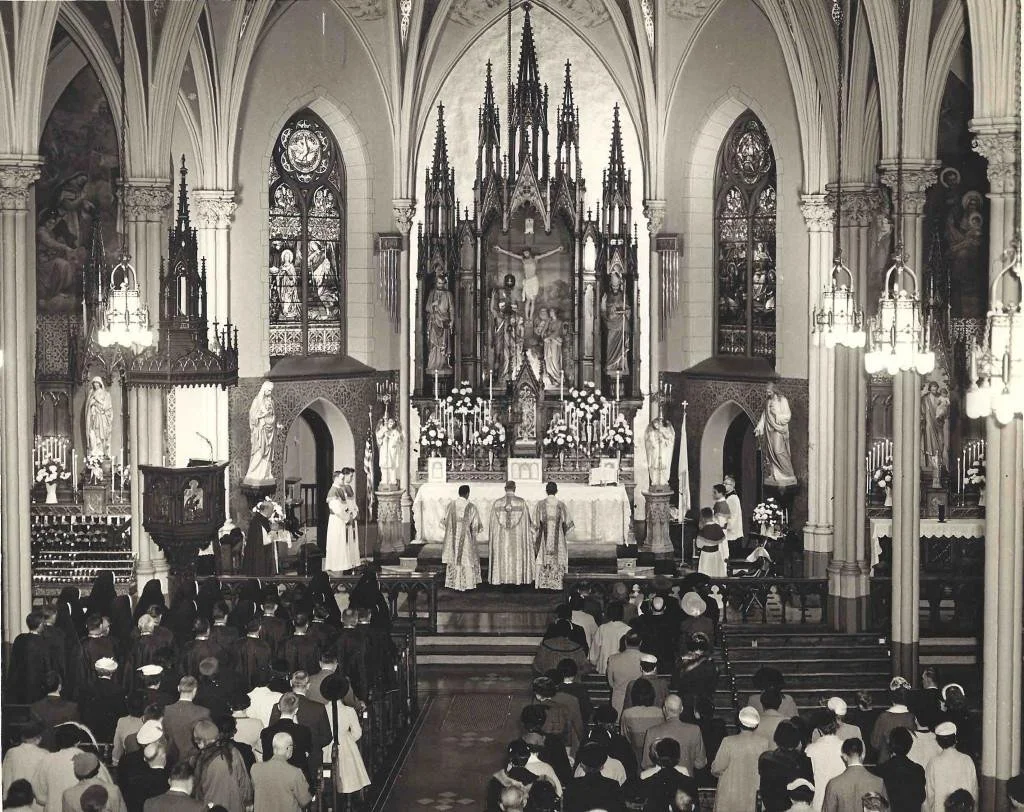
A traditional Roman Mass before Vatican II. The high altar, crucifix, priestly orientation, altar servers and ordered ceremonial formed part of a liturgical world inherited through centuries of Roman Catholic worship.
Organic Development Is Not the Same Thing as Liturgical Reconstruction
This distinction is indispensable. Traditional Catholics do not need to pretend that the Roman Mass never changed. It changed.
But historically its development was ordinarily:
gradual;
cumulative;
conservative;
received rather than comprehensively redesigned;
protective of older forms;
particularly conservative regarding the Canon.
A feast might be added. A rubric might change. A prayer might enter the rite. A calendar might be revised.
But the Roman Church did not normally appoint an international body to dismantle the existing Order of Mass, examine its component parts and reassemble the entire rite according to a comprehensive pastoral programme.
That is the qualitative distinction.
The Preconciliar Liturgical Movement
The 1969 reform did not begin from nothing in 1963. During the nineteenth and twentieth centuries a Liturgical Movement developed within Catholicism. Much of its original purpose was legitimate and laudable:
deeper understanding of the liturgy;
restoration of Gregorian chant;
greater appreciation of the liturgical year;
better participation by the faithful;
recovery of neglected patristic and liturgical sources.
Important reforms therefore preceded Vatican II. Under Pius XII, significant changes included the restoration of the Easter Vigil and reform of Holy Week. Paul VI himself described the reforms under Pius XII as an initial stage in the process that eventually led to the broader revision.
This matters because the postconciliar reform had preconciliar antecedents. But continuity of personnel or reforming activity does not prove continuity of scale or method.
The reforms after Vatican II accelerated dramatically.
Vatican II Gives the Mandate
On 4 December 1963, Paul VI promulgated Vatican II's Constitution on the Sacred Liturgy, Sacrosanctum Concilium. The document did not merely authorise translation of the existing Missal. It called for a general restoration of the liturgy. Regarding the Mass specifically, Article 50 ordered:
“The rite of the Mass is to be revised.”
It called for simplification, removal of duplications and elements regarded as having been added with less advantage, and restoration of other elements according to the tradition of the Fathers. Article 51 called for a greatly expanded presentation of Scripture.
But Sacrosanctum Concilium also contained an extraordinarily important principle in Article 23:
There should be no innovations unless the genuine and certain good of the Church requires them, and new forms should grow organically from forms already existing.
That criterion becomes crucial when judging what followed.
Did the new liturgy grow organically from the received Roman rite?
Or was the existing rite treated as material to be reconstructed?
The Consilium
In January 1964 Paul VI established a special body to implement the liturgical constitution. This became the Consilium ad exsequendam Constitutionem de Sacra Liturgia. Paul VI explicitly entrusted it with the implementation of Vatican II's liturgical programme.
The Consilium worked alongside the Congregation of Rites and later became central to the production of the revised liturgical books. Its president was Cardinal Giacomo Lercaro. Its secretary—and one of the personalities most closely associated with the reform—was Annibale Bugnini. Bugnini was therefore not some marginal outsider who subsequently distorted an otherwise completed conciliar reform. He occupied a central administrative position within the body officially charged with implementing it.
Ultimately, however, responsibility cannot simply be placed upon Bugnini.
Paul VI approved and promulgated the reformed liturgy.
That point is essential. The Novus Ordo was not merely the private experiment of rebellious liturgists. It became an official postconciliar reform authorised from Rome.
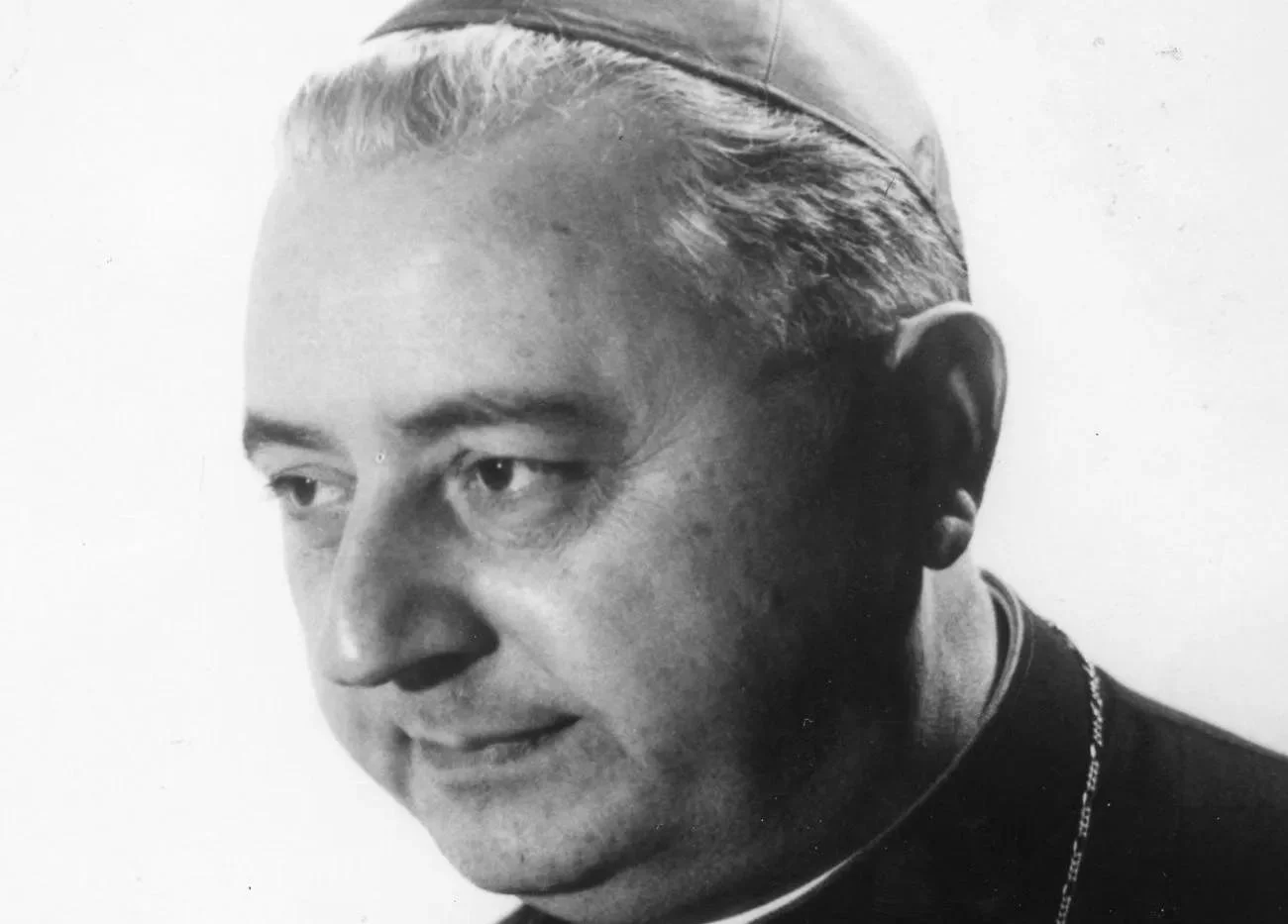
Annibale Bugnini, secretary of the Consilium charged with implementing Vatican II's liturgical constitution and one of the principal organisers of the postconciliar reform.
The Reform Was Introduced Incrementally
The old Mass did not disappear overnight on 4 December 1963. The changes came in stages. This is historically important because Catholics lived through a succession of apparently limited reforms that cumulatively transformed the liturgy.
The 1964 instruction Inter Oecumenici explicitly stated that the reform should proceed “step by step in stages.” The first major transitional changes took effect in 1965. Further changes followed. The 1967 instruction Tres abhinc annos explicitly described itself as introducing additional adaptations following those of 1964–1965. The sequence therefore matters:
1963 → Sacrosanctum Concilium establishes the principles and mandate for reform.
1964 → Paul VI creates the implementation machinery.
1965 → Substantial changes become visible in parish worship.
1967 → Further revisions are introduced.
1967 → An experimental “Normative Mass” is presented to the Synod of Bishops.
1969 → Paul VI promulgates the new Ordo Missae and Roman Missal.
The transformation took approximately five years. Compare that speed with the many centuries through which the inherited Roman liturgy had grown.
What Was Actually Changed?
This is where the claim that the Novus Ordo is merely “the old Mass in English” collapses.
The reform involved far more than language. Paul VI's own Missale Romanum acknowledges extensive revision. He identified the new Eucharistic Prayer arrangements as the reform's major innovation and stated that, beyond changes to the Eucharistic Prayer, Order of Mass and biblical readings, other portions had been considerably modified, including:
the Proper of Seasons;
the Proper of Saints;
Commons;
ritual Masses;
votive Masses;
numerous prayers.
The changes included, among other things:
The Prayers at the Foot of the Altar
The traditional preparatory prayers including Psalm 42 and the double Confiteor disappeared from the new Order of Mass.
The Traditional Offertory
The ancient offertory complex was replaced by substantially different prayers. The traditional prayers spoke unmistakably of:
an immaculate Victim;
sacrifice offered for sins, offences and negligences;
salvation;
the chalice of salvation;
sacrifice offered to God.
The new preparation of the gifts uses substantially different formularies.
The Roman Canon
For centuries the Roman rite possessed essentially one Eucharistic Canon. The reform introduced additional Eucharistic Prayers. Paul VI himself called this the major innovation and simultaneously acknowledged the ancient stability of the Roman Canon.
The Words Surrounding the Consecration
The traditional arrangement of the consecratory formula was altered. Mysterium fidei was removed from within the chalice formula and became the introduction to a congregational acclamation.
The Lectionary
The traditional annual cycle was replaced by a much larger multi-year lectionary. This greatly increased the amount of Scripture read publicly, but it was nevertheless a significant restructuring of the inherited liturgical cycle.
The Calendar
The calendar was extensively revised. Paul VI formally approved a new universal calendar prepared by the Consilium for implementation in 1970.
Rubrics and Ceremonial
Numerous gestures, repetitions, signs of the Cross, genuflections, priestly prayers and ceremonial elements were eliminated or altered.
Liturgical Roles
The distribution of spoken and ceremonial functions between priest, ministers and congregation was significantly changed.
Language
Although Sacrosanctum Concilium stipulated preservation of Latin while allowing wider vernacular use, postconciliar implementation resulted in predominantly vernacular parish worship across much of the Roman Church. The cumulative result cannot reasonably be described as translation alone. It was a reconstruction.
Paul VI Himself Acknowledged the Magnitude of the Change
One of the strongest pieces of evidence comes not from traditionalist critics but from Paul VI himself. On 19 November 1969, shortly before the new rite became obligatory in Italy, Paul VI addressed Catholics about what was coming.
He acknowledged that the Mass would be celebrated in a form noticeably different from that known for the preceding four centuries. More importantly, he characterised the change as something “surprising” and “extraordinary”, precisely because the Mass had been regarded as the traditional and almost untouchable expression of Catholic worship and Faith.
That testimony deserves considerable weight. The pope introducing the reform understood that Catholics were confronting something historically extraordinary.
This was not merely:
the old Mass, but in the vernacular.
It was a new liturgical order.
1570 to 1969: 399 Years—but the Continuity Goes Much Further Back
From the promulgation of Pius V's Missal in 1570 to Paul VI's new Missal in 1969 lies a period of 399 years. But even that comparison understates the matter.
Pius V did not create the Roman Canon.
St Gregory did not create it.
Paul VI himself acknowledged its late-antique formation.
The real contrast therefore stretches across a much longer history:
CHRIST AND THE APOSTLES
↓
APOSTOLIC EUCHARISTIC WORSHIP
↓
EARLY ROMAN CHRISTIAN LITURGY
↓
ROMAN CANON FORMED IN LATE ANTIQUITY
↓
ST GREGORY THE GREAT
↓
MEDIEVAL ROMAN RITE
↓
ST PIUS V — 1570 CODIFICATION
↓
CENTURIES OF CONTINUITY AND ORGANIC DEVELOPMENT
↓
VATICAN II — 1963
↓
CONSILIUM — 1964
↓
SUCCESSIVE ALTERATIONS — 1964–1967
↓
PAUL VI MISSAL — 1969
Seen in this perspective, the historical rupture becomes difficult to dismiss.
The Protestant Observers: What Actually Happened?
This subject must be handled carefully because exaggerated claims weaken an otherwise strong case. Six non-Catholic Protestant observers were associated with the Consilium proceedings. Their presence is historically significant.
It demonstrates the explicitly ecumenical atmosphere surrounding the reform and represents a remarkable novelty in the history of Roman liturgical revision.
But two different claims must be distinguished.
What We Can Say
Protestant observers were present. They had access to the process and were consulted within that environment. Their participation reflected the postconciliar emphasis on ecumenism.
What We Should Not Say Without Qualification
It is not historically accurate simply to say:
“Six Protestants wrote the Novus Ordo.”
They possessed no papal legislative authority.
They were not bishops of the Catholic Church.
They did not possess the authority to promulgate the Missal.
Accounts differ concerning the extent of their practical influence, and Bugnini himself minimised their participation. Therefore the strongest case does not depend upon pretending that Protestants legislated the Catholic Mass.
The important questions remain:
Why were representatives of communities descended from the Reformation involved at all in deliberations concerning the reconstruction of the Roman Mass?
And:
Did the resulting reforms reduce liturgical expressions particularly objectionable to Protestant theology?
Those questions must be answered by comparing the rites themselves rather than by relying upon sensational claims about secret Protestant authorship.
What About the Allegations Concerning Bugnini?
Annibale Bugnini has long been the subject of allegations concerning membership in Freemasonry or other covert activity. These allegations should not be presented as established historical fact unless supported by documentary evidence sufficient to prove them.
They are also unnecessary to the central argument. We do not need a conspiracy theory to establish what happened to the Mass. The public documents already establish:
Vatican II mandated general liturgical reform;
Paul VI created the Consilium;
Bugnini served as its secretary;
reforms were introduced incrementally;
a new Order of Mass was constructed;
Paul VI promulgated it;
extensive portions of the Roman Missal were changed.
These are documented historical facts. The problem therefore exists even if every allegation concerning Bugnini's private affiliations were false. That actually strengthens the argument.
The Novus Ordo was not merely an illicit underground assault upon an otherwise untouched Vatican II liturgy.
It was the official result of the postconciliar reform process.
The Ottaviani Intervention
Resistance appeared immediately. In September 1969, Cardinals Alfredo Ottaviani and Antonio Bacci transmitted to Paul VI a Brief Critical Study of the New Order of Mass prepared by theologians.
Its central accusation was exceptionally grave.
It argued that the Novus Ordo represented, as a whole and in its details, a “striking departure” from the Catholic theology of the Mass formulated at the Council of Trent.
This does not by itself settle the theological question.
The study was not an act of the Magisterium.
But it is extremely important historical evidence that serious churchmen immediately recognised that the dispute concerned much more than Latin, nostalgia or ceremonial taste.
The issue was Catholic sacrificial theology.
The Council of Trent Is the Necessary Doctrinal Baseline
The Catholic Mass is fundamentally a sacrifice. The Council of Trent defined that in the Mass the same Christ who offered Himself once bloodily upon the Cross is sacramentally offered in an unbloody manner.
The Mass is:
truly sacrificial;
propitiatory;
offered for the living and the dead;
inseparably connected with the Catholic priesthood.
These doctrines cannot be changed. Liturgical disciplines can change. Ceremonies can change. Languages can change. But a Catholic rite of Mass should express Catholic Eucharistic doctrine with clarity and integrity.
Consequently, the theological question raised by the postconciliar reform is not merely:
Is every sentence of the Novus Ordo capable of an orthodox interpretation?
A deeper liturgical question must also be asked:
What Catholic doctrines were emphasised repeatedly and unmistakably in the inherited Roman rite, and what happened to those expressions in the reconstructed rite?
That comparison is essential.
The Most Important Example: The Offertory
The traditional Offertory deserves particular attention. Before the Consecration, the priest offers bread with the prayer Suscipe, sancte Pater, speaking of the “immaculate Victim” offered for his sins and for all faithful Christians, living and dead, unto salvation.
The chalice is offered as the “chalice of salvation.” Other prayers repeatedly express sacrificial language. The Novus Ordo replaced this complex with prayers of preparation based partly upon Jewish-style blessing formulas:
Blessed are you, Lord God of all creation...
The new prayers are not heretical. But the theological issue is not exhausted by saying that.
The question is:
Why were ancient Catholic prayers explicitly expressing victimhood, propitiation, sin, salvation and sacrifice removed from a rite whose very essence is sacrificial?
That is precisely the sort of comparison required when determining whether the reform merely simplified the inherited Roman Mass or altered its theological expression.
From One Roman Canon to Multiple Eucharistic Prayers
For centuries the Roman Canon stood at the heart of the Roman rite. Its antiquity was so remarkable that Paul VI himself acknowledged its stable form from late antiquity. Then the reform added three new Eucharistic Prayers.
Paul VI called this the major innovation. That single change illustrates the difference in method.
For well over a millennium the Roman Church had guarded one enormously ancient Canon as the centre of her rite. Within the postconciliar reform, alternative Eucharistic Prayers were deliberately composed and placed beside it.
Whatever judgment one ultimately makes concerning the doctrinal orthodoxy of those prayers, historically this is plainly not ordinary incremental development.
It represents a fundamentally different approach to the Roman liturgical inheritance.
Did Vatican II Actually Require Everything That Followed?
No. This distinction is important. Sacrosanctum Concilium did mandate substantial reform.
But it did not explicitly command every subsequent development commonly associated with postconciliar parish worship.
It did not abolish Latin.
It did not explicitly command priests universally to celebrate facing the people.
It did not command Communion in the hand.
It did not command the removal of altar rails.
It did not command churches to destroy historic high altars.
Therefore abuses, later permissions and cultural developments must not simply be attributed indiscriminately to the conciliar text. But neither can Vatican II be completely separated from the reform.
Paul VI explicitly stated that Sacrosanctum Concilium supplied the basis for the general revision of the Roman Missal.
The Consilium was created precisely to implement that constitution.
The reformers themselves understood their work as implementing Vatican II.
The causal chain is therefore historically real:
VATICAN II
↓
GENERAL LITURGICAL REVISION AUTHORISED
↓
CONSILIUM CREATED
↓
STAGED REFORMS
↓
NEW ORDER OF MASS
↓
NEW ROMAN MISSAL
The Novus Ordo cannot credibly be described as having nothing to do with Vatican II.
The Strongest Defence of the Reform
The strongest Novus Ordo response is not that nothing changed. Plainly much changed. The stronger defence argues:
liturgy contains mutable elements;
the pope possesses authority over liturgical discipline;
the Roman rite had developed previously;
Vatican II legitimately sought active participation;
ancient liturgical materials were recovered;
Scripture was expanded;
vernacular worship improved comprehension;
the Roman Canon was retained as Eucharistic Prayer I;
Catholic sacrificial doctrine remained officially affirmed;
therefore the 1969 Missal represents legitimate reform rather than a different religion.
That argument deserves to be taken seriously. But it does not answer the central historical objection. The issue is not whether ecclesiastical authority may ever reform liturgy. The question is one of nature, extent and continuity.
At what point does reform cease to look like organic development and become reconstruction?
And why did Article 23 of Sacrosanctum Concilium itself insist that new forms should grow organically from existing forms if wholesale reconstruction were unobjectionable?
Response: Authority Does Not Make the Historical Rupture Disappear
Appealing to papal authority may address a juridical question. It does not erase the historical evidence. The following facts remain:
The Roman Canon possessed extraordinary antiquity.
The inherited Roman rite developed over many centuries.
Pius V codified rather than invented it.
Its central liturgical identity survived centuries of subsequent development.
Vatican II mandated a general reform.
An implementation commission systematically examined and revised the rite.
Reform proceeded in deliberate stages.
The traditional Offertory was replaced.
Multiple Eucharistic Prayers were introduced beside the Roman Canon.
The lectionary, calendar, prayers, rubrics and ceremonial were substantially altered.
Paul VI himself called the resulting change extraordinary.
This is sufficient to establish a historical rupture in the mode and scale of Roman liturgical development, whatever theological conclusion one subsequently draws about validity, authority or ecclesial identity.
A Sacred Inheritance or Material for Reconstruction?
This is where the reader must confront the deeper question. If the Roman Mass:
descended from apostolic Eucharistic worship;
developed within the ancient Roman Church;
possessed a Canon of immense antiquity;
was consolidated by saints and popes;
was codified and protected after Trent;
formed saints for centuries;
accompanied missionaries across continents;
nourished monasteries, convents, parishes and Catholic households;
expressed the sacrificial theology solemnly defended at Trent;
then what attitude should Catholics naturally have toward such a liturgy?
One of possession?
Or reception?
One of experimentation?
Or guardianship?
One of redesign?
Or reverence?
The Catholic instinct for most of the Church's history was that sacred worship is fundamentally received.
The priest does not invent the Eucharist.
The congregation does not invent the Eucharist.
A generation does not own the inherited liturgy as if it were a cultural product needing periodic reinvention.
It receives something sacred.
That does not prohibit legitimate development. But it establishes a powerful presumption against radical reconstruction.
The Rupture Was Therefore More Than External
The transformation was not merely:
LATIN → ENGLISH
or:
CHANT → HYMNS
or:
HIGH ALTAR → TABLE ALTAR
Those visible alterations matter because they accompanied something deeper. The older liturgy communicated an entire religious world:
priest and victim;
altar and sacrifice;
propitiation;
sin;
mediation;
the sacred;
silence;
adoration;
hierarchy;
transcendence;
judgment;
intercession for the dead;
the communion of saints;
sacramental realism.
Postconciliar worship increasingly presented a different external and psychological experience:
increased verbal participation;
increased congregational response;
broader use of vernacular;
celebration oriented toward visible communal interaction in widespread practice;
simplified ceremonial;
multiple options;
enlarged Scripture readings;
increased lay liturgical roles;
a stronger emphasis upon communal meal and assembly.
Not every one of those things is intrinsically un-Catholic. But taken together they manifest a profound change in liturgical culture. The question is whether that change merely expressed the same Catholic theology differently—or whether some doctrines formerly embodied with overwhelming clarity became less prominent while other emphases came to dominate.
That is where liturgical rupture becomes theological.
What We Can and Cannot Conclude
What We Can Conclude
The evidence establishes that:
The traditional Roman Mass was not invented by Pius V.
Its historical roots precede Trent by many centuries.
Its central Roman Canon possessed extraordinary antiquity and stability.
Pius V codified and protected an existing Roman liturgical inheritance.
The Roman rite underwent legitimate development before Vatican II.
Vatican II nevertheless initiated a general reform of unprecedented scope in modern Roman liturgical history.
The reform proceeded deliberately and incrementally between 1964 and 1969.
The Consilium was an official organ of implementation.
Bugnini occupied an important position within that work.
Paul VI possessed ultimate responsibility for authorising and promulgating the reformed Missal.
The new Missal involved substantially more than translation into the vernacular.
Major structures, prayers, rubrics, readings and calendrical arrangements were reconstructed.
The Roman Canon ceased to be the sole Eucharistic Prayer.
The traditional Offertory was replaced.
Paul VI himself recognised the extraordinary character of the change.
Serious Catholic churchmen immediately objected that the reform endangered the clear expression of Tridentine Eucharistic theology.
Taken together, these establish a genuine historical and liturgical rupture in method and scale between traditional Roman development and the postconciliar reconstruction.
What We Cannot Conclude Merely From These Historical Facts
These facts alone do not prove:
that every Novus Ordo Mass is invalid;
that every person attending it lacks Catholic Faith;
that every reformer consciously intended to destroy Catholicism;
that the Protestant observers authored the Missal;
that disputed allegations against Bugnini are true;
that every postconciliar liturgical abuse was required by Vatican II;
that Pius V dogmatically deprived every subsequent pope of all power to modify liturgical discipline.
Those are separate questions requiring their own evidence. But none of those qualifications eliminates the central conclusion.
Conclusion
The traditional Roman Mass was not an arbitrary collection of medieval customs waiting for modern experts to improve it. Neither was it invented by St Pius V in 1570.
Its sacramental reality originates in Christ's institution of the Eucharist and His command to the Apostles. Its Roman liturgical expression grew through the worship of the ancient Church. Its Canon attained remarkable stability in Christian antiquity. St Gregory inherited and consolidated it. Medieval Catholicism developed it. St Pius V codified and protected it. Generations of popes guarded it. Missionaries carried it around the world. Saints prayed it, offered it, served it and were formed within the spiritual world it expressed.
That history does not prove that no ceremony could ever be changed. It establishes something more important:
The traditional Roman Mass was a received sacred inheritance rather than a liturgical product created for the needs of a particular age.
After Vatican II, the relationship to that inheritance changed. Within a remarkably short period, an official commission systematically revised the Roman rite. The process began in stages, altered the existing Mass progressively and culminated in 1969 in a new Order of Mass and Roman Missal involving extensive alterations to prayers, Offertory, Eucharistic Prayers, readings, calendar, rubrics and ceremonial.
The pope who introduced it acknowledged that the change was extraordinary. This therefore cannot credibly be reduced to:
“They translated the old Mass into English.”
Nor can the difference be dismissed as nostalgia. The old and new rites embody materially different approaches to the Roman liturgical inheritance. One was principally the product of centuries of received and gradual development.
The other emerged through an organised programme of deliberate reconstruction implemented within a few years. That is rupture in the historical method of Roman liturgical development.
The deeper theological question follows inevitably:
If the traditional Roman Mass embodied Catholic sacrificial theology so profoundly, had been safeguarded through centuries, possessed a Canon reaching into Christian antiquity, had nourished generations of saints and had been solemnly protected by Catholic authority, what necessity justified dismantling and reconstructing so much of it?
And an even more serious question follows:
Can a religious revolution substantially alter a civilisation's inherited worship without eventually altering the way that civilisation understands the religion being worshipped?
The postconciliar transformation of Catholic life cannot be understood without confronting what happened to the Mass. The changes in altars, sanctuaries, priestly orientation, Communion, music, language and ceremonial were not isolated accidents. They accompanied the replacement of the historic Roman liturgical order itself. For a Catholic examining Vatican II objectively, this should provoke more than an aesthetic preference for the old liturgy.
It should provoke the fundamental question:
Why was a sacred Roman inheritance extending deep into Christian antiquity—guarded by popes, prayed by saints and centred upon the Sacrifice instituted by Christ—subjected after Vatican II to a reconstruction of a kind and scale essentially without precedent in its previous history?
That question leads directly into the wider question confronting this entire series:
Was postconciliar Catholicism merely the ancient Catholic religion expressed in modern forms—or was the reconstruction of its worship one of the clearest outward signs that something far deeper had changed?
Primary Sources
Holy Scripture — Matthew 26:26–28; Luke 22:19–20; 1 Corinthians 11:23–29 — Christ's institution of the Eucharist and the apostolic transmission of the rite.
St Justin Martyr, First Apology, chapters 65–67, c. AD 155 — early description of Christian Eucharistic worship and belief in the Real Presence.
Council of Trent, Session XXII (1562) — Catholic doctrine concerning the Holy Sacrifice of the Mass.
St Pius V, Quo Primum (1570) — promulgation and protection of the revised Roman Missal following Trent.
Second Vatican Council, Sacrosanctum Concilium (1963), especially 21–23 and 47–58 — mandate and governing principles for liturgical reform.
Paul VI, Sacram Liturgiam (1964) — establishment of the implementation machinery for the conciliar liturgical reform.
Sacred Congregation of Rites / Consilium, Inter Oecumenici (1964) — first major implementation instruction; explicitly envisages reform proceeding step by step.
Sacred Congregation of Rites, Tres Abhinc Annos (1967) — second stage of liturgical adaptations.
Paul VI, Mysterii Paschalis (1969) — promulgation of the revised Roman calendar.
Paul VI, Missale Romanum (1969) — promulgation of the revised Roman Missal; acknowledges both the ancient stability of the Roman Canon and extensive modifications made in the new Missal.
Paul VI, General Audience, 19 November 1969 — acknowledges the surprising and extraordinary character of the liturgical change.
Cardinals Alfredo Ottaviani and Antonio Bacci, letter accompanying the Brief Critical Study of the New Order of Mass (1969) — contemporary criticism alleging a striking departure from the theology of the Mass formulated at Trent.
Further Reading
Adrian Fortescue, “Canon of the Mass,” Catholic Encyclopedia — valuable preconciliar history of the extraordinary antiquity and stability of the Roman Canon.
Adrian Fortescue, “Liturgy of the Mass,” Catholic Encyclopedia — historical development of the Roman liturgy.
Annibale Bugnini, The Reform of the Liturgy 1948–1975 — firsthand account by one of the principal organisers of the reform; useful precisely because it presents the reformer's own perspective.
Michael Davies, Pope Paul's New Mass — traditional Catholic historical critique of the reform.
A Brief Critical Study of the New Order of Mass — the “Ottaviani Intervention” — contemporary theological criticism of the 1969 reform.
Related Questions
What Did Catholic Worship Look Like Before Vatican II—and What Did It Become Afterwards?
What Exactly Changed Between the Traditional Mass and the Novus Ordo?
Did the New Mass Change the Catholic Understanding of Sacrifice?
Why Were Altars, Sanctuaries and Catholic Churches Physically Altered After Vatican II?
Why Did Communion Practices Change After Vatican II?
Did Vatican II Require the Liturgical Revolution That Followed?
What Was the Ottaviani Intervention, and Why Did Cardinals Warn Paul VI About the New Mass?
Can the Novus Ordo and Traditional Roman Mass Really Be Called Two Expressions of the Same Liturgical Tradition?