Was Vatican II a Dogmatic or Pastoral Council?
Short Answer
Vatican II repeatedly presented itself as a Council with a predominantly pastoral purpose, but this must not be misunderstood to mean that it dealt only with pastoral practice or that it left Catholic doctrine untouched.
It issued documents explicitly described as dogmatic, taught extensively on doctrine, claimed substantial magisterial authority, and introduced consequential new formulations concerning
religious liberty,
ecumenism,
ecclesiology,
episcopal collegiality,
relations with non-Catholic Christians and non-Christian religions, and
the Church's relationship with the modern world.
The crucial question is therefore not simply:
“Was Vatican II dogmatic or pastoral?”
It is:
“Did Vatican II merely change the Church's pastoral methods, or did it introduce principles and doctrinal formulations which departed from the Catholic Faith previously taught and which, when followed through after the Council, produced a substantially different religion?”
That is the real controversy.
The traditional Catholic case examined throughout these articles is that Vatican II did not merely produce confusion or accidentally inspire isolated abuses. It opened the door deliberately to a new conception of Catholicism:
new principles were introduced at the Council and subsequently developed through liturgical reconstruction,
ecumenism,
interreligious dialogue,
religious liberty,
new ecclesiology,
revised sacramental rites,
new canon law,
new catechetical formulations and
a fundamentally altered relationship between the Church, other religions and the modern secular world.
The result, according to the analysis developed in this FAQ, was not simply traditional Catholicism expressed in modern language.
It was a postconciliar religious system retaining Catholic names, offices, buildings and institutional structures while progressively changing important elements of the religion itself.
If that analysis is correct, the problem is far more serious than a badly implemented pastoral council.
It is a question of rupture, indefectibility and authority.
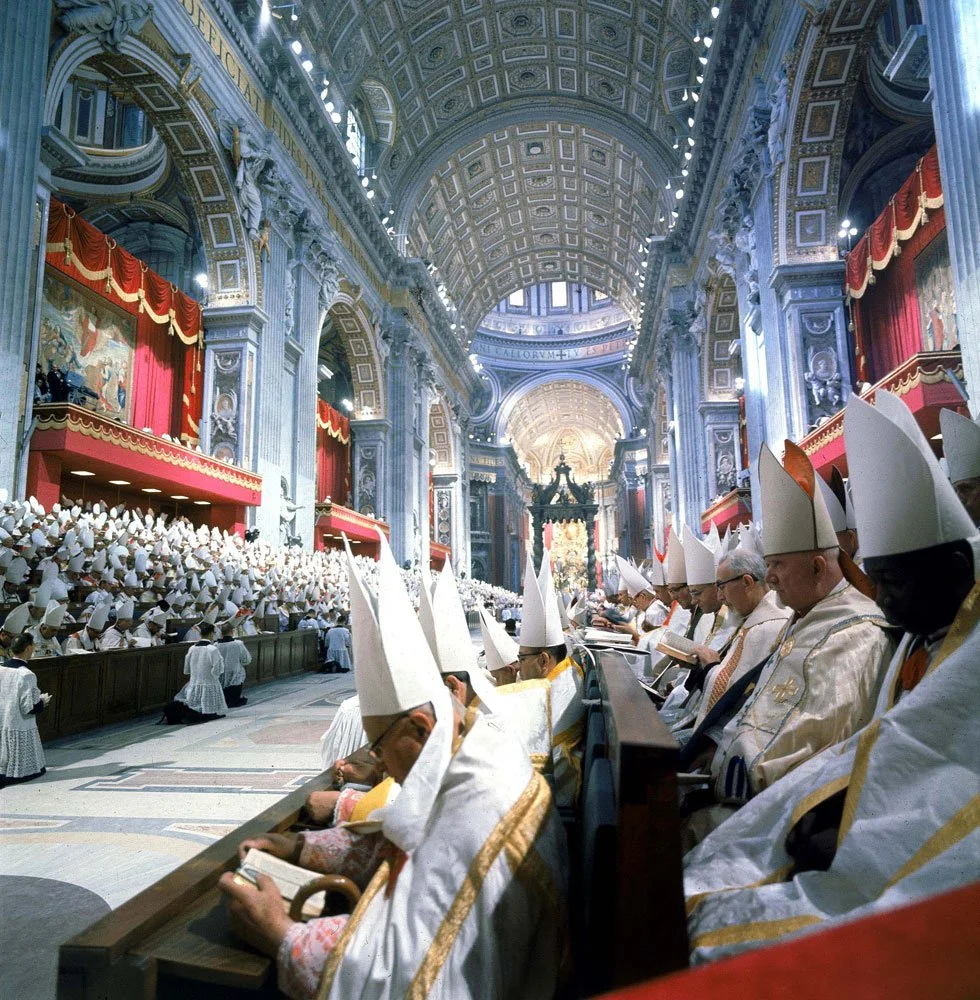
Bishops assembled in St Peter’s Basilica during the Second Vatican Council (1962–1965). More than 2,000 bishops from across the world participated in the Council, whose sixteen documents would initiate far-reaching changes in Catholic doctrine, worship, ecumenism and the Church’s relationship with the modern world.
Why This Question Matters
The description of Vatican II as a “pastoral council” is frequently used as though it resolves the controversy. It does not.
A Catholic unfamiliar with the crisis may hear the word pastoral and reasonably conclude:
Vatican II did not really change Catholic doctrine. It simply tried to present the same Faith in language better suited to the modern world. Unfortunately, some people went too far afterwards.
That explanation must itself be tested. The issue is not whether abuses occurred after Vatican II. They plainly did. The deeper issue is whether the postconciliar transformation can adequately be explained as abuse of the Council, or whether important elements of that transformation proceeded from principles deliberately introduced or authorised by the Council itself.
That distinction is fundamental. If Vatican II taught exactly the same religion as before, then continuity should be demonstrable. If, however, its new principles concerning religious liberty, ecumenism, ecclesiology and religious pluralism cannot be reconciled with the previous Magisterium without altering the meaning of earlier teaching, then the problem is not merely pastoral. It is doctrinal.
And if those principles subsequently transformed Catholic worship, missionary activity, canon law, catechesis and religious practice throughout the world, then the postconciliar crisis cannot be dismissed as the work of a few disobedient priests or radical theologians.
What Did Vatican II Claim to Be?
When John XXIII opened Vatican II on 11 October 1962, he distinguished between the immutable deposit of Faith and the manner in which that Faith might be presented. He said that the Church's doctrine was to be studied and presented according to the needs of the age, while maintaining the same meaning and judgment. Vatican
That distinction is perfectly legitimate in principle. Catholic doctrine does not have to be expressed in precisely the same vocabulary in every century.
But changing the presentation of a doctrine is one thing.
Changing the meaning of the doctrine is another.
The controversy over Vatican II is therefore not resolved by demonstrating that John XXIII said the deposit of Faith was immutable. The question is whether the Council actually maintained that immutability in its new formulations. That question must be answered by comparing what the Church taught before Vatican II with what Vatican II taught afterwards.
“Pastoral” Did Not Mean “Non-Doctrinal”
This distinction is essential. Vatican II produced:
a Dogmatic Constitution on the Church, Lumen Gentium;
a Dogmatic Constitution on Divine Revelation, Dei Verbum;
a Constitution on the Sacred Liturgy, Sacrosanctum Concilium;
a Pastoral Constitution on the Church in the Modern World, Gaudium et Spes;
declarations and decrees addressing religious liberty, ecumenism, non-Christian religions, bishops, religious life, missionary activity and other subjects.
Therefore it is misleading to reason:
Vatican II was pastoral → therefore Vatican II did not teach doctrine → therefore doctrinal continuity is not an issue.
The Council plainly taught on doctrinal matters. The more precise point is that Vatican II did not characteristically proceed by issuing new solemn definitions accompanied by anathemas in the manner familiar from earlier doctrinal councils. But this does not establish that Vatican II introduced nothing doctrinally new.
That is precisely what must be investigated.
The Real Question: What Changed?
The dispute becomes clearer if we stop concentrating on the label pastoral and examine the substance. Before Vatican II, the Catholic Church possessed an extensive body of authoritative teaching concerning:
the identity of the Church of Christ;
the necessity of the Catholic Church for salvation;
Christian unity;
relations with heretics and schismatics;
false religions;
the rights of truth and error;
Church and state;
the Social Kingship of Christ;
papal and episcopal authority;
Catholic missionary activity;
and the nature of Catholic worship.
Vatican II introduced new formulations and orientations in precisely these areas. That is why the controversy cannot be resolved by saying that the Council defined no new solemn dogma.
The question is whether it contradicted doctrine that already existed.
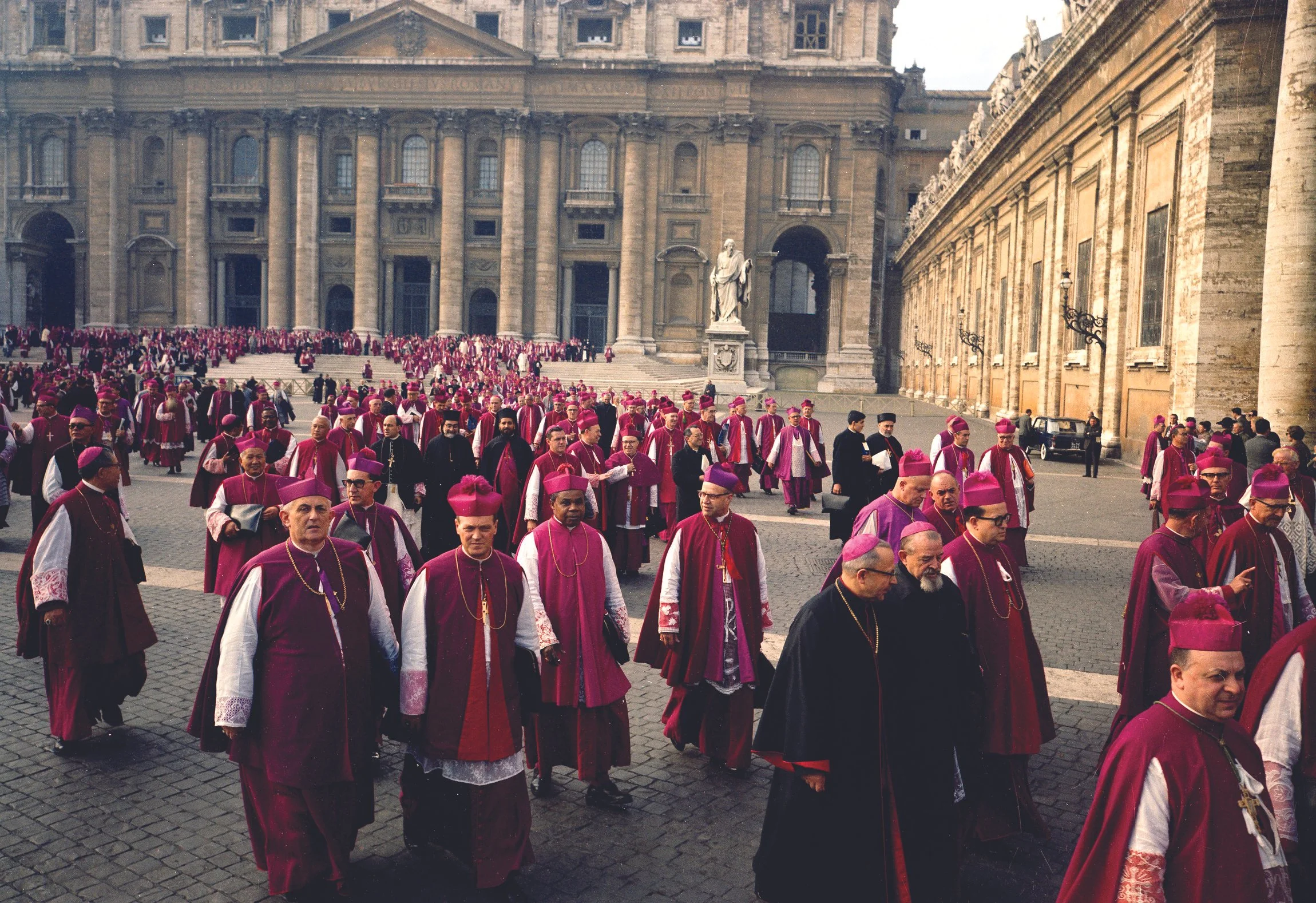
Bishops leave St Peter’s Basilica after a session of the Second Vatican Council in 1962. More than 2,000 bishops from across the world participated in a Council whose teachings and reforms would profoundly reshape Catholic life in the decades that followed.
Vatican II Opened Doors That Had Previously Been Kept Closed
The Council did not merely alter vocabulary.
It deliberately pursued new approaches in several areas of Catholic life.
Religious Liberty
Dignitatis Humanae declared:
“The human person has a right to religious freedom.”
It further taught that this right was founded in the dignity of the human person and should be recognised in constitutional law as a civil right. Vatican
The document simultaneously claimed that it left untouched traditional Catholic teaching concerning the duties of individuals and societies toward the true religion. Vatican
That claim of continuity must be examined rather than merely assumed.
The relevant comparison is with the preconciliar Magisterium concerning:
the Social Kingship of Christ;
the duties of civil society toward the true religion;
religious toleration;
the supposed natural right publicly to propagate false religion;
and the distinction between tolerating an evil for the common good and recognising a positive civil right grounded in human dignity.
If those teachings cannot be reconciled, the problem is doctrinal—not merely pastoral.
Ecumenism
Before Vatican II, Catholic ecumenism meant fundamentally the restoration of those separated from Catholic unity to the one Church Christ founded.
Vatican II adopted a substantially different ecumenical framework.
Unitatis Redintegratio declared the restoration of Christian unity to be one of the Council's principal concerns and instructed Catholics to participate in the ecumenical movement. More significantly, it taught that separated Churches and ecclesial communities possess elements capable of producing grace and that the Spirit of Christ can use them as “means of salvation.” Vatican
The document also retained the assertion that the fullness of the means of salvation belongs to the Catholic Church. Vatican
But the question remains:
Is this the same understanding of Christian unity taught before Vatican II?
That comparison becomes particularly important when Unitatis Redintegratio is read beside Pius XI's Mortalium Animos and the Church's previous approach to the return of separated Christians.
The issue is not merely that Catholics became friendlier toward Protestants. It concerns the theological status attributed to separated religious bodies themselves.
Ecclesiology: From “Is” to “Subsists In”
Pius XII taught in Mystici Corporis that the Mystical Body of Christ and the Roman Catholic Church are one and the same reality. Vatican II's Lumen Gentium instead declared that the Church of Christ:
“subsists in the Catholic Church.”
It then spoke of elements of sanctification and truth existing outside her visible structure. Vatican Press
This wording generated so much controversy that the postconciliar Congregation for the Doctrine of the Faith later issued explanations insisting that subsistit in did not change the doctrine and that the Church of Christ remains fully identified with the Catholic Church. Vatican
But again, the question cannot be settled merely by asserting continuity.
Why was the traditional direct identification reformulated?
What theological possibilities did the new expression permit?
How was it subsequently connected with the recognition of ecclesial elements and salvific activity outside visible Catholic unity?
These questions matter because ecclesiology concerns what the Church actually is.
Collegiality
Lumen Gentium also developed the doctrine of episcopal collegiality, describing the episcopal college, always with and never without its head, as possessing supreme authority over the universal Church. Vatican
The Council retained papal primacy. Therefore it would be inaccurate simply to say that Vatican II formally abolished the supremacy of the Roman Pontiff.
But the controversy concerns whether its new emphasis upon the episcopal college, subsequently embodied in episcopal conferences and eventually developed into the postconciliar emphasis upon synodality, changed the practical and theological understanding of authority within the Church.
The issue deserves examination precisely because the Council itself considered the matter sufficiently delicate to require clarification concerning the relationship between collegiality and papal primacy.

The Holy Door of St Peter’s Basilica. Vatican II was presented as opening the Church more fully to the modern world; its critics argue that it also opened doors which earlier Catholic teaching and discipline had deliberately kept closed, allowing doctrinal novelty, ecumenism, liturgical experimentation and accommodation to modern ideas to enter Catholic life.
The Liturgical Revolution Was Not Unrelated to Vatican II
One of the most visible transformations following Vatican II was the reconstruction of Catholic worship. It is sometimes argued that the Council had nothing to do with this and that later reformers simply betrayed Sacrosanctum Concilium.
That explanation is inadequate.
The Constitution itself declared that the Council saw “particularly cogent reasons” for undertaking the reform and promotion of the liturgy. It authorised revision of rites, expanded the role of territorial episcopal authorities, contemplated adaptations, and even permitted controlled experimentation in certain circumstances. Vatican
It is true that Sacrosanctum Concilium also imposed safeguards. It said that innovations should occur only when genuinely required by the good of the Church and that new forms should grow organically from existing forms. Vatican Press
That creates an important historical question:
Did the reform actually implemented after the Council remain within those safeguards?
The answer cannot be supplied simply by calling every subsequent change an “abuse.” The reform was conducted by the authorities established to implement the Council and culminated in a substantially reconstructed Roman liturgy.
From the Traditional Roman Mass to the Novus Ordo
The transformation was extensive.
Altars were commonly turned toward the people.
The vernacular became dominant.
Traditional Offertory prayers disappeared.
The lectionary was reconstructed.
The calendar was extensively revised.
Numerous traditional prayers, gestures and ceremonial elements were removed or altered.
New Eucharistic prayers appeared.
Communion practices changed.
The audible and communal dimensions of worship became much more prominent.
The cumulative effect was a liturgical experience dramatically different from that known by Catholics before the Council. This was not merely a question of whether Catholics preferred Latin. It concerned how Catholic doctrine was expressed through worship.
In 1969 Cardinals Alfredo Ottaviani and Antonio Bacci presented Paul VI with the Short Critical Study of the New Order of Mass. Their accompanying letter argued that the Novus Ordo represented a “striking departure” from the Catholic theology of the Mass formulated by the Council of Trent. Internet History Sourcebooks
That criticism did not itself constitute a magisterial judgment. But it demonstrates that opposition to the new Mass was not originally based merely upon nostalgia or aesthetics. The objection was theological.
The Change Did Not Stop With the Mass
This is essential to understanding the scale of the postconciliar transformation.
The Mass was not changed in isolation. During the years following Vatican II, the wider sacramental and institutional life associated with Roman Catholicism was extensively revised.
The rites surrounding the sacraments were changed.
The rites of ordination and episcopal consecration were revised.
The liturgical calendar was reconstructed.
Canon law was eventually replaced by the 1983 Code.
A new universal catechism appeared in 1992.
Ecumenical activity became institutionalised.
Interreligious dialogue became normal.
Episcopal conferences assumed an increasingly visible role.
The relationship between Catholic institutions and secular states changed.
Missionary activity increasingly incorporated dialogue with other religions.
The language by which Catholic authorities spoke about Protestants, schismatics and non-Christian religions changed profoundly.
Not every one of these developments appears explicitly in a sentence of Vatican II. That is not the claim. The point is that the postconciliar authorities themselves presented these developments as implementation, application or development of the Council.
The Council was not an isolated four-year event. It became the organising principle of the postconciliar transformation.
The Result Was More Than a Change of Appearance
This is where the scale of the crisis becomes apparent.
If Catholic churches merely acquired different architecture, the issue would principally concern aesthetics.
If Latin were simply replaced by English, Italian or French, the issue would principally concern discipline.
If priests merely wore different clothing, the issue would principally concern custom.
But the transformation penetrated much more deeply.
The understanding and practice of ecumenism changed.
The doctrine and application of religious liberty changed.
The terminology used to identify the Church of Christ changed.
The relationship with Protestant communities changed.
The relationship with non-Christian religions changed.
Catholic worship was comprehensively reconstructed.
Sacramental rites were revised.
Canon law was rewritten.
Catechesis was recast within the postconciliar framework.
The Church's relationship with the secular state changed.
The missionary approach toward non-Catholics changed.
The traditional public emphasis upon the Social Kingship of Christ receded while religious pluralism and dialogue became characteristic features of postconciliar Catholic life.
At some point the question has to be asked:
How many fundamental characteristics of a religion can be transformed before we must ask whether we are still dealing with the same religion?
From Catholicism to a Postconciliar Religion
This is the crux of the matter. The traditional Catholic criticism developed in this FAQ is not that Vatican II made Catholicism slightly more liberal. Nor is it simply that irresponsible priests misunderstood an otherwise harmless Council. The argument is that
Vatican II opened the doctrinal and institutional doors through which a new religious orientation entered Catholic structures.
It retained Catholic terminology.
It retained Catholic buildings.
It retained dioceses.
It retained episcopal titles.
It retained the word Mass.
It retained the word Eucharist.
It retained the papacy as an institutional claim.
It continued to call itself the Catholic Church.
But continuity of names and structures does not by itself establish continuity of religion.
A religion is identified also by what it believes, how it worships, what it teaches concerning salvation, how it understands itself, what it requires of its members, and how it relates to religious error. If these things are substantially altered, institutional continuity alone cannot answer the theological problem.
From the traditional Catholic analysis, the postconciliar system therefore increasingly resembles a pseudo-Catholic religion:
Catholic in name and external institutional inheritance,
but altered in crucial aspects of doctrine, worship, ecclesiology and religious practice.
That is a grave conclusion. It therefore cannot rest upon rhetoric. It must be demonstrated article by article by comparing the postconciliar propositions with the Catholic Magisterium that preceded them.
Was This Merely an Accidental “Spirit of Vatican II”?
The strongest objection is that none of this proves Vatican II itself responsible. According to this argument, the Council was orthodox; radicals subsequently invoked a false “spirit of Vatican II”; liturgical abuses exceeded the Council's instructions; secularisation caused the collapse in religious practice; and ambiguous conciliar passages must simply be interpreted according to Tradition.
There is truth in part of this objection. Not every postconciliar abuse was mandated by Vatican II. Some developments clearly went beyond the literal wording of the documents.
Sacrosanctum Concilium, for example, contained safeguards that the subsequent liturgical transformation appears, in important respects, to have exceeded. Vatican Press
But that does not settle the matter. The relevant question is whether the overall direction of the postconciliar transformation was contrary to Vatican II or proceeded along lines the Council itself opened.
Consider the evidence.
The Council itself called for liturgical reform. Vatican
The Council itself proclaimed a right to religious liberty grounded in human dignity. Vatican
The Council itself formally embraced the ecumenical movement and attributed salvific significance to separated Christian bodies. Vatican
The Council itself adopted subsistit in and spoke of ecclesial elements beyond the Church's visible structure. Vatican Press
The Council itself developed episcopal collegiality. Vatican
These were not inventions of rebellious parish priests in 1975.
They were contained in the Council.
The subsequent transformation therefore cannot simply be separated from Vatican II by calling everything objectionable an “abuse.”
Paul VI Himself Acknowledged the Postconciliar Crisis
The profound crisis that followed Vatican II was not something invented decades later by traditional Catholics.
Paul VI himself publicly acknowledged it while the postconciliar transformation was still unfolding.
Only three years after the Council ended, in his 1968 Credo of the People of God, Paul VI warned that even Catholics were being seized by a passion for “change and novelty.” He acknowledged the resulting “disturbance and perplexity in many faithful souls.”
This was already a remarkable admission. Vatican II had been presented as the beginning of a great renewal, yet within only a few years the man who had presided over most of the Council and promulgated its principal documents was publicly acknowledging serious uncertainty among the faithful.
Four years later, his language became considerably more dramatic. On 29 June 1972, reflecting upon the condition of the Church, Paul VI declared that he had the sensation that:
“from some fissure the smoke of Satan has entered the temple of God.”
He described a Church afflicted by doubt, uncertainty, questioning, anxiety and dissatisfaction. He lamented the advance of profanation, desacralisation and secularisation and the loss of confidence that had entered Catholic life. Even more striking was his comparison between what had been expected from Vatican II and what had actually followed.
Paul VI recalled the expectation that after the Council there would come a “day of sunshine” for the Church. Instead, he spoke of:
“clouds, storms, darkness, searching, uncertainty.”
He acknowledged that this uncertainty existed within the Church herself.
These statements are historically significant because they did not come from Archbishop Lefebvre, Cardinal Ottaviani or later traditional Catholic critics. They came from Paul VI himself—the pope who had directed most of Vatican II, promulgated its documents, authorised the postconciliar reforms and presided over the first years of their implementation.
Paul VI did not conclude that Vatican II itself was responsible for the catastrophe he described. He attributed the crisis to hostile and even preternatural forces seeking to frustrate the good fruits he believed the Council should have produced.
That distinction is important. But it does not make the historical problem disappear.
If Vatican II was supposed to bring renewal, greater understanding of the Faith and a new flourishing of Catholic life, why did its principal implementer find himself only seven years after the Council describing the Church in terms of doubt, uncertainty, desacralisation, darkness and the “smoke of Satan”?
And there is a deeper question still.
Was the crisis simply an accidental corruption of Vatican II—or did Vatican II itself open the doors through which the postconciliar transformation entered?
The answer cannot be found merely by examining what the Council's architects said they hoped would happen.
We must examine
what Vatican II actually taught and authorised,
what the postconciliar authorities subsequently implemented in its name, and
whether those changes continued the Catholic Faith or progressively replaced it with something substantially different.
That is the crucial distinction. The “smoke of Satan” did not appear in a vacuum. It appeared during the very years in which Catholic worship was being reconstructed, traditional disciplines were being dismantled, ecumenism was being institutionalised, religious liberty was being implemented, religious life was undergoing enormous upheaval, and the Council's new theological orientations were being applied throughout Catholic institutions.
This does not by itself prove that Vatican II caused every element of the crisis. But it makes one explanation increasingly difficult to sustain without further evidence:
that Vatican II preserved the Catholic religion entirely intact, while an unrelated collection of abuses somehow transformed Catholic life immediately afterwards.
The real question is whether the postconciliar revolution represented a betrayal of Vatican II—or the development of principles that Vatican II itself had deliberately introduced and authorised.
That question must be answered by comparing the preconciliar Faith, the conciliar texts and the postconciliar reforms themselves.
The Problem Was Not Merely That Catholics Were Confused
Confusion is itself significant, but it is not the deepest problem. The deeper problem is that Catholics were increasingly being asked to accept propositions and practices that appeared difficult to reconcile with what they or the previous generation had been taught as Catholic truth.
What had previously been condemned could now appear to be approved.
What had previously been treated as religious error could now become a partner in dialogue.
What had previously been described as return to Catholic unity could now be described as ecumenical convergence.
What had previously been expressed through an unmistakably sacrificial liturgy could now be expressed through radically reconstructed forms.
What had previously been spoken of as the conversion of nations could increasingly be reframed in terms of dialogue, religious liberty and pluralism.
This creates a spiritual danger greater than mere confusion. The ordinary Catholic can eventually conclude:
If all these things can change, perhaps none of them was ever really true.
That is how doctrinal instability can produce religious indifferentism. Not necessarily by explicitly saying:
“Catholicism is false.”
But by creating the practical impression:
“Catholicism does not matter very much.”
Did Vatican II Cause Everything That Followed?
Historical causation requires care. The decades after Vatican II also witnessed:
rapid secularisation;
the sexual revolution;
changing family structures;
mass consumer culture;
challenges to traditional authority;
demographic change;
political and social upheaval.
It would therefore be simplistic to claim that Vatican II alone caused every decline in Mass attendance, religious vocations, Catholic schools or adherence to Catholic doctrine. But that observation raises another question rather than eliminating the problem.
At precisely the moment when Western society was undergoing one of its most aggressive periods of secularisation, did Vatican II strengthen Catholic resistance to that secularisation—or did the simultaneous internal reconstruction of Catholic doctrine, worship and practice weaken it?
At the very moment when Catholics needed extraordinary clarity about supernatural truth, the Church's unique claims and the necessity of conversion, Catholic life entered an unprecedented period of internal experimentation.
The historical coincidence does not prove causation by itself. But neither can it simply be ignored.
The Question Ultimately Leads Beyond Vatican II
This is where the argument eventually reaches ecclesiology itself. The Catholic Church is indefectible. Christ promised:
“Upon this rock I will build my church, and the gates of hell shall not prevail against it.” — Matthew 16:18
St Paul calls the Church:
“the church of the living God, the pillar and ground of the truth.” — 1 Timothy 3:15
The Catholic Church therefore
cannot cease to be the Church Christ founded,
defect from the Faith entrusted to her, or
become an instrument for corrupting the religion she was divinely commissioned to preserve.
This is what makes the Vatican II crisis so serious. The question is no longer merely hypothetical. The traditional Catholic case examined throughout these articles is that the postconciliar authorities:
promulgated teachings on religious liberty, ecumenism and ecclesiology that cannot be reconciled with the previous Magisterium without substantially changing the meaning of earlier teaching;
replaced the traditional Roman Mass in ordinary Catholic life with a radically reconstructed liturgy whose traditional critics argued weakened the expression of the Mass as a propitiatory sacrifice and moved Catholic worship visibly closer to Protestant forms;
authorised and promoted ecumenical and interreligious practices that weakened in practice the distinction between the one true religion and false religions, fostering religious indifferentism; and
developed an ecclesiology of subsistence, degrees of communion and ecclesial elements outside visible Catholic unity that traditional Catholic critics contend cannot be reconciled with the Church's previous understanding of herself.
These are not minor disagreements about administration or ceremonial preference. They concern
the identity of the Church,
the nature of Catholic worship,
the uniqueness of the Catholic religion and
the integrity of the Faith itself.
The question therefore becomes: Could the Catholic Church herself universally
teach doctrines contrary to her previous Magisterium,
impose worship harmful to the Faith,
establish disciplines that foster religious indifferentism, or
promulgate an ecclesiology incompatible with her divinely revealed identity?
Traditional Catholic theology teaches that the Church is indefectible. She cannot become a false Church. She cannot transform the religion revealed by Christ into another religion while remaining the divinely protected teacher of the same Faith.
Therefore, if the contradictions identified in Vatican II and the postconciliar religion are real—and the following articles must demonstrate them carefully, issue by issue—then another explanation must be sought. The problem becomes one of authority.
If the Catholic Church cannot defect, yet men claiming supreme authority over her promulgate and impose what is shown to be contrary or harmful to the Catholic Faith, Catholics must ask whether those men actually possessed the authority they claimed.
That is where the Vatican II crisis ultimately leads to the questions of
public heresy,
Church membership,
jurisdiction,
ecclesiastical office,
papal authority,
indefectibility and
sedevacantism.
Main Objection: “The Faith Is Still the Same”
The strongest response from defenders of Vatican II is straightforward:
The Catholic Faith did not change. Vatican II developed doctrine without contradicting it. Later abuses should not be attributed to the Council, and difficult passages must be interpreted in continuity with Tradition.
That position deserves to be tested seriously. But “continuity” cannot simply be asserted. It must be demonstrated.
If two propositions appear contradictory, it is not enough to say that both must be Catholic because authorities presented both as Catholic. The actual propositions must be examined. The relevant questions are therefore concrete:
Does Dignitatis Humanae teach the same doctrine on religious liberty as the preconciliar Magisterium?
Does Unitatis Redintegratio teach the same conception of Christian unity as Mortalium Animos?
Does the ecclesiology of Lumen Gentium preserve without alteration the previous identification of the Mystical Body of Christ with the Catholic Church?
Is the postconciliar approach to non-Christian religions compatible with the traditional necessity of conversion and membership in the Church?
Does the Novus Ordo preserve adequately and unambiguously the Catholic theology of the Mass defined at Trent?
Those questions cannot be answered by slogans about either “rupture” or “continuity.” The texts must be compared. That is what the following FAQ articles will do.
What We Can and Cannot Conclude
We can conclude:
Vatican II cannot adequately be dismissed as a Council that dealt only with pastoral technique. It taught extensively on doctrinal matters. It deliberately inaugurated new approaches to ecumenism, religious liberty, ecclesiology, liturgy and the Church's relationship with the modern world.
The postconciliar authorities subsequently implemented and developed those principles across Catholic worship, law, catechesis and institutional life. The resulting transformation was profound enough to raise the legitimate theological question of whether it represented development or rupture.
And if genuine doctrinal contradiction is established, the problem necessarily reaches the doctrines of indefectibility and ecclesiastical authority.
We cannot conclude merely from this introductory article:
That every sentence of every Vatican II document is erroneous.
That every postconciliar practice was explicitly commanded by the Council.
That every Catholic who accepted Vatican II consciously intended to abandon Catholicism.
That social and religious decline after the Council had only one cause.
Or that the sedevacantist conclusion may simply be assumed without establishing the doctrinal and ecclesiological premises upon which it rests.
Those matters require evidence. The purpose of the articles that follow is to provide it.
Conclusion
So, was Vatican II a dogmatic or pastoral council? The most useful answer is no longer simply to choose one of those two words.
Vatican II was deliberately pastoral in method and orientation, but it taught extensively on doctrinal matters and introduced consequential new formulations and principles concerning religious liberty, ecumenism, ecclesiology, collegiality, liturgy and relations with other religions.
The decisive question is not whether Vatican II formally defined a new dogma. It is whether Vatican II contradicted doctrines the Catholic Church had already taught.
If it did, then calling the Council “pastoral” changes nothing. The Council deliberately opened Catholic life to new approaches.
It initiated liturgical reform.
It institutionalised ecumenism.
It proclaimed religious liberty in new terms.
It introduced new ecclesiological formulations.
It developed episcopal collegiality.
It sought a fundamentally new engagement with the modern world.
And the decades that followed witnessed not merely isolated abuses but a comprehensive reconstruction of Catholic religious life.
The traditional Roman Mass largely disappeared from ordinary parish life.
Catholic worship was radically reconstructed.
Sacramental rites were revised.
Canon law was replaced.
Catechesis was recast.
Ecumenical and interreligious activity became normal.
The relationship between Church and state changed.
The language of conversion increasingly gave way to dialogue. The institutional structures still called themselves Catholic. But the religion practised within those structures became increasingly difficult to recognise as the Catholicism that had existed before Vatican II.
This does not prove that Vatican II alone caused every subsequent crisis. Nor does it prove that every postconciliar abuse was demanded explicitly by a Council document. But it does mean that Vatican II cannot simply be detached from the transformation carried out in its name and according to its principles.
It opened the doors.
And through those doors came a new religious orientation that progressively transformed doctrine, worship, ecclesiology and Catholic practice.
From the traditional sedevacantist analysis developed in these articles, the result is therefore not adequately described as “the same Catholic Faith expressed differently.”
The contention is much more serious:
A postconciliar religion emerged which retained the Catholic name and much of the Catholic institutional structure while departing, in crucial areas, from the doctrine, worship and religious principles of the Catholic Faith that preceded it.
In that sense, the central problem of Vatican II is the emergence of what traditional Catholic critics regard as a pseudo-Catholic religion—Catholic in institutional appearance and terminology, but substantially altered where the integrity of the Faith is concerned.
That contention must now be proved carefully. We must place the old teaching beside the new.
What did the Catholic Church teach about religious liberty before Vatican II—and what did Vatican II teach?
What did the Church teach about Christian unity—and what did the new ecumenism teach?
What did the Church teach about her own identity—and what changed with the new ecclesiology?
What did Catholic theology teach about the Holy Sacrifice of the Mass—and what happened when the Roman Rite was reconstructed?
What did the Church teach about conversion, salvation and false religions—and what emerged from the postconciliar approach to religious pluralism?
If those comparisons reveal legitimate development, continuity can be demonstrated. But if they reveal contradiction, calling the contradiction “development” cannot make it Catholic.
Truth cannot develop into its opposite.
And that brings us to the deepest problem of all. The Catholic Church is indefectible. She cannot become another religion. She cannot give the universal faithful a corrupted Faith and remain the divinely protected “pillar and ground of the truth.”
Therefore, if the postconciliar religion is shown to contradict the Catholic Faith previously taught, the final conclusion cannot simply be:
“The Catholic Church changed her religion.”
The question must become:
Are we witnessing the Catholic Church herself defecting—or are we dealing with men and an institutional structure that retained the Catholic name while lacking the Catholic authority they claimed?
That is why the Vatican II question ultimately leads to heresy, Church membership, jurisdiction, ecclesiastical office, papal authority, indefectibility and sedevacantism.
This is not fundamentally an argument about Latin, vestments, architecture or nostalgia for the 1950s. It concerns something infinitely more important:
Is the religion presented to Catholics after Vatican II, in doctrine, worship and ecclesiology, the same Catholic Faith handed down before it?
Because if the Catholic Faith comes from God, it cannot become its opposite. And if Christ established His Church to preserve that Faith and lead souls to eternal life, determining whether that Faith has been preserved is not merely an historical controversy.
It is a matter of the identity of the Church, the integrity of the Faith, and ultimately the salvation of souls.
Primary Sources
Related Questions
Did Vatican II Contradict Previous Catholic Teaching?
Did Vatican II Change Catholic Teaching on Religious Liberty?
Did Vatican II Change Catholic Teaching on Ecumenism?
Did Vatican II Change the Church's Understanding of Herself?
Did the Novus Ordo Change the Catholic Theology of the Mass?
Can Catholic Doctrine Change or Develop?
Can the Catholic Church Defect From the Faith?
Does Public Heresy Separate a Person From the Church and Prevent Him From Holding Ecclesiastical Office?