What Was the Nouvelle Théologie — and Why Does It Matter for Understanding Vatican II?
Short Answer
The Nouvelle Théologie—literally the “New Theology”—was the name given to a broad theological movement that developed principally among French Jesuit and Dominican theologians during the 1930s and 1940s. It was especially associated with the Jesuit milieu of Fourvière at Lyon and the Dominican school of Le Saulchoir, and with theologians such as Henri de Lubac, Jean Daniélou, Marie-Dominique Chenu, Yves Congar and Henri Bouillard.
It was not a formally organised society with a single manifesto, and its members did not agree on everything. What united them broadly was dissatisfaction with aspects of contemporary Scholastic theology and a desire for theological renewal through ressourcement—a “return to the sources,” especially Sacred Scripture, the Fathers of the Church, the liturgy and the history of Christian doctrine. Modern historical scholarship identifies Fourvière and Le Saulchoir as the principal centres and de Lubac, Daniélou, Chenu and Congar among the principal figures.
Why should an ordinary person investigating the Catholic Faith care about an apparently obscure dispute among French theologians eighty plus years ago?
Because the Nouvelle Théologie forms an important intellectual bridge between the pre–Vatican II Church and the Second Vatican Council. Several theologians whose ideas or methods had caused serious concern before the Council later became influential during Vatican II. Academic histories of ressourcement expressly describe the movement as contributing to the reforms of Vatican II, and one major scholarly treatment describes the Council itself as the fourth stage in which central features of the Nouvelle Théologie were assimilated.
Therefore we need to understand this movement not because French theological history is intrinsically necessary for salvation, but because Vatican II did not appear out of nowhere in 1962. Decades of theological argument preceded it. Questions concerning Scholasticism, historical consciousness, the development of doctrine, ecclesiology, ecumenism, Scripture, Tradition and engagement with the modern world had already been contested before the Council.
The striking historical sequence is this:
Modernism condemned → new theological currents emerge → Pius XII warns against certain tendencies → several associated theologians encounter restrictions → Vatican II is called → many of the same theological currents become influential at the Council.
Understanding that sequence helps explain why the theological language and orientation encountered at Vatican II could appear so different from much of the immediately preceding papal teaching.
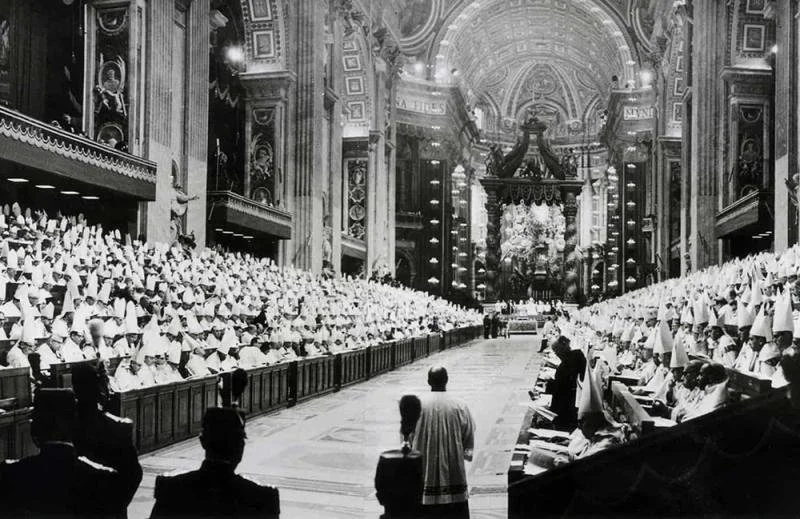
The opening of the Second Vatican Council in St Peter’s Basilica, 11 October 1962. The theological orientation of the Council did not arise suddenly in 1962; important currents that shaped its intellectual environment had been developing for decades.
Why This Question Matters
Imagine a sincere Catholic or non-Catholic beginning to investigate Vatican II.
He may first discover the Catholicism of the first half of the twentieth century: a Church that spoke confidently about doctrinal certainty, conversion, missionary activity, the Social Kingship of Christ, the uniqueness of the Catholic Church, Thomistic philosophy and the dangers of Modernism.
He then opens the documents and history of Vatican II and encounters a noticeably different vocabulary and orientation:
dialogue;
ecumenism;
engagement with the modern world;
historical consciousness;
the Church as mystery and sacrament;
the People of God;
collegiality;
elements of sanctification outside visible Catholic unity;
renewed emphasis upon Scripture and the Fathers;
adaptation of theological expression to contemporary circumstances.
The reasonable question is:
Where did this theological change of emphasis come from?
It did not suddenly begin when the bishops assembled in St Peter's Basilica in October 1962.
For several decades a generation of theologians had been arguing that Catholic theology required significant renewal. Their ideas were controversial before Vatican II. Yet many of their concerns became prominent during the Council.
The Nouvelle Théologie therefore belongs in this FAQ as a bridge article:
What was Catholicism like before Vatican II?
↓
What was Modernism, and why did the Church condemn it?
↓
What was the Nouvelle Théologie?
↓
Why was Vatican II called?
↓
Who influenced Vatican II?
↓
What did Vatican II actually teach and change?
↓
Was this legitimate development or departure from previous Catholic teaching?
That is why the subject matters.
The Historical Sequence at a Glance
| Date | Development |
|---|---|
| 1879 | Leo XIII promotes the restoration of Christian philosophy, particularly St Thomas Aquinas, in Aeterni Patris. |
| 1907 | St Pius X condemns Modernism in Pascendi Dominici Gregis. |
| 1930s–1940s | Nouvelle Théologie develops particularly around Le Saulchoir and the Jesuit theological milieu at Lyon-Fourvière. |
| 1937 | Chenu's Une école de théologie: Le Saulchoir appears. |
| 1942 | Chenu's work is placed on the Index; he is removed from Le Saulchoir and restricted from teaching and publishing. |
| 1942 | The first volume of Sources Chrétiennes appears, associated particularly with Jean Daniélou and Henri de Lubac. |
| 1946 | Garrigou-Lagrange publishes his famous criticism, “Where Is the New Theology Going?” Pius XII separately warns against a theology conceived as continually evolving. |
| 1950 | Pius XII issues Humani Generis, warning against historicism, dogmatic relativism, depreciation of Scholastic theology and unstable philosophical reinterpretations of dogma. |
| 1950s | Some theologians associated with the movement face teaching or publishing restrictions. |
| 1958 | Pius XII dies. |
| 1959 | John XXIII announces an ecumenical council. |
| 1962–1965 | Vatican II meets. Theological figures associated with ressourcement become influential participants and advisers. |
| After 1965 | Biblical, patristic, historical, ecumenical and ressourcement themes become central features of mainstream postconciliar theology. |
The extraordinary feature is the short period separating 1950 and 1962.
Ideas being scrutinised during the pontificate of Pius XII were represented by highly influential theologians during Vatican II barely twelve years later.
What the Catholic Church Taught Before the Nouvelle Théologie
To understand the controversy correctly, we must avoid a false choice. The debate was not:
Bible and Fathers versus St Thomas Aquinas.
Traditional Catholic theology had always recognised Scripture and Tradition as the sources of Revelation and had always revered the Fathers.
Scripture, the Fathers and Scholastic Theology
Pope Leo XIII, in Aeterni Patris (1879), explained that the medieval Scholastics did not replace the Fathers. They gathered, organised, defended and developed the theological inheritance handed down through Scripture and the Fathers.
Leo describes the Scholastics as undertaking the great work of collecting and arranging the theological riches dispersed throughout patristic writings.
The traditional progression was therefore approximately:
Divine Revelation
↓
Sacred Scripture and Apostolic Tradition
↓
Fathers and Doctors
↓
Councils and Magisterium
↓
Scholastic synthesis and precise theological analysis
St Thomas was not an alternative to the Fathers. He constantly used them.
Scholastic theology attempted to define terms, distinguish propositions, resolve apparent contradictions and explain the relationships among truths of Revelation.
This precision would become crucial to the Nouvelle Théologie controversy.
The Background: The Modernist Crisis
Only a generation before the rise of the Nouvelle Théologie, the Church had confronted the Modernist crisis.
In Pascendi Dominici Gregis (1907), Pope St Pius X condemned a theological system in which religion became rooted in subjective religious experience and dogmatic formulas became historically conditioned expressions capable of changing with human consciousness.
The issue was not legitimate development of doctrine. Catholic doctrine can develop in the sense that the Church may understand, explain and define a revealed truth more explicitly.
The problem occurs when the meaning of the truth itself is made dependent upon changing historical consciousness.
That distinction provides important background for what followed.
When a new generation later spoke of:
historical consciousness;
recovering earlier forms of theology;
revisiting the development of doctrine;
questioning aspects of Neo-Scholastic presentation;
using contemporary philosophical categories;
traditional theologians naturally asked whether the Modernist problem was reappearing in another form.
That does not prove that the Nouvelle Théologie was simply Modernism. But it explains why the controversy became so serious.
Where Did the Nouvelle Théologie Come From?
The movement emerged principally during the 1930s and 1940s, particularly within French Catholic intellectual life. Two centres were especially important.
Fourvière
The Jesuit environment around Fourvière in Lyon produced or influenced theologians including:
Henri de Lubac;
Jean Daniélou;
Henri Bouillard;
Gaston Fessard.
Le Saulchoir
The Dominican school of Le Saulchoir was associated particularly with:
Marie-Dominique Chenu;
Yves Congar.
Historical scholarship identifies precisely these Jesuit and Dominican circles as the principal settings of the movement. The movement also had intellectual predecessors. Historians identify influences including Léonce de Grandmaison, Jules Lebreton, Pierre Rousselot, Joseph Maréchal and Maurice Blondel, among others.
It therefore did not begin with one man or one book. It developed gradually as part of a broader Catholic attempt to respond to the intellectual and cultural upheavals of the twentieth century.
What Was Ressourcement?
The French term ressourcement means approximately:
a return to the sources.
Its advocates believed Catholic theology had sometimes become overly dependent upon theological manuals, abstract propositions and later Scholastic categories while insufficiently presenting the richness of:
Sacred Scripture;
the Fathers of the Church;
early Christian worship;
patristic spirituality;
biblical typology;
the historical development of Christian doctrine;
the mystery of the Church;
salvation history.
The intention to recover these sources was not intrinsically objectionable.
Indeed, in Humani Generis Pius XII himself insisted that theologians must continually return to the sources of divine Revelation.
That point is essential.
Pius XII did not condemn the study of Scripture or the Fathers.
He himself had encouraged serious biblical scholarship in Divino Afflante Spiritu (1943). The controversy concerned how the return to the sources was used.
A Concrete Example: Sources Chrétiennes
One of the most valuable achievements associated with ressourcement was the creation of the Sources Chrétiennes series.
The first volume appeared in 1942 and contained St Gregory of Nyssa's Life of Moses. Jean Daniélou and Henri de Lubac were central figures in establishing the collection.
The series made major patristic texts available in critical editions and translations. This demonstrates why it would be inaccurate simply to describe everything associated with Nouvelle Théologie as evil or Modernist. Recovering the Fathers was valuable.
The real question was:
What theological conclusions would be drawn from that recovery?
Legitimate and Problematic Ressourcement
Pius XII's own principles allow a useful distinction.
| Legitimate Return to the Sources | Potentially Problematic Use of the Sources |
|---|---|
| Scripture and the Fathers deepen understanding of Catholic doctrine | Earlier sources are used to undermine later authoritative definitions |
| Patristic theology enriches Scholastic theology | Scholastic theology is dismissed as merely an obsolete historical system |
| Historical study clarifies how doctrine developed | Historicism makes doctrinal meaning relative to changing periods |
| Theology discovers richer biblical and liturgical dimensions | Precise dogmatic terminology is treated as dispensable |
| Modern philosophy is critically examined | Catholic doctrine is reconstructed through philosophies incompatible with Catholic metaphysics |
| Earlier and later stages of doctrine are understood organically | Earlier formulations are used as a tribunal against later Magisterial teaching |
This distinction is one of the most important points in the article.
The controversy was not over whether Catholics should read St Augustine or St Irenaeus.
It was over whether historical retrieval should deepen Catholic doctrinal continuity or become a method of reinterpreting it.
The Major Figures
| Theologian | Dates | Principal Interests | Later Significance |
|---|---|---|---|
| Marie-Dominique Chenu, O.P. | 1895–1990 | Historical theology, St Thomas in historical context, theology and contemporary society | Influential precursor of conciliar theological renewal |
| Henri de Lubac, S.J. | 1896–1991 | Fathers, nature and grace, Church, spiritual exegesis | Became a major theological figure associated with Vatican II |
| Yves Congar, O.P. | 1904–1995 | Church, Tradition, laity, ecumenism, reform | Major conciliar theologian; important influence upon postconciliar ecclesiology |
| Jean Daniélou, S.J. | 1905–1974 | Fathers, salvation history, biblical typology | Vatican II expert; major figure in patristic renewal |
| Henri Bouillard, S.J. | 1908–1981 | Grace, St Thomas, theology and historical expression | Central figure in debates concerning dogmatic concepts and historical theology |
These men did not form a political party and did not agree about every theological question. Nor did they all follow identical trajectories after Vatican II. It is therefore misleading to speak as though one tightly organised group deliberately designed every subsequent reform.
Their historical importance lies instead in the fact that themes cultivated in their theological milieu became influential in the intellectual world of Vatican II.
Marie-Dominique Chenu and the Historical Method
Fr Marie-Dominique Chenu, O.P. (1895–1990) was one of the most important figures at Le Saulchoir. His Une école de théologie: Le Saulchoir appeared in 1937.
Chenu sought to understand theology historically, including St Thomas himself within the intellectual environment in which he had written. The approach became controversial.
In 1942, Une école de théologie was placed on the Index of Forbidden Books. Chenu was required to leave Le Saulchoir and was prohibited from teaching and publishing for a period. Modern research drawing upon Vatican archival material confirms this sequence.
Why did this matter? Because Chenu's method raised a fundamental question:
To what extent are theological systems products of their historical period?
There is an obviously legitimate sense in which theology is historical. St Augustine wrote in one context; St Thomas in another. But if theological concepts become too closely identified with their historical context, a further question arises:
Are the concepts used to define dogma themselves permanently capable of expressing truth?
That issue would become central to the controversy.
Henri de Lubac and the Question of Nature and Grace
Fr Henri de Lubac, S.J. (1896–1991) became perhaps the best-known theologian associated with ressourcement.
His work ranged across:
patristics;
biblical interpretation;
ecclesiology;
the supernatural order;
the history of theology;
the relationship between Christianity and contemporary culture.
His Surnaturel (1946) reopened a highly technical debate concerning the relationship between human nature and man's supernatural destiny.
Traditional Catholic theology insisted that the Beatific Vision is absolutely supernatural and gratuitous: no created nature possesses a strict natural right to it.
Humani Generis subsequently reaffirmed this principle by rejecting the proposition that God could not create intellectual beings without ordering them to the Beatific Vision.
De Lubac's precise position and its relationship to Humani Generis remain subjects of theological interpretation, so the article should not simplistically claim that Pius XII formally condemned de Lubac by name. He did not.
What can be established historically is that the controversy affected de Lubac severely. His Jesuit superiors removed him from teaching in 1950, and he remained restricted for a substantial period before later rehabilitation.
Then came the striking reversal.
In 1960, John XXIII appointed de Lubac a consultor to the preparatory work for Vatican II; he subsequently participated in the Council as a theological expert. A theologian removed from teaching around 1950 had become an important conciliar theologian little more than a decade later. That is precisely why this history matters.
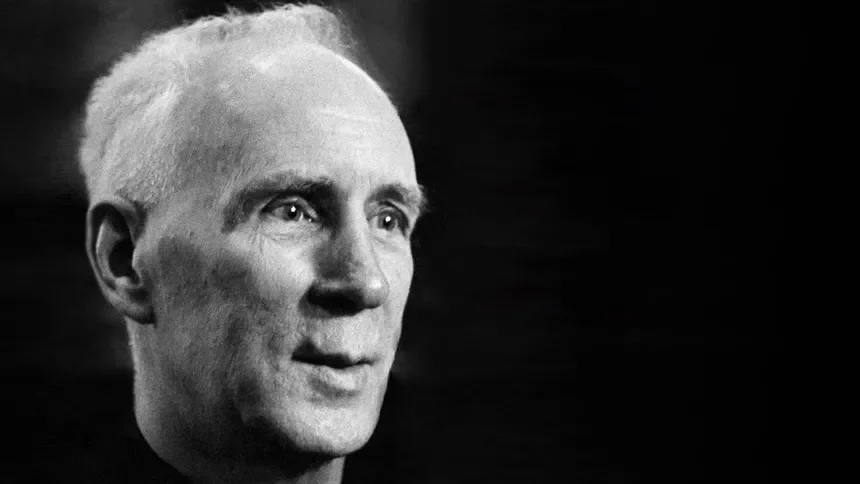
Henri de Lubac, S.J. (1896–1991), one of the principal theologians associated with ressourcement. Removed from teaching during the controversy surrounding the Nouvelle Théologie in 1950, he was later brought into the preparations for Vatican II and became an influential theologian of the conciliar period.
Jean Daniélou and the Fathers
Fr Jean Daniélou, S.J. (1905–1974) specialised particularly in:
the Greek Fathers;
biblical typology;
salvation history;
early Christianity.
His scholarship helped restore appreciation for the ancient Christian interpretation of Scripture in which Old Testament persons, events and institutions foreshadow Christ and the New Covenant.
This aspect of ressourcement could recover something genuinely ancient that had sometimes received less attention within contemporary theological manuals. Daniélou co-founded and directed Sources Chrétiennes with de Lubac and later served as an expert at Vatican II.
His career again demonstrates the transition from pre-conciliar theological renewal to the Council itself.
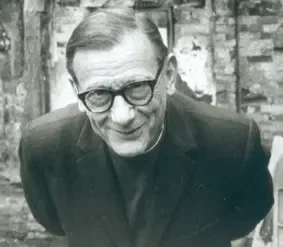
Fr Jean Daniélou, S.J. (1905–1974) — French Jesuit theologian and patristic scholar, co-founder of Sources Chrétiennes and later a theological expert at the Second Vatican Council. His work helped revive interest in the Church Fathers, biblical typology and salvation history.
Yves Congar: Church, Laity and Ecumenism
Fr Yves Congar, O.P. (1904–1995) became enormously influential in several areas that would later become central at Vatican II:
ecclesiology;
the nature of Tradition;
the role of the laity;
ecclesial reform;
Christian unity;
ecumenism;
the relationship between hierarchy and the entire body of the faithful.
His writings concerning the sensus fidelium also contributed significantly to later discussion about the participation of the faithful in the life of the Church. A later Vatican theological study explicitly recognises Congar's important contribution in this area.
Congar subsequently became one of the major theologians of Vatican II. Benedict XVI would later include Henri de Lubac and Yves Congar among the “great figures” of the Council.
Again, the historical point is not speculative. The theological transition can be documented.
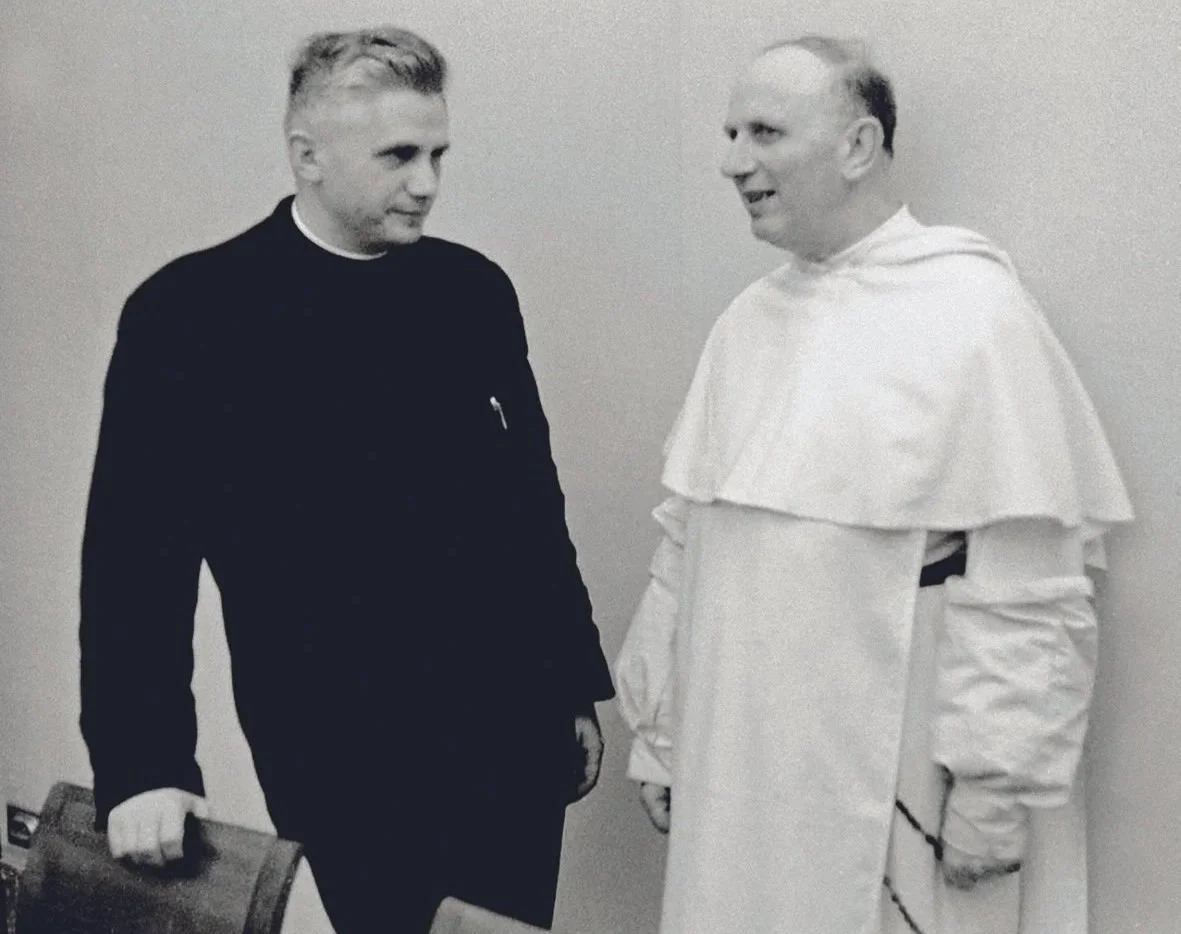
Fr Joseph Ratzinger with Fr Yves Congar, O.P., during the Second Vatican Council in 1962. Ratzinger, who later became Pope Benedict XVI, served as a theological adviser at the Council and was then identified with the reform-oriented wing of Catholic theology. Congar was one of the leading theologians associated with ressourcement and became highly influential at Vatican II.
Was the Nouvelle Théologie Simply Anti-Scholastic?
No. That would be too crude. Several Nouvelle Théologie figures knew St Thomas extremely well.
Chenu was a Dominican medieval scholar.
De Lubac did not simply advocate abandoning Catholic tradition.
Congar constantly used patristic and medieval sources.
Many proponents believed they were recovering a richer and more authentic tradition than the sometimes highly schematic Neo-Scholastic manual theology of their own period.
Nevertheless, a genuine dispute existed. The traditional Thomistic position insisted that although terminology can develop, certain fundamental concepts express objective realities and cannot simply be replaced according to changing historical fashions.
Pius XII would defend precisely that position.
Why Scholastic Precision Mattered
Consider a dogmatic term such as:
substance;
person;
nature;
cause;
essence.
These are not merely decorative medieval words. Terms of this kind became instruments through which Councils and theologians expressed precise distinctions about realities.
If dogmatic concepts are only temporary products of particular historical philosophies, a danger arises. Someone may say:
The doctrine remains the same; only the concepts have changed.
But if the concepts are changed sufficiently, the actual meaning of the doctrine may change with them. That was the central concern of the traditional critics.
Garrigou-Lagrange Asks: Where Is the New Theology Going?
One of the leading Thomistic critics was Fr Réginald Garrigou-Lagrange, O.P. (1877–1964). In 1946 he published the famous article:
La nouvelle théologie où va-t-elle?
“Where Is the New Theology Going?”
in Angelicum, vol. 23, pp. 126–145. The journal record confirms the original article and pagination.
Garrigou-Lagrange feared that once dogmatic concepts were made dependent upon changing philosophical systems, Catholic theology would eventually arrive at dogmatic relativism. His criticism was severe. He believed the “new theology” risked returning toward the Modernism that St Pius X had condemned.
That judgment should be reported accurately rather than exaggerated. Garrigou-Lagrange's argument does not prove that every theologian associated with ressourcement consciously embraced the complete Modernist system of Pascendi. They did not.
The question was whether certain methodological principles could eventually produce similar consequences.
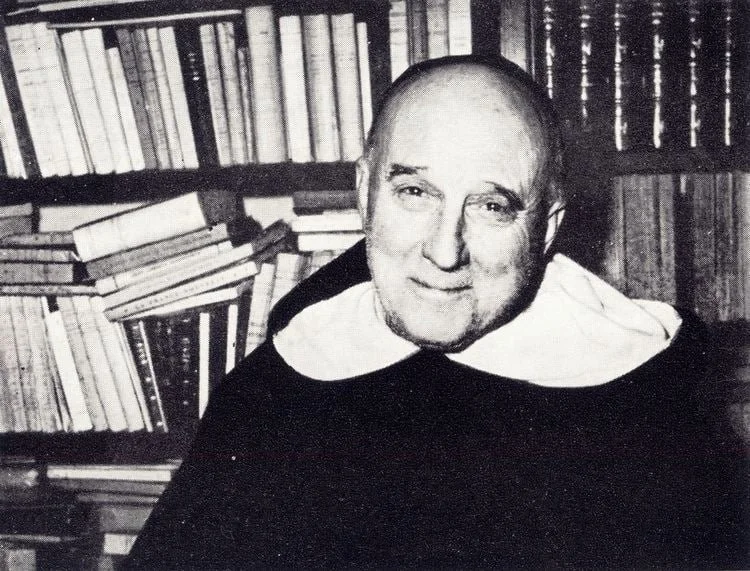
Fr Réginald Garrigou-Lagrange, O.P. (1877–1964) — French Dominican theologian and one of the foremost Thomists of the twentieth century. In his influential 1946 article La nouvelle théologie où va-t-elle? (“Where Is the New Theology Going?”), he warned that certain new theological methods risked weakening the stability of dogma and leading back toward principles associated with Modernism.
Pius XII Warns About a “New Theology”
The issue was not confined to a disagreement between professors.
On 17 September 1946, Pope Pius XII addressed the Twenty-Ninth General Congregation of the Society of Jesus. In that address he warned against the notion of a theology continually adapting and evolving in such a way that it never arrives at stable truth.
The official Vatican archive preserves the address. The central concern was straightforward:
If theology continually changes with intellectual fashion, what happens to immutable Catholic dogma?
Four years later Pius XII addressed the problem in much greater detail.
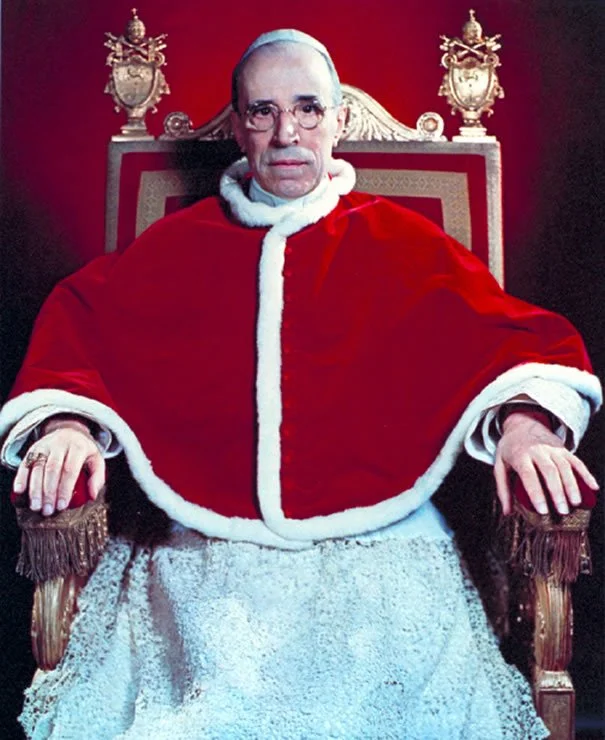
Pope Pius XII (1876–1958). His 1950 encyclical Humani Generis warned against historicism, dogmatic relativism, depreciation of Scholastic theology and attempts to replace established theological concepts with unstable philosophical systems, while expressly affirming the need to return continually to the sources of Revelation.
Humani Generis — The Crucial Intervention
On 12 August 1950, Pius XII issued the encyclical:
Humani Generis — Concerning Some False Opinions Threatening to Undermine the Foundations of Catholic Doctrine.
The Pope did not publish a list saying:
“These named theologians constitute the Nouvelle Théologie and are all condemned.”
That would be historically inaccurate. Nevertheless, both the contemporary controversy and later scholarship recognise Humani Generis as a major intervention in the theological crisis surrounding the Nouvelle Théologie.
The encyclical identifies several tendencies directly relevant to the controversy.
Historicism
Pius XII warned against a historicism which, by attributing value only to changing historical circumstances, undermined permanent truth and absolute law.
History matters. Historical context matters. But truth cannot become true in one century and false in another.
Dogmatic Relativism
Pius XII described theologians who wished to minimise the meaning of dogmas and free them from terminology established in the Church. He warned especially against the idea that mysteries of faith are expressed only through approximate and constantly changing concepts.
He identified the consequence clearly:
“dogmatic relativism.”
This is probably the single most important theological issue in the controversy.
Returning to Scripture and the Fathers
Here the encyclical becomes particularly important for understanding ressourcement correctly. Pius XII did not reject a return to Scripture and the Fathers.
Quite the contrary. He stated that theologians:
“must always return to the sources of divine revelation.”
But the Pope insisted that these sources must be interpreted together with the living Teaching Authority of the Church.
Therefore:
returning to the Fathers = legitimate
but:
using the Fathers to relativise subsequent Magisterial definitions = illegitimate.
That is the crucial distinction.
Scholastic Theology
Pius XII also defended Scholastic theology against those who regarded it as obsolete. He acknowledged that terminology could be improved. He did not claim that every historical Scholastic expression was perfect.
But he warned that contempt for the terms and concepts used by Scholastic theologians could weaken speculative theology itself. He particularly reaffirmed the importance of the philosophy of St Thomas Aquinas in the formation of priests. The concern was therefore not nostalgia for medieval textbooks. It was whether theology requires a stable metaphysics capable of expressing objective truth.
Pius XII's Position Was More Balanced Than Either Side Sometimes Suggests
This deserves emphasis. Pius XII did not say:
never study modern philosophy;
never revisit theological questions;
never improve theological terminology;
never study history;
never return to Scripture;
never return to the Fathers.
He explicitly recognised legitimate theological research and acknowledged that even erroneous philosophical movements could contain elements worth examining critically. His governing principle was:
new truth cannot contradict truth already securely established.
Theology may build:
truth upon truth.
It cannot construct a new theology by destroying the foundations already received.
What Happened After Humani Generis?
Some theologians associated with the controversy experienced restrictions.
Chenu had already been disciplined in 1942.
De Lubac was removed from teaching by his Jesuit superiors in 1950.
The period has sometimes been described in scholarship as the “execution of Fourvière.”
For a moment, it appeared that the theological movement might have been stopped. It was not.
During the 1950s, ressourcement spread internationally. Scholarship describing the movement identifies a third period of internationalisation between approximately 1950 and 1962. Then came Vatican II.
The Remarkable Reversal
Pius XII died on 9 October 1958. Later that month, John XXIII was elected. On 25 January 1959, John announced his intention to convene an ecumenical council.
Within a few years, theologians who had previously experienced restriction or suspicion were participating in the theological environment of the Council.
De Lubac became a consultor and then conciliar theologian.
Daniélou served as a Vatican II expert.
Congar became one of the most important theological figures associated with the Council.
The Vatican itself has subsequently described de Lubac and Congar as major figures of Vatican II.
A Vatican press presentation concerning the Council's archives even remarked upon the striking historical fact that theologians regarded as suspicious or condemned only years before—including Congar, de Lubac, Daniélou and Chenu—had become important representatives of conciliar renewal. This is precisely why the Nouvelle Théologie matters.
Vatican II Did Not Come Out of Nowhere
The transition can now be seen more clearly:
1907 — Modernism condemned
↓
1930s–1940s — theological renewal develops
↓
1946 — “new theology” controversy erupts publicly
↓
1950 — Humani Generis
↓
1950s — restrictions and international spread
↓
1959 — Council announced
↓
1962–1965 — Vatican II
↓
post-1965 — conciliar theological orientation becomes mainstream
This does not prove by itself that Vatican II taught heresy. Nor does it prove a secret conspiracy. It does establish something historically important:
the theological world of Vatican II had a prehistory.
Many of its characteristic emphases had been developing for decades.
How Can the Influence Be Seen in Vatican II?
The strongest evidence is not speculation about private intentions. It is the actual conciliar texts.
Scripture, the Fathers and Salvation History
Dei Verbum presents Revelation strongly through the framework of God's saving action in history, emphasises Scripture and Tradition, and gives significant attention to the historical transmission and deepening understanding of revealed truth.
This does not mean that Dei Verbum is simply “a de Lubac document.”
It means that the biblical, patristic and salvation-historical orientation characteristic of ressourcement had become highly visible in conciliar theology.
The New Pattern of Theological Formation
Perhaps the clearest example is Optatam Totius §16.
The decree prescribes an order of theological formation in which:
biblical themes come first
↓
the Fathers are studied
↓
the history of dogma is examined
↓
speculative penetration follows under the guidance of St Thomas
↓
the mysteries are related to liturgy and the life of the Church.
That is an extraordinarily revealing passage. Notice what it does not do. It does not abolish St Thomas.
But the theological structure is deliberately biblical → patristic → historical → Thomistic synthesis. This strongly resembles the methodological concerns promoted by ressourcement.
Ecclesiology
Lumen Gentium presents the Church through several biblical and patristic images and concepts:
mystery;
sacrament;
People of God;
Body of Christ;
episcopal collegiality;
universal call to holiness.
The document's ecclesiology is not reducible to any single Nouvelle Théologie author. Nevertheless, themes strongly developed by theologians such as de Lubac and Congar clearly belonged to the intellectual environment in which this conciliar ecclesiology emerged. Modern scholarship likewise identifies sacramental ecclesiology and communion ecclesiology as major areas of ressourcement thought.
Ecumenism
Congar had worked on Christian unity and ecumenism for decades before Vatican II. The Council's Unitatis Redintegratio made ecumenical engagement an official major concern and spoke of elements of sanctification and truth existing outside visible Catholic unity.
Whether all the Council's ecumenical propositions can be reconciled with the pre-conciliar Magisterium is a separate question. But historically, the relationship between the earlier ecumenical theological movement and the Council's programme is impossible to ignore.
Engagement With the Modern World
Gaudium et Spes begins by deliberately addressing the condition, hopes, anxieties and aspirations of contemporary humanity. It repeatedly emphasises:
historical change;
contemporary culture;
dialogue with mankind;
human dignity;
social development;
the “signs of the times.”
The Council states that the Church must scrutinise those signs and interpret them in the light of the Gospel. Again, one should not claim that this entire approach originated with a handful of French theologians.
But the resemblance to the Nouvelle Théologie concern with history, concrete human existence and engagement with contemporary culture is unmistakable. Historians likewise identify historical method and engagement with modernity as central characteristics of the movement.
Before and After: What Changed in the Theological Climate?
| Pre-Conciliar Controversy | Conciliar Environment |
|---|---|
| Concern about theological historicism | Historical consciousness becomes highly prominent |
| Concern about excessive criticism of Scholastic theology | Biblical, patristic and historical approaches become much more prominent |
| Pius XII warns against unstable philosophical reinterpretations | Council seeks forms of expression suited to contemporary man |
| Ecumenical eirenism is treated cautiously | Ecumenism becomes a major conciliar programme |
| Chenu's programme is censured | Historically conscious theology becomes increasingly mainstream |
| De Lubac is removed from teaching | De Lubac becomes a major conciliar theological figure |
| Congar faces earlier restrictions and suspicion | Congar becomes one of Vatican II's leading theologians |
| Nouvelle Théologie is controversial | Ressourcement becomes deeply influential in postconciliar theology |
This table should not be read as proving that every post-conciliar development directly contradicts Pius XII. Its purpose is simpler.
It shows the reader that a substantial change of theological climate occurred.
Did These Theologians “Reconfigure the Church”?
There is an important distinction to make. It is historically supportable to say that theologians associated with Nouvelle Théologie and ressourcement:
helped shape the theological environment of Vatican II;
became influential conciliar advisers;
contributed ideas concerning ecclesiology, Tradition, ecumenism, Scripture, patristics and theological method;
subsequently became major interpreters of the Council.
It is harder to establish that a small group consciously designed a programme to “rebrand Catholicism” and then successfully imposed it upon the universal Church.
That stronger claim would require evidence of coordinated intention. The Catholic critique does not need such a theory. The public historical sequence is significant enough. One can examine:
what they wrote before the Council
↓
what Pius XII warned against
↓
what the Council actually promulgated
↓
what subsequently changed
without claiming knowledge of secret motives.
Was Nouvelle Théologie Simply Modernism Repackaged?
Not exactly. The theologians associated with Nouvelle Théologie did not collectively profess the entire Modernist system condemned by St Pius X. Nor were they all intellectually identical.
Some later became critical of extreme postconciliar developments themselves. The traditional concern is more specific:
Did some of the intellectual principles or theological methods associated with Nouvelle Théologie reopen doors that the anti-Modernist Magisterium had attempted to close?
The similarities alleged by traditional critics concern areas such as:
historicism;
changing doctrinal formulations;
dissatisfaction with traditional Scholastic metaphysics;
accommodation to modern philosophy;
theological pluralism;
reinterpretation of Tradition;
changing ecclesiology;
ecumenism;
engagement with modernity.
Garrigou-Lagrange believed the answer was yes. Pius XII did not simply identify all the Nouvelle theologians as Modernists, but Humani Generis explicitly warned against several of the tendencies at issue.
Therefore the responsible conclusion is:
Nouvelle Théologie should not simply be equated wholesale with the Modernism of Pascendi, but the possible continuity between certain methodological principles deserves serious examination.
The Main Objection
A defender of ressourcement could make a strong objection.
The pre-conciliar theological establishment, he might argue, had allowed theology to become too abstract, overly dependent upon manuals and insufficiently rooted in Scripture, the Fathers, liturgy and salvation history.
Nouvelle Théologie did not attack Catholic Tradition. It tried to recover a deeper Tradition.
The Fathers came before Neo-Scholastic textbooks.
Scripture came before theological manuals.
Furthermore, Pius XII himself encouraged biblical scholarship and explicitly said theologians must return to the sources. Vatican II did not abolish St Thomas. Optatam Totius expressly recommends him.
Therefore, the argument continues, ressourcement should be understood as genuine Catholic renewal rather than disguised Modernism. This objection deserves to be taken seriously.
Response
Much of the objection is correct. The recovery of Scripture and the Fathers was valuable. Catholic theology should never be reduced to memorising propositions from textbooks.
St Thomas himself was biblical, patristic, philosophical, liturgical and contemplative. The real controversy therefore lies somewhere deeper. The question is:
Who interprets the sources, and according to what doctrinal rule?
The traditional Catholic sequence is:
Revelation
↓
Scripture and Tradition
↓
Fathers and Doctors
↓
authoritative Magisterial clarification
↓
deeper theological understanding
Once the Church has authoritatively clarified doctrine, theologians cannot return to an earlier, less explicit stage and use it to dissolve the later clarification. Nor can a dogmatic definition be treated merely as the temporary product of one historical philosophical vocabulary. Pius XII's concern was therefore not:
Do not return to the Fathers.
It was:
Do not use the return to the Fathers to make dogma unstable.
That distinction remains decisive.
The Deeper Issue: What Happens When the Method Changes?
The reader should now see why this article is not simply theological biography. A theological method determines which questions are asked and how answers are framed.
Consider two approaches.
Traditional Scholastic emphasis
What has God revealed?
↓
What has the Church authoritatively defined?
↓
What precisely do the terms mean?
↓
How do the propositions logically relate?
Ressourcement-historical emphasis
How was the mystery experienced in Scripture?
↓
How did the Fathers express it?
↓
How did doctrine develop historically?
↓
How can the mystery be expressed to contemporary man?
Neither sequence is necessarily wrong by itself. The difficulty arises if the second ceases to be governed by the doctrinal precision safeguarded by the first. At that point:
renewal can become reinterpretation.
And reinterpretation can eventually become:
change of meaning.
That was the danger Pius XII feared.
What We Can and Cannot Conclude
Established Historical Fact:
The Nouvelle Théologie was a significant twentieth-century theological movement centred particularly around French Jesuit and Dominican theologians associated with Fourvière and Le Saulchoir.
Major figures included de Lubac, Daniélou, Chenu and Congar, with Bouillard and others also important.
The movement strongly promoted ressourcement: renewed engagement with Scripture, the Fathers, patristic theology and the history of doctrine.
Chenu's Une école de théologie was placed on the Index in 1942 and Chenu suffered disciplinary consequences.
Pius XII publicly warned in 1946 about a conception of “new theology” involving continual theological evolution.
In Humani Generis, Pius XII rejected dogmatic relativism, warned against historicism, defended stable philosophical concepts and Scholastic theology, and reaffirmed the importance of St Thomas.
Established Catholic Teaching:
The same encyclical insisted that theologians must continually return to the sources of Revelation.
Therefore returning to Scripture and the Fathers was not itself the error.
Established Historical Fact: Within little more than a decade, important theologians associated with ressourcement became influential figures in the theological environment of Vatican II.
Strong Historical Conclusion: Nouvelle Théologie and the wider ressourcement movement form an important intellectual bridge between the theological controversies of the pontificate of Pius XII and the theological orientation of Vatican II.
Question Requiring Separate Doctrinal Analysis: The fact that Nouvelle Théologie influenced Vatican II does not by itself prove that Vatican II contradicted previous Catholic doctrine.
That must be demonstrated proposition by proposition by comparing:
earlier Magisterium ↔ Vatican II text ↔ postconciliar interpretation and practice.
What Is Not Necessary to Establish: No theory of secret conspiracy is required.
The public writings, papal interventions, disciplinary history, biographies of the theologians and conciliar documents provide sufficient evidence to establish the theological transition.
Conclusion
Why, then, should someone sincerely investigating Catholicism know about the Nouvelle Théologie? Because Vatican II cannot be properly understood without understanding the theological movement that preceded it.
The Council did not suddenly invent its characteristic theological concerns in 1962. For decades theologians had been arguing for:
renewed biblical theology;
return to the Fathers;
historical understanding of doctrine;
reconsideration of aspects of Scholastic theology;
renewed ecclesiology;
ecumenical engagement;
greater engagement with modern thought and culture.
Some of those developments were unquestionably capable of enriching Catholic theology. But some also raised profound questions.
Pius XII therefore drew the essential boundary.
Catholic theology may return to its sources.
It may deepen.
It may clarify.
It may employ richer language.
It may confront new philosophical questions.
But it cannot make revealed truth dependent upon changing historical consciousness or turn dogma into something whose meaning continually changes.
The historical progression is therefore crucial:
Modernist crisis
↓
Pascendi
↓
Nouvelle Théologie and ressourcement
↓
pre-conciliar theological controversy
↓
Humani Generis
↓
rehabilitation and renewed influence of several theologians
↓
Vatican II
The reader can now understand something important:
Vatican II did not come out of nowhere.
Behind it stood decades of theological debate about precisely those subjects that would become central to the Council. That discovery leads naturally to the next question.
If theologians whose methods had caused serious concern before Vatican II became influential during the Council, then we must examine what the Council actually taught.
The decisive issue is no longer personalities. It is doctrine.
Did Vatican II simply recover neglected elements of authentic Catholic Tradition—or did its new theological orientation allow teachings and practices to emerge that departed from what the Catholic Church had previously taught?
That question must be answered by comparing the texts themselves.
Primary Sources
Pope Leo XIII, Aeterni Patris, 4 August 1879.
On Christian philosophy, the Fathers, the Scholastic synthesis and the importance of St Thomas Aquinas. Read Aeterni Patris
Pope St Pius X, Pascendi Dominici Gregis, 8 September 1907.
Essential background concerning Modernism, religious experience, dogma and doctrinal evolution. Read Pascendi Dominici Gregis
Pope Pius XII, Divino Afflante Spiritu, 30 September 1943.
Important evidence that the pre-conciliar Church actively encouraged serious biblical scholarship. Read Divino Afflante Spiritu
Pope Pius XII, Address to the Twenty-Ninth General Congregation of the Society of Jesus, 17 September 1946.
Contains the Pope's warning concerning an evolving “new theology.” Read Pius XII's 1946 address
Réginald Garrigou-Lagrange, O.P., “La nouvelle théologie où va-t-elle?”, Angelicum 23 (1946), 126–145.
One of the most important contemporary Thomistic critiques of the Nouvelle Théologie. View the original Angelicum issue
Pope Pius XII, Humani Generis, 12 August 1950.
The essential papal text concerning historicism, dogmatic relativism, theological method, Scholasticism and perennial philosophy. Read Humani Generis
Second Vatican Council, Lumen Gentium, 21 November 1964.
For the Council's ecclesiology of mystery, sacrament, People of God and episcopal collegiality. Read Lumen Gentium
Second Vatican Council, Unitatis Redintegratio, 21 November 1964.
For the Council's ecumenical programme and treatment of separated Christians and ecclesial communities. Read Unitatis Redintegratio
Second Vatican Council, Optatam Totius, 28 October 1965, especially §§15–16.
Particularly valuable for comparing the conciliar pattern of theological formation with pre-conciliar theological methodology. Read Optatam Totius
Second Vatican Council, Dei Verbum, 18 November 1965.
For Revelation, Scripture, Tradition, salvation history and the development of understanding within the Church. Read Dei Verbum
Second Vatican Council, Gaudium et Spes, 7 December 1965.
For the Council's engagement with historical change, contemporary humanity and the modern world. Read Gaudium et Spes
Further Reading
Gabriel Flynn and Paul D. Murray, eds., Ressourcement: A Movement for Renewal in Twentieth-Century Catholic Theology (Oxford University Press, 2011).
A substantial scholarly study of the origins, principal theologians, controversies and influence of ressourcement, including chapters specifically addressing Humani Generis and Vatican II.
Jürgen Mettepenningen, “Nouvelle Théologie: Four Historical Stages of Theological Reform Towards Ressourcement (1935–1965).”
Especially useful because it traces the movement through four stages culminating in Vatican II.
Joseph A. Komonchak, “Humani Generis and Nouvelle Théologie.”
Useful for understanding the historical relationship between the 1950 encyclical and the theological controversy.
Jon Kirwan, An Avant-garde Theological Generation: The Nouvelle Théologie and the French Crisis of Modernity (Oxford University Press, 2018).
A detailed historical treatment of Fourvière, Le Saulchoir and the wider French intellectual environment.
Hans Boersma, Nouvelle Théologie and Sacramental Ontology: A Return to Mystery (Oxford University Press, 2009).
Useful for understanding the movement's theology of Tradition, Scripture, ecclesiology and the supernatural from a broadly sympathetic scholarly perspective.
Related Questions
What Was Modernism, and Why Did the Church Condemn It?
What Was Catholicism Like Immediately Before Vatican II?
Why Was the Second Vatican Council Called?
Who Were the Major Theologians Who Influenced Vatican II?
Can Catholic Doctrine Change or Develop?
What Did Vatican II Actually Change?
Did Vatican II Contradict Earlier Catholic Teaching?
How Did Catholicism Change After Vatican II?