What Are Papal Primacy and Papal Infallibility?
Short Answer
Papal primacy and papal infallibility are related doctrines, but they are not the same thing.
Papal primacy concerns authority and jurisdiction. Christ gave St Peter a true primacy over the whole Church, and that office continues in Peter's successors, the Bishops of Rome. The First Vatican Council (1869–1870) taught that the Roman Pontiff possesses supreme, full, ordinary and immediate jurisdiction over the universal Church—not merely a primacy of honour or a right to advise other bishops. This authority extends to matters of faith and morals and also to the discipline and government of the Church. At the same time, diocesan bishops remain true pastors possessing real episcopal authority over their own flocks. (Vatican)
Papal infallibility concerns something different: protection from doctrinal error in a particular exercise of the papal teaching office. Vatican I defined that when the Roman Pontiff, acting as shepherd and teacher of all Christians by his supreme apostolic authority, definitively teaches a doctrine concerning faith or morals to be held by the whole Church, he is preserved by divine assistance from teaching error. Such an act is called ex cathedra—literally, "from the chair," meaning from the authoritative office of Peter.
This does not mean that everything a pope says is infallible. Nor does it mean that a pope is omniscient, inspired with new revelation, incapable of making mistakes in history or science, incapable of imprudent personal decisions, or incapable of sin. In particular,
infallibility must never be confused with impeccability.
Impeccability would mean an inability to sin. The Catholic Church has never taught that the pope is impeccable. Traditional catechisms explicitly distinguish the two. (Intratext)
Yet the opposite mistake must also be avoided. It is false to reason: "Unless the pope is speaking ex cathedra, Catholics may simply ignore him." Popes exercise a genuine ordinary teaching authority as well. Pope Pius XII specifically rejected the claim that teaching contained in papal encyclicals may be dismissed merely because it is not an exercise of the supreme defining power. (Vatican)
Understanding these distinctions is indispensable before considering later questions about the Magisterium, doctrinal continuity, the Church's indefectibility, or the theological problem of a claimant to the papacy who appears publicly to depart from the Catholic Faith.
Why This Question Matters
Few Catholic doctrines are more frequently misunderstood.
One misunderstanding exaggerates papal infallibility until the pope becomes almost an oracle whose every sermon, interview, administrative act or private opinion is supposedly guaranteed by God. That is not Catholic doctrine.
The opposite misunderstanding reduces the pope to little more than an honoured spokesman whose teaching may ordinarily be accepted or rejected according to one's private judgment. That also contradicts Catholic doctrine.
The traditional teaching lies between these caricatures.
The pope possesses a real divinely instituted governing office, but
he is Christ's Vicar, not Christ Himself.
His authority is supreme within the Church, yet
it is received from Christ and
exists to preserve and transmit the revelation already entrusted to the Apostles.
Vatican I therefore made an extraordinarily important qualification while explaining papal infallibility: the Holy Ghost was promised to Peter's successors not so that they might "make known some new doctrine", but so that they would faithfully guard and expound the apostolic deposit of faith. (In The Same Sense)
The papacy is consequently not a mechanism by which Catholic doctrine can be reinvented. Its purpose is precisely the opposite:
to preserve the Church in the Faith received from Christ and the Apostles.
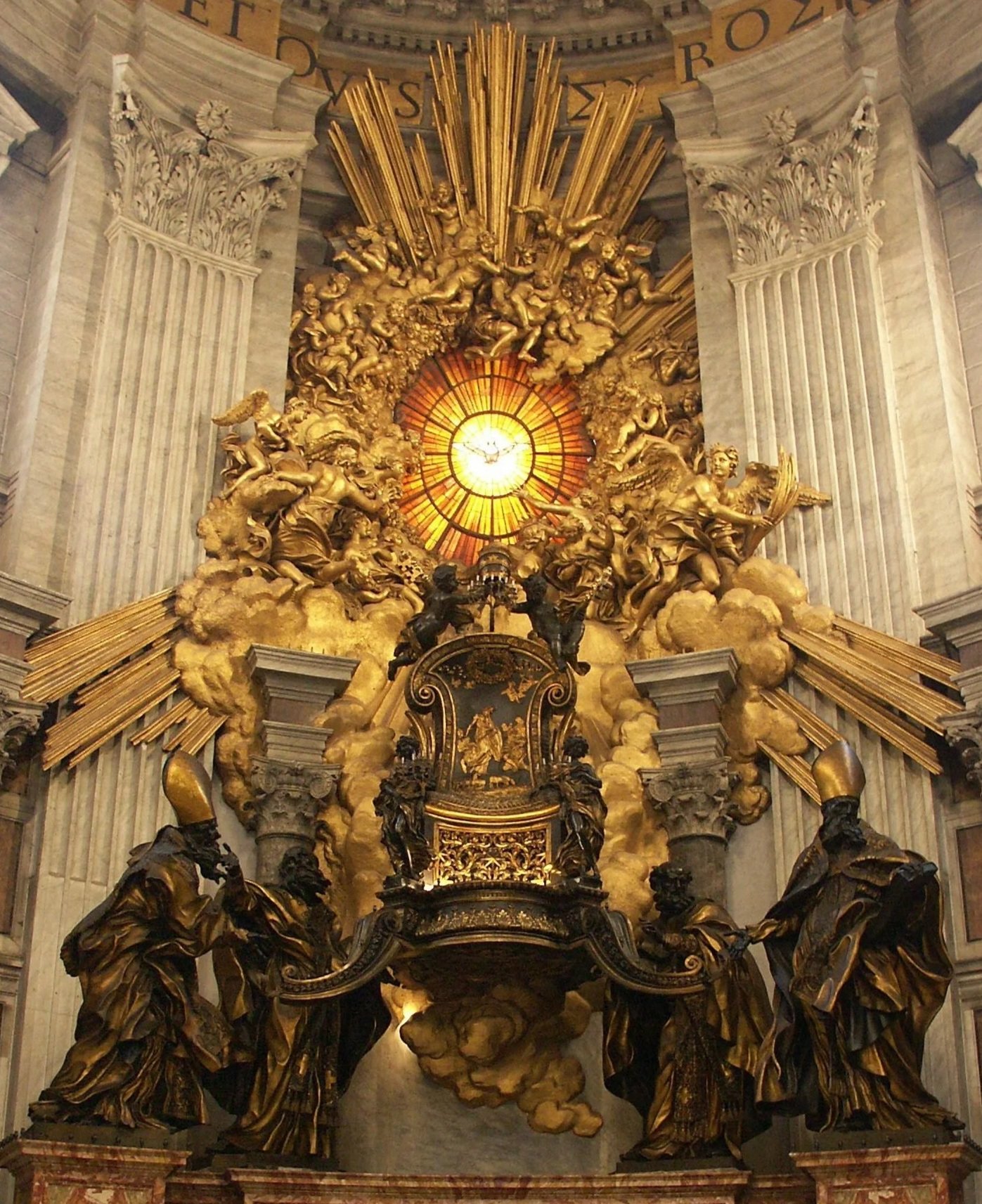
The Chair of Saint Peter (Cathedra Petri) in St Peter’s Basilica, Rome. The cathedra signifies Peter’s teaching office and helps explain the expression ex cathedra—a definitive teaching given by the Roman Pontiff in his office as supreme shepherd and teacher of the universal Church.
What the Catholic Church Teaches
Sacred Scripture
The biblical foundation was treated more fully in Why Did Christ Establish the Papacy? It is sufficient here to recall the three principal Petrine texts.
In Matthew 16:18–19 Christ changes Simon's name to Peter, makes him the rock connected with the building of His Church, promises that the gates of hell will not prevail against it, and entrusts to Peter personally the keys of the kingdom of heaven, together with the authority of binding and loosing.
In Luke 22:31–32 Our Lord warns that Satan desires to sift the Apostles, but then turns specifically to Simon:
"I have prayed for thee, that thy faith fail not."
Peter is then commanded to confirm—or strengthen—his brethren.
Finally, in John 21:15–17 the risen Christ gives Peter a pastoral commission embracing both the lambs and the sheep: the whole flock is entrusted to his pastoral care.
These passages concern more than personal honour. Peter receives a particular responsibility for unity, government, teaching and confirmation of the brethren.
The Acts of the Apostles show him exercising a corresponding leadership. At the Council of Jerusalem, after "much disputing," Peter rises and addresses the doctrinal question; the assembly then falls silent before Paul, Barnabas and James continue the discussion. See Acts 15:1–12.
Biblical Foreshadowing and Fulfilment
The most important Old Testament background is the royal stewardship described in Isaiah 22.
The Davidic king possessed a chief steward who exercised delegated authority within the kingdom. When Eliakim is appointed, God says:
"I will lay the key of the house of David upon his shoulder." See Isaiah 22:22–24.
Christ is the fulfilment of the Davidic kingdom. He is the King; Peter is not a rival king but a steward under the King.
When Christ therefore gives Peter "the keys of the kingdom of heaven" in Matthew 16, the Old Testament imagery helps explain the nature of Peter's office: delegated but real authority within a kingdom whose true sovereign remains Christ.
| Old Testament Shadow | Greater New Covenant Fulfilment |
|---|---|
| Davidic king | Christ the eternal King |
| Royal steward beneath the king | Peter as Christ’s visible chief shepherd and steward |
| Key of the house of David | Keys of the kingdom of heaven |
| Authority to open and shut | Authority to bind and loose |
The type should not be pressed beyond what it establishes. Isaiah 22 does not by itself formulate the later theological definition of papal infallibility. It does, however, illuminate the office and jurisdiction signified by Christ's gift of the keys.
Papal Primacy: Universal Jurisdiction
The First Vatican Council's constitution Pastor Aeternus, promulgated by Pope Pius IX on 18 July 1870, gives the Church's solemn teaching on the primacy.
Vatican I reaffirmed the earlier Council of Florence and taught that the Roman Pontiff is Peter's successor, the Vicar of Christ, head of the whole Church, and father and teacher of all Christians. It then defined the character of his jurisdiction. (Vatican)
Several words are important.
Supreme
There is no higher ecclesiastical jurisdiction on earth to which the Roman Pontiff is ordinarily subject in governing the universal Church. The papacy is therefore not an executive office controlled by an ecumenical council standing above it.
Full
The pope does not possess merely one portion of the Church's supreme authority while some equal supreme authority belongs independently elsewhere.
Ordinary
Here ordinary is a technical jurisdictional term. It means that the authority belongs to the papal office itself; it is not merely delegated to the pope by bishops, councils or civil rulers.
This meaning of "ordinary" must not be confused with the entirely different expression ordinary Magisterium.
Immediate
Papal jurisdiction is capable of reaching directly to the bishops, particular Churches and individual faithful. The pope does not possess authority over a diocesan bishop only indirectly through some intermediate ecclesiastical body.
Truly Episcopal
Vatican I describes papal jurisdiction as genuinely episcopal. Yet this does not abolish the episcopate.
The same chapter expressly protects the real ordinary jurisdiction of bishops over their dioceses. Pope Leo XIII later stressed the same point in Satis Cognitum (1896): bishops are not merely papal functionaries; as successors of the Apostles they are true pastors, while remaining subject to the supreme authority of Peter's successor. (Vatican)
The 1917 Code of Canon Law, Canon 218, expressed the doctrine juridically. It states that the Roman Pontiff possesses not merely a primacy of honour but supreme and full jurisdiction over the universal Church, and that this authority is episcopal, ordinary and immediate over individual Churches, pastors and faithful.
Pope Pius XII likewise taught in Mystici Corporis Christi (1943) that Christ remains the principal Head of His Mystical Body while visibly governing it through His Vicar on earth. The pope is therefore a visible head under Christ, not a second divine head alongside Him. (Vatican)
Papal Infallibility: What Does Ex Cathedra Mean?
Vatican I's definition of papal infallibility appears in Chapter IV of Pastor Aeternus.
A papal teaching is ex cathedra when the following elements are present:
The Roman Pontiff is acting in his office as shepherd and teacher of all Christians.
He acts by his supreme apostolic authority.
He definitively determines a doctrine concerning faith or morals.
He intends that doctrine to be held by the universal Church.
When these conditions exist, the pope possesses the same infallibility Christ willed His Church to enjoy when definitively teaching faith and morals. The resulting definition is irreformable of itself, not because the bishops or the faithful subsequently ratify it.
The Catechism of St Pius X gives essentially the same explanation: the pope is infallible when, as pastor and teacher of all Christians and by his supreme apostolic authority, he defines a doctrine of faith or morals to be held by the whole Church.
The important word is defines. Papal infallibility does not attach mechanically to everything uttered by a pope. The intention to settle a matter definitively for the universal Church must be present.
Nor does ex cathedra require the pope literally to be sitting upon a particular physical throne. "Cathedra" signifies the authoritative teaching office. The older Baltimore Catechism accordingly explains the phrase in terms of speaking from the office or chair of Peter. (Intratext)
Infallibility Is Not Inspiration
The pope does not receive new revelation when defining doctrine.
The deposit of public revelation was entrusted to the Apostles. Papal infallibility assists the Church in preserving, explaining and definitively judging questions concerning that deposit.
Vatican I itself explicitly rejects the idea that papal authority exists to reveal novel doctrines. The pope is the guardian and authoritative interpreter of revelation, not its author. (In The Same Sense)
Infallibility is therefore commonly described as a divine assistance or protection from error, rather than prophetic inspiration.
A pope may consult Scripture, Tradition, theologians, bishops and historical evidence before defining a doctrine. The charism does not dispense him from human study or prudent investigation.
Ordinary Papal Authority Is Not the Same as Ex Cathedra Infallibility
This distinction is essential. Not every authoritative act of papal teaching is an ex cathedra definition. Popes ordinarily teach through encyclicals, apostolic letters, doctrinal instructions, allocutions and other acts without intending to issue a new solemn definition.
But non-infallible does not mean non-authoritative.
Pope Pius XII addressed this misconception directly in Humani Generis (1950). He warned against treating encyclicals as though they did not demand assent simply because the pope was not exercising his supreme defining power. He explained that such teaching belongs to the ordinary teaching authority. (Vatican)
A further distinction is necessary:
ordinary papal Magisterium is not identical with the ordinary and universal Magisterium of the Church.
The latter can itself teach infallibly. Canon 1323 §1 of the 1917 Code states that truths contained in Scripture or Tradition and proposed by the Church as divinely revealed are to be believed with divine and Catholic faith whether proposed by solemn judgment or by the ordinary and universal Magisterium. Canon 1323 §2 identifies an ecumenical council or the Roman Pontiff speaking ex cathedra as organs of solemn judgment.
This produces an important distinction:
| Form of Teaching | What It Means |
|---|---|
| Papal ex cathedra definition | A solemn definitive papal judgment protected by infallibility |
| Ecumenical conciliar definition confirmed by the Pope | A solemn infallible judgment of the teaching Church |
| Ordinary and universal Magisterium | The bishops throughout the world, united with the Pope, teaching a doctrine as definitively belonging to the Faith; also infallible |
| Ordinary papal teaching | Genuine papal teaching authority, requiring appropriate assent, but not automatically an ex cathedra definition |
| Private papal opinion | A statement made as a private theologian or individual rather than as a binding act of the Church’s Magisterium |
A non-ex-cathedra papal document can also repeat doctrine which is already infallibly established by Scripture, Tradition, a prior definition or the ordinary and universal Magisterium. In such a case the doctrine does not become uncertain merely because the particular papal document restating it was not itself an ex cathedra act.
Infallibility Is Not Impeccability
This distinction should be stated as plainly as possible.
Infallibility concerns protection from teaching error under specified conditions.
Impeccability would mean incapacity to commit sin.
The Church teaches the first. She does not teach the second.
The Baltimore Catechism asks explicitly whether the pope can sin and answers that he can; he needs the Sacrament of Penance like other men. It then immediately explains that infallibility concerns teaching falsehood when speaking ex cathedra. (Intratext)
The Catholic Encyclopedia likewise states that what Catholic doctrine claims for the pope is infallibility, not impeccability or inspiration. (New Advent)
This distinction is already visible in St Peter himself. Peter denied Christ three times. Later St Paul tells us that at Antioch he "withstood him to the face" because Peter's conduct regarding Jewish and Gentile Christians was causing scandal. Neither incident is an ex cathedra definition of false doctrine.
A pope can therefore be personally sinful without thereby proving papal infallibility false.
It is helpful to distinguish four concepts:
| Distinction | Meaning |
|---|---|
| Infallibility | Divine protection from teaching error under the conditions established by Christ for the Church’s definitive teaching office |
| Impeccability | Personal freedom from sin |
| Papal infallibility | Does not mean that every papal statement, judgment, decision or action is free from error |
| Personal holiness | Is not a condition for the validity of the papal office or for the exercise of a genuinely infallible definition |
| Sinful or imprudent pope | A pope may commit personal sins or make imprudent administrative decisions without thereby disproving the doctrine of papal infallibility |
Historical and Theological Evidence
St Irenaeus and the Roman Church
St Irenaeus of Lyons (c. AD 130–202), writing Against Heresies around AD 180, appeals to apostolic succession against the Gnostics and gives particular attention to the Church of Rome.
In Against Heresies III.3.2 he says that every Church must agree with Rome because of its "preeminent authority." He then traces the Roman succession from the Apostles. (New Advent)
Irenaeus is not reproducing the technical terminology of Vatican I seventeen centuries in advance. His importance lies in showing that the Church of Rome and its apostolic succession already occupied a unique normative position in the second century.
St Cyprian of Carthage
St Cyprian of Carthage (c. AD 200–258) had serious disputes with Pope Stephen, so he cannot plausibly be dismissed as an uncritical advocate of later papal claims.
Yet in his letter to Pope Cornelius he describes Rome as the "throne of Peter" and the principal Church from which priestly unity takes its source. See Epistle 54, 14 in the numbering used by New Advent; letter numbering varies between editions. (New Advent)
The value of this evidence is precisely its historical complexity: disagreement with a Roman bishop did not erase Cyprian's recognition of the special Petrine significance of the Roman See.
St Leo the Great and Chalcedon
Pope St Leo the Great (c. AD 400–461) repeatedly explained Roman authority in explicitly Petrine terms. In his Letter 10 he teaches that Christ placed the principal responsibility upon Peter, chief of the Apostles. (New Advent)
At the Council of Chalcedon (AD 451), after Leo's Tome was read and judged consonant with the apostolic faith, the bishops famously acclaimed:
"Peter has spoken thus through Leo."
The statement should not be exaggerated into a word-for-word anticipation of Vatican I. But it is strong evidence that the fifth-century Church associated the authoritative doctrinal voice of the Roman bishop with the continuing office of Peter. (New Advent)
The Doctrine Predates Vatican I
Vatican I did not create papal primacy in 1870. The Council itself explicitly renewed the teaching of the Council of Florence (1439) that the Roman Pontiff is Peter's successor, true Vicar of Christ, head of the whole Church, and possesses full power to feed, rule and govern the universal Church.
Pope Leo XIII later summarised this historical continuity in Satis Cognitum, arguing that merely honorary primacy could not perform the role Christ assigned to Peter as the visible principle of ecclesiastical unity. (Vatican)
Vatican I therefore represents a solemn dogmatic definition and clarification of doctrines already rooted in Scripture and Tradition, not the creation of a previously nonexistent papal office.
Common Objections
"If the pope is infallible, why did St Paul correct St Peter?"
Because infallibility is not impeccability, and not every action of Peter constituted an infallible exercise of his teaching office.
Galatians 2 concerns Peter's conduct at Antioch. His behaviour created a practical contradiction between his prior acceptance of Gentile Christians and his later withdrawal from table fellowship under pressure.
Paul corrected the behaviour. He did not overturn an ex cathedra dogmatic definition by Peter.
Indeed, the episode is valuable precisely because Scripture does not hide Peter's personal weakness. Christ chose a man capable of fear and failure, yet nevertheless entrusted him with the keys and commanded him to strengthen his brethren.
"Does the case of Pope Honorius disprove papal infallibility?"
The historical case of Pope Honorius I (625–638) is more complicated than either polemical side sometimes admits.
The Third Council of Constantinople (680–681) anathematized Honorius in connection with the Monothelite controversy, and Pope Leo II subsequently confirmed the council's condemnation. Historians have disputed the precise nature of Honorius's fault and how Leo II's explanation should be understood. (New Advent)
What is clear for the present question is that Honorius's controversial letters were not ex cathedra definitions addressed to and binding the universal Church. He was not solemnly defining Monothelitism as Catholic doctrine.
Consequently, whatever judgment is made about his personal culpability or theological language, the Honorius controversy does not satisfy the conditions defined by Vatican I and therefore does not constitute a counterexample to the dogma of papal infallibility.
"But history records popes holding mistaken theological opinions."
That is not contrary to the definition either.
Pope John XXII (1316–1334) preached sermons proposing that the blessed did not enjoy the full Beatific Vision until after the General Judgment. Contemporary theologians opposed him. John himself made clear that he was not issuing a definitive judgment, and before his death he withdrew the disputed position. His successor Benedict XII later solemnly settled the question in Benedictus Deus in 1336. (New Advent)
This is an especially useful historical example because it demonstrates the distinction between
a pope expressing a non-definitive theological position and
the pope defining doctrine for the universal Church.
"Wasn't Rome originally only first among equals?"
The historical record is more substantial than a merely ceremonial primacy.
St Irenaeus appealed to Rome's preeminent authority; St Cyprian referred to the Chair of Peter and the principal Church; St Leo explicitly understood his Roman office as a continuation of Peter's pastoral responsibility; and Chalcedon associated Leo's doctrinal intervention with Peter. (New Advent)
It is true that the administrative exercise of papal jurisdiction developed historically and did not appear in the first centuries with every later canonical procedure already fully elaborated.
Development in the exercise and juridical articulation of an office is not the same as the invention of the office itself.
What We Can and Cannot Conclude
Established Catholic doctrine: Christ conferred a real primacy of jurisdiction upon St Peter; Peter's primacy continues in his successors in the Roman See; the Roman Pontiff possesses supreme, full, ordinary and immediate jurisdiction over the universal Church; and when he fulfils the conditions defined by Vatican I and speaks ex cathedra on faith or morals for the universal Church, his definition is protected from error.
Also established: the Church can teach infallibly through the ordinary and universal Magisterium. Papal infallibility is therefore not the only manner in which Catholic doctrine may be infallibly proposed.
Authoritative but not necessarily definitive teaching: the ordinary papal Magisterium is not automatically ex cathedra, yet Catholics may not simply treat official papal doctrinal teaching as though it carried no authority. The required assent depends upon the character and theological status of the teaching.
Not Catholic doctrine: that the pope is omniscient, inspired in everything he says, incapable of administrative mistakes, incapable of personal sin, or impeccable.
Not implied by universal jurisdiction: that the pope may alter divine revelation, overturn a dogma, abolish the divine constitution of the Church, or invent a new Faith. His office exists to guard the apostolic deposit.
A separate theological question: pre-Vatican II theologians discussed whether a pope could personally fall into heresy and, if so, what consequences would follow for membership in the Church and possession of papal office. Vatican I's dogma of infallibility does not by itself settle every aspect of that hypothetical question. It requires separate treatment using traditional theology and canon law.
That distinction becomes extremely important when examining the later crisis in the Church. One cannot answer questions concerning public heresy, ecclesiastical office or sedevacantism simply by saying either "the pope is infallible in everything" or "only ex cathedra statements matter." Both propositions misrepresent traditional Catholic teaching.
Conclusion
Papal primacy and papal infallibility describe two different aspects of the office Christ established in Peter.
Primacy concerns government: Peter and his successors possess true authority over the universal Church. The biblical keys signify an office exercised under Christ the King, fulfilling on a higher plane the Old Testament image of the Davidic royal steward.
Infallibility concerns teaching: when the Roman Pontiff acts as shepherd and teacher of all Christians and definitively teaches a doctrine of faith or morals to be held by the universal Church, Christ protects that definition from error.
But infallibility is not impeccability. A pope remains a man capable of personal sin and human weakness. Nor does infallibility turn every papal word into dogma.
At the same time, Catholic obedience cannot be reduced to the proposition that only ex cathedra statements matter. The papal office includes an ordinary teaching and governing authority established by Christ for the protection, unity and sanctification of His Church.
The governing principle is therefore simple:
Christ is the Head → Peter is His visible steward → the papal office serves the apostolic Faith → infallibility protects definitive teaching → none of this makes the pope sinless or permits him to create a new religion.
With these distinctions established, the next question can be approached accurately: what happens if someone claiming the papal office publicly departs from the Catholic Faith? That question concerns public heresy, membership in the Church, ecclesiastical office and the Church's indefectibility, and must be examined separately.
Primary Sources
Sacred Scripture: Matthew 16:18–19; Luke 22:31–32; John 21:15–17; Acts 15; Isaiah 22:22–24; all together
First Vatican Council, Pastor Aeternus, 18 July 1870, especially Chapters III–IV. English text | Official Vatican Latin text.
Pope Leo XIII, Satis Cognitum, 29 June 1896, especially §§11–14. Official text.
Pope Pius XII, Mystici Corporis Christi, 29 June 1943, especially §§40–42. Official text.
Pope Pius XII, Humani Generis, 12 August 1950, especially §§18–21. Official text.
1917 Code of Canon Law, Canons 218 and 1322–1324. English translation and Latin apparatus.
St Irenaeus of Lyons (c. AD 130–202), Against Heresies (c. AD 180), III.3.2. Text.
St Cyprian of Carthage (c. AD 200–258), Epistle 54, especially §14 in the cited edition. Text.
Council of Chalcedon (AD 451), Session II and the reception of Pope St Leo's Tome. Acts of the Council.
Catechism of St Pius X, questions 54–62 concerning the pope and infallibility. Text.
Baltimore Catechism, questions 526–534 concerning ecclesiastical and papal infallibility. Text.
Further Reading
Catholic Encyclopedia (1911), "Infallibility." Particularly useful for the distinctions between infallibility, inspiration and impeccability and for the conditions of an ex cathedra definition. Read online.
Catholic Encyclopedia (1911), "The Pope." Detailed treatment of Petrine succession, Roman primacy and ordinary immediate jurisdiction. Read online.
Pope Leo XIII, Satis Cognitum (1896). One of the clearest pre-Vatican II papal explanations of the visible unity of the Church and the relationship between papal and episcopal authority. Read online.
Mgr Joseph Clifford Fenton, The Catholic Church and Salvation and his ecclesiological writings, for a pre-Vatican II theological treatment of the Church's teaching authority, membership and indefectibility.
Related Questions
Why Did Christ Establish the Papacy?
What Authority Did Christ Give to His Church?
What Is the Magisterium?
Can the Catholic Church Teach Error in Faith and Morals?
What Is Apostolic Succession and Why Does It Matter?
What Is the Difference Between Dogma Doctrine Discipline and Theological Opinion?
Can a Pope Become a Heretic and Remain Pope?
How Are Papal Infallibility and the Church's Indefectibility Related?