Why Did Christ Establish the Papacy?
Short Answer
Christ established the papacy because He willed His Church to remain one visible Church, united in one faith, one communion and one government until the end of time. Christ Himself remains forever the invisible and principal Head of the Church, but before ascending into Heaven He established a visible pastoral office through which His flock would be governed and its unity preserved. He gave this office first to Simon Peter and ordained that it should continue in Peter's successors.
The biblical evidence is cumulative and remarkably coherent.
Christ changes Simon's name to Peter, making his new name signify his mission;
He declares Peter to be the rock upon which He will build His Church;
He alone gives Peter the keys of the kingdom of heaven and the power to bind and loose;
He prays particularly for Peter that his faith fail not and
commands him to strengthen his brethren; and
after the Resurrection He entrusts to Peter His lambs and sheep.
These are not disconnected compliments. Together they describe an office of leadership, jurisdiction, doctrinal confirmation and universal pastoral care.
The Old Testament prepares us to understand the symbolism.
Joseph was placed over Pharaoh's household and kingdom, with only Pharaoh's throne above him.
Still more precisely, Eliakim was appointed chief steward of the Davidic royal household and received the key of the house of David, with authority to open and shut.
Christ is the true Davidic King. When He gives Peter the keys of His Kingdom, He appoints Peter as His chief steward or vicar under the King.
“Prime minister” is a useful modern analogy, although Scripture itself speaks of a royal steward or one set over the house.
This Petrine office was not intended to die with Peter. The First Vatican Council solemnly taught that Christ established in Peter a permanent visible principle of unity, and that Peter has perpetual successors in the bishops of the Roman See.
Thus the papacy is not a later medieval invention added to Christianity: according to Catholic doctrine, it belongs to the constitution Christ Himself gave His Church. (Papal Encyclicals Online)
Why This Question Matters
The question is not merely whether Peter was especially prominent among the Apostles. Almost everyone who reads the New Testament can see that he was. The deeper question is whether Christ gave Peter an office, what that office involved, and whether Christ intended it to continue.
That matters because Christ did not found Christianity as an association of independent congregations joined only by invisible spiritual bonds. He founded a visible Church that could teach, judge, govern, settle disputes and preserve the deposit of faith. A visible worldwide society requires a visible principle of unity.
The papacy is therefore not principally about honouring one Apostle. It concerns how Christ intended His Church to remain visibly one after the Apostles died.
The First Vatican Council expressed precisely this purpose. Christ set Peter over the other Apostles so that the episcopate might remain one and the faithful might be held together in unity of faith and communion. Peter was established as the enduring visible foundation of that unity. (Papal Encyclicals Online)
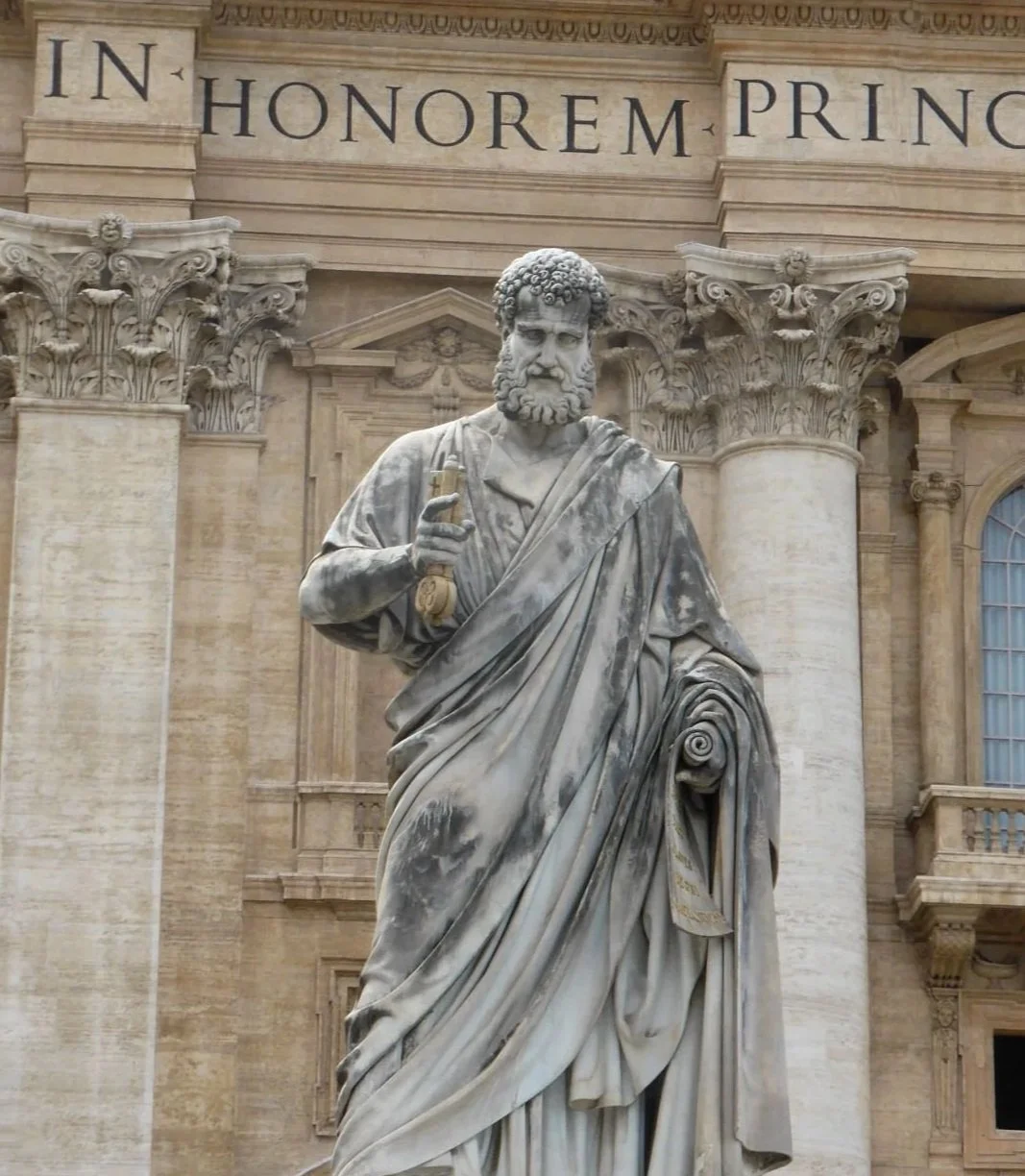
Giuseppe De Fabris, St Peter (1838), St Peter’s Square, Rome. The Apostle holds the keys of the Kingdom entrusted to him by Christ: “I will give to thee the keys of the kingdom of heaven” (Matthew 16:19).
The façade of St Peter’s Basilica, in the background, bears the inscription “In honorem Principis Apostolorum” — “In honour of the Prince of the Apostles” — expressing the Church’s ancient recognition of St Peter’s primacy among the Apostles.
What the Catholic Church Teaches
The Papacy Is a Divine Institution
The Catholic doctrine is stronger than the proposition that Peter happened to become the most influential Apostle.
The First Vatican Council (1869–1870) solemnly taught in Pastor Aeternus that Christ directly promised and conferred upon Peter a true primacy of jurisdiction over the whole Church. It expressly rejected the idea that Peter possessed merely an honorary precedence. (Papal Encyclicals Online)
The Council identified the principal Gospel texts by which this office was promised and conferred:
Simon → Peter → rock → keys → binding and loosing → strengthening the brethren → feeding the whole flock.
These elements illuminate one another.
The keys explain what kind of “rock” Peter is;
the command to strengthen the brethren shows his responsibility toward the other Apostles; and
“feed my sheep” demonstrates that his pastoral charge extends beyond a merely local congregation.
Simon Is Renamed Peter: A New Name for a New Mission
The story begins before Matthew 16. When Andrew first brings Simon to Christ, Our Lord looks upon him and says:
“Thou art Simon the son of Jona: thou shalt be called Cephas, which is interpreted Peter.” John 1:42
This should not be treated as a casual nickname. Throughout Scripture, a divinely given change of name frequently accompanies a new vocation or covenantal mission.
God changes Abram to Abraham when making him father of many nations. Genesis 17:5–7
Jacob becomes Israel, the name thereafter borne by God's covenant people. Genesis 32:28
A name bestowed by God can therefore reveal what the person is being commissioned to become.
The same pattern appears with Simon. Jesus does not merely say that Simon resembles a rock. He gives him a new name—Cephas, from the Aramaic Kepha, rock. Later, at Caesarea Philippi, He explains the significance of that name:
“Thou art Peter; and upon this rock I will build my church.” Matthew 16:17–19
Simon → Cephas/Peter → rock
The name foretells the office. Pope Leo XIII explicitly drew attention to this. In Satis Cognitum (1896) he cites St Cyril of Alexandria explaining that Christ no longer wished Simon to be called merely Simon but named him Peter because upon him He was about to found His Church. (Vatican)
“Upon This Rock I Will Build My Church”
Christ is, of course, the principal foundation of His Church. No Catholic doctrine places Peter in competition with Christ. Christ is the source of Peter's authority and the reason Peter can fulfil his office at all.
Scripture can speak of Christ as foundation and rock while also speaking of subordinate human foundations.
The Church is built upon “the foundation of the apostles and prophets,” with Christ as the chief cornerstone (Ephesians 2:20).
The heavenly Jerusalem likewise has foundations bearing the names of the twelve Apostles (Apocalypse 21:14).
Peter therefore does not replace Christ. He participates ministerially in something that belongs principally to Christ.
Leo XIII expressed the distinction clearly: Christ is Rock by His own nature; Peter is rock through Christ. Christ can communicate what He possesses essentially to a servant who exercises it dependently. (Vatican)
This becomes even clearer when Christ immediately gives Peter the keys.
Biblical Foreshadowing and Fulfilment
Joseph: An Earlier Pattern of Authority Under the King
Joseph provides an important Old Testament pattern for understanding delegated universal government beneath a supreme ruler.
After Joseph interprets Pharaoh's dreams, Pharaoh tells him:
“Thou shalt be over my house…”
and adds that only in the royal throne will Pharaoh be above Joseph. Pharaoh then gives Joseph his ring, clothes him in official garments, places him in the second chariot and appoints him over Egypt. See Genesis 41:39–44
In modern language Joseph functions rather like a prime minister: Pharaoh remains sovereign, but Joseph exercises enormous authority in Pharaoh's name.
This helps answer a common misunderstanding of the papacy. If Peter possesses authority under Christ, it does not follow that Peter has displaced Christ any more than Joseph displaced Pharaoh.
Pharaoh remained king → Joseph governed under him.
In the infinitely greater New Covenant reality:
Christ remains King → Peter governs ministerially under Christ.
Joseph is therefore a useful pattern of delegated vice-regal authority, although he is not the closest direct type of the Petrine office. For that we must turn to the Davidic kingdom and the key.
Eliakim: The Chief Steward Who Receives the Key of David
The most important Old Testament background to Matthew 16 is Isaiah 22:20–22.
The kingdom of Judah possessed a royal household with officers under the Davidic king. In Isaiah 22, an unworthy steward, Sobna or Shebna, is removed and Eliakim son of Helcias is appointed in his place.
God says that Eliakim will be clothed with the insignia of office, that authority will be placed in his hand, and that he will be a father to Jerusalem and Judah. Then comes the crucial sign:
“I will lay the key of the house of David upon his shoulder…”
He will open and no one will shut; he will shut and no one will open. Isaiah 22:20–22
The key therefore represents an office of authority exercised under the Davidic king. The steward is not the king. Precisely because the king remains sovereign, he can entrust real authority over his household to another.
This office was also successive. Isaiah describes one officeholder being removed and another installed. What matters is therefore not merely the personal qualities of Shebna or Eliakim but an identifiable office within the royal household.
Christ Is the Davidic King
The New Testament deliberately presents Christ as heir to David's throne. Gabriel tells the Blessed Virgin that God will give her Son “the throne of David his father” and that His kingdom will have no end. Luke 1:32–33
Christ Himself ultimately possesses the key of David. The Apocalypse describes Him as the One who holds that key and whose opening and shutting cannot be overturned. Apocalypse 3:7
This is essential. The authority belongs originally and absolutely to Christ.
But Christ can delegate ministerial authority within His Kingdom. And that is precisely what happens in Matthew 16.
Peter Receives the Keys of the Kingdom
Immediately after calling Peter the rock, Christ says:
“I will give to thee the keys of the kingdom of heaven.”
He then joins the keys to the authority to bind and loose. Matthew 16:18–19
The parallel is difficult to miss:
| Old Testament Preparation | Office and Sign | Greater New Covenant Fulfilment |
|---|---|---|
| Joseph under Pharaoh | Placed over the ruler's household; only the throne remains above him | Peter exercises delegated authority while Christ remains supreme King and Head |
| Eliakim under the Davidic king | Placed over the royal house and given the key of David | Peter receives the keys of Christ's Kingdom |
| Eliakim opens and shuts | Authoritative administration of the royal household | Peter binds and looses with heavenly ratification |
| Davidic steward is an office | One officeholder can be replaced by another | The Petrine ministry continues beyond Peter personally |
| David's earthly kingdom | Temporal kingdom anticipating the Messiah | Christ's universal and everlasting Kingdom |
This is biblical typology, not an assertion that Isaiah explicitly prophesies the word “pope.” Isaiah describes the Davidic office that provides the biblical conceptual background. Matthew then presents the Messiah establishing His Kingdom and giving its keys to one man.
Thus “Peter is Christ's prime minister” can be a useful shorthand provided it is properly understood. Chief steward of the King is closer to the biblical imagery.
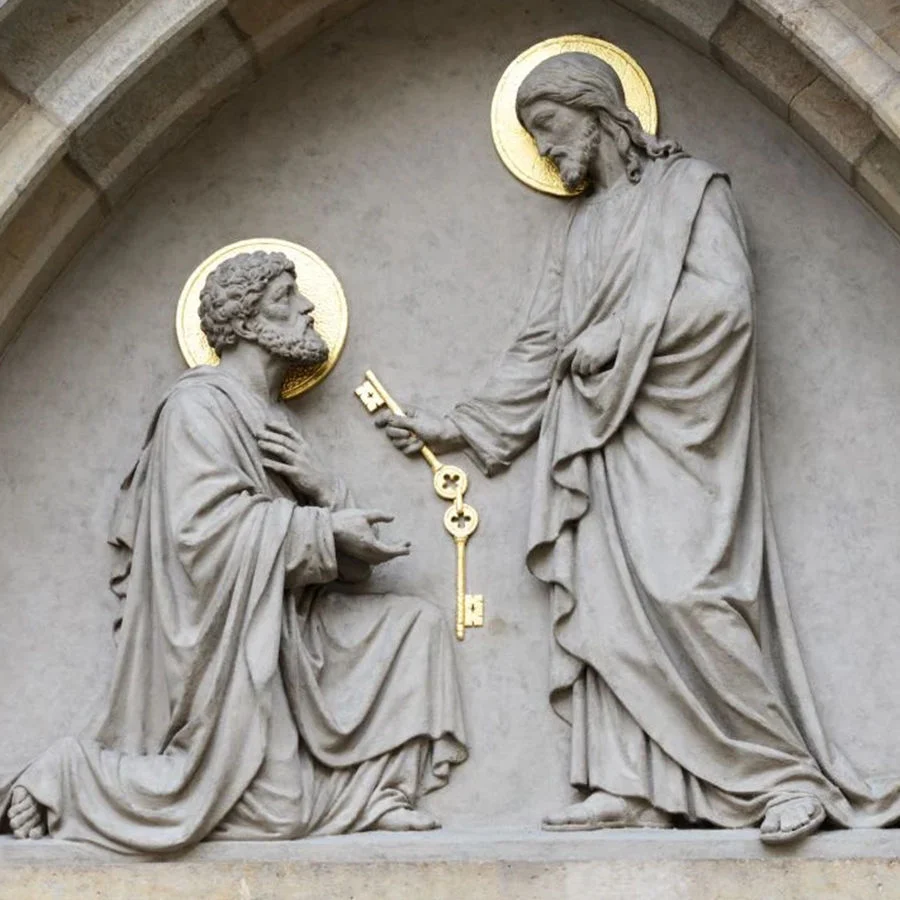
Relief at the Church of St Peter, Prague. Christ entrusts the keys of the Kingdom to St Peter, recalling His words: “I will give to thee the keys of the kingdom of heaven” (Matthew 16:19).
What About “Binding and Loosing”?
The Old Testament passage speaks of opening and shutting, not literally of “binding and loosing.” That distinction should be preserved.
Nevertheless, both images concern authoritative administration: admission and exclusion, judgment and government.
Christ joins the keys in Matthew 16 with the authority to bind and loose, thereby identifying Peter's stewardship with genuine ecclesiastical jurisdiction.
Pope Leo XIII taught that the keys signify governing authority and interpreted binding and loosing as encompassing the authority necessary for legislation and judgment in the Church. (Vatican)
The authority is real precisely because Christ promises heavenly ratification. Peter is not given freedom to invent a different religion. He is an officeholder under Christ, entrusted with Christ's household and bound to Christ's revelation.
Historical and Theological Evidence
“I Have Prayed for Thee … Confirm Thy Brethren”
On the night of the Last Supper Christ says:
“Simon, Simon… I have prayed for thee, that thy faith fail not… confirm thy brethren.” Luke 22:31–32
The wording is striking. Satan's assault concerns the apostolic band, yet Christ singles out Simon for a particular prayer and gives Simon a duty toward the others.
Peter is himself capable of personal weakness—as his denial of Christ proves only hours later. The promise therefore cannot mean personal impeccability or freedom from every error of judgment. Instead, Christ gives Peter a specific ecclesial responsibility: to strengthen his brethren in the faith.
The papacy was not instituted because Peter was naturally the strongest man. The Passion demonstrates precisely the opposite. The stability attached to his office comes from Christ's prayer and promise, not Peter's unaided character.
Leo XIII connects this text directly with Peter's duty to safeguard the unity of faith. (Vatican)
“Feed My Lambs … Feed My Sheep”
After the Resurrection Christ again addresses Peter individually.
Three times Peter professes his love, and three times Christ entrusts His flock to him:
“Feed my lambs” and finally “Feed my sheep.” John 21:15–17
This scene certainly restores Peter after his threefold denial, but Catholic interpretation has never reduced it to personal rehabilitation. Christ entrusts His own flock to Peter.
That distinction is crucial:
The sheep remain Christ's sheep.
Peter becomes their commissioned shepherd.
Christ therefore remains the Good Shepherd and supreme Pastor; Peter possesses a subordinate pastoral authority received from Him.
First Vatican I identified John 21 as the conferral of Peter's office as supreme pastor of Christ's earthly flock. (Papal Encyclicals Online)
Peter's Primacy Appears Throughout Acts
After the Ascension, Peter repeatedly acts in the foreground of the apostolic Church.
He takes the initiative concerning the replacement of Judas (Acts 1:15–26);
stands with the Eleven and delivers the principal sermon at Pentecost (Acts 2:14–41);
performs the prominent first healing recorded after Pentecost (Acts 3:1–10);
pronounces judgment in the case of Ananias and Sapphira (Acts 5:1–11);
receives the revelation preparing the admission of the Gentiles in the case of Cornelius (Acts 10–11); and
gives a decisive doctrinal intervention concerning Gentile converts at Jerusalem (Acts 15:7–11).
These narratives are not, by themselves, the formal definition of papal jurisdiction. But they harmonise naturally with the explicit Petrine commissions of the Gospels. The Scripture compilation supplied for this article likewise gathers these texts under Peter's primacy and apostolic succession.
St Clement of Rome and the Church at Corinth
Only a few decades after the Apostolic age, St Clement of Rome (d. c. AD 99) provides an important early witness. His Letter to the Corinthians (c. AD 96) is sent from the Church of Rome to the Church of Corinth during a serious internal dispute.
The Roman Church addresses the Corinthian crisis and urges restoration of ecclesiastical order. The letter's own opening identifies Rome as writing to Corinth and refers to matters brought to Rome's attention. (New Advent)
This fact should not be exaggerated into the claim that every detail of later papal jurisprudence is already explicitly articulated in 1 Clement. Nevertheless, it is historically significant that, at an exceptionally early date,
Rome is intervening authoritatively in the affairs of another apostolic Church.
St Clement of Rome — Letter to the Corinthians
St Irenaeus Gives the Roman Succession
The evidence becomes especially explicit with St Irenaeus of Lyons (c. AD 130–202).
In Against Heresies III.3.2–3 (c. AD 180), Irenaeus appeals to apostolic succession as a public test against Gnostic innovators. Rather than attempting to enumerate every Church, he points particularly to the ancient Church at Rome associated with Peter and Paul and says that every Church must agree with it because of its potiorem principalitatem, commonly translated in this text as preeminent authority. (New Advent)
Even more importantly for the question of succession, Irenaeus then actually supplies a list of Roman bishops: the Apostles entrust the episcopate to Linus, followed by Anacletus, then Clement, and onward through successive bishops to Irenaeus's own day. His argument depends upon the continuity of an identifiable Roman episcopal succession preserving apostolic doctrine. (New Advent)
St Irenaeus — Against Heresies III.3
This is extraordinarily early evidence. By approximately AD 180, Roman succession is not being invented retrospectively from the Middle Ages; it is being invoked as an already established public fact against second-century heresy.
St Cyprian: Unity Begins From One
St Cyprian of Carthage (c. AD 200–258), in On the Unity of the Catholic Church (AD 251), 4, begins his treatment of ecclesial unity with Christ's words to Peter.
The textual history of this chapter contains two recensions, so individual phrases must be cited carefully rather than treated as textually uncontested. What is secure across the discussion, however, is Cyprian's use of Peter to illustrate that Christ establishes the origin and manifestation of ecclesial unity from one even while the Apostles share genuine episcopal authority. (New Advent)
That is an important Catholic balance: Petrine primacy does not abolish the episcopate.
Bishops Are Not Merely Papal Delegates
Catholic teaching does not say that Peter was the only true Apostle or that later bishops are simply administrative assistants of the Pope.
Leo XIII explicitly taught that just as Peter's authority continues in the Roman Pontiff, the apostolic episcopal office continues in the bishops. Bishops possess real ordinary pastoral authority in their own churches; nevertheless, visible unity requires their communion with the successor of Peter. (Vatican)
Thus Catholic ecclesiology is neither:
Peter without the Apostles, nor the Apostles without Peter.
It is:
Peter with the Apostles → Pope with the bishops → one visible episcopate united under one visible head.
Why the Petrine Office Had to Continue
If Peter's primacy existed merely to solve problems during Peter's lifetime, it would disappear precisely when its purpose became most necessary.
The Apostles personally knew Christ, received His teaching directly and could consult one another. Later centuries would face the geographical expansion of Christianity, doctrinal controversies, disputed episcopal elections, schisms and questions unknown to the first generation.
If visible unity required a Petrine principle while the Apostles were alive, there is no obvious reason why Christ's worldwide Church would cease needing that principle when the Apostles died.
First Vatican I therefore taught not merely Peter's primacy, but its permanence. What Christ instituted for the Church's continuing salvation and benefit must remain. The Council declared that Peter “lives and presides” in his successors, the bishops of the Roman See, and defined that the Roman Pontiff succeeds Peter in this primacy. (Papal Encyclicals Online)
The sequence is therefore:
Christ establishes the office → Peter receives it → the Church is to endure until the end of time → the office continues → Peter's succession is attached to the Roman See.
This is the Roman succession of the papacy.
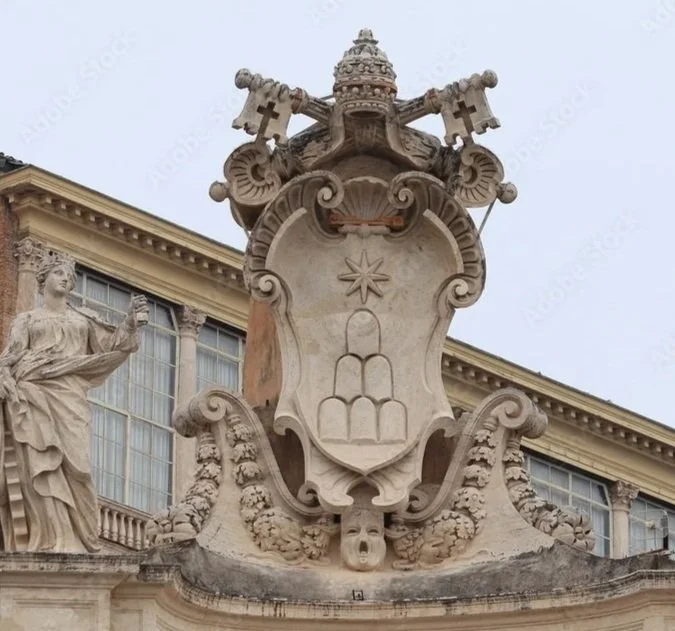
Coat of arms of the Holy See above St Peter’s Basilica, Rome. The crossed keys recall Christ’s words to St Peter: “I will give to thee the keys of the kingdom of heaven” (Matthew 16:19), symbolising the authority of the Petrine office under Christ the King.
The Main Objection
A serious Protestant or Eastern Orthodox objection runs approximately as follows:
Peter was certainly prominent, but all the Apostles possessed authority. Christ later gave the power of binding and loosing to the Apostles collectively in Matthew 18:18. Christ, not Peter, is the true Rock and Head of the Church. Peter could even act wrongly and was publicly corrected by St Paul in Galatians 2:11–14. At the Council of Jerusalem, James also exercised an important leadership role. Therefore, the biblical evidence may establish Petrine prominence but does not necessarily establish a supreme office transmitted exclusively to the bishops of Rome.
This objection rightly insists upon several truths Catholics must preserve:
Christ alone is the supreme Head in the absolute sense; the other Apostles possessed genuine authority; bishops are real successors of the Apostles; Peter was personally fallible in conduct; and papal primacy does not imply personal sinlessness.
The disagreement concerns whether those truths exclude a distinct Petrine primacy.
Response
They do not.
First, shared apostolic authority and Petrine primacy are not mutually exclusive. Matthew 18 gives the Apostles collectively authority to bind and loose, but Matthew 16 gives Peter individually something not there given to the group: the keys. Leo XIII made precisely this distinction: certain powers belong to the Apostles with Peter, while particular things are entrusted to Peter individually. (Vatican)
Second, the Petrine case does not stand upon one ambiguous phrase. The evidence accumulates:
Peter alone is renamed Rock.
Peter alone receives the keys.
Peter receives a special prayer for his faith.
Peter is commanded to strengthen his brethren.
Peter is individually commissioned to feed Christ's flock.
When the pieces are read together, the interpretation that Peter possesses nothing more than honorary precedence becomes increasingly difficult.
Third, Christ being the Rock does not prevent Peter from being a rock by participation. Nor does Christ being Shepherd prevent Peter from shepherding. Nor does Christ possessing the key of David prevent Him from entrusting the keys ministerially to Peter. The entire biblical conception of ecclesiastical office depends upon God communicating subordinate authority without surrendering His own sovereignty.
Fourth, Galatians 2 does not disprove papal primacy. Paul rebukes Peter's conduct because Peter's behaviour concerning table fellowship was inconsistent and liable to mislead others. Nothing in the episode says that Peter ceased to possess his office, that Paul replaced him, or that Peter had issued an erroneous definitive teaching binding the universal Church. Authority does not imply impeccability.
Indeed, Peter's faults actually help clarify Catholic doctrine. The papacy was never established because every Pope would be personally heroic, prudent or sinless. Its foundation is Christ's institution and promise, not the personal excellence of every officeholder.
What We Can and Cannot Conclude
Established Catholic doctrine: Christ directly instituted a true primacy of jurisdiction in St Peter. Peter was established as the visible head of the Church militant under Christ and as a permanent principle of visible unity. The Petrine primacy continues in Peter's successors, the bishops of Rome. Vatican I defines these points explicitly. (Papal Encyclicals Online)
Strong biblical evidence: Peter's divinely bestowed name, the rock, the keys, binding and loosing, Christ's special prayer for his faith, his commission to strengthen the brethren and his charge to feed Christ's flock form an interconnected scriptural case for a unique Petrine office.
Traditional biblical typology: Joseph supplies an earlier pattern of a ruler placing one man over his household beneath himself; Eliakim and the key of David provide the much closer Davidic pattern of a chief steward exercising delegated authority under the king. Matthew 16 brings that royal imagery into Christ's greater and everlasting Kingdom.
Established historical evidence: Very early Christianity knows an identifiable Roman Church connected with Peter and Paul, and by approximately AD 180 St Irenaeus can enumerate the succession of Roman bishops as evidence of continuity with apostolic faith. (New Advent)
What this article does not by itself determine: The doctrine of the papacy does not answer every later question concerning the validity of a particular papal election, the effect of public heresy upon ecclesiastical office, how a prolonged vacancy could be resolved, or the application of traditional principles to particular post-Vatican II claimants. Those require separate theological and canonical arguments.
That distinction is important. One must first understand what the papacy is before asking whether a particular man actually possesses the office.
Conclusion
Christ established the papacy because His Church was to be one visible flock professing one faith under a visible ecclesiastical government.
He prepared the pattern in the Old Testament. Joseph shows the principle of a supreme ruler delegating vast authority to one servant placed over his house. More precisely, the Davidic king possessed a chief steward to whom was entrusted the key of the royal house, with authority to open and shut.
Then comes the greater fulfilment.
Christ is the true Son of David, the everlasting King. He possesses the key of David in His own right.
Yet He renames Simon Peter—the Rock,
promises to build His Church upon him, and
gives him the keys of the Kingdom.
He commissions Peter to bind and loose,
prays particularly that Peter's faith fail not,
commands him to strengthen his brethren, and finally
entrusts to him His lambs and sheep.
The pattern can therefore be summarised:
Joseph over Pharaoh's house → Eliakim with the key of David → Christ the eternal Davidic King → Peter with the keys of the Kingdom → Peter's continuing office in the Roman succession.
Peter is not another king beside Christ. He is not another head independent of Christ. He is the
chief steward beneath the King,
the visible shepherd beneath the Chief Shepherd,
the rock made firm by Christ the Rock.
That is why the papacy exists: not to obscure Christ, but to serve the visible unity, government and preservation of the Church Christ founded.
Primary Sources
Holy Scripture: John 1:42; Matthew 16:17–19; Luke 22:31–32; John 21:15–17; Genesis 41; Isaiah 22:20–22; Luke 1:32–33; Apocalypse 3:7.
First Vatican Council (1869–1870), Pastor Aeternus, Session IV, chapters 1–3. Decrees of the First Vatican Council
Pope Leo XIII, Satis Cognitum, 29 June 1896, especially §§11–14. Satis Cognitum
St Clement of Rome (d. c. AD 99), Letter to the Corinthians (c. AD 96). 1 Clement
St Irenaeus of Lyons (c. AD 130–202), Against Heresies (c. AD 180), III.3.1–3. Against Heresies III.3
St Cyprian of Carthage (c. AD 200–258), On the Unity of the Catholic Church (AD 251), 4. The existence of differing recensions of this chapter should be kept in mind when quoting individual clauses. On the Unity of the Church
Further Reading
Pope Leo XIII, Satis Cognitum — particularly valuable because it brings together the rock, keys, feeding of the flock, strengthening of the brethren, episcopal authority and Roman succession in one pre-Vatican II magisterial treatment. Read Satis Cognitum
First Vatican Council, Pastor Aeternus — the definitive conciliar treatment of the institution, permanence, jurisdiction and doctrinal office of the Roman primacy. Read Pastor Aeternus
St Irenaeus, Against Heresies III.3 — particularly important for the second-century witness to apostolic succession at Rome. Read Irenaeus III.3
Related Questions
Did Christ Establish a Visible Church?
What Authority Did Christ Give to His Church?
What Is Apostolic Succession and Why Does It Matter?
Why Is the Pope the Bishop of Rome?
Did St Peter Really Go to Rome?
What Does Papal Infallibility Actually Mean?
Can a Pope Teach Error or Fall into Heresy?
What Happens to Ecclesiastical Office If a Cleric Publicly Defects from the Catholic Faith?