Did the Catholic Church Add Books to the Bible?
Short Answer
No. The Catholic Church did not add seven books to the Bible at the Council of Trent. The books commonly called the deuterocanonical books—
Tobit,
Judith,
Wisdom,
Ecclesiasticus or Sirach,
Baruch,
1 Maccabees and
2 Maccabees, together with
additional portions of Esther and Daniel
—were read and used by Christians many centuries before the Protestant Reformation.
The history is more complicated than the slogan “Catholics added books” or its equally simplistic reverse, “every Christian always possessed exactly the modern Catholic canon.” During the first Christian centuries there were genuine local uncertainties about several Old Testament books—and also about such New Testament books as Hebrews, James, 2 Peter and the Apocalypse. Individual Fathers did not always give identical canonical lists. What eventually emerged, however, was the Church's settled reception of the longer Old Testament canon in the West.
St Augustine explicitly listed the deuterocanonical books as canonical; the African councils did likewise; Pope Innocent I transmitted essentially the same list in AD 405; and the Ecumenical Council of Florence listed the same books in 1442—more than a century before Trent. (New Advent)
The Council of Trent in 1546 did not create this canon. Faced with the Reformation's rejection or demotion of books long received in the Catholic Church, Trent solemnly defined the matter. The First Vatican Council later reaffirmed that the books enumerated by Trent, “entire with all their parts,” are sacred and canonical because, being inspired by the Holy Ghost, they have God as their author. (Papal Encyclicals Online)
The historically precise description is therefore this:
the Protestant Reformation reopened and rejected part of the Old Testament canon previously received by the Catholic Church; Trent responded by defining dogmatically the canon the Church had already been using.
Why This Question Matters
The dispute is not merely about whether one Bible contains seven more books than another. It raises a deeper question:
How does a Christian know which books constitute the Bible in the first place?
Sacred Scripture does not contain an inspired table of contents. No biblical verse says: “The Old Testament shall contain these books and the New Testament these twenty-seven.” The Christian therefore needs some historically identifiable means by which the inspired books were distinguished from merely useful religious writings.
This connects directly with the wider questions treated in
Why Isn't the Bible Alone Sufficient as the Rule of Faith?,
What Are Sacred Scripture and Sacred Tradition?, and
What Is the Magisterium?
The canon itself demonstrates the problem with sola Scriptura. Before Scripture can function as one's sole rule of faith, one must first know what belongs to Scripture. That determination cannot be derived solely from a book whose own table of contents is the very matter in dispute.
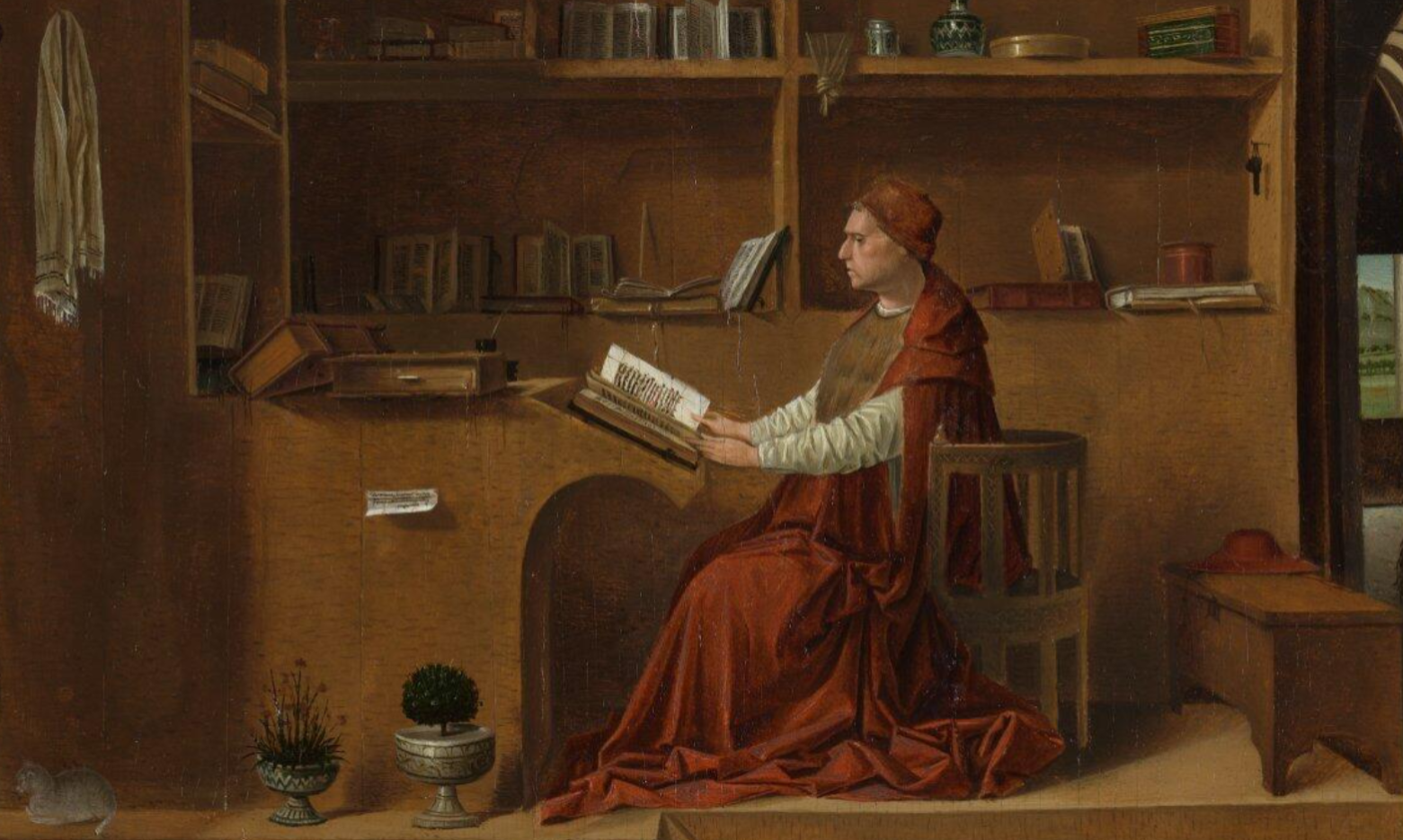
Antonello da Messina, Saint Jerome in His Study (c. 1475), National Gallery, London. St Jerome's biblical scholarship produced the Latin Vulgate. His own reservations concerning some Old Testament books also illustrate an important point in the history of the canon: individual Fathers could differ before the Church definitively settled the question.
What the Catholic Church Teaches
What Are the Deuterocanonical Books?
The Catholic Old Testament contains:
| Books accepted by Catholics but rejected from the Protestant Old Testament | Additional Catholic portions |
|---|---|
| Tobit | Portions of Esther |
| Judith | Prayer of Azarias and Canticle of the Three Children in Daniel 3 |
| Wisdom | Susanna in Daniel |
| Ecclesiasticus / Sirach | Bel and the Dragon in Daniel |
| Baruch | |
| 1 Maccabees | |
| 2 Maccabees |
The word deuterocanonical does not mean “second-class Scripture” or Scripture possessing a lesser degree of inspiration. It distinguishes books whose canonical status was disputed for a longer period from those whose reception was comparatively uncontested. Catholic scholarship made the same distinction regarding several New Testament books whose canonical status was disputed in parts of the early Church. (New Advent)
Thus a book being disputed for a time does not mean that it was eventually “added.”
The Church Receives Inspired Books; She Does Not Make Them Inspired
Catholic doctrine does not teach that a council can take a merely human book and transform it into inspired Scripture.
The First Vatican Council (1869–1870) explained that the biblical books are sacred and canonical not because the Church subsequently conferred inspiration upon them, but because they were written under the inspiration of the Holy Ghost, have God as their author, and were handed down to the Church as such. First Vatican Council — Dei Filius, Chapter II
The Church therefore discerns and authoritatively identifies the inspired books; she does not cause their inspiration. That distinction is essential.
Historical and Theological Evidence
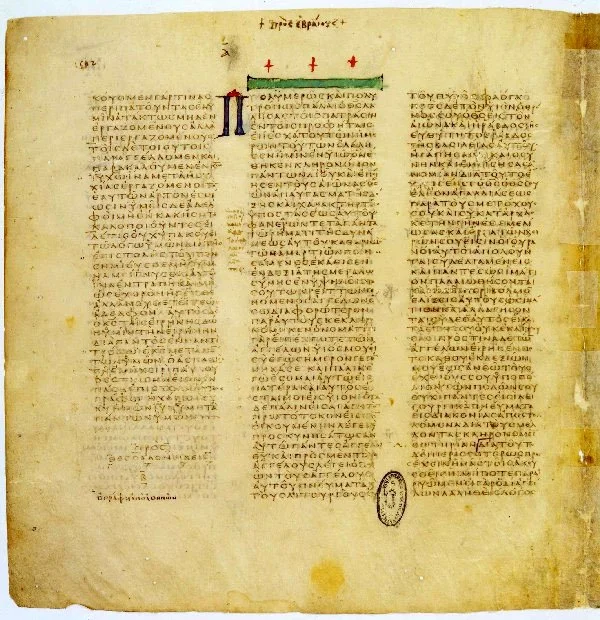
Codex Vaticanus (4th century), one of the earliest surviving great Greek biblical manuscripts. Early Christianity inherited and extensively used the Greek Scriptures of the Septuagint tradition, within which the deuterocanonical books circulated.
The Septuagint and the World of the Apostles
Several centuries before Christ, Jewish Scriptures began to be translated into Greek. This collection became known as the Septuagint, often abbreviated LXX.
Greek was the common international language of much of the eastern Mediterranean world, and the New Testament writers frequently quote the Old Testament in forms corresponding more closely to the Greek Septuagint than to the later standard Hebrew textual tradition.
Examples noted in the supplied biblical apologetics material include the Septuagintal forms underlying passages such as Isaiah 7:14 → Matthew 1:23 and other Old Testament quotations used in the New Testament. The same source also identifies important correspondences between the deuterocanonical books and the New Testament.
A qualification is important, however. It is too simplistic to imagine “the Septuagint” in the first century as one universally standardized, leather-bound Bible with an uncontested table of precisely forty-six Old Testament books. Ancient Jewish scriptural collections developed over time, and modern scholarship recognizes significant diversity in Jewish scriptural usage around the time of Christ. One major scholarly study concludes that before about AD 100 there was not simply one universally accepted Jewish canonical collection but a plurality of authoritative scriptural collections. (OUP Academic)
The Catholic argument therefore does not need the exaggerated claim that every first-century Septuagint manuscript contained precisely the later Tridentine canon.
The more defensible historical points are:
Greek Scripture was extensively used by the apostles and early Christians.
The deuterocanonical books circulated within this Greek scriptural world.
Early Christians repeatedly read and cited them.
The Church eventually settled disputes over their status through her own ecclesiastical authority.
The New Testament Knows the Deuterocanonical World
The New Testament does not provide a canonical list. Nor does it explicitly quote every Old Testament book with the formula “it is written.” Nevertheless, there are striking connections between the New Testament and the deuterocanonical books.
Hebrews 11 and the Maccabean Martyrs
Perhaps the clearest example is Hebrews 11:35:
“Others were racked, not accepting deliverance, that they might find a better resurrection.”
The latter part of the verse corresponds remarkably to the martyrdoms described in 2 Maccabees 6–7, particularly the mother and seven sons who endure torture rather than violate God's law because they hope for resurrection.
This connection is specifically identified in the supplied Scripture apologetics material.
Hebrews presents these sufferers among the great Old Covenant examples of faith. That does not, by itself, constitute a formal New Testament definition of the canon, but it demonstrates that 2 Maccabees belongs to the religious and scriptural world from which the inspired New Testament draws.
Wisdom and the Passion of Christ
A second extraordinary correspondence occurs in Wisdom 2:12–20.
The wicked conspire against “the just one,” saying that he claims God as his Father and proposing:
“For if he be the true son of God, he will defend him.” Wisdom 2
At Calvary Christ's enemies mock Him in strikingly similar language:
“He trusted in God; let him now deliver him if he will have him; for he said: I am the Son of God.”
See Matthew 27:43.
This should be described carefully. Matthew does not formally introduce Wisdom with “as it is written.” It is therefore better classified as a strong verbal and conceptual parallel than as a direct quotation.
Yet the theological significance is considerable. Wisdom depicts the righteous man persecuted precisely because he claims a unique relationship with God, subjected to insult and condemned to a shameful death. In Christ, the pattern reaches a far greater fulfilment.
This is prophetic foreshadowing, rather than one of Scripture's formally identified person-to-person types.
Wisdom and St Paul's Teaching About Creation
The supplied apologetics material also identifies the close conceptual relationship between Wisdom 13:1–9 and Romans 1:18–23: both condemn men who can perceive the Creator through His works yet turn instead toward created things.
Again, an allusion or conceptual dependence is not equivalent to a formal declaration of canonicity. But such passages make the claim that the deuterocanonical books were completely foreign to apostolic Christianity historically untenable.
The Early Church
There Was Genuine Early Disagreement
Some Fathers distinguished between books received in the strictest canonical sense and other books nevertheless read in the Church.
St Athanasius of Alexandria (c. AD 296–373), in his Thirty-Ninth Festal Letter (AD 367), gave an Old Testament list that differs from the later Catholic enumeration. Yet even his list included Baruch together with Jeremiah, while he specifically commended Wisdom, Sirach, Judith and Tobit for Christian instruction. St Athanasius — Festal Letter 39
Rufinus of Aquileia (c. AD 345–411) similarly distinguished “canonical” from “ecclesiastical” books and placed Wisdom, Sirach, Tobit, Judith and Maccabees in the latter category, saying that they were read in the Churches but were not used by him to establish doctrine. Rufinus — Commentary on the Apostles' Creed §§37–38
These facts should not be concealed. They show that the canon underwent a genuine process of ecclesiastical discernment.
But they do not prove that Trent invented the deuterocanon.
St Clement of Alexandria
St Clement of Alexandria (c. AD 150–215) repeatedly uses Ecclesiasticus. In Stromata II he cites Sirach within his exposition of divinely revealed wisdom. Eusebius later specifically observes that Clement employed Wisdom and Sirach among the scriptural testimonies used in his writings. St Clement of Alexandria — Stromata II
St Cyprian of Carthage
St Cyprian of Carthage (c. AD 200–258), in his Testimonies to Quirinus, describes his collection as being drawn from the “Holy Scriptures” and repeatedly quotes Ecclesiasticus alongside books universally acknowledged as Scripture. St Cyprian — Testimonies to Quirinus III
St Irenaeus and Baruch
St Irenaeus of Lyons (c. AD 130–202) provides another revealing example. In Against Heresies V.35.1 he cites material from Baruch 4–5, attributing it to Jeremiah—the common ancient practice because Baruch circulated in close association with Jeremiah.
This shows how counting ancient canonical books purely by modern book titles can be misleading. A Father who lists “Jeremiah” may sometimes encompass material now printed separately as Baruch.
St Augustine Gives the Catholic Canon
The evidence becomes particularly explicit with St Augustine of Hippo (AD 354–430).
In On Christian Doctrine II.8, written beginning around AD 397, Augustine explains that in judging canonical Scripture one must consider the reception of the Catholic Churches. He then lists Tobias, Judith, 1 and 2 Maccabees, Wisdom and Ecclesiasticus among the canonical Scriptures. St Augustine — On Christian Doctrine II.8
This is approximately 1,150 years before the Council of Trent.
The Councils and the Growth of Canonical Certainty
The development can be seen chronologically:
| Date | Witness | Significance |
|---|---|---|
| 2nd–3rd centuries | Irenaeus, Clement, Cyprian and others | Deuterocanonical writings are quoted and used extensively, although terminology and the precise boundaries of the canon are not everywhere identical. |
| AD 367 | St Athanasius | Distinguishes a stricter canon from books appointed for Christian reading; includes Baruch with Jeremiah. |
| AD 397 | St Augustine and Council of Carthage | The Catholic Old Testament, including Tobit, Judith, Wisdom, Sirach and Maccabees, is explicitly received. |
| AD 405 | Pope Innocent I to Exuperius | Gives essentially the Catholic canonical list. |
| AD 419 | Council of Carthage | Again lists Tobias, Judith, Maccabees and the other Catholic books as canonical Scripture. |
| 1442 | Ecumenical Council of Florence | Explicitly lists Tobit, Judith, Wisdom, Sirach, Baruch, 1 and 2 Maccabees together with the rest of the biblical canon. |
| 1546 | Ecumenical Council of Trent | Solemnly defines the canon amid the Reformation controversy, declaring the complete catalogue of books sacred and canonical. |
| 1870 | First Vatican Council | Reaffirms the Tridentine canon and the divine inspiration of the books received by the Church. |
The Council of Carthage (AD 419) ordered that nothing be read in the Church under the name of divine Scripture except the canonical books and then expressly included Tobit, Judith and two books of Maccabees in its list. Council of Carthage — Canon 24
More importantly for the claim that Trent invented the books, the Ecumenical Council of Florence (1438–1445), in the decree Cantate Domino of 1442, expressly enumerated Tobias, Judith, Wisdom, Ecclesiasticus, Baruch and the two Maccabees among the books received by the Church. Council of Florence — Cantate Domino
Florence predates Luther's complete German Bible by approximately ninety years and Trent by more than a century.
That fact alone disproves the claim that Trent first added these books in 1546.
What Happened at the Protestant Reformation?
Martin Luther Did Not Initially Tear the Books Out of the Binding
Historical precision matters here too.
Martin Luther's complete German Bible of 1534 did not simply make the deuterocanonical books disappear. He gathered them into a separate section labelled “Apocrypha.”
Its title page described them as books:
“not held to be equal to Holy Scripture, but … useful and good to read.”
Luther's 1534 Bible — Gruber Collection
So the first major Protestant move was principally reclassification and demotion, rather than immediate physical deletion from every Bible.
The Anglican Position
The Thirty-Nine Articles of Religion, Article VI, likewise place Tobias, Judith, Wisdom, Sirach, Baruch and the Maccabees outside the canonical Old Testament. They permit these books to be read “for example of life and instruction of manners,” but not for establishing doctrine. Church of England — Article VI
This resembles the narrower position found in certain Fathers such as Jerome and Rufinus rather than the position of Augustine and the African councils.
Even the 1611 King James Bible Contained Them
The original King James Version of 1611 included an Apocrypha section. Cambridge University Press notes that early Protestant Bibles commonly retained these writings and that printers gradually omitted them for theological and economic reasons. (Cambridge University Press)
Thus it is historically inaccurate to imagine that the moment the Reformation began, every Protestant Bible instantly became the modern sixty-six-book Bible.
The Reformers rejected their canonical authority; widespread physical omission from Protestant Bibles developed further over time.
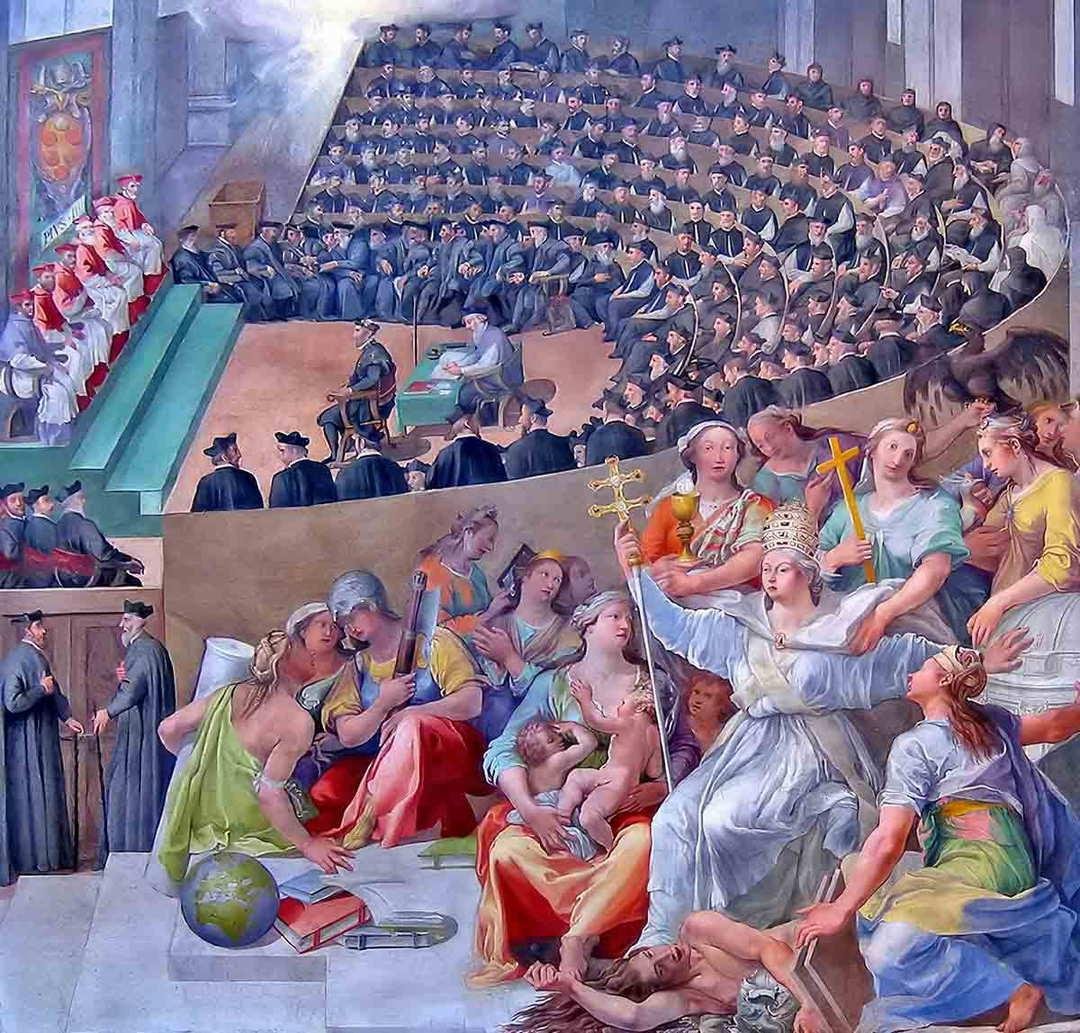
Pasquale Cati, The Council of Trent (1588), Basilica of Santa Maria in Trastevere, Rome. In 1546 the Council of Trent solemnly defined the canon in response to Reformation controversy; it did not create a new collection of biblical books.
The Main Objection
The strongest Protestant objection is considerably better than simply saying, “Trent added books.”
It runs roughly as follows:
The Jewish people possessed the Old Testament before the Church. The later rabbinic Hebrew Bible does not contain Tobit, Judith, Wisdom, Sirach, Baruch or Maccabees. Furthermore, respected Fathers such as St Jerome and St Athanasius distinguished at least some of these books from the stricter canon. Therefore the Reformers were not removing Scripture but restoring the Hebrew canon and following an ancient Christian position that Trent later rejected.
That objection deserves a serious response.
Response
St Jerome Really Did Express Doubts
St Jerome (c. AD 347–420) strongly preferred what he called the Hebraica veritas—the Hebrew textual tradition. In his famous Prologus Galeatus, he placed several of the deuterocanonical books outside his strict canonical enumeration. St Jerome — Prologus Galeatus (Christian Classics Ethereal Library)
In his preface to the books of Solomon, Jerome likewise stated that the Church read Judith, Tobit and Maccabees, and that Wisdom and Sirach were suitable for edification, although according to his own canonical criterion they were not to establish doctrine. St Jerome — Preface to Proverbs Ecclesiastes and the Song of Songs (Christian Classics Ethereal Library)
That is genuine historical evidence for the Protestant objection.
But Jerome was one Father, albeit an exceptionally important one. His personal canonical judgment was not itself a definition of the Catholic Magisterium.
At almost the same period Augustine held the fuller canon, the African councils formally listed it, and Pope Innocent I supplied essentially the same list. The question therefore cannot be settled merely by saying, “Jerome thought otherwise.”
No Father Individually Determines the Canon
This is precisely why the historical disagreement matters.
If one chooses Jerome because his Old Testament list resembles the Protestant list, why should Jerome's judgment be decisive rather than Augustine's?
If Athanasius's precise list determines the canon, one immediately encounters other differences, since Athanasius treated Esther differently while grouping Baruch with Jeremiah and recommended several other books for ecclesiastical reading. (New Advent)
The existence of disagreement demonstrates the need for an authoritative ecclesiastical judgment.
The same issue exists in the New Testament. Several books accepted by Catholics and Protestants alike were disputed in portions of the ancient Church. Christians do not therefore delete Hebrews, James, 2 Peter, 2 and 3 John, Jude or the Apocalypse because some ancient Christians questioned them.
A book's early disputed status is precisely what deuterocanonical describes.
The Later Jewish Canon Does Not Determine the Christian Canon
It is true that the rabbinic Hebrew canon is shorter than the Catholic Old Testament. But several distinctions are necessary.
First, Christianity did not simply inherit a finished New Testament-era rabbinic canon accompanied by an inspired table of contents. Recent historical scholarship has emphasized considerable diversity among Jewish scriptural collections around the period in which Christianity emerged. (OUP Academic)
Second, the formerly popular claim that a formal Council of Jamnia around AD 90 definitively closed the Jewish canon is no longer a secure historical position. The evidence points instead toward a more gradual process of consolidation. (OUP Academic)
Third, the Church had already received Christ and the apostolic deposit. After the coming of Christ, the ultimate authority for the Christian canon is not a later rabbinic decision concerning which books Christians may recognize.
The Church received both Testaments within the life of the apostolic Christian community.
Common Objections
“Jesus Never Quoted the Deuterocanonical Books”
Even if one granted that there is no unambiguous formula such as “it is written” followed by a quotation from one of the seven disputed books, this does not establish non-canonicity.
The New Testament never provides the principle:
A book belongs to the Old Testament only if Jesus or an Apostle explicitly quotes it.
If that criterion were applied consistently, difficulties would arise for Old Testament books universally accepted by Protestants but never formally identified by Christ as canonical.
Furthermore, as seen above, the New Testament contains significant allusions and parallels to the deuterocanonical books, particularly Hebrews 11:35 and 2 Maccabees 7.
The correct question is not merely, “Was this book directly quoted?” but,
“Which books did the Church founded by Christ ultimately receive as inspired Scripture?”
“The Deuterocanonical Books Were Not Written in Hebrew”
That claim is historically inadequate. Some were indeed composed in Greek, but others had Hebrew or Aramaic originals or substantial Semitic textual histories. The pre-Vatican II Catholic Encyclopedia, for example, notes Semitic originals or probable originals for several of the books. (New Advent)
More fundamentally, divine inspiration does not depend upon Hebrew composition. The entire New Testament was transmitted to the Church overwhelmingly in Greek. Language cannot determine inspiration.
“Trent Defined Them Only Because They Supported Catholic Doctrines”
The timing explains why Trent gave a solemn definition; it does not prove that Trent invented the underlying canon.
2 Maccabees 12, for example, provides important evidence concerning prayer for the dead, which became controversial during the Reformation. But the book was already present in Augustine's canonical list, the African councils, medieval Catholic Bibles, and Florence centuries before Luther's challenge.
Trent's decree therefore represents dogmatic settlement in response to controversy, not manufacture of new Scripture.
That pattern is familiar throughout Church history. Doctrines are frequently defined most precisely after they are challenged. The definition may be later than the belief without the belief itself being new.
What We Can and Cannot Conclude
Established Catholic doctrine: The books enumerated by the Council of Trent, complete with all their parts, are divinely inspired Sacred Scripture. Vatican I reaffirmed this expressly.
Established historical fact: Tobit, Judith, Wisdom, Sirach, Baruch and Maccabees were known, read and used by Christians long before the sixteenth century.
Established historical fact: Augustine and the African councils recognized substantially the Catholic Old Testament canon more than a millennium before Trent. (New Advent)
Established historical fact: Florence explicitly listed the Catholic canon in 1442, before the Reformation. (Vatican)
Established historical fact: Certain Fathers, particularly Jerome, Athanasius and Rufinus, made distinctions that do not correspond exactly to the later Tridentine enumeration. (Christian Classics Ethereal Library)
Historical conclusion: The early canonical process was more complex than either “everyone always had the exact seventy-three-book Catholic Bible” or “the Catholic Church invented seven books at Trent.”
What should not be claimed: It should not be argued that mere inclusion in any surviving Septuagint manuscript automatically proves inspiration. Ancient Septuagint manuscripts vary.
Also unnecessary to the argument: It is unnecessary to depend upon the often-cited claim that the Roman Synod of AD 382 definitively settled the canon under Pope Damasus. The textual history of the so-called Damasine list is disputed. The securely documented evidence from Augustine, Carthage, Innocent I, Florence and Trent is sufficient without resting the case upon that contested attribution. (Roman Missal)
Conclusion
The Catholic Church did not add books to the Bible in the sixteenth century. The deuterocanonical writings belonged to the scriptural inheritance used throughout ancient Christianity, although—as with several New Testament books—their exact canonical status was disputed in some places for a time. St Augustine recognized them as canonical; the African councils listed them; Rome transmitted the same general canon; and the Ecumenical Council of Florence explicitly enumerated them more than a century before the Reformation.
During the Reformation, Luther and other Protestants adopted a shorter Old Testament corresponding more closely to the Hebrew canon and relegated the disputed books to an “Apocrypha.” Luther's 1534 Bible still printed them, but expressly denied them equality with Holy Scripture. Later Protestant traditions increasingly omitted them altogether.
Trent therefore did not say, “Let us add seven books.” It settled a dispute that had been reopened:
Which books had the Church received as the inspired Old Testament?
Its answer was the canon already witnessed centuries earlier in Catholic ecclesiastical usage and explicitly listed at Florence. And the question ultimately points beyond these seven books. Before anyone can appeal to “the Bible” as his authority, he must first answer a prior question:
By what authority does he know which books constitute the Bible?
That leads naturally to the next question:
Why Isn't the Bible Alone Sufficient as the Rule of Faith?
Primary Sources
Council of Carthage (AD 419), Canon 24 — lists the canonical Scriptures including Tobit, Judith and two books of Maccabees. Council of Carthage — Canon 24
St Augustine of Hippo (AD 354–430), On Christian Doctrine, II.8 — gives his explicit catalogue of canonical Scripture. St Augustine — On Christian Doctrine II.8
St Athanasius of Alexandria (c. AD 296–373), Festal Letter 39 (AD 367) — important evidence for both early canonical distinctions and ecclesiastical use of disputed books. St Athanasius — Festal Letter 39
Rufinus of Aquileia (c. AD 345–411), Commentary on the Apostles' Creed, 37–38 — distinguishes canonical and ecclesiastical books. Rufinus — Commentary on the Apostles' Creed
St Jerome (c. AD 347–420), Prologus Galeatus — primary evidence for Jerome's preference for the Hebrew canon. St Jerome — Prologus Galeatus
Council of Florence, Cantate Domino (1442) — gives the Catholic biblical canon before the Protestant Reformation. Council of Florence — Cantate Domino
Council of Trent, Session IV (8 April 1546), Decree Concerning the Canonical Scriptures. Council of Trent — Session IV
First Vatican Council, Dei Filius (24 April 1870), Chapter II — reaffirms the Tridentine canon and explains why the books are sacred and canonical. First Vatican Council — Dei Filius
Martin Luther, German Bible (1534), Apocrypha title page. Luther's 1534 Bible — Gruber Collection
Church of England, Thirty-Nine Articles, Article VI — formal Anglican treatment of the books as non-canonical but suitable for reading. Thirty-Nine Articles — Article VI
Further Reading
Catholic Encyclopedia — “Canon of the Old Testament” — useful survey of the development of the canon, including Augustine, Jerome and the African councils. Canon of the Old Testament
Catholic Encyclopedia — “Scripture” — explains the traditional distinction between proto- and deuterocanonical books. Scripture
Timothy H. Lim, The Formation of the Jewish Canon (Yale University Press, 2013) — useful modern historical scholarship concerning the diversity and eventual formation of Jewish scriptural collections. (OUP Academic)
Related Questions
Why Isn't the Bible Alone Sufficient as the Rule of Faith?
What Are Sacred Scripture and Sacred Tradition?
How Do We Know Which Books Belong in the Bible?
What Is the Magisterium?
What Authority Did Christ Give to His Church?
Can the Catholic Church Teach Error in Faith and Morals?
What Are Purgatory and Indulgences? — especially relevant to the use of 2 Maccabees 12.
Why Catholicism Rather Than Protestantism?