 Image 1 of 1
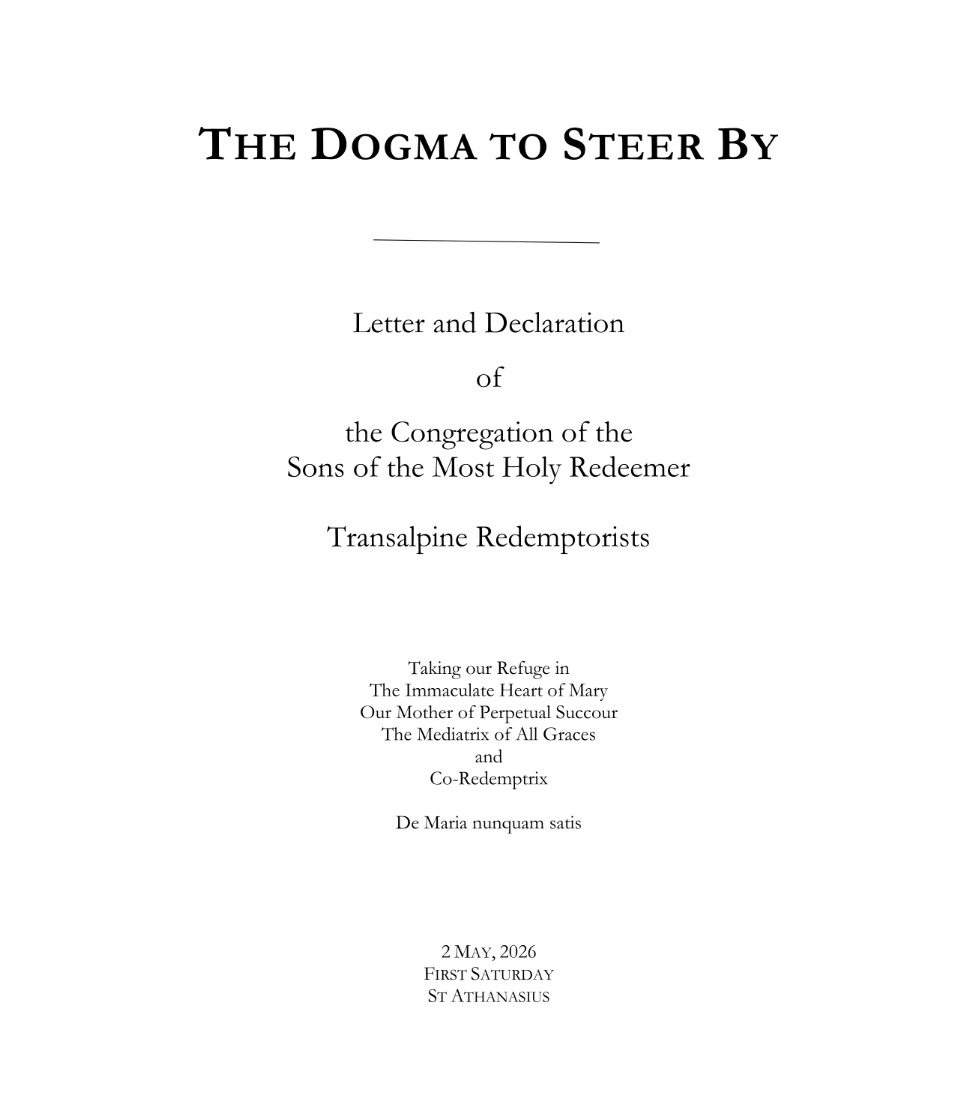
The Dogma To Steer By: Letter and Declaration of the Congregation of the Sons of the Most Holy Redeemer Transalpine Redemptorists
Summary
The Dogma to Steer By is a letter and formal declaration issued on 2 May 2026 by the Congregation of the Sons of the Most Holy Redeemer, also known as the Transalpine Redemptorists. It represents a decisive change in the congregation’s position: it rejects the legitimacy of the post–Vatican II papal claimants and abandons the traditionalist “recognise and resist” position that it had followed after its 2008 reconciliation with Rome.
1. Central diagnosis
The document argues that the contemporary institutional Church has been progressively infiltrated and overtaken by Modernists who outwardly retain Catholic offices, buildings and terminology but profess a different religion.
It presents this infiltration as a long historical process beginning before Pope St Pius X, developing through seminaries and the clergy, and reaching its decisive triumph at the Second Vatican Council.
The authors connect this alleged transformation with:
Modernism;
Freemasonry;
religious indifferentism;
religious liberty;
ecumenism;
alleged Communist infiltration of seminaries.
The text repeatedly distinguishes between the indefectible Catholic Church and what it calls the “official,” “Conciliar” or “Vatican II Church.”
2. The principal doctrinal issue: religious indifferentism
The document’s central theological concern is the proposition that different religions may be legitimate paths to God or salvation.
It contrasts pre–Vatican II papal condemnations of indifferentism with:
Nostra Aetate;
Dignitatis Humanae;
Unitatis Redintegratio;
the interreligious meetings at Assisi;
John Paul II’s reported kissing of the Quran;
the Abu Dhabi document on Human Fraternity;
the Pachamama controversy;
Francis’s 2024 remarks in Singapore;
statements attributed to Leo XIV.
The congregation concludes that the post-conciliar approach is not merely ambiguous or imprudent but directly contradictory to the previous papal magisterium.
3. The “dogma to steer by”
The document’s controlling theological premise is a passage from the First Vatican Council:
“This See of St Peter always remains unimpaired by any error.”
From this the authors formulate the following syllogism:
The See of Peter cannot teach religious error.
The post–Vatican II claimants have publicly taught religious error.
Therefore, they cannot have been legitimate occupants of the See of Peter.
The document says this is not a formal canonical deposition or juridical judgment. It calls it a “judgement of faith and practical necessity.”
This is the principal basis for its sedevacantist conclusion.
4. Rejection of “recognise and resist”
A particularly significant aspect of the declaration is its rejection of the position commonly associated with Archbishop Marcel Lefebvre and much of the traditionalist movement: recognising the reigning claimant as pope while resisting his teachings, disciplines or liturgical reforms.
The authors argue that a Catholic cannot consistently:
recognise a man as the Vicar of Christ;
refuse his doctrinal teaching;
reject his disciplinary authority;
reject the liturgy promulgated under his authority.
They now regard their own 2008 reconciliation with the Roman hierarchy as a mistake because it required them simultaneously to recognise and resist that hierarchy.
5. Practical consequences
The congregation declares that it will:
give no juridical recognition to Leo XIV or his bishops;
refuse communion with the “Conciliar” hierarchy;
continue offering the traditional Roman Mass;
adhere to the pre–Vatican II papal magisterium;
encourage faithful Catholics to seek priests outside the Conciliar structure;
form independent traditional Catholic communities;
work towards an “Imperfect General Council.”
The proposed council would consist of bishops whom the congregation considers to have retained the Catholic faith. Its task would be to examine and pronounce upon the status of the current papal claimant and his post–Vatican II predecessors.
6. Formal declaration
The declaration’s formal conclusions include the following propositions:
Enemies had infiltrated the Church before Vatican II.
Vatican II taught principles previously condemned as indifferentism, false ecumenism and religious liberty.
Paul VI through Leo XIV contradicted the pre–Vatican II magisterium.
The apparent popes since Vatican II produced a spiritual catastrophe.
Post-conciliar doctrinal, moral, liturgical and disciplinary decisions cannot be accepted.
Acceptance of Vatican II’s allegedly false teachings separates a person from the Catholic Church.
Recognising a pope while resisting his doctrinal and disciplinary authority is untenable.
The declaration is signed by the congregation’s priests and religious, whose signatures appear on pages 10 and 11.
Selected quotations from the authors
On the nature of the crisis
“The Modernist presence within the structures and hierarchy of the official Church has gone beyond critical mass to a near saturation point.”
— Page 2
“From the outside they look to be Catholics, but they do not profess the Catholic Faith as taught through the centuries.”
— Page 2
“We must stand firmly with the Catholic Church and move well away from the camouflage of its counterfeit.”
— Page 2
On Vatican II
“Our spiritual French Revolution came. It came at the Second Vatican Council.”
— Page 3
“The documents of Vatican II reject the condemnation of Indifferentism and ignore the constant teaching of Church.”
— Page 3
On the document’s central theological argument
“If the See of Peter were to teach error, then beyond any possible doubt, the person teaching that error is not a Catholic Pope.”
— Page 4
“And if he is not a Catholic Pope, he is no Pope at all.”
— Page 4
“We are not making a canonical judgement — only the Church can do that. But we are making a judgement of faith and practical necessity.”
— Page 4
On separation from the post-conciliar hierarchy
“We must move away from all cooperation with those who have abandoned the Faith and therefore the Church.”
— Page 5
“We must give no juridical recognition to those who have departed from it, including Leo XIV and his bishops.”
— Page 5
“You must find priests who offer the traditional Mass, who teach the traditional Faith, who reject the heresies of Indifferentism, Ecumenism, and Modernism.”
— Page 5
On the congregation’s previous position
“There has been a great mistake on our part to think that the hierarchy of the Novus Ordo was sufficiently Catholic for us to operate under its command.”
— Page 9
“That mistake was the fruit of nearly 20 years of living the non-Catholic stance of recognising but resisting those whom we thought were the authorities of the Church.”
— Page 9
“Recognition of the destroyers of the Faith and any submission to them at all is both impossible and endangering one’s Faith.”
— Page 9
Final statement of continuity
“Our statement is new. Our perspective has changed. But our Faith has not changed.”
— Page 9
“Holding the True Faith of our Fathers, we will continue to offer the True Mass.”
— Page 9
Important historical and theological quotations reproduced in the document
The document also relies heavily on older papal and theological sources.
Pope St Pius X, Pascendi Dominici Gregis
“The partisans of error are to be sought not only among the Church’s open enemies; they lie hid … in her very bosom and heart.”
— Quoted on pages 2 and 13
“They lay the axe not to the branches and shoots, but to the very root, that is, to the faith and its deepest fibres.”
— Quoted on pages 2 and 13
Pope Gregory XVI, Mirari Vos
“This perverse opinion is spread on all sides … that it is possible to obtain the eternal salvation of the soul by the profession of any kind of religion.”
— Page 15
“Without a doubt, they will perish forever, unless they hold the Catholic faith whole and inviolate.”
— Page 15
Pope Pius IX, Qui Pluribus
“Also perverse is the shocking theory that it makes no difference to which religion one belongs.”
— Page 15
“They remove all distinction between virtue and vice, truth and error.”
— Page 15
Pope Leo XIII, Humanum Genus
“They thereby teach the great error of this age … that all religions are alike.”
— Pages 15 and 20
“The Catholic religion … as it is the only one that is true, cannot … be regarded as merely equal to other religions.”
— Pages 15 and 20
First Vatican Council
“This See of St. Peter always remains unimpaired by any error.”
— Pages 4, 8 and 16
St Alphonsus de Liguori
“If the Pope were ever to fall into heresy as a private person, then he would immediately fall from the papacy.”
— Page 16
Pope Pius XI, Mortalium Animos
“The Apostolic See cannot on any terms take part in their assemblies, nor is it anyway lawful for Catholics either to support or to work for such enterprises.”
— Page 20
Overall significance
The document is not simply a criticism of Vatican II or of particular papal actions. It is a formal adoption of a sedevacantist position by the Transalpine Redemptorists. Its decisive claim is that the contradiction it perceives between the pre-conciliar and post-conciliar magisterium can only be resolved by concluding that the post–Vatican II claimants never possessed, or ceased to possess, legitimate papal authority.
Its most consequential sentence regarding the congregation itself is:
“Our statement is new. Our perspective has changed. But our Faith has not changed.”
That sentence encapsulates the document’s purpose: to present the congregation’s change of juridical and ecclesiological position as a consequence of preserving, rather than altering, its Catholic faith.
Watch their interview on Kokx News here.
Summary
The Dogma to Steer By is a letter and formal declaration issued on 2 May 2026 by the Congregation of the Sons of the Most Holy Redeemer, also known as the Transalpine Redemptorists. It represents a decisive change in the congregation’s position: it rejects the legitimacy of the post–Vatican II papal claimants and abandons the traditionalist “recognise and resist” position that it had followed after its 2008 reconciliation with Rome.
1. Central diagnosis
The document argues that the contemporary institutional Church has been progressively infiltrated and overtaken by Modernists who outwardly retain Catholic offices, buildings and terminology but profess a different religion.
It presents this infiltration as a long historical process beginning before Pope St Pius X, developing through seminaries and the clergy, and reaching its decisive triumph at the Second Vatican Council.
The authors connect this alleged transformation with:
Modernism;
Freemasonry;
religious indifferentism;
religious liberty;
ecumenism;
alleged Communist infiltration of seminaries.
The text repeatedly distinguishes between the indefectible Catholic Church and what it calls the “official,” “Conciliar” or “Vatican II Church.”
2. The principal doctrinal issue: religious indifferentism
The document’s central theological concern is the proposition that different religions may be legitimate paths to God or salvation.
It contrasts pre–Vatican II papal condemnations of indifferentism with:
Nostra Aetate;
Dignitatis Humanae;
Unitatis Redintegratio;
the interreligious meetings at Assisi;
John Paul II’s reported kissing of the Quran;
the Abu Dhabi document on Human Fraternity;
the Pachamama controversy;
Francis’s 2024 remarks in Singapore;
statements attributed to Leo XIV.
The congregation concludes that the post-conciliar approach is not merely ambiguous or imprudent but directly contradictory to the previous papal magisterium.
3. The “dogma to steer by”
The document’s controlling theological premise is a passage from the First Vatican Council:
“This See of St Peter always remains unimpaired by any error.”
From this the authors formulate the following syllogism:
The See of Peter cannot teach religious error.
The post–Vatican II claimants have publicly taught religious error.
Therefore, they cannot have been legitimate occupants of the See of Peter.
The document says this is not a formal canonical deposition or juridical judgment. It calls it a “judgement of faith and practical necessity.”
This is the principal basis for its sedevacantist conclusion.
4. Rejection of “recognise and resist”
A particularly significant aspect of the declaration is its rejection of the position commonly associated with Archbishop Marcel Lefebvre and much of the traditionalist movement: recognising the reigning claimant as pope while resisting his teachings, disciplines or liturgical reforms.
The authors argue that a Catholic cannot consistently:
recognise a man as the Vicar of Christ;
refuse his doctrinal teaching;
reject his disciplinary authority;
reject the liturgy promulgated under his authority.
They now regard their own 2008 reconciliation with the Roman hierarchy as a mistake because it required them simultaneously to recognise and resist that hierarchy.
5. Practical consequences
The congregation declares that it will:
give no juridical recognition to Leo XIV or his bishops;
refuse communion with the “Conciliar” hierarchy;
continue offering the traditional Roman Mass;
adhere to the pre–Vatican II papal magisterium;
encourage faithful Catholics to seek priests outside the Conciliar structure;
form independent traditional Catholic communities;
work towards an “Imperfect General Council.”
The proposed council would consist of bishops whom the congregation considers to have retained the Catholic faith. Its task would be to examine and pronounce upon the status of the current papal claimant and his post–Vatican II predecessors.
6. Formal declaration
The declaration’s formal conclusions include the following propositions:
Enemies had infiltrated the Church before Vatican II.
Vatican II taught principles previously condemned as indifferentism, false ecumenism and religious liberty.
Paul VI through Leo XIV contradicted the pre–Vatican II magisterium.
The apparent popes since Vatican II produced a spiritual catastrophe.
Post-conciliar doctrinal, moral, liturgical and disciplinary decisions cannot be accepted.
Acceptance of Vatican II’s allegedly false teachings separates a person from the Catholic Church.
Recognising a pope while resisting his doctrinal and disciplinary authority is untenable.
The declaration is signed by the congregation’s priests and religious, whose signatures appear on pages 10 and 11.
Selected quotations from the authors
On the nature of the crisis
“The Modernist presence within the structures and hierarchy of the official Church has gone beyond critical mass to a near saturation point.”
— Page 2
“From the outside they look to be Catholics, but they do not profess the Catholic Faith as taught through the centuries.”
— Page 2
“We must stand firmly with the Catholic Church and move well away from the camouflage of its counterfeit.”
— Page 2
On Vatican II
“Our spiritual French Revolution came. It came at the Second Vatican Council.”
— Page 3
“The documents of Vatican II reject the condemnation of Indifferentism and ignore the constant teaching of Church.”
— Page 3
On the document’s central theological argument
“If the See of Peter were to teach error, then beyond any possible doubt, the person teaching that error is not a Catholic Pope.”
— Page 4
“And if he is not a Catholic Pope, he is no Pope at all.”
— Page 4
“We are not making a canonical judgement — only the Church can do that. But we are making a judgement of faith and practical necessity.”
— Page 4
On separation from the post-conciliar hierarchy
“We must move away from all cooperation with those who have abandoned the Faith and therefore the Church.”
— Page 5
“We must give no juridical recognition to those who have departed from it, including Leo XIV and his bishops.”
— Page 5
“You must find priests who offer the traditional Mass, who teach the traditional Faith, who reject the heresies of Indifferentism, Ecumenism, and Modernism.”
— Page 5
On the congregation’s previous position
“There has been a great mistake on our part to think that the hierarchy of the Novus Ordo was sufficiently Catholic for us to operate under its command.”
— Page 9
“That mistake was the fruit of nearly 20 years of living the non-Catholic stance of recognising but resisting those whom we thought were the authorities of the Church.”
— Page 9
“Recognition of the destroyers of the Faith and any submission to them at all is both impossible and endangering one’s Faith.”
— Page 9
Final statement of continuity
“Our statement is new. Our perspective has changed. But our Faith has not changed.”
— Page 9
“Holding the True Faith of our Fathers, we will continue to offer the True Mass.”
— Page 9
Important historical and theological quotations reproduced in the document
The document also relies heavily on older papal and theological sources.
Pope St Pius X, Pascendi Dominici Gregis
“The partisans of error are to be sought not only among the Church’s open enemies; they lie hid … in her very bosom and heart.”
— Quoted on pages 2 and 13
“They lay the axe not to the branches and shoots, but to the very root, that is, to the faith and its deepest fibres.”
— Quoted on pages 2 and 13
Pope Gregory XVI, Mirari Vos
“This perverse opinion is spread on all sides … that it is possible to obtain the eternal salvation of the soul by the profession of any kind of religion.”
— Page 15
“Without a doubt, they will perish forever, unless they hold the Catholic faith whole and inviolate.”
— Page 15
Pope Pius IX, Qui Pluribus
“Also perverse is the shocking theory that it makes no difference to which religion one belongs.”
— Page 15
“They remove all distinction between virtue and vice, truth and error.”
— Page 15
Pope Leo XIII, Humanum Genus
“They thereby teach the great error of this age … that all religions are alike.”
— Pages 15 and 20
“The Catholic religion … as it is the only one that is true, cannot … be regarded as merely equal to other religions.”
— Pages 15 and 20
First Vatican Council
“This See of St. Peter always remains unimpaired by any error.”
— Pages 4, 8 and 16
St Alphonsus de Liguori
“If the Pope were ever to fall into heresy as a private person, then he would immediately fall from the papacy.”
— Page 16
Pope Pius XI, Mortalium Animos
“The Apostolic See cannot on any terms take part in their assemblies, nor is it anyway lawful for Catholics either to support or to work for such enterprises.”
— Page 20
Overall significance
The document is not simply a criticism of Vatican II or of particular papal actions. It is a formal adoption of a sedevacantist position by the Transalpine Redemptorists. Its decisive claim is that the contradiction it perceives between the pre-conciliar and post-conciliar magisterium can only be resolved by concluding that the post–Vatican II claimants never possessed, or ceased to possess, legitimate papal authority.
Its most consequential sentence regarding the congregation itself is:
“Our statement is new. Our perspective has changed. But our Faith has not changed.”
That sentence encapsulates the document’s purpose: to present the congregation’s change of juridical and ecclesiological position as a consequence of preserving, rather than altering, its Catholic faith.
Watch their interview on Kokx News here.