Why Do Catholics Use Statues, Relics, Medals and Sacramentals?
Short Answer
Catholics use statues, sacred images, relics, medals and other sacramentals because Christianity is not a religion in which matter is evil or irrelevant.
God created the material world;
the Son of God truly became flesh;
Christ used material things in His saving work; and
Scripture repeatedly shows God employing physical objects as instruments, memorials and signs of His action.
Catholics do not believe
that a statue is a god,
that a saint’s bone possesses independent supernatural power, or
that a medal is a magical charm.
Adoration belongs to God alone. Sacred images direct the mind to the person represented; relics are honoured because of the saints to whom they belonged and because the saints’ bodies were temples of the Holy Ghost; sacramentals are sacred things or actions instituted by the Church to obtain principally spiritual benefits through her prayer.
Far from condemning every religious image, Scripture records God Himself commanding sacred images for the Ark and Temple. It records miracles connected with the bones of the prophet Eliseus, the shadow of St Peter, and cloths that had touched St Paul.
The decisive Christian principle is the Incarnation: “the Word was made flesh.” God the Son, previously invisible in His divine nature, truly entered visible creation and could be seen, touched and depicted according to His humanity.
The Second Council of Nicaea and the Council of Trent therefore distinguished sharply between idolatry, which worships a creature as God, and legitimate Christian veneration, which passes through the sign or image to the person represented. (New Advent)
Why This Question Matters
Many Christians encounter Catholic churches filled with crucifixes, statues, paintings, reliquaries, candles and holy water and immediately ask whether these things contradict the commandment against idols.
That is an important question. Idolatry is a grave sin. Catholics should never minimise it. The Church herself condemns superstition, divination, magic and the attribution of divine power to created objects. The real question, however, is not whether idolatry is wrong. Catholics and Protestants agree that it is. The question is what makes something an idol.
If every religious image were intrinsically idolatrous, God would have contradicted Himself when He commanded Moses to make golden cherubim and the brazen serpent. If all physical objects were incapable of being associated with divine action, Scripture's accounts of Eliseus' bones and St Paul's handkerchiefs would be inexplicable.
The biblical distinction is therefore between using created things in the service of God and treating created things as gods.
What the Catholic Church Teaches
Adoration Belongs to God Alone
Catholic theology traditionally distinguishes latria, the adoration owed to God alone, from the veneration shown to the saints.
The Catechism of St Pius X states explicitly that idolatry consists in giving to a creature—whether a man, statue or image—the supreme adoration due to God. The same catechism immediately explains that Scripture's prohibition cannot mean that all images are forbidden, because God Himself commanded images such as the cherubim and the brazen serpent. It also distinguishes dulia, the veneration of the saints, from hyperdulia, the unique but still created honour accorded to the Blessed Virgin Mary.
A Catholic who believed that a wooden statue was itself divine would therefore be committing precisely the idolatry that Catholic doctrine condemns.
Sacred Images Represent Persons; They Are Not Gods
A statue is simply a three-dimensional sacred image. The theological principle is the same whether the representation is a statue, painting, mosaic, crucifix or icon.
The Council of Trent taught that images of Christ, the Blessed Virgin and the saints are legitimately retained and venerated, while expressly denying that Catholics believe any divinity or independent power resides in the image itself. The honour given to the image is referred to the person represented. (SanctumNomen)
This is easy to understand at an ordinary human level. A man may kiss a photograph of his deceased wife. He is not in love with paper and ink. The affection directed physically toward the photograph terminates in the person represented.
Sacred images operate similarly, though within Christian religious devotion.
Relics Are Honoured Because of Their Relationship to the Saints
A relic is the bodily remains of a saint or something intimately associated with a holy person.
The Church does not teach that bones, clothing or other relics possess supernatural power independently of God. Rather, the bodies of the saints were members of Christ, temples of the Holy Ghost and instruments of holiness during earthly life; they also await the resurrection of the body.
The Council of Trent therefore taught that the bodies of the martyrs and other saints are rightly venerated and that God has sometimes bestowed benefits through them. (SanctumNomen)
Sacramentals Are Not Sacraments
This distinction is essential. The seven sacraments were instituted by Christ and confer the grace they signify when validly administered and rightly received. Sacramentals, by contrast, are instituted by the Church.
The 1917 Code of Canon Law, canon 1144, defines sacramentals as things or actions which the Church employs, in a certain imitation of the sacraments, to obtain through her intercession effects that are principally spiritual. Canon 1150 also requires consecrated or constitutively blessed objects to be treated reverently and not devoted to profane uses. (canonlaw.info)
The theological difference can therefore be summarised as follows:
| What it is | Where its efficacy comes from | What Catholics do not believe |
|---|---|---|
| Sacrament | Christ's institution; the sacrament acts ex opere operato when properly received | That it is merely a devotional reminder |
| Sacramental | Principally the Church's prayer and the dispositions of the faithful | That it mechanically produces sanctifying grace |
| Sacred image | It directs honour toward the person represented | That wood, stone, paint or plaster is divine |
| Relic | God may use it according to His will; honour is referred to the saint and ultimately God | That the object has independent magical power |
| Medal | When blessed, it participates in the Church's sacramental devotional life | That it is an amulet or talisman |
Pre–Vatican II theological teaching explicitly distinguishes sacramentals from the sacraments: sacramentals do not produce sanctifying grace ex opere operato merely by the performance of the rite or possession of the object. (New Advent)
Historical and Theological Evidence
Scripture Does Not Forbid Every Religious Image
The principal objection normally begins with Exodus 20:3–5:
“Thou shalt not make to thee a graven thing…”
Read in isolation, that might appear to prohibit every image. But Scripture itself shows that this cannot be the meaning. The command begins with the prohibition against having strange gods, and continues by forbidding making images in order to “adore them” and “serve them.” The object of the prohibition is idolatry. Only a few chapters later, God commands Moses to make two golden cherubim for the Ark of the Covenant:
“Two Cherubims also thou shalt make of beaten gold, on both sides of the oracle. Let one Cherub be on the one side, and the other on the other. Let them cover both sides of the Propitiatory spreading their wings, and covering the oracle, and let them look one towards the other, their faces turned unto the Propitiatory wherewith the ark is to be covered, wherein thou shalt put the testimony that I will give thee. Thence will I command, and will speak to thee over the propitiatory & from the midst of the two Cherubims which shall be upon the ark of testimony, all things which I will command the children of Israel by thee.” Exodus 25:18–22
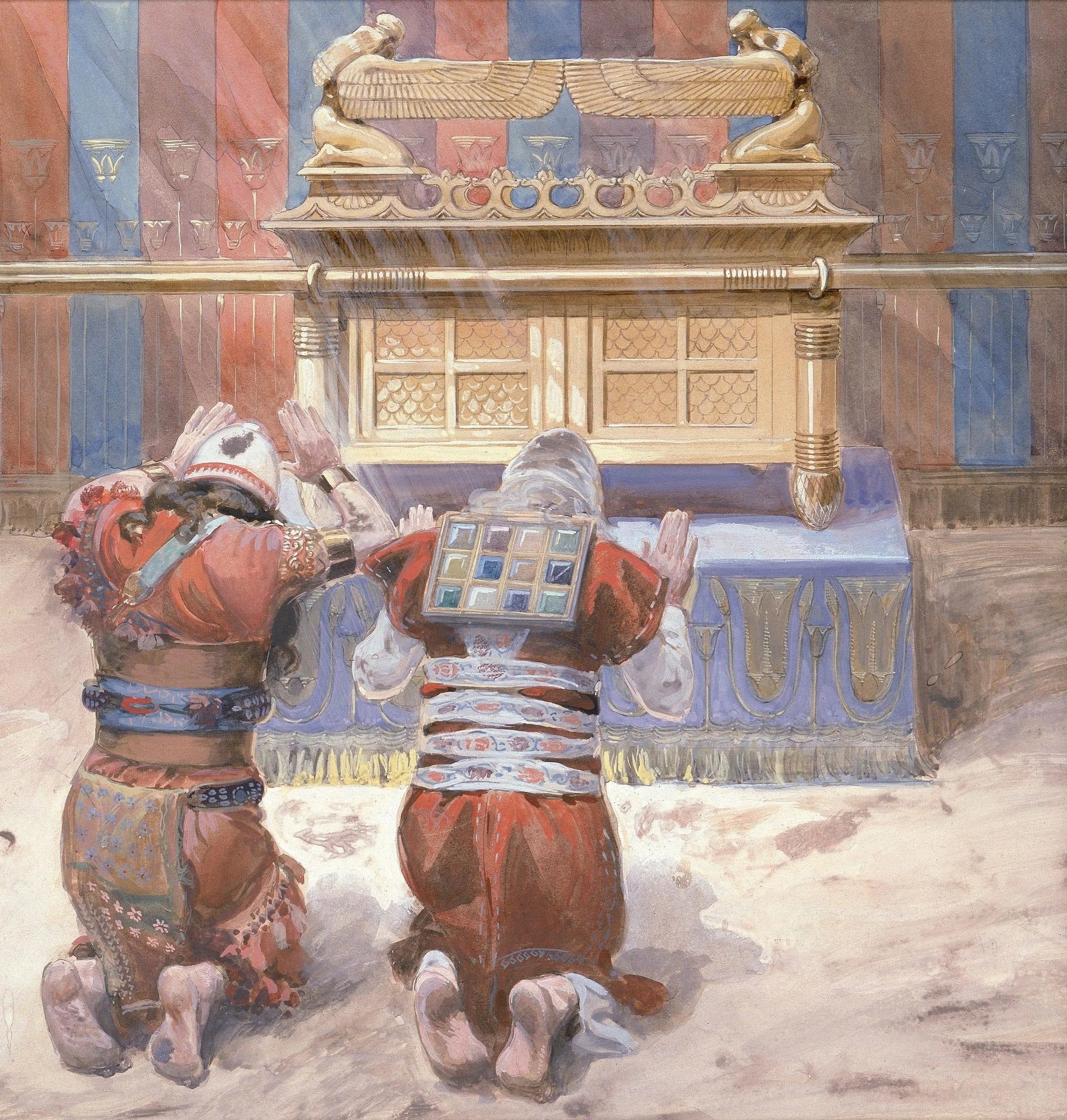
James Tissot and followers, Moses and Joshua in the Tabernacle (c. 1896–1902). The Ark of the Covenant bears the two golden cherubim commanded by God in Exodus 25:18–22—clear biblical evidence that the prohibition of graven images concerned idolatry, not every sacred image.
God therefore cannot be understood as saying, “Never make any sacred representation whatsoever.” He condemns making and treating an image as a god. The same principle appears in Solomon's Temple. The sanctuary contained enormous carved cherubim, together with carved cherubim, palms and other representations covering its walls:
“And he made in the oracle two Cherubs of olive trees, of ten cubits in height. One wing of a cherub of five cubits, and the other wing of a cherub five cubits: that is, having ten cubits, from the end of one wing unto the end of the other wing. Of ten cubits also was the second cherub: in like measure, and the work was one in both cherubs, that is to say, one cherub had the height of ten cubits, and in like manner the second cherub. And he put the cherubs in the midst of the inner temple: and the cherubs extended their wings, and the one wing touched the wall, and the wing of the second cherub touched the other wall: and the other wings in the middle part of the temple touched each other.
He covered also the cherubs with gold. And all the walls of the temple round about he graved with diverse engravings and carving: & he made in them cherubs, and palm trees, and diverse pictures, as it were standing out of the wall, and coming forth. Yea the pavement also of the house he covered with gold within and without. And in the entrance of the oracle he made little doors of the timber of olivetrees, and five corner posts. And two doors of olivetimber: and he graved in them pictures of Cherubs, and figures of Palm trees, and graven works standing out very much; and he covered them with gold: and he covered as well the Cherubs and the palmtrees, and the other things with gold. And he made in the entrance of the temple posts of olivetimber four square: and two doors of fir trees, one against another: and either door was double, & so opened with folding leaves. And he graved Cherubs, and palmtrees, and engravings appearing very much: and he covered all with golden plates in square work by rule.” 3 Kings 6:23–35
These were not pagan intrusions into Israelite worship. They were part of the Temple dedicated to the true God.
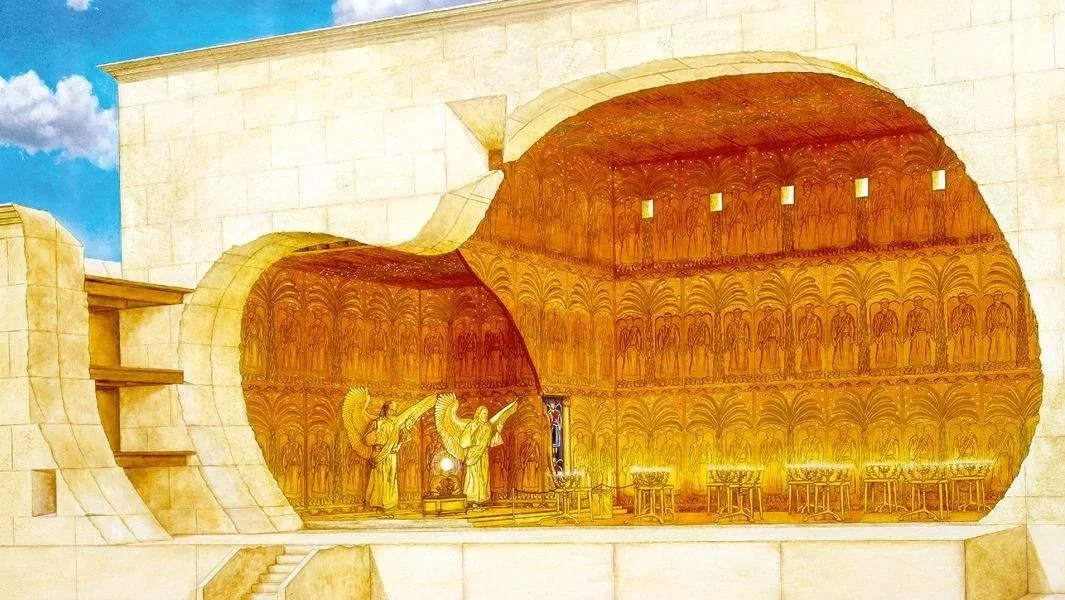
Artistic reconstruction of the interior of Solomon’s Temple. Scripture records that the sanctuary walls and doors were carved with cherubim, palm trees and flowers and overlaid with gold (3 Kings 6:23–35). Sacred imagery therefore formed part of the Temple of the true God and was not, in itself, idolatrous.
The Brazen Serpent: Sacred Image and Prophetic Type of Christ
The clearest biblical example is especially important because it combines the question of images with biblical typology.
When poisonous serpents afflicted Israel, God told Moses:
“Make a brazen serpent, and set it for a sign: he that being strucken looketh on it, shall live. Moyses therefore made A brazen Serpent, and set it for a sign: whom when they that were strucken looked on, they were healed.” Numbers 21:8–9
Moses was commanded to make a brazen serpent, raise it publicly, and instruct the afflicted Israelites to look upon it. God therefore commanded not merely decorative artwork but the construction of a religious image connected with His miraculous intervention. Even more importantly, Christ Himself later identified the event as a prophetic type of His Crucifixion:
“And as Moyses exalted the serpent in the desert, so must the Son of man be exalted: that every one which believeth in him, perish not, but may have life everlasting.” John 3:14–15
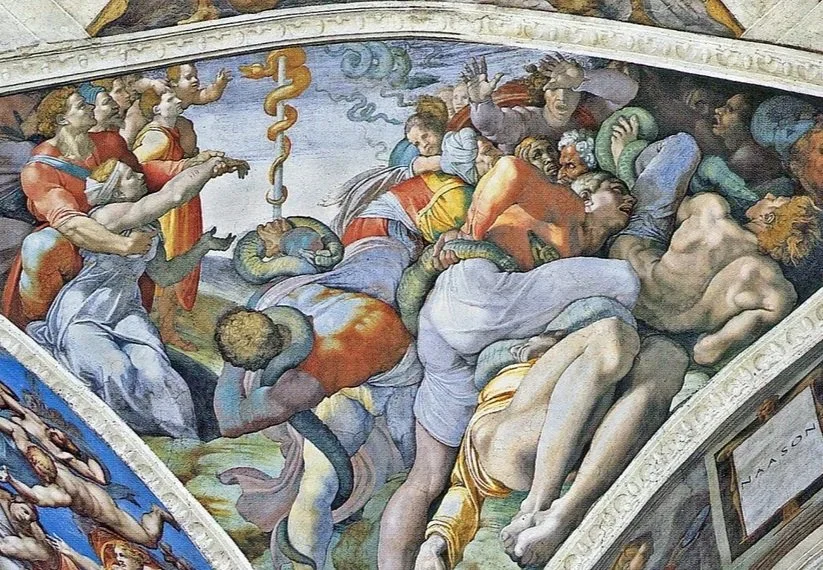
Michelangelo Buonarroti, The Brazen Serpent (1511), Sistine Chapel. The Israelites afflicted by fiery serpents turn toward the brazen serpent raised at God’s command. Christ later identified this event as a figure of His Crucifixion: “As Moses lifted up the serpent in the desert, so must the Son of man be lifted up” (John 3:14).
The progression is profound:
| Type or Shadow | Old Testament Reality | Greater Fulfilment |
|---|---|---|
| Brazen serpent raised before Israel | Those afflicted by the serpent looked upon the sign God had appointed and lived | Christ is lifted upon the Cross so that those who believe in Him receive eternal life |
| A material image used by God's command | The object itself was not a god and possessed no independent power | Created matter may serve God's saving purpose without becoming an idol |
| Serpent later abused | Israel eventually burned incense to it | A legitimate sacred thing becomes sinful when treated superstitiously or idolatrously |
That final point is crucial. Centuries later King Ezechias destroyed the same brazen serpent because the Israelites had begun burning incense to it as an object of false worship (2 Kings 18:4).
This does not prove that sacred images are intrinsically evil. It proves the Catholic distinction. The same object could be legitimately used when directed according to God's will and wickedly abused when treated idolatrously.
The abuse had to be destroyed; the principle of sacred imagery did not.
St Justin Martyr (c. AD 100–165), Dialogue with Trypho, 94, already recognised the brazen serpent as a prophetic sign pointing toward Christ and His Cross. (Douay-Rheims Bible)
The Incarnation Changes the Question of Sacred Representation
The deepest Christian foundation for sacred images is not merely the cherubim or the brazen serpent. It is the Incarnation. Before the Incarnation, God was invisible and had not assumed a bodily form. But:
“The Word was made flesh.” John 1:14
God the Son took a real human body. The Apostles saw His face. They touched Him. His Mother held Him. He ate, walked, suffered, bled and died visibly before men.
This does not mean that God's invisible divine essence can be captured by paint or stone. It means that Jesus Christ can truly be represented according to the visible humanity He actually assumed.
This was central to the defence of sacred images during the iconoclastic controversy.
St John Damascene (c. AD 675–749), First Treatise on the Divine Images, 16, argued that because God has now been seen in the flesh, Christians may depict the incarnate Word. His reasoning was explicitly incarnational rather than idolatrous. (St. Vladimir's Seminary)
The Second Council of Nicaea (AD 787) gave definitive conciliar expression to this distinction. It ordered that sacred images of Christ, the Mother of God, the angels and saints could be displayed in churches, homes and elsewhere, while distinguishing their respectful veneration from the true adoration belonging to the divine nature alone. It also connected sacred imagery to the reality of the Incarnation: Christian images testify that the Word genuinely became man rather than merely seeming to possess a body. (New Advent)
The logic is therefore:
Invisible God → the Word becomes flesh → Christ becomes visible → Christ's visible humanity may be represented → the image directs the mind to the Incarnate Lord
The image is not a rival to the Incarnation. Properly understood, it is a confession of it.
Sacred Images Teach as Well as Adorn
The Council of Trent (1545–1563), Session XXV, explained another reason for sacred images: they help Christians remember the mysteries of redemption and place before the faithful the works of Christ and the examples of the saints. (Catholic Culture)
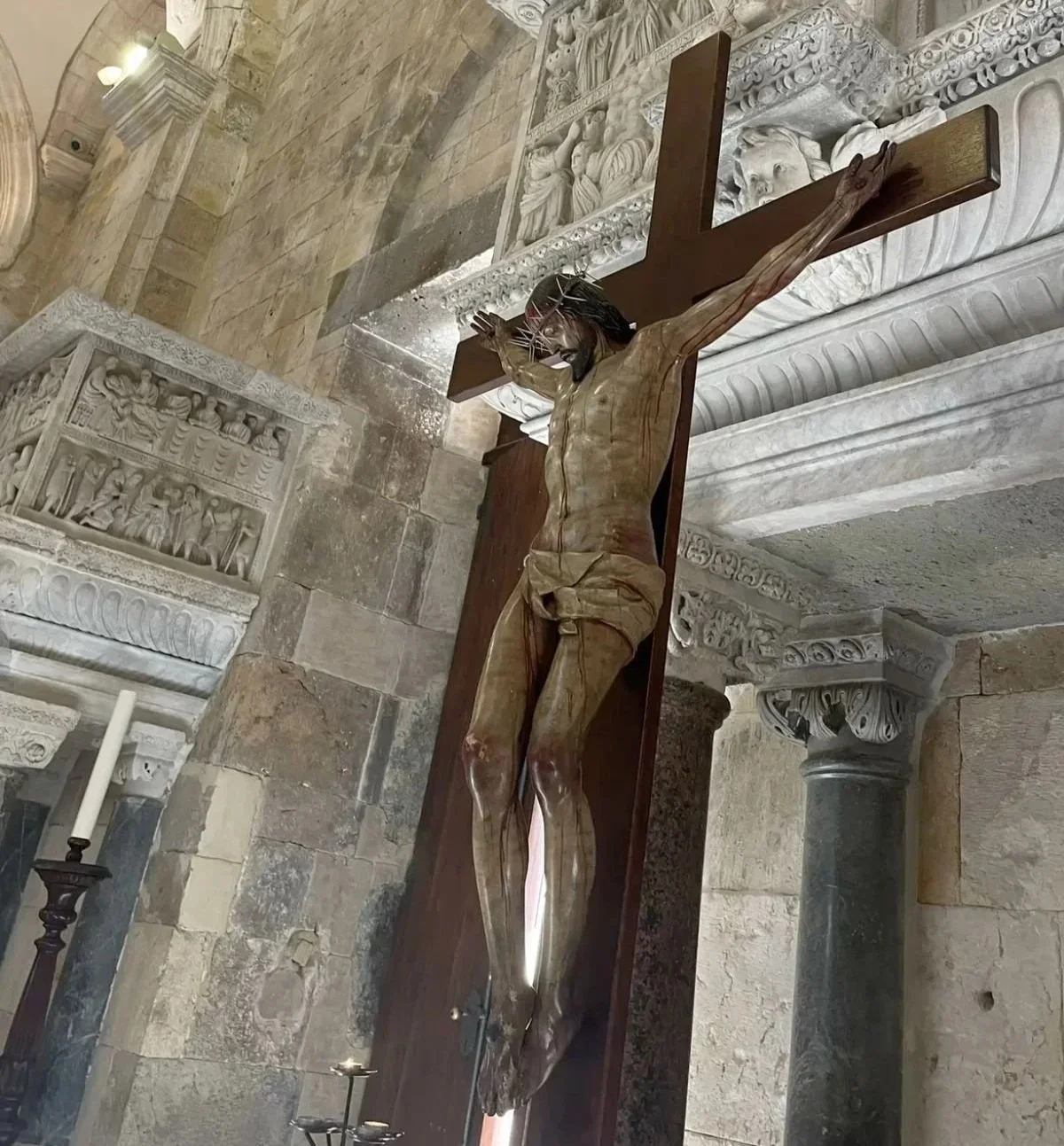
A crucifix does something that an empty wall does not. It visibly proclaims:
Christ crucified for our sins.
A Nativity scene teaches the Incarnation.
An image of the Sacred Heart recalls Christ's burning charity.
An image of a martyr reminds Christians what fidelity to Christ may cost.
Such objects do not replace preaching or Scripture. They help the embodied human person remember, meditate upon and love the realities the Faith teaches.
Biblical Evidence for Relics
The Bones of Eliseus
One of Scripture's most striking passages occurs after the death of the prophet Eliseus:
“Eliseus therefore died, and they buried him. And the rovers of Moab came into the land the same year. And certain persons burying a man, saw the rovers, & threw the body in the sepulchre of Eliseus. Which when it had touched the bones of Eliseus, the man revived & stood upon his feet.” 4 Kings 13:20–21
A dead man was hastily placed in Eliseus' sepulchre. When his body touched the prophet's bones, the man revived. The Roman Catechism later explicitly appealed to this passage when explaining why there is nothing contrary to Christianity in God's working through the relics of His saints. (Sancta Clara Press)
The bones did not possess independent life-giving power. God raised the man. But He chose to do so upon contact with the prophet's remains.
That is precisely the Catholic principle concerning relics.
St Peter's Shadow
In Acts 5:15–16, the sick were carried into the streets so that St Peter's shadow might fall upon them, and Scripture records extraordinary healings associated with the Apostles' ministry.
A shadow is even less substantial than a relic. Yet God was perfectly capable of associating physical proximity to His Apostle with miraculous healing.
Again, the glory belongs not to Peter's shadow but to God.
Cloths That Had Touched St Paul
The New Testament gives an even clearer example:
“And God wrought by the hand of Paul miracles not common: so that there were also brought from his body napkins or handkerchiefs upon the sick, and the diseases departed from them, and the wicked spirits went out.” Acts 19:11–12
Notice the inspired text's wording: “God wrought” the miracles.
Catholic devotion to relics therefore does not mean transferring divine power from God to matter. Scripture itself presents the opposite principle:
God remains the cause; created things may become instruments according to His will.
Biblical Progression: Matter in the Service of Grace
The pattern runs throughout salvation history:
Creation is good → God uses physical signs → the Word becomes flesh → Christ heals through touch and material signs → God works through His Apostles → the Church continues to bless material creation for sacred use
Christianity is therefore neither pagan materialism nor a religion that despises matter. It is the religion of the Incarnation.
The Early Church and Relics
The Martyrdom of St Polycarp
One of the earliest post-apostolic testimonies comes from the Martyrdom of Polycarp, written shortly after the bishop's martyrdom in the mid-second century.
St Polycarp of Smyrna (c. AD 69–155) had been a disciple of St John according to early Christian tradition. After his martyrdom, the Christians of Smyrna gathered his bones, describing them as more precious than jewels, and deposited them in a suitable place where they could gather to commemorate his martyrdom. Martyrdom of Polycarp 18. (New Advent)
This is extremely early evidence. Veneration of a martyr's remains was not a medieval invention arising centuries after Christianity began.
St Augustine
St Augustine of Hippo (AD 354–430), City of God, XXII.8, written in the early fifth century, explicitly records miracles associated with the relics of the martyrs and discusses the relics of St Stephen. He distinguishes these Christian miracles from pagan magical claims by directing the glory to Christ. (Internet History Sourcebooks)
The significance is not that every medieval relic claim must therefore be accepted. It is that the theological principle of venerating relics and believing that God may work through them is demonstrably ancient.
St Thomas Aquinas
St Thomas Aquinas (AD 1225–1274) gives a particularly precise treatment in Summa Theologiae, III, q. 25. In article 3, he distinguishes the material image considered merely as wood or paint from the image considered precisely as representing Christ. Honour does not terminate in the wood. It passes to the one represented.
In article 6, he explains the veneration of saints' relics from their relationship to the saints themselves. The saints' bodies were instruments of their holy lives, temples of the Holy Ghost and are destined for resurrection. Therefore Christians fittingly honour their remains without giving them the divine worship owed to God. (New Advent)
This is the same basic distinction later expressed with great clarity by Trent.
Medals and Other Sacramentals
What Is a Catholic Medal?
A Catholic medal ordinarily bears an image or symbol of Christ, the Blessed Virgin, a saint, a mystery of the Faith, a shrine or some event in Christian history.
Its first purpose is remembrance. A crucifix worn around the neck recalls Christ's Passion. A medal bearing Our Lady recalls her relationship to Christ and invites the wearer to seek her intercession. A medal of a saint recalls the saint's virtues and example.
The Catholic Encyclopedia describes devotional medals as commemorative objects that can recall Christ, saints and mysteries of Faith, encourage piety, and, when properly blessed, form part of Catholic devotional practice. (New Advent)
A medal is therefore not a Christian version of a lucky charm.
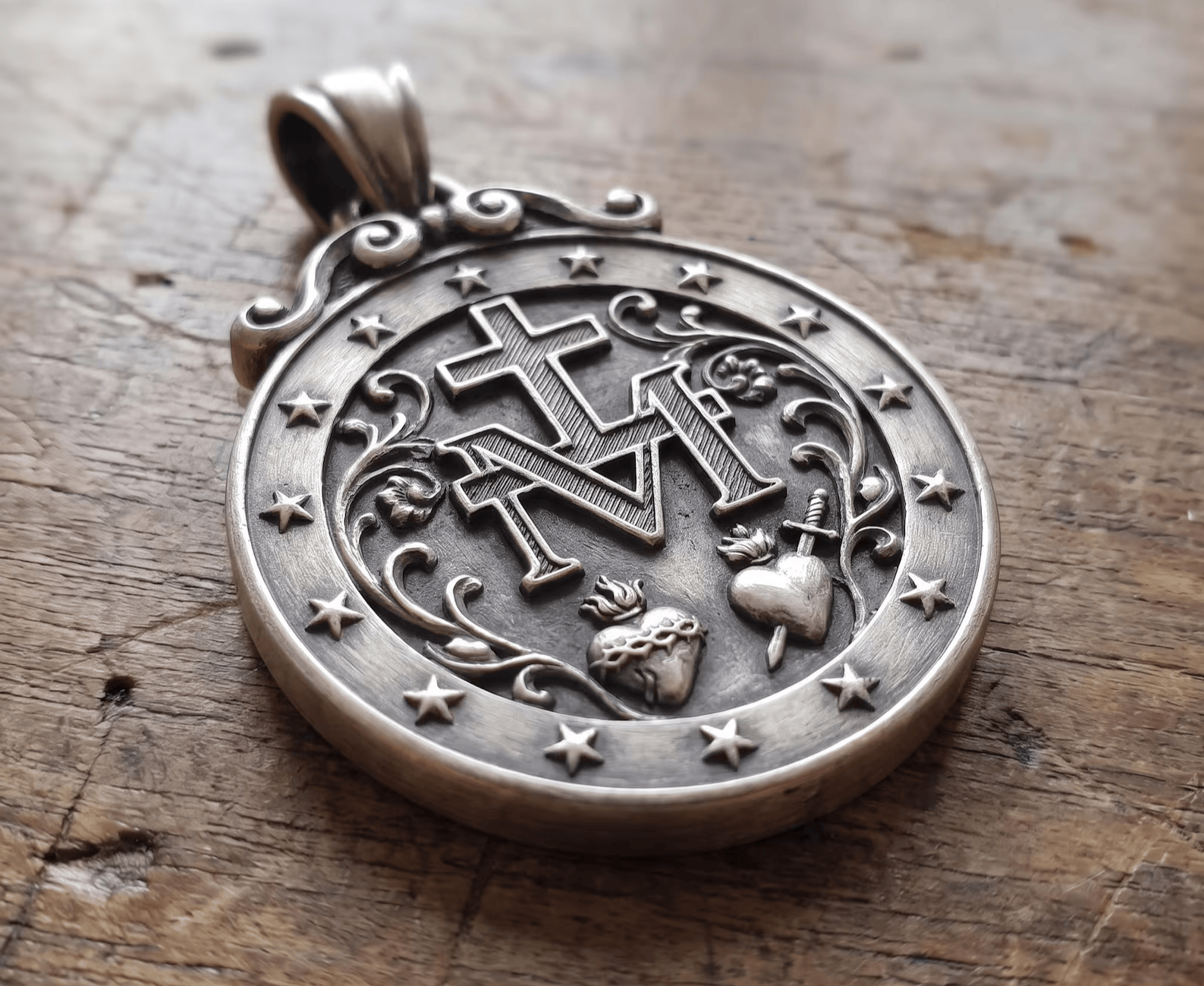
Miraculous Medal
The Sacramentals
The Baltimore Catechism gives familiar examples of sacramentals: blessings, holy water, blessed candles, ashes, palms, crucifixes, medals, rosaries, scapulars and sacred images. It also gives the indispensable warning that sacramentals must be used “with faith and devotion” and never as objects of superstition. That warning should be taken seriously.
A Catholic should not think:
“If I wear this medal, nothing bad can happen to me.”
Rather:
“This blessed object reminds me of God, unites me to the prayers of the Church and encourages me to live in faith, prayer and repentance.”
The distinction is between religion and magic.
Religion petitions God and submits to His will.
Magic attempts to manipulate hidden powers.
Catholic sacramentals belong to the first category, not the second.
The Main Objection
The strongest objection is straightforward:
Exodus explicitly says not to make graven images or bow before them. Catholics nevertheless construct statues, kneel before them, kiss them, burn candles before them and carry them in procession. Whatever Catholics say about their intentions, these actions look exactly like the idolatry Scripture condemns.
The objection deserves a serious response because outward gestures matter. A Catholic cannot simply answer, “I know in my heart that I am not worshipping the statue,” if his understanding and conduct genuinely attribute divine power to it.
Response
The first problem with the objection is that it interprets Exodus in a way that makes Scripture contradict itself. The same God who forbade idols commanded the cherubim above the Ark and later commanded Moses to construct the brazen serpent. Solomon's Temple was filled with sacred carvings. The prohibition therefore cannot concern the mere existence of religious art.
Second, Scripture distinguishes the outward gesture from the interior and objective meaning of the act. Bowing can signify divine worship, but it can also signify honour or reverence. The moral meaning depends upon whom or what is being honoured and with what intention.
Third, the Catholic Church explicitly rejects the very belief the objection attributes to her. Trent states that no divinity or intrinsic supernatural virtue is believed to reside in sacred images. The honour passes to the prototype. (SanctumNomen)
Fourth, Christianity adds something decisive that Old Covenant Israel did not yet possess in its fullness: God has become visible in Christ.
As Nicaea II recognised, Christians depict the incarnate Christ precisely because the Son of God did not merely appear human; He truly assumed flesh. (New Advent)
The Catholic position therefore does not evade the First Commandment. It depends upon it:
God alone is adored. Everything else is honoured only according to its relationship with Him.
Common Objections
“Why Do Catholics Keep Christ on the Cross? He Has Risen.”
Catholics certainly believe that Christ rose bodily from the dead. The crucifix does not imply that Christ is still dead; it depicts the historical Sacrifice by which He redeemed mankind.
St Paul, who preached the Resurrection with great force, nevertheless declared:
“We preach Christ crucified” (1 Corinthians 1:23), and,
“I judged not myself to know anything among you, but Jesus Christ, and him crucified” (1 Corinthians 2:2).
An empty cross is a legitimate Christian symbol, but it does not by itself depict the Resurrection—the Cross was already empty when Christ’s body was placed in the tomb. The more direct images of the Resurrection are the empty tomb and the risen Christ. The crucifix has a different purpose:
it makes visible the love, suffering and self-offering of Christ upon Calvary.
Nor did the Resurrection erase the significance of His wounds. The risen Christ showed St Thomas His hands and side (John 20:27).
In Heaven, St John sees Christ as “a Lamb standing as it were slain” (Apocalypse 5:6): standing, because He lives and has conquered death; as slain, because His victorious Sacrifice remains eternally significant. The crucifix therefore does not oppose the Resurrection. It proclaims the whole Christian mystery:
Christ crucified → Christ risen → the Lamb standing as though slain → Christ reigning forever.
It honours not a defeated Christ, but the victorious Redeemer whose Sacrifice conquered sin and death.
“But Ezechias Destroyed the Brazen Serpent”
Yes—and Catholics should learn from him. The image that God Himself had ordered became an occasion of sin when the Israelites began burning incense to it idolatrously. Ezechias therefore destroyed it. That proves that a good sacred object can be abused.
It does not prove that its original use was sinful. God had commanded that use. Catholic doctrine therefore condemns both extremes: iconoclasm, which treats every sacred image as an idol, and superstition, which treats a sacred object as though it possessed divine power in itself.
“Relics Are Just Bones. Only God Can Heal.”
Catholicism agrees that only God can work a miracle. The issue is whether God may choose to work through created means.
Scripture answers yes: through Eliseus' bones, St Peter's shadow and objects that had touched St Paul. The object is instrumental; God is the cause.
“Medals Are Just Catholic Amulets”
They become amulets only if someone uses them superstitiously. Proper Catholic use is fundamentally different. The medal recalls a mystery of faith or a holy person, bears the blessing and prayer of the Church when blessed, and encourages the Christian to prayer and fidelity.
The Church herself condemns superstition. Trent ordered that superstition surrounding images, relics and devotional practices be removed. (SanctumNomen)
“There Is No Verse Telling Christians to Wear Medals”
There is no claim that Christ personally commanded the wearing of devotional medals. Medals belong to ecclesiastical devotion and discipline, not to the seven divinely instituted sacraments.
Scripture establishes the underlying principles:
God uses material things;
sacred signs are legitimate;
the Church possesses authority to regulate Christian worship;
Christians preserve the memory of holy persons; and
physical things may be blessed and employed in the service of religion.
The later development of particular devotional objects does not require pretending that each one appears explicitly in the New Testament. This question also touches the broader issue treated in Why Isn't the Bible Alone Sufficient as the Rule of Faith?
What We Can and Cannot Conclude
Established Catholic doctrine: Idolatry is gravely wrong; divine adoration belongs to God alone; sacred images of Christ and the saints may legitimately be used and venerated; relics of the saints may legitimately be honoured; and the Church may institute sacramentals.
Established biblical fact: God commanded sacred images in the Old Covenant; Christ identified the brazen serpent as a type of His Crucifixion; Scripture records miraculous events involving Eliseus' bones, St Peter's shadow and material objects that had touched St Paul.
Established historical fact: Christians were preserving and honouring the remains of martyrs by the second century, as the Martyrdom of Polycarp demonstrates. The legitimacy of sacred images was formally defended by the Second Council of Nicaea and reaffirmed by Trent. (New Advent)
What does not follow: The Church's doctrine on relics does not prove that every object claimed to be a relic is authentic. Historical authenticity must be investigated separately.
What also does not follow: Catholic doctrine does not oblige anyone to believe every report of a miracle associated with a relic, medal, statue or shrine. Particular miracle claims require their own evidence.
What Catholic teaching excludes: No statue, relic or medal should be treated as possessing divine power independently of God. No sacramental should become a substitute for conversion, prayer, the sacraments, obedience to God's commandments or confidence in divine Providence.
Conclusion
Catholics use statues, relics, medals and sacramentals because the Catholic Faith takes seriously both creation and the Incarnation.
Scripture does not teach:
matter → evil → therefore avoid religious objects.
It reveals something very different:
God creates matter good → God appoints material signs → the brazen serpent foreshadows Christ raised upon the Cross → the Word becomes flesh → Christ sanctifies material creation by entering it → God works through the physical ministry of His Apostles → the Church continues to place created things at the service of faith and prayer.
The brazen serpent provides an especially illuminating pattern. God commanded it; through it He bestowed healing; Christ revealed that it prefigured His Cross; and when Israel later transformed it into an idol, the object was rightly destroyed. That is the Catholic principle in miniature.
Sacred use is not idolatry. Superstition is not devotion. The object is never God.
A crucifix should lead the Christian to the Crucified Christ. A statue of a saint should lead him to imitate the saint's fidelity to Christ. A relic should remind him that the Christian body is destined for resurrection. A blessed medal should remind him to pray and live according to the Faith it represents.
Everything ultimately terminates in God. The sincere Christian should therefore neither despise matter nor worship it, but use created things according to their proper place—so that what is visible may help raise the mind and heart toward the invisible God who, for our salvation, became visible in Jesus Christ.
Primary Sources
Sacred Scripture
Exodus 20 — prohibition of idolatry.
Exodus 25 — God commands the cherubim for the Ark.
Numbers 21 — the brazen serpent.
3 Kings 6 — sacred imagery in Solomon's Temple.
4 Kings 13:20–21 — the dead man restored to life upon contact with Eliseus' bones.
John 1 — “the Word was made flesh.”
John 3 — Christ identifies the brazen serpent as a type of His Crucifixion.
Acts 5:15–16 — St Peter's shadow.
Acts 19:11–12 — cloths associated with St Paul's miraculous ministry.
The Martyrdom of Polycarp 18 — early Christian preservation of a martyr's relics.
St Augustine City of God XXII.8 — miracles and relics of the saints.
Second Council of Nicaea AD 787 — doctrinal decree concerning sacred images.
St John Damascene On the Divine Images — the Incarnation and sacred imagery.
St Thomas Aquinas Summa Theologiae III q.25 — sacred images, the Cross and relics.
Council of Trent Session XXV — invocation of saints, relics and sacred images.
Roman Catechism First Commandment — saints and relics.
1917 Code of Canon Law cc. 1144–1153 — sacramentals.
Catechism of St Pius X — idolatry, images and relics.
Further Reading
Baltimore Catechism — The Sacramentals — concise traditional explanation of sacramentals, their benefits and the need to avoid superstition.
Catholic Encyclopedia — Sacramentals — pre–Vatican II theological treatment of their nature and efficacy.
Catholic Encyclopedia — Devotional Medals — historical and theological treatment of medals.
Catholic Encyclopedia — Blessing — traditional blessings of crosses, images, medals, rosaries and other devotional objects.
Related Questions
Why Do Catholics Pray to the Saints?
Why Do Catholics Honour the Blessed Virgin Mary?
What Are the Seven Sacraments?
Why Isn't the Bible Alone Sufficient as the Rule of Faith?
What Are Sacred Scripture and Sacred Tradition?
How Is the Mass Connected to the Worship of Heaven?