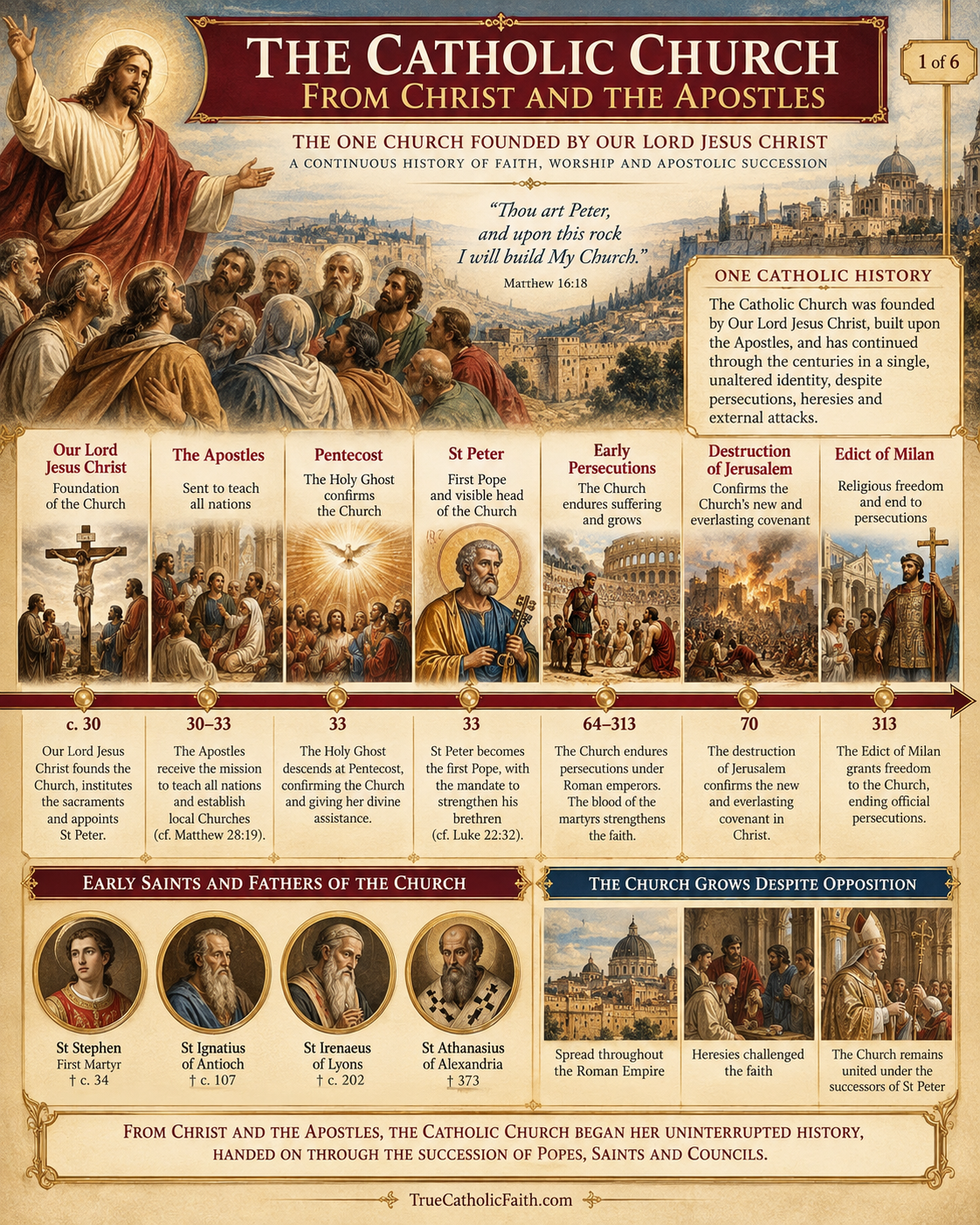
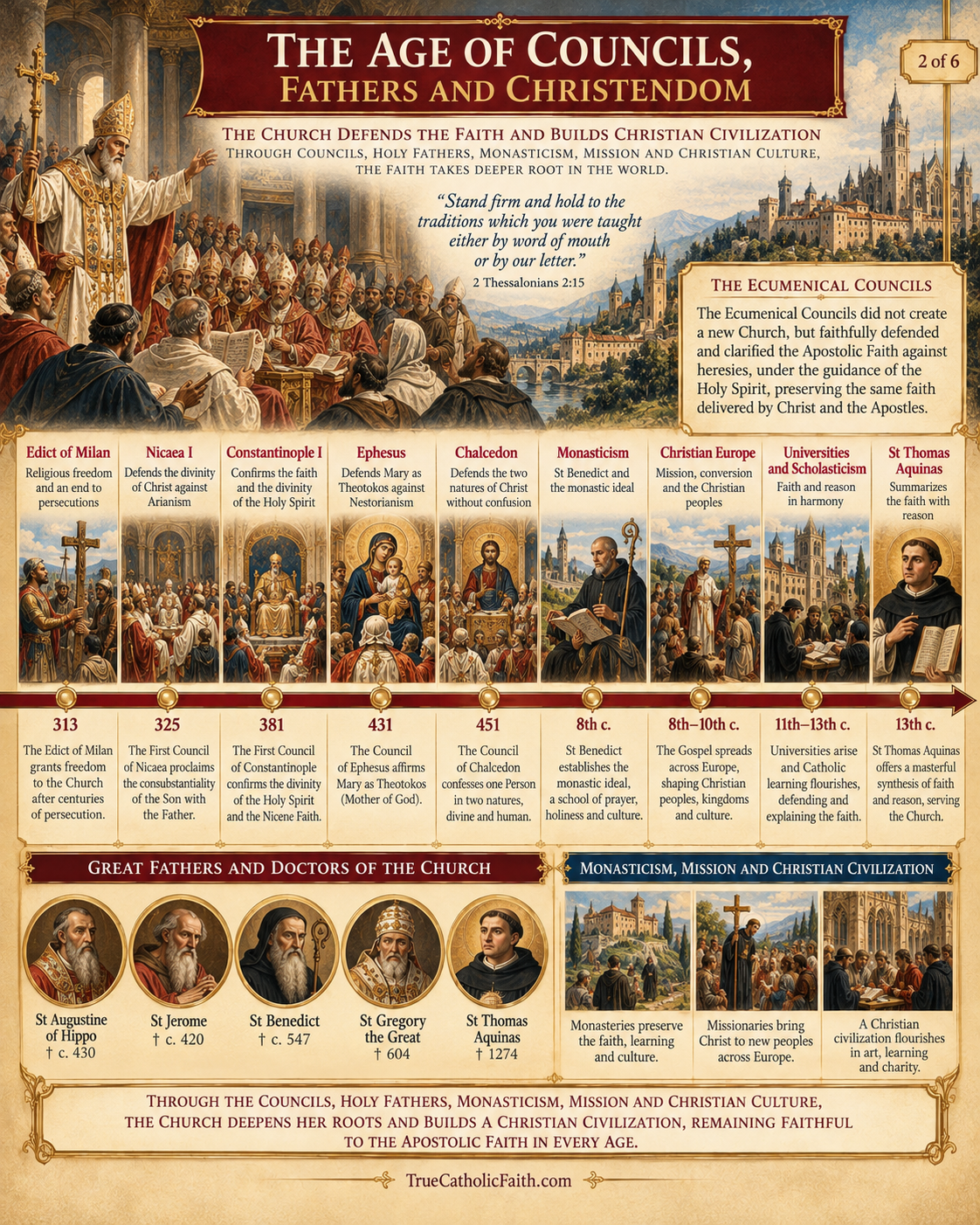
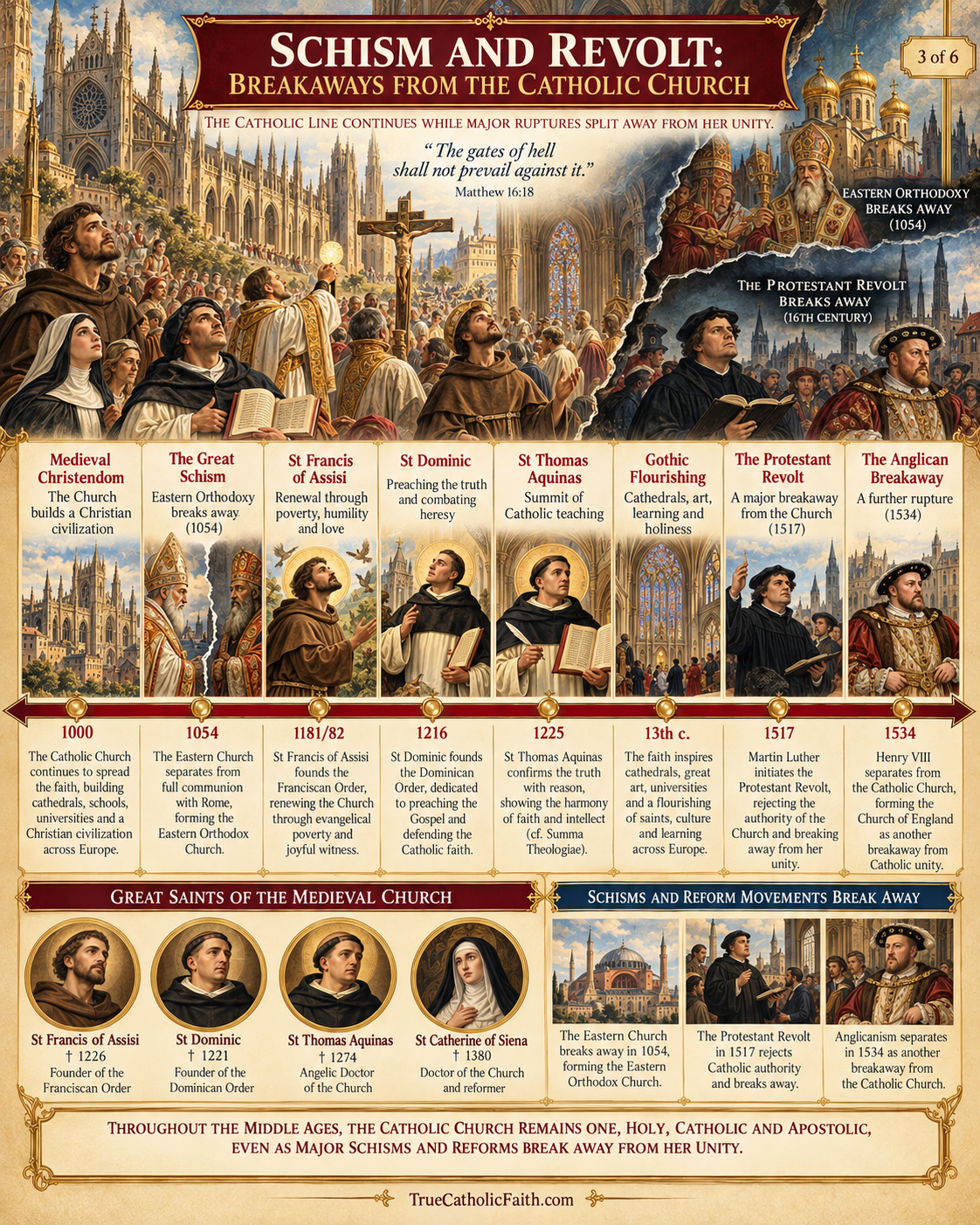
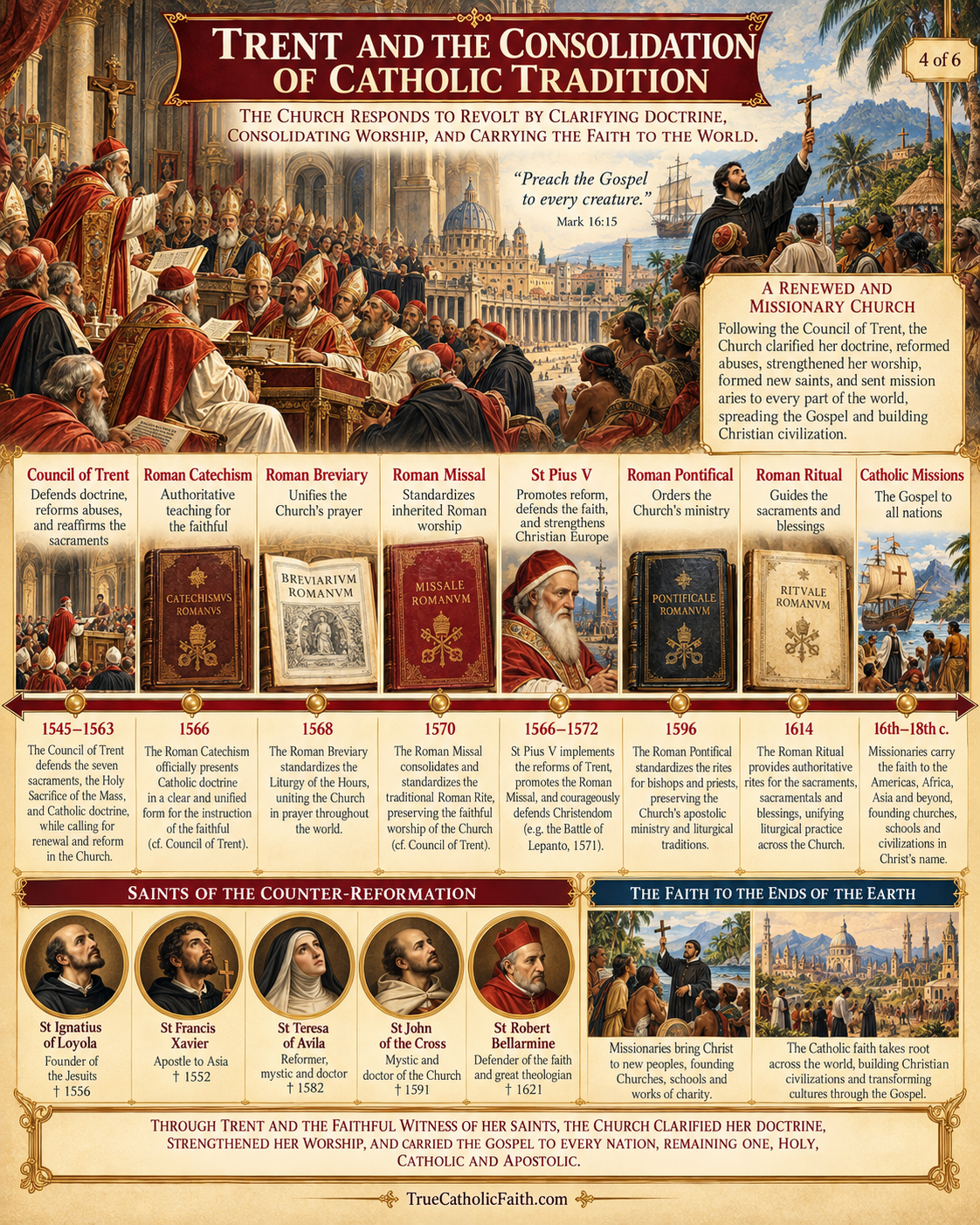
For nearly two thousand years, the Catholic Church preserved the faith entrusted to her by Jesus Christ. Her councils defended revealed doctrine, her sacraments communicated divine grace, and her liturgical traditions developed through centuries of Catholic worship.
Why, then, did the Vatican II–Novus Ordo establishment introduce sweeping alterations to sacramental rites, public worship, religious teaching, ecclesiastical law and traditional Catholic practices within a single generation—while continuing to claim Catholic identity and authority?
The answer involves more than a change in religious ceremonies. It concerns the deliberate introduction of an interconnected programme affecting the principal means by which a religion preserves, practises and transmits its beliefs.
Short Answer
The Catholic Church did not become the Vatican II–Novus Ordo religion. The postconciliar establishment departed from the Catholic faith while continuing to claim Catholic identity and authority.
This is the sedevacantist theological conclusion already developed in the preceding articles of this FAQ series. The present article proceeds from that conclusion and examines the extraordinary speed, extent and organisation of the subsequent religious transformation.
The historical contrast is remarkable. For centuries, the Catholic Church's ecumenical councils
clarified doctrine,
condemned heresies,
addressed schisms and
regulated ecclesiastical discipline.
The seven sacraments instituted by Jesus Christ were explained and solemnly defended, particularly by the Councils of Florence and Trent.
Their Roman rites developed and were progressively codified over centuries.
Then, following the Vatican II assembly of 1962–1965, a comprehensive programme of religious alteration was introduced under the claimed authority of men whom the established sedevacantist conclusion does not recognise as legitimate Roman Pontiffs.
Between 1968 and 1973—approximately five years—the Vatican II–Novus Ordo establishment introduced revised Roman rites associated with all seven sacraments.
These alterations were not merely translations or changes to external ceremonies. Certain changes affected sacramental formulas, ordination prayers and ritual expressions of fundamental Catholic doctrines.
The programme extended far beyond the sacraments. It affected
the Roman Mass,
Divine Office,
liturgical calendar,
ecclesiastical governance,
religious liberty,
ecumenism,
relations with non-Christian religions,
penitential discipline,
canon law and catechetical instruction.
A replacement Latin Code of Canon Law followed in 1983 and a new universal Catechism in 1992. The postconciliar authorities explicitly connected these developments with Vatican II. The changes were neither wholly accidental nor simply the result of unauthorised experimentation by local clergy.
The postconciliar leadership established specialised commissions, prepared replacement liturgical books, directed their implementation and required acceptance of the new arrangements.
Most strikingly, the establishment responsible did not generally announce that it was founding a separate religion. Its leaders continued claiming the Roman Pontificate and other Catholic ecclesiastical offices. It retained the Catholic name and effective control over many historic churches, dioceses, seminaries and religious institutions.
Consequently, many adherents sincerely believed they were continuing to practise the Catholic religion, even as the religious system presented to them underwent extensive alterations.
Meanwhile, Catholics preserving the traditional faith frequently had to seek independent chapels, rented premises, private homes and other places in which to worship.
Within the established sedevacantist conclusion, these Catholics did not found another Church by rejecting the postconciliar innovations. They continued professing the inherited Catholic faith.
The Catholic Church herself continued to exist, preserving her divine constitution, Apostolic doctrine and essential sacramental principles, notwithstanding the vacancy of the Roman See.
The purpose of this article is therefore not to reopen the religious-identity question already examined in the preceding FAQ articles.
It is to establish how the postconciliar transformation occurred, why its promoters considered extensive alterations necessary, how those changes were organised and enforced, and what their cumulative consequences reveal about the distinct religious system that developed.
1. The Catholic Church Cannot Become a Different Religion
Before examining the historical changes, it is necessary to establish what Catholic teaching permits—and what it excludes.
Jesus Christ founded one Church and entrusted her with the revelation delivered to His Apostles. Before His Ascension, He commanded:
"Going therefore, teach ye all nations; baptizing them in the name of the Father, and of the Son, and of the Holy Ghost." — St Matthew 28:19
He instructed the Apostles
to teach what He had commanded,
not to construct a new religion according to the changing preferences of succeeding generations.
St Paul likewise warned against accepting another Gospel, even if apparently presented by someone of extraordinary authority:
"But though we, or an angel from heaven, preach a gospel to you besides that which we have preached to you, let him be anathema." — Galatians 1:8
The Apostle instructed St Timothy to guard the deposit entrusted to him (1 Timothy 6:20; 2 Timothy 1:13–14).
These passages establish an essential principle: divine revelation is received and preserved, not replaced.
The Catholic Church possesses legitimate authority to explain revealed truths more fully, condemn new errors, regulate ecclesiastical discipline and determine the human elements of sacred worship.
She does not possess authority to reverse divine revelation or alter the substance of sacraments instituted by Jesus Christ.
Genuine doctrinal development does not produce a contradictory religion
St Vincent of Lérins (c. 390–450), writing in his Commonitorium around AD 434, distinguished authentic development from alteration of the faith. In chapter 23, he explained that Christian doctrine may grow in understanding and expression while retaining its essential identity and meaning.
The First Vatican Council reaffirmed this principle in Dei Filius, chapter 4 (24 April 1870). Dogma is not a provisional human theory that may eventually acquire a contradictory meaning.
The Council's constitution Pastor Aeternus, chapter 4 (18 July 1870), likewise explained that the Holy Ghost was promised to the successors of St Peter so that they might faithfully preserve and expound Apostolic revelation—not disclose a fundamentally different doctrine.
This principle extends to the sacraments.
Pope Pius XII, in Mediator Dei (20 November 1947), distinguished the unchangeable divine elements of worship from human liturgical arrangements that competent ecclesiastical authority may legitimately regulate. He expressed the sacramental principle even more explicitly in Sacramentum Ordinis (30 November 1947). The Church, he taught, has never substituted other sacraments for those instituted by Christ, nor does she possess authority to change their substance.
This does not prohibit every alteration of ceremonial detail. The Roman liturgy developed across centuries, and legitimate Roman Pontiffs introduced revisions. The Church also recognised legitimate Eastern liturgical traditions whose ceremonies differed from those of Rome.
The restriction concerns the preservation of revealed doctrine and the divinely instituted substance of the sacraments.
Claimed authority is not necessarily legitimate Catholic authority
An individual does not acquire the authority of the Roman Pontiff merely by claiming to occupy the Roman See. Nor does widespread recognition, possession of ecclesiastical buildings or practical control over diocesan institutions independently establish legitimate spiritual jurisdiction.
The preceding articles in this FAQ series have examined papal authority, public heresy, membership of the Church, indefectibility and the post-1958 papal claims. They have reached the sedevacantist theological conclusion that the men claiming the Roman Pontificate after Pius XII were not legitimate Roman Pontiffs.
The present article proceeds from that conclusion. The postconciliar claimants exercised considerable practical power over institutions recognising their authority. Their instructions were implemented, replacement liturgical books were distributed, and new regulations were enforced.
But effective institutional control is not identical with legitimate Catholic ecclesiastical authority.
Consequently, when this article describes changes introduced by the Vatican II–Novus Ordo establishment, it does not mean that the Catholic Church herself lawfully adopted them. It means that the changes were introduced within institutions operating under the authority claimed by the postconciliar leadership.
This distinction governs everything that follows.
2. Two Thousand Years of Councils: Defending the Faith Rather Than Replacing It
The historical perspective becomes clearer when Vatican II is considered against the long history of the Church's councils. From Apostolic times, the Church confronted disputes concerning doctrine, worship and ecclesiastical discipline.
The Council of Jerusalem, recorded in Acts 15 and commonly dated around AD 49–50, addressed whether Gentile converts were required to observe particular provisions of the Mosaic Law. It demonstrated the Apostolic Church's authority to resolve religious controversies.
Approximately 275 years later, in AD 325, the First Council of Nicaea assembled to confront Arianism and defend the true divinity of Jesus Christ. Nicaea was the first of the twenty ecumenical councils recognised by the Catholic Church before Vatican II.
The twenty ecumenical councils before Vatican II
The following table identifies each council by its opening year, the interval since the previous council and its principal purpose or result.
| Council | Year | Interval | Principal Purpose or Result |
|---|---|---|---|
| 1. Nicaea I | 325 | First | Condemned Arianism and defended Christ's true divinity. |
| 2. Constantinople I | 381 | 56 years | Defended the divinity of the Holy Ghost and opposed Macedonian errors. |
| 3. Ephesus | 431 | 50 years | Condemned Nestorianism and affirmed the Blessed Virgin Mary as Mother of God. |
| 4. Chalcedon | 451 | 20 years | Defined Christ as one divine Person in two natures. |
| 5. Constantinople II | 553 | 102 years | Addressed the Three Chapters controversy and reaffirmed Christological doctrine. |
| 6. Constantinople III | 680 | 127 years | Condemned Monothelitism and defended Christ's two wills. |
| 7. Nicaea II | 787 | 107 years | Defended the legitimate veneration of sacred images. |
| 8. Constantinople IV | 869 | 82 years | Addressed the Photian controversy and ecclesiastical authority. |
| 9. Lateran I | 1123 | 254 years | Addressed the Investiture Controversy and ecclesiastical independence. |
| 10. Lateran II | 1139 | 16 years | Addressed schism and ecclesiastical discipline. |
| 11. Lateran III | 1179 | 40 years | Regulated papal elections and addressed schism and abuses. |
| 12. Lateran IV | 1215 | 36 years | Defended Catholic doctrine and established important disciplinary regulations. |
| 13. Lyons I | 1245 | 30 years | Addressed Emperor Frederick II and wider ecclesiastical questions. |
| 14. Lyons II | 1274 | 29 years | Addressed reunion with Eastern Christians, papal elections and a profession of faith. |
| 15. Vienne | 1311 | 37 years | Addressed the Knights Templar and ecclesiastical and doctrinal concerns. |
| 16. Constance | 1414 | 103 years | Helped end the Western Schism and addressed doctrinal controversies. |
| 17. Basel–Ferrara–Florence | 1431 | 17 years | Addressed ecclesiastical unity and issued important doctrinal decrees, particularly at Florence. |
| 18. Lateran V | 1512 | 81 years | Addressed ecclesiastical discipline, governance and theological questions. |
| 19. Trent | 1545 | 33 years | Defended Catholic doctrine against Protestant errors and corrected disciplinary abuses. |
| 20. Vatican I | 1869 | 324 years | Addressed faith, reason, revelation, papal primacy and infallibility. |
Intervals are calculated between opening years. The recognition and authority of particular proceedings at Constance and Basel require historical qualifications; not every decree issued during those complex assemblies possessed the same authority.
The intervals were not regular. Some councils followed one another within a few decades; others were separated by centuries. Nor was every council convened exclusively to condemn heresy. Councils also addressed governance, discipline, schism and reconciliation. Nevertheless, their doctrinal work reveals a recurring principle.
When fundamental Catholic truths were challenged, the Church defended the faith she had received.
Nicaea defended Christ's divinity. Ephesus defended the unity of His Person. Chalcedon defined His two natures. Nicaea II defended sacred images against iconoclasm. The councils did not create new divine truths. They clarified and defended the Apostolic faith.
Trent: the most revealing historical comparison
The Council of Trent met between 1545 and 1563 in response to the Protestant Reformation and the grave doctrinal and disciplinary challenges of that period. Protestant reformers disputed Catholic teaching concerning justification, the Mass, the priesthood, sacramental grace and the number and nature of the sacraments. Trent responded by solemnly defending the inherited Catholic faith.
In Session VII (3 March 1547), it reaffirmed that the seven sacraments of the New Law were instituted by Jesus Christ.
In Session XXII (17 September 1562), it defended the Mass as a true and propitiatory sacrifice.
A propitiatory sacrifice is one offered in relation to the forgiveness of sins and reconciliation with God. The Mass makes present sacramentally the one sacrifice of Christ; it is not merely a commemorative religious meal. Trent also addressed clerical abuses, improved ecclesiastical discipline and required the establishment of seminaries. It therefore distinguished immutable doctrine from human disciplinary arrangements. But Trent did not treat Protestant objections as justification for replacing Catholic sacramental doctrine with a different understanding of priesthood, sacrifice or salvation.
It answered religious error by reaffirming the faith entrusted to the Church.
Vatican I: the purpose and limits of papal authority
The First Vatican Council opened in 1869 and was suspended in 1870 amid the political and military events affecting Rome. Its constitution Dei Filius addressed faith, reason and revelation. Pastor Aeternus reaffirmed papal primacy and defined the conditions under which a legitimate Roman Pontiff exercises infallibility.
The purpose of this authority was the faithful preservation and explanation of Apostolic revelation. The legitimate Roman Pontiff is the guardian of the deposit of faith, not its owner. He cannot lawfully establish a contradictory religion.
Vatican II: an assembly claiming Catholic authority
Ninety-two years after Vatican I's suspension, the Vatican II assembly opened on 11 October 1962 under Angelo Giuseppe Roncalli, the papal claimant who styled himself John XXIII. Giovanni Battista Montini, who subsequently claimed the Roman Pontificate as Paul VI, directed the assembly to its conclusion on 8 December 1965.
The Vatican II–Novus Ordo establishment presents this assembly as the twenty-first ecumenical council.
Within the sedevacantist conclusion already established in this series, however, Roncalli and Montini lacked legitimate papal authority.
Vatican II is consequently not accepted as an authoritative ecumenical council of the Catholic Church.
Historically, its promoters identified contemporary challenges, including secularisation, religious division and difficulties in communicating Christian teaching. They argued that pastoral adaptation, renewed engagement with the modern world and changes to religious practice would strengthen religious life.
These stated intentions must be acknowledged accurately. The decisive issue is what the assembly taught and what was subsequently implemented under its claimed authority. Unlike Trent, which defended the seven sacraments against doctrinal attacks, Vatican II was followed by the introduction of revised Roman rites associated with every sacrament. The programme extended into ecclesiology, religious liberty, ecumenism, governance, worship and ecclesiastical discipline.
The significance is not simply that Vatican II occurred relatively soon after Vatican I. Earlier Catholic councils had also followed one another within short intervals.
It is the extraordinary breadth and rapid implementation of the postconciliar programme under a claim to Catholic authority that the established sedevacantist conclusion rejects.
3. The Seven Sacraments: Instituted by Christ, Defined Over Centuries and Preserved in the Roman Tradition
The sacramental history provides one of the clearest contrasts. Three distinct matters must be understood: the divine institution of the sacraments, the historical clarification of their doctrine, and the development and codification of their particular liturgical rites. These are not the same events.
The sacraments originated with Jesus Christ
The Council of Trent solemnly affirmed that all seven sacraments of the New Law were instituted by Christ.
They were not invented by medieval theologians or introduced by ecclesiastical administrators.
The New Testament contains the foundations of Catholic sacramental life.
Christ commanded Baptism in St Matthew 28:19. He instituted the Eucharist at the Last Supper (St Luke 22:19–20). He gave the Apostles the authority to forgive and retain sins (St John 20:22–23).
Acts 8:14–17 describes the conferral of the Holy Ghost through Apostolic ministry, while St James 5:14–15 describes anointing and prayer for the sick.
Other passages illuminate Holy Orders and Christian Matrimony.
The Catholic Church's understanding of these sacraments developed through Scripture, Apostolic Tradition, the Fathers, councils and theological explanation.
St Thomas Aquinas (1225–1274), in the Summa Theologiae, III, question 65, explained the seven sacraments as an ordered system of supernatural life.
The Church's increasing precision did not mean that she had invented new sacraments.
Centuries of sacramental doctrine and Roman liturgical codification
| Date | Historical Milestone | Significance |
|---|---|---|
| Apostolic age | Christ's institution of the sacraments | Divine origin of Catholic sacramental life. |
| Early centuries | Development of Christian sacramental rites | Eastern and Western liturgical traditions take shape. |
| 12th century | Scholastic sacramental synthesis | Increasingly systematic explanation of the seven sacraments. |
| 1274 | Second Council of Lyons | A profession of faith explicitly enumerates the seven sacraments. |
| 1439 | Council of Florence | Exultate Deo, the Decree for the Armenians, explains sacramental doctrine. |
| 1547 | Council of Trent | Session VII solemnly affirms the seven sacraments instituted by Christ. |
| 1566 | Roman Catechism | Authoritative explanation of Catholic doctrine for parish clergy. |
| 1568 | Roman Breviary | Standardised edition of the Roman Divine Office. |
| 1570 | Roman Missal | Standardised the inherited Roman Mass while preserving recognised ancient usages. |
| 1596 | Roman Pontifical | Authoritative Roman edition regulating major episcopal liturgical functions. |
| 1614 | Roman Ritual | Official Roman book for many sacraments and ceremonies administered by priests. |
| 1917 | Code of Canon Law | Consolidated Latin ecclesiastical legislation and sacramental discipline. |
| 1947 | Sacramentum Ordinis | Pius XII clarified the essential matter and form of Holy Orders in the Latin rites. |
These milestones do not imply that every prayer and ceremony remained literally unchanged. Legitimate Roman Pontiffs introduced revisions throughout the centuries.
St Pius X reorganised the Roman Breviary's psalter in 1911. Pius XII revised the Holy Week ceremonies during the 1950s.
The Catholic Church also recognised legitimate Eastern liturgical traditions whose ceremonies differed from the Roman rite. Nevertheless, the inherited Roman liturgical books maintained recognisable continuity through successive editions over centuries.
The Missal of 1570 preceded the new Roman Missal introduced in 1969 by 399 years.
The standardised Roman Pontifical of 1596 preceded the replacement ordination rites of 1968 by 372 years.
The Roman Ritual of 1614 preceded the principal postconciliar ritual alterations by more than three and a half centuries.
Then, within approximately five years, the postconciliar establishment introduced revised Roman rites associated with all seven sacraments.
The contrast is not between an entirely unchanging Catholic ceremonial system and one that suddenly changed.
It is between centuries of inherited liturgical development and an unusually concentrated programme of comprehensive ritual replacement.
That difference deserves careful examination.
4. The Five-Year Concentration of Sacramental Alterations, 1968–1973
The postconciliar authorities did not merely authorise translations of inherited Latin prayers. They introduced new or substantially revised Roman liturgical books. The chronology is revealing.
| Sacrament | Date | Principal Postconciliar Alteration |
|---|---|---|
| Holy Orders | 1968 | Replacement rites for bishops, priests and deacons, including a new episcopal consecratory prayer. |
| Matrimony | 1969 | Revised Roman Marriage rite. |
| Holy Eucharist | 1969–1970 | New Roman Order of Mass and Missal. |
| Baptism | 1969; 1972 | Revised infant Baptism rite and new adult Christian initiation rite. |
| Confirmation | 1971 | Replacement Roman Confirmation formula and rite. |
| Extreme Unction | 1972 | New Anointing of the Sick rite, including alterations to the formula, anointings and permitted oils. |
| Penance | 1973 | Revised Roman rite of Penance. |
These dates identify the principal promulgations and liturgical books. Local introduction and translation sometimes occurred later.
This was a comprehensive programme affecting the Roman ritual arrangements associated with every sacrament. Yet the changes did not all have the same sacramental significance.
Altering a surrounding ceremony is not necessarily equivalent to changing the essential sacramental form. Nor does the absence of legitimate legislative authority automatically establish the invalidity of every sacrament administered using a new rite.
Catholic sacramental theology examines the required minister, matter, form, intention and, where relevant, jurisdiction or canonical form. Nevertheless, several alterations concerned precisely the prayers and ritual actions whose significance sacramental theology requires us to examine most carefully.
Holy Orders: the consequences of the 1968 replacement rite
On 18 June 1968, Montini issued Pontificalis Romani, introducing replacement rites for episcopal consecration and priestly and diaconal ordination within the postconciliar establishment. The most consequential alteration concerned the episcopal consecratory prayer.
In 1947, Pius XII had identified the essential matter and form of Holy Orders for the traditional Latin rites. He required the sacramental form to signify univocally the power of the particular Order being conferred and the grace of the Holy Ghost.
The inherited episcopal formula included the petition Comple in Sacerdote tuo ministerii tui summam, referring to the fullness of the sacred ministry.
The 1968 replacement form instead employed the expression Spiritus principalis, commonly rendered as the governing or principal Spirit.
The earlier FAQ examinations of Holy Orders address this alteration, including the distinction between sacramental Order and ecclesiastical governance, the appeal to ancient liturgical material and the role of the surrounding consecratory prayer.
The theological position adopted in this series is that the 1968 replacement episcopal consecration rite is invalid.
Earlier examinations identified, at minimum, a serious positive doubt concerning its validity and presented arguments for the stronger conclusion of invalidity. This is a contested sacramental assessment, not a solemn definition of the Catholic Church. It is also distinct from the conclusion that Montini lacked legitimate papal authority.
The consequences of an invalid episcopal consecration are profound.
A man who has not received valid episcopal consecration
does not possess the sacramental character and power of a bishop, regardless of his vestments, title, appointment or recognition by the postconciliar establishment.
He cannot validly ordain priests or consecrate other bishops.
Where a purported episcopal succession depends entirely upon invalid consecrations, the defect extends to subsequent purported episcopal consecrations and priestly ordinations dependent upon that lineage. This has direct consequences for the sacraments requiring valid priestly Orders.
The Holy Eucharist requires a validly ordained priest for Eucharistic consecration. Penance and Extreme Unction likewise require valid priestly Orders. Penance additionally requires the jurisdiction or faculty necessary for valid absolution.
Confirmation ordinarily requires a valid bishop, although a validly ordained priest can administer it under the applicable conditions and faculties.
A defect in episcopal succession may therefore affect sacramental ministry across subsequent generations.
The important precedent of the Anglican Ordinal
The concern is not without precedent in pre-Vatican II Catholic teaching.
In Apostolicae Curae (13 September 1896), Leo XIII examined Anglican ordination rites and declared Anglican Orders null and void. His judgment concerned defects of sacramental form and intention and the significance of alterations to the Anglican Ordinal. He did not treat continued possession of episcopal titles, religious buildings or ceremonial vestments as proof of valid Orders.
The analogy is important because it demonstrates that changes to ordination rites may have consequences reaching far beyond external ceremony. Nevertheless, Leo XIII's decision concerned the Anglican Ordinal. It did not formally adjudicate the separate rite introduced in 1968.
The latter requires its own sacramental analysis. An important qualification also remains. Not every priest or bishop active after 1968 necessarily derives his Orders from the replacement rite. Clergy validly ordained or consecrated through independently valid lineages retain their sacramental character.
Likewise, the revised priestly ordination form presents a distinct question from the new episcopal form; it continues to contain explicit references to the dignity of the priesthood.
The proponents of the 1968 episcopal rite also appeal to ancient Eastern and other liturgical material in defending its validity. Those arguments must be considered on their actual merits, rather than dismissed solely because a formula was changed. These distinctions prevent a justified concern about the transmission of Holy Orders from becoming an unsupported assertion about every individual clergyman.
The central historical fact is that the postconciliar establishment replaced a long-established, certainly valid Roman ordination rite with a substantially altered ritual whose sacramental validity became the subject of serious theological controversy.
For the detailed case adopted by this series, see the earlier discussion of the 1968 episcopal rite and Fr Anthony Cekada's study, Absolutely Null and Utterly Void.
The Holy Eucharist: replacing the inherited Roman Mass
On 3 April 1969, Montini issued Missale Romanum, introducing a new Roman Order of Mass within the postconciliar establishment. The changes extended well beyond the use of vernacular languages.
They included extensive alterations to the Order of Mass, the preparation of the offerings, Eucharistic prayers, lectionary and ritual arrangements.
The inherited Roman Offertory contained explicit language referring to the offering of the spotless host and the chalice of salvation.
The new preparation of the gifts employed substantially different prayers.
The Roman Canon remained available, and the new Missal continued to contain expressions of sacrifice. It would therefore be inaccurate to claim that every reference to sacrifice disappeared.
The doctrinal criticism concerns the cumulative presentation of the Mass, including its ritual context, new prayers, changed emphases and the treatment of the sacrificial priesthood. The Council of Trent had solemnly defended the Mass as a true and propitiatory sacrifice. Traditional critics therefore examined whether the new Order adequately preserved and expressed that doctrine. The concern arose almost immediately.
In September 1969, Cardinals Alfredo Ottaviani and Antonio Bacci transmitted a critical study of the new Order of Mass, commonly called the Ottaviani Intervention. The study alleged significant theological deficiencies when the new rite was compared with the doctrine of the Mass defined at Trent. This demonstrates that objections were not simply invented decades later.
However Montini lacked legitimate authority to replace the inherited Roman Mass.
The separate question of the validity of an individual purported Eucharistic consecration depends upon the validity of the minister's priesthood and the essential sacramental requirements. Those distinctions are treated more fully in the related articles concerning the traditional Mass, the Novus Ordo and valid Holy Orders.
Confirmation: replacement of the prescribed Roman sacramental formula
On 15 August 1971, Montini issued Divinae Consortium Naturae, introducing a replacement Roman rite of Confirmation.
The traditional Roman formula was: Signo te signo crucis et confirmo te chrismate salutis. In nomine Patris, et Filii, et Spiritus Sancti.
The replacement formula was: Accipe signaculum Doni Spiritus Sancti.
This was not simply a vernacular translation. The prescribed words used in administering the sacrament changed. The postconciliar document appealed to ancient Eastern Christian liturgical usage in support of the new formula.
That defence must be understood accurately. A formula is not automatically invalid because its wording differs from the earlier Roman form. Nevertheless, the alteration directly concerns sacramental language and therefore requires theological examination.
The validity of Confirmation must also be distinguished from the validity of the minister's Orders. Where a purported bishop has not received valid episcopal consecration, his claimed episcopal ministry cannot be presumed sacramentally effective merely because the external ceremony is performed.
The earlier sacramental analyses supply the series' assessment of the replacement rites. The new Confirmation rite was introduced without legitimate papal authority; it was not lawfully imposed upon the Catholic Church herself.
Extreme Unction: altered sacramental formula and ceremonies
In 1972, Montini issued Sacram Unctionem Infirmorum, introducing a replacement Roman rite of Anointing of the Sick. The revised rite altered the prescribed sacramental formula, the number of anointings and the regulations concerning permitted oils.
The inherited Roman form of Extreme Unction explicitly referred to the forgiveness of sins associated with the senses being anointed.
The replacement formula used different language, expressing divine assistance through the grace of the Holy Ghost and salvation through the sacrament.
These were substantial ritual and textual changes. Their sacramental consequences require examination of the matter, form, intention and valid Orders of the minister. A man without valid priestly Orders cannot validly administer Extreme Unction merely by pronouncing the required words or performing the external anointings. The postconciliar alteration therefore cannot be considered independently of the broader problem concerning valid Holy Orders.
Baptism, Penance and Matrimony: different changes and different consequences
The revised Roman rites of Baptism, Penance and Matrimony formed part of the same programme, but their sacramental requirements differ. The postconciliar establishment introduced a revised infant Baptism rite in 1969 and a new Order of Christian Initiation of Adults in 1972.
The Trinitarian baptismal formula continued to be prescribed. A Baptism administered with true water, the proper Trinitarian formula and the requisite intention may be valid even when administered outside Catholic communion.
The revised Roman Marriage rite was promulgated in March 1969, and the new rite of Penance followed in December 1973. Matrimonial consent remained central to the Marriage rite. Its validity must be assessed according to genuine consent, impediments and applicable canonical requirements.
Individual sacramental absolution remained part of the revised Penance rite, but its valid administration requires a validly ordained priest and the jurisdiction or faculty required for absolution. The existence of invalid or doubtful episcopal Orders does not automatically invalidate Baptism or Matrimony, since the essential requirements of those sacraments differ.
The Catholic Church did not abolish or lose any of her seven sacraments.
The postconciliar establishment introduced replacement Roman rituals under claimed authority, with differing objective sacramental consequences depending upon the particular rite and minister.
The historical significance is that the Roman ritual system associated with all seven sacraments was subjected to an extensive and centrally coordinated programme of alteration within approximately five years.
5. Why Did the Postconciliar Authorities Claim Such Extensive Changes Were Necessary?
The postconciliar authorities publicly explained why they considered changes desirable. Their reasoning is particularly important because it can be compared with what they subsequently introduced.
In Sacrosanctum Concilium (4 December 1963), paragraph 21, Vatican II described the objective of enabling sacred rites to express their meaning more clearly and helping the faithful understand and participate in them more readily. Paragraph 62 stated that features had entered sacramental rites which, in the assembly's judgment, obscured their nature and purpose for contemporary people. It therefore called for changes.
This assertion deserves close examination.
The authorities were not merely saying that Catholics needed better catechetical instruction.
They were claiming that elements of the inherited rites themselves required alteration.
What precisely had become inadequate? The traditional rites had nourished countless Catholics, including generations of saints, priests, missionaries and martyrs. Their prayers expressed doctrines solemnly defended by Catholic councils.
If contemporary Catholics lacked understanding, improved catechesis and priestly instruction were available responses. Why, then, was such extensive ritual replacement judged preferable?
These questions become more significant when Vatican II's own stated criteria are considered. Paragraph 23 of Sacrosanctum Concilium required careful theological, historical and pastoral investigation before liturgical innovations. It also required a genuine and certain need and directed that new forms develop organically from existing forms.
The major replacements should therefore be examined against these requirements.
Was a genuine necessity established?
Were the alterations proportionate?
Did they preserve the inherited doctrinal expression?
Did the new forms grow organically from the older ones?
There is also the separate question of legitimate ecclesiastical authority. However the postconciliar claimants possessed no papal authority to impose replacements upon the Catholic Church.
The remaining historical questions illuminate the objectives and methods of the separate religious establishment they directed.
The machinery of change: the Consilium and the rapid implementation programme
The speed of the postconciliar transformation becomes more understandable when the administrative machinery responsible is examined. The programme was not implemented solely by individual priests experimenting with ceremonies. It was prepared by specialised bodies operating under the claimed authority of the postconciliar leadership.
On 25 January 1964, while Vatican II was still underway, Montini issued Sacram Liturgiam, establishing a special commission to implement the Constitution on the Sacred Liturgy. This body became known as the Consilium ad exsequendam Constitutionem de Sacra Liturgia. Its organisation reveals the scale of the undertaking.
According to the postconciliar liturgical dicastery's own institutional history, the Consilium comprised 48 members and more than 200 international consultors and advisers organised into approximately 40 specialised study groups.
Its work included revising liturgical books, preparing implementation documents and coordinating with local ecclesiastical institutions. For several years it operated as a specialised body alongside the Sacred Congregation of Rites. In 1969, following the reorganisation of the relevant Roman congregations, its work was integrated into the new administrative arrangements for divine worship. This explains how substantial changes could proceed on several fronts simultaneously.
Different groups could work upon distinct sacramental rites, ceremonies and liturgical books, while the postconciliar leadership retained the ability to approve, promulgate and coordinate the resulting texts. Sacram Liturgiam also provided for diocesan commissions concerned with liturgy, sacred music and sacred art. It recognised important functions for episcopal conferences, including aspects of territorial liturgical regulation and implementation.
The resulting system connected central preparation with local administrative structures. The principal alterations were therefore not merely encouraged through informal suggestions. They were prepared through organised institutional procedures and then introduced into the religious bodies recognising the postconciliar authorities.
The promulgation of the 1969 Marriage rite provides a clear example. The official decree published in Notitiae expressly described the new Ordo Celebrandi Matrimonium as having been prepared by the Consilium, approved by Montini and promulgated for use. The same publication identified the specialist study groups involved.
This documentary evidence establishes how the postconciliar establishment could prepare and implement revised Roman rites associated with all seven sacraments within approximately five years.
It also demonstrates that the principal changes must not be dismissed as merely unauthorised abuses or the independent preferences of local clergy. They were part of a centrally directed programme. The institutionally organised character of the programme is a historical fact.
Whether its directors possessed legitimate Catholic authority is a separate theological matter already answered negatively within the sedevacantist conclusion adopted in this series.
6. The Changes Extended Far Beyond the Seven Sacraments
If the postconciliar programme had concerned only the language of the Mass, it might have appeared to be a comparatively limited liturgical controversy. But the alterations reached nearly every principal means by which religious beliefs are taught, practised and transmitted. The following chronology illustrates the broader programme.
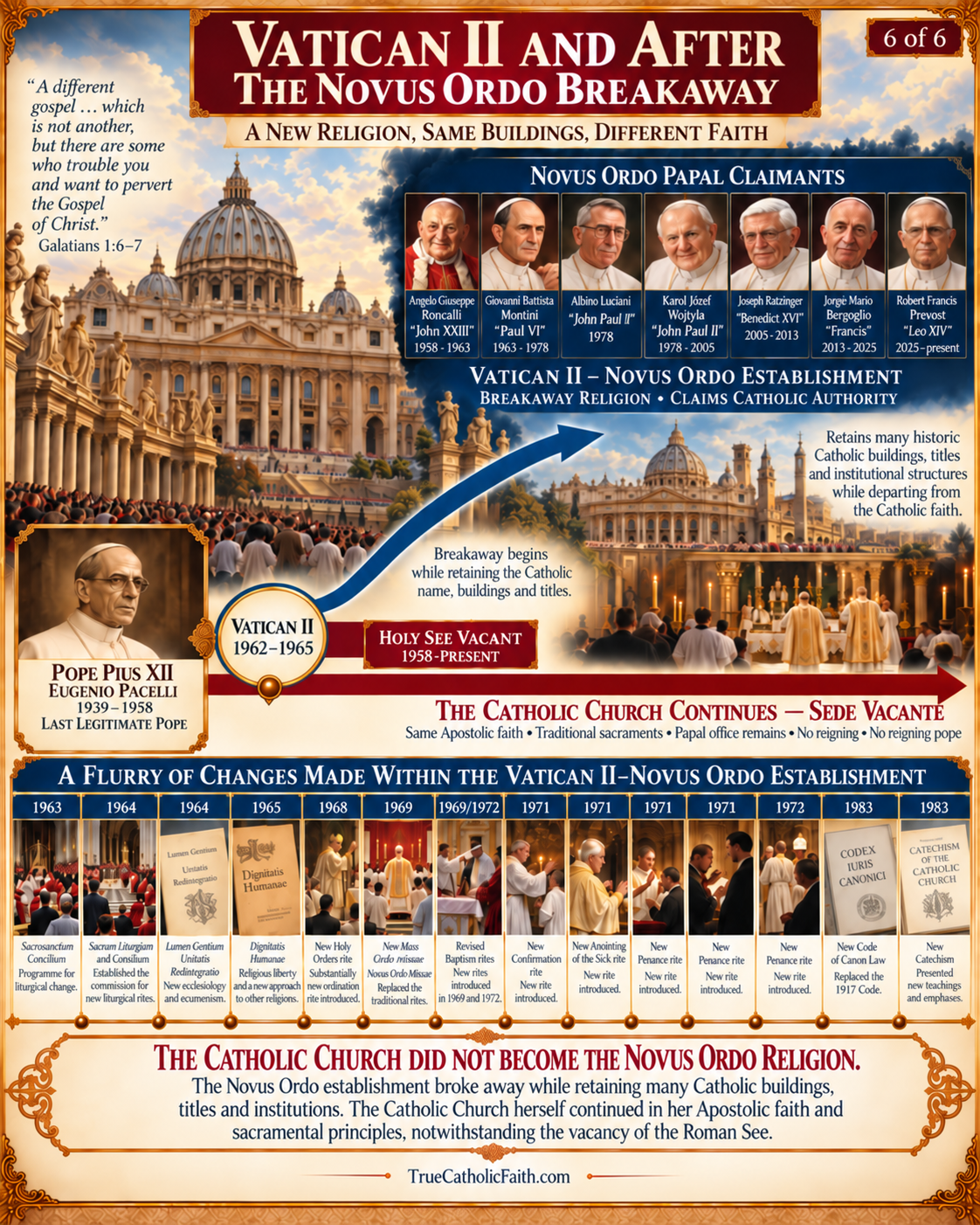
| Date | Area Affected | Principal Development |
|---|---|---|
| 1963 | Sacred liturgy | Sacrosanctum Concilium established the programme for extensive liturgical alteration. |
| 1964 | Implementation | Sacram Liturgiam established the special commission that became the Consilium. |
| 1964 | Ecclesiology | Lumen Gentium introduced formulations concerning the Church's identity and episcopal collegiality. |
| 1964 | Ecumenism | Unitatis Redintegratio adopted a new ecumenical framework. |
| 1965 | Religious liberty | Dignitatis Humanae articulated a civil right to religious freedom. |
| 1965 | Non-Christian religions | Nostra Aetate adopted a new approach to other religions. |
| 1965 | Governance | A permanent Synod of Bishops was established. |
| 1966 | Penitential discipline | Paenitemini altered fasting and abstinence obligations. |
| 1966 | Doctrinal discipline | The Index of Prohibited Books lost its ecclesiastical legal force. |
| 1967 | Indulgences | Indulgentiarum Doctrina introduced disciplinary alterations. |
| 1968–1973 | Seven sacraments | New or substantially revised Roman rites were introduced. |
| 1969 | Roman Mass | A new Order of Mass was introduced. |
| 1969 | Liturgical calendar | Mysterii Paschalis introduced a revised universal Roman Calendar. |
| 1969 | Holy Communion | Memoriale Domini addressed permissions concerning Communion in the hand. |
| 1970–1971 | Divine Office | Laudis Canticum introduced the Liturgy of the Hours. |
| 1972 | Clerical ministries | Ministeria Quaedam altered the traditional Latin arrangements for minor orders and ministries. |
| 1973 | Distribution of Communion | Immensae Caritatis expanded provisions for extraordinary ministers. |
| 1983 | Canon law | A replacement Latin Code of Canon Law was introduced. |
| 1983 | Canonisation procedures | Divinus Perfectionis Magister introduced new procedures. |
| 1992 | Religious instruction | A new universal Catechism of the Catholic Church was published. |
| 1997 | Catechetical text | The Latin typical edition of the new Catechism was published. |
Not all these developments possessed the same doctrinal significance.
A relaxation of fasting regulations is not equivalent to replacing a sacramental formula.
An alteration to the liturgical calendar does not automatically contradict divine revelation.
Likewise, admitting particular disciplinary changes does not prove that every subsequent innovation was invalid or heretical.
But the cumulative pattern is unmistakable. The postconciliar programme affected the religious doctrines adherents encountered, the forms of worship they practised, the sacraments they received, the penitential disciplines they observed and the authorities they recognised. It also affected the training of future clergy and the instruction of successive generations.
The impact extended into practical parish life: altar arrangements, liturgical languages, ceremonial practices, modes of receiving Holy Communion and the involvement of laypersons in functions previously associated with ordained ministers.
Some familiar changes, such as celebration facing the people, involved local practices, permissions and developments that must be distinguished from what particular universal documents actually required. Others, such as the replacement Roman Order of Mass and new sacramental books, were central institutional acts. This difference matters.
An accurate historical account must distinguish what Vatican II explicitly prescribed, what the postconciliar authorities subsequently authorised, and what arose through local initiatives or abuses.
Nevertheless, the broad transformation of worship, governance and religious identity cannot reasonably be explained as a collection of unrelated minor adjustments.
7. The Doctrinal Differences Were More Fundamental Than Changes of Ceremony
The postconciliar transformation was not simply a dispute over Latin, vestments, architecture or ceremonial preferences. It extended into questions concerning the nature of the Church, the obligations owed to religious truth, Christian unity, salvation, ecclesiastical authority and the Holy Sacrifice of the Mass.
These questions have received detailed treatment in the earlier FAQ articles. The Vatican II–Novus Ordo establishment professes principles incompatible with the Apostolic Catholic faith and cannot be identified with the Church founded by Jesus Christ.
The comparisons below summarise the main issues without attempting to reproduce their full demonstrations.
Religious liberty and the duties of civil society
Pius IX, in Quanta Cura (8 December 1864), condemned propositions concerning liberty of conscience and worship in the wider context of religious indifferentism and the obligations of civil society towards the true religion.
Leo XIII subsequently explained Catholic principles concerning Church and State in Immortale Dei (1885) and Libertas (1888).
These teachings recognised duties owed by individuals and societies to the true religion. Vatican II's Dignitatis Humanae (7 December 1965), particularly paragraph 2, articulated a civil right to religious freedom understood as immunity from coercion within specified limits. The declaration also professed to leave intact traditional teaching concerning duties towards the true religion.
Its defenders therefore argue that the newer teaching concerns civil immunity rather than a moral right to profess religious error. That qualification must be acknowledged.
The sedevacantist objection concerns whether the postconciliar principle of civil religious immunity, as formulated and implemented, is compatible with the earlier Catholic doctrine governing religious truth and the duties of public society. The difference cannot be settled merely because the documents use different terminology. The actual propositions must be compared in the same sense and within their respective doctrinal contexts.
The earlier FAQ article on religious liberty examines the resulting theological argument.
For the present investigation, the significance is that the postconciliar establishment adopted and subsequently institutionalised a markedly different framework concerning religion and civil society.
Ecumenism and the unity of the Church
In Mortalium Animos (6 January 1928), Pius XI rejected approaches to Christian unity that treated the Catholic Church as merely one religious denomination among several seeking a common union. He affirmed that genuine Christian unity rests upon profession of the true faith and communion with the Catholic Church.
Vatican II's Unitatis Redintegratio (21 November 1964), particularly paragraph 3, employed a different approach. It recognised elements of sanctification and truth outside visible Catholic communion and attributed significance to separated Christian communities. The document did not explicitly teach that all Christian denominations were equally true or that Catholic unity had become unnecessary. Its defenders argue that genuine Christian elements may exist outside visible Catholic communion without making religious error legitimate.
The sedevacantist criticism concerns the ecclesial and salvific standing attributed to separated communities within the newer framework and its subsequent implementation. The issue is not whether Catholics should treat non-Catholics with charity. It concerns the nature and necessity of the one Church founded by Jesus Christ.
The identity of the Church and the meaning of subsistit in
In Mystici Corporis Christi (29 June 1943), Pius XII identified the Mystical Body of Christ with the Catholic Church. Paragraph 22 explained membership with reference to Baptism, profession of the true faith and continued ecclesiastical unity.
Vatican II's Lumen Gentium, paragraph 8 (21 November 1964), employed the expression subsistit in, acknowledging elements of sanctification and truth outside the Catholic Church's visible structure. The change in terminology generated substantial controversy.
In 2007, the postconciliar Congregation for the Doctrine of the Faith issued a clarification insisting that subsistit in preserved the unique identity of the Church of Christ with the Catholic Church.
The sedevacantist criticism concerns the whole ecclesiological framework, including the treatment of ecclesial communities, membership, unity and salvation. A single change in Latin wording cannot bear the weight of the entire argument by itself.
The conclusion developed in the preceding FAQ articles rests upon cumulative doctrinal comparison and the subsequent practical implementation of the new ecclesiology.
The Mass, sacrifice and the priesthood
Trent defended the propitiatory sacrifice of the Mass, the Catholic priesthood and the divine institution of Holy Orders. The postconciliar establishment introduced a replacement Roman Order of Mass and revised ordination rites. The changes to the preparation of the gifts, sacrificial prayers and ritual presentation warrant comparison with the inherited Roman Missal and Pontifical. A prayer may be omitted without the resulting rite necessarily denying every doctrine expressed in that prayer.
Conversely, a large body of alterations may significantly change the religious meaning communicated through worship even if some traditional expressions remain. For this reason, the theological question cannot be answered merely by counting the number of deleted prayers. The new texts, their ritual context and their relationship to Catholic sacramental doctrine must be examined together. The earlier FAQ articles address these issues in detail.
The historical significance is that the postconciliar establishment's new theological principles and its altered forms of worship were developed through the same wider institutional programme.
The changes concerned not simply the appearance of religion, but its doctrinal and sacramental foundations.
8. The 1983 Code and 1992 Catechism Embedded the Postconciliar Programme Into Religious Life
The institutional character of the postconciliar transformation becomes particularly clear when the replacement Code of Canon Law and new Catechism are examined. These documents demonstrate how the programme moved beyond individual rites and became part of an enduring system of religious legislation and instruction.
The 1983 Code: Vatican II's ecclesiology translated into legislation
On 25 January 1983, Karol Józef Wojtyła, the postconciliar papal claimant who styled himself John Paul II, issued Sacrae Disciplinae Leges, purporting to promulgate a replacement Latin Code of Canon Law. Its significance lies not merely in the publication of a new legal book.
Wojtyła expressly connected it with Vatican II's understanding of the Church. He described the Code as an effort to translate the Council's ecclesiology into canonical language. This is unusually direct documentary evidence.
The new legislation was consciously intended to give legal expression to the religious principles promoted by Vatican II. One example concerns the administration of sacraments to separated Christians.
Canon 731 §2 of the 1917 Code prohibited administering the Church's sacraments to heretics and schismatics unless they first rejected their errors and were reconciled.
Canon 844 of the 1983 Code permitted, under specified circumstances, the administration of certain sacraments to members of separated Eastern Churches and, under more restricted conditions, other Christians.
The latter provision did not establish an unrestricted permission for sacramental sharing. Nevertheless, it represented a substantial disciplinary difference associated with the postconciliar ecumenical framework. A disciplinary difference is not, merely because it exists, a formally demonstrated doctrinal contradiction. But neither can the relationship between the changed discipline and the underlying ecclesiology be ignored.
The new legislation shows how the postconciliar understanding of Christian unity and ecclesiastical relationships was translated into practical religious governance.
However Wojtyła possessed no legitimate authority to abrogate the Catholic Church's existing universal legislation. The replacement Code was implemented within the postconciliar establishment, not lawfully imposed upon the Catholic Church herself.
The 1992 Catechism: transmitting the new religious framework to future generations
On 11 October 1992, Wojtyła issued Fidei Depositum, directing publication of the new Catechism of the Catholic Church. The Roman Catechism, published in 1566 after Trent, had provided authoritative doctrinal instruction for parish clergy. Other approved catechisms, including the Catechism of St Pius X, likewise instructed generations of Catholics.
The 1992 Catechism retained much familiar Christian teaching and the traditional arrangement around the Creed, sacraments, moral life and prayer. It did not formally abolish every existing local catechism. Nevertheless, it incorporated Vatican II's theological formulations and was intended to serve as a principal reference for religious instruction throughout the postconciliar establishment.
Its institutional purpose was explicit. In Fidei Depositum, Wojtyła linked the Catechism with the preceding liturgical changes and the new canonical codifications. These developments were presented as connected elements of the programme initiated by Vatican II. By 1992, the establishment therefore possessed an interconnected system of altered liturgical worship, ecclesiastical legislation and catechetical instruction.
This matters because religious identity is not transmitted only through formal doctrinal declarations.
Sacred worship shapes how adherents pray and understand sacrifice.
Ecclesiastical legislation shapes their obligations, relationships and understanding of authority.
Catechisms shape the beliefs of future generations.
Seminaries train clergy who will teach and administer the rites.
By altering the principal institutions responsible for worship, legislation and instruction, the postconciliar leadership established mechanisms through which its religious programme could be transmitted to successive generations.
This does not require speculation about secret intentions. The purpose and interconnection of the programme are documented in the official publications themselves. The Vatican II–Novus Ordo establishment had advanced its programme of doctrinal, liturgical, sacramental and institutional alterations, while the Catholic Church continued to preserve the Apostolic faith entrusted to her by Christ, unchanged in its divine substance and definitive doctrine.
9. A Breakaway Religion That Retained Much of the Catholic Institutional Apparatus
One of the most unusual aspects of the crisis is the relationship between religious departure and outward institutional continuity. Ordinarily, when a group separates from the Catholic Church, it establishes a distinct denomination, develops its own religious institutions and publicly distinguishes itself from Catholicism.
Within the sedevacantist understanding, the postconciliar crisis followed a different pattern.
The Vatican II–Novus Ordo establishment continued claiming to be the Catholic Church.
Its leaders claimed the Roman Pontificate and other ecclesiastical offices.
Its institutions retained Catholic names, familiar clerical titles, historic buildings and extensive administrative structures.
The changes were introduced within these familiar surroundings.
This outward continuity could create a powerful impression that the same religion necessarily remained in place.
But institutional possession is not identical with religious identity.
The fact that a historic cathedral remains physically intact does not determine whether every doctrine subsequently professed within it is Catholic. Likewise, the possession of episcopal vestments or the title of Roman Pontiff does not establish legitimate spiritual authority. That must be determined according to Catholic doctrine and the requirements of ecclesiastical office.
Why many Novus Ordo adherents believed they remained Catholic
For many ordinary adherents of the Vatican II–Novus Ordo establishment, the surrounding circumstances appeared reassuring.
They continued attending churches that had existed for generations.
Their clergy continued wearing familiar garments and using Catholic titles.
Their religious institutions continued displaying Catholic symbols.
The authorities introducing the alterations claimed that the changes represented legitimate renewal rather than departure from the faith.
Consequently, many adherents sincerely believed they were continuing to practise Catholicism.
The extent of their individual knowledge, responsibility and canonical status cannot be determined merely from their association with the establishment. A person may accept religious changes without understanding their doctrinal significance. Nevertheless, sincere belief in institutional continuity does not independently demonstrate that the religious system concerned preserves Catholic doctrine.
The distinction is between what individuals believe about their religious affiliation and the objective theological identity of the establishment they follow.
Why Catholics preserving the traditional faith often had to worship elsewhere
The consequences for Catholics who rejected the postconciliar innovations were often very different. Where historic Catholic churches came under the practical control of the postconciliar establishment and no longer provided the traditional worship and sacraments sought by those Catholics, alternative premises became necessary.
Traditional Catholic clergy and faithful established or maintained chapels, private oratories and other places where inherited Catholic worship could continue.
Some used converted buildings or private homes.
Others travelled considerable distances to receive the sacraments from clergy whose Orders and doctrinal profession they considered reliable.
These circumstances could impose financial sacrifices, family difficulties and serious disruptions to ordinary parish life.
These Catholics had not founded a new religion by preserving inherited Catholic faith and worship.
Nor had they rejected the papacy as a divine institution.
They rejected the claims of the postconciliar leadership and the innovations introduced under its purported authority.
There is also an important qualification: not every independent traditional clergyman automatically possesses valid Orders, legitimate jurisdiction or sound doctrine merely because he rejects Vatican II. These questions require proper examination.
The religious departure described in this article was not necessarily accompanied by the physical departure of the people controlling the historic buildings.
The Vatican II–Novus Ordo establishment continued occupying much of the outward institutional apparatus historically associated with the Catholic Church. Catholics preserving the inherited faith frequently had to find other places in which to worship. The Catholic Church herself did not disappear or become another religion. She continued to exist notwithstanding the vacancy of the Roman See.
10. The Postconciliar Leaders' Own Words: A Deliberate Programme and Its Consequences
The extraordinary transformation following Vatican II was not simply an accidental accumulation of unrelated liturgical, doctrinal and administrative changes. Its principal alterations were consciously planned, promulgated and implemented by men claiming the authority of the Catholic Church. Their own statements reveal the importance they attached to the programme, the extent of the changes they intended, their determination that the changes should be accepted and their recognition of serious religious upheaval.
These statements are especially significant because they come from the principal figures directing the postconciliar establishment, rather than merely from their traditional Catholic critics.
The documentary evidence establishes deliberate religious transformation, conscious replacement of inherited worship and enforcement through institutional authority.
That is considerably more consequential than suggesting that the new religious system emerged accidentally because of administrative incompetence.
1965: Montini directs the implementation of Vatican II
On 4 November 1965, shortly before Vatican II concluded, Montini issued the apostolic exhortation Postrema Sessio.
He discussed the substantial doctrinal and disciplinary work of the assembly and anticipated the programme that would follow.
He referred to numerous doctrinal matters and new disciplinary directions.
He also instructed the bishops recognising his authority to prepare their followers to accept the new norms, encourage those reluctant to adapt, restrain unauthorised innovations and promote obedience to the authorities directing implementation.
The significance is plain.
The changes were not intended to remain optional academic proposals.
They were to be implemented through ecclesiastical structures under the authority Montini claimed to possess.
The document also demonstrates that the programme extended beyond ceremonies into doctrine, discipline and governance. Montini described the implementation as a major undertaking requiring prudence, perseverance, effective leadership and the cooperation of the faithful. He expected substantial work after the Council's conclusion, not simply the spontaneous continuation of existing arrangements.
The historical evidence therefore establishes planning, organisation and an expectation of obedience before the principal postconciliar sacramental alterations had even been introduced.
December 1965: The reported reference to the Apocalypse
Jean Guitton (1901–1999), the French philosopher and personal friend of Montini, later recalled an extraordinary remark allegedly made near the conclusion of Vatican II. In an interview published in Avvenire on 11 October 1992 and reproduced in ADISTA on 21 October 1992, Guitton attributed the following words to Montini:
"I am about to sound the seven trumpets of the Apocalypse."
Guitton associated the remark with the conclusion of Vatican II in December 1965.
The imagery is striking. In the Apocalypse of St John, the seven trumpets announce divine judgments and extraordinary events preceding the ultimate triumph of Christ (Apocalypse 8–11). Nevertheless, the evidentiary limitations must be acknowledged. The words are known through Guitton's recollection published approximately twenty-seven years later, not through a verified contemporary recording or transcript.
Furthermore, Guitton himself interpreted the language positively, associating it with the final triumph of Christ and His Church. It would therefore be historically unjustified to describe this reported remark as a confession that Montini intended to destroy Catholicism.
Its interest lies in the dramatic language attributed to him at the conclusion of an assembly followed by extensive religious change. The strongest evidence of his actual decisions and intentions comes from his authenticated public statements.
March 1966: Montini speaks of the “Conciliar Church”
On 8 March 1966, Montini addressed members of the Permanent Committee of the International Congresses for the Apostolate of the Laity. His address contains one of the most revealing expressions associated with the postconciliar period:
L'Église conciliaire — the Conciliar Church.
He explained that following Vatican II required more than merely collecting and communicating its teachings. Adherents were to conform themselves to the image of this Conciliar Church, renewed in prayer, the expression of faith and hope, and dialogue with other Christians and humanity.
This was a programme intended to shape religious outlook and behaviour.
Montini was not simply proposing an adjustment to administrative arrangements.
He was encouraging the formation of a renewed religious pattern of life associated with Vatican II.
He did not publicly describe this as the foundation of a non-Catholic denomination. On the contrary, he claimed that it represented authentic Catholic renewal.
That distinction is central to understanding the historical development.
A comprehensive programme of religious transformation was introduced under a continuing claim to Catholic identity and authority.
Within the established sedevacantist conclusion, the resulting establishment departed from the Catholic faith. Montini's 1966 statement does not, by itself, prove that he privately understood the programme to be the creation of a separate non-Catholic religion. It does demonstrate that he consciously promoted a distinctive postconciliar religious framework.
December 1968: Montini acknowledges “self-demolition”
On 7 December 1968, Montini addressed the Pontifical Lombard Seminary. Speaking about unrest and internal criticism, he used the Italian expression autodemolizione—self-demolition. He described an unexpected internal upheaval following Vatican II.
A period of religious flourishing had been anticipated, yet the reality included serious conflict and criticism.
The timing is important. By December 1968, the postconciliar establishment had already introduced replacement ordination rites, including the new episcopal consecratory prayer.
Further changes to the Roman Mass and the other sacraments were being prepared. Thus, the man claiming the highest ecclesiastical authority within the establishment was publicly acknowledging grave internal disruption while its wider programme was still developing. This was not an allegation invented by later traditional Catholic critics. It was an assessment made by Montini himself.
He attributed the turmoil principally to internal criticism and opposition and did not confess to intentionally creating the self-demolition he described. Nevertheless, his statement establishes contemporary awareness of serious religious upheaval. The leadership was not wholly unaware that the postconciliar period was producing consequences far removed from the anticipated flourishing.
November 1969: The sacrifice of inherited worship was consciously accepted
On 26 November 1969, shortly before the new Roman Order of Mass entered into widespread use, Montini addressed the changes directly.
His remarks are among the most revealing contemporary documents concerning the liturgical replacement.
He acknowledged the historic importance of Latin, the inherited sacred language and Gregorian chant.
He recognised that replacing Latin as the principal language of the Mass involved surrendering a precious religious inheritance extending across centuries.
He described the sacrifice as being of inestimable value.
Montini nevertheless defended the change by appealing to intelligibility and the participation of contemporary worshippers. This is a particularly consequential admission.
The man directing the replacement of inherited Roman worship publicly acknowledged the substantial value of what was being surrendered.
He did not proceed simply because he was unaware of the importance of the traditional liturgical language and ceremonial inheritance. He recognised the loss and considered it justified by other priorities.
This was a deliberate religious judgment. Its legitimacy must be considered in light of traditional Catholic teaching concerning sacred worship, the asserted necessity of the changes and the claimed authority under which they were introduced.
However Montini lacked legitimate papal authority to replace the inherited Roman Mass. His public acknowledgement of the sacrifice involved nevertheless makes clear that the changes were consciously undertaken.
June 1972: The “smoke of Satan” and the acknowledged crisis
On 29 June 1972, Montini delivered a homily commemorating the anniversary of his claimed pontificate. The Vatican's published contemporary account records his famous observation that the smoke of Satan appeared to have entered the temple of God. He also described doubt, uncertainty, dissatisfaction and spiritual disturbance. He contrasted expectations of religious flourishing after Vatican II with the reality of clouds, storms, darkness and uncertainty.
These statements were made while the postconciliar sacramental programme remained underway.
The revised rites of Holy Orders, the Mass and Confirmation had already been introduced.
The new Anointing of the Sick rite and revised rite of Penance followed.
Montini therefore publicly recognised serious religious turmoil during the same period in which substantial sacramental alterations were being introduced. He interpreted the upheaval as the work of an adverse spiritual influence frustrating the good consequences he associated with Vatican II. He did not publicly identify his own programme as a deliberate attempt to destroy Catholicism. Nevertheless, his statement raises an important historical question.
If the leadership recognised grave disruption, to what extent did it examine whether its own authorised alterations were contributing to that disruption?
It would be insufficient to attribute every negative consequence to unauthorised local abuses without first examining changes deliberately introduced by the central postconciliar authorities.
The evidence establishes recognition of a serious crisis while the programme continued.
May 1976: Montini declares that the new Mass was intended to replace the old
An even more significant statement came on 24 May 1976. Addressing a consistory, Montini criticised those resisting Vatican II and the subsequent changes, particularly Archbishop Marcel Lefebvre and his followers. He rejected the claim that the inherited Roman liturgical tradition could be maintained independently of the regulations issued by the postconciliar authorities.
Most importantly, he expressly declared that the new Order of Mass had been promulgated to replace the old.
The Italian original states:
Il nuovo Ordo è stato promulgato perché si sostituisse all'antico.
This is direct documentary evidence of deliberate replacement. There is no need to infer Montini's intention merely from the subsequent disappearance of the older rite from many churches.
He expressly stated that the new Order of Mass had been introduced to replace the inherited one.
He also insisted that acceptance of the new liturgical arrangements was not simply a matter of personal choice.
He referred to limited exceptions and demanded compliance with the wider postconciliar programme.
This demonstrates more than the introduction of an alternative form of worship. At least in the case of the Roman Mass, Montini consciously intended the new Order to displace the inherited one and required institutional conformity.
He possessed no legitimate papal authority to make those demands of Catholics. Nevertheless, his effective control over institutions recognising his authority gave those demands considerable practical consequences. The historical conclusion is clear.
The replacement of inherited Roman worship was deliberate, publicly defended and institutionally enforced.
August 1979: Wojtyła explicitly acknowledges the transformative character of Vatican II
Karol Józef Wojtyła subsequently described Vatican II in striking terms. On 1 August 1979, reflecting upon Montini's work, he spoke of a charism of transformation associated with Roncalli and Montini. He described a transformed appearance of the Church as something simultaneously familiar and different.
Wojtyła expressly denied that the difference meant abandonment of the Church's essential nature. But his remarks unmistakably show that the leadership understood Vatican II and its implementation in terms of profound transformation.
Wojtyła praised Montini as the principal director of that programme. He referred to concrete changes involving the Synod of Bishops, ecumenical initiatives, the Roman Curia, governance and the implementation of Vatican II's decisions. His own explanation presented these as authentic Catholic renewal.
However, the resulting religious system is judged to have departed from Catholicism.
The historical significance of Wojtyła's words is that the transformative nature of the programme was publicly recognised and celebrated by one of its principal successors.
February 2013: Ratzinger acknowledges grave consequences
The recognition of serious postconciliar upheaval did not end with Montini. On 14 February 2013, Joseph Ratzinger, the postconciliar papal claimant who styled himself Benedict XVI, addressed the clergy of Rome. Reflecting upon Vatican II and its aftermath, he acknowledged
severe difficulties, including
the closure of seminaries and convents,
deteriorated liturgical practices and
considerable suffering.
Ratzinger sought to distinguish what he called the real Council from a competing interpretation shaped by the media and contemporary cultural influences. In his explanation, much of the damage resulted from misunderstanding or misrepresentation rather than Vatican II's authentic intentions. Nevertheless, his acknowledgement of the scale of the disruption remains historically significant.
Severe consequences were recognised not only by traditional Catholic critics but also by leading figures within the postconciliar establishment itself. The disagreement concerns their causes.
The replacement Roman Mass, revised sacramental rites, new Code of Canon Law and new Catechism were introduced through official institutional decisions. They cannot all be attributed to unauthorised local improvisation or media interpretation. Those decisions must be examined in their own right.
What these statements establish about deliberate intention
Taken together, the documents establish considerably more than the existence of extensive postconciliar changes.
They demonstrate that the leadership of the Vatican II–Novus Ordo establishment consciously intended to replace important elements of inherited Catholic religious life, reshape the worship and religious outlook of its adherents, and require acceptance of the resulting system under the ecclesiastical authority it claimed to possess.
The chronological evidence is especially compelling.
In 1965, Montini directed implementation of the conciliar programme.
In 1966, he spoke of forming adherents according to the image of the Conciliar Church.
In 1968, he acknowledged unexpected internal disruption and self-demolition.
In 1969, he publicly recognised the considerable sacrifice involved in surrendering elements of inherited Roman worship.
In 1972, he described a grave religious crisis.
In 1976, he explicitly declared that the new Order of Mass was intended to replace the old and demanded acceptance of the wider programme.
Wojtyła subsequently praised the programme's transformative character, while Ratzinger acknowledged severe negative consequences in later decades. These statements cannot reasonably be reduced to a story of leaders who accidentally presided over an entirely unintended sequence of religious changes.
The programme of transformation was substantial, consciously directed and institutionally enforced.
The records also show that serious upheaval was recognised by the leadership.
There is, however, one further distinction. Intending a programme of religious transformation is not logically identical to intending every consequence of that transformation. The first is directly documented. The second requires additional evidence concerning the particular individuals and purposes involved.
The postconciliar leaders generally claimed that their programme was intended to renew and preserve Christian religious life. Their public statements do not constitute explicit confessions that they consciously intended to destroy Catholicism, deceive the faithful or invalidate the sacraments.
But the objective religious character of the system they introduced can be evaluated independently of their private motives. The Vatican II–Novus Ordo establishment departed from the Apostolic Catholic faith while continuing to claim Catholic identity and authority.
The historical statements examined here add evidence about how that transformation occurred. They demonstrate that the principal leaders were active participants who promoted substantial changes, understood their importance, recognised serious disruption and demanded compliance.
The decisive historical finding is that the transformation was deliberately directed, not that every destructive consequence was necessarily intended as an end in itself.
That conclusion is sufficiently serious without requiring unproved allegations about hidden motives.
11. The Strongest Objection: Were These Merely Legitimate Exercises of Ecclesiastical Authority?
A defender of Vatican II may object that the Catholic Church has always possessed authority to regulate ecclesiastical discipline and nonessential elements of sacred worship.
The Roman liturgical books underwent revisions before Vatican II.
Pius XII himself introduced substantial ceremonial changes.
The postconciliar authorities also claimed that their programme was intended to preserve Christian doctrine, improve catechesis and encourage fuller participation in the sacred liturgy. Moreover, Vatican II's defenders argue that its doctrinal statements can be reconciled with earlier Catholic teaching when properly interpreted. The objection concludes that the number and scale of changes cannot independently establish the emergence of a different religion.
Several elements of this argument are correct. The Catholic Church possesses legitimate authority to regulate human disciplinary and ceremonial matters. Not every change to a prayer, calendar or ecclesiastical regulation constitutes doctrinal error. Nor can a rite's invalidity be established solely from the absence of legitimate authority in the person who introduced it.
The serious question concerns the actual content, authority and consequences of the particular alterations. The earlier FAQ articles have already examined the relevant doctrinal and ecclesiological questions, including the distinction between development and contradiction.
They have also considered papal infallibility, indefectibility, the membership of the Church, public heresy and the legitimacy of the postconciliar papal claims. The postconciliar claimants were not legitimate Roman Pontiffs. They therefore lacked authority to impose replacement sacramental rites or universal ecclesiastical legislation upon the Catholic Church.
Nor does the general legitimacy of some disciplinary changes establish the doctrinal compatibility of every postconciliar principle. The strongest continuity defence also invokes the widespread recognition of the postconciliar claimants and the Church's visibility and indefectibility. Those objections cannot be dismissed merely by pointing to changed buildings, rites or terminology.
They require the theological treatment already undertaken in the earlier articles concerning papal authority and sedevacantism.
The present article adds a different kind of evidence. It establishes the exceptional concentration of alterations and the systematic means by which the postconciliar programme became embedded in religious worship, governance, legislation and instruction.
The historical chronology does not replace the earlier theological case.
It demonstrates how the religious system identified by that case was developed and institutionalised.
12. The Four Marks of the Church and the Consequences for Ecclesiastical Authority
The Catholic Church professes herself to be one, holy, Catholic and apostolic. These four marks concern the identity of the Church founded by Jesus Christ.
Her unity involves profession of the same faith and legitimate ecclesiastical communion.
Her holiness includes the possession of the true means of sanctification.
Her catholicity concerns her universal mission and the fullness of the means of salvation.
Her apostolicity requires continuity in Apostolic doctrine and the divine constitution established by Christ.
A religious institution cannot establish that it possesses these marks merely by retaining historic Catholic buildings, episcopal titles and administrative structures. Nor does widespread institutional recognition, considered in isolation, resolve every theological question concerning legitimate ecclesiastical office.
The Vatican II–Novus Ordo establishment departed substantially from the inherited Catholic faith while claiming Catholic identity and authority. Its papal claimants did not legitimately possess the Roman Pontificate.
This judgment is theological; the proposition that the Holy See has remained vacant since 1958 has not itself been solemnly defined as Catholic dogma. Nevertheless, the present series proceeds from the conclusion it has already adopted.
The postconciliar claimants could not lawfully bind the Catholic Church through legislation issued under papal authority they did not possess.
Their replacement liturgical books did not cause the Catholic Church herself to adopt a new sacramental system.
Their canonical legislation did not constitute a lawful replacement of the Church's existing universal law.
The Catholic Church continued to exist, preserving her essential divine constitution and Apostolic faith.
The permanent institution of the papacy must be distinguished from uninterrupted occupation of the papal office. A vacancy of the Roman See does not mean that Christ abolished the papacy or abandoned His Church.
Questions concerning the practical continuation of ecclesiastical jurisdiction, legitimate episcopal authority and eventual restoration of ordinary ecclesiastical order are addressed separately within the sedevacantist framework.
The historical evidence presented in this article does not itself resolve every such question. What it demonstrates is the extent to which the Vatican II–Novus Ordo establishment developed its own interconnected religious programme while continuing to claim the authority and identity of the Catholic Church.
13. What We Can and Cannot Conclude
The historical record establishes that the postconciliar transformation was extensive, interconnected and deliberately implemented.
The Catholic doctrine of the seven sacraments had been clarified and defended over centuries.
The inherited Roman liturgical books had developed through legitimate historical revisions while maintaining a recognisable tradition.
Following Vatican II, the postconciliar establishment introduced revised Roman rites associated with all seven sacraments between 1968 and 1973.
The wider programme affected religious doctrine, public worship, ecclesiastical discipline, institutional governance, canon law and catechetical instruction.
Specialised commissions organised and prepared the changes, while the principal authorities directed their introduction.
Montini explicitly declared that the new Roman Order of Mass was intended to replace the inherited one.
Wojtyła subsequently connected the replacement Code of Canon Law and the new Catechism with the programme initiated by Vatican II.
These conclusions rest upon public documents and identifiable institutional actions. The establishment continued claiming Catholic identity and authority while retaining extensive control over historical Catholic institutions. Consequently, many adherents believed they remained within the Catholic religion, while Catholics preserving traditional worship frequently had to use alternative premises.
These are substantial historical findings. The Vatican II–Novus Ordo establishment departed from Catholicism and that its papal claimants lacked legitimate Catholic authority.
The present article proceeds from that conclusion.
It does not suggest that the Catholic Church herself became a false religion, lawfully adopted the postconciliar innovations or ceased to exist.
Nor does it abandon the series' adopted assessment of the 1968 replacement episcopal consecration rite.
That assessment has serious implications for purported episcopal and priestly Orders dependent upon the rite. Nevertheless, a contested sacramental judgment must not be misrepresented as a solemn Catholic definition. The status of particular clergy must also be assessed according to their actual sacramental history.
Independently valid Orders and the different requirements governing Baptism, Matrimony, Penance and other sacraments remain relevant. Similarly, documented intentional transformation does not, by itself, prove that every postconciliar leader privately intended to deceive adherents or destroy the faith. Claims concerning hidden motives require additional evidence.
These distinctions do not negate the central findings.
The postconciliar programme was extensive, consciously organised, officially introduced and institutionally enforced.
The earlier doctrinal and sacramental examinations explain why the series judges the resulting religious establishment incompatible with Catholicism. The present historical investigation demonstrates how rapidly and comprehensively that separate religious system was developed.
Conclusion: The Catholic Church Remained While the Postconciliar Establishment Developed a Different Religion
For centuries, the Catholic Church defended and transmitted the Apostolic faith.
Her ecumenical councils clarified revealed doctrine, condemned errors, resolved schisms and regulated ecclesiastical discipline.
The seven sacraments instituted by Jesus Christ were explained and solemnly defended.
The Roman liturgical tradition developed through centuries of worship and was codified in authoritative liturgical books.
Then came Vatican II.
Under men claiming the Roman Pontificate, the Vatican II–Novus Ordo establishment initiated an extensive programme of religious alteration.
Within approximately five years, revised Roman rites had been introduced for all seven sacraments.
The changes extended into the Mass, ordination rites, sacramental formulas, ecclesiastical discipline, religious liberty, ecumenism, canon law and catechetical instruction.
The programme was supported by specialised commissions, coordinated through ecclesiastical structures and enforced by authorities claiming supreme spiritual jurisdiction.
Its deliberate character is confirmed by the statements of its own leaders.
Montini acknowledged the sacrifice involved in replacing inherited worship, recognised serious religious upheaval and expressly declared that the new Order of Mass had been introduced to replace the old. Wojtyła subsequently praised the programme's transformative character and connected the new Code and Catechism with Vatican II.
These were not merely isolated or insignificant changes. They affected the principal means through which religious belief, worship and practice are transmitted to future generations. The transformation was especially unusual in another respect.
The establishment introducing the changes retained much of the Catholic Church's outward institutional apparatus while continuing to claim Catholic identity and authority.
Many of its adherents therefore sincerely believed they were continuing to practise the same religion. Meanwhile, Catholics who rejected the postconciliar innovations often had to preserve traditional worship in independent chapels, private homes and other alternative premises.
Those Catholics had not founded a new religion or rejected the divinely instituted papacy. They continued professing the inherited Catholic faith. The Catholic Church herself did not become the Vatican II–Novus Ordo religion. Her divine constitution, Apostolic doctrine and essential sacramental principles remained intact.
The postconciliar establishment departed from that faith while retaining the Catholic name and many outward signs of institutional continuity. Its leaders claimed Catholic authority without legitimately possessing it under the theological conclusion adopted in this series.
The extraordinary speed, breadth, organisation and enforcement of the postconciliar programme provide important historical evidence of how this distinct religious system developed. Whether particular individuals additionally intended to deceive the faithful must be investigated through evidence of their actual motives. The documented transformation does not depend upon proving those private intentions.
The central lesson of the history is that Catholic identity cannot be established merely by possessing historic Catholic buildings, retaining familiar ecclesiastical titles or claiming the authority of the Roman Pontiff.
It requires fidelity to the Apostolic faith and legitimate ecclesiastical authority.
The Catholic Church continued to exist. The duty of Catholics remains to preserve the faith entrusted by Jesus Christ to His Apostles, seek valid sacraments, persevere in Catholic worship and pray for the restoration of normal ecclesiastical order under a legitimate Roman Pontiff.
Primary Sources
Sacred Scripture and traditional Catholic doctrine
Douay-Rheims Bible — St Matthew 16:18; 28:19–20; Galatians 1:8–9; 1 Timothy 6:20; 2 Timothy 1:13–14; Hebrews 13:8.
St Vincent of Lérins, Commonitorium (c. 434), chapter 23 — authentic development of doctrine.
The Ecumenical Councils — historical texts and council chronology.
Council of Trent, Session VII (1547) — divine institution and number of the sacraments; Session XXII (1562) — the propitiatory sacrifice of the Mass. Texts available through the council collection above.
First Vatican Council, Dei Filius and Pastor Aeternus (1870) — development of doctrine, papal primacy, infallibility and preservation of Apostolic revelation.
Pius IX, Quanta Cura (1864); Leo XIII, Immortale Dei (1885) and Libertas (1888) — religious truth, liberty and the obligations of civil society.
Pius XI, Mortalium Animos (1928) — Catholic unity and ecumenism.
Pius XII, Mystici Corporis Christi (1943) — the identity and membership of the Catholic Church.
Pius XII, Mediator Dei (1947) — sacred worship and legitimate liturgical authority.
Pius XII, Sacramentum Ordinis (1947), original Latin — essential matter and form of Holy Orders.
Leo XIII, Apostolicae Curae (1896), original Latin — sacramental form and intention in the judgment concerning Anglican Orders.
Codex Iuris Canonici (1917), canon 731 §2 — sacramental discipline concerning heretics and schismatics.
Vatican II and documents of the postconciliar establishment
The following texts are cited as historical evidence of what the postconciliar authorities taught, claimed and implemented. Their official titles and descriptions are preserved as source information, not as acknowledgment of the legitimate Catholic authority claimed by their authors.
Sacrosanctum Concilium (1963), particularly §§21–23, 50 and 62 — the liturgical programme.
Montini, Sacram Liturgiam (1964) — implementation arrangements and establishment of a special commission.
The Consilium: official institutional history — membership, study groups, responsibilities and administrative development.
Lumen Gentium (1964), particularly §8 — ecclesiology.
Unitatis Redintegratio (1964), particularly §3 — ecumenism.
Dignitatis Humanae (1965), particularly §§1–2 — religious liberty.
Montini, Postrema Sessio (1965), original Latin — doctrinal, disciplinary and implementation programme.
Montini, address concerning the Conciliar Church (1966), French — l'Église conciliaire.
Montini, Pontificalis Romani (1968), original Latin — replacement rites of Holy Orders.
Montini, address to the Pontifical Lombard Seminary (1968), Italian — internal upheaval and autodemolizione.
Ordo Celebrandi Matrimonium (1969), decree of the Sacred Congregation of Rites, published in Notitiae, vol. 5 — introduction of the revised Marriage rite.
Montini, Missale Romanum (1969) — replacement Roman Missal.
Montini, general audience of 26 November 1969, Italian — the acknowledged sacrifice associated with the new Mass.
Ordo Baptismi Parvulorum (1969) — revised rite of infant Baptism.
Montini, Divinae Consortium Naturae (1971), original Latin — replacement Confirmation rite.
Ordo Initiationis Christianae Adultorum (1972) — revised adult Christian initiation rite.
Montini, Sacram Unctionem Infirmorum (1972) — replacement Anointing of the Sick rite.
Montini, published account of the homily of 29 June 1972, Italian — the smoke of Satan and recognised religious disruption.
Ordo Paenitentiae (1973) — revised Roman rite of Penance.
Montini, consistory address of 24 May 1976, Italian — express intention to replace the inherited Roman Order of Mass and demanded acceptance of the wider programme.
Wojtyła, general audience of 1 August 1979 — the claimed charism of transformation.
Wojtyła, Sacrae Disciplinae Leges (1983) — the replacement Code of Canon Law and Vatican II ecclesiology.
Codex Iuris Canonici (1983), canon 844 — provisions concerning the administration and reception of certain sacraments involving separated Christians.
Wojtyła, Fidei Depositum (1992) — the Catechism and its relationship to the wider programme.
Congregation for the Doctrine of the Faith, Responses to Some Questions Regarding Certain Aspects of the Doctrine on the Church (2007) — the postconciliar explanation of subsistit in.
Ratzinger, address to Roman clergy (2013) — acknowledged disruption and his explanation of its causes.
Supplementary historical testimony: Maurizio Blondet, “Guitton: Nel segno dei Dodici,” Avvenire, 11 October 1992; reproduced in ADISTA, no. 5208, 21 October 1992, pp. 10–11. The reported Apocalypse remark and a reproduction of the interview are discussed in Novus Ordo Watch. This is a later recollection rather than a verified contemporary transcript.
Further Reading
Philip Hughes, The Church in Crisis: A History of the General Councils, 325–1870 (1961) — historical account of the Church's ecumenical councils.
Romano Amerio, Iota Unum: A Study of Changes in the Catholic Church in the Twentieth Century (1985; English translation 1996) — detailed treatment of twentieth-century religious changes.
Michael Davies, Pope Paul's New Mass (1980) — historical and theological criticism of the replacement Roman Mass. The original title is retained as a bibliographic citation.
Ralph M. Wiltgen, S.V.D., The Rhine Flows into the Tiber (1967) — historical account of the Vatican II proceedings.
Karol Wojtyła, Sign of Contradiction (Italian edition 1977; English edition 1979) — Wojtyła's theological reflections.
St Robert Bellarmine, De Romano Pontifice, Book II, chapter 30 — theological discussion of a manifestly heretical claimant to the Roman Pontificate.
Rev. Anthony Cekada, Absolutely Null and Utterly Void — the argument for the invalidity of the 1968 replacement episcopal consecration rite.
These works have differing historical, theological and ecclesiastical perspectives. Secondary interpretations should be checked against the original sources.
Related FAQ Questions
Can Catholic Doctrine Change or Develop? — Browse the FAQ series
Are the New Ordination and Consecration Rites After Vatican II Invalid?
Isn't the New Rite of Episcopal Ordination Still Valid?
Why Do Sedevacantists Believe the Holy See Is Vacant?
Did Scripture Foretell a Great Apostasy or Crisis in Religion?
Explore the wider FAQ: Vatican II, the Mass, the Sacraments and What Catholics Should Do