What Is Apostasy — and Are We Living Through the Great Apostasy?
Short Answer
Apostasy is the total abandonment of the Christian Faith by a baptized person.
It is more radical than an individual act of heresy.
A heretic still professes to be Christian but pertinaciously denies or doubts one or more truths that must be believed with divine and Catholic faith.
An apostate repudiates Christianity itself.
The 1917 Code of Canon Law makes precisely this distinction in Canon 1325 §2: one who “totally withdraws from the Christian faith” is an apostate. (Codex Iuris Canonici) This is also the precise terminology used throughout this FAQ series: apostasy, heresy, schism and excommunication must not be treated as interchangeable labels.
Sacred Scripture also foretells a great future defection from the Faith before the return of Christ. St Paul warns that the Day of the Lord will not come “unless there come a revolt first, and the man of sin be revealed.”
The Holy Bible explicitly calls these two signs a general apostasy and the coming of Antichrist. 2 Thessalonians 2
The Roman Catechism likewise teaches that three principal signs precede the General Judgment:
the preaching of the Gospel throughout the world,
a defection from the faith, and
the coming of Antichrist. (Sancta Clara Press)
Are we living through that final Great Apostasy now?
We can say with considerable confidence that we are living through an extraordinary and widespread falling away from Christianity and from the Catholic Faith.
It is also reasonable to ask whether this may be the apostasy foretold by St Paul.
But Catholic theology does not permit us to declare the identification certain simply by matching present events to prophecy.
St Cyril of Jerusalem believed the religious crisis of his own fourth century exhibited the “falling away,” yet immediately cautioned that he did not know whether the final events would occur in his time or after it. (New Advent) That is an important precedent for sobriety.
The “abomination of desolation” foretold by Daniel and cited by Christ is also relevant. It had historical foreshadowings in the desecration of the Temple and the destruction of Jerusalem, while Fathers such as St Jerome saw Antiochus Epiphanes as a type of the final Antichrist. Traditional Catholic commentators also associated Daniel's removal of the “continual sacrifice” with a future attempt to suppress the Holy Sacrifice of the Mass. But the precise final fulfilment remains a matter of biblical interpretation rather than a defined Catholic dogma. (Haydock Commentary)
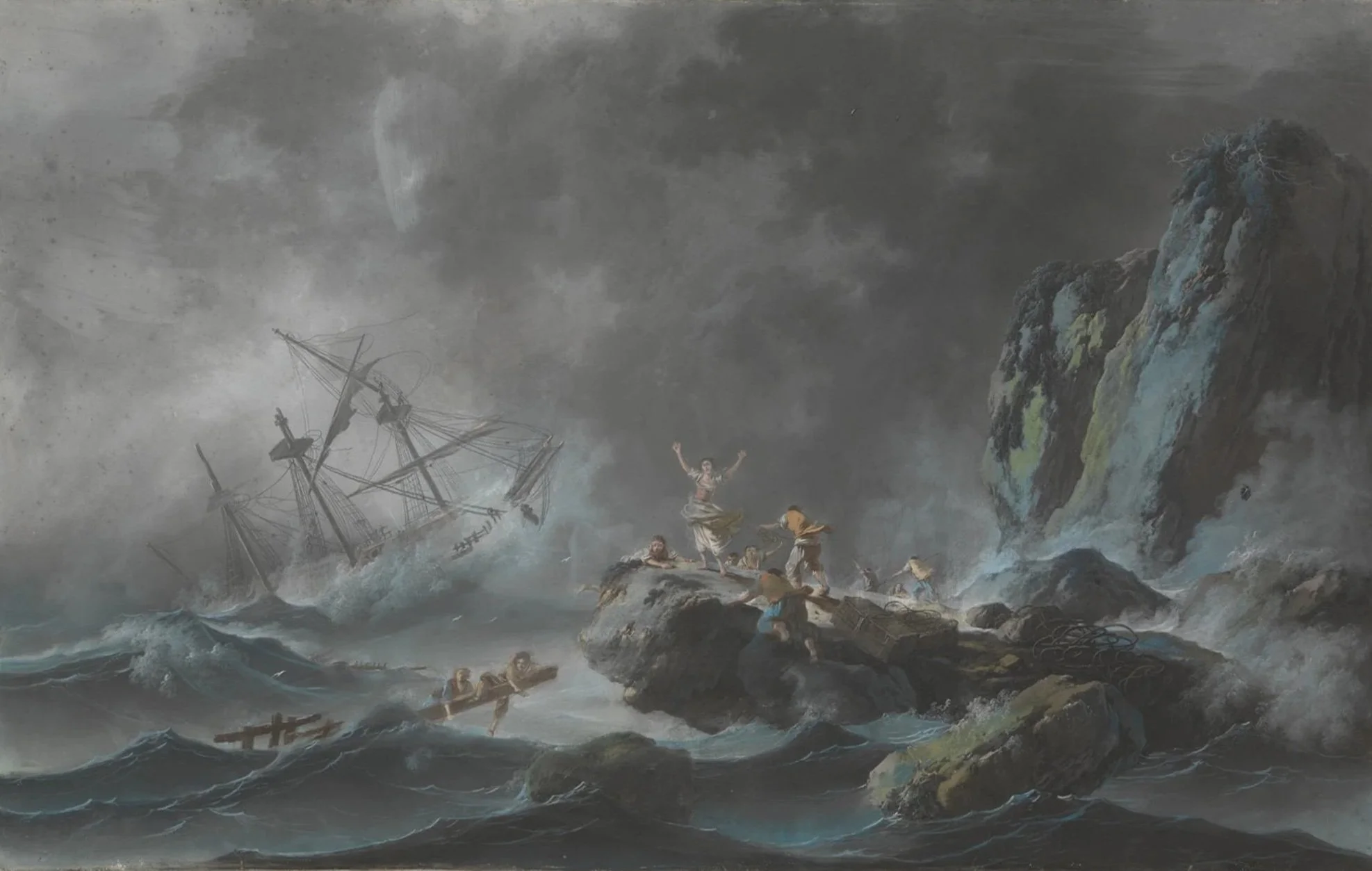
Jean-Baptiste Pillement (1728–1808) A Shipwreck in a Storm
Why This Question Matters
The word apostasy is often used loosely. A society becomes irreligious and people call it apostasy. A churchman says something erroneous and he is called an apostate. A Catholic stops attending Mass and is described as having apostatized.
Traditional Catholic theology is more exact.
A person may commit a grave sin without abandoning Christianity.
A Catholic may become a heretic while continuing to profess Christ.
Someone may cease practising the Faith through indifference while still professing to believe it.
None of those situations is automatically identical with apostasy in the strict canonical sense.
The distinction matters even more when interpreting biblical prophecy. St Paul's prophecy of a great apostasia should not become a label that Catholics attach to every period of ecclesiastical disorder. At the same time, Scripture plainly does teach that a profound religious defection precedes the final confrontation between Christ and Antichrist.
The purpose of studying these prophecies is therefore not to calculate dates or identify every contemporary event with a verse of Daniel. Christ's repeated command is rather to
watch,
remain faithful and
persevere.
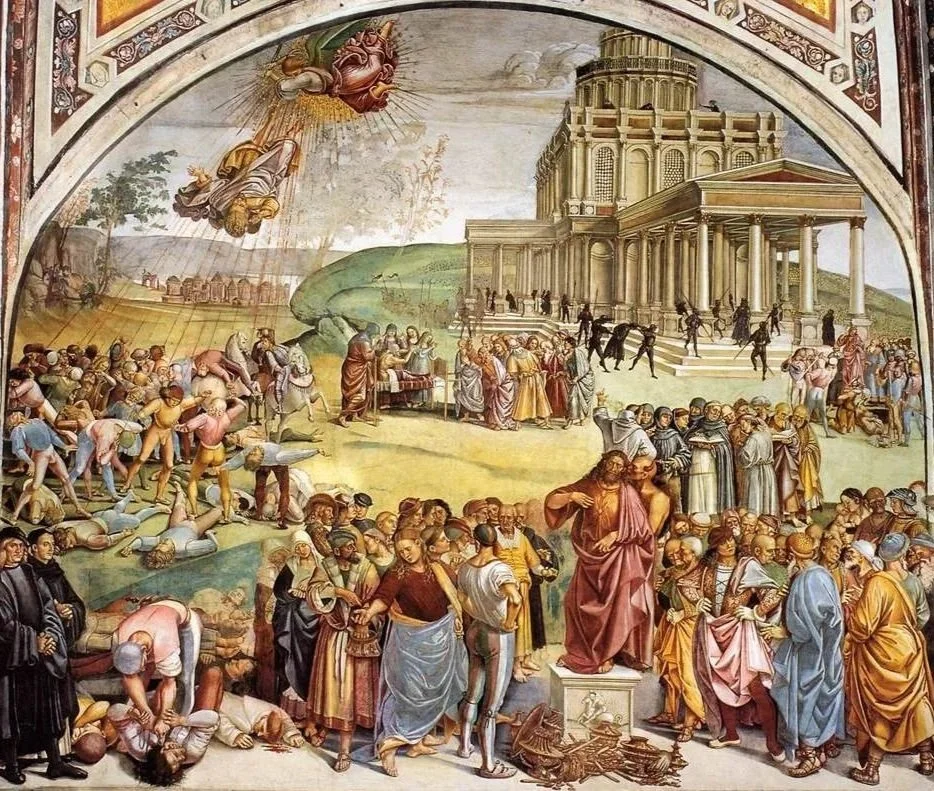
Luca Signorelli, Sermon and Deeds of the Antichrist (1499–1502), San Brizio Chapel, Orvieto Cathedral. The fresco depicts the deception associated with Antichrist and the final conflict between truth and falsehood foretold in Sacred Scripture.

Luca Signorelli, Sermon and Deeds of the Antichrist detail.
The Antichrist is depicted with Christ-like features while Satan whispers into his ear, symbolising the final religious deception foretold in Scripture.
What the Catholic Church Teaches
Apostasy Is Not the Same as Heresy
Canon 1325 §2 of the 1917 Code of Canon Law provides an unusually concise distinction. 1917 Code of Canon Law — Canon 1325
| Category | What It Means | Example |
|---|---|---|
| Heresy | Pertinacious denial or doubt, after Baptism, of one or more truths that must be believed by divine and Catholic faith, while still retaining the Christian name | A baptized person continues to call himself Christian but obstinately rejects a revealed dogma proposed by the Church |
| Apostasy | The complete abandonment of the Christian faith by a baptized person | A baptized Christian wholly rejects Christianity and no longer professes the Christian faith |
| Schism | Refusal of submission to the Roman Pontiff or refusal of communion with members of the Church subject to him | A person professes the Christian faith but deliberately separates himself from the Church's legitimate ecclesiastical unity |
| Material doctrinal error | An erroneous belief held without the knowledge or pertinacity required for formal heresy | A baptized person misunderstands a Catholic doctrine but remains willing to accept the Church's teaching when corrected |
Thus a Catholic who becomes Protestant ordinarily has not abandoned Christianity altogether; the relevant questions would concern heresy and schism.
A Catholic who repudiates Christ and Christianity in order to become an atheist, Muslim, Buddhist or adherent of another non-Christian religion presents the classic case of apostasy.
Neither ordinary temptation nor involuntary doubt constitutes apostasy. Nor should a person's interior state be presumed merely from confusion, ignorance or weakness.
There is also a distinction between the sin of apostasy and the external canonical delict. Canonical consequences presuppose the external conditions required by law; one cannot simply infer a canonical crime from hidden thoughts.
Apostasy Severs Ecclesiastical Membership
Pope Pius XII taught in Mystici Corporis Christi (1943) that membership in the Church requires
baptism,
profession of the true Faith and
continued unity with the Body.
He then specifically distinguished ordinary grave sin from those acts which sever ecclesiastical unity, naming schism, heresy and apostasy. (Vatican)
The 1917 Code treated external apostasy correspondingly seriously. Canon 2314 placed apostates from the Christian Faith alongside heretics and schismatics among those who incurred excommunication under the law then in force. (CanonLaw.Ninja)
This does not mean that every sinner ceases to be a Catholic. Pius XII explicitly taught the opposite. Mortal sin destroys sanctifying grace; apostasy concerns the Faith itself and therefore has additional ecclesiological consequences.
Scripture Warns That Christians Really Can Fall Away
The New Testament repeatedly warns baptized believers against falling from the Faith.
Hebrews 6:4–8 speaks of those who have been enlightened and tasted heavenly gifts yet fall away.
Hebrews 10:26–29 warns of terrible consequences for one who has been sanctified and afterwards rejects God's grace.
2 Peter 2:20–22 describes people who escaped the pollution of the world through Christ but became entangled in it again.
Our Lord warns that a branch once joined to the vine can fail to remain in Him and be cast away in John 15:5–6.
St Paul warns Christians: “he that thinketh himself to stand, let him take heed lest he fall” in 1 Corinthians 10:12.
The Scripture compilation prepared for this series likewise gathers Hebrews 6, Hebrews 10 and 2 Peter 2 among the texts demonstrating the real possibility of falling away after having believed.
This is one reason Catholic teaching has never accepted the proposition that a person who has once genuinely believed can never subsequently abandon the Faith.
The Great Apostasy in Sacred Scripture
St Paul's Prophecy in 2 Thessalonians
The most explicit biblical prophecy occurs in 2 Thessalonians 2.
The Thessalonians had apparently become alarmed that the Day of the Lord was already imminent. St Paul corrects them:
“Unless there come a revolt first, and the man of sin be revealed…”
The chapter then describes the man of sin, the “son of perdition,” who exalts himself against God, the already-operative “mystery of iniquity,” extraordinary deception and lying signs, and finally Christ destroying the wicked one at His coming.
There is therefore a basic biblical progression:
mystery of iniquity already at work → revolt or apostasy → revelation of the man of sin → extraordinary deception → return of Christ → destruction of Antichrist
Not every detail has received one unanimous interpretation. Traditional commentators differed concerning exactly what St Paul meant by the “revolt” and by the power which presently “withholdeth” Antichrist.
George Leo Haydock's nineteenth-century Catholic commentary records several traditional interpretations.
One concerns the dissolution of the Roman Empire;
another understands the apostasy particularly in relation to Antichrist himself;
a third, described by Haydock as a common interpretation, understands it as a great falling away of large numbers from the Catholic Faith in countries where it had previously been professed.
Haydock simultaneously insists that this cannot mean the disappearance or doctrinal defection of the Catholic Church herself. (Bible Hub)
That qualification is essential.
The Roman Catechism Gives Us a Firm Framework
The Catechism of the Council of Trent does not attempt to settle every disputed detail of 2 Thessalonians. It does, however, state clearly that three principal signs will precede the General Judgment:
the Gospel preached throughout the world → defection from the Faith → Antichrist
It grounds the first in Matthew 24:14 and the latter signs in 2 Thessalonians 2. (Sancta Clara Press)
Thus the existence of a great final defection is not merely an exotic interpretation invented by later prophecy writers. Precisely how all the prophetic passages fit together is another question.
Other Biblical Signs of the Final Defection
Our Lord's discourse on the Mount of Olives contains several related warnings.
In Matthew 24, Christ foretells
religious deception,
false Christs,
persecution,
betrayal,
false prophets and
a chilling of charity.
He says that the Gospel will be preached throughout the world before the consummation, refers explicitly to Daniel's “abomination of desolation,” foretells severe tribulation and warns that false Christs and false prophets will attempt to deceive even the elect. Matthew 24
But Christ also explicitly warns against treating every upheaval as proof that the end has arrived. Concerning wars and disturbances, He says that these things must occur, “but the end is not yet.”
Similarly, St Paul says:
“In the last times some shall depart from the faith…” in 1 Timothy 4:1.
In Luke 18:8, Christ asks the haunting question whether the Son of Man, when He comes, will find faith upon the earth.
And 2 Timothy 4:3–4 foretells a time when men will refuse sound doctrine and turn their hearing away from truth.
Taken together, these passages point toward an intensified conflict between truth and religious deception as history approaches its consummation.
The Abomination of Desolation
Daniel's Prophecy
The expression occurs repeatedly in Daniel.
Daniel 9:27 speaks of sacrifice failing and “the abomination of desolation” appearing in the Temple.
Daniel 11:31 speaks of the sanctuary being profaned, the continual sacrifice removed and the abomination established.
Daniel 12:11 again joins two ideas:
the continual sacrifice is taken away → the abomination unto desolation is established.
These prophecies therefore concern not merely general immorality but a direct assault upon true worship and the sanctuary of God.
Could This Relate to the Present Crisis?
Daniel’s prophecy concerns an attack upon true worship, sacrifice and the sanctuary of God. Its immediate historical setting involved the Temple at Jerusalem, but the New Testament also uses temple imagery for the Church and the Christian faithful:
“you are the temple of God” (1 Corinthians 3:16–17; Ephesians 2:19–22).
This becomes especially significant in St Paul’s prophecy of Antichrist:
“So that he sitteth in the temple of God, shewing himself as if he were God.” — 2 Thessalonians 2:4
Some of the Fathers understood this “temple” in relation to the Church.
St John Chrysostom (c. AD 347–407) wrote that Antichrist would establish himself
“not in Jerusalem only, but also in every Church.” (St John Chrysostom)
St Augustine (AD 354–430) said that the passage might refer either to the Temple of Solomon or to the Church, and recorded the interpretation that Antichrist and his followers could present themselves as though they themselves were the true temple of God—the Church. (St Augustine)
St Thomas Aquinas (c. 1225–1274) likewise preserved the interpretation that the “temple of God” may signify the Church.
This does not mean that the true Catholic Church herself could become apostate. Christ promised that the gates of hell would not prevail against His Church and that He would remain with her until the end of the world. The Church is indefectible.
But this raises a serious question when considering the post-Vatican II crisis. If doctrines, worship or religious principles contrary to the traditional Catholic Faith were introduced by men apparently occupying Catholic institutions, the conclusion could not simply be that the Catholic Church herself had defected.
The question would instead be:
Did the Catholic Church abandon the Faith—or did those who abandoned the Faith cease to represent the Catholic Church?
This is where the later question of sedevacantism begins.
The sedevacantist argument is not that the Catholic Church became apostate. It argues precisely the opposite:
because the Church cannot defect, public departure from the Catholic Faith raises questions concerning Church membership and ecclesiastical office.
Nor can the issue be decided merely by possession of Catholic buildings, institutions and titles. These are important visible elements of the Church, but they cannot make a religion Catholic if the Catholic Faith itself has been abandoned.
Put simply:
They may possess the buildings and institutions; the decisive question is whether they have preserved the Catholic Faith.
None of this proves that Vatican II or the Novus Ordo is the final “abomination of desolation.” Biblical prophecy alone cannot establish that conclusion. But the traditional interpretation makes the possibility of a final religious deception appearing within, or under the outward appearance of, the Church especially significant.
The biblical pattern is therefore worth keeping in mind:
attack upon the Faith → corruption or suppression of true worship → religious deception → persecution of the faithful → eventual victory of Christ.
Whether the present crisis fits that pattern must be examined from Catholic doctrine concerning indefectibility, heresy, Church membership and ecclesiastical office—questions addressed later in this series.
Antiochus Epiphanes as a Foreshadowing
There is an important biblical pattern of historical event → type → greater final fulfilment.
Antiochus IV Epiphanes attempted to suppress the Jewish religion, profaned the Temple and imposed pagan worship in the second century before Christ. The pre-Vatican II Catholic Encyclopedia describes how the Temple was dedicated to Zeus and pagan sacrifice imposed in place of the worship of God. (New Advent)
But Christian tradition did not necessarily regard Antiochus as exhausting Daniel's prophecy.
St Jerome (c. AD 347–420), in his Commentary on Daniel, interpreted the actions of Antiochus as occurring in a preliminary way as a type of Antichrist, who would later exalt himself against God. (Catena Bible & Commentaries)
Likewise, material preserved from St Hippolytus of Rome (c. AD 170–235) distinguishes Antiochus's historical desecration from a future and more universal abomination associated with Antichrist. (New Advent)
The pattern is therefore:
| Shadow or Preliminary Fulfilment | Historical Reality | Greater Eschatological Fulfilment |
|---|---|---|
| Antiochus Epiphanes | True worship suppressed and the Temple profaned | Antichrist wages a final assault upon God and true religion |
| Removal of the continual sacrifice | Temple sacrifice interrupted | Daniel's language is traditionally applied by Catholic commentators to a final assault upon Christian sacrifice |
| Desecration of the sanctuary | Pagan worship imposed upon a holy place | The final “abomination of desolation,” whose precise form is not completely defined |
| Jerusalem's later destruction | Christ warns His disciples concerning the coming catastrophe | Jerusalem's judgment also anticipates the final judgment and tribulation |
The Old Testament event is therefore not merely an antiquarian episode. It provides a type of a still greater conflict between true worship and sacrilegious counterfeit worship.
Christ Applies Daniel's Prophecy
Christ Himself makes the connection:
“When therefore you shall see the abomination of desolation, which was spoken of by Daniel the prophet…” — Matthew 24:15
His discourse also concerns the destruction awaiting Jerusalem. This means that Catholic interpreters have long recognized both a nearer historical dimension and a more ultimate eschatological one. The 1907 Catholic Encyclopedia notes genuine interpretive disagreement over exactly what constituted the historical “abomination” associated with Jerusalem's destruction. (New Advent)
This prevents an overly simplistic interpretation in which every verse of Matthew 24 is forced exclusively into either AD 70 or the last days.
Prophecy can have a historical fulfilment that itself becomes a figure of a greater consummation.
Will the Holy Sacrifice Be Suppressed?
Here traditional Catholic commentary becomes particularly striking.
Haydock's commentary on Matthew 24:15 interprets Daniel's final fulfilment as connected with Antichrist and his precursors attempting to abolish the Holy Sacrifice of the Mass. It likewise records the interpretation of Daniel 12:11's removal of the “daily sacrifice” as referring ultimately to an attempted suppression of the Mass. (Haydock Commentary)
This deserves serious consideration, but its theological status must be kept clear.
It is traditional Catholic exegesis, not a solemnly defined dogma specifying exactly how Daniel 12:11 must be fulfilled.
Whether post-Vatican II liturgical changes represent doctrinal corruption must be established from the rites themselves, their theological content, the traditional doctrine of the Mass and the authoritative pre-Vatican II teaching of the Church. Questions of sacramental validity require a further distinct analysis concerning matter, form, minister and intention.
Prophecy may illuminate a demonstrated crisis. It cannot substitute for demonstrating it.
Nevertheless, the traditional expectation that the final crisis will involve an attack upon the Holy Sacrifice makes the history of Catholic worship in our own age a legitimate subject of serious examination.
Are We Living Through the Great Apostasy?
There are serious reasons to consider the possibility.
Christian belief has collapsed dramatically in many societies that were once overwhelmingly Christian. In the United States, for example, Pew's nationally representative 2023–24 Religious Landscape Study found that the proportion of adults identifying as Christian had fallen from 78% in 2007 to 62% in 2023–24, while the religiously unaffiliated had risen from 16% to 29%. Pew also notes that the decline appears to have levelled somewhat since about 2019, which is important context rather than evidence of uninterrupted collapse. The study surveyed 36,908 U.S. adults and therefore cannot simply be projected onto the entire world.
Nor is nominal Catholic identity equivalent to robust Catholic practice. A separate 2025 Pew survey found that among U.S. adults identifying as Catholic, 28% reported weekly Mass attendance and 23% annual confession. Again, these are American survey figures and are not measurements of canonical apostasy. They demonstrate weakened religious practice, not necessarily total individual repudiation of Christianity.
More important for this FAQ series is the doctrinal question. If the arguments established elsewhere concerning contradictions between perennial pre-Vatican II Catholic teaching and postconciliar teachings or practices are correct, the crisis is more significant than declining church attendance. A defection involving Christian doctrine and worship would bear a much closer relationship to St Paul's warning than ordinary secularisation alone.
But even that would not automatically prove:
“Therefore 2 Thessalonians 2:3 has now received its final and complete fulfilment.”
That conclusion involves eschatological interpretation in addition to doctrinal analysis.
St Cyril Gives Us an Important Warning
One of the most remarkable witnesses comes from St Cyril of Jerusalem (c. AD 315–386).
In his Catechetical Lecture XV, delivered around AD 348, St Cyril quotes St Paul's prophecy of the falling away and Antichrist. Looking at the Arian crisis and the religious confusion surrounding him, he says in substance that the falling away was already occurring: men were departing from right faith and heresy was appearing even within the Church.
He then immediately adds that Christians did not know whether the final events would occur in their own time or later. (New Advent)
That is extraordinarily relevant to us. St Cyril was not wrong to recognise apostasy around him. The fourth-century crisis was real. Yet he distinguished:
recognising the characteristics of apostasy → from claiming certain knowledge that the final prophetic sequence had arrived.
We should make the same distinction. The present crisis may prove to be the final Great Apostasy. It may be one of its immediate preparations. Or it may constitute an enormous historical apostasy that anticipates an even more explicit final revolt.
We do not presently possess divine certainty about which of those alternatives is true.
The Great Apostasy Cannot Mean the Catholic Church Herself Becomes False
This is a crucial Catholic qualification. Christ promised:
“The gates of hell shall not prevail against it.” — Matthew 16:18
and:
“Behold I am with you all days, even to the consummation of the world.” — Matthew 28:20
The biblical material assembled for this FAQ series likewise places these promises alongside Daniel 2:44, Daniel 7:14 and Ephesians 3:21 as testimony to the perpetuity of Christ's Church.
Accordingly, the final apostasy can involve enormous numbers of nominal Christians, nations, clergy or other persons falling away. It cannot mean that
Christ's true Church itself becomes a false religion, officially defects from the Faith, and ceases to be Christ's indefectible Church.
Haydock makes the same point while discussing the common interpretation of the final apostasy as a mass falling away: the Church remains visible and Catholic in her faith until the end. (Bible Hub)
This distinction becomes highly important when considering the post-Vatican II crisis. The theological question is not whether Christ's true Church could abandon the Faith. Catholic doctrine excludes that possibility. The question becomes how Catholic ecclesiology accounts for apparent public doctrinal defection among persons or institutions claiming ecclesiastical authority.
That leads into the separate questions of heresy, Church membership, ecclesiastical office, indefectibility and ultimately the sedevacantist thesis. Those arguments must be established on their own theological and canonical foundations rather than merely asserted from prophecy.
What Are the Signs?
The principal scriptural and traditional indications can be summarized as follows:
| Sign | Principal Source | What Can Safely Be Said |
|---|---|---|
| Gospel preached among the nations | Matthew 24:14; Roman Catechism | A principal sign preceding the consummation |
| Defection from the Faith | 2 Thessalonians 2:3; Roman Catechism | A major apostasy or revolt precedes the final judgment |
| Religious deception | Matthew 24:4–5, 11, 23–24; 2 Thessalonians 2:9–12 | False teaching and extraordinary deception intensify |
| Charity grows cold | Matthew 24:12 | Moral and spiritual deterioration accompanies the crisis |
| Persecution and betrayal | Matthew 24:9–10 | The faithful undergo severe trial |
| Antichrist / man of sin revealed | 2 Thessalonians 2:3–10 | A principal sign explicitly taught in Scripture |
| Abomination of desolation | Daniel 9; 11; 12; Matthew 24:15 | Has historical types and an eschatological application; exact final form disputed |
| Assault upon true sacrifice | Daniel 12:11; traditional Catholic exegesis | Traditionally associated by commentators with an attempt to suppress the Mass |
| Severe final tribulation | Matthew 24:21–24 | A great trial accompanied by deception |
| Visible return of Christ | Matthew 24:27–31; 2 Thessalonians 2:8 | Christ Himself ends Antichrist's dominion |
| Resurrection and judgment | Daniel 12:2; Catholic Creed | The dead rise and Christ judges mankind |
Notice what does not constitute a sufficient proof by itself: wars, earthquakes, epidemics or political turmoil. Christ mentions such events but expressly warns that “the end is not yet.”
The specifically religious signs—loss of faith, deception, Antichrist, persecution and the assault upon true worship—are far more important.
What Happens Next?
If the final Great Apostasy is indeed underway, Scripture directs attention not toward a human political solution but toward the climactic religious conflict.
St Paul says the man of sin will be revealed and that his coming will involve exceptional satanic deception and “lying signs and wonders.”
Those who reject the truth become vulnerable precisely because they have refused “the charity of the truth.” (2 Thesalonians 2)
St Cyril and other Fathers understand this in terms of a personal final Antichrist. St Augustine likewise says that 2 Thessalonians 2 concerns Antichrist and the Day of Judgment, although he openly admits uncertainty regarding some details—including the precise meaning of the “temple” in which Antichrist sits. (New Advent)
Matthew 24 then describes extraordinary deception and tribulation, after which Christ's coming will not be secret or ambiguous:
“As lightning cometh out of the east, and appeareth even into the west: so shall also the coming of the Son of man be.”
St Paul says Christ will destroy the wicked one “with the manifestation of his advent.”
Daniel 12 then looks beyond the tribulation to the resurrection:
“Many of those that sleep in the dust of the earth shall awake…”
some to everlasting life and others to everlasting reproach. Thus the final Christian hope is not Antichrist, catastrophe or ecclesiastical crisis.
It is the return and victory of Jesus Christ.
The Main Objection
A reasonable objection is this:
Christians in almost every troubled age have thought they were living in the last days. The Roman persecutions, Arian crisis, collapse of Rome, medieval plagues, Protestant revolt and modern wars have all been interpreted apocalyptically. Why should the present age be different?
Response
The objection contains an important truth. The example of St Cyril demonstrates that even a Church Father could look upon his own age and see striking elements of the foretold falling away. That should cure Catholics of reckless date-setting. But it does not follow that the Great Apostasy therefore does not exist.
The proper conclusion is more precise:
earlier apostasies can be genuine historical manifestations or anticipations of the same mystery of iniquity without necessarily constituting its final manifestation.
St Paul himself says that the “mystery of iniquity” was already working in the apostolic age. History can therefore contain repeated anticipations of the final conflict.
Antiochus similarly really desecrated the Temple; Jerusalem really was destroyed; early heresies really constituted departures from the Faith. Yet the Fathers could see those events as types or precursors of something greater still. The same method should govern our assessment of the present crisis.
What We Can and Cannot Conclude
What Catholic Doctrine and Scripture Establish
Apostasy is the total abandonment of Christianity by one who has received baptism.
Heresy is different: it involves pertinacious denial or doubt of revealed Catholic truth while the person retains the Christian profession.
A final defection from the Faith will precede the General Judgment. The Roman Catechism expressly identifies it as one of the three principal signs.
Antichrist precedes Christ's return.
Christ's Church cannot completely defect or cease to exist.
Christ will ultimately overcome Antichrist and return visibly in glory.
The resurrection of the dead and General Judgment follow the consummation of history.
What Is Strong Traditional Catholic Interpretation
The final apostasy will involve an extensive falling away of formerly Christian peoples. Antiochus Epiphanes is a historical type of the final Antichrist.
Daniel's removal of the continual sacrifice has traditionally been understood by important Catholic commentators as foreshadowing an attempt to suppress the Holy Sacrifice of the Mass.
The final Antichrist is understood by the mainstream patristic tradition as a personal adversary, although many lesser “antichrists” and precursors already operate throughout Christian history.
What Remains Disputed or Uncertain
We cannot yet demonstrate with certainty that our present crisis is the terminal Great Apostasy of 2 Thessalonians 2.
The exact identity of the force or person who “withholdeth” Antichrist in 2 Thessalonians 2 has been disputed since patristic times. The exact meaning of Antichrist sitting in the “temple of God” has likewise received differing interpretations. St Augustine expressly acknowledged the uncertainty. (New Advent)
The exact manner in which Daniel's abomination and cessation of sacrifice will receive their final fulfilment has not been solemnly defined. The prophetic periods of Daniel should not be used to manufacture confident calendars for Christ's return. And no present individual should be identified as the Antichrist merely because he is wicked, heretical or politically powerful.
Christ Himself warns:
“Of that day and hour no one knoweth.” — Matthew 24:36
Conclusion
Apostasy is the total abandonment of the Christian Faith. It is therefore more radical than heresy, in which a baptized person continues to profess Christianity while pertinaciously denying or doubting a revealed truth that must be believed with divine and Catholic faith.
Sacred Scripture also foretells a far greater defection from the Faith before the return of Christ. St Paul speaks of a “revolt” preceding the revelation of the man of sin in 2 Thessalonians 2, while Our Lord warns of widespread deception, false prophets, persecution and the “abomination of desolation” foretold by Daniel.
Daniel’s prophecy is especially striking because the abomination is associated with the profanation of the sanctuary and the suppression of true sacrifice. Historically, this had preliminary fulfilments in the persecution of Antiochus Epiphanes and the destruction of Jerusalem. Yet the Fathers also looked beyond those events toward the final crisis under Antichrist.
Significantly, some traditional interpreters understood St Paul’s “temple of God” not only as a physical temple but also in relation to the Church. This raises the possibility that the final religious deception may appear not simply as open persecution from outside Christianity, but under the outward appearance of Christian or ecclesiastical authority.
That possibility gives the present Catholic crisis particular importance. It would be premature to declare that Vatican II, the Novus Ordo or the present ecclesiastical situation is certainly the final Great Apostasy or the final abomination of desolation. Biblical prophecy by itself cannot establish such a conclusion.
But Catholic doctrine gives us one firm principle:
the true Catholic Church cannot apostatize, defect from the Faith or become the teacher of a false religion.
Therefore, if it can be demonstrated that men or institutions claiming Catholic authority have publicly departed from the Catholic Faith, the solution cannot be that Christ’s Church herself failed. The question must instead become:
Did the Catholic Church abandon the Faith—or did those who abandoned the Faith cease to represent the Catholic Church?
This is the point at which the questions of indefectibility, public heresy, membership in the Church, ecclesiastical office and sedevacantism become unavoidable. Possession of Catholic buildings, institutions, titles and historical structures is not, by itself, sufficient to establish Catholic identity if continuity of the Catholic Faith has been lost.
The biblical pattern is therefore worth remembering:
true worship → attack upon the Faith → suppression or corruption of worship → religious deception → persecution of the faithful → triumph of Christ
Whether our own age constitutes the final fulfilment of that pattern cannot yet be stated with certainty. But the parallels are serious enough to require careful examination rather than dismissal.
The Christian response, however, is not speculation, panic or date-setting. It is exactly what St Paul commanded after describing the coming apostasy and Antichrist:
“Therefore, brethren, stand; and hold the traditions which you have learned.” — 2 Thessalonians 2:15
Whatever stage of history we are living through, the duty remains the same:
hold fast to the Catholic Faith, reject error, remain faithful to the true worship of God, pray, do penance and persevere in grace.
For the final word belongs not to apostasy, Antichrist or desolation, but to Jesus Christ.
“He that shall persevere to the end, he shall be saved.” — Matthew 24:13
Primary Sources
2 Thessalonians 2 — the revolt, man of sin and coming of Christ
Matthew 24 — abomination of desolation and the coming of Christ
Daniel 12 — cessation of sacrifice, tribulation and resurrection
Roman Catechism — Article VII on the signs preceding the General Judgment
Further Reading
Related Questions
What Is Heresy?
What Is Schism?
Can a Heretic Remain a Member of the Catholic Church?
Who Is the Antichrist?
What Does the Catholic Church Teach About the End Times?
Can the Catholic Church Ever Defect from the Faith?
Did Vatican II Depart from the Catholic Faith?
What Happens to Ecclesiastical Office When a Cleric Publicly Abandons the Faith?