What Did Catholicism Teach Before Vatican II?
Short Answer
Before the Second Vatican Council opened in 1962, Catholicism presented itself with remarkable clarity as the
“one true religion revealed by God and the Catholic Church as the one visible Church founded by Jesus Christ.”
Christ had entrusted His Church with divine authority to teach, govern and sanctify; the Roman Pontiff was the successor of St Peter and visible head of the Church; the Mass was the true Sacrifice of Christ sacramentally offered upon the altar; the priesthood was a divinely instituted sacramental order; the Holy Eucharist was truly the Body, Blood, Soul and Divinity of Jesus Christ; and salvation came through Christ and His Church.
The same Catholicism taught
that Christ was King not merely of private consciences but of families, nations and human society;
that religious error possessed no claim equal to revealed truth;
that Christian unity meant return to the unity of Christ's Catholic Church rather than the permanent coexistence of contradictory denominations; and
that missionary work was directed toward the conversion of peoples to Jesus Christ, baptism, the Catholic Faith and eternal salvation.
These themes are explicit in the pre-conciliar papal Magisterium of Leo XIII, St Pius X, Pius XI and Pius XII.
But Catholicism before Vatican II was not merely a collection of propositions in theological books. It formed an entire sacramental culture.
Churches looked sacred.
Mass sounded and appeared unlike ordinary life.
The priest faced the altar in sacrificial worship.
Latin predominated in the Roman Rite.
Women ordinarily covered their heads; men removed theirs hats.
Catholics genuflected toward the tabernacle.
Holy Communion was ordinarily received kneeling and on the tongue.
Confession, fasting, Friday abstinence, Holy Days of Obligation, Benediction, Eucharistic processions, the Rosary, parish missions and the liturgical seasons shaped ordinary Catholic existence.
Catholic families tended to be larger.
Priests, seminarians, nuns and religious brothers were highly visible.
Catholic schools, hospitals, convents, monasteries, seminaries and missions multiplied.
Missionary activity was expanding.
The Papacy possessed immense public visibility, and
papal teaching addressed not merely internal Church affairs but marriage, medicine, politics, economics, education, communism, war, peace and public morality.
Even those who rejected Catholic claims could not easily ignore Rome.
This makes the historical setting of Vatican II particularly important.
The previous ecumenical council, Vatican I, had been suspended in October 1870.
Vatican II opened in October 1962—almost exactly 92 years later.
Before Vatican I, more than three centuries had passed since Trent. Ecumenical councils were therefore extraordinary events, not the ordinary mechanism by which the Church governed herself. (Vatican)
And the Pope who convoked Vatican II did not describe the Church as dying.
In Humanae Salutis of 25 December 1961, John XXIII contrasted a spiritually troubled modern world with the Church of Christ “flourishing with vitality.”
He presented the Council primarily as a means of bringing the perennial power of the Gospel to the changed conditions of the modern world. (Vatican)
That leaves the reader with an important historical question:
If the Church entering the 1960s was doctrinally confident, missionary, vocationally strong, internationally respected and described by John XXIII himself as flourishing with vitality, what precisely required another ecumenical council—and why was the remedy chosen a radically different kind of council from many that had preceded it?
That question should be answered from the evidence.
Why This Question Matters
It is impossible to understand Vatican II merely by starting with Vatican II.
Before asking whether a teaching was developed, altered or contradicted, one must know what the Catholic Church had already taught. Before evaluating liturgical reform, one must know what Catholic worship actually looked like. Before assessing later statistics concerning Mass attendance, vocations, religious life or missionary activity, one must understand the Church that entered the Council.
This article therefore establishes the baseline. It does not assume that everything old was immutable. Nor does it claim that every Catholic in 1955 was devout, every priest holy, every Catholic country healthy, or every parish flourishing. The question is more precise:
What did the Catholic Church teach, how did Catholics worship, what kind of ecclesiastical culture existed, and what condition was the Church actually in when Vatican II was convoked?
Only after answering that can the later contrast be examined fairly.
What the Catholic Church Taught
Christ Founded One Visible Church
Pre-conciliar Catholicism did not understand the Church merely as the invisible collection of everyone who sincerely believed in Christ. Christ established a visible society. He gave St Peter the keys of the Kingdom:
“And I say to thee: That thou art Peter; and upon this Rock will I build my Church, and the gates of Hell shall not prevail against it.
And I will give to thee the keys of the Kingdom of Heaven. And whatsoever thou shalt bind upon earth, it shall be bound also in the Heavens: and whatsoever thou shalt loose in earth, it shall be loosed also in the Heavens.” Matthew 16:18–19
He commanded His Apostles to teach all nations:
“And Jesus coming near spake unto them, saying: All power is given to me in Heaven and in earth. Going therefore teach ye all Nations: Baptizing Them in The Name of The Father, And of The Son, And of The Holy Ghost, teaching them to observe all things whatsoever I have commanded you: and behold I am with you all days, even to the consummation of the world.” Matthew 28:18–20
St Paul called the Church:
“the pillar and ground of the truth.” 1 Timothy 3:15
This visible understanding reaches back to the earliest centuries.
St Ignatius of Antioch (c. AD 35–107), in his Letter to the Smyrnaeans (c. AD 107), connected the Eucharist, the bishop and the visible Catholic Church. He spoke of the Eucharist as the flesh of Christ and famously wrote that where Jesus Christ is, there is the Catholic Church. (New Advent)
St Irenaeus of Lyons (c. AD 130–202), in Against Heresies III.3.1–3 (c. AD 180), answered heretics by appealing to the public succession of bishops from the Apostles and particularly to the succession of the Roman Church. (New Advent)
The Church was therefore:
visible → hierarchical → apostolic → sacramental → doctrinally united.
This is the ecclesiological world within which Vatican II must later be examined.
The Pope, Successor of St Peter, Was the Visible Head of the Universal Church
The First Vatican Council (1869–1870) defined the primacy of the Roman Pontiff. The Pope was not understood merely as the first among independent bishops or as the symbolic spokesman of a federation of local churches. As successor of St Peter, he possessed supreme jurisdiction over the universal Church.
Vatican I also defined papal infallibility under precisely specified conditions.
This did not mean that every papal remark was inspired or that popes were personally sinless. It meant that Christ had established a teaching office whose definitive exercise in faith and morals could not lead the whole Church into error.
The Catholic attitude toward Rome followed logically from this theology.
For Catholics, the Pope was the Vicar of Christ on earth and the visible head of the Church.
Non-Catholics obviously did not accept that doctrinal claim. Nevertheless, by the mid-twentieth century the Papacy had become an unusually visible international moral voice.
Pius XII routinely addressed not only bishops and clergy but governments, diplomats, physicians, surgeons, scientists, psychologists, teachers, journalists, military representatives and political leaders. His 1958 public addresses alone illustrate the enormous range of subjects on which Rome was expected to speak. (Vatican)
The Pope was expected to speak about truth and error, marriage and family, medicine and morality, peace and war, communism and materialism, education, social justice and man's obligations before God.
Rome did not present itself principally as a commentator on contemporary events. It spoke as a teaching authority.
The Mass Was a Sacrifice
The Council of Trent taught definitively that the Mass is a true and proper sacrifice.
Calvary occurred once. The Mass does not crucify Christ again. Rather, the same divine Victim who offered Himself bloodily upon Calvary is sacramentally offered in an unbloody manner through the ministry of the priest.
Pius XII's Mediator Dei (1947) reaffirmed this entire sacrificial theology and described the Eucharist as containing Christ truly, really and substantially. He also explained the adoration due to Christ present in the Blessed Sacrament. (Vatican)
Consequently, the Mass was not principally understood as a meeting of the Christian community with a Eucharistic meal attached. It was first the Holy Sacrifice of the Mass.
Communion followed sacrifice.
The Priesthood Was Sacramental
The Catholic priest was not understood merely as a community leader. Through the Sacrament of Holy Orders he received an objective sacramental character and powers which the laity did not possess.
The intimate relationship between priesthood and sacrifice was fundamental.
The Catholic priest stood at the altar to offer the Holy Sacrifice in the person of Christ according to the Church's sacramental theology.
The laity genuinely participated in the Mass—praying, offering themselves spiritually and receiving the Sacrament—but Pius XII explicitly rejected any understanding that erased the essential distinction between the ministerial priesthood and the common priesthood of the faithful. (Vatican)
Biblical Foreshadowing Made This Worship Intelligible
Catholic worship understood the New Covenant as the fulfilment of what God had prepared in the Old.
| Type or Shadow | Old Testament Reality | Greater Fulfilment |
|---|---|---|
| Melchizedek | Priest-king associated with bread and wine | Christ the eternal High Priest and the Eucharistic Sacrifice |
| Isaac | The beloved son carries the wood of sacrifice | Christ carries the Cross and willingly offers Himself |
| Passover Lamb | The spotless victim is slain, its blood saves, its flesh is eaten | Christ is the true Paschal Lamb, sacrificed and received sacramentally |
| Manna | Bread from heaven sustains Israel | Christ is the true Bread from Heaven |
| Temple and altar | Consecrated worship and sacrifice | The perfect Sacrifice of Christ and Christian sacramental worship |
| Old Covenant priesthood | Priests offer sacrifice | Christ the High Priest and the sacramental priesthood He establishes |
| Davidic kingship | God's anointed king rules Israel | Christ the universal and everlasting King |
This biblical world helps explain why the traditional Catholic church contained an altar, sanctuary, tabernacle, crucifix, priest, candles, sacred vessels, vestments and ritual actions.
They formed a theological whole.
Step Back in Time: Enter a Catholic Church Around 1955
This is where the difference becomes immediately visible. Imagine entering a busy Catholic parish on Sunday morning.
The church does not resemble an auditorium.
The sanctuary is clearly differentiated from the nave.
At its centre stands the altar.
Above or close to it is the crucifix.
The tabernacle occupies a conspicuous place of honour.
The sanctuary lamp indicates the Eucharistic Presence.
There may be side altars, statues, stained glass, carved wood or stone, candles and sacred paintings.
The effect varies according to the wealth and architectural style of the parish, but the underlying message is remarkably consistent: you have entered sacred space.
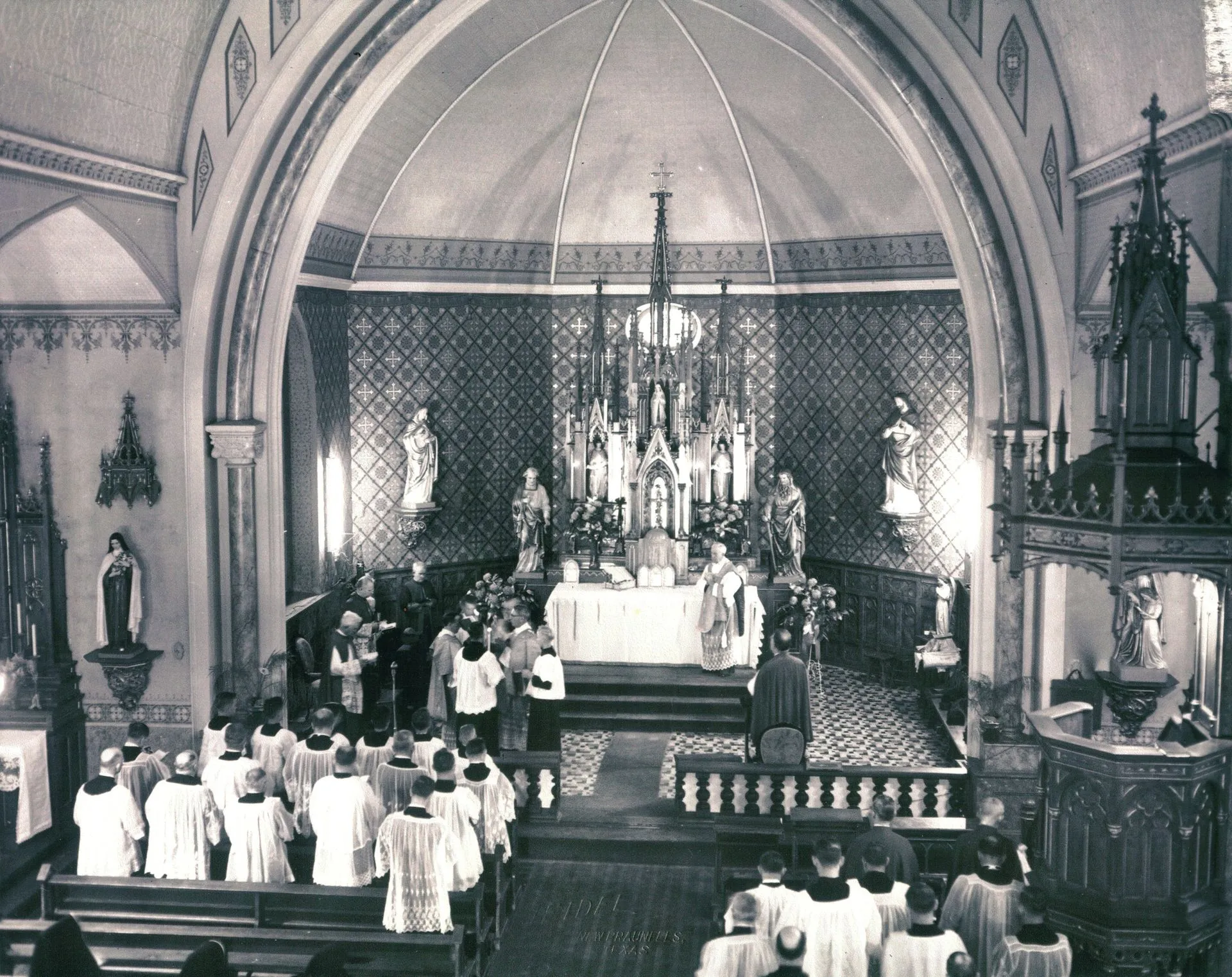
Traditional Catholic worship before Vatican II: the sanctuary, high altar and sacrificial orientation visibly distinguished the church from an ordinary meeting hall.
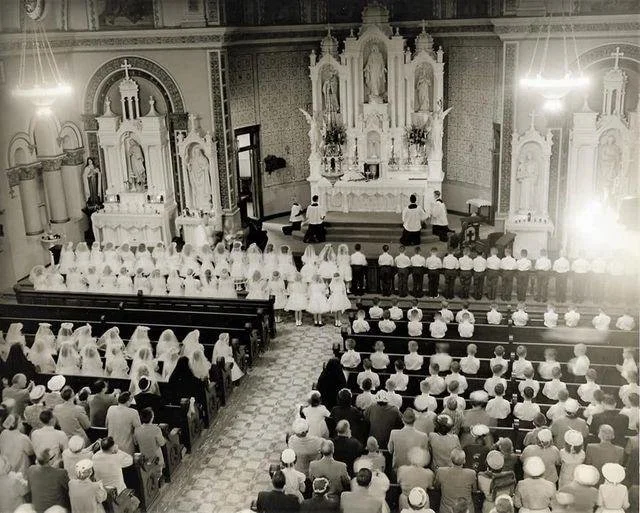
First Communion in a mid-twentieth-century Catholic parish. Formal dress, veils, altar servers and the traditional sanctuary reinforced the sacred character of the Sacrament.
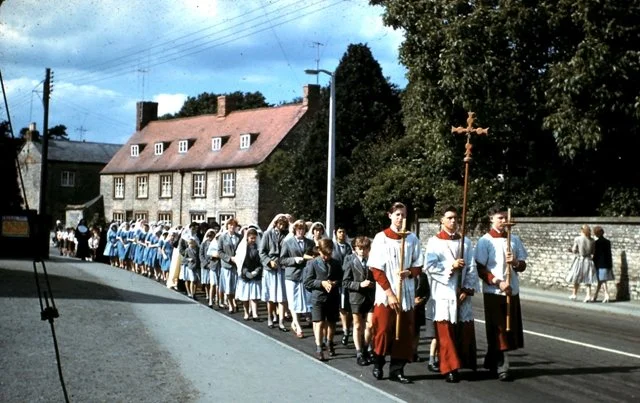
Corpus Christi procession, 1950s–60s. Catholic Eucharistic faith did not remain inside the church building: the Blessed Sacrament was carried publicly through towns and streets.
People Dressed for the House of God
The clothing also looked different.
Men commonly attended Sunday Mass in jackets, suits, shirts and ties or whatever respectable formal clothing their circumstances permitted.
Women generally wore dresses or skirts, frequently with hats, chapel veils or other head coverings.
These fashions were partly cultural, so one must not convert 1950s clothing styles into Catholic dogma. But head covering was more than social fashion.
Canon 1262 §2 of the 1917 Code of Canon Law prescribed that men ordinarily be bareheaded during sacred rites and that women have their heads covered and be modestly dressed, particularly when approaching Holy Communion. (Restore the 54)
The broader principle was unmistakable:
one did not approach divine worship as though entering an ordinary social venue.
Dress, posture and behaviour expressed reverence.
Silence, Genuflection and Reverence
Catholics entering the church blessed themselves with holy water.
They genuflected toward the tabernacle.
Many knelt in private prayer before Mass.
Conversation was generally subdued because the church was understood as the dwelling place of the Blessed Sacrament.
The theological reason mattered more than the custom itself. Catholics believed Someone was present.
Pius XII explained that the Eucharist permanently contains the Author of grace Himself and commended visits to the tabernacle, Benediction, Eucharistic exposition and solemn processions. (Vatican)
The genuflection therefore said physically what Catholic theology said intellectually:
Jesus Christ is really here.
The Roman Mass Was Normally in Latin
In the Latin Church, the traditional Roman Rite was normally celebrated in Latin. Pius XII called Latin a conspicuous sign of unity in the Church, although legitimate vernacular concessions existed and Latin itself was not a divinely revealed dogma.
The Roman Mass was marked by ritual precision, silence, bows, genuflections, signs of the Cross, sacred vestments, altar kisses, incense in solemn celebrations and prayers saturated with the language of sacrifice, sin, propitiation, judgment, grace and the saints.
Gregorian chant occupied a privileged position. The priest's liturgical action centred visibly upon God and the altar. The congregation was not treated as an audience watching a personality conduct proceedings.
Pius XII described authentic liturgical worship in terms of sacredness, nobility and universality, while encouraging genuinely worthy sacred art rather than simply freezing one artistic period forever. (Vatican)
Holy Communion Was Received With Visible Reverence
In the normal Roman practice of the period, the communicant did not take the consecrated Host into his own hands. The priest placed the Host directly upon the tongue. Where an altar rail was available, communicants ordinarily knelt. The posture itself was catechetical.
It communicated:
I am receiving God—not ordinary food.
This did not imply that Catholics were supposed to receive Communion rarely. St Pius X had strongly encouraged frequent and even daily Communion for Catholics properly disposed.
Traditional Eucharistic spirituality therefore joined two ideas which should not be separated:
receive frequently when properly disposed — and receive with profound reverence.
Catholics Fasted Before Receiving Communion
Eucharistic preparation also involved the body. For much of Catholic history the Latin discipline required fasting from midnight before receiving Holy Communion.
Pius XII relaxed that discipline in stages. In 1953 water ceased to break the Eucharistic fast under the revised discipline, and in 1957 the rules were reduced broadly to three hours for solid food and alcoholic beverages and one hour for other non-alcoholic beverages.
That is important because it demonstrates that discipline could change before Vatican II.
The length of the fast was not dogma. What remained constant was the principle:
Holy Communion requires preparation because the communicant is approaching the Body of Christ.
Confession Was Part of Normal Catholic Life
Traditional Catholic catechesis spoke plainly about:
mortal sin
venial sin
contrition
confession
sacrilege
sanctifying grace
judgment
heaven
purgatory
hell
a good death
A Catholic conscious of mortal sin was required to seek sacramental absolution before receiving Holy Communion. Confession was therefore not merely therapeutic conversation. It concerned reconciliation with God and the eternal destiny of the soul.
Regular parish confession times, parish missions and examinations of conscience belonged naturally to this Catholic world.
The spiritual rhythm was comprehensible:
sin → repentance → confession → absolution → Communion → perseverance in grace.
The Catholic Year Governed More of Life
Sunday was not the only religious day. The calendar contained feast days, penitential seasons, vigils, Ember Days, Holy Days of Obligation, Friday abstinence and the great cycles of Christmas and Easter.
Canon 1247 of the 1917 Code listed, in addition to every Sunday, universal feasts of precept including Christmas, the Circumcision, Epiphany, Ascension, Corpus Christi, the Immaculate Conception, the Assumption, St Joseph, Saints Peter and Paul, and All Saints—although legitimate local dispensations and reductions meant that the practical list differed by country. (Fatima Center)
Friday recalled the Passion.
Lent actually required bodily penance.
Advent prepared for Christmas.
Corpus Christi publicly honoured the Eucharist.
The Ember Days sanctified portions of the year.
Catholicism consequently entered time itself.
The Church calendar told the Catholic not only what to believe but when to feast, when to fast, when to mourn, when to rejoice and when to abstain.
Churches Were Intended to Be Beautiful
No particular architectural style is a Catholic dogma. A Romanesque basilica, Gothic cathedral, Baroque church and humble mission chapel can all be genuinely Catholic. But the governing assumption was that a church should look like a place consecrated to God.
The altar proclaimed sacrifice.
The tabernacle proclaimed Presence.
The crucifix identified the Victim.
The sanctuary differentiated sacred ministry from the nave.
Candles, incense, sacred images, statues, vestments and stained glass addressed the senses as well as the intellect.
Pius XII encouraged the worthy adornment of churches and altars and required liturgical furnishings to be appropriate to divine worship. Interestingly, he did not simply demand imitation of older artistic periods: he expressly permitted worthy modern sacred art while rejecting art inconsistent with the sanctity of the church. (Vatican)
Beauty was therefore not supposed to be empty decoration. It served theology. The building itself taught:
God is transcendent.
The sanctuary is sacred.
The Mass is sacrifice.
The Eucharist is adored.
Heaven is greater than ordinary earthly life.
Catholic Life Extended Far Beyond Sunday Mass
The parish contained more than Sunday worship. Catholics encountered:
the Rosary;
Stations of the Cross;
Benediction;
Forty Hours devotion;
Corpus Christi processions;
Sacred Heart devotion;
First Friday and First Saturday practices;
Marian devotions;
novenas;
parish missions;
retreats;
confraternities;
Catholic Action;
the Legion of Mary;
Eucharistic societies;
and numerous charitable and apostolic organisations.
Pius XII expressly commended visits to the Blessed Sacrament, Benediction, Eucharistic processions and public adoration. (Vatican)
Religion therefore entered the week, the family, education and public life.
Catholic Family Life Was Different
Catholic teaching presented marriage as sacred, permanent and ordered by nature toward the generation and education of children.
Children were not principally portrayed as obstacles to personal fulfilment.
They were blessings entrusted by God.
Large Catholic families therefore became a highly visible feature of many Catholic communities, particularly during the mid-twentieth-century baby boom. Historical demographic research confirms a marked Catholic fertility differential in the United States during that period and associates it partly with Catholic teaching and a distinctive Catholic family culture. (PubMed Central (PMC))
Pius XII addressed associations of large families in January 1958 and explicitly praised the generosity, responsibility and spiritual fruit that could arise within large Christian families. He also noted their historic connection with priestly and religious vocations. (Vatican)
Again, this does not mean every Catholic family had ten children. Nor should economic circumstances, infant mortality, national culture and the post-war baby boom be ignored. But the Catholic family ideal was recognisable. One might find:
family prayer;
grace before meals;
a crucifix and sacred images in the home;
the family Rosary;
Catholic schooling;
Friday abstinence;
Sunday Mass together;
preparation for First Communion and Confirmation;
several children;
and the possibility that one of those children might enter a seminary, convent or religious house.
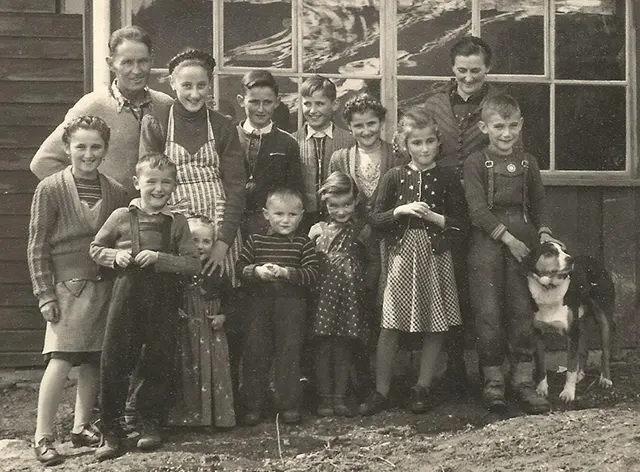
A big, happy family pictured in Germany, 1930.
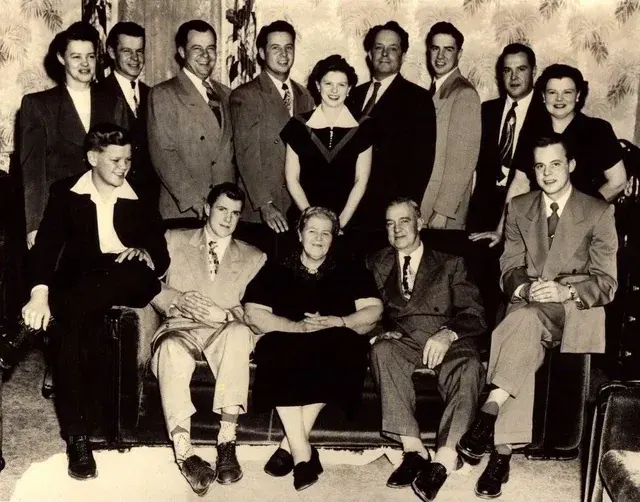
Grandparents and all 12 of their children.
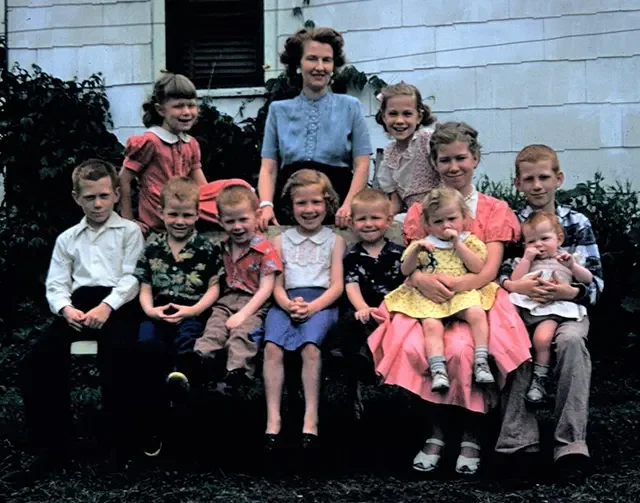
Mom and her first 11 kids in Iowa, 1957. She went on to have six more
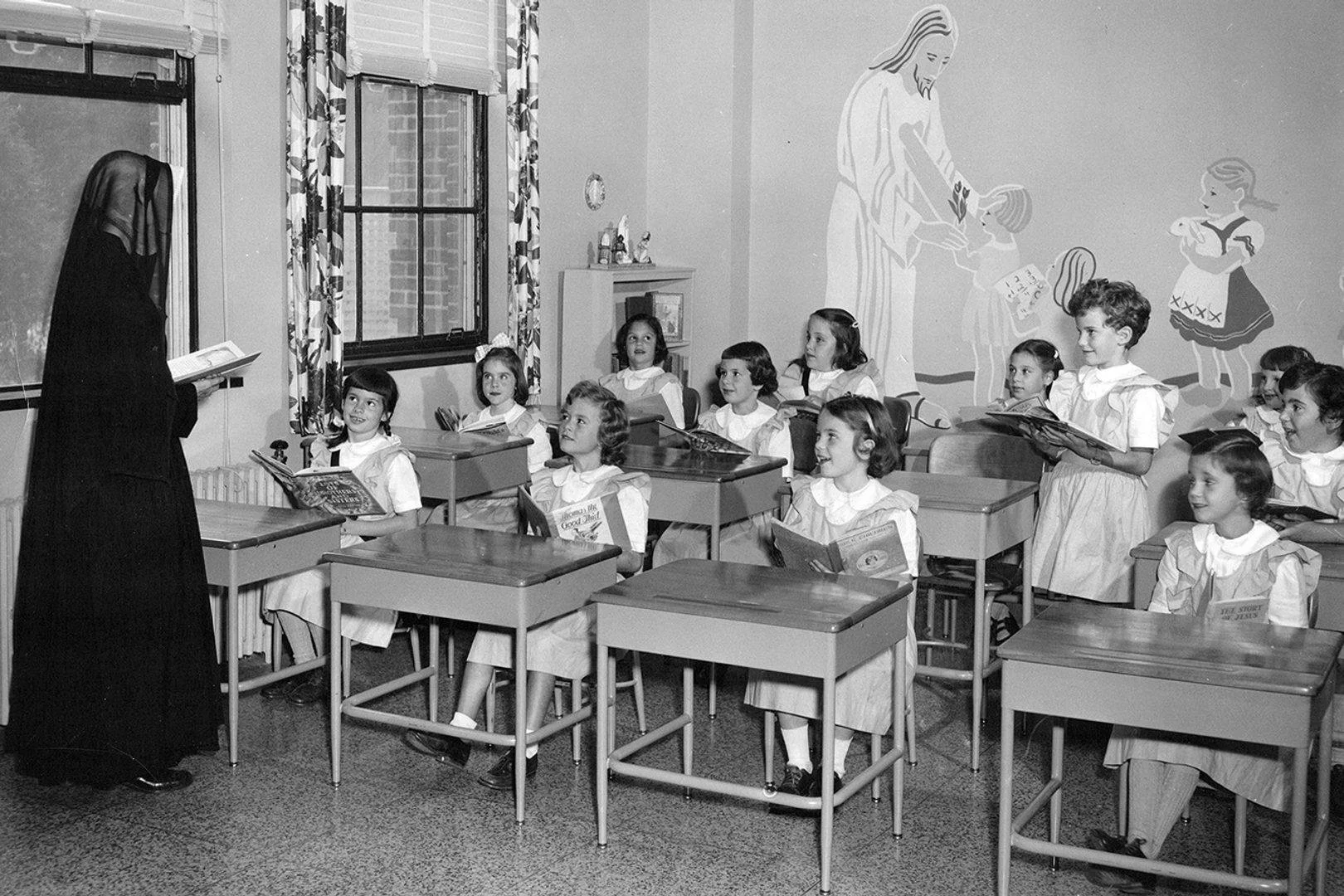
Catholic education in the 1950s: religious sisters were a highly visible presence in schools, hospitals and charitable institutions.
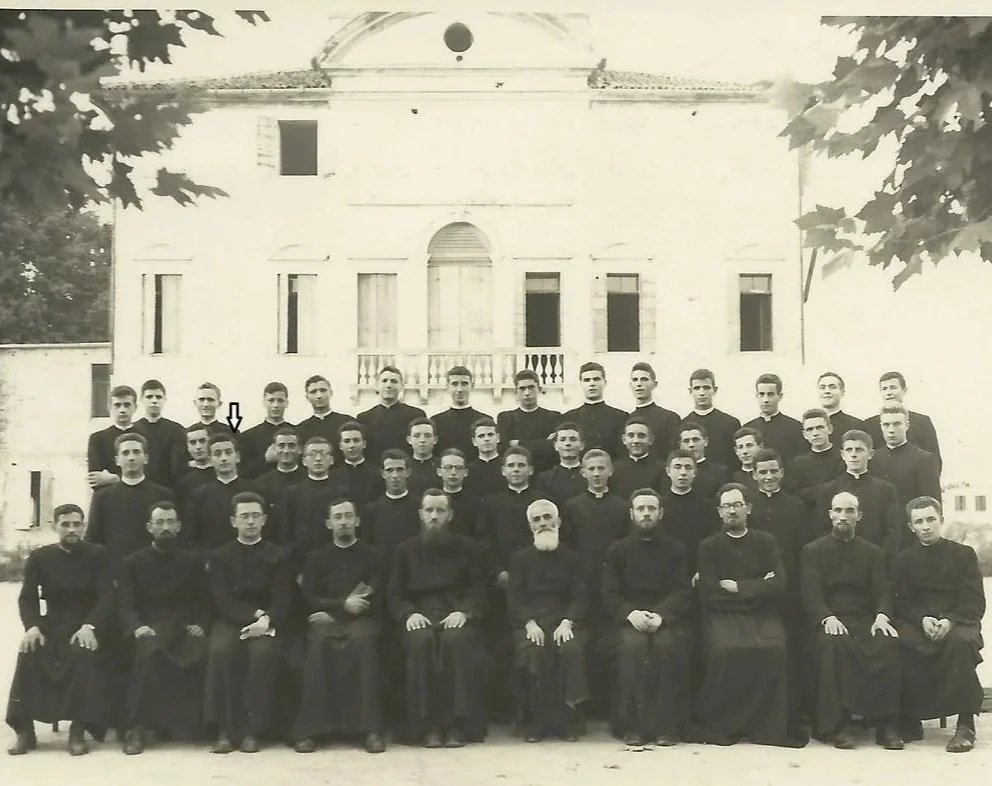
A seminary community in 1951. Priesthood and religious life were sufficiently visible within Catholic culture that a religious vocation represented a realistic possibility for many young Catholics.
Vocations Were Abundant
The visibility of priests and religious is difficult for many younger Catholics to imagine.
Parishes commonly possessed more than one priest.
Religious sisters staffed enormous networks of schools and hospitals.
Religious brothers taught, administered institutions and lived in communities.
Monasteries, novitiates, convents and seminaries were familiar Catholic institutions.
For the United States, CARA's historical data provide a revealing near-conciliar benchmark. In 1965—the year Vatican II ended—the country had approximately:
| United States | 1965 |
Novus Ordo 2026 / Latest Available |
|---|---|---|
| Total priests | 58,632 | 33,462 |
| Diocesan priests | 35,925 | 23,510 |
| Religious priests | 22,707 | 10,064 |
| Priestly ordinations | 994 | 428* |
| Graduate-level seminarians | 8,325 | 2,686 |
| Religious sisters | 179,954 | 33,135 |
| Religious brothers | 12,271 | 3,290 |
* 428 men were identified as scheduled for priestly ordination in 2026. Other modern figures use the latest comparable national data available.
These figures come from CARA's historical statistical series, sourced from materials including the Official Catholic Directory and Vatican statistical records. (Roland Ley's Web Site)
The year 1965 should not be falsely presented as an untouched “pre-Vatican II” year—the Council had already been meeting for three years. But it is a useful measure of the enormous vocational infrastructure inherited from the pre-conciliar Church.
A Catholic child could grow up surrounded by priests and religious. Vocations were not an exotic phenomenon encountered only on the internet. They were visible in the parish, school, hospital and neighbourhood.
The Church Was Missionary—and Expected Conversion
Perhaps no feature of pre-conciliar Catholicism reveals its confidence more clearly than the missions. The Church did not send missionaries around the world merely to conduct cultural dialogue. Missionaries certainly founded schools, clinics, hospitals and works of charity, and the papal Magisterium repeatedly warned against confusing Catholic mission with colonial nationalism.
But the supernatural objective remained unmistakable:
preach Jesus Christ → teach the Catholic Faith → baptize → establish the Church → sanctify souls → save them.
Christ's command was understood literally:
“Going therefore, teach ye all nations.”
Pius XII's Evangelii Praecones (1951) documented remarkable expansion over the preceding twenty-five years. The number of Catholic missions had risen from about 400 in 1926 to nearly 600; the number of priests working in mission territories had risen from roughly 14,800 to more than 26,800; and 88 missions had been entrusted to native clergy. (Vatican)
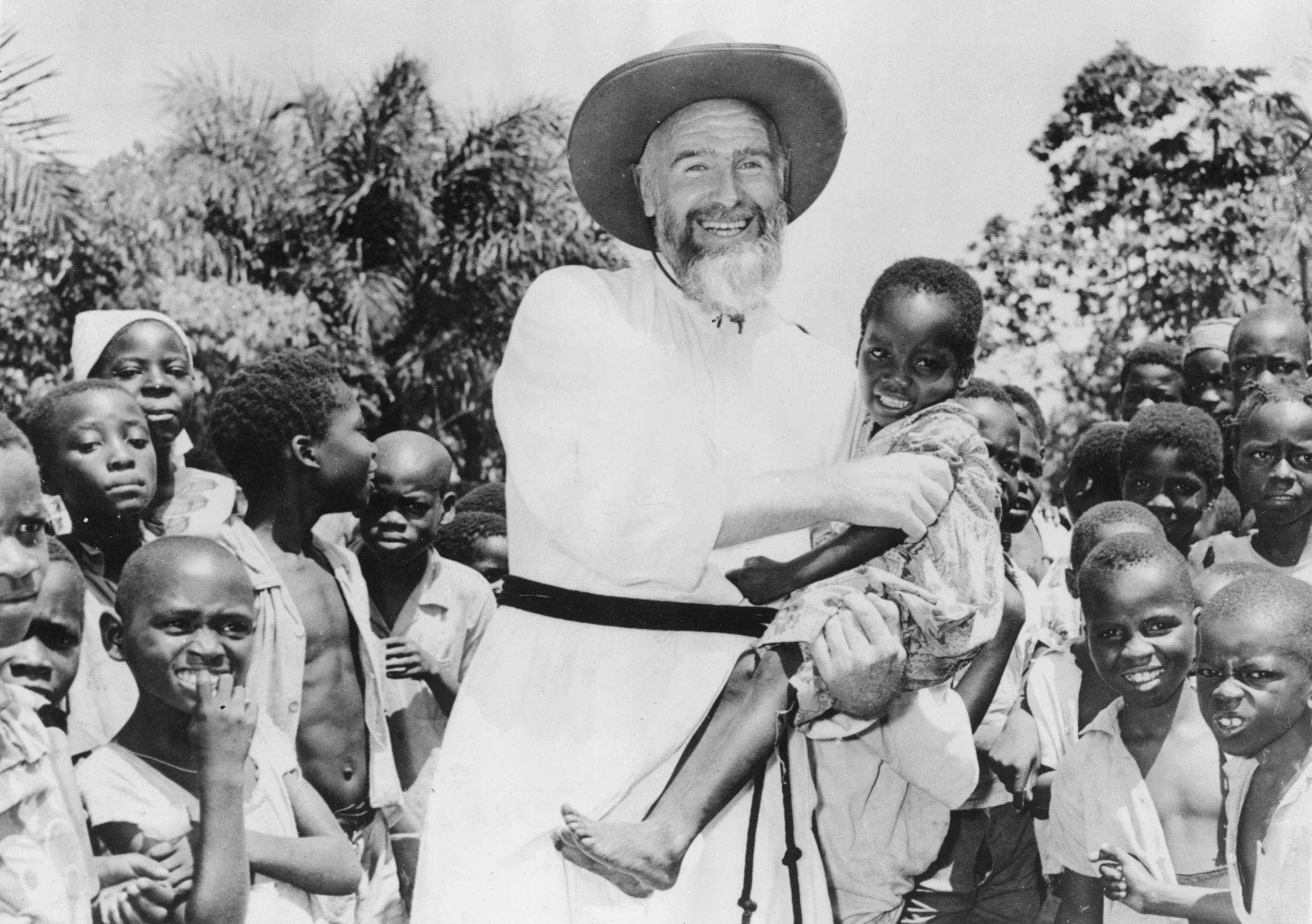
Catholic missionary life in the mid-twentieth century. Missionaries established parishes, schools, hospitals and native clergy because the Church understood Christ's command to teach and baptize all nations as an enduring obligation.
Conversion Was Not an Embarrassing Word
The Catholic Church believed that man needed more than material improvement. He needed supernatural redemption. Mission was therefore ultimately concerned with souls.
Pius XII described the world in Evangelii Praecones as facing a fundamental crisis “for Christ or against Christ” and called Catholics to support missionary work and missionary vocations. (Vatican)
The pre-conciliar Catholic did not ordinarily understand evangelisation to mean telling another person simply to become more faithful to whichever religion he already possessed. Catholics were required to respect persons, reject forced conversion and act with charity.
But religious systems were not thereby considered equally true.
Christ was the universal Saviour.
The Catholic Faith was objectively true.
Therefore conversion mattered.
Ecumenism Meant Return to Catholic Unity
Catholics certainly prayed for Christian unity before Vatican II. But unity had a specific meaning.
Pius XI's Mortalium Animos (1928) rejected the concept of the Church as a federation of mutually contradictory Christian bodies seeking to reconstruct a unity that Christ's Church had somehow lost.
The Catholic position was that the unity established by Christ continued to exist in the Catholic Church.
Consequently, reunion meant separated Christians entering or returning to that existing unity. This did not justify hostility toward individual Protestants or Orthodox Christians. It followed instead from a doctrinal proposition:
there cannot simultaneously be several contradictory versions of revealed Christianity that are all the Church founded by Christ.
Religious Liberty Did Not Mean That Error and Truth Had Equal Rights
Traditional Catholic teaching strongly rejected coerced belief. Faith cannot genuinely be produced by force.
But Leo XIII also distinguished that principle from the proposition that every religious belief possessed an equal moral right simply because someone sincerely believed it. The traditional framework distinguished:
freedom from coercion in embracing the Faith
from
a supposed moral right of religious error as such.
Civil toleration could be permitted for serious reasons of the common good. Toleration and coercion were therefore different questions from whether religious truth and error possessed equal claims before God.
This distinction is essential before examining Vatican II's Dignitatis Humanae.
Christ Was King of Society, Not Merely Private Hearts
Pius XI's Quas Primas (1925) established the Feast of Christ the King against the increasing secularisation of public life.
Christ's sovereignty was understood to embrace not merely individual souls but families and societies.
Civil governments were not the Church. Nor was Catholic doctrine tied to one form of constitutional government. But political and social life were not morally independent of God. Government, education, marriage, economics and public law remained subject to objective moral truth.
The feast itself taught this doctrine liturgically.
Davidic kingdom → Christ the universal King.
Catholics were not supposed to leave Christ at the church door.
“Outside the Church There Is No Salvation”
Traditional Catholicism taught unequivocally that there is no salvation outside the Church.
Properly understood, this did not mean that Catholics could infallibly judge the eternal destiny of every visibly non-Catholic person. Traditional theology distinguished culpable rejection of the true Faith from invincible ignorance and acknowledged baptism of desire and implicit desire according to the relevant theological principles.
But it equally rejected the proposition that false religions save as false religions. The central principle remained:
one Saviour → one supernatural order of grace → one Church established by Christ → one ultimate end, eternal salvation.
Missionary urgency flowed directly from this conviction.
The Church Had a Public Voice
Catholicism also occupied public space more visibly.
Corpus Christi processions passed through towns.
Religious habits and cassocks were seen in schools, hospitals and streets.
Church bells structured neighbourhood life.
Catholic organisations influenced education, charity and public debate.
And the Papacy possessed enormous international visibility.
It would be historically excessive to claim that every non-Catholic accepted the Pope as his spiritual authority. They plainly did not.
Papal statements were international events. Rome received ambassadors, heads of government, scientists, physicians, academics and professional organisations. Catholics expected the Pope to speak authoritatively about faith and morals.
The Church did not behave as though supernatural religion should restrict itself to private sentiment.
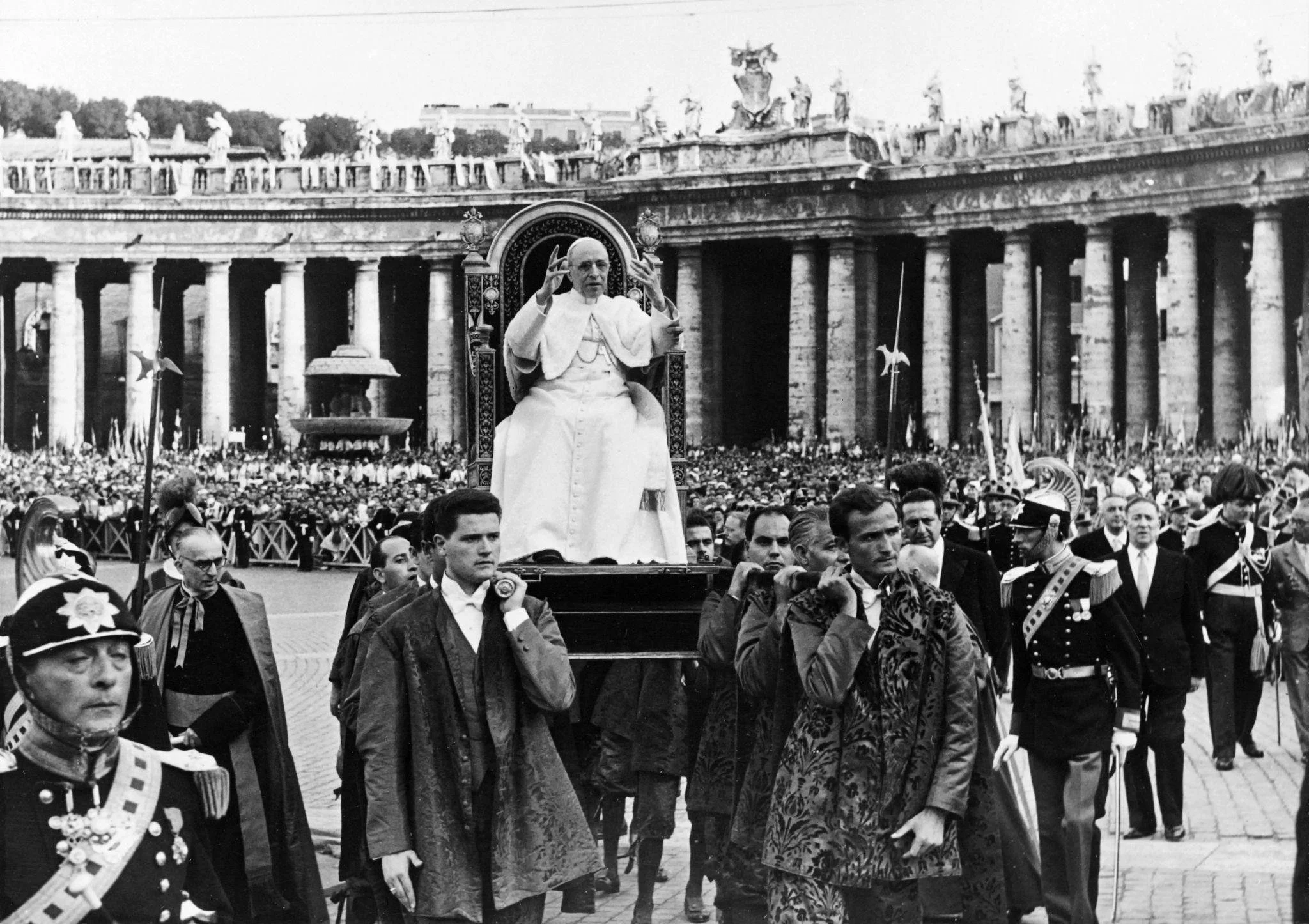
Pope Pius XII and the public Papacy of the mid-twentieth century. The Pope was understood by Catholics as the Vicar of Christ and was also a highly visible international moral and diplomatic figure whose statements reached far beyond practicing Catholics.
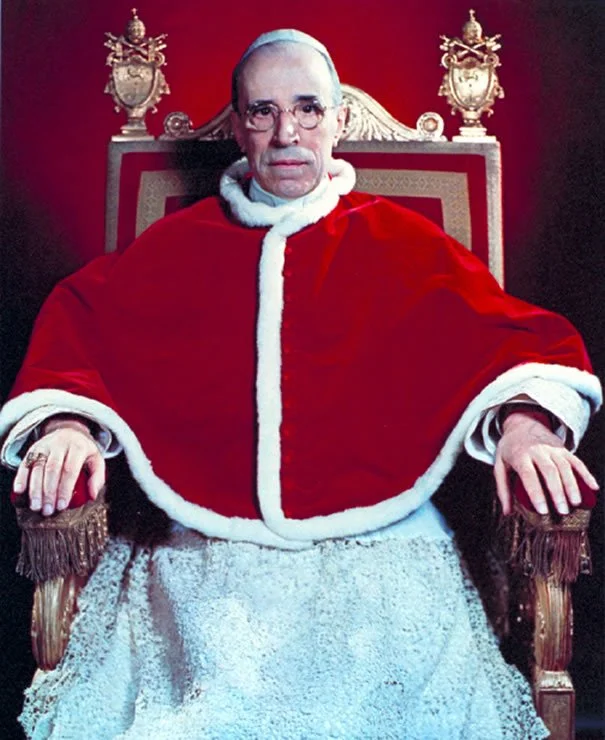
Pope Pius XII
Faith, Morality and the Fear of God Were Spoken About Plainly
This older Catholic vocabulary deserves special attention. One regularly encountered:
God's commandments
sin
mortal sin
purity
modesty
repentance
confession
penance
judgment
hell
purgatory
heaven
conversion
sanctifying grace
the salvation of souls
the fear of God
The fear of God did not mean viewing God merely as a tyrant. Traditional theology distinguished servile fear, centred upon punishment, from the higher filial fear by which the Christian fears offending God whom he loves.
Catholic preaching united God's mercy with God's holiness and justice.
Christ had died to save sinners.
Therefore sin mattered.
Judgment mattered.
Conversion mattered.
Eternity mattered.
Catholicism was not merely intended to make temporal life more agreeable. It was intended to make saints and bring souls to Heaven.
So Was the Church Collapsing When Vatican II Was Called?
This is where the historical evidence becomes especially interesting. One should avoid romantic exaggeration. The world of the 1950s contained grave problems.
Europe had emerged from two catastrophic wars.
Communism controlled enormous populations.
Nuclear weapons threatened civilization.
Materialism and secularisation were advancing.
Marriage and sexual morality were beginning to encounter profound cultural upheaval.
The Church suffered persecution in Communist countries.
Intellectual currents within theology and liturgical studies were already producing debate.
Not every nominal Catholic possessed deep faith.
Not every priest or bishop was exemplary.
The Church therefore unquestionably faced serious challenges. But that is not the same proposition as saying that the Catholic Church herself was visibly collapsing.
And strikingly, John XXIII did not describe her that way when he convoked Vatican II.
John XXIII Said the Church Was “Flourishing With Vitality”
On 25 December 1961, John XXIII formally convoked Vatican II with the apostolic constitution Humanae Salutis.
The document is extraordinarily important for understanding why the Council was called. John described modern humanity as suffering from profound spiritual poverty, technological pride, materialism and practical atheism. But then he deliberately contrasted the condition of the world with the condition of the Church.
He described:
a spiritually impoverished humanity
on one side,
and
the Church of Christ “flourishing with vitality”
on the other. (Vatican)
He spoke of the Church as possessing perpetual youth and vitality and wished the Council to increase the effectiveness with which she brought Christian truth to contemporary mankind. (Vatican)
This is critical.
The Pope who called Vatican II did not say that the Catholic Church had become doctrinally bankrupt, that her seminaries were empty, that her missions had collapsed, or that she had lost the Faith.
His diagnosis was primarily that the modern world had changed dramatically and was suffering a spiritual crisis, and that the Church should address those changed conditions more effectively.
That is John XXIII's own explanation.
How Long Had It Been Since the Previous Ecumenical Council?
| Council | Date | Approximate Interval to the Next Council |
|---|---|---|
| Council of Trent | 1545–1563 | About 306 years until Vatican I opened |
| First Vatican Council | 1869–1870 | About 92 years until Vatican II opened |
| Second Vatican Council | 1962–1965 | — |
Vatican I opened in December 1869. Following the capture of Rome, Pius IX suspended it sine die on 20 October 1870.
Vatican II opened on 11 October 1962.
That is just under 92 years between Vatican I's suspension and Vatican II's opening. Paul VI later remarked that Vatican I itself had been the first ecumenical council for roughly three centuries after Trent. (Vatican)
The sheer rarity of such councils matters. They were not routinely convened every generation.
What Were Ecumenical Councils Normally For?
The pre–Vatican II Catholic Encyclopedia offers a revealing description. It explains that councils concern doctrine and discipline and historically appear when faith, morals or discipline are gravely threatened. More specifically, it says that in ordinary times councils are not part of the normal government of the Church but assist the Pope in
“extraordinary difficulties arising from heresies, schisms, relaxed discipline, or external foes.” (New Advent)
That fits much of conciliar history.
Nicaea (325) addressed Arianism.
Ephesus (431) confronted Nestorian controversy.
Chalcedon (451) dealt with grave Christological controversy.
Constance (1414–1418) addressed the Western Schism and related ecclesiastical disorders.
Trent (1545–1563) confronted Protestant doctrinal challenges while undertaking major internal reform.
Vatican I (1869–1870) addressed grave modern errors and defined doctrines concerning revelation, faith, reason and papal authority.
This does not mean that an ecumenical council can only be summoned when a new heresy requires condemnation. Councils have dealt with discipline, reform, jurisdiction and wider ecclesiastical needs.
But historically, a universal council was an extraordinary instrument for extraordinary circumstances, not simply the normal administrative cycle of the Church. (New Advent)
Vatican II Was Deliberately Different
John XXIII himself highlighted the difference. At the solemn opening of Vatican II on 11 October 1962, he acknowledged that the Church had repeatedly opposed errors and had often condemned them severely.
For the new Council, however, he said that the Church wished to employ principally another approach. He spoke of using the “medicine of mercy” rather than primarily taking up the weapons of severity and of presenting doctrine in a manner suited to a Magisterium whose character at the Council was especially pastoral. (Vatican)
That makes Vatican II historically unusual.
No new dogma requiring definition had precipitated it.
No single new heresy comparable to Arianism had forced a Nicaea.
No Protestant revolt comparable to that preceding Trent had just occurred.
No Western Schism required resolution.
Rather, John XXIII wished the existing Catholic Faith to be presented to the modern world in a renewed pastoral way.
That was the experiment. Whether the texts and reforms that followed actually preserved the inherited Faith while accomplishing that goal is a separate question—and precisely the question the subsequent articles in this series must examine.
The Question the Reader Should Now Ask
At this point one should resist two simplistic conclusions.
The first is:
Everything before Vatican II was perfect.
It was not.
The second is:
The pre-conciliar Church had obviously failed and therefore required fundamental reconstruction.
The evidence presented above does not establish that either.
Instead, consider what existed on the eve of the Council:
| The Catholic Church Entering the Council | What the Historical Record Shows |
|---|---|
| Doctrine | Clear claims about the Church, Papacy, Mass, priesthood, salvation and Christ's Kingship |
| Liturgy | Distinctly sacred Roman worship centred upon sacrifice and Eucharistic adoration |
| Holy Communion | Ordinarily received kneeling and on the tongue |
| Sacramental life | Strong culture of confession, preparation, fasting and Eucharistic devotion |
| Catholic calendar | Sundays, Holy Days, fasting, abstinence and feast days structured life |
| Family | Strong culture of marriage, children, Catholic upbringing and family devotion |
| Vocations | Large numbers of priests, religious and seminarians in major Catholic countries |
| Schools and hospitals | Extensive Catholic institutional presence |
| Missionary work | Expanding missions, indigenous clergy and active missionary departures |
| Evangelisation | Explicit objective of conversion to Christ and the Catholic Church |
| Public presence | Processions, organisations, education, charity and visible clergy and religious |
| Papacy | Major international moral and religious presence |
| John XXIII's own description | The Church was “flourishing with vitality” as Vatican II was being convoked |
The question therefore almost asks itself:
If the Church was flourishing, what exactly needed an ecumenical council?
And there is a second question:
Why, only 92 years after Vatican I—and after more than three centuries had separated Trent from Vatican I—was another universal council considered necessary?
John XXIII did give an answer. His concern was principally the changed modern world.
The Church, he believed, needed to present the perennial deposit of Faith more effectively to technological, secularised and increasingly unbelieving modern man. (Vatican)
That is a legitimate historical answer.
But it leads directly to another question:
Did Vatican II merely present the same Catholic Faith more effectively—or did some of its principles and the reforms carried out in its name alter the very Catholic identity that had existed before it?
That cannot be answered merely by looking at photographs of full seminaries or full churches. Nor can it be answered simply by saying Vatican II was “pastoral.” It requires comparing the actual teachings.
The Main Objection
A serious defender of Vatican II can reasonably reply:
The Church may have possessed large seminaries, numerous religious sisters and substantial missionary growth, but numbers alone do not prove spiritual health.
The modern world was undergoing unprecedented transformation. Communism, secularism, mass communication, nuclear warfare, decolonisation, philosophical relativism and new social conditions created pastoral problems that older methods did not necessarily answer adequately.
Furthermore, some outward Catholic practice may have been conventional rather than deeply internalised. If millions abandoned traditional practices rapidly after the Council, perhaps weaknesses already existed beneath the surface.
Accordingly, one could argue that John XXIII was correct: the Church was doctrinally intact and institutionally strong but required a Council precisely to equip that strong Church to evangelise a rapidly changing world.
That is the strongest reasonable objection.
Response
Much of that objection should be conceded.
Large numbers are not proof of holiness.
A full seminary does not prove that every seminarian has a supernatural vocation.
High Mass attendance does not establish that every worshipper possesses deep faith.
Beautiful churches cannot substitute for conversion of heart.
And secularisation did not suddenly begin in 1965.
Any responsible history of the crisis must acknowledge forces already operating before the Council. But precisely because this is true, another distinction becomes crucial.
There is a great difference between saying:
“A strong Church faced a dangerous and rapidly changing world and needed to evangelise it more effectively,”
and saying:
“The old Catholicism had failed and needed fundamental reconstruction.”
John XXIII's own convocation supports the first proposition much more clearly than the second. He described the world as spiritually disordered and the Church as flourishing in vitality. (Vatican)
Therefore the proper historical investigation is not:
Was everything perfect in 1958?
Obviously not.
It is:
Were the doctrinal, liturgical, disciplinary and ecclesiological changes that followed Vatican II necessary responses to those problems, and were they consistent with the Catholic principles that existed beforehand?
That is a much more serious question.
What We Can and Cannot Conclude
We can establish as Catholic doctrine that before Vatican II the Church taught one visible Church, papal primacy, the sacrificial Mass, the sacramental priesthood, the Real Presence, missionary conversion, Christ's social Kingship and the necessity of the Church for salvation.
We can establish historically that Catholic worship was ordinarily more formal, penitential and visibly sacral in the Roman Rite: Latin liturgy, Communion ordinarily on the tongue and frequently kneeling, head coverings for women under the 1917 discipline, stricter Eucharistic fasting, more extensive fasting and abstinence, and a highly visible devotional culture.
We can establish historically that large institutional Catholic structures existed immediately before and during the Council, including very substantial numbers of priests, religious and seminarians in countries such as the United States. (Roland Ley's Web Site)
We can establish historically that Catholic missionary activity underwent substantial expansion during the decades before Vatican II. (Vatican)
We can establish from John XXIII's own words that he contrasted a spiritually troubled world with a Church he described as flourishing with vitality. (Vatican)
We can establish historically that Vatican II opened roughly 92 years after Vatican I had been suspended and that ecumenical councils had historically been extraordinary rather than routine mechanisms of Church government. (Vatican)
But we cannot conclude merely from high vocation numbers or beautiful churches that every aspect of Catholic life was healthy.
Nor can statistics alone prove that Vatican II subsequently caused every decline that occurred. Chronology and correlation must not automatically be converted into causation.
And the fact that John XXIII called Vatican II does not by itself establish whether all of the Council's eventual texts, interpretations and subsequent reforms represented legitimate development or discontinuity.
Those questions require direct examination of the evidence.
Conclusion
Before Vatican II, Catholicism looked, sounded and spoke differently because it understood itself differently.
The Catholic entered a church and genuflected because Christ was there.
He knelt at the Communion rail because the Host was not ordinary bread.
The priest approached the altar because the Mass was sacrifice.
The confessional mattered because sin could separate the soul from God.
Fasting mattered because the body participated in religion.
Holy Days mattered because time belonged to God.
Sacred architecture mattered because beauty should raise the soul toward Heaven.
The large Christian family mattered because marriage was ordered toward life and eternity.
Vocations mattered because the priesthood and religious life were supernatural callings.
Missionaries crossed oceans because Jesus Christ had commanded His Church to teach and baptize every nation.
Conversion mattered because truth mattered.
The Pope's words mattered because Catholics believed him to be the successor of St Peter and Vicar of Christ.
And Christ's Kingship mattered because God was not merely Lord of one's private Sunday morning but King of the individual, the family and society itself.
This was not an extinct medieval world. Much of it existed in living memory on the eve of Vatican II.
Its churches were full in many places.
Its seminaries and convents were substantial.
Its missionaries were departing for every continent.
Its schools and hospitals were visible throughout society.
Its doctrine was defined.
Its liturgy was recognisably Catholic.
Its hierarchy possessed considerable public authority.
And on 25 December 1961, when formally summoning Vatican II, John XXIII himself described the Church of Christ as flourishing with vitality. (Vatican)
Then consider the chronology.
The Council of Trent ended in 1563.
Vatican I did not open until 1869, more than three centuries later.
Vatican I was suspended in 1870.
Vatican II opened in 1962—about 92 years later.
For nineteen centuries, ecumenical councils had been extraordinary events. The pre-conciliar Catholic Encyclopedia explicitly observed that they were not instruments of ordinary Church government but were particularly associated with extraordinary difficulties involving heresy, schism, discipline or external danger. (New Advent)
Vatican II was consciously different. John XXIII did not principally summon it to condemn a newly arisen heresy or define a disputed dogma. He wished the Church to address the modern world using a predominantly pastoral approach. (Vatican)
That leaves a question which deserves to be asked without prejudice:
If the Catholic Church was flourishing, missionary, vocationally strong and doctrinally certain, why was a new ecumenical council necessary?
And still more importantly:
What happened when the attempt was made to reshape the Church's presentation, worship and relationship with the modern world?
The answer cannot be assumed. It must be investigated.
That investigation begins by placing what Catholicism taught before Vatican II directly beside what Vatican II taught and what followed afterward.
Only then can the reader judge whether what occurred was continuity, legitimate development—or something much more serious.
Primary Sources
First Vatican Council — Pastor Aeternus (1870)
Pope Leo XIII — Immortale Dei (1885)
Pope Leo XIII — Libertas (1888)
Pope Pius XI — Quas Primas (1925)
Pope Pius XI — Mortalium Animos (1928)
Pope Pius XII — Mystici Corporis Christi (1943)
Pope Pius XII — Mediator Dei (1947)
Pope Pius XII — Evangelii Praecones (1951)
Pope John XXIII — Princeps Pastorum (1959)
Pope John XXIII — Humanae Salutis (1961), convoking Vatican II
Pope John XXIII — Opening Address to Vatican II, 11 October 1962
St Ignatius of Antioch — Letter to the Smyrnaeans
St Irenaeus — Against Heresies III.3
Further Reading
The Roman Catechism / Catechism of the Council of Trent should accompany this article as the principal catechetical synthesis of Tridentine Catholic doctrine.
The 1917 Code of Canon Law is essential for understanding the disciplinary world in which pre-conciliar Catholics lived: Holy Days, fasting, abstinence, dress in church, sacramental practice and relations with non-Catholic worship.
The pre–Vatican II Catholic Encyclopedia article on General Councils is particularly useful for understanding how unusual the convocation of an ecumenical council historically was. Catholic Encyclopedia — General Councils
CARA's historical statistics are useful for quantifying the scale of Catholic priesthood and religious life around the conclusion of Vatican II. CARA — Frequently Requested Church Statistics
Related Questions
What Did Vatican II Actually Change?
Did Vatican II Change Catholic Teaching on Religious Liberty?
Did Vatican II Change Catholic Teaching on Ecumenism?
What Did Vatican II Teach About Non-Christian Religions?
How Does the Traditional Roman Mass Differ From the Novus Ordo?
What Happened to Catholic Vocations After Vatican II?
What Happened to Catholic Mass Attendance After Vatican II?
Can Catholic Doctrine Change or Develop?
Can the Catholic Church Teach Error in Faith and Morals?
Was Vatican II Merely a Pastoral Council?