Did Vatican II Change Catholic Teaching on Christian Unity and Ecumenism?
Short Answer
Yes—in the understanding and practice of Christian unity, Vatican II introduced a substantially different ecumenical framework from that taught by the pre-Vatican II Magisterium.
Traditional Catholic teaching held that Christ founded one visible Church and endowed that Church with unity from the beginning.
The Catholic Church therefore did not need to recover a unity she had lost. Christians separated from her were called to conversion and return to the unity already possessed by the Catholic Church.
Pope Leo XIII taught that Christ “made this one Church” and gave it unity. Pope Pius XI explicitly rejected the theory that Christ's prayer “that they all may be one” referred to a unity which had not yet been realised and must subsequently be constructed among separated Christian bodies. In Mortalium Animos he taught instead that Christian unity could be promoted only by the return of those separated from the one true Church. Pius XII maintained this principle.
Vatican II's Unitatis Redintegratio still affirmed that Christ founded one Church and that the unity given by Christ “subsists in the Catholic Church as something she can never lose.”
Yet it simultaneously
described baptized non-Catholics as existing in an “imperfect” communion with the Catholic Church;
called separated bodies “Churches and ecclesial Communities”;
said that some of their religious actions can give “access to the community of salvation”;
stated that the Spirit of Christ uses separated Churches and Communities as “means of salvation”;
encouraged theological dialogue, cooperation and certain common prayer; and
distinguished individual reconciliation with the Catholic Church from the ecumenical movement itself.
The question therefore cannot be settled merely by observing that Vatican II occasionally retained traditional expressions. The decisive question is whether the ecclesiology underlying the new ecumenical programme is the same as that taught before the Council.
A direct comparison shows a real rupture in the governing conception:
from the conversion and return of those outside Catholic unity to an ecumenical journey among Christians and Christian communities already understood as possessing varying degrees of communion, together seeking the restoration or perfection of visible unity.
That difference profoundly affects Catholic missionary activity, conversion, common prayer, dialogue and ultimately the doctrine of the Church herself.
Why This Question Matters
Ecumenism can initially sound like little more than Christians treating one another charitably.
Catholics have always been obliged to love Protestants, Orthodox Christians and every human being. The Church has always prayed for those outside her visible unity. She has always desired their salvation. She has permitted theological discussion with non-Catholics under appropriate circumstances. She has also recognised whatever truth non-Catholics retain from the Catholic inheritance. That is not the controversy. The real question is:
What is the unity for which Christians are praying?
Did Jesus Christ establish a Church which already possesses the unity He intended?
Or is Christ's Church divided among different Christian bodies, so that Catholics, Orthodox, Protestants and others must now travel together toward a unity that has yet to be fully realised?
Those are very different ecclesiological conceptions. And remarkably, Pope Pius XI addressed almost exactly this question decades before Vatican II.
What the Catholic Church Traditionally Taught
Christ Founded One Church
Our Lord did not establish a federation of denominations. He said:
“Upon this rock I will build my church.” — Matthew 16:18
St Paul likewise teaches:
“One body and one Spirit… One Lord, one faith, one baptism.” — Ephesians 4:4–5
The Church's unity therefore originates not in subsequent negotiations among Christians but in Christ Himself.
He founded one Church.
He gave it one faith.
He established one government.
He instituted one sacramental communion.
And He promised its perpetuity.
“That They All May Be One”
The passage most frequently associated with ecumenism is Christ's prayer at the Last Supper:
“That they all may be one, as thou, Father, in me, and I in thee.” — John 17:21
How should these words be understood? Modern ecumenical language often applies them to the present separation of Catholics, Orthodox and Protestants and speaks of Christians working toward the fulfilment of Christ's prayer.
But Leo XIII gave a very different explanation. In Satis Cognitum (1896), his great encyclical on the unity of the Church, Leo XIII explicitly cites John 17 and explains that Christ gave His Church unity.
He writes that Christ:
“made this one Church” and “also gave it unity.”
That unity consists principally in unity of faith and unity of government and communion under the authority established by Christ. Leo therefore speaks of bringing those who have wandered away back to the fold, not of rebuilding a Church whose unity has been lost.
This distinction is fundamental:
Christ's prayer does not imply that His Church failed to possess unity. It expresses and safeguards the supernatural unity with which He constituted His Church.
Individual Christians can abandon that unity.
Whole populations can become separated from it.
Schisms can occur.
Heresies can arise.
But the Church herself does not cease to be one.
Unity Is a Mark of the Church
Catholics profess in the Creed:
“I believe in one, holy, Catholic and apostolic Church.”
Unity is therefore one of the Church's four Marks. It is not merely an aspiration. It is an identifying property of Christ's Church.
Leo XIII insisted that Christ did not establish several Christian communities subsequently requiring federation. The Church is one by her very constitution: one in faith, one in government and one in communion.
Pius XII taught the same doctrine in Mystici Corporis Christi (1943). Identifying the true Church of Christ as the “One, Holy, Catholic, Apostolic and Roman Church,” he explained that the Mystical Body must possess an “unbroken unity.” He specifically rejected theories imagining an invisible Church uniting otherwise separated Christian communities. The traditional proposition is therefore not:
Christians ought someday to create the unity of Christ's Church.
It is:
Christ created His Church one; Christians who separate themselves from her unity must be reunited with her.
The Early Church: Unity, Heresy and Schism
The Fathers likewise spoke of unity as something possessed by the Church and forfeited by those who separated from her.
St Cyprian of Carthage (c. 210–258), in De Unitate Ecclesiae, compared the Church to Christ's seamless garment and insisted that the Church's unity cannot itself be divided.
St Augustine (354–430), confronting the Donatist schism, did not imagine the Catholic Church and the Donatists as two Christian communities jointly seeking some future Church. The Donatists had separated from Catholic unity and needed to return to it.
This distinction remained fundamental throughout Catholic ecclesiology:
The Church does not depart from unity. Men depart from the Church.
Traditional “Return Ecclesiology”
This produced what is sometimes called return ecclesiology. The expression can sound harsh to modern ears, but its logic is straightforward.
If:
Christ founded one visible Church;
that Church is the Catholic Church;
unity is an indefectible Mark of that Church; and
Christians subsequently separated from her,
then restoration of Christian unity means their restoration to Catholic unity.
It cannot mean rebuilding a unity which the Catholic Church herself supposedly lost.
Benedict XIV and the Eastern Churches
This point requires an important clarification.
Return to Catholic unity never meant that Eastern Christians had to become culturally or liturgically Latin.
Long before Vatican II, Pope Benedict XIV vigorously defended legitimate Eastern Catholic rites. In Allatae Sunt (1755), Benedict XIV documented the Roman Church's longstanding policy of protecting approved Eastern rites and repeatedly opposed unnecessary Latinisation. He recalled previous reunions in which Eastern Christians entered or restored communion with Rome while retaining their ancient liturgical traditions. This distinction is essential:
Unity of Faith and government does not require uniformity of rite.
A Byzantine Catholic can remain Byzantine.
A Maronite remains Maronite.
An Armenian Catholic can preserve the Armenian tradition.
The issue is not whether everyone worships according to the Roman Rite. The issue is Catholic faith and communion with the Roman Pontiff.
Pius XII Makes the Point Explicit
Pius XII removed any possible ambiguity in Orientales Omnes Ecclesias (1945). Speaking of Eastern Christians separated from Rome, he described the repeated efforts of Roman Pontiffs to call them:
“to return speedily to the unity which they had unhappily abandoned.”
But immediately afterwards he explained that Eastern Christians:
“need have no fear at all of being compelled to abandon their lawful rites and customs”
when unity of faith and government was restored. Thus the contrast sometimes presented—
return to Rome versus preservation of Eastern identity
—is historically false. Traditional Catholicism demanded return to Catholic communion, not compulsory Latinisation.
Pius XI and Mortalium Animos
The clearest preconciliar treatment of modern ecumenism is Pope Pius XI's 1928 encyclical Mortalium Animos.
Its importance can hardly be overstated because Pius XI confronted arguments strikingly similar to those later associated with the ecumenical movement.
The Theory Pius XI Rejected
Pius XI described ecumenists who appealed to Christ's words:
“That they all may be one.”
He then identified their underlying assumption: that the unity Christ desired had not yet been fully achieved and that Christians must therefore work together to obtain it.
He rejected precisely this conception. According to Pius XI, it was erroneous to suppose that the unity of faith and government constituting the true Church:
“does not to-day exist”
and must therefore be attained as an ideal. Why? Because Christ already established His Church as one. If the Church could lose one of her essential Marks, Christ's promises concerning His Church would have failed.
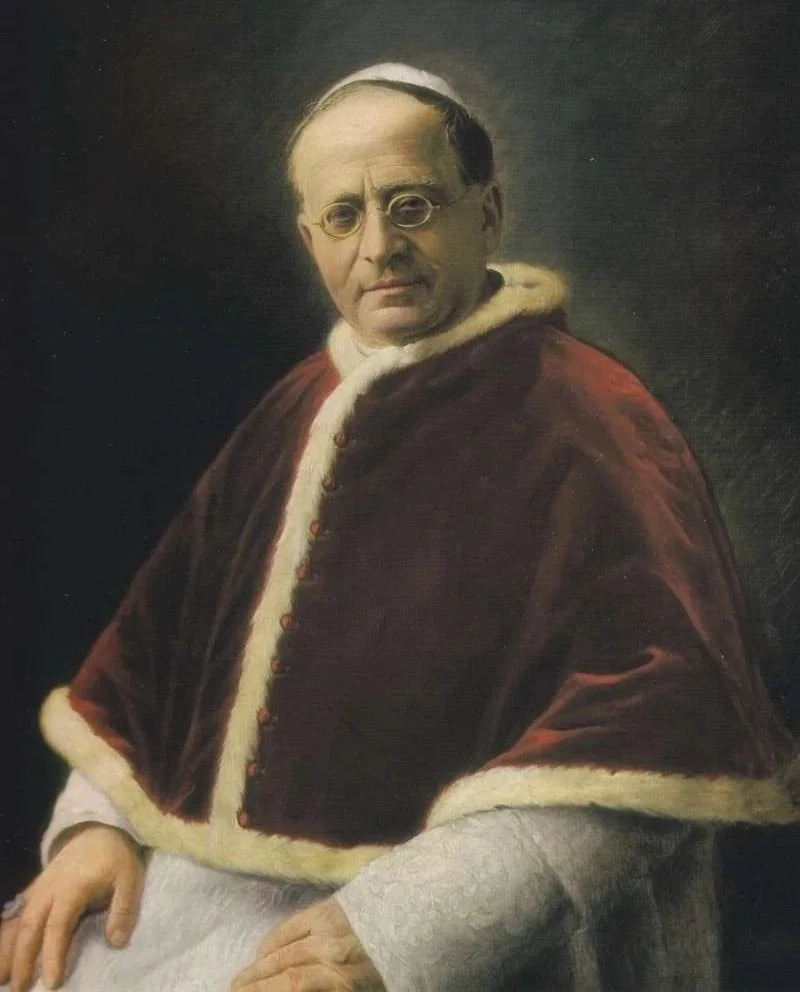
Pope Pius XI (1857–1939). In Mortalium Animos (1928), he rejected the idea that Christ’s Church lacked unity and taught that Christian unity was to be promoted by the return of those separated from the one true Church.
Pius XI's Solution: Return
Pius XI therefore stated:
“the union of Christians can only be promoted by promoting the return to the one true Church of Christ of those who are separated from it.”
He concluded by calling separated Christians to approach the Apostolic See, not expecting the Church to surrender Catholic doctrine, but so that they might embrace her teaching and government. The conceptual structure is unmistakable:
One Church already exists → she already possesses unity → Christians have separated from her → unity is restored by their return.
This was not merely Pius XI's personal preference concerning ecumenical strategy. It followed from his ecclesiology.
Pius XII and the Holy Office
It is sometimes claimed that Pius XII effectively anticipated Vatican II by permitting Catholic participation in the developing ecumenical movement.
The historical record is more precise. The Holy Office's 1949 instruction De Motione Oecumenica recognised the desire among non-Catholics for Christian unity and permitted carefully regulated theological meetings. But it insisted that this activity remain governed by traditional Catholic ecclesiology. The instruction warned against suggesting that the Catholic Church herself had not attained the fullness of Christ or could:
“still be perfected from outside.”
It required the entire Catholic doctrine to be presented and specifically identified:
“the only true union by the return of the dissidents to the one true Church of Christ.”
It even cautioned Catholics not to speak as though converts brought the Church something substantial which she previously lacked.
Pius XII therefore permitted contact.
He permitted explanation.
He permitted tightly controlled theological discussion.
He encouraged prayer for unity.
But the ecclesiological destination remained conversion and return to the Catholic Church.
That is materially different from saying that Pius XII had already adopted Vatican II's ecumenical theology.
What Vatican II Introduced
The Second Vatican Council promulgated its Decree on Ecumenism, Unitatis Redintegratio, on 21 November 1964.
Its opening sentence announces:
“The restoration of unity among all Christians is one of the principal concerns of the Second Vatican Council.”
It acknowledges that Christ founded “one Church and one Church only.” Taken by itself, that is entirely compatible with traditional Catholic doctrine. The change becomes visible when the Council explains the relationship between the Catholic Church and Christians separated from her.
“Separated Brethren” and “Imperfect Communion”
Unitatis Redintegratio teaches that baptized non-Catholics:
“are in communion with the Catholic Church even though this communion is imperfect.”
It further says that they have a right to be called Christians and should be accepted as brethren.
The pastoral expression “separated brethren” itself is not the central difficulty. Catholics before Vatican II could certainly recognise validly baptized Protestants as Christians in a qualified sense and acknowledge supernatural realities that originated from the Catholic inheritance. The deeper question is the ecclesiological structure constructed around this fact.
Instead of principally categorising non-Catholics as persons outside the visible unity of the Church who must return to her, Vatican II describes them as already existing in a real, although incomplete, ecclesial communion. This introduces the vocabulary of:
full communion ↔ imperfect or partial communion.
That framework became fundamental to postconciliar ecclesiology.
“Churches and Ecclesial Communities”
Vatican II further speaks of separated Christian bodies as:
“Churches and ecclesial Communities.”
This terminology distinguishes especially between Eastern bodies possessing valid episcopacy and Eucharist and Protestant communities lacking elements traditionally considered essential to a particular Church.
Again, the problem is not merely vocabulary. Unitatis Redintegratio goes further. It says that many elements capable of building and giving life to the Church can exist outside the Catholic Church's visible boundaries, including Scripture, grace, faith, hope, charity and visible ecclesial elements. Most significantly, it states that separated Christian bodies:
“have been by no means deprived of significance and importance in the mystery of salvation”
and that:
“the Spirit of Christ has not refrained from using them as means of salvation.”
This is one of the most consequential passages in the decree. Traditional theology certainly recognised that valid Baptism, Scripture and other truths retained outside visible Catholic communion ultimately came from the Catholic Church and could operate toward bringing souls into her. But Vatican II predicates salvific significance of the separated Churches and Communities as such.
That is a significant ecclesiological development and cannot simply be dismissed as a change in tone.
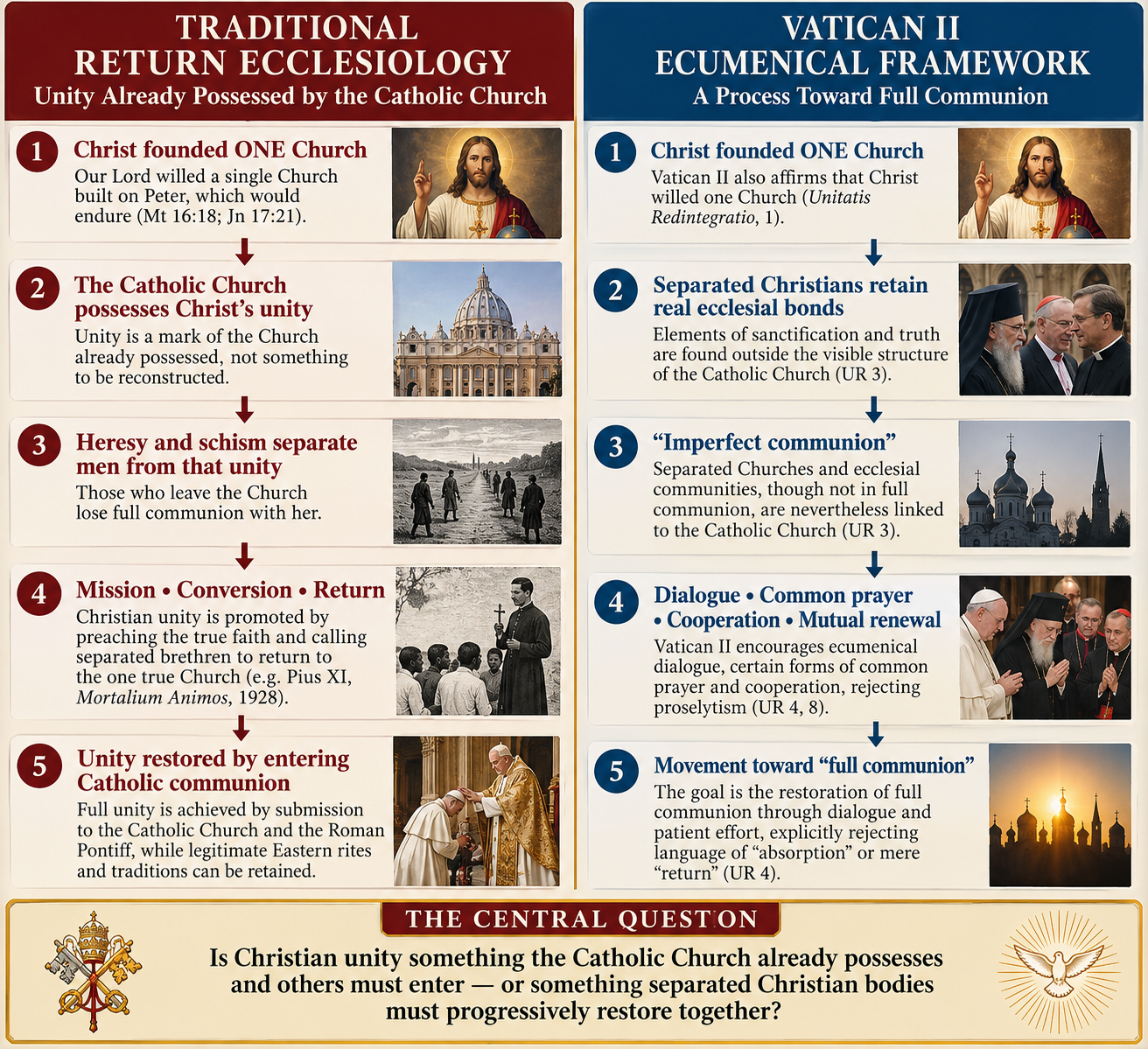
A Direct Comparison
| Question | Traditional Catholic Teaching | Vatican II / Postconciliar Framework |
|---|---|---|
| Did Christ found one Church? | Yes | Yes |
| Does Christ's Church possess unity? | Yes, as an indefectible Mark | Yes; Vatican II says this unity subsists in the Catholic Church and cannot be lost |
| What happened in schism and heresy? | Men and communities separated from Catholic unity | Communities became separated from “full communion” |
| Relationship of baptized non-Catholics to Catholic Church | Outside visible Catholic unity, though Baptism and other Catholic elements may remain | In “imperfect communion” |
| Separated bodies | Heretical or schismatic bodies retaining varying Christian elements | “Churches and ecclesial Communities” |
| Goal | Conversion and return to Catholic unity | Restoration/perfection of “full communion” |
| Principal method | Mission, apologetics, conversion and reconciliation | Dialogue, mutual understanding, cooperation, common prayer, renewal and eventual full communion |
| Does Catholic Church lack essential unity? | No | Formally, no |
| Can separated communities contribute to salvation? | Truth and sacraments retained from Catholicism may benefit individuals | Separated Churches/Communities themselves may be used as “means of salvation” |
| Reunion with Eastern Christians | Return to Catholic faith and papal communion while preserving legitimate Eastern rites | Restoration of full communion respecting legitimate diversity |
| Common prayer | Strictly restricted because worship signifies religious unity | Permitted and sometimes encouraged under specified circumstances |
| Conversion of individuals | Central missionary objective | Still possible, but formally distinguished from ecumenical action |
The last distinction is particularly revealing.
Conversion Is Distinguished From Ecumenism
Unitatis Redintegratio states:
“when individuals wish for full Catholic communion, their preparation and reconciliation is an undertaking which of its nature is distinct from ecumenical action.”
The Council adds that the two are not opposed. Nevertheless, the distinction itself matters enormously. Under the earlier framework, ecumenical contact was ultimately ordered toward the conversion and return of non-Catholics.
Under Vatican II, individual conversion into Catholic communion and the ecumenical movement become distinct undertakings. Ecumenism therefore acquires an objective and methodology not reducible to missionary conversion. That represents considerably more than a change in vocabulary.
Dialogue “On an Equal Footing”
The 1949 Holy Office instruction permitted controlled theological discussions but insisted that their purpose remain consistent with the return of dissidents to Catholic unity. It warned against treating different confessions as though Catholicism itself needed supplementation from them. Vatican II instead recommended dialogue in which theologians from different Churches and Communities meet:
“on an equal footing.”
It says that through such dialogue each side acquires a better understanding and appreciation of the other, while Catholics themselves are called to renewal.
Dialogue is not intrinsically wrong. Catholic missionaries and theologians have debated non-Catholics for centuries. The doctrinal question is what dialogue is ordered toward.
If dialogue explains Catholic truth more effectively so that another person can recognise and embrace it, there is no conflict with traditional missionary theology.
If dialogue becomes a reciprocal ecclesial process in which separated communions together search for a future form of Christian unity, the governing ecclesiology has changed.
Common Prayer
Another major change concerns common prayer. The 1949 Holy Office instruction remained extremely restrictive regarding communicatio in sacris. Even where theological conferences were authorised, participation in common worship was to be avoided, although certain approved prayers, such as the Our Father, could be recited under specified conditions. Unitatis Redintegratio describes prayer with separated Christians as the “soul” of spiritual ecumenism and states that in certain circumstances it is:
“allowable, indeed desirable”
for Catholics to join separated Christians in prayer. The decree does retain limits. It explicitly says common worship must not be used “indiscriminately.”
That qualification should not be concealed. Nevertheless, the governing presumption has visibly changed: an activity previously surrounded by strong prohibitions because it could falsely signify religious unity becomes an authorised and sometimes positively recommended instrument of ecumenism.
The Strongest Continuity Argument
A serious analysis must acknowledge that Unitatis Redintegratio contains passages that appear deliberately designed to preserve traditional Catholic claims. It teaches that:
Christ founded one Church;
the Catholic Church possesses all divinely revealed truth and all means of grace;
serious doctrinal differences remain;
false irenicism must be rejected;
Catholic doctrine must be presented in its entirety;
full incorporation into Christ's Catholic Church remains necessary;
and the unity Christ bestowed upon His Church “subsists in the Catholic Church as something she can never lose.”
A defender of continuity can therefore argue that Vatican II did not teach that the Catholic Church lost unity. Rather, separated Christians possess incomplete participation in an objectively Catholic unity because they retain Baptism, Scripture, Christian faith and other elements derived from the Church.
Ecumenism, on this reading, simply seeks to bring that incomplete communion to perfection. That is the strongest continuity argument. It deserves to be stated accurately.
The Difficulty With That Explanation
The difficulty is that Pius XI had already confronted an ecumenical conception in which separated Christian communities were treated as participants in a broader quest for Christian unity. His answer was not to construct degrees of ecclesial communion. It was to insist that the true Church already existed in complete unity and that:
Christian union means return to that Church.
The 1949 Holy Office instruction reinforced precisely this point immediately before Vatican II: Catholicism must not be presented as though the Church herself could acquire something substantial from those separated from her.
Vatican II, however, establishes an enduring ecumenical relationship between the Catholic Church and separated ecclesial bodies; attributes genuine ecclesial and salvific functions to those bodies; encourages reciprocal dialogue and common prayer; and explicitly distinguishes ecumenical action from individual reconciliation with Catholicism. Thus the difference cannot adequately be described as:
same return ecclesiology + kinder terminology.
A different conceptual architecture has emerged.
After Vatican II: “Unity Is Not Absorption”
The postconciliar development makes that change still clearer.
John Paul II repeatedly described the unity sought with separated Eastern Christians as neither “absorption” nor “fusion,” but a meeting in truth and love.
Benedict XVI similarly said:
“The unity that we seek is neither absorption nor fusion” while describing the ecumenical task as rebuilding unity that had been seriously damaged.
Francis went further in 2016:
“unity is not absorption” and said Christian unity does not imply an ecumenism “in reverse”; he also described proselytism as “a poison for the journey of ecumenism.”
More recently, Leo XIV spoke in November 2025 of restoring full communion without “absorption or domination,” instead involving an “exchange of the gifts” received by the respective Churches.
This is not incidental terminology. It illustrates how the postconciliar conception has developed institutionally from Vatican II's principles.
But “Return” Never Meant “Absorption”
Here an important historical correction must be made. If “absorption” means destroying Eastern liturgical, spiritual and disciplinary traditions and making every reunited Christian Latin, then traditional Catholicism also rejected absorption. Benedict XIV proves this beyond serious dispute. So does Pius XII.
Eastern Catholics historically retained:
their own liturgies;
their own liturgical languages;
their own spiritual traditions;
their own canonical customs;
their own hierarchies where circumstances permitted;
and legitimate theological expressions proper to their traditions.
Benedict XIV documented this principle extensively in Allatae Sunt. Pius XII explicitly stated that reunited Eastern Christians need not abandon their lawful rites.
Therefore the true contrast is not:
Pre-Vatican II: absorption into Latin Christianity
Post-Vatican II: legitimate diversity.
The actual contrast is:
Traditional: preserve legitimate diversity, but return to one Catholic Faith, government and communion.
Postconciliar: pursue “full communion” through ecumenical dialogue between ecclesial bodies already possessing genuine, though incomplete, communion and ecclesial gifts.
That is a much more accurate comparison.
Proselytism: Another Necessary Distinction
The word proselytism is also capable of causing confusion. If proselytism means:
coercion;
deception;
manipulation;
material inducement;
exploitation of poverty;
dishonest attacks upon another person's religion;
then Catholics need not defend it. Faith must be free.
A forced profession of Catholicism is not supernatural faith. But historically the word proselytism can also mean simply seeking converts. And Christianity is intrinsically missionary. Christ commanded:
“Going therefore, teach ye all nations; baptizing them in the name of the Father, and of the Son, and of the Holy Ghost.” — Matthew 28:19
Therefore one must distinguish:
coercive or dishonest proselytism from charitably persuading another person to embrace the Catholic Faith.
The latter is simply evangelisation and conversion. To condemn manipulation is Catholic. To discourage attempts to convert non-Catholics because conversion itself is regarded as contrary to ecumenism would be something very different.
Conversion Versus Dialogue
Traditional Catholic missionary activity had a definite supernatural objective:
bring men to Christ and into His Church.
Dialogue could serve that objective.
Apologetics could serve it.
Friendship could serve it.
Education could serve it.
Charity could serve it.
But the destination remained conversion. After Vatican II, dialogue increasingly became a permanent ecclesial activity in its own right. The Catholic and the Orthodox theologian, for example, are no longer ordinarily presented as:
one representing Christ's true Church and the other needing to return to it.
They are increasingly presented as representatives of Churches possessing gifts of the Spirit who must listen to one another, learn from one another and travel together toward “full communion.” Francis explicitly spoke of Christians as:
“committed together to seek the way”
toward obedience to God's call for unity.
Leo XIV's 2025 language of an “exchange of gifts” between Churches demonstrates how firmly this reciprocal conception has become embedded in contemporary ecumenism.
The Missionary Consequence
The theological change inevitably affects missionary psychology. Under traditional ecclesiology, the missionary encounters a separated Christian and thinks:
Here is a soul whom Christ loves and whom I want to help enter the unity of His Catholic Church.
Under the postconciliar ecumenical framework, the instinct increasingly becomes:
Here is a fellow Christian already joined to us by Baptism and possessing genuine ecclesial gifts; we should dialogue, cooperate, pray together and journey toward fuller communion.
Those attitudes are not identical.
The first creates urgency about conversion.
The second can make conversion appear unnecessary, inappropriate or even contrary to ecumenism.
That does not prove that every postconciliar Catholic rejects conversion. Unitatis Redintegratio expressly recognises individual reconciliation with Catholic communion. But it explains why the missionary imperative toward other Christians has been profoundly reconfigured.
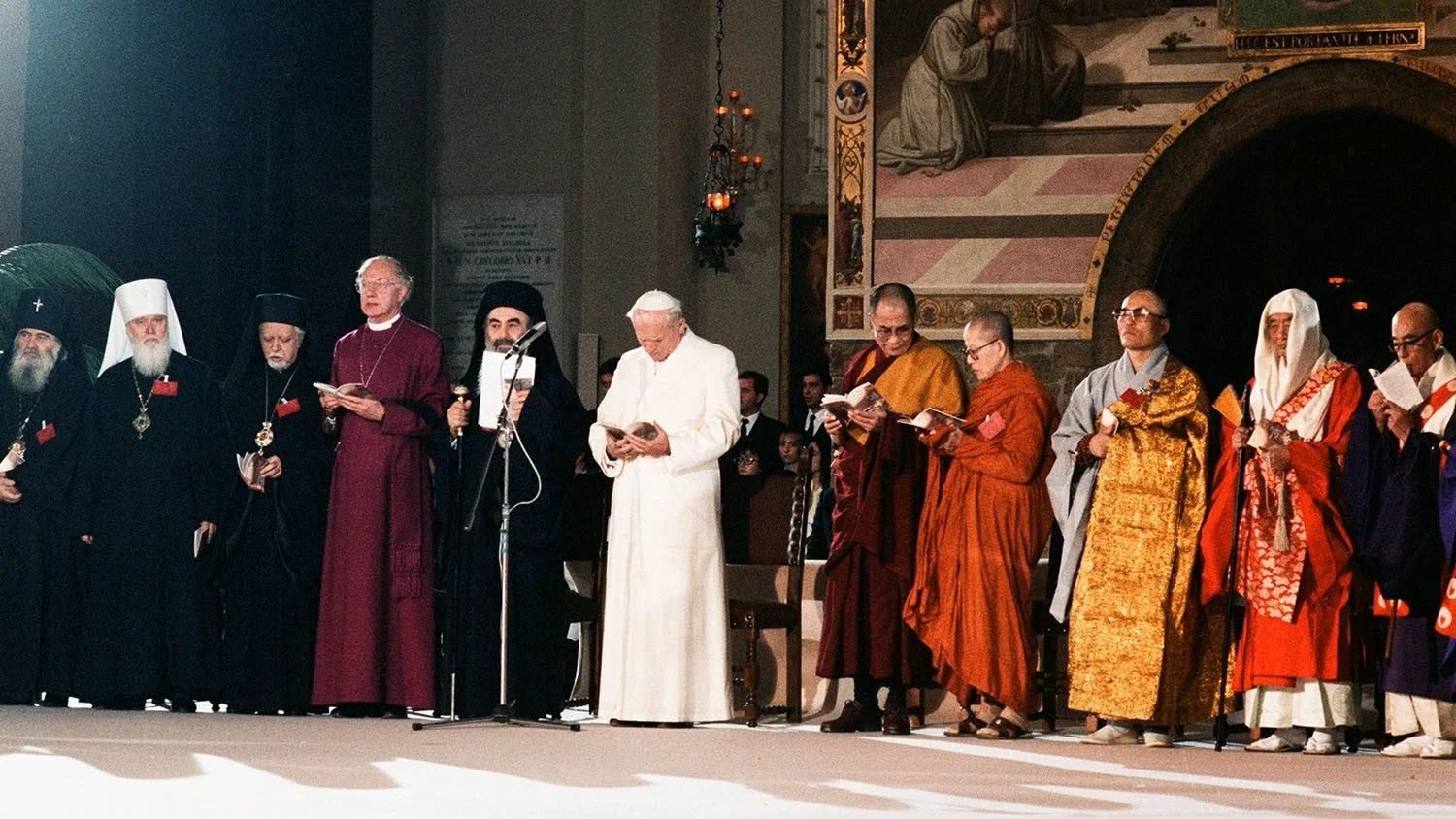
John Paul II with representatives of world religions at Assisi, 27 October 1986. Although Assisi extended beyond Christian ecumenism into interreligious relations, it became one of the most visible manifestations of the postconciliar emphasis on dialogue and common initiatives across religious boundaries.
Why Mortalium Animos Is So Difficult to Reconcile With the New Framework
The comparison can finally be reduced to two propositions.
Pius XI:
The Church's unity already exists; Christian unity is promoted through the return of those separated from the one true Church.
Vatican II and its subsequent development:
Separated Christians and ecclesial bodies already participate imperfectly in communion; their communities can function as means of salvation; Catholics and other Christians therefore engage together in dialogue, prayer, mutual renewal and an ecumenical journey toward full communion.
There are points of continuity between these propositions.
Both affirm Christ.
Both affirm Baptism.
Both affirm one Church.
Both desire complete Christian unity.
Both formally preserve a unique fullness in Catholicism.
But those similarities do not remove the fundamental difference concerning where Christian unity presently resides and how those outside full Catholic communion relate ecclesially to it.
That is the doctrinal centre of the controversy.
The Traditionalist Critique
Traditional Catholic writers have therefore argued that the problem is not simply that postconciliar Catholics became excessively friendly toward Protestants and Orthodox Christians. The objection is ecclesiological.
The CMRI, for example, directly compares Unitatis Redintegratio with preconciliar teaching and argues that Vatican II's conception of imperfect communion and salvific separated communities conflicts with the earlier Magisterium.
Its discussion of Pius XII's 1949 instruction likewise stresses that Pius XII's limited acceptance of ecumenical contacts remained explicitly subordinate to conversion and return, rather than anticipating the later theology of reciprocal ecumenical dialogue.
Other traditional Catholic critiques similarly identify the abandonment of return ecclesiology as central to the modern ecumenical transformation.
These are secondary theological arguments rather than magisterial authorities. Their value lies principally in directing attention back to the primary texts—which ultimately must decide the comparison.
Main Objection
The strongest objection is that no contradiction exists. Vatican II explicitly says that Christ founded one Church; that the Catholic Church possesses all revealed truth and means of grace; that Catholic unity can never be lost; and that separated Christians have not attained full ecclesiastical communion. “Imperfect communion,” on this interpretation, merely provides more precise theological language for realities traditional Catholicism already recognised.
A baptized Protestant possesses a valid Baptism.
An Orthodox bishop may possess valid episcopal orders.
An Orthodox Eucharist may therefore be valid.
A Protestant possesses the Scriptures.
Consequently there were always objective supernatural bonds connecting separated Christians with Catholicism.
Vatican II simply developed this truth and found new pastoral methods for restoring complete communion. Furthermore, the preservation of Eastern traditions demonstrates that “return” could never legitimately have meant absorption or Latinisation. This is a serious argument.
Response
The difficulty is not Catholic recognition of valid Baptism, valid Eastern sacraments or fragments of Catholic truth existing outside visible Catholic communion. Those realities preceded Vatican II. The issue is what ecclesiological conclusion follows from them.
The traditional conclusion was:
These are Catholic goods retained outside Catholic unity which should draw their possessors into that unity.
The new formulation says separated Churches and Communities themselves possess ecclesial significance, participate imperfectly in communion, and can be used by the Spirit as means of salvation. Likewise, the traditional objective was:
conversion and return.
Vatican II expressly distinguishes individual reconciliation from ecumenical action and establishes dialogue, common prayer, cooperation and mutual renewal as the continuing means of an ecumenical movement.
Most decisively, Pius XI had already considered and rejected an ecumenical theory based upon Christians jointly striving toward a unity supposedly requiring future attainment. His answer was not “imperfect communion.” His answer was return to the one true Church.
And as late as 1949 the Holy Office explicitly insisted that Catholic ecumenical activity retain precisely that interpretation. The historical sequence is therefore difficult to explain as mere terminological development:
Leo XIII → unity already possessed
Pius XI → rejection of unity-as-future-project; return to the one Church
Pius XII/Holy Office → controlled contacts explicitly ordered toward return
Vatican II → imperfect communion + Churches and ecclesial Communities + means of salvation + dialogue + common prayer + ecumenical movement distinct from individual reconciliation
Postconciliar development → full communion + reciprocal exchange of gifts + rejection of absorption/reverse ecumenism + denunciation of proselytism
The direction of development is evident in the texts themselves.
What We Can and Cannot Conclude
What We Can Conclude
The pre-Vatican II Magisterium taught unmistakably that the Catholic Church already possesses the unity Christ gave His Church.
Leo XIII applied John 17 to that existing ecclesial unity.
Pius XI explicitly rejected the notion that Christian unity had yet to be realised and taught that unity was to be restored through the return of separated Christians to the one true Church.
Pius XII's Holy Office maintained that principle immediately before Vatican II.
Vatican II introduced a substantially different ecumenical framework based upon degrees of communion, separated “Churches and ecclesial Communities,” salvific elements operating through them, dialogue, reciprocal renewal, cooperation and certain forms of common prayer.
The postconciliar authorities subsequently developed this framework using concepts such as “full communion,” journeying together, exchange of gifts, rejection of “absorption,” and opposition to proselytism. This represents considerably more than a change of diplomatic tone.
It reflects a changed ecclesiological conception of how separated Christians and their communities stand in relation to the Catholic Church.
What We Cannot Conclude
We cannot
conclude that Vatican II explicitly taught that all Christian denominations are equally true. It did not.
say that Unitatis Redintegratio formally declared that the Catholic Church lost her unity. It explicitly says otherwise.
equate every theological conversation with non-Catholics with false ecumenism. Pius XII permitted carefully controlled discussions.
equate traditional “return” ecclesiology with compulsory Latinisation. Benedict XIV and Pius XII expressly contradict that caricature.
Nor should every condemnation of “proselytism” automatically be interpreted as a condemnation of conversion. Dishonest, coercive or manipulative proselytism must be distinguished from legitimate Catholic evangelisation. But these qualifications do not eliminate the underlying doctrinal problem.
They make it possible to identify it more precisely.
Conclusion
Christ did not leave His followers a collection of divided Churches charged with eventually constructing His Church's unity. He founded one Church. And He gave that Church unity.
That is why Leo XIII could speak of bringing wandering sheep back to the fold; why Pius XI could reject the interpretation that Christ's prayer “that they all may be one” remained ecclesiologically unfulfilled; and why Pius XII's Holy Office could insist, only fifteen years before Unitatis Redintegratio, upon the “return of the dissidents to the one true Church of Christ.”
Vatican II retained important elements of this doctrine in words. It continued to affirm one Church and acknowledged that the Catholic Church possesses the fullness of revealed truth and the means of grace.
But it placed those affirmations within a new ecumenical structure:
imperfect communion, separated Churches and ecclesial Communities, ecclesial means of salvation, reciprocal dialogue, common prayer, mutual renewal and a progressive movement toward full communion.
The subsequent abandonment of straightforward return language was therefore not an isolated pastoral fashion. It followed the conceptual trajectory established by the Council.
The decisive question remains the one Pius XI effectively posed in 1928:
Did Christ establish a Church already possessing the unity for which He prayed, or did He leave Christianity divided in such a way that His Church's visible unity must subsequently be reconstructed through an ecumenical movement?
Traditional Catholic ecclesiology answers unequivocally:
Christ's Church already possesses unity.
Men may leave it.
Nations may fall away from it.
Heresies may oppose it.
Schisms may separate millions from it.
But Christ's Church cannot cease to possess one of the Marks with which her Divine Founder constituted her.
If Vatican II's ecumenical ecclesiology requires Christians to understand the separated bodies not principally as communities whose members must be brought back into the Church's existing unity, but as ecclesial partners already participating in varying degrees in Christ's Church and travelling together toward fuller unity, then the difference concerns the nature of the Church herself, not merely ecumenical technique.
And that raises the larger question running throughout the Vatican II crisis:
If the Catholic Church is indefectibly one in faith, government and communion, can her own authoritative Magisterium replace the ecclesiology taught by Leo XIII, Pius XI and Pius XII with a substantially different one?
That question ultimately leads beyond ecumenism to indefectibility, authority and the identity of the Church during the postconciliar crisis.
Primary Sources
Holy Scripture
John 17:20–23 — Christ's prayer “that they all may be one,” central to both traditional and modern discussions of Christian unity.
Ephesians 4:4–5 — St Paul's description of the Church's existing unity: “one body… one Lord, one faith, one baptism.”
Matthew 28:18–20 — Christ's missionary command to teach and baptize all nations.
Benedict XIV, Allatae Sunt (1755) — Important evidence that traditional Catholic reunion with the East did not require destruction of legitimate Eastern rites. Allatae Sunt — Vatican text
Leo XIII, Satis Cognitum (1896) — One of the clearest magisterial treatments of the Church's unity in faith, government and communion and of Christ having constituted His Church one. Satis Cognitum — Vatican text
Pius XI, Mortalium Animos (1928) — Essential preconciliar teaching on ecumenism; explicitly rejects the conception that the Church's unity remains an unrealised ideal and identifies Christian reunion with return to the one true Church. Mortalium Animos — Vatican text
Pius XII, Mystici Corporis Christi (1943) — Identifies Christ's Mystical Body with the One, Holy, Catholic, Apostolic and Roman Church and insists upon its visible and unbroken unity. Mystici Corporis Christi — Vatican text
Pius XII, Orientales Omnes Ecclesias (1945) — Particularly useful for demonstrating simultaneously the traditional call to “return” and the preservation of legitimate Eastern rites. Orientales Omnes Ecclesias — Vatican text
Holy Office, De Motione Oecumenica (1949) — Demonstrates exactly what forms of ecumenical contact were permitted under Pius XII and the doctrinal principles governing them, including the continued insistence upon return to the Catholic Church. Holy Office Instruction on the Ecumenical Movement
Second Vatican Council, Unitatis Redintegratio (1964) — The principal conciliar text establishing the new Catholic ecumenical programme. Unitatis Redintegratio — Vatican text
Further Reading
For a traditionalist comparison of Unitatis Redintegratio with the earlier Magisterium:
CMRI — The Decrees of Vatican II on Ecumenism Compared with Past Church Teachings
For an examination specifically of the claim that Pius XII anticipated postconciliar ecumenism:
CMRI — The Ecumenical Movement: Did Pope Pius XII Condone Ecumenism?
For a broader traditional critique of postconciliar ecumenism:
CMRI — The Last Days and False Ecumenism
Catholic Apologetics — Modern Ecumenism Is a Fraud
These are secondary traditionalist analyses and should be read as such; the principal doctrinal case should ultimately be judged from the primary magisterial texts quoted above.
Related Questions
What Did Vatican II Change About the Nature of the Church?
What Does “Subsists In” Mean?
Can Non-Catholic Religions or Churches Be Means of Salvation?
What Did Vatican II Change About Catholic Missionary Activity?
What Did the Catholic Church Traditionally Teach About Membership in the Church?
Can Catholic Doctrine Change or Develop?
What Is the Indefectibility of the Catholic Church?
If Vatican II Contradicted Previous Catholic Teaching, What Does That Mean for Catholic Authority?