What Is Heresy?
Short Answer
Heresy is the pertinacious denial or doubt, after Baptism and while retaining the Christian name, of a truth that must be believed with divine and Catholic faith.
This is the precise traditional definition embodied in the 1917 Code of Canon Law, Canon 1325 §2. The definition therefore contains several essential elements:
the person is baptized;
remains professedly Christian rather than rejecting Christianity altogether;
denies or positively doubts a revealed truth proposed by the Church for divine and Catholic belief; and
does so pertinaciously, that is, with an obstinate refusal to give the assent of faith.
Not every theological mistake is therefore heresy. A Catholic may
misunderstand a doctrine,
express himself badly,
be ignorant of what the Church actually teaches,
struggle with an intellectual difficulty, or
ask whether a doctrine is true without thereby becoming a heretic.
St Augustine made this distinction explicitly:
people who have received a false belief from others but sincerely seek the truth and are prepared to be corrected are not to be counted as heretics merely because their present belief is wrong.
Heresy may also be considered at different levels.
Internal heresy exists in the intellect and will when a person knowingly and obstinately rejects the faith in his own mind.
External heresy occurs when that rejection is manifested through words, writing, actions or other externally perceptible conduct.
This distinction is essential because the sin of heresy and the canonical crime of heresy are related but not identical. Canon 2195 §1 defines an ecclesiastical delict as an external and morally imputable violation of a law to which a canonical sanction is attached. An entirely internal sin therefore does not, simply as such, constitute a canonical delict in the external forum.
Nor should external be confused with public. An external act can remain occult. Canon 2197 separately distinguishes public, notorious and occult delicts. This becomes particularly important when questions of Church membership, ecclesiastical office, canonical penalties and public heresy are considered elsewhere in this FAQ series.
Why This Question Matters
Few theological words are used more loosely today than heresy.
Someone disagrees with a Catholic writer and is called a heretic.
A priest makes an inaccurate statement and is immediately labelled a heretic.
A Catholic struggles to understand a dogma and fears that his questions have made him a heretic.
Conversely, doctrines explicitly contrary to revealed Catholic faith may be dismissed as mere differences of theological emphasis.
Traditional Catholic theology permits neither extreme.
Heresy is neither a general term for religious error nor merely an insulting description for somebody whose theology we dislike. It is a precise theological and canonical concept concerning the supernatural virtue of faith itself.
This precision becomes especially important when considering later questions such as:
whether public heresy separates a person from membership in the Church;
whether a cleric can possess ecclesiastical office while publicly defecting from the Faith;
how heresy differs from apostasy and schism;
whether an erroneous proposition is formally heretical or merely erroneous;
and what evidence is required before applying these principles to a particular person.
Those questions cannot be answered responsibly unless heresy itself is first defined correctly.
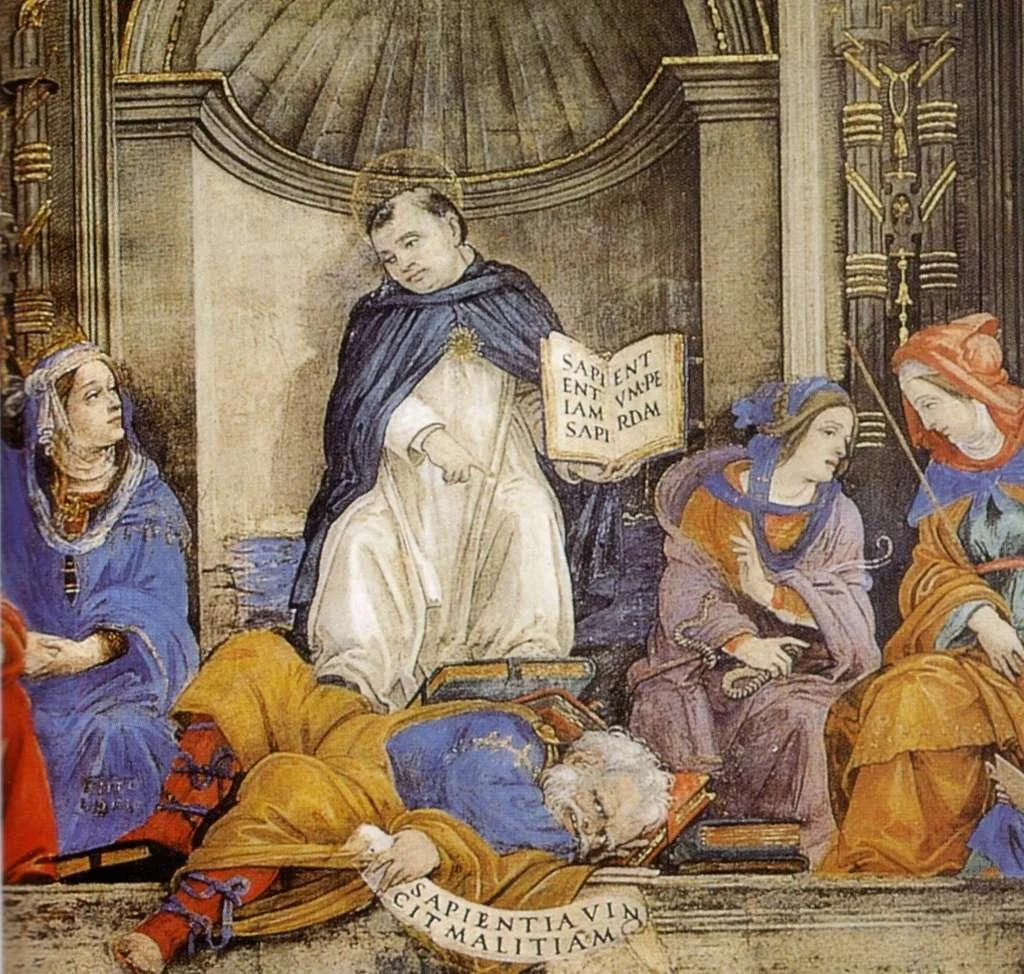
Filippino Lippi, The Triumph of St Thomas Aquinas over the Heretics (1489–1491), St Thomas Aquinas defending Catholic truth against heresy. Heresy is not simply disagreement, but the pertinacious rejection of truth revealed by God and proposed by His Church.
What the Catholic Church Teaches
What Must Be Believed With Divine and Catholic Faith?
The object of heresy is not simply anything a Catholic teacher has ever said.
Canon 1323 §1 of the 1917 Code of Canon Law, substantially incorporating the teaching of the First Vatican Council, explains that divine and Catholic faith must be given to truths contained in the Word of God, whether written or handed down, which the Church proposes as divinely revealed through either a solemn judgment or her ordinary and universal Magisterium.
This is the category traditionally called dogma or a truth de fide divina et catholica.
A dogma may therefore be proposed through such means as a solemn definition of an Ecumenical Council, an ex cathedra definition of the Roman Pontiff, or the Church's ordinary and universal Magisterium.
The crucial point is that the proposition must be presented as divinely revealed.
This distinction prevents the word heresy from swallowing every other theological category.
A proposition may be false, dangerous, rash, offensive to pious ears, erroneous in theology, proximate to heresy or contrary to an authoritative but non-definitive teaching without necessarily being formally heretical in the strict sense. Canon 1324 itself warned Catholics not only to avoid heresy but also errors which approach it, demonstrating that the categories are not identical.
The Precise Definition in the 1917 Code
Canon 1325 §2 states in substance that, after Baptism, a person who retains the Christian name and pertinaciously denies or doubts a truth that must be believed with divine and Catholic faith is a heretic.
Each part of that definition matters.
| Element | Meaning |
|---|---|
| After Baptism | Heresy in the strict Christian sense presupposes incorporation into Christianity through Baptism. |
| Retaining the Christian name | Total repudiation of Christianity is apostasy, not merely heresy. |
| Truth of divine and Catholic faith | The disputed truth must belong to divine revelation and have been proposed by the Church as such. |
| Denial | The person refuses assent to the revealed truth or affirms its contradictory. |
| Doubt | The person positively treats the revealed truth as uncertain rather than giving it the assent of faith. |
| Pertinaciously | The denial or doubt involves an obstinate refusal of the assent owed to God's revealed truth as proposed by the Church. |
The Catechism of St Pius X gives the same principle in simpler language:
“heretics are baptized persons who obstinately refuse belief in a truth revealed by God and taught as an article of faith by the Catholic Church. ”
Elsewhere it describes heresy as
“a culpable intellectual error by which a truth of faith is obstinately denied.”
St Thomas Aquinas: Heresy Is a Corruption of Christian Faith
St Thomas Aquinas (c. 1225–1274) explains in the Summa Theologiae, II-II, q. 11, a. 1, that heresy is a species of unbelief belonging specifically to those who profess Christianity but corrupt its dogmas.
The word itself derives from the idea of choosing. The heretic does not simply fail to know Christianity. He professes to accept Christ while selecting according to his own judgment what he will or will not accept as Christ's doctrine.
This explains why heresy attacks faith at its root.
Catholic faith does not consist in believing a collection of propositions merely because each proposition seems independently convincing. The Christian believes because God has revealed, and God can neither deceive nor be deceived.
Consequently, knowingly rejecting even one truth which one recognizes as divinely revealed does not merely subtract one item from an otherwise intact collection. It substitutes one's own judgment for the authority of God revealing.
Why One Denied Dogma Is Enough
Pope Leo XIII, in Satis Cognitum (1896), explains that Catholic faith requires assent to revealed truth in its entirety. The historical heresies did not normally reject every Christian doctrine. Arians, Nestorians and other heretics retained large portions of Christian belief while rejecting particular revealed truths.
Yet the Church regarded their selective rejection as incompatible with the unity of faith.
This is because the formal motive of supernatural faith is God's authority as Revealer.
If a person knowingly says in effect, “I believe God and His Church on these revealed truths, but I will not believe them concerning this revealed truth,” his ultimate rule of belief has ceased to be God revealing and has become his own judgment.
That does not mean that every person who happens objectively to hold one erroneous proposition has consciously performed such an act. That is precisely why material error must be distinguished from formal heresy.
Denial and Doubt
Heresy can take the form either of denial or of doubt.
Denial is comparatively straightforward. If the Church proposes that Christ is truly divine, for example, deliberately maintaining that Christ is not divine contradicts the dogma directly.
Doubt requires more care. The doubt contemplated in the traditional definition is not merely an unwanted thought, a temptation against faith, an unresolved intellectual difficulty, or the honest question:
“I do not yet understand how this can be true—can someone explain it?”
Such questions can coexist with faith. Rather, heretical doubt involves a deliberate withholding of the certainty owed to a revealed truth: the person positively treats as doubtful or uncertain what he knows the Church proposes as divinely revealed. Traditional moral theology consequently distinguished such positive doubt from difficulties, involuntary temptations and states of uncertainty that do not involve pertinacious rejection.
Someone may therefore say:
“I believe what the Church teaches, but I do not understand this doctrine.”
That is not heresy.
Another may say:
“I know the Church teaches this as revealed by God, but I refuse to believe it.”
That is fundamentally different.
What Does “Pertinacious” Mean?
Pertinacity is one of the most important words in the definition. It prevents every mistaken belief from being automatically classified as formal heresy. St Augustine gives an unusually clear early explanation.
St Augustine of Hippo (AD 354–430), writing in Letter 43 (AD 397), distinguishes people who hold false doctrine obstinately from those who inherited an erroneous belief but sincerely seek the truth and are willing to be corrected. The latter, he says, are not to be counted as heretics merely on account of their error.
Pertinacity therefore concerns the will's refusal to submit the intellect to the rule of faith.
It should not be reduced to mere emotional stubbornness. Nor does the word itself mean that someone must angrily repeat an error for years before heresy can exist. At the same time, accusations of pertinacity should not be made casually.
The external forum deals with what can be manifested and established. Admonition can therefore be particularly important in demonstrating whether a person misunderstood the doctrine, spoke inaccurately, or knowingly persists in rejecting what he understands the Church to require.
Significantly, Canon 1325 defines heresy by pertinacious denial or doubt, rather than by specifying a fixed number of warnings. Canon 2314 separately prescribes admonitions in connection with certain additional canonical penalties.
Material Heresy and Formal Heresy
Traditional theology commonly distinguishes material from formal heresy.
Material heresy refers to holding an objectively heretical proposition without the pertinacious culpability required for formal heresy.
A person might have been taught false doctrine from childhood, never have understood the Catholic teaching correctly, or genuinely believe that his position agrees with the Catholic Faith. The proposition remains false. It does not become Catholic merely because the person sincerely believes it. But the person's subjective culpability is a separate question.
Formal heresy, by contrast, involves the knowing and voluntary refusal of the assent required by Catholic faith.
The distinction appears clearly in traditional catechetical theology. The Baltimore Catechism explains that a refusal which is voluntary and obstinate is formal heresy, whereas an involuntary error is material. This is why it is often more precise to say:
“This proposition is heretical”
before saying:
“This person is formally a heretic.”
The first judgment concerns the objective theological content of a proposition. The second additionally concerns the person's relation to that proposition, including the necessary element of pertinacity.
Sacred Scripture
Heresy was not invented by medieval canon lawyers. The fundamental reality appears already in the New Testament.
In Titus 3:10–11, St Paul commands Titus to admonish the heretical man and, after unsuccessful admonition, avoid him. The passage links heresy with personal responsibility and obstinate persistence.
In Galatians 1:6–9, St Paul condemns the substitution of another gospel for that which the Apostles had delivered, even hypothetically were such a message to come from an angel.
2 Peter 2:1 warns that false teachers will arise among Christians and introduce destructive sects and false doctrine.
And 1 Timothy 3:15 identifies the Church as the house of God and the “pillar and ground of truth.”
Taken together, these passages show the basic pattern later expressed with theological precision: Christ has revealed a definite faith; the Apostles transmit that faith; the Church preserves and teaches it; and deliberate departure from that revealed faith is a serious rupture rather than merely another legitimate Christian opinion.
The Early Church Fathers
St Irenaeus of Lyons
St Irenaeus of Lyons (c. AD 130–202) wrote Against Heresies around AD 180 specifically against the Gnostic systems which claimed superior or secret versions of Christianity.
His answer was fundamentally ecclesial. The authentic Faith was publicly transmitted from the Apostles and preserved in the churches through their succession of bishops. Heretical teachers could not demonstrate an equivalent apostolic continuity for the doctrines they had introduced. In Against Heresies III.3, Irenaeus appeals explicitly to apostolic succession and the publicly transmitted faith as the standard against later innovations.
Heresy, therefore, was understood very early not simply as intellectual originality but as departure from the received apostolic Faith.
Tertullian
Tertullian (c. AD 155–220), in The Prescription Against Heretics (c. AD 200), similarly connects the term heresy with “choice”: the heretic chooses for himself rather than receiving faithfully what comes from Christ through the Apostles.
Although Tertullian's own later history requires caution in using him as an ecclesiastical authority, this work remains important historical testimony to the early Christian understanding of doctrinal deviation.
St Augustine of Hippo
St Augustine adds the crucial subjective distinction.
False doctrine alone does not establish personal pertinacity. Someone who inherited error and remains genuinely ready to discover and embrace Catholic truth should not simply be treated as though he knowingly rebelled against it.
Thus the patristic evidence already contains both sides of the Catholic understanding:
the objective obligation to preserve the Apostolic Faith and the need to distinguish erroneous belief from obstinate rejection.
Internal and External Heresy
This distinction is especially important.
Internal Heresy
An act of heresy can occur within the intellect and will. Suppose a baptized Catholic clearly knows that the Church teaches a particular proposition as divinely revealed and nevertheless deliberately decides:
“I refuse to believe that.”
Even if he tells nobody, there has been an interior act against faith. That concerns the moral and sacramental forum of conscience. God sees the interior act.
The Church's canonical penal order, however, does not treat a purely internal act as an ecclesiastical crime simply because it exists within the soul.
External Heresy
Heresy becomes external when the rejection is manifested outwardly—for example through speech, publication, teaching, subscription to a statement, or conduct which unambiguously expresses the denial.
This external character is essential to the canonical concept of a delict. Canon 2195 §1 defines a canonical crime as an external and morally imputable violation of a law carrying a canonical sanction. The distinction can therefore be summarized:
| Situation | Moral / Theological Character | Canonical Character |
|---|---|---|
| Interior temptation or difficulty resisted by the will | Not heresy | Not a canonical crime |
| Innocent doctrinal error without pertinacity | Material error | Does not by itself establish the crime of heresy |
| Interior knowing and pertinacious rejection of dogma | Sin of formal heresy | Purely internal act is not by itself an external canonical delict |
| Pertinacious rejection externally manifested | Formal external heresy | May constitute the canonical delict when the legal requirements of imputability are present |
| External heresy widely divulged or occurring in circumstances in which it will readily become divulged | External and public | Canonically public according to the principles of Canon 2197 |
This is why one must never use internal, external, public, manifest and notorious as though they were interchangeable words.
External Does Not Necessarily Mean Public
Canon 2197 of the 1917 Code divides canonical offences into categories including public, notorious and occult.
A delict is public when it has already been divulged or occurs in circumstances in which it can prudently be expected readily to become divulged.
A delict can also be occult, meaning that it is not public. The Code further distinguishes whether the act itself or its imputability remains hidden.
Consequently:
all canonical crimes must involve something external, but not every external crime is public.
That distinction will become crucial when discussing the theological consequences of public heresy, since Catholic theologians discussing Church membership and office are not necessarily using every term in exactly the same sense as a casual modern speaker.
Heresy as Sin and Heresy as Canonical Crime
The distinction between sin and crime is fundamental.
A sin concerns the moral order before God.
A canonical crime or delict concerns an externally manifested violation which falls under the Church's juridical order.
The two may coincide, but they should not simply be identified. A person might internally commit a grave sin against faith which nobody else knows about. That is morally real, but no external canonical delict has thereby been manifested. Conversely, when evaluating an external statement canonically, the Church must consider not merely the words in isolation but whether the legally relevant requirements—including moral imputability—are established.
Under the 1917 Code, Canon 2314 attached canonical penalties to apostasy, heresy and schism, beginning with ipso facto excommunication, while prescribing additional measures in specified circumstances.
This is another reason why heresy and excommunication must not be treated as synonyms.
Heresy is a sin and doctrinal defection defined by its relation to faith.
Excommunication is an ecclesiastical censure governed by canon law.
A canonical penalty may follow from a delict of heresy, but the concepts themselves remain distinct.
Heresy Is Not the Same as Apostasy or Schism
Canon 1325 §2 carefully distinguishes three realities.
Heresy is the pertinacious denial or doubt of a truth of divine and Catholic faith while retaining the Christian name.
Apostasy is total departure from the Christian Faith.
Schism concerns refusal of submission to the Roman Pontiff or refusal of communion with members of the Church subject to him.
A person therefore should not be called an apostate merely because he denies one dogma. Nor should someone be called a heretic merely because the dispute is principally one of ecclesiastical obedience or communion.
The categories may sometimes overlap in actual cases, but their definitions must remain distinct.
Not Every Error Is Heresy
This point deserves emphasis because Catholic theology traditionally possessed a much richer vocabulary of doctrinal censures than the modern habit of calling everything either “orthodox” or “heretical.”
The pre-Vatican II Catholic Encyclopedia explains distinctions between strict heresy and theological propositions which may instead be proximate to heresy, theologically erroneous, or otherwise censurable without directly contradicting a dogma. Likewise, disagreement over a matter of discipline, historical interpretation, prudential policy or legitimate theological opinion is not heresy merely because the dispute is intense.
Heresy has a specific object:
divinely revealed truth proposed by the Church for belief with divine and Catholic faith.
This principle is indispensable if accusations of heresy are to have theological meaning rather than function as polemical abuse.
The Main Objection
A reasonable objection is:
“If this definition is applied strictly, wouldn't enormous numbers of ordinary Christians become heretics merely because they misunderstand Catholic doctrine or were raised outside the Catholic Church?”
That conclusion would confuse objective doctrinal error with formal pertinacious heresy.
A Protestant, Orthodox Christian, poorly instructed Catholic, or other baptized person may objectively hold propositions contrary to Catholic dogma. The propositions themselves can be materially heretical. But the individual's culpability requires a further analysis.
Has he understood what the Catholic Church actually teaches?
Does he know that the doctrine is presented as divinely revealed?
Is he refusing that doctrine because he will not submit to the Church's rule of faith?
Or has he misunderstood the doctrine, inherited an erroneous account of Catholic teaching, or remained genuinely prepared to accept whatever he can establish to be Christ's truth?
St Augustine's distinction is directly relevant. A person sincerely searching for truth and prepared to be corrected is not placed in the same category as one who knowingly resists it. This does not make error harmless.
It means that truth about the doctrine and justice toward the person must both be preserved.
A Second Objection: “Surely Denying One Doctrine Cannot Destroy the Whole Faith”
Catholic theology distinguishes between possessing much Christian truth and possessing the supernatural virtue of Catholic faith in its integrity. Someone may continue to believe that God exists, that Christ rose from the dead, that Scripture is inspired and many other Christian truths while rejecting one dogma.
But if he knowingly rejects something precisely because he refuses to accept God's revealed truth as proposed by the Church, the problem is not merely mathematical—as though he now believes ninety-nine doctrines instead of one hundred.
The problem concerns the principle by which he believes.
Pope Leo XIII explains this in Satis Cognitum: the person who selectively accepts revealed doctrine ultimately makes his own judgment the rule determining what in revelation he will accept.
That is why a single pertinaciously rejected dogma can constitute formal heresy.
A Third Objection: “Doesn't a Person Have to Be Warned First?”
Titus 3:10–11 speaks explicitly about admonishing the heretical man, and ecclesiastical warnings have an obvious practical importance.
A warning can clarify what the Church actually teaches, eliminate an innocent misunderstanding and establish whether a person is willing to correct his position.
But the theological essence of pertinacity should not simply be equated with completing a mechanical sequence of warnings.
Canon 1325 defines the heretic through pertinacious denial or doubt. It does not say that pertinacity means nothing more or less than having received a specified number of formal warnings. Warnings may therefore provide powerful evidence concerning pertinacity, especially when an external canonical judgment is required. They must not be confused with the theological definition itself.
What We Can and Cannot Conclude
Established Catholic doctrine: Heresy concerns the obstinate rejection or doubt of revealed truth proposed for belief with divine and Catholic faith.
Established Catholic doctrine: Faith requires assent because of the authority of God revealing, not because the believer independently finds every revealed proposition persuasive.
Established theological and canonical distinction: Objective doctrinal error must be distinguished from formal pertinacious heresy.
Established canonical principle: A canonical delict requires an external and morally imputable violation; therefore a purely internal sin and an external canonical crime are not identical concepts.
Established canonical distinction: External does not necessarily mean public. Canon 2197 expressly recognises occult external delicts as well as public and notorious ones.
Established traditional teaching: Formal heresy has serious consequences for ecclesiastical unity. Pope Pius XII taught in Mystici Corporis Christi (1943) that heresy, schism and apostasy differ from ordinary grave sins precisely because they sever a person from the unity of the Church's Body.
What does not follow is that every doctrinally inaccurate sentence proves that its speaker is a formal heretic.
Nor can we normally know another person's interior culpability merely by speculation.
Nor should every theological error be upgraded rhetorically into formal heresy.
Nor should heresy, apostasy, schism and excommunication be treated as interchangeable terms.
Finally, this article has not attempted to settle every subsequent question concerning public heresy, membership in the Church, loss of ecclesiastical office or the application of these principles to particular claimants to ecclesiastical authority. Those questions require additional theological and canonical distinctions and should be examined separately.
Conclusion
Heresy has a precise meaning in traditional Catholic theology. It is not mere disagreement, intellectual difficulty, ignorance or ordinary theological error.
It is the pertinacious post-baptismal denial or doubt of a truth which must be believed with divine and Catholic faith while retaining the Christian profession.
The distinction between material error and formal heresy protects both truth and justice. The Church can identify a proposition objectively opposed to revelation without pretending automatically to know the interior culpability of every person who repeats it.
The distinction between internal and external heresy is equally necessary. Interior formal heresy is a sin against faith; canonical crime belongs to the external juridical order. And even an external delict must not automatically be called public, since the 1917 Code distinguishes external offences which are public, notorious or occult.
These distinctions are not theological technicalities without practical importance. They allow Catholics to defend revealed truth without turning the gravest doctrinal terminology into polemical name-calling.
Christ entrusted a definite Faith to His Church. St Paul therefore warns against another gospel, St Irenaeus directs Christians back to the apostolic Faith publicly preserved in the Church, St Augustine distinguishes innocent error from obstinate resistance, and Catholic theology eventually expresses these principles with canonical precision.
The follow up question is therefore unavoidable:
What effect does formal public heresy have upon membership in the Catholic Church?
Primary Sources
Sacred Scripture: Titus 3:10–11; Galatians 1:6–9; 2 Peter 2:1. ; 1 Timothy 3:15; all together.
First Vatican Council, Dei Filius (24 April 1870), chapter 3, on divine and Catholic faith. Vatican text of Dei Filius
1917 Code of Canon Law, Canons 1323–1325, defining the object of divine and Catholic faith and heresy. 1917 Code Canons 1322–1325
1917 Code of Canon Law, Canons 2195–2197, on the nature and classification of canonical delicts. 1917 Code Book V
1917 Code of Canon Law, Canon 2314, on canonical penalties for apostasy, heresy and schism. Canon 2314 text
Pope Leo XIII, Satis Cognitum (29 June 1896), especially the sections concerning unity of faith and the obligation to accept every revealed truth. Satis Cognitum
Pope Pius XII, Mystici Corporis Christi (29 June 1943), §§22–23, concerning membership and separation through heresy, schism or apostasy. Mystici Corporis Christi
St Thomas Aquinas (c. 1225–1274), Summa Theologiae, II-II, q. 11, aa. 1–2. St Thomas on Heresy
St Irenaeus of Lyons (c. AD 130–202), Against Heresies (c. AD 180), III.1–4, particularly III.3. Against Heresies III.3
St Augustine of Hippo (AD 354–430), Letter 43 (AD 397), 1, concerning error and obstinate adherence. St Augustine Letter 43
Catechism of St Pius X, sections concerning heresy and those outside the visible communion of the Church. Catechism of St Pius X
Further Reading
The Baltimore Catechism, especially its treatment of sins against faith and the distinction between formal and material heresy.
The Catholic Encyclopedia, “Heresy,” for the traditional theological distinctions between heresy strictly so called and lesser theological censures. Catholic Encyclopedia — Heresy
St Irenaeus, Against Heresies, Book III, for the relation between apostolic Tradition, episcopal succession and preservation of the true Faith. Against Heresies Book III
Related Questions
What Is the Difference Between Dogma Doctrine Discipline and Theological Opinion?
Can the Catholic Church Teach Error in Faith and Morals?
What Does It Mean to Be a Member of the Catholic Church?
What Does “Outside the Church There Is No Salvation” Mean?
What Is Apostasy?
What Is Schism?
Does Public Heresy Separate a Person From the Catholic Church?
Can a Public Heretic Hold Ecclesiastical Office?