Short Answer
No. The Catholic Church is not experiencing a crisis in which she has abandoned her Faith, corrupted her doctrines, altered her divine constitution, or transformed herself into another religion. She remains the one, holy, Catholic and apostolic Church founded by Our Lord Jesus Christ, preserving the same Faith entrusted to her by Christ and His Apostles.
Yes. The Vatican II–Novus Ordo establishment is experiencing its own religious and institutional crisis. It is a pseudo-Catholic religious system that claims to be the Catholic Church but has departed fundamentally from traditional Catholicism. Its doctrines, worship, ecclesiology and understanding of the Church's mission constitute a substantially different religion.
Although the postconciliar establishment retains the Catholic name, claims the authority of the papacy and hierarchy, and controls many of the Church's historic buildings and institutions, possession of Catholic institutions does not establish possession of the Catholic Faith or legitimate Catholic authority.
The Catholic Church did not become the Vatican II–Novus Ordo religion. Rather, a different religious establishment emerged within her historical institutions, claiming her identity and authority while departing from the Faith she has always professed.
This distinction does not mean that faithful Catholics are free from extraordinary trials. The prolonged vacancy of the Roman See, the disruption of normal ecclesiastical government and the difficulty of obtaining traditional sacramental assistance present serious hardships. But the suffering of the faithful must not be confused with the defection of the Church herself.
The Catholic Church remains indefectible. The Vatican II–Novus Ordo establishment is not the Catholic Church, despite retaining the Catholic name, claiming her ecclesiastical authority and controlling many of her historic institutions.
The crisis is not that the Catholic Church has become a different religion. It is that the Vatican II–Novus Ordo establishment, having departed fundamentally from traditional Catholicism, is widely mistaken for the Catholic Church.
Why This Question Matters
For decades, traditional Catholics have described the religious upheaval following the Second Vatican Council as a “crisis in the Church.”
The expression appears in books, sermons, articles and discussions about the changes introduced after Vatican II. People speak of a crisis of doctrine, a crisis of the Mass, a crisis of priestly vocations, a crisis of authority and a crisis of Catholic identity.
Yet this familiar description conceals a fundamental theological question. When someone says that the Catholic Church embraced religious indifferentism, introduced a substantially different Mass, adopted teachings contrary to her previous Magisterium, or abandoned her traditional missionary purpose, who exactly is being accused of doing these things?
If the answer is the Catholic Church herself, then the accusation presents a serious problem concerning her indefectibility.
The Catholic Church cannot be both:
the indefectible Church established by Christ; and
an institution that has officially abandoned the religion Christ entrusted to her.
This raises a fundamental question:
Did the Catholic Church herself abandon her traditional Faith and adopt a substantially different religion, or did another religious establishment emerge that claimed her identity and authority?
Describing the post-Vatican II religious transformation merely as a “crisis in the Church” risks assuming the very point that must first be established: whether the religious establishment responsible for those changes is, in fact, the Catholic Church.
The decisive issue is not who possesses historic Catholic buildings, occupies ecclesiastical offices or claims succession from previous Catholic authorities. It is whether the doctrines, worship and religious principles of that establishment remain faithful to the religion entrusted by Christ to His Church.
This distinction matters because familiar language can create mistaken assumptions.
A person investigating Vatican II might conclude that the Catholic Church once taught one religion but subsequently adopted another, and that the task of traditional Catholics is to persuade her legitimate authorities to restore what they themselves abandoned.
Even Catholics who reject postconciliar innovations sometimes describe the situation as though the Church herself had been corrupted by the very authorities established to preserve her Faith.
But that is precisely what did not happen.
The Catholic Church did not abandon Catholicism. Rather, the postconciliar establishment departed from traditional Catholic teaching and worship while claiming to act with the authority of the Catholic Church.
This is not merely a matter of choosing more accurate terminology. It concerns the identity, authority, visibility and continued existence of the Church founded by Jesus Christ.
To understand why, we must begin with what the Catholic Church has always taught about herself.
What the Catholic Church Teaches About Her Indefectibility
The starting point is not Vatican II, modern religious controversies or the present condition of Catholic institutions. It is the nature of the Church established by Our Lord.
Christ promised St Peter:
“Upon this rock I will build my church, and the gates of hell shall not prevail against it.” — Matthew 16:18
Before His Ascension, Our Lord commissioned His Apostles to teach all nations and promised:
“Behold I am with you all days, even to the consummation of the world.” — Matthew 28:20
These promises concern the Church Christ established, not merely the personal perseverance of individual Christians.
They provide the foundation for the doctrine of indefectibility: the Catholic Church will continue until the end of time as the same Church founded by Christ, preserving her essential divine constitution, the deposit of revealed truth, her sacramental principles and the supernatural mission entrusted to her.
Indefectibility does not mean that every Catholic will remain faithful. Individual members may sin, apostatise or separate themselves from Catholic communion. Bishops may fail in their duties, priests may abandon their vocations, and entire nations may forsake the Faith.
Ecclesiastical institutions may be confiscated, damaged or occupied by those who do not profess Catholic doctrine.
But the failures of individual members and the loss of material institutions must not be confused with the defection of the Church herself.
The Testimony of Leo XIII and Pius XI
In Satis Cognitum (1896), Pope Leo XIII explained that Christ founded one visible Church, united in faith and government, possessing a supernatural life inseparable from her visible constitution.
The Church is not merely an association of people sharing similar religious opinions. Nor is she simply a corporation identified by its property, administrative offices or institutional history. She is a divinely constituted society, established to communicate the truth and means of salvation entrusted to her by Christ.
Pope Pius XI reaffirmed the same doctrine in Mortalium Animos (1928).
In paragraph 6, Pius XI explained that the Church founded by Christ must remain visible, united in doctrine and government, and permanently established for the salvation of souls. He concluded that the Church continues to exist and remains exactly the same Church as in the time of the Apostles.
In paragraph 10, he reaffirmed this continuity, explaining that separated Christians must return to the one true Church of Christ, which remains the same Church instituted by her divine Founder.
Invoking St Cyprian's teaching concerning the purity of the Bride of Christ, Pius XI affirmed that the Church has never been contaminated and cannot be contaminated in the future.
This is not a promise that every member of the Church will remain free from sin or error. It concerns the continued identity and holiness of the Church as the Mystical Spouse of Christ.
The Testimony of Pius XII
Pope Pius XII developed this ecclesiology in Mystici Corporis Christi (1943).
In paragraph 22, he explained the conditions of membership in the visible Church, including Baptism, profession of the true Faith and continued ecclesiastical communion.
In paragraphs 40–42, he emphasised the visible government established by Christ and the relationship between the Roman Pontiff, the bishops and the faithful.
In paragraph 69, he explained that the visible unity of the Church is expressed through common profession of Faith, common worship, participation in the same Sacrifice and observance of ecclesiastical law.
These teachings exclude the idea that Catholic identity can be established merely by institutional self-designation. A religious body cannot prove that it is the Catholic Church simply by calling itself Catholic or by possessing institutions historically associated with Catholicism. Its claim must be considered in relation to the Faith, sacraments, communion and divinely instituted authority belonging to the Church founded by Christ.
The Church may suffer persecution, institutional disruption and grievous losses.
But she cannot officially transform herself into a different religion while remaining the same indefectible Church.
Papal Infallibility and the Church's Indefectibility Belong Together
This conclusion becomes clearer when the doctrine of papal infallibility is considered alongside indefectibility.
The First Vatican Council, in Pastor Aeternus (1870), Chapter IV, defined the conditions under which a true Roman Pontiff teaches infallibly ex cathedra: when, exercising his office as supreme pastor and teacher of all Christians, he definitively proclaims a doctrine concerning faith or morals to be held by the whole Church.
This protection does not mean that everything a pope says is inspired, that every administrative decision is infallible, or that every disciplinary measure is necessarily the best possible decision. Yet papal infallibility must not be treated as an isolated privilege bearing no relationship to the Church's wider teaching and governing mission.
Christ established the papacy to preserve the unity of His Church in faith and communion.
Vatican I expressly taught that the Holy Ghost was not promised to Peter's successors so that they might reveal new doctrine, but so that they might faithfully preserve and expound the apostolic deposit of Faith. The Church also possesses a broader indefectibility that cannot be reduced to the relatively narrow conditions of a solemn papal definition.
Pius XI's Mortalium Animos illustrates the importance of an authentic, continuing teaching authority capable of preserving the unity of revealed doctrine. Solemn definitions serve that mission but do not exhaust it. The relationship between doctrine and worship is equally important.
In Mediator Dei (1947), §§44–48, Pope Pius XII explained that the sacred liturgy is subject to legitimate ecclesiastical authority precisely because it is intimately connected with Catholic doctrine.
The public worship of the Church must conform to the Faith she professes.
This does not mean that every liturgical change is intrinsically harmful or that every approved disciplinary measure is individually infallible. The Church has always possessed authority to regulate her worship and discipline within the limits established by divine law and revealed truth.
The serious question arises when an alleged Catholic authority is said to have introduced and universally promoted a substantially different religious system. If a true Roman Pontiff and the authentic Catholic hierarchy could use their governing and teaching authority to impose upon the faithful an officially corrupted religion, the difficulty would extend far beyond the technical conditions of an ex cathedra definition. It would concern the reliability of the Church's divine mission itself.
This is why the postconciliar controversy cannot be dismissed simply by observing that Vatican II proclaimed no new solemn dogmatic definitions. The issue concerns the cumulative exercise of purported ecclesiastical authority in doctrine, worship, discipline and religious practice.
The question is not whether every act of a true pope is infallible.
It is whether the divinely protected authority of the Catholic Church can become the means by which a substantially false religion is imposed upon the faithful.
The Catholic Church cannot become the instrument of her own doctrinal destruction.
The transformation attributed to the postconciliar claimants therefore raises the question of whether those claimants actually possessed the Catholic authority they professed to exercise.
The Fundamental Error: Confusing the Catholic Church With the Postconciliar Establishment
Consider the language commonly used to describe the period following Vatican II. It is often said that the Catholic Church changed her teaching on religious liberty, adopted a new understanding of ecumenism, introduced the Novus Ordo Mass, replaced traditional sacramental rites and established a different approach to non-Catholic religions.
These statements are misleading because they identify the wrong religious authority as the agent responsible. The Catholic Church did not introduce these innovations.
The historical fact is that the postconciliar authorities, claiming to govern the Catholic Church without possessing legitimate ecclesiastical authority, introduced and implemented changes within the institutions under their practical control.
In 1969, Giovanni Battista Montini, the postconciliar papal claimant who styled himself Paul VI, issued Missale Romanum, purporting to promulgate a revised Roman Missal. The new liturgical system was subsequently implemented throughout much of the post Vatican II-Novus Ordo establishment. That widespread implementation is a documented historical fact.
But the fact that a directive was implemented does not establish that the individual issuing it possessed legitimate Catholic papal authority.
The same distinction applies to the 1968 alterations to the rites of Holy Orders, the 1971 revised Confirmation rite, the replacement Code of Canon Law introduced in 1983, and the postconciliar catechetical and ecclesiastical system.
These measures were introduced by men claiming Catholic papal or ecclesiastical authority. They did not possess the legitimate authority they claimed.
Their actions therefore cannot be described as lawful transformations of Catholic doctrine, worship or universal legislation by the Catholic Church herself.
Practical control is nevertheless real. Administrative decisions may have extensive consequences. People may obey them, religious communities may follow them, and institutions may continue operating under the same historic names. But practical power and legitimate spiritual jurisdiction are not interchangeable.
The Catholic Church is not whatever religion happens to be practised inside historically Catholic buildings.
The decisive question is whether the religious system operating within those buildings retains the doctrine, worship and legitimate authority belonging to Christ's Church.
Can Two Contradictory Religious Systems Both Be the Catholic Faith?
No. Two religious systems that teach genuinely contradictory doctrines concerning the same revealed truths cannot both represent the one true Catholic Faith. The Catholic Church cannot teach one doctrine as divinely revealed truth for centuries and subsequently teach its contradiction as equally true.
This is the fundamental difficulty when comparing traditional Catholicism with the religion introduced within the Vatican II–Novus Ordo establishment. The differences concern matters as significant as the nature and identity of the Church, religious liberty, Christian unity, worship, the sacraments and the mission of salvation. The decisive question is whether these differences constitute legitimate developments of earlier Catholic teaching or genuine contradictions of it.
Authentic Catholic doctrine can develop in clarity and understanding, but it cannot be reversed into its opposite.
If the postconciliar teachings genuinely contradict doctrines that the Catholic Church previously taught definitively, then both cannot be true.
There are only two logical possibilities concerning such a contradiction:
either the earlier teaching was true and the later contradictory teaching is false, or the later teaching is true and the earlier teaching was false.
But the second possibility presents an insurmountable difficulty where the earlier teaching belongs to the Church's definitive doctrine. It would mean that the Catholic Church had taught error as divine truth, potentially for centuries, misleading generations of Catholics concerning matters she was divinely commissioned to teach and preserve. Such a possibility is incompatible with the Catholic doctrine of indefectibility.
The Church founded by Jesus Christ cannot teach revealed error as divine truth for centuries and subsequently discover that her authentic doctrine was false. This would undermine the very purpose for which Christ established His Church and promised His abiding assistance.
The First Vatican Council addressed this principle in Dei Filius (1870), Chapter IV, teaching that the meaning of sacred dogmas once declared by the Church must be permanently retained and cannot be abandoned under the pretext of a deeper understanding. This does not prevent legitimate doctrinal development.
St Vincent of Lérins, writing in the fifth century, distinguished genuine progress in understanding from an alteration that transforms the Faith into something else. In his Commonitorium, Chapter 23, he explained that Catholic doctrine may grow in clarity and understanding while retaining its essential identity.
Catholic doctrine may be explained more clearly, its implications developed, and its truths defended against new errors. But genuine development must preserve the same essential meaning.
A contradiction cannot become a legitimate development merely because it is introduced centuries later.
Defenders of Vatican II generally do not claim that the Catholic Church taught a false religion for more than nineteen centuries and then corrected herself. Rather, they maintain that the postconciliar teachings represent authentic developments compatible with earlier Catholic doctrine. That claim must be examined on its merits.
A difference in terminology does not necessarily establish a contradiction. Nor does every alteration to ecclesiastical discipline or liturgical practice amount to a change in revealed doctrine. The Church possesses legitimate authority to regulate such matters within the limits of divine law. Nevertheless, where two doctrinal propositions genuinely contradict one another in the same sense, both cannot be true.
No appeal to changing historical circumstances, pastoral language or deeper understanding can reconcile an actual contradiction.
The implications are profound. If the traditional Catholic doctrine was true and protected by the Church's indefectibility, then a later religious establishment teaching its genuine contradiction cannot claim to have corrected the Catholic Faith through legitimate ecclesiastical authority.
Conversely, if the later contradictory teaching were true, the earlier teaching would have been false. If that earlier teaching belonged to the Church's definitive doctrine, the result would contradict her divinely guaranteed preservation of the Faith.
The Catholic Church cannot have spent nineteen centuries teaching a false Faith only to discover at Vatican II that her previous definitive doctrines needed to be contradicted or replaced.
This is why the question cannot be settled simply by observing that the Vatican II–Novus Ordo establishment inherited Catholic buildings, occupied historic ecclesiastical offices and maintained institutional structures associated with the Catholic Church. Institutional continuity is not, by itself, proof of doctrinal continuity.
The decisive issue is whether the Vatican II–Novus Ordo establishment professes the same Catholic Faith that the Church has always taught.
The cumulative doctrinal, liturgical and ecclesiological departures introduced within the postconciliar establishment reveal a religious system fundamentally different from traditional Catholicism.
The Catholic Church did not correct centuries of false teaching at Vatican II. She had not been teaching a false religion in the first place.
Rather, a different religious system emerged within institutions historically associated with Catholicism, claiming the name and authority of the Church while departing from her inherited Faith.
This does not mean that every change of wording, ceremony or discipline constitutes heresy. Genuine doctrinal contradictions must be demonstrated through careful examination of the earlier and later teachings, their meaning, their authority and their qualifications. But once a genuine contradiction with definitive Catholic doctrine has been established, the conclusion cannot be evaded.
The Catholic Church cannot have been wrong about the Faith entrusted to her by Christ.
A religious establishment that teaches a genuine contradiction of that Faith cannot possess the divine authority it claims.
That is the essential theological distinction between the enduring Catholic Church and the Vatican II–Novus Ordo establishment.
The Catholic Church did not become a different religion.
The postconciliar establishment departed from the Catholic religion while retaining its name, claiming its authority and occupying many of its historical institutions.
Two Different Understandings of Christian Unity
The preceding articles of this FAQ have examined the cumulative doctrinal, liturgical and ecclesiological differences between traditional Catholicism and the postconciliar establishment. It is useful, however, to consider one representative comparison directly rather than simply repeating that a rupture occurred.
The treatment of Christian unity provides an especially revealing example.
In Mortalium Animos (1928), Pope Pius XI examined the growing movement toward cooperation and reunion among separated Christian bodies. He rejected approaches that treated doctrinal differences as negotiable or envisioned Christian unity as a federation of communities retaining incompatible beliefs. The underlying principle was that Christ had already founded one true Church, possessing unity of Faith and government. Reunion therefore meant returning to the unity that already existed in the Catholic Church, not constructing a new unity through compromise among denominations.
In paragraph 8, Pius XI rejected Catholic participation in the particular ecumenical enterprises he had described because their underlying assumptions threatened the integrity of revealed truth.
In paragraph 10, he identified the return of separated Christians to the one true Church as the proper means of promoting Christian unity.
Now consider Unitatis Redintegratio (1964), the Vatican II decree on ecumenism. The document introduced an official framework encouraging Catholics to participate in ecumenical activity with separated Christian communities.
In paragraph 3, it acknowledged significant Christian elements outside the visible boundaries of the Catholic Church and attributed salvific significance to separated communities.
In paragraph 8, it expressly permitted and encouraged certain forms of prayer with separated Christians, while distinguishing such prayer from indiscriminate common worship.
The contrast is significant.
Under Pope Pius XI, the governing principle was that those separated from Catholic unity—including validly baptised non-Catholics who profess Christ—must return to the one true Catholic Church. Unity could not be achieved through religious compromise, the abandonment of Catholic doctrine, or the creation of a federation of different denominations.
Under the postconciliar framework, separated religious communities are recognised as possessing positive ecclesial and salvific significance, while ecumenical cooperation and certain forms of shared prayer are officially encouraged.
The distinction is not merely one of terminology. It concerns the nature of the Catholic Church, the conditions of membership in her visible body, and the religious status attributed to communities separated from Catholic unity.
But a rigorous comparison must go further than identifying different language or practices.
The Importance of Canon 1258 and the Distinction Between Prayer and Common Worship
The 1917 Code of Canon Law, Canon 1258, provides an important pre-Vatican II disciplinary reference. Canon 1258 §1 prohibited Catholics from actively assisting or participating in the sacred rites of non-Catholics. Paragraph 2 permitted passive or merely material presence at certain non-Catholic ceremonies, such as funerals and weddings, for serious reasons and provided that danger to faith and scandal were absent.
The distinction between active religious participation and passive attendance was therefore explicit.
Unitatis Redintegratio §8, by contrast, described certain shared prayers during ecumenical gatherings as permissible and even desirable. The same paragraph cautioned that common worship, or communicatio in sacris, must not be used indiscriminately and recognised that the witness of ecclesiastical unity generally forbids it, although other considerations might sometimes commend it.
Canon 1258 specifically addressed participation in non-Catholic sacred rites. It did not necessarily place every conceivable instance of Catholics praying in the presence of separated Christians in precisely the same category. Likewise, Unitatis Redintegratio did not authorise unrestricted participation in every non-Catholic religious ceremony. It distinguished certain forms of prayer from common worship and imposed qualifications.
Consequently, the mere fact that the two texts prescribe different practices does not, by itself, establish a formal doctrinal contradiction. Ecclesiastical discipline can change within the limits of divine law and authentic Catholic doctrine.
The deeper question concerns the theological principles underlying the practices.
Why the Difference Is More Than Disciplinary
A comparison of Mortalium Animos §§8–10 with Unitatis Redintegratio §§3–4 and 8 reveals a wider difference in the presentation of Christian unity.
Pius XI treats the one visible Catholic Church as the already-existing unity to which separated Christians must return. His rejection of the ecumenical enterprises he describes is inseparable from the principle that revealed truth cannot be compromised or treated as though contradictory religious professions were alternative expressions of the same Faith.
Unitatis Redintegratio likewise professes that Christ founded one Church. It does not expressly declare all denominations equal or dispense with the need for full Catholic communion. Indeed, paragraph 3 maintains that separated communities derive their salvific efficacy from the fullness of grace and truth entrusted to the Catholic Church. That qualification is central to the postconciliar defence of continuity.
According to this defence, the decree does not present separated communities as independent sources of salvation. It acknowledges that certain elements of Christian truth and practice—including Sacred Scripture, valid Baptism where present, and particular doctrines of the Faith—may exist among non-Catholics, while maintaining that these elements belong by right to the one Church of Christ.
The disputed issue is not whether such elements can exist outside visible Catholic communion, but whether separated religious communities themselves possess the ecclesial and salvific significance attributed to them by the postconciliar decree.
Ecumenical dialogue and certain shared prayers are consequently understood as means of encouraging movement toward full unity, not as substitutes for it. The difficulty concerns whether this explanation adequately reconciles the new framework with the earlier understanding of visible Church membership, religious unity and the ecclesiastical standing of separated communities.
In particular, the postconciliar text attributes positive salvific significance to separated communities as communities, rather than merely acknowledging that valid Baptism, elements of Christian truth or individual dispositions may exist outside visible Catholic communion.
It also presents ecumenical activities, including certain shared prayers, as expressions of an existing but imperfect communion.
This raises a substantive ecclesiological question: whether the new conception of partial communion and the positive religious functions attributed to separated communities are compatible with the earlier teaching concerning the unity and membership of the Church.
The issue cannot be resolved simply by treating all forms of prayer as identical, nor by assuming that every disciplinary alteration constitutes doctrinal rupture. It requires examining the underlying propositions about the Church, her members and the religious significance of separated bodies.
The postconciliar explanation of continuity is inadequate.
The altered understanding of ecclesiastical unity forms part of a wider departure involving religious liberty, the identity of the Church, interreligious relations, worship and the mission of conversion.
The contrast between Mortalium Animos and Unitatis Redintegratio therefore serves as a representative part of that argument, rather than a single isolated quotation purportedly resolving the entire controversy.
The earlier articles have examined related questions, including the relationship between traditional Catholic teaching on religious liberty and Dignitatis Humanae §§1–2.
There too, the actual propositions and qualifications must be considered.
Dignitatis Humanae expressly claimed to leave untouched traditional duties toward the true religion; the disputed issue is whether the civil right it formulated can be reconciled with earlier Catholic teaching.
The central question is not whether every postconciliar text explicitly denies an earlier dogma.
It is whether the cumulative doctrinal and institutional system remains the same Catholic religion under legitimate Catholic authority.
The doctrinal and ecclesiological changes examined throughout this FAQ establish that it does not.
From Doctrinal Change to Institutional Religious Practice
The differences associated with Vatican II did not remain confined to theological documents. They influenced worship, missionary activity, religious education and the public conduct of the postconciliar establishment.
The replacement Roman Missal issued under Montini's purported authority in 1969 illustrates the magnitude of the liturgical alterations. Its revised prayers, multiple Eucharistic Prayers, modified ritual structure and altered ceremonial emphases represented considerably more than a translation of the inherited Roman rite into vernacular languages.
The official promulgating document itself acknowledged important structural changes, including the introduction of additional Eucharistic Prayers.
It would nevertheless be inaccurate to claim that the new Roman Missal expressly rejected the sacrificial nature of the Eucharist. Its official texts retain language of sacrifice and offering. The criticism developed elsewhere in this FAQ concerns the cumulative changes to the inherited Roman liturgy, their theological implications, and the authority under which they were introduced.
The wider postconciliar approach to non-Catholic religions can also be seen in a particularly significant historical event.
The Assisi Gathering of 27 October 1986
On 27 October 1986, Karol Józef Wojtyła, the postconciliar papal claimant who styled himself John Paul II, convened religious representatives in Assisi for a World Day of Prayer for Peace. Representatives of different Christian communities and non-Christian religions participated in the gathering.
In his official address of that date, Wojtyła explained that the participating religions would pray in separate locations according to their respective traditions, before gathering together for a sequence of prayers and reflection. He explicitly denied that the event represented an attempt to establish religious consensus or a concession to relativism.
The gathering did not simply consist of all religions participating in one undifferentiated rite. Nor does the mere presence of a non-Catholic religious representative at an event, by itself, establish that every participant committed an act of idolatry. Nevertheless, the event illustrates the substantial change in official religious practice.
A man claiming the Roman Pontificate publicly convened representatives of different religions and facilitated a religious gathering in which their distinct forms of prayer were given an organised place.
Such an initiative raises serious questions when examined against the earlier Catholic insistence upon the uniqueness of revealed religion and the danger of public religious practices that could obscure the distinction between true and false worship.
The Assisi gathering exemplifies the new approach to interreligious relations promoted by the postconciliar establishment. It is not treated as an isolated personal eccentricity, but as a visible expression of a wider religious outlook.
The purpose of mentioning Assisi is not to allege unproven motives or exaggerate the individual actions performed there. It is to demonstrate how the postconciliar approach moved beyond theoretical formulations into organised public religious activity.
Taken together with the doctrinal, liturgical and sacramental changes examined throughout this FAQ, such developments contribute to the conclusion that the Vatican II–Novus Ordo establishment represents a substantially different religious system.
The theological consequence follows from that conclusion.
If the postconciliar establishment professes and implements a substantially different religion, then the Catholic Church did not legitimately become that religion.
The identity and authority of the establishment responsible must be examined.
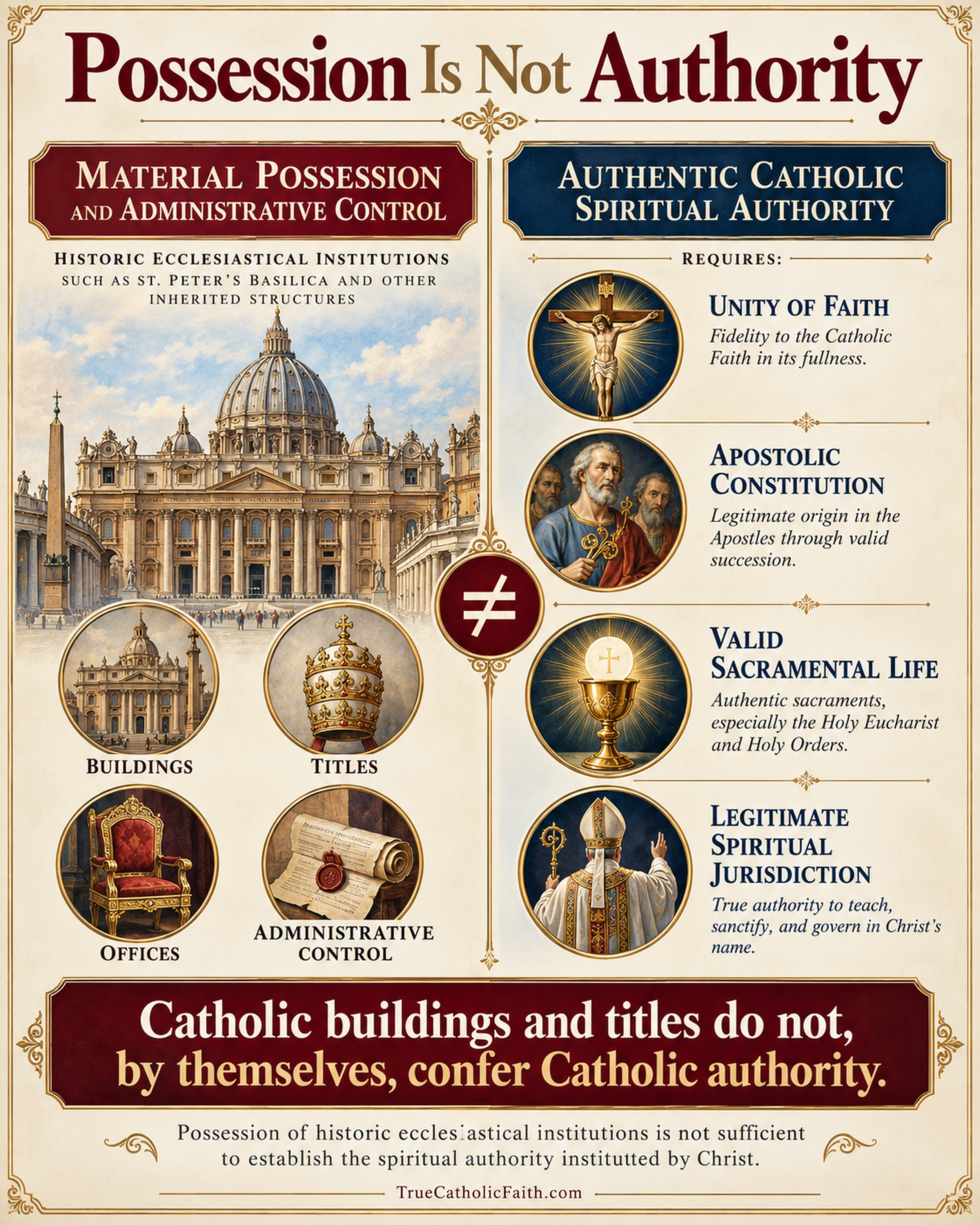
Catholic Buildings and Institutions Do Not Determine Catholic Identity
One of the greatest obstacles to recognising this distinction is the extraordinary degree of institutional continuity retained by the postconciliar establishment.
The buildings remained.
Vatican offices continued to function.
Historic dioceses retained their names.
Men continued to occupy ancient episcopal sees.
Seminaries, universities, religious houses and charitable institutions maintained their institutional histories.
To an ordinary observer, the postconciliar establishment appears to be the same religious body that existed under Pope Pius XII. But appearance and legitimacy are different questions.
Throughout Christian history, ecclesiastical offices have been contested, churches have been occupied by factions separated from Catholic unity, and governments have confiscated Catholic religious properties. Such events did not automatically transfer the spiritual authority of the Catholic Church to whoever obtained possession of the buildings.
The same distinction applies to the postconciliar establishment. It may possess civil title to historic properties and exercise effective administrative control over institutions associated with Catholicism. But civil ownership, administrative power and public recognition are not themselves sufficient to establish legitimate Catholic ecclesiastical jurisdiction.
This distinction is especially important because the postconciliar transformation largely occurred within existing institutional structures. Unlike religious movements that openly separated from Catholicism and subsequently created their own churches and institutions, the postconciliar establishment continued to claim the Catholic identity of the organisations it controlled.
Consequently, millions of people continued to regard it as the Catholic Church. Yet widespread recognition and institutional possession cannot independently settle the question of legitimate spiritual authority.
This does not mean that every individual involved knowingly participated in deception, or that every property transfer constituted illegal appropriation. Such claims would require separate historical and legal evidence. The central theological conclusion does not depend upon them.
A religious establishment may possess Catholic buildings, titles, vestments and institutional history without thereby possessing the Catholic Faith or the authority of the Church founded by Christ.
This is the principal reason that the problem of mistaken identity deserves attention. The question is not simply who controls Rome, who occupies St Peter's Basilica, or who commands the largest administrative structure. It is whether the religious body exercising that control possesses the doctrine, unity and legitimate authority belonging to the Catholic Church.
The Catholic Church Remains Even While the Roman See Is Vacant
A substantial objection now arises. If the Vatican II–Novus Ordo establishment is not the Catholic Church, and its papal claimants are not legitimate Roman Pontiffs, has the Catholic Church effectively disappeared?
No. But the answer requires more than a general appeal to indefectibility. The Roman See has remained vacant since the death of Pope Pius XII on 9 October 1958.
The papal office itself has not been abolished. Vatican I taught in Pastor Aeternus, Chapter II, that the primacy established in St Peter must continue permanently in the Church through legitimate successors. This is a doctrine of the Catholic Faith.
It does not follow, however, that every individual who claims the office necessarily possesses it, or that the office must be occupied without interruption at every moment of history. The Catholic Church has always recognised vacancies between pontificates.
Pope Pius XII's Vacantis Apostolicae Sedis (1945) provided legislation governing the Apostolic See precisely when no Roman Pontiff was reigning.
A vacant office is not an abolished office. Nevertheless, an ordinary interval between pontificates and a vacancy continuing over many decades are profoundly different circumstances.
Pius XII's legislation presupposed the normal structures required for the election of a successor. It cannot be treated as though it had expressly resolved every difficulty presented by a prolonged absence of a legitimate Roman Pontiff.
The questions concerning restoration, election and the continuing exercise of ecclesiastical jurisdiction therefore remain serious.
The Strongest Difficulty: The Church Must Remain Visibly Governed
The objection becomes especially important when the Church's visible and hierarchical constitution is considered.
In Mystici Corporis Christi §40, Pope Pius XII explained that Christ governs His Mystical Body not only invisibly but also through His visible Vicar on earth.
In paragraph 41, he warned against accepting Christ as Head of the Church while rejecting the visible government He instituted.
In paragraph 69, he taught that the Church's visible unity is expressed through common profession of Faith, worship, sacramental sacrifice and ecclesiastical law.
He also emphasised the necessity of the visible supreme head in the Church's divinely established order.
These teachings must be taken seriously. They do not allow the Catholic Church to be reduced to an invisible collection of isolated individuals who happen to preserve similar theological opinions.
The Catholic Church is a visible, sacramental and hierarchical society. Her constitution includes a perpetual Roman Primacy, apostolic succession and legitimate ecclesiastical government. A prolonged vacancy therefore presents a substantial theological difficulty.
It is not enough to observe that papal vacancies have occurred before. Nor is it enough to distinguish an office from its occupant and then assume that every question concerning visible government has been resolved.
The distinction between a permanent office and a temporary vacancy establishes that the papacy is not abolished during an interregnum.
It does not, by itself, establish how the Church's ordinary visible government, jurisdictional succession and capacity to elect a legitimate successor are preserved through a vacancy lasting many decades.
That further question requires theological and canonical analysis.
The Church's Divine Constitution Remains Unchanged During a Papal Vacancy
The divine constitution of the Catholic Church remains unchanged during a vacancy of the Roman See. The papacy is a permanent institution established by Our Lord Jesus Christ, and its existence does not depend upon the office being occupied at every moment. The Roman Primacy remains essential to the Church's constitution.
Catholic doctrine continues to bind the faithful, the apostolic mission of the Church endures, and the obligation to recognise and submit to a legitimate Roman Pontiff remains intact.
The absence of a reigning pope does not abolish the papacy, destroy the Catholic Church, or invalidate Christ's promises.
The Church remains the one, holy, Catholic and apostolic Church founded by Christ. Her Faith, divine constitution and supernatural mission do not change because the Roman See is vacant. The continued existence of validly consecrated bishops and validly ordained priests also demonstrates that the sacramental character received through Holy Orders does not disappear merely because the Apostolic See is vacant.
Nevertheless, sacramental validity and ecclesiastical jurisdiction must be carefully distinguished. Valid episcopal consecration does not automatically confer ordinary jurisdiction over a diocese. Nor does the existence of traditional Catholic chapels establish, by itself, the continuation of every normal structure of hierarchical government.
The Catholic Church is not merely an invisible association of people who share traditional beliefs. She is a visible, sacramental and hierarchical society established by Christ. Her visible constitution includes the Roman Primacy, apostolic succession, the profession of the true Faith, the sacraments and legitimate ecclesiastical government.
An extraordinarily prolonged vacancy therefore presents serious theological and canonical questions concerning the exercise of ordinary jurisdiction, the continuation of visible hierarchical government and the eventual restoration of a legitimate Roman Pontiff.
These difficulties must be examined without confusing the absence of a legitimate occupant with the disappearance of the papal office itself. The permanent institution of the papacy and the legitimacy of a particular claimant are related but distinct questions.
A man does not become the legitimate Roman Pontiff merely because he occupies the Vatican, receives widespread recognition, or exercises practical control over institutions historically associated with the papacy. Neither, however, does rejecting an illegitimate claimant automatically resolve every question concerning the Church's visible government.
The doctrine of indefectibility requires that the Church retain her essential constitution. It does not provide a ready-made explanation of every extraordinary historical circumstance affecting the exercise of ecclesiastical authority.
The problem of a prolonged vacancy must therefore be considered within the complete Catholic teaching on the Church's visibility, apostolicity, jurisdiction and perpetual Roman Primacy.
A detailed examination of these questions is provided in the related FAQ article, How Can the Catholic Church Continue Without a Reigning Pope?.
For the present discussion, the essential distinction is clear.
A prolonged vacancy of the Roman See is not the same as the Catholic Church abandoning her Faith or transforming herself into a different religion.
The first presents extraordinary difficulties for Catholic ecclesiastical life. The second would contradict the indefectibility promised to the Church by Christ.
The Church's divine constitution remains unchanged, and the faithful must continue to uphold the necessity of legitimate papal government while praying for its restoration.
The Church Is Indefectible, but Her Faithful Can Suffer Extraordinary Trials
The distinction between the Catholic Church and the Vatican II–Novus Ordo establishment must not create another misunderstanding: that indefectibility guarantees Catholics uninterrupted access to normal ecclesiastical government, sacramental life or institutional security.
It does not.
Throughout history, the Church has endured persecution, schism, contested ecclesiastical elections, confiscation of religious property and widespread departures from the Faith among those who once professed it.
During the fourth-century Arian controversy, serious doctrinal conflict affected bishops and Christian communities.
During the Western Schism of 1378–1417, competing papal obediences created grave uncertainty about legitimate ecclesiastical government.
These circumstances are not exact precedents for the extraordinarily prolonged vacancy of the Roman See since 1958. Nevertheless, they demonstrate that the historical life of the Church can be profoundly troubled without her divine constitution being abolished.
The present circumstances involve extraordinary difficulties of their own. Normal structures of ecclesiastical jurisdiction have been severely disrupted, while many faithful Catholics lack ready access to traditional clergy and sacramental life.
Families must sometimes travel considerable distances to attend Mass, seek valid sacraments or obtain sound Catholic instruction. Some endure prolonged periods without the assistance of a priest.
For Catholics who have spent much of their lives within the Vatican II–Novus Ordo establishment, recognising its departure from traditional Catholicism can be particularly painful. Leaving a familiar parish may mean losing friendships, religious fellowship, familiar routines and a sense of belonging. Some experience misunderstanding or opposition from relatives who continue to identify the postconciliar establishment with the Catholic Church. Others face significant practical sacrifices in order to obtain the traditional sacraments. These may involve long journeys, financial expenses, difficult travel arrangements and prolonged intervals between opportunities to attend Mass or receive Confession.
Such difficulties should not be minimised. Catholic life is not simply intellectual agreement with a collection of doctrines. It is a supernatural life sustained by grace, expressed through worship, strengthened by the sacraments and lived through charity, prayer, family responsibilities and the duties of one's state in life. The disruption of these ordinary supports creates real spiritual and practical hardship.
But the suffering of the Church's members must not be confused with the defection of the Church herself.
The Catholic Church can suffer persecution without being overcome.
Her faithful can experience deprivation without her ceasing to exist.
Her visible institutions can be disrupted without her revealed doctrines becoming false.
The Church's divine constitution remains essential even when the normal exercise of ecclesiastical government is gravely impaired. Thus, when Catholics speak of the extraordinary trials associated with the prolonged vacancy of the Roman See, they are describing genuine difficulties affecting Catholic life.
But when the postconciliar establishment introduces doctrines and religious practices incompatible with the traditional Catholic Faith, those developments must not be attributed to the Catholic Church herself.
That would confuse two fundamentally different realities. The Church's faithful may be suffering extraordinary deprivation. The Vatican II–Novus Ordo establishment may be experiencing serious difficulties within its own religious and institutional system. Neither circumstance establishes that the Catholic Church has defected.
Indefectibility does not mean that the faithful will never suffer extraordinary trials.
It means that the Church founded by Christ will never cease to be the Church He established.
Is the Vatican II–Novus Ordo Establishment Actually in Crisis?
There is an important irony in the usual discussion of the postconciliar situation. The religious establishment that is widely mistaken for the Catholic Church may indeed be experiencing serious institutional and religious difficulties. Declining participation, shortages of clergy, internal doctrinal disagreements, financial pressures, institutional restructuring and controversies concerning religious identity may all be relevant indicators of difficulties within that establishment, where supported by reliable evidence.
Yet such developments, even if widespread, would not demonstrate that the Catholic Church herself had suffered doctrinal or institutional collapse.
They would constitute difficulties within the Vatican II–Novus Ordo establishment, not evidence that the Catholic Church had abandoned her Faith.
Consider the situation of a Protestant denomination experiencing declining membership, theological disputes or diminishing religious influence.
Catholics might regard those developments as historically significant.
They might be concerned for the spiritual welfare of the people involved and hope that the resulting questions would lead souls toward the Catholic Faith.
But no Catholic would ordinarily conclude that the Catholic Church herself was experiencing doctrinal collapse because another religious denomination was in decline.
The same distinction applies here. The Vatican II–Novus Ordo establishment is not another legitimate expression of the Catholic Church. It constitutes a substantially different religious system, claiming the identity and authority of the Church while differing from her inherited Faith in doctrine, worship and ecclesiology. Its internal difficulties therefore belong to that establishment.
Indeed, a decline in the influence of a religious system promoting error need not be regarded as a loss for the Catholic Faith. If such a decline leads people to question mistaken religious assumptions, examine Catholic doctrine and seek the true Church, it may provide an opportunity for conversion.
At the same time, institutional decline alone establishes nothing decisive about religious truth.
A false religion may possess enormous wealth, impressive buildings and millions of adherents.
Conversely, the true Church may suffer persecution, material deprivation and loss of influence.
The truth of Catholicism has never depended upon the number of people who profess it or the extent of the property controlled by its representatives. Nor should Catholics rejoice in the spiritual confusion or personal suffering of those who adhere to the postconciliar establishment.
Many sincerely believe they are practising Catholicism. They may have received little or no instruction concerning the doctrinal differences between traditional Catholicism and the postconciliar religious system. Their conversion and salvation remain matters of Christian charity.
The fundamental question is therefore not whether the postconciliar establishment prospers or declines. It is whether that establishment possesses the identity, doctrine and legitimate authority of the Church founded by Christ.
A flourishing counterfeit would remain counterfeit.
A declining counterfeit would not thereby become the true Church.
The Catholic Church cannot be identified merely by institutional size, social influence, financial strength or widespread public recognition.
Her identity rests upon the Faith, sacraments and divine constitution entrusted to her by Jesus Christ.
Main Objection: Is This Not Simply a Troubled Catholic Church Rather Than a Different Religion?
The strongest opposing argument must be considered fairly.
Those who recognise the postconciliar papal claimants maintain that the Catholic Church remains visibly identifiable through her historical episcopal succession, diocesan structures, communion with the Roman See and continuing institutional life.
They argue that Vatican II represents legitimate doctrinal development rather than the introduction of a different religion.
Religious liberty, they contend, concerns immunity from coercion rather than the equal truth of every religion.
Ecumenism acknowledges Christian elements present among separated communities without denying the unique role of the Catholic Church.
The revised liturgy continues to profess the sacrificial nature of the Eucharist.
They also emphasise that the Church can experience corruption among her members, widespread confusion, defective pastoral policies and imprudent decisions without losing her Catholic identity.
From this perspective, the appropriate description is an extraordinary crisis affecting the Catholic Church, rather than the emergence of a separate religious establishment.
This objection has genuine theological weight.
Catholic doctrine requires the Church to remain visible, hierarchical and apostolic.
An accusation of doctrinal error does not automatically prove that a religious superior lacks legitimate jurisdiction.
Nor is every statement, disciplinary measure or administrative act of a true pope individually infallible.
Consequently, neither an isolated novelty nor an unfortunate ecclesiastical decision is sufficient to establish the existence of a different religion.
The decisive question is whether the postconciliar changes amount to legitimate developments within the Catholic Faith or constitute substantive contradictions of what the Church had previously taught and preserved.
Response: The Decisive Question Is Legitimate Catholic Authority
The objection must be answered by returning to the distinction between ordinary ecclesiastical difficulties and the introduction of a substantially different religious system.
A true Catholic pope may make prudential mistakes. Individual bishops may teach erroneously in non-definitive contexts, and members of the Church may act contrary to authentic Catholic doctrine. But these possibilities do not demonstrate that the Church's authentic supreme teaching and governing authority can become the regular means by which a substantially false religion is universally established.
The case against the postconciliar establishment is cumulative. It concerns:
The theological principles introduced at Vatican II.
The subsequent official liturgical and sacramental changes.
The alterations to ecclesiastical discipline and religious practice.
The claims to Catholic authority under which these changes were introduced and implemented.
The preceding articles have examined these matters and concluded that the resulting religious system cannot be reconciled with the traditional Catholic Faith or with the Church's indefectibility.
At the heart of the matter lies a principle that cannot be compromised.
The Catholic Church cannot have spent nineteen centuries teaching a false Faith only to discover at Vatican II that her previous definitive doctrines needed to be contradicted or replaced.
Authentic doctrine may develop in clarity and expression. Ecclesiastical discipline may also change within the limits established by divine law. But a genuine contradiction of definitive Catholic doctrine cannot become legitimate merely because it is introduced at a later historical period.
If an earlier definitive teaching and a later teaching genuinely contradict one another in the same sense, both cannot be true. The Catholic Church cannot have been wrong about revealed truth that she was divinely commissioned to preserve.
This principle does not eliminate the need to demonstrate that a genuine doctrinal contradiction exists. Differences in terminology, disciplinary practice or theological emphasis do not automatically establish such a contradiction. Nevertheless, where substantive incompatibility with definitive Catholic teaching has been established, the later religious system cannot be justified as an authentic development of the Faith.
This is also why the recognise-and-resist position presents a fundamental difficulty.
That approach acknowledges the postconciliar claimants as legitimate Roman Pontiffs while maintaining that Catholics must resist substantial elements of the religious system introduced under their claimed universal authority.
Catholic obedience is not blind obedience to sin, and legitimate authority has real limits. Nevertheless, the Roman Primacy was divinely instituted as a principle of unity in faith and government, not as a permanent source of religious innovations from which the faithful must systematically protect themselves.
To acknowledge a man as the supreme Catholic teacher and governor while treating his officially established religious system as fundamentally incompatible with Catholicism raises a serious problem concerning the purpose of papal authority.
The solution is to distinguish the permanent institution of the papacy from the legitimacy of particular claimants.
The Catholic Church cannot be reduced to a collection of individuals preserving doctrine without legitimate ecclesiastical structure. But neither can a religious establishment acquire Catholic authority simply by maintaining institutional continuity and claiming the papal office.
The question must ultimately be resolved through Catholic doctrine concerning the Church, public profession of Faith, membership, ecclesiastical office and legitimate jurisdiction.
The postconciliar claimants did not possess the legitimate Catholic papal authority they purported to exercise. The substantially different religious system introduced under their claimed governance therefore cannot be attributed to the Catholic Church herself.
This conclusion does not remove every difficulty concerning the prolonged vacancy or the restoration of normal ecclesiastical government. It does, however, preserve the essential distinction between the Catholic Church's divine constitution and the claims of those who have occupied her historical institutions without possessing legitimate Catholic authority.
The Catholic Church has not contradicted her own Faith.
The contradiction lies between the Faith she has always professed and the religious system introduced by the postconciliar establishment.
What This Means for Faithful Catholics
Understanding this distinction should bring clarity rather than despair.
A Catholic who recognises the postconciliar establishment as a different religious system need not believe that the Catholic Church has been destroyed, that Christ's promises have failed, or that Catholicism must somehow be reconstructed from the remnants of a lost religion.
The Catholic Faith has not become obsolete. Its authentic doctrines have not been legitimately replaced by contradictory teachings. The traditional Holy Sacrifice of the Mass has not ceased to belong to the Catholic Church because a different rite was introduced under disputed authority.
The Faith remains the same.
The practical task is therefore not to create a new religious denomination or establish an alternative Church. It is to remain faithful to the Catholic Church founded by Christ.
This requires:
Sound Catholic doctrine: Understanding and professing the Faith traditionally taught by the Church.
Prayer and spiritual growth: Cultivating virtue, maintaining a regular life of prayer and striving to remain in the state of grace.
Fidelity to one's duties: Fulfilling family responsibilities and the obligations of one's state in life.
Traditional sacramental life: Seeking valid traditional sacraments wherever reasonably possible.
It also requires care in distinguishing sacramental validity from legitimate ecclesiastical jurisdiction.
The absence of legitimate postconciliar papal authority does not automatically render every sacrament administered within the establishment invalid. Questions of sacramental validity must be assessed according to the requirements applicable to each sacrament, including valid matter, form, minister and intention where relevant.
Traditional clergy and chapels likewise must not be treated as possessing ordinary canonical jurisdiction merely because they preserve traditional rites or have valid Holy Orders.
Faithful Catholics should avoid reducing their religious identity to membership in a particular traditionalist organisation or continual argument about the postconciliar establishment.
The objective is Catholicism itself, not membership in a new religious organisation.
To reject an illegitimate claim to the papal office is not to reject the papacy itself. On the contrary, fidelity to the Roman Primacy requires recognising the difference between the divinely instituted office and an individual who merely claims to possess it.
Catholics should therefore pray for the restoration of normal ecclesiastical government under a legitimate Roman Pontiff, for faithful bishops and priests, for religious vocations, and for the conversion of those who sincerely but mistakenly identify the postconciliar establishment with the Catholic Church. Such prayers express fidelity to the divine constitution of the Church, not dissatisfaction with the papacy.
Recognising a false religious system does not diminish the obligation of charity toward those who adhere to it. Many people remain within the postconciliar establishment because it is the only religion they have known, while others have never seriously examined its differences from traditional Catholicism.
The appropriate response is not contempt, bitterness or personal hostility, but prayer, patience, charitable explanation and fidelity to the truth. The purpose of identifying religious error is not to win a controversy but to preserve the true Faith and assist souls toward salvation.
The goal is not merely to separate oneself from error.
It is to live faithfully as a Catholic.
What We Can and Cannot Conclude
The argument requires several important distinctions.
What Catholic doctrine establishes: The Catholic Church is indefectible. She cannot cease to be the Church founded by Christ, abandon her essential divine constitution or legitimately replace revealed truth with a contradictory religion. Her visible, hierarchical and sacramental constitution remains essential to her identity.
What the preceding theological examination concludes: The cumulative doctrinal, liturgical, sacramental and ecclesiological transformation associated with Vatican II constitutes a substantial departure from traditional Catholicism. The postconciliar establishment therefore cannot be identified with the indefectible Catholic Church, and its papal claimants do not possess legitimate Catholic papal authority.
What historical evidence establishes: The postconciliar authorities introduced and implemented significant changes while claiming Catholic ecclesiastical authority. The institutions recognising their claims retained much of the material and administrative inheritance of Catholicism, including historic buildings, diocesan structures and ecclesiastical titles.
What the doctrinal comparisons establish: Earlier and later official texts contain important differences in their presentation of ecclesiastical unity, religious liberty, worship and religious practice. Whether particular differences constitute irreconcilable doctrinal contradictions requires careful examination of the propositions involved, their scope, their qualifications and their doctrinal authority. The conclusion of substantial rupture rests upon the cumulative examination undertaken in this series.
What Catholics can suffer without the Church defecting: The prolonged absence of normal papal government, disruption of ecclesiastical life, scarcity of accessible traditional clergy, loss of familiar institutions and difficulty obtaining sacramental assistance can constitute grave trials for the faithful without implying that the Church herself has abandoned her Faith.
What remains unresolved: The prolonged vacancy raises substantial theological and canonical questions concerning the continuation and exercise of jurisdiction, visible hierarchical government, and the eventual restoration of a legitimate Roman Pontiff. The ordinary provisions governing a papal interregnum do not, by themselves, resolve every difficulty associated with an extraordinarily prolonged vacancy.
What must not be assumed: These theological conclusions do not establish that every participant in the postconciliar establishment knowingly intended deception, that every sacrament administered there was invalid, that every institutional property arrangement amounted to legal theft, or that every individual within the establishment is personally guilty of formal heresy.
Finally, the conclusion that the Roman See has remained vacant since the death of Pope Pius XII is a theological judgment reached through the application of Catholic ecclesiology to the postconciliar situation. It is not itself a separately defined dogma of the Catholic Church.
These distinctions do not weaken the central argument. They ensure that the conclusion is not burdened with claims that its premises do not establish.
The essential question remains whether the postconciliar establishment possesses the same Catholic Faith and legitimate authority as the Church founded by Christ.
Conclusion: The Catholic Church Has Not Failed
The expression “crisis in the Church” has become so familiar that its theological implications are rarely examined. Yet the fundamental question remains:
Did the Catholic Church herself change her religion, or did a different religious establishment emerge that claimed her name, institutions and authority?
The Catholic Church cannot have spent nineteen centuries teaching a false Faith only to discover, through Vatican II, that her previous definitive doctrines needed to be corrected or replaced. Such a possibility would contradict the very nature of the Church founded by Jesus Christ, to whom He promised His abiding assistance and against whom the gates of hell would never prevail.
Authentic Catholic doctrine can develop in clarity and understanding, but it cannot be reversed into its opposite. Where an earlier definitive teaching and a later teaching genuinely contradict one another in the same sense, both cannot be true. Nor can a doctrinal contradiction become legitimate merely because it is presented as a development, adaptation or response to changing historical circumstances.
Defenders of Vatican II maintain that its teachings are compatible with earlier Catholic doctrine. That claim must be examined carefully rather than dismissed. Nevertheless, the cumulative doctrinal, liturgical and ecclesiological evidence considered throughout this FAQ leads to the theological conclusion that the postconciliar religious system has departed substantially from traditional Catholicism.
The implications are decisive.
If the Catholic Church faithfully preserved the religion entrusted to her by Christ, then a later establishment professing doctrines genuinely incompatible with that religion cannot claim to have corrected the Church through legitimate Catholic authority.
The Catholic Church did not abandon her Faith, corrupt her authentic doctrines, or transform herself into the Vatican II–Novus Ordo religion. She remains the one, holy, Catholic and apostolic Church founded by Our Lord Jesus Christ.
Rather, the postconciliar establishment introduced a substantially different religious system while retaining the Catholic name and exercising control over much of the Church's historical institutional inheritance. Its possession of St Peter's Basilica, historic dioceses, ecclesiastical titles, seminaries, universities and religious properties does not, by itself, establish legitimate Catholic spiritual authority. Material and administrative continuity cannot substitute for continuity of Catholic Faith and legitimate ecclesiastical government.
The possession of Catholic institutions does not make a religious establishment Catholic if its religion is fundamentally incompatible with the Catholic Faith.
This also explains why the familiar description of a “crisis in the Church” can be misleading. The Vatican II–Novus Ordo establishment may indeed suffer doctrinal controversies, declining participation, diminishing vocations and serious institutional difficulties. But such problems belong to that establishment. They do not establish that the Catholic Church herself has abandoned her divine mission or ceased to profess the true Faith.
At the same time, the extraordinary difficulties endured by faithful Catholics must not be minimised. The prolonged vacancy of the Roman See, the disruption of normal ecclesiastical government, the loss of familiar religious institutions and the difficulty of obtaining traditional sacramental assistance present serious challenges. Questions concerning visible hierarchical government, jurisdiction and the eventual restoration of a legitimate Roman Pontiff also require careful theological examination.
But the suffering and deprivation of the faithful must be distinguished from the doctrinal defection of the Church herself.
Indefectibility does not mean that Catholics will never suffer extraordinary trials.
It means that the Church founded by Christ will never cease to be the Church He established.
Nor does recognising the postconciliar establishment as a different religion mean founding another Church or joining a new religious denomination. The objective is not to create an alternative to Catholicism, but to remain faithful to Catholicism itself.
The duty of the faithful remains to preserve the traditional Catholic Faith, seek valid sacraments wherever reasonably possible, fulfil the obligations of their state in life, practise charity, and pray for the restoration of legitimate ecclesiastical government. This includes charity toward those who sincerely believe the postconciliar establishment to be the Catholic Church. The purpose of identifying religious error is not to condemn individuals or presume their culpability, but to uphold the truth and assist souls toward salvation.
The central distinction can therefore be stated plainly:
The Catholic Church did not become the Vatican II–Novus Ordo religion.
The postconciliar establishment is a substantially different religious system claiming the identity and authority of the Catholic Church while possessing many of her historical institutions.
The true Catholic Church remains what she has always been: the Mystical Body of Christ, preserving the Faith entrusted to the Apostles, constituted according to divine law, and ordered toward the glory of God and the salvation of souls.
Her members may suffer persecution, isolation, uncertainty and extraordinary deprivation. Her normal government may be gravely disrupted, and her historic buildings and institutions may be controlled by those whose claims to Catholic authority are disputed. But none of these circumstances means that the Catholic Church has become a false religion.
The crisis is not that the Catholic Church has abandoned Catholicism.
It is that the Vatican II–Novus Ordo establishment, having departed fundamentally from traditional Catholicism, is widely mistaken for the Catholic Church.
The Catholic Church has not failed.
Christ has kept His promise.
Primary Sources
Holy Scripture
Matthew 16:18 — Christ's promise concerning the endurance of His Church.
Matthew 28:18–20 — The universal mission of the Church and Christ's abiding presence.
First Vatican Council — Pastor Aeternus (1870) Dogmatic Constitution on the Church of Christ
Especially Chapters II–IV, concerning the perpetuity of Petrine succession, the jurisdiction of the Roman Pontiff and the defined conditions of papal infallibility.
First Vatican Council — Dei Filius (1870) Dogmatic Constitution on the Catholic Faith
Especially Chapter IV, concerning the relationship between faith and reason and the permanent meaning of dogma once declared by the Church.
Pope Leo XIII — Satis Cognitum (1896) Official text
Concerning the Church's visible and supernatural constitution, unity and legitimate government.
Pope Pius XI — Mortalium Animos (1928) Official text
Especially §§2, 6 and 8–11, concerning the permanence of the Catholic Church, her identity with the Church founded by Christ, and the principles of Christian unity.
Pope Pius XII — Mystici Corporis Christi (1943) Official text
Especially §§22, 40–42 and 69–70, concerning membership, the visible supreme head, hierarchical government and ecclesiastical unity.
Pope Pius XII — Mediator Dei (1947) Official text
Especially §§44–49, concerning the relationship between Catholic doctrine, sacred liturgy and legitimate ecclesiastical authority.
Pope Pius XII — Vacantis Apostolicae Sedis (1945) Official Latin text
Legislation concerning the vacancy of the Apostolic See and the election of a Roman Pontiff.
1917 Code of Canon Law — Canon 1258 Canon 1258, Latin text with French translation
Concerning active participation in non-Catholic sacred rites and narrowly qualified passive attendance at certain ceremonies.
Council of Trent — Session XXII (1562) Doctrine and Canons Concerning the Sacrifice of the Mass
The dogmatic teaching concerning the Mass as a true and propitiatory sacrifice.
Vatican II and Postconciliar Documents — Historical Evidence
Lumen Gentium (1964), §8 — Postconciliar ecclesiology and the formulation subsistit in.
Unitatis Redintegratio (1964), §§3–4 and 8 — The postconciliar framework for ecumenism, the significance attributed to separated Christian communities and certain forms of shared prayer.
Dignitatis Humanae (1965), §§1–2 — The declaration concerning civil religious freedom.
Missale Romanum (1969) — The document purporting to promulgate the revised Roman Missal under Montini's claimed papal authority.
Assisi Address of 27 October 1986 — Primary documentation of the interreligious gathering convened by Wojtyła.
These postconciliar texts are cited as historical evidence of what the relevant authorities claimed, taught and implemented. Their authentic titles and historical descriptions do not imply recognition of legitimate Catholic papal authority.
Further Reading
St Robert Bellarmine — De Controversiis, especially De Ecclesia Militante and De Romano Pontifice. Traditional theological works relevant to Church membership, ecclesiastical unity, heresy and papal authority.
St Vincent of Lérins — Commonitorium, Chapter 23. A patristic explanation of the distinction between authentic doctrinal development and alteration of the Faith.
Msgr Gerard Van Noort — Dogmatic Theology, Volume II: Christ's Church. A pre-Vatican II treatment of the Church's nature, visibility, indefectibility, unity and jurisdiction.
Fr E. Sylvester Berry — The Church of Christ (1927). A preconciliar theological manual useful for examining the Church's visibility, apostolicity, authority and indefectibility.
Louis Cardinal Billot — Tractatus de Ecclesia Christi. A substantial theological treatment of the Church's constitution, authority and unity.
Related Questions
The following subjects are examined in greater detail elsewhere in the FAQ series:
The Catholic doctrine of the papacy and the legitimacy of the post-Vatican II papal claimants.
How Can the Catholic Church Continue Without a Reigning Pope?
The continuation of traditional bishops, priests and valid sacramental life.
The differences between the Traditional Roman Mass and the Novus Ordo.
The doctrinal differences between traditional Catholic teaching and Vatican II.
The practical steps necessary to return to the traditional Catholic Faith.
For the full sequence, see the True Catholic Faith FAQ.