The Short Answer
If you have established that the Vatican II–Novus Ordo religious system contradicts the Catholic Faith, you are obliged to separate yourself from that religious system, reject its errors, cease active participation in its worship, and remain faithful to the Catholic Church founded by Jesus Christ.
The preceding articles have established the sedevacantist conclusion: the Vatican II–Novus Ordo establishment constitutes a counterfeit Catholic religion, not the Catholic Church founded by Christ. Its papal claimants do not legitimately occupy the See of Peter, and its doctrinal and liturgical departures cannot be reconciled with the Church's traditional teaching and indefectibility.
The practical consequence is not merely to reject Vatican II's errors while remaining within the Novus Ordo establishment.
It is to withdraw from that religious system altogether in matters of religious worship and allegiance.
A Catholic who has reached this conclusion must not continue attending the Novus Ordo Mass, receiving its religious ministrations indiscriminately, or recognising the authority of its papal claimants merely because he personally disagrees with their doctrinal innovations.
Remaining in the Novus Ordo while privately rejecting its errors does not resolve the fundamental problem. Participation in religious worship is itself a religious act, not merely an expression of one's private theological preferences.
Nor is the solution simply to attend a traditional Latin Mass celebrated within the postconciliar establishment. The use of an older liturgical rite does not, by itself, resolve questions concerning ecclesiastical communion, sacramental validity or legitimate authority.
The Catholic must instead preserve the unchanged Faith, refuse active participation in false worship, and seek authentic Catholic Masses and sacraments from trustworthy traditional clergy. The particular questions concerning una cum Masses and sacramental validity are examined in the sections below.
Where suitable Catholic sacramental ministry is not reasonably accessible, the obligation to avoid false worship remains. The faithful must continue their Catholic lives through prayer, penance, spiritual Communion, religious instruction and the conscientious fulfilment of their ordinary duties.
Leaving the Vatican II–Novus Ordo religious system is not leaving the Catholic Church.
It is the practical consequence of recognising that the two are not the same religion.
This does not mean abandoning one's spouse, children, relatives or legitimate responsibilities. Nor does it justify hostility towards individuals who continue practising the Novus Ordo, many of whom may never have seriously examined its doctrinal foundations.
Fidelity to the Catholic Faith requires both firmness in religious obligations and charity towards others.
The objective is therefore not merely to reject individual Modernist teachings while continuing to participate in the religious system that promulgates them.
It is to reject the counterfeit religion, remain faithful to the Catholic Church, preserve the true Faith, live in God's grace and save one's soul.
Why This Question Matters
For someone who has spent many years attending the Novus Ordo, trusting its clergy and believing its institutions to be Catholic, discovering the contradictions between the postconciliar religion and traditional Catholicism can be profoundly unsettling.
The questions are no longer merely theological or historical. They become personal and practical.
Should I continue attending my parish?
Where can I receive the sacraments?
What if no traditional Catholic priest is nearby?
What should I tell my spouse or children?
Must I leave everything familiar to remain faithful to Christ?
These questions matter because recognising religious truth places obligations upon the conscience.
The preceding articles have examined the Church's divine constitution, the unchangeable deposit of Faith, the errors associated with Vatican II, the transformation of Catholic worship, the problem of postconciliar papal authority and the sedevacantist conclusion.
The conclusion is not that the Catholic Church has failed. It is that the Vatican II religious system cannot be identified with the indefectible Church established by Jesus Christ.
That distinction changes everything.
A Catholic does not owe religious allegiance to an institution merely because it possesses historic Catholic buildings, inherited titles, recognisable ceremonies or the support of large numbers of people.
He owes allegiance to Christ and to the Church Christ actually founded.
The question now is how to remain faithful to that Church while confronting the real difficulties created by the present ecclesiastical crisis.
1. Your First Duty Is to Adhere to the Catholic Faith
The most fundamental obligation is to believe and profess the Faith revealed by God and entrusted to His Church. This duty does not arise from sedevacantism. It is an elementary obligation of Catholicism itself. St Paul warns:
"But though we, or an angel from heaven, preach a gospel to you besides that which we have preached to you, let him be anathema." — Galatians 1:8
The Apostle does not exempt even himself from the obligation to preserve the Gospel already received. The authority of a messenger cannot make a different Gospel true.
The First Vatican Council taught in its dogmatic constitution Pastor Aeternus (18 July 1870), Chapter IV, that the Holy Ghost was not promised to the successors of St Peter so that they might reveal new doctrine, but so that they might faithfully preserve and expound the apostolic deposit of Faith. Read Pastor Aeternus, Chapter IV, official Latin text.
The Catholic Church can explain revealed truth more clearly, defend it against new errors and draw out what is contained within it. She cannot contradict what God has revealed.
St Vincent of Lérins (d. c. AD 445), writing in his Commonitorium around AD 434, distinguished genuine progress in doctrinal understanding from alteration of the Faith itself. Read St Vincent, Commonitorium, Chapter 23.
This distinction is essential. Legitimate doctrinal development preserves the same truth, whereas doctrinal corruption changes its meaning.
The 1917 Code of Canon Law also expressed the obligation to avoid religious error.
Canon 1324 declared that it is not sufficient merely to avoid heresy; Catholics must diligently avoid errors which approach it and observe the relevant condemnations issued by the Holy See.
Canon 1325 §1 required the faithful to profess their Faith openly whenever silence, evasion or conduct would amount to an implicit denial of the Faith, contempt for religion, injury to God or scandal to others. Read Canon 1324 and Canon 1325.
These canons express a principle of considerable practical importance:
Catholic fidelity requires both adherence to truth and the rejection of what is contrary to it.
Therefore, once a person has responsibly reached the conclusions demonstrated in the preceding articles, he cannot consistently continue to treat the postconciliar religious system as an authentic expression of Catholicism.
This does not mean that every disagreement about religious language, liturgical discipline or theological explanation constitutes heresy. Such judgments require proper distinctions.
But where a genuine contradiction with Catholic doctrine has been established, the obligation to reject it is not optional.
2. Understand Why the Sedevacantist Conclusion Changes Your Obligations
It is important to understand exactly what has been established, and what follows from it. The objection to Vatican II is not principally that modern ceremonies are aesthetically inferior, that Latin has been abandoned, or that contemporary church architecture lacks beauty. These matters may illustrate the wider transformation, but they are not the foundation of the argument.
The fundamental questions concern the Catholic Church's doctrine and authority.
Earlier articles have examined the relationship between traditional Catholic teaching and the postconciliar positions on religious liberty, ecumenism, the identity of the Church, episcopal collegiality, sacramental worship and the exercise of ecclesiastical authority.
They have also considered the attempted reconciliation of these developments with traditional Catholic doctrine, including the Recognise-and-Resist approach. The sedevacantist conclusion proceeds from three connected propositions.
First, the Catholic Church, founded by Christ, is indefectible. She cannot cease to be the true Church or become the authoritative instrument for establishing a different religion.
Second, her legitimate teaching authority cannot impose upon the universal Church doctrines, worship and religious principles that fundamentally contradict the apostolic Faith.
Third, if a claimant to the papacy is responsible for promulgating and maintaining a religious system incompatible with those principles, the problem concerns his claim to legitimate authority, not merely the wisdom of individual administrative decisions.
As demonstrated in the preceding articles, the Vatican II papal claimants cannot legitimately be recognised as Roman Pontiffs without contradicting the Catholic principles governing the Church's indefectibility, doctrinal authority and preservation of the apostolic Faith.
The sedevacantist conclusion is therefore not a rejection of the papacy.
It is a rejection of particular claims to the papacy in order to preserve the doctrine of the papacy itself.
A further distinction is necessary for theological accuracy. The Church's indefectibility, the divine institution of the papacy and the obligation to preserve revealed doctrine belong to established Catholic teaching.
The judgment that the postconciliar claimants lack legitimate papal authority is a theological conclusion drawn from those principles and the historical evidence. It is not itself a separate solemn definition issued by the Catholic Church.
This distinction does not require the reader to reopen the entire argument. It identifies the authority appropriate to each proposition.
Once the conclusion has been reached, however, its practical consequences must be taken seriously.
One cannot reject the legitimacy of the postconciliar religious system while continuing to recognise and practise its religion as though nothing had changed.
3. Withdraw from the Worship of the Postconciliar System
The first immediate obligation concerns religious worship. Catholicism does not regard participation in religious worship as a matter of personal preference. Worship expresses religious belief and may signify communion with the religious body responsible for the rite.
The Catholic obligation to avoid participation in false worship is established in traditional Catholic moral theology and canon law.
Canon 1258 §1 of the 1917 Code of Canon Law expressly prohibited Catholics from actively assisting at, or participating in, non-Catholic religious rites. Read Canon 1258, including both paragraphs.
The canon directly concerned rites already classified as non-Catholic. Its application to the Novus Ordo therefore follows from the sedevacantist conclusion established in the preceding articles, rather than proving that conclusion independently.
But once the postconciliar system has been identified as a religion distinct from Catholicism, the practical implication is decisive.
A Catholic must refrain from active participation in its religious worship.
This is not merely a recommendation based upon concerns about reverence, liturgical aesthetics or the possible invalidity of a particular sacrament.
The fundamental objection concerns the religious system itself: its doctrines, its worship and its claims to ecclesiastical authority.
Even if a particular sacramental act were valid, that fact alone would not establish that participation in the surrounding religious worship is lawful.
What Must I Stop Attending?
A Catholic who has reached the sedevacantist conclusion must cease active participation in the Novus Ordo Mass and the religious worship of the postconciliar establishment.
Attendance cannot be justified merely because a particular celebration is reverent, conducted in Latin or accompanied by traditional-looking ceremonial.
The problem is not simply how the rite is celebrated. It concerns the religion expressed by the rite and the ecclesiastical authority under which it has been promulgated. Nor does the absence of a convenient alternative justify attending the Novus Ordo as a substitute for the traditional Catholic Mass.
One cannot fulfil an obligation to Catholic worship by deliberately participating in worship one has established to be non-Catholic.
This conclusion follows from the theological premises established in the preceding articles. It should not be confused with a universal declaration that every individual Novus Ordo celebration is sacramentally invalid.
Sacramental validity and the moral lawfulness of religious participation are separate questions.
What About Traditional Latin Masses Offered Within the Postconciliar Establishment?
The use of the older Roman rite does not, by itself, establish that a celebration is suitable for Catholics who have accepted the sedevacantist conclusion.
The Priestly Fraternity of St Peter (FSSP) and the Institute of Christ the King Sovereign Priest (ICKSP) retain traditional liturgical forms while recognising and operating under the postconciliar hierarchy.
Their use of the traditional rite does not resolve the underlying objection concerning religious communion with that establishment.
The Society of St Pius X (SSPX) maintains a different institutional relationship with the postconciliar hierarchy, but continues to recognise the Vatican II papal claimant and to adopt the Recognise-and-Resist approach examined in the preceding articles.
These differences must be acknowledged. The organisations do not occupy identical theological, canonical or institutional positions.
Nevertheless, for readers following the ecclesiological conclusions of this series, their recognition of postconciliar papal authority raises an objection that cannot be resolved merely by the celebration of the traditional Latin Mass.
The appropriate practical course is to seek traditional Catholic worship from trustworthy clergy who do not profess communion with the postconciliar papal claimant.
The Problem of Una Cum Masses
An important question concerns traditional Masses offered by priests who name a Vatican II papal claimant in the Roman Canon.
In the prayer una cum famulo tuo Papa nostro N., the celebrant names an individual as "our pope."
Where the man named is a Vatican II papal claimant, the priest is liturgically identifying as Roman Pontiff someone who, according to the sedevacantist conclusion already established, does not legitimately possess that office.
This raises an objection concerning the ecclesiastical communion expressed by the celebrant. The problem is not necessarily the validity of the consecration. It is the relationship between the celebration and the profession of papal authority expressed in the liturgical prayer.
A priest who regards a Vatican II claimant as the legitimate successor of St Peter professes a position concerning ecclesiastical authority that is incompatible with the sedevacantist conclusion.
Nevertheless, the precise moral implications of attending an una cum traditional Mass have been disputed among sedevacantist theologians.
Some maintain that such participation is impermissible because it involves or signifies religious communion with a false claimant. Others distinguish the celebrant's profession of communion from the layperson's participation and do not regard attendance as necessarily forbidden in every circumstance.
These disagreements must not be concealed or confused with the underlying conclusion concerning the claimant's lack of legitimate authority.
The practical recommendation of this series is therefore to seek non-una-cum traditional Catholic Masses from trustworthy clergy who reject the authority claims of the postconciliar establishment.
This recommendation reflects the ecclesiological position already established and avoids the disputed expression of communion.
However, it should not be presented as though every possible question concerning attendance at an una cum traditional Mass has been definitively settled by a universal canonical judgment.
Nor should a non-una-cum Mass be presumed valid or otherwise suitable merely because the name of the postconciliar claimant is omitted.
The celebrant's sacramental orders, doctrinal profession and other relevant circumstances must still be examined.
The Governing Principle
The central obligation is not to preserve the outward appearance of traditional Catholic worship at any cost. It is to remain faithful to the Catholic religion itself.
A Catholic who has established that the Vatican II–Novus Ordo establishment is a departure from Catholicism must not continue actively participating in that establishment's religious worship.
This obligation remains even when obedience to it causes inconvenience, misunderstanding or the loss of familiar religious surroundings.
The faithful must seek authentic Catholic worship without compromising the Faith they are obliged to preserve.
4. Does This Mean I Must Avoid Family and Friends Who Follow the Novus Ordo Religion?
No. The obligation to reject religious error does not remove the obligation to practise Christian charity.
A Catholic may have a spouse, parents, children, relatives, friends or colleagues who continue practising the Novus Ordo religion. These relationships do not automatically cease to carry moral responsibilities.
Catholics remain bound by justice, charity, truthfulness and the legitimate duties arising from marriage, parenthood, family relationships, employment and ordinary social life. Neither Catholic doctrine nor the sedevacantist conclusion justifies contempt for persons who hold erroneous religious beliefs.
There is also an essential distinction between the objective character of a religious system and the subjective culpability of an individual who adheres to it. Many people have inherited the postconciliar religion from childhood. Others have received little instruction in traditional Catholic doctrine or have never examined the documentary evidence concerning Vatican II and the subsequent reforms.
It would be unjustified to conclude from their religious affiliation alone that every such person knowingly and obstinately rejects Catholic truth. Nor can a person's precise ecclesiastical status always be determined merely from the institution he habitually attends.
The Catholic must reject religious error without presuming authority to judge every individual's conscience or culpability.
Charity Does Not Require Religious Compromise
There is, however, an equally important principle. Charity towards family members and friends does not require participation in religious worship established to be false.
A spouse's preference, a parent's wishes, a relative's expectations or the desire to avoid embarrassment cannot remove an obligation towards God.
Where a Catholic has reached the established conclusion concerning the Novus Ordo religion, he must not continue actively participating in its worship merely to preserve family harmony or maintain social acceptance.
He should explain his reasons calmly and respectfully, but he must not act against an obligation of conscience properly formed according to Catholic teaching.
Such firmness does not authorise hostility. One may decline an invitation to religious worship while continuing to show affection, assist relatives, attend appropriate family gatherings and fulfil ordinary obligations.
The duty to God takes precedence over human expectations, but it must be fulfilled with genuine charity towards others.
What About Attending a Novus Ordo Wedding or Funeral?
The Church's traditional moral discipline distinguishes active participation in non-Catholic worship from certain forms of passive or merely material presence.
Canon 1258 §1 prohibited active participation in non-Catholic religious rites.
Canon 1258 §2 contemplated tolerating passive presence at non-Catholic funerals, weddings and comparable ceremonies for a grave reason involving civil duty or honour, provided that the conditions concerning scandal and danger to the Faith were satisfied. In doubtful cases, the canon referred the judgment to the bishop.
This distinction must be preserved.
A Catholic must not actively participate in worship he has established to be non-Catholic.
However, the traditional law did not treat every instance of physical presence at a religious ceremony as necessarily equivalent to participation in its worship.
For example, the funeral of a parent or the marriage of one's child may raise serious questions involving family obligations, respect for persons and public scandal.
Where passive presence is morally justified, it must remain genuinely passive. The Catholic should not receive religious Communion, participate in acts expressing assent to false worship or deliberately give the appearance of religious agreement.
Conversely, it would be inaccurate to assert that the traditional canonical prohibition automatically makes every possible instance of passive attendance sinful.
The permissibility of such presence depends upon the circumstances and the applicable moral principles. Where uncertainty exists, the faithful should seek competent traditional Catholic moral guidance.
The rule is clear: active participation in false worship must be refused; genuinely passive presence requires a separate moral assessment and must never be used as a pretext for religious compromise.
5. Seek the Authentic Catholic Mass and Sacraments
The rejection of false worship must not become an excuse for neglecting true worship.
The Holy Sacrifice of the Mass makes present sacramentally the one sacrifice of Calvary. The sacraments were instituted by Christ as efficacious signs of grace. They are not optional devotional practices which can simply be replaced by private prayer whenever receiving them becomes inconvenient.
Pius XII's Mediator Dei (1947) explains the centrality of the sacred liturgy and the Eucharistic sacrifice in the life of the Church. The Catholic who has reached the sedevacantist conclusion should therefore make a serious effort to locate trustworthy traditional Catholic clergy and receive the sacraments wherever they are genuinely and morally available.
This requires more investigation than simply finding a chapel offering Mass in Latin.
A priest's appearance, vestments, reputation or attachment to the traditional rite does not by itself establish that his ordination is valid or that receiving sacraments from him is lawful.
Several distinct questions must be answered.
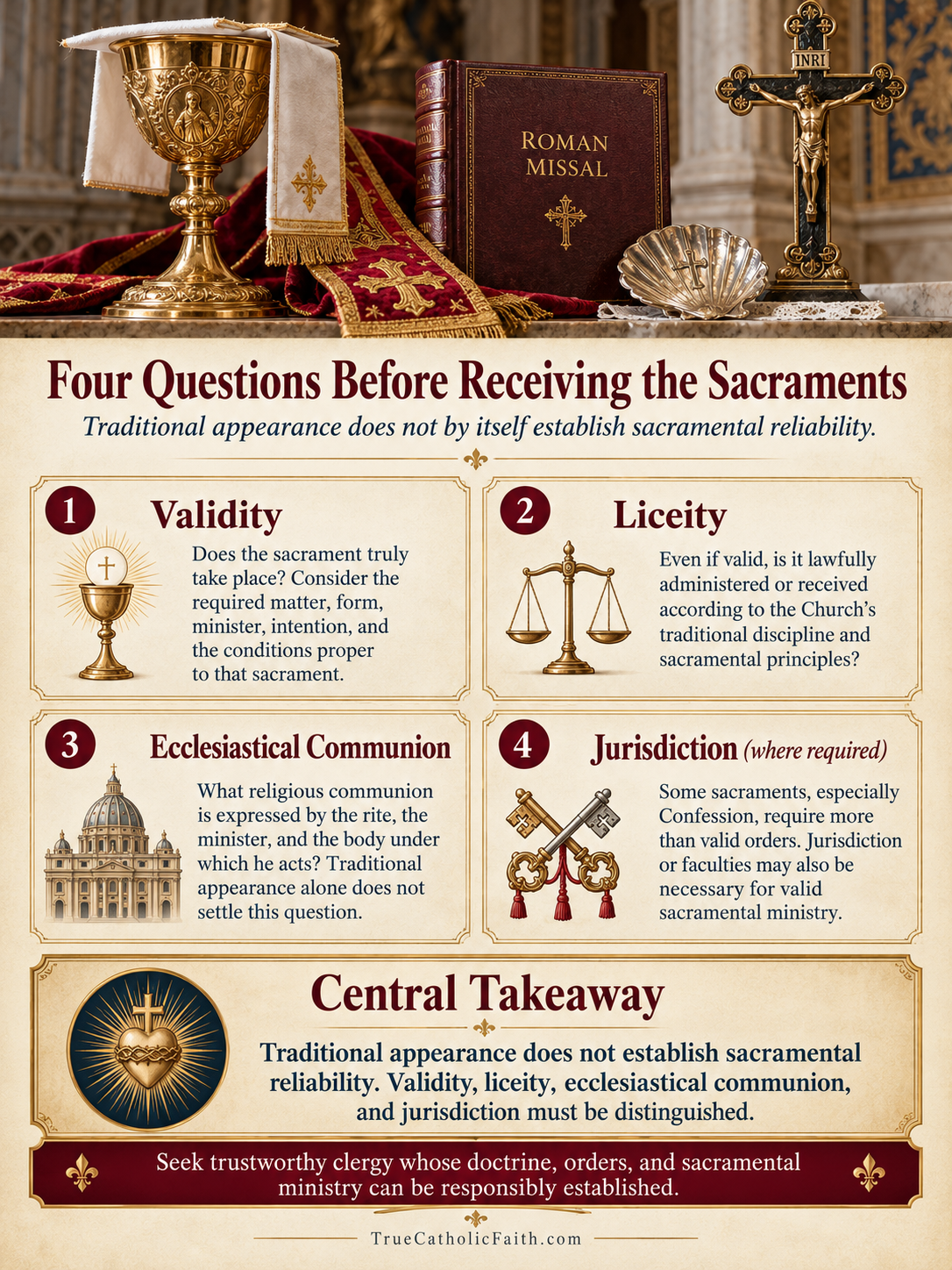
Validity, Lawfulness and Ecclesiastical Communion Are Not the Same Thing
Sacramental validity concerns whether a sacrament actually takes place, with the matter, form, minister, intention and other conditions required for that sacrament.
Liceity concerns whether its celebration or reception is lawful according to the Church's applicable laws.
Ecclesiastical communion concerns the relationship of the minister and the act of worship to the Church and its legitimate authority.
Moral suitability for reception concerns whether a Catholic may properly receive a particular sacrament from that minister in those circumstances.
These distinctions are fundamental.
A sacrament can be valid without its administration being lawful.
A priest can possess valid orders without possessing the jurisdiction necessary for every act of ministry.
A traditional-looking ceremony can raise serious questions about the minister's orders or religious communion.
Consequently, the faithful should seek clergy who
profess the unchanged Catholic Faith,
possess reliably valid sacred orders,
observe traditional sacramental principles
and can give a defensible account of the basis on which they exercise their ministry.
In particular, the claim that a cleric possesses authority from the postconciliar hierarchy cannot, within the sedevacantist conclusion, establish that he possesses legitimate Catholic jurisdiction.
Such questions must instead be examined according to Catholic sacramental theology, the Church's traditional law and the principles applicable to the present extraordinary circumstances.
The obligation is to seek authentic Catholic sacramental life—not merely the closest available imitation of traditional ceremony.
6. The Serious Problem of Post-1968 Holy Orders
The reforms of Holy Orders require particular attention because doubts concerning episcopal consecration and priestly ordination can affect the sacraments subsequently administered by the clergy involved.
The question must be approached through Catholic sacramental theology, not simply through a dislike of modern ceremonies.
In Sacramentum Ordinis (30 November 1947), Pius XII identified the essential matter and form required for the valid conferral of the diaconate, priesthood and episcopate in the Roman rites then in use.
He taught that the matter is the imposition of hands and that the sacramental form consists of the words determining that matter and sufficiently signifying the sacramental effects.
He also reiterated the Church's teaching that ecclesiastical authority cannot change the substance of the sacraments.
The postconciliar establishment subsequently introduced revised rites of Holy Orders through Pontificalis Romani Recognitio, issued under the authority claimed by Paul VI on 18 June 1968.
Read the 1968 document and revised sacramental formulas.
This document is cited as historical evidence of the changes introduced, not as an acknowledgement of legitimate papal authority.
Why the Distinction Between Priestly and Episcopal Ordination Matters
The essential formula used for priestly ordination in the revised rite retains wording closely related to the form identified by Pius XII.
It would therefore be inaccurate to argue that the revised priestly rite is necessarily invalid simply because every word of its essential form was replaced. The revised episcopal consecration rite, however, introduced a substantially different consecratory formula.
The central theological question is whether that form, considered in its proper liturgical context, sufficiently signifies the conferral of episcopal order and the sacramental effects necessary for validity.
Sedevacantist theologians who reject the validity of the revised episcopal rite argue that the new form and its context fail to express adequately what Catholic sacramental theology requires.
Defenders of the revised rite appeal to the meaning of the complete consecratory prayer and to parallels in ancient and Eastern Christian liturgical traditions.
These competing claims must be assessed by reference to sacramental theology, the actual texts and the evidence of their historical use—not merely by the assertion that the rite is new or old.
The importance of the question is evident:
if the bishop who attempts to ordain a priest does not himself possess valid episcopal orders, the subsequent priestly ordination cannot be valid, regardless of the apparent correctness of the priestly formula.
What Should the Faithful Do?
Recognition by the postconciliar hierarchy cannot establish sacramental validity where serious objections arise concerning the essential requirements of Holy Orders. The faithful should therefore seek clergy whose episcopal succession and priestly ordinations can be established independently of the disputed post-1968 rites.
In particular, the serious objections to the revised episcopal consecration rite must not be dismissed merely because the postconciliar establishment officially recognises its bishops.
This does not justify declaring every ordination performed after 1968 invalid. Many clergy were ordained after that date using older rites by bishops whose own consecrations can be traced through traditional sacramental lines.
The decisive questions concern the actual bishop, the sacramental succession, the rite employed and the other conditions necessary for validity—not the calendar date alone.
Neither should a doubtful sacrament be treated as certainly valid merely because it is pastorally convenient. Equally, Catholic sacramental theology does not permit declaring individual orders invalid without adequate grounds.
This approach preserves the serious objections to the postconciliar reforms without exaggerating what the documentary and sacramental evidence establishes.
7. Confession Requires More Than a Validly Ordained Priest
Confession presents a particularly important difficulty. For valid sacramental absolution, ordinary Catholic sacramental theology requires not only valid priestly orders and the proper sacramental acts, but also the necessary jurisdiction or faculty to absolve.
The 1917 Code of Canon Law provides important distinctions.
Canon 209 addressed supplied jurisdiction in circumstances of common error or positive and probable doubt, whether concerning law or fact. Read Canon 209.
Canon 882 expressly provided that, in danger of death, priests could validly and lawfully absolve penitents even when they lacked ordinary approval to hear confessions, subject to the canon's stated provisions. Read Canon 882.
The two canons concern different circumstances.
Canon 209 cannot simply be reduced to the assertion that necessity always supplies jurisdiction. It identifies particular juridical conditions under which the Church supplies what would otherwise be lacking.
Canon 882 concerns the special case of danger of death.
Can the Postconciliar Hierarchy Supply Legitimate Jurisdiction?
Within the sedevacantist conclusion, a Vatican II papal claimant possesses no legitimate papal authority merely by claiming the office. Consequently, an alleged delegation of Catholic jurisdiction cannot be regarded as legitimate solely because it originates from that claimant or from an ecclesiastical structure dependent upon his disputed authority.
But this does not establish that every traditional priest outside the postconciliar establishment automatically possesses ordinary or delegated jurisdiction. Nor does it mean that the Church's extraordinary provisions concerning supplied jurisdiction have ceased to matter.
Traditional sedevacantist theologians have proposed different explanations for sacramental ministry during the present crisis. Some appeal to principles of supplied jurisdiction, common error, probable doubt or extraordinary necessity, but they differ in how these principles should be applied.
For the faithful, the practical lesson is that a priest's valid ordination does not automatically settle the question of his ability to absolve validly in every circumstance.
One should therefore seek trustworthy traditional Catholic clergy who can explain the basis of their sacramental ministry, rather than assuming that every independent priest possesses whatever jurisdiction he considers necessary.
The 1917 Code remains an indispensable source of preconciliar Catholic discipline. Its precise application to the extraordinary circumstances of a prolonged papal vacancy, including disputed questions of ecclesiastical governance and supplied jurisdiction, requires careful canonical reasoning.
A state of necessity does not abolish sacramental theology or permit Catholics to invent jurisdiction at will.
8. Baptism and Matrimony Must Be Considered Separately
It would be a serious mistake to conclude that rejection of the postconciliar religion automatically invalidates every sacrament administered within it. Baptism and Matrimony deserve particular attention.
Baptism: Why Novus Ordo Baptisms Require Serious Investigation
Baptism is the gateway to the other sacraments and the foundation of Christian life. Its validity is therefore of the utmost importance. Our Lord declared:
"Unless a man be born again of water and the Holy Ghost, he cannot enter into the kingdom of God." — John 3:5
The Catholic Church has always taught that valid Baptism requires the correct
sacramental matter,
form
and intention.
The Council of Trent, Session VII (3 March 1547), affirmed the necessity of true and natural water and the validity of Baptism administered with the Trinitarian formula and the intention of doing what the Church does. Read the Council of Trent, Session VII, Canons on the Sacraments and Baptism.
The fact that the Novus Ordo baptismal rite ordinarily retains the words "I baptize you in the name of the Father, and of the Son, and of the Holy Spirit" does not, by itself, establish that every ceremony conducted under that rite was valid.
The essential question is not simply what the prescribed ritual says, but whether the sacrament was actually administered with valid matter, form and intention.
Serious concerns have arisen concerning postconciliar baptismal practices. Documented departures from the prescribed formulas, doubtful applications of water, and a culture of liturgical improvisation have led some sedevacantist theologians to question whether the ordinary presumption of validity can safely be applied to recent Novus Ordo baptisms without further investigation.
Within the ecclesiological conclusion already established in this series, the postconciliar establishment cannot be relied upon merely as an institution to guarantee sound Catholic sacramental practice.
It would therefore be imprudent simply to presume that a baptism is valid because a certificate exists or because a ceremony was performed by someone described as a Catholic priest.
1. Invalid Baptismal Formulas Have Actually Been Used
This is not a merely hypothetical concern. Documented postconciliar baptisms have been performed using altered formulas, including:
"We baptize you in the name of the Father, and of the Son, and of the Holy Spirit."
"I baptize you in the name of the Creator, and of the Redeemer, and of the Sanctifier."
Other substitutes for the traditional invocation of the three divine Persons.
The postconciliar doctrinal authorities themselves acknowledged the invalidity of specified substitutions in documents issued in 2008 and 2020. These documents are cited as historical evidence that invalid baptismal formulas were being used and formally addressed by the postconciliar establishment, not as an acknowledgement of legitimate papal authority.
Read the 2008 response concerning alternative Trinitarian formulas.
Read the 2020 response concerning the formula "We baptize you."
The consequences have been considerable. In the Archdiocese of Detroit, a deacon used the altered "We baptize" formula during baptisms between 1986 and 1999. The discovery led to an investigation affecting hundreds of baptismal records.
One recipient, Matthew Hood, subsequently discovered that his own baptism had been invalidly performed. This also affected his purported reception of Holy Orders, requiring the sacramental situation to be corrected.
Similar problems arose in the Diocese of Phoenix, where a minister was discovered to have used the same defective wording over many years.
These are documented examples of invalid baptisms, not merely theoretical possibilities.
They also demonstrate why reliance upon a baptismal certificate, without examining how a doubtful ceremony was performed, may be insufficient.
2. Doubtful Application of Water
Another serious concern involves the actual application of baptismal water. The traditional Roman practice carefully directs that water be poured over the head, ordinarily the forehead, so that a genuine washing takes place.
This is not merely a matter of ceremonial appearance. In sacramental theology, Baptism requires a genuine ablution with natural water.
Some postconciliar baptismal ceremonies show water being poured predominantly over the hair, with no clear evidence that it reaches and washes the skin. Other practices involve minimal applications of water, including gestures which may not constitute a genuine washing.
Preconciliar theologians treated such circumstances seriously. The Catholic Encyclopedia (1907), in its article on Baptism, explains that water applied only to the hair may still confer the sacrament, but that such a case requires caution because of the uncertainty surrounding the required ablution. Read the preconciliar Catholic Encyclopedia on Baptism.
Fr Herbert Jone, O.F.M.Cap., in Moral Theology (1951 English adaptation), likewise treats a baptism in which water touches only the hair rather than the skin as doubtful.
Accordingly, it would be inaccurate to declare every baptism in which water falls upon the hair certainly invalid. The question is whether a genuine sacramental washing occurred, and whether sufficient grounds exist for a prudent doubt.
Nor does pouring water only once, rather than three times as prescribed by the traditional rite, automatically invalidate Baptism when the essential sacramental conditions are present. The distinction between essential validity and correct observance of liturgical rubrics must be maintained.
Nevertheless, where there is a serious question whether the required ablution occurred, the validity of the baptism must be investigated rather than simply assumed.
3. Defective Sacramental Intention
The Council of Trent, Session VII, Canon 11, defined that a minister must have at least the intention of doing what the Church does when conferring a sacrament. This requirement remains binding regardless of the religious system to which the minister belongs.
A person who deliberately intends merely to stage a symbolic performance rather than administer Baptism may lack the requisite sacramental intention.
The postconciliar tendency to present Baptism primarily as a celebration of community membership can therefore give rise to legitimate concerns when accompanied by evidence that a minister no longer intends to perform the sacramental act instituted by Christ.
However, Catholic theology makes an important distinction.
A minister's erroneous personal theology does not necessarily invalidate Baptism.
St Thomas Aquinas explains in the Summa Theologiae, III, question 64, articles 8–10, that the minister's intention must be directed towards doing what the Church does. The minister need not personally possess a complete or orthodox theological understanding of every sacramental effect. Read St Thomas on sacramental intention.
Consequently, one cannot declare a baptism invalid merely because its minister held Modernist beliefs, denied some aspect of Catholic doctrine or belonged to the postconciliar establishment. There must be a sound basis for questioning the intention actually involved.
The serious danger arises when defective doctrine leads to a demonstrable exclusion of the sacramental act, rather than simply to an erroneous understanding of its effects.
4. Invalid Priestly Orders Do Not Automatically Invalidate Baptism
A further distinction is essential. Unlike the Eucharist, Penance or Holy Orders, Baptism does not absolutely require an ordained priest as its minister.
The Council of Trent, Session VII, Canon 4 on Baptism, explicitly upheld the validity of Baptism administered by heretics using the proper Trinitarian form and intending to do what the Church does.
Likewise, the 1917 Code of Canon Law, Canon 742 §1, recognised that non-solemn Baptism could be administered by any person who observed the required matter, form and intention.
Therefore, even if a Novus Ordo minister lacks valid priestly ordination, his baptismal act may nevertheless be valid. The minister's lack of sacred orders cannot, by itself, establish invalidity.
This makes the investigation of Baptism different from the investigation of the sacraments that require a validly ordained priest or bishop.
The central questions are whether a genuine Baptism took place and whether its essential sacramental requirements were fulfilled.
5. Bishop Donald Sanborn's Argument for Investigating Novus Ordo Baptisms
An important examination of these difficulties is provided by Bishop Donald J. Sanborn in his 2023 article, Can Novus Ordo Baptisms Be Trusted as Valid?
Bishop Sanborn distinguishes two separate questions:
First, did a baptismal ceremony actually occur?
Second, was that ceremony performed in a manner sufficient to confer valid Baptism?
He argues that establishing the first does not necessarily establish the second. The Roman Catholic Institute therefore follows a policy of investigating both the occurrence and the validity of Novus Ordo baptisms, particularly those performed from 1990 onwards.
The year 1990 is used as a practical threshold in that Institute's policy, reflecting concerns over changes in clerical formation and reported sacramental abuses. It is not a doctrinal date after which Baptism necessarily became invalid.
Under this approach, reliable eyewitness testimony, available recordings and other pertinent evidence should be examined to establish whether the sacrament was correctly administered. If diligent investigation cannot establish validity and a prudent doubt remains, conditional Baptism is required under that approach.
This is not, however, a unanimous disciplinary practice among sedevacantist clergy. Bishop Sanborn explicitly contrasts the Roman Catholic Institute's approach with that of clergy associated with Saint Gertrude the Great, who generally presume validity once the occurrence of the baptism has been established, unless positive evidence establishes doubt.
The disagreement concerns the circumstances necessary to justify the presumption of validity and the existence of prudent doubt.
For this FAQ series, the Roman Catholic Institute's insistence upon investigating the actual administration of the sacrament provides a particularly important safeguard. It is grounded in traditional moral-theological principles concerning sacramental certainty and the obligation to resolve prudent doubts involving a sacrament necessary for salvation.
Read Bishop Sanborn's complete article and Supplementary photos and videos for the article
6. When Is Conditional Baptism Required?
The 1917 Code of Canon Law supplies the governing traditional principle.
Canon 732 §1 states that Baptism, Confirmation and Holy Orders cannot be repeated because they imprint an indelible sacramental character.
Canon 732 §2 provides that where a prudent doubt exists concerning whether these sacraments were actually or validly conferred, they are to be administered conditionally.
Read Canon 732, official Latin text with French translation.
This gives rise to three possible situations.
Where it has been established that Baptism was validly administered, it must not be repeated, even conditionally.
Where it is certain that no valid Baptism occurred, the sacrament must be administered absolutely.
Where a genuine and prudent doubt remains after appropriate investigation, Baptism should be administered conditionally, using the proper conditional intention and formula.
Conditional Baptism does not imply that the person has necessarily remained unbaptised. It safeguards against the possibility that the first ceremony failed while respecting the prohibition against repeating a sacrament already validly conferred.
Fr Felix Cappello, S.J., Tractatus Canonico-Moralis de Sacramentis, and other approved preconciliar moral theologians discuss the investigation required when the validity of Baptism administered outside the Church is uncertain.
Bishop Sanborn reproduces their reasoning in his article, including the need to examine not merely the written ritual but the way in which the minister actually administered the sacrament.
Neither automatic acceptance nor indiscriminate rebaptism is the correct Catholic principle.
The obligation is to investigate and resolve prudent doubt according to traditional sacramental theology.
7. What Should Someone Baptised in the Novus Ordo Do?
A person who received Baptism within the postconciliar establishment should take the question seriously. The fact that a ceremony was performed and entered into a parish register does not necessarily prove that all the conditions of validity were fulfilled.
The appropriate course is to consult trustworthy traditional Catholic clergy, explain when and where the baptism occurred, identify the minister where possible, and provide any available witnesses, photographs or recordings.
Particular attention should be given to the words actually pronounced, the application of natural water, and any evidence of deliberate alterations or omissions affecting the essential rite.
A video recording is useful evidence but is not the only possible means of establishing moral certainty.
Where the available evidence demonstrates valid Baptism, the sacrament must not be repeated.
Where the evidence establishes invalidity, Baptism must be properly administered.
Where a prudent doubt remains after suitable investigation, the provisions concerning conditional Baptism should be followed.
This is particularly important for someone preparing to receive other sacraments, and especially for a man seeking ordination, since the validity of Baptism is fundamental to the valid reception of Holy Orders.
It would be irresponsible to presume that all Novus Ordo baptisms are valid.
It would be equally inaccurate to assert that all are invalid simply because they were performed within the postconciliar religious system.
The documented abuses establish that invalid baptisms have occurred, sometimes affecting substantial numbers of people. They justify serious examination, although the available evidence does not establish a reliable percentage of all Novus Ordo baptisms that are invalid.
The practical conclusion is that Catholics coming from the postconciliar establishment should have the validity of their Baptism responsibly examined, and genuine unresolved doubts should be addressed through conditional Baptism according to traditional Catholic sacramental principles.
The salvation of souls is too important for casual assumptions about the administration of the first and foundational sacrament.
Matrimony
Similarly, a marriage does not become invalid simply because one or both spouses subsequently reject the postconciliar religion. Marriage concerns the consent of the parties, their capacity to marry, the absence of invalidating impediments and the applicable canonical form.
Among baptised persons, a valid matrimonial contract is a sacrament.
The Church's traditional law also recognised extraordinary circumstances in which marriage could be contracted without the ordinary presence of an authorised priest.
Canon 1098 of the 1917 Code addressed particular cases where an authorised priest could not be obtained or approached without grave inconvenience. Under specified conditions, including danger of death or a situation prudently expected to continue for a month, marriage before witnesses alone could be valid and lawful. Read Canon 1098 in the 1917 Code.
This is an exceptional canonical provision, not a general permission for couples to disregard Catholic matrimonial law or arrange marriages according to private preference.
Questions concerning canonical form, mixed marriage, disparity of cult, impediments or previous marriages can be technically complex and require competent examination.
The conclusion that the postconciliar establishment lacks legitimate Catholic authority must not be used to make careless judgments about existing marriages, baptisms or other sacramental acts.
9. What If No Suitable Catholic Mass Is Available?
For many Catholics, this is one of the most difficult consequences of the present ecclesiastical crisis. There may be no trustworthy traditional Catholic priest in the country where they live. Travelling to Mass may require considerable expense, time away from work or separation from family responsibilities.
Some Catholics may have access to a suitable Mass only occasionally. Others may experience prolonged periods without access to the sacraments. These circumstances can cause genuine spiritual hardship.
Nevertheless, the absence of an accessible Catholic Mass does not justify participation in worship established to be false.
Within the sedevacantist conclusion of this series, a Catholic must not attend the Novus Ordo as a substitute merely because no suitable traditional Mass is available.
The obligation to preserve the Faith does not disappear because observing it becomes difficult.
Does the Sunday Mass Obligation Still Apply?
The traditional discipline of the Church required Catholics to attend Mass on Sundays and holy days of obligation.
The 1917 Code of Canon Law prescribed this obligation in Canon 1248 and addressed the conditions governing its fulfilment in Canon 1249. Read Canon 1248 and Canon 1249.
Traditional Catholic moral theology also recognises that positive ecclesiastical laws do not oblige a person to perform what is physically or morally impossible. Illness, serious danger, grave inconvenience and the genuine absence of accessible Catholic worship may excuse a person from the obligation to attend Mass.
This principle must be applied prudently. Ordinary inconvenience does not necessarily excuse attendance, but Catholics are not required to undertake impossible journeys or impose disproportionate hardship upon themselves or their dependants.
The crucial distinction is between being excused from a positive ecclesiastical obligation because fulfilling it is impossible, and attempting to fulfil that obligation through participation in religious worship contrary to the Faith.
If no suitable Catholic Mass is reasonably accessible, the faithful may be excused from attendance.
They are not thereby obliged or permitted to substitute active participation in worship they have established to be non-Catholic.
How Should Sunday Then Be Observed?
The obligation to sanctify the Lord's Day remains.
A Catholic should dedicate appropriate time to prayer, religious instruction, spiritual reading and acts of devotion.
Where possible, a family should gather to pray the Rosary, read the Sunday Epistle and Gospel from a traditional missal, study the Catechism and make an act of spiritual Communion.
Time should also be reserved for rest from unnecessary servile work, according to traditional Catholic moral principles and the circumstances of one's state in life.
Spiritual Communion expresses the desire to receive Our Lord sacramentally and to be united to Him in charity. It is especially appropriate when sacramental reception is genuinely impossible.
However, reciting the prayers of the Mass at home or watching a livestream does not constitute physical assistance at the Holy Sacrifice itself.
Private devotion should not be described as though it replaces the sacrament.
Continue Seeking Authentic Sacramental Life
A Catholic who lacks access to a suitable Mass should continue seeking reasonable opportunities to attend one. This may involve occasional travel, arranging visits by trustworthy traditional clergy or attending Mass when legitimate opportunities arise. Such efforts must be balanced with health, financial circumstances and family obligations.
The faithful should not conclude that the absence of an accessible chapel means that their Catholic life has ceased. Christ remains faithful to His Church even when individual Catholics are deprived, through circumstances beyond their control, of ordinary access to the sacraments.
It is better to endure the genuine hardship of being unable to attend Mass than to compromise an obligation to preserve the Catholic Faith.
The duty is to remain faithful, sanctify Sunday as circumstances permit, and seek authentic Catholic worship when it becomes reasonably available.
Where Can I Find A Catholic (Non Una-Cum) Mass?
Ecclesiam. Locations on the world map.
A Note About These Mass Listings
These listings are provided to help Catholics and sincere seekers locate traditional non-una-cum Masses and communities dedicated to preserving the Catholic Faith.
While every effort is made to provide useful and reliable information, inclusion in this directory should not be understood as a comprehensive endorsement of any particular priest, chapel or religious community. Questions concerning sacramental orders, doctrine, pastoral care and local practices should be considered on their own merits.
We encourage visitors to contact the chapel beforehand, ask reasonable questions and approach each community with charity and an open mind. Priests and congregations, like all human communities, have their individual strengths and imperfections.
Do not let an imperfect first experience discourage you from continuing your search for authentic Catholic worship and sacramental life.
What matters most is fidelity to the Catholic Faith, the integrity of the sacraments and the sincere pursuit of holiness.
If you have information that may help us keep these listings accurate and useful, we welcome your feedback.
How Should Sunday Be Observed?
Even when Mass cannot be attended, Sunday must remain a day dedicated to God.
A Catholic can set aside time for the Rosary, read the Sunday Epistle and Gospel from a traditional missal, study the Catechism, make an act of spiritual Communion and engage in additional prayer and spiritual reading.
Families should, where practicable, pray together and preserve a recognisably Catholic observance of Sunday.
Spiritual Communion expresses the desire to receive Our Lord sacramentally and to be united to Him in charity. It should be encouraged, particularly when sacramental reception is impossible.
However, reading the prayers of the Mass at home, watching a livestream or making a spiritual Communion does not constitute attendance at the Holy Sacrifice itself. Private devotion must not be represented as though it were a substitute sacrament.
The faithful should continue seeking reasonable opportunities to attend a trustworthy Catholic Mass, even if these opportunities arise only periodically.
They should not conclude that the absence of a local chapel means that their Catholic life has ceased.
Christ remains present to His faithful through grace and providence even when they are deprived, through circumstances beyond their control, of ordinary access to the sacraments.
10. Establish a Serious Life of Prayer, Penance and Virtue
It is possible to reach sound conclusions concerning the present crisis and still live a spiritually negligent life. A person might reject the Novus Ordo, possess extensive knowledge of traditional theology and engage constantly in religious controversy while neglecting prayer, repentance, charity and the commandments. That would be a grave misunderstanding of the purpose of the Catholic Faith.
The goal of Catholic life is sanctification.
The Baltimore Catechism expresses the fundamental purpose of human existence: to know, love and serve God in this world and to be happy with Him forever in Heaven.
The Catholic who has reached the sedevacantist conclusion should therefore establish a disciplined spiritual life.
Morning and evening prayer,
the Rosary,
regular examination of conscience,
meditation on the life of Christ,
spiritual reading,
devotion to the Sacred Heart and the Blessed Virgin Mary,
and observance of appropriate fasting and penance should form part of ordinary Catholic practice.
The Sacrifice of the Mass and the sacraments remain central wherever they are genuinely accessible.
Special importance should be attached to avoiding mortal sin.
Where valid Confession is available, the faithful should approach it properly and regularly.
Where it is genuinely unavailable, a Catholic who has fallen into grave sin should immediately repent and seek perfect contrition, which arises from love of God above all things and includes the firm resolution to confess grave sins when valid sacramental absolution becomes available.
Perfect contrition must not be confused with a guaranteed substitute for Confession or presumed to exist merely because a particular prayer has been recited.
Catholics should also avoid turning their religious lives into an endless preoccupation with ecclesiastical controversy. Theological study remains necessary, especially when serious questions arise, but it must serve the love of God and the practice of virtue.
The fruits of authentic religious conviction should include greater humility, purity, patience, honesty, courage, charity and fidelity to one's duties.
Rejecting a counterfeit religion is not the entirety of Catholic life.
One must actually live the Catholic Faith.
11. Your Family Responsibilities Remain Binding
Religious conversion or a serious change in ecclesiastical conviction can produce tension within families. This is particularly likely where a person has spent years practising the Novus Ordo with a spouse, children or relatives who continue to regard it as Catholic.
The obligation to remain faithful to Christ does not eliminate legitimate family responsibilities.
If Your Spouse Does Not Agree
A Catholic who has reached the established conclusion that the Vatican II–Novus Ordo establishment constitutes a counterfeit Catholic religion must refuse active participation in its religious worship.
This is not an optional precaution or a matter of personal preference. It follows from the obligation to preserve the Catholic Faith and avoid participation in false worship.
The 1917 Code of Canon Law, Canon 1258 §1, expressly prohibited Catholics from actively participating in non-Catholic religious rites. Given the sedevacantist conclusion established in the preceding articles, this principle applies to participation in the worship of the postconciliar religious system.
The reasons are substantial.
The postconciliar establishment has introduced doctrinal and liturgical changes judged incompatible with traditional Catholic teaching.
Its papal claimants do not legitimately possess the authority of the Roman Pontiff.
Serious sacramental objections also arise concerning the revised rites of Holy Orders and clergy ordained through them.
The obligation to refuse participation does not depend upon proving that every individual priest or sacrament is invalid.
Sacramental validity and the lawfulness of participating in a religious rite are distinct questions.
Consequently, a Catholic must not continue attending the Novus Ordo Mass merely to accommodate a spouse, preserve domestic harmony or avoid uncomfortable disagreements. The obligation to God and the Catholic Faith takes precedence over a spouse's preference concerning religious worship.
Nevertheless, this obligation must be fulfilled with charity, patience and prudence.
A husband or wife who has reached the sedevacantist conclusion should explain the reasons calmly, using reliable Catholic sources and avoiding unnecessarily accusatory language.
A spouse who disagrees must not be subjected to threats, humiliation or coercion. Disagreement over religious practice does not dissolve the marriage or remove the obligations of fidelity, mutual assistance, affection and justice.
St Paul addresses the duties of Christians whose spouses do not share their faith in 1 Corinthians 7:12–16.
Although the passage does not directly resolve the postconciliar crisis, it reinforces the duty to honour legitimate marital obligations despite religious differences. A Catholic must therefore refuse active participation in what he has established to be false worship while continuing to love, honour and support his spouse in every legitimate aspect of married life.
Where family weddings, funerals or similar occasions arise, the traditional distinction between active religious participation and potentially permissible passive presence for a grave reason must be observed, subject to the conditions of Canon 1258 §2.
The practical principle is clear:
A Catholic must not compromise the Faith by actively participating in worship established to be false.
Yet he remains obliged to love, honour and support his spouse in every legitimate aspect of married life.
Religious fidelity does not excuse marital neglect. Marital charity does not justify participation in false worship.
The obligation to God comes first, but that obligation must be fulfilled with genuine charity towards one's family.
If Your Children Were Raised in the Novus Ordo
Parents possess a grave duty to educate their children in the true Faith. Pius XI explained the importance of Catholic education in Divini Illius Magistri (1929).
For parents who have reached the sedevacantist conclusion, it is not enough simply to discontinue attendance at a postconciliar parish. Children require positive Catholic formation. They should learn the Apostles' Creed, the Commandments, their prayers, the seven sacraments, the meaning of the Holy Sacrifice of the Mass and the duties of Christian life. The traditional Roman Catechism, Baltimore Catechism and Catechism of St Pius X provide valuable foundations.
Parents should also explain why Catholic truth matters and why religious error cannot be treated as equally acceptable. Yet religious instruction should not become an atmosphere of constant argument, fear or hostility. Children need affection, stability, appropriate education, companionship and parental example.
As children mature into adulthood, the responsibility to teach and advise remains, but it does not confer an unlimited right to coerce their religious judgments. The objective is to raise Catholics who understand and love the Faith, rather than merely repeat their parents' conclusions.
Parents, Employment and Other Obligations
The same principles apply to elderly parents, dependent relatives, contractual commitments, financial responsibilities and professional duties.
A person should not resign from employment, relocate a family, disrupt a child's education or undertake major expenditure merely because he has experienced a sudden period of anger or disillusionment.
Where a genuine conflict of conscience arises, it should be addressed according to its seriousness, with due consideration for all legitimate obligations. The duties of one's state in life are part of Catholic moral responsibility.
Fidelity to the Faith should make a person more conscientious in fulfilling legitimate duties, not less.
12. Do Not Make Reckless Decisions Through Anger or Fear
The discovery of what one has concluded to be a grave religious deception can provoke strong emotions. Anger, disappointment, grief and confusion are understandable reactions. But Catholic moral judgments must be governed by reason enlightened by faith, not by emotion alone.
St Thomas Aquinas treats prudence in the Summa Theologiae, II–II, question 47. Read St Thomas on prudence.
Prudence is not timidity or an excuse for disobeying a clear obligation. It is the virtue by which right reason governs practical action. This means distinguishing decisions that follow directly from established principles from decisions that require further information.
For example, if a person has reached a properly grounded conclusion that certain religious worship is false, he should not continue participating in it merely because withdrawal is uncomfortable. But selecting a trustworthy priest, arranging travel, resolving a matrimonial question or moving a family requires additional judgment.
The same applies to theological accusations. Catholics should not assert that every individual associated with the Novus Ordo knowingly deceives others, or that every traditional cleric outside a particular organisation is necessarily untrustworthy.
Claims about persons require evidence. One must also avoid exaggerating sacramental conclusions, spreading allegations that have not been substantiated, or treating every unresolved historical question as though it had already been definitively settled.
A sound theological position does not become stronger through exaggeration.
Where the truth is established, adhere to it firmly.
Where further evidence is required, investigate honestly.
13. Remain in the Catholic Church—Do Not Create Your Own Religion
One of the greatest dangers arising from the present crisis is the temptation to replace the authority of the Church with private religious judgment. Someone may conclude that the postconciliar hierarchy lacks legitimate authority and then assume that he is free to determine every aspect of Catholic doctrine, discipline and sacramental practice for himself.
That does not follow. Jesus Christ established a visible, hierarchical Church. The papacy, episcopate, apostolic succession, ecclesiastical jurisdiction and unity of the Church are not optional institutions which may be discarded because the present crisis makes their operation difficult to understand.
Leo XIII taught in Satis Cognitum (1896) that the Church requires unity in faith and government.
Pius XII described the Church's visible and supernatural constitution in Mystici Corporis Christi (1943).
These teachings remain binding.
The Roman See is vacant: the Vatican II papal claimants do not legitimately occupy the office of the Roman Pontiff.
This is the sedevacantist conclusion established in the preceding articles. It does not mean that the papacy has ceased to exist, that Christ's Church has disappeared, or that private individuals have acquired the power to replace her divinely established constitution.
The papal office and the man who claims to occupy it are not the same thing. Rejecting an illegitimate claimant does not amount to rejecting the divinely instituted office.
Who Constitutes the Catholic Church During the Vacancy?
The Catholic Church does not become a new denomination when Catholics refuse to accept a false claimant to ecclesiastical authority. Those who preserve and profess the Catholic Faith remain obliged to adhere to the one Church founded by Christ. But it would be incomplete to define that Church merely as an informal collection of individuals possessing correct beliefs.
Catholic ecclesiology also concerns Baptism, profession of faith, sacramental communion, legitimate government, apostolic succession and the Church's visible constitution. Some sedevacantists maintain that bishops possessing valid traditional episcopal orders preserve a necessary element of apostolic continuity during the crisis. Other authors, including proponents of the Cassiciacum Thesis, offer more elaborate accounts distinguishing material designation or succession from formal possession of ecclesiastical authority.
These questions involve genuine theological disagreements. They cannot be resolved simply by asserting that any individual who professes traditional doctrine may assume the offices or jurisdiction of the Catholic hierarchy. Nor do the difficulties permit Catholics to abandon the doctrinal and sacramental principles that govern the Church.
The faithful must preserve not only Catholic doctrine but also the Catholic understanding of what the Church is.
The rejection of the postconciliar claimants is not a declaration of independence from the Catholic Church. It is an act of fidelity to the Church's enduring doctrine and divine constitution, as understood through the sedevacantist conclusion already established.
14. The Hardest Objection: Are You Not Abandoning the Visible Church?
The strongest objection should be confronted directly. An opponent may argue:
"If Christ established a visible Church governed by the successors of St Peter and the Apostles, how can someone reject the hierarchy recognised by almost the entire Catholic world and claim still to belong to that Church? Does this not reduce Catholicism to private judgment and destroy the Church's visibility?"
This objection is serious because it appeals to authentic Catholic doctrines. It cannot adequately be answered by saying that the true Church consists simply of whoever agrees with a particular individual or traditionalist organisation. Nor is it sufficient to appeal vaguely to a small faithful remnant without explaining the Church's continuing apostolic and hierarchical constitution.
The sedevacantist response begins by accepting the doctrines on which the objection relies.
The Church is visible.
The papacy is divinely instituted.
Apostolic succession is necessary.
Catholics owe obedience to legitimate ecclesiastical authority.
The dispute concerns the identification of that authority.
Recognition of a man's claim to the papacy does not, by itself, prove that he legitimately possesses the office.
The preceding articles have examined the qualifications for possessing ecclesiastical office, the consequences of public departure from the Faith and the incompatibility identified between the postconciliar religion and the Church's indefectibility.
The sedevacantist conclusion is that those principles preclude recognising the Vatican II papal claimants as legitimate Roman Pontiffs.
But What About Widespread Recognition?
A further objection appeals to the theological argument concerning the universal peaceful acceptance of a pope. Traditional theologians have regarded the Church's universal peaceful acceptance of a man as Roman Pontiff as carrying special theological weight. This is not a trivial argument, and it must not be dismissed merely because widespread recognition can occur in ordinary human institutions.
Widespread recognition and legitimate possession of the papacy are not interchangeable concepts.
The theological argument concerning universal peaceful acceptance cannot be reduced to a simple count of individuals or institutions recognising a claimant. The relevant questions concern the nature of the Church's acceptance, the conditions required for the theological principle to apply, and the identity of the body whose acceptance is invoked.
Within the sedevacantist analysis developed in the preceding articles, recognition by the postconciliar establishment cannot simply be presumed equivalent to the Church's definitive acceptance of a legitimate Roman Pontiff. That is precisely the ecclesiological identification which the earlier arguments have challenged.
Sedevacantist theologians have disputed whether the conditions required by the traditional principle apply to the Vatican II papal claimants, particularly in light of their assessment of the doctrinal changes and the identity of the religious body giving its acceptance.
These arguments require distinguishing genuine acceptance by the Catholic Church from numerical or institutional recognition by a body whose Catholic identity is itself in dispute. The earlier article on the papal crisis addresses the matter in detail.
What must be avoided is circular reasoning: assuming that the postconciliar body is necessarily the Catholic Church because it recognises the claimant, and then proving the claimant's legitimacy solely because that body recognises him.
Conversely, a sedevacantist must not simply dismiss the Church's visibility or universal acceptance as irrelevant whenever those principles present a difficulty. The traditional doctrine must be respected, and any theological explanation of the present crisis must be consistent with it.
Does a Prolonged Vacancy Destroy the Papacy?
No. The office and the occupant are distinct. A vacant office has not ceased to exist.
Nevertheless, an extraordinarily prolonged vacancy creates real questions about the Church's visible hierarchy, jurisdiction, apostolic succession and the eventual restoration of ordinary government.
These are genuine theological difficulties requiring serious treatment. Some explanations advanced by sedevacantists remain disputed, and no private theologian possesses the authority to resolve them definitively for the universal Church.
But the existence of unresolved questions concerning the practical resolution of a crisis does not logically establish the legitimacy of a claimant whose claim has been rejected on independent doctrinal grounds.
The crucial distinction remains:
The Catholic Church's divine constitution must be preserved.
A particular claim to possess authority within that constitution must be tested against the requirements of Catholic doctrine.
On the principles and evidence established in this series, fidelity requires rejecting the postconciliar claimants while remaining attached to the papacy, episcopate and visible Church instituted by Christ.
15. What If I Fear That I Am Making a Mistake?
A decision involving the religion practised throughout one's life naturally deserves serious consideration. But fear of consequences must not be confused with a reason to reject an established conclusion.
Catholic teaching requires that conscience be properly formed according to objective truth.
Conscience does not create doctrine. Its task is to apply moral truth to particular circumstances.
A person should therefore distinguish genuine uncertainty about the evidence from reluctance to accept the practical consequences of what he has already established.
The first calls for further study.
The second calls for courage and perseverance.
The preceding articles have provided the doctrinal and historical case for the sedevacantist conclusion. Readers should understand its essential principles well enough to distinguish it from unsupported theories, private revelations, rumours or speculative accounts of conspiracy.
The foundational argument does not depend upon such materials. It depends upon Catholic doctrine concerning the Church, the papacy, the deposit of Faith and the documentary evidence of postconciliar changes. Where a particular sacramental, historical or canonical question remains genuinely uncertain, it should be acknowledged as uncertain.
But uncertainty about some secondary matter does not automatically undo conclusions established through independent arguments. Likewise, social isolation, criticism from relatives or the absence of a convenient traditional chapel do not establish that a theological conclusion is false.
Religious truth cannot be determined by convenience, popularity or fear of its consequences.
16. What Should I Do First? A Practical Course of Action
A person who has reached the sedevacantist conclusion established in the preceding articles must now bring his religious practice into conformity with that conclusion. The necessary response should be deliberate, prayerful and prudent, but it must not become an excuse for indefinitely postponing obligations already understood.
First: Resolve to Preserve the Catholic Faith
Make a firm resolution to profess the Catholic religion as handed down through Sacred Scripture, Apostolic Tradition and the Church's authoritative teaching.
Reject doctrines that have been established to contradict the apostolic Faith.
Do not attempt to reconcile genuine doctrinal contradictions merely because doing so preserves familiar institutions, social relationships or religious customs.
The first duty is fidelity to revealed truth.
Second: Cease Active Participation in the Novus Ordo Religion
A Catholic who has accepted the established conclusion that the Vatican II–Novus Ordo establishment constitutes a counterfeit Catholic religion must discontinue active participation in its religious worship. This is a duty, not merely a preferred course of action.
Do not continue attending the Novus Ordo Mass from habit, convenience, family pressure or fear of criticism.
Nor should the absence of a suitable traditional Catholic Mass be treated as a justification for attending the Novus Ordo.
Such absence may excuse the ecclesiastical obligation to attend Mass. It does not justify participation in what has been established to be false worship.
The practical distinction between active participation and potentially permissible passive presence at certain family ceremonies must nevertheless be preserved.
Third: Seek Trustworthy Traditional Catholic Clergy
Begin investigating accessible traditional Catholic chapels and clergy who profess the unchanged Faith.
Examine their doctrinal position, sacramental orders, liturgical practices and account of ecclesiastical authority.
Seek non-una-cum traditional Catholic worship from clergy who do not recognise the authority claims of the postconciliar papal claimant.
A chapel's description as traditional, independent or sedevacantist does not by itself guarantee the validity of its sacraments or the reliability of its clergy. Ask informed questions, particularly concerning Holy Orders, Confession, Baptism and Matrimony. Where theological or canonical questions remain genuinely disputed, distinguish those questions from the obligations already established.
Fourth: Establish a Stable Life of Prayer and Penance
Begin or maintain regular morning and evening prayers, examination of conscience, devotion to Our Lady, spiritual reading and the study of the traditional Catholic Catechism.
Observe Sunday as the Lord's Day even when suitable Catholic worship is inaccessible.
Where valid Confession and Holy Communion are genuinely available, seek the sacraments according to the Church's moral and sacramental principles.
Where they are unavailable, do not regard private devotions as equivalent to the sacraments, but continue the spiritual life through sincere repentance, prayer and spiritual Communion.
Avoid mortal sin and seek to remain in sanctifying grace.
Fifth: Fulfil Your Family Responsibilities
Explain your conclusions to your spouse and children with patience and charity.
Where appropriate, provide positive Catholic instruction to children and establish a consistent family prayer life.
Do not participate in worship established to be false merely to accommodate family expectations.
At the same time, do not use religious disagreement as an excuse for neglecting legitimate marital, parental, financial or professional responsibilities.
Fidelity to God must be accompanied by fidelity to the moral obligations He has established.
Sixth: Continue Studying the Faith
Study the traditional Catechisms, Sacred Scripture, preconciliar Magisterium and reliable Catholic theologians.
Understand the principles underlying the sedevacantist conclusion, rather than relying exclusively upon statements made by individual contemporary commentators.
Where serious objections arise, examine them honestly.
But do not allow endless controversy concerning the present crisis to displace prayer, virtue and the ordinary duties of Catholic life.
Seventh: Persevere Without Compromise or Despair
The present ecclesiastical crisis may continue for an extended period. Some Catholics may face social isolation, family misunderstanding or prolonged difficulty obtaining the sacraments. These circumstances can test faith and perseverance. They do not alter the revealed Faith or the obligations arising from it.
Catholics are not required to solve every unresolved theological question concerning the eventual restoration of ordinary ecclesiastical government before remaining faithful to the religion Christ established. They are required to fulfil the Catholic obligations that can be known and performed.
Preserve the Faith.
Refuse active participation in false worship.
Seek authentic Catholic sacraments.
Pray, practise charity, fulfil your duties and persevere.
These are not merely recommendations for those who find them convenient. They express the practical responsibilities arising from the religious conclusions already established, while leaving room for prudent judgment where individual circumstances require it.
What We Can and Cannot Conclude
What We Can Conclude
Catholics are obliged to preserve the divinely revealed Faith. The obligation to adhere to Catholic truth, reject heresy, avoid dangerous religious error and profess the Faith when necessary is established Catholic teaching.
Legitimate ecclesiastical authority exists to preserve the apostolic deposit. The Church's indefectibility and the divinely instituted constitution of the papacy cannot be reconciled with the proposition that the Church may authoritatively impose a fundamentally different religion.
The sedevacantist conclusion carries definite practical obligations. Having established that the Vatican II–Novus Ordo establishment constitutes a departure from Catholicism, a Catholic must not continue actively participating in its religious worship.
Family pressure, convenience and lack of alternatives do not remove the obligation to avoid false worship. These circumstances may create hardship, but they do not make active participation in worship established to be non-Catholic morally permissible.
The Vatican II papal claimants do not legitimately occupy the Roman See under the established sedevacantist conclusion. Widespread recognition of their claims does not, by itself, settle the question of legitimate possession of papal authority.
Catholics should seek authentic traditional Catholic sacramental life. Validity, liceity, ecclesiastical communion, jurisdiction and the moral lawfulness of reception are distinct matters which must be examined according to the requirements of Catholic theology and law.
Serious sacramental objections concerning the post-1968 rites must be taken seriously. The validity of particular Holy Orders must be assessed according to the actual minister, sacramental succession, rite employed and other necessary conditions—not by an indiscriminate assumption based only upon the date of ordination.
The absence of accessible suitable Catholic worship may excuse the obligation to attend Mass. It does not justify substituting active participation in worship established to be false. Sunday must still be sanctified through appropriate prayer and religious observance.
Legitimate family and social obligations remain binding. Fidelity to the Catholic Faith requires charity, prudence and conscientious fulfilment of one's marital, parental and other duties.
The Catholic Church remains indefectible. The sedevacantist conclusion does not abolish the papacy, destroy the Church's divine constitution or authorise individual Catholics to invent a new ecclesiastical authority.
What We Cannot Conclude
We cannot declare every individual associated with the Novus Ordo personally guilty of formal heresy. Objective religious error must be distinguished from individual knowledge, intention and culpability.
We cannot assume that every sacrament administered within the postconciliar establishment is invalid. The requirements for validity differ between sacraments, and particular cases require appropriate evidence.
We cannot claim that every possible attendance at an una-cum traditional Mass has been definitively forbidden by an undisputed theological or canonical judgment. The question has been debated among sedevacantist theologians, even though this series recommends non-una-cum worship in accordance with its ecclesiological conclusions.
We cannot presume that every independent traditional priest possesses all jurisdiction or faculties necessary for every sacramental ministry. Valid ordination alone does not establish the valid or lawful exercise of every priestly function.
We cannot disregard Catholic sacramental and matrimonial law because of the present crisis. Extraordinary circumstances must be addressed through sound theological and canonical principles, not private improvisation.
We cannot reduce the Catholic Church to an invisible association of individuals who merely share traditional beliefs. Her visibility, hierarchy, apostolic succession and divinely instituted government remain essential Catholic doctrines.
We cannot present every disputed sedevacantist explanation as defined Catholic dogma. The theological conclusion concerning the vacancy must be distinguished from unresolved questions about jurisdiction, succession and the eventual restoration of ordinary ecclesiastical government.
We cannot treat fidelity to tradition as an excuse for spiritual pride, bitterness, cruelty or neglect of legitimate responsibilities. Catholic truth must be accompanied by Catholic virtue.
The resulting principle is clear:
Where a Catholic obligation follows from established doctrinal and moral principles, it must be fulfilled.
Where the relevant facts or theological applications remain genuinely disputed, conclusions must not exceed the evidence.
Conclusion: Remain Catholic
The recognition of the postconciliar crisis should not cause a person to abandon the Catholic Faith. It should cause him to hold to that Faith more firmly.
The Catholic Church did not begin with Vatican II. Nor did Christ authorise anyone to replace the religion He established with a fundamentally different system of doctrine, worship and ecclesiastical principles.
The preceding articles have examined the historical changes and doctrinal arguments leading to the sedevacantist conclusion:
that the Vatican II–Novus Ordo establishment constitutes a counterfeit Catholic religion, rather than the continuation of Catholicism under a legitimate exercise of the Church's divine authority.
Under that conclusion, the Vatican II papal claimants do not legitimately possess the office of the Roman Pontiff. Their widespread recognition does not, by itself, confer the authority of an office they do not possess. The Catholic response is therefore not to abandon the Church, reject the papacy or create a new religion.
It is to remain faithful to the Church founded by Jesus Christ.
That fidelity carries real obligations. A Catholic must preserve the Faith, reject doctrines established to contradict it, refuse active participation in false religious worship and seek authentic Catholic sacramental life.
These obligations do not become optional because they are inconvenient. They do not disappear because one's spouse disagrees, one's family expects conformity, one's friends are critical or no suitable Catholic chapel is nearby. At the same time, fidelity to God requires charity towards others, conscientious fulfilment of family obligations, prudence in difficult decisions and humility concerning questions that have not been definitively resolved.
The purpose of remaining Catholic is not merely to identify the errors of the postconciliar establishment.
It is to know, love and serve Almighty God, to remain in sanctifying grace and to attain eternal salvation.
Our Lord promised His Church:
"And behold I am with you all days, even to the consummation of the world." — Matthew 28:20
That promise does not mean that every institution calling itself Catholic must be legitimate, nor that every person claiming ecclesiastical authority must actually possess it. It means that Christ will never abandon the Church He established. A Catholic may find himself deprived of an accessible Mass. He may face misunderstanding from those closest to him. He may encounter divisions and difficulties among those who profess to preserve tradition. Yet none of these circumstances changes the revealed Faith.
The obligation is to persevere in fidelity to Christ and His Church, whatever difficulties that fidelity may involve.
Hold fast to what the Catholic Church has always taught.
Reject what contradicts it.
Refuse active participation in worship established to be false.
Seek the authentic sacraments.
Pray, fulfil your duties, practise charity and persevere in the state of grace.
Do not abandon Christ's Church because others have departed from her.
REMAIN CATHOLIC!
Primary Catholic Sources and Further Reading
Sacred Scripture
Galatians 1:6–9 — The warning against another Gospel.
1 Thessalonians 5:16–22 — Prayer, discernment and perseverance in what is good.
1 Corinthians 7:12–16 — Marriage and fidelity to domestic obligations.
Matthew 28:18–20 — Christ's commission and promise to His Church.
Traditional Magisterium
First Vatican Council, Pastor Aeternus (1870) — The divine institution of the papacy, its authority, perpetuity and doctrinal office. Official Latin text.
Leo XIII, Satis Cognitum (1896) — The nature, visibility and unity of the Catholic Church.
St Pius X, Pascendi Dominici Gregis (1907) — The condemnation of Modernism and the obligation to preserve revealed truth.
Pius XI, Mortalium Animos (1928) — Catholic religious unity and the rejection of false ecumenism.
Pius XI, Divini Illius Magistri (1929) — The rights and obligations of Catholic parents in education.
Pius XI, Casti Connubii (1930) — Catholic marriage and family responsibilities.
Pius XII, Mystici Corporis Christi (1943) — The Church as the Mystical Body of Christ.
Pius XII, Mediator Dei (1947) — The Holy Sacrifice of the Mass and Catholic liturgical worship.
Pius XII, Sacramentum Ordinis (1947) — Sacramental matter and form in Holy Orders.
Traditional Canon Law
The following provisions are drawn from the 1917 Code of Canon Law, a primary source of preconciliar Catholic discipline. Their application to exceptional circumstances arising from a prolonged vacancy must be distinguished from their original legislative context.
Canon 1324 — Duty to avoid heresy and errors approaching it.
Canon 1325 — Public profession of Faith; definitions concerning heresy, apostasy and schism.
Canon 1258 — Active participation in non-Catholic rites and limited passive presence.
Canon 1248 — Mass attendance on days of obligation.
Canon 1249 — Conditions governing the fulfilment of the Mass obligation.
Canon 209 — Supplied jurisdiction in common error or positive and probable doubt.
Canon 882 — Absolution in danger of death.
Canon 1098 — Extraordinary form of marriage under specified circumstances.
Fathers and Approved Theologians
St Vincent of Lérins (d. c. AD 445), Commonitorium (c. AD 434) — Preservation of the deposit of Faith and the distinction between genuine doctrinal development and alteration.
St Thomas Aquinas (1225–1274), Summa Theologiae, II–II, q. 47 — The virtue of prudence.
St Thomas Aquinas, Summa Theologiae, II–II, q. 11 — The nature of heresy.
Postconciliar Primary Document for Historical Comparison
Pontificalis Romani Recognitio (18 June 1968) — The revised rites and essential sacramental formulas for Holy Orders, issued under the authority claimed by Paul VI. Cited as historical documentary evidence, not as an acknowledgement of legitimate postconciliar papal authority.
Further Reading on the Ecclesiastical Crisis
The following sources provide sedevacantist theological analysis and practical guidance. They are secondary theological resources and must be distinguished from Sacred Scripture, the traditional Magisterium and the Church's authoritative law.
CMRI — Articles on the Traditional Catholic Faith — The vacancy of the Apostolic See, traditional sacramental life, doctrinal questions and Catholic practice.
Most Holy Trinity Seminary — Articles — The Cassiciacum Thesis, indefectibility, apostolicity, Recognise-and-Resist, ecclesiastical authority, una cum Masses and related objections.
True Catholic Faith — Links and Resources — Traditional Catholic publications, resources and Mass directories.