Did Vatican II Change Catholic Teaching on Religious Liberty?
Short Answer
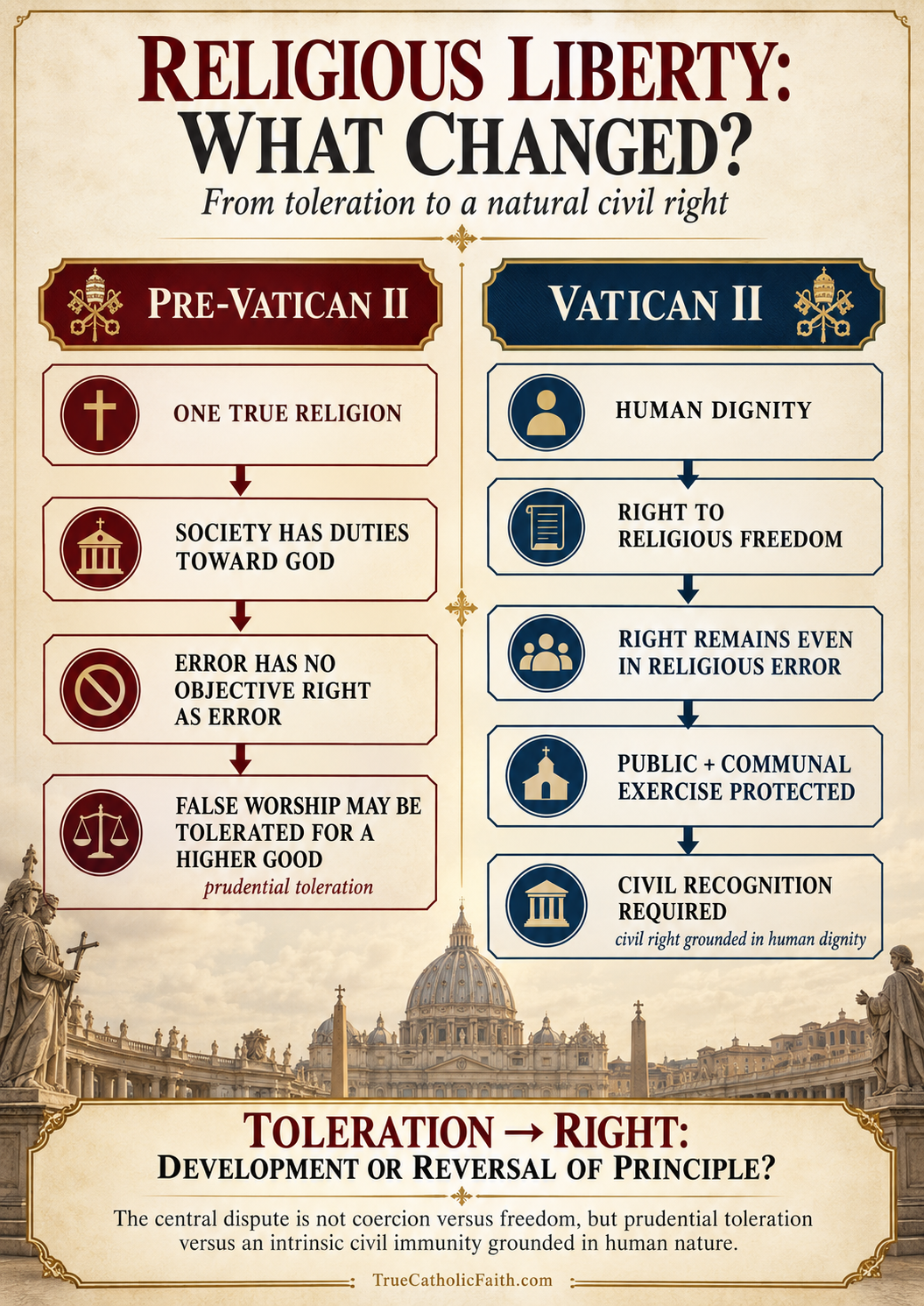
Yes. Vatican II's Dignitatis Humanae introduced a principle concerning religious liberty that cannot be reduced to the traditional Catholic doctrine of tolerating false religion for the sake of a greater good.
Before Vatican II, the Catholic Church taught that:
individuals and societies have objective duties toward the true religion;
civil society itself is subject to God;
Catholicism, where sufficiently known, possesses a unique public claim because it is true;
no one may be forced to embrace the Catholic Faith;
false religious worship may prudently be tolerated when suppression would cause a greater evil;
but religious error does not thereby acquire an objective natural right to public propagation or action.
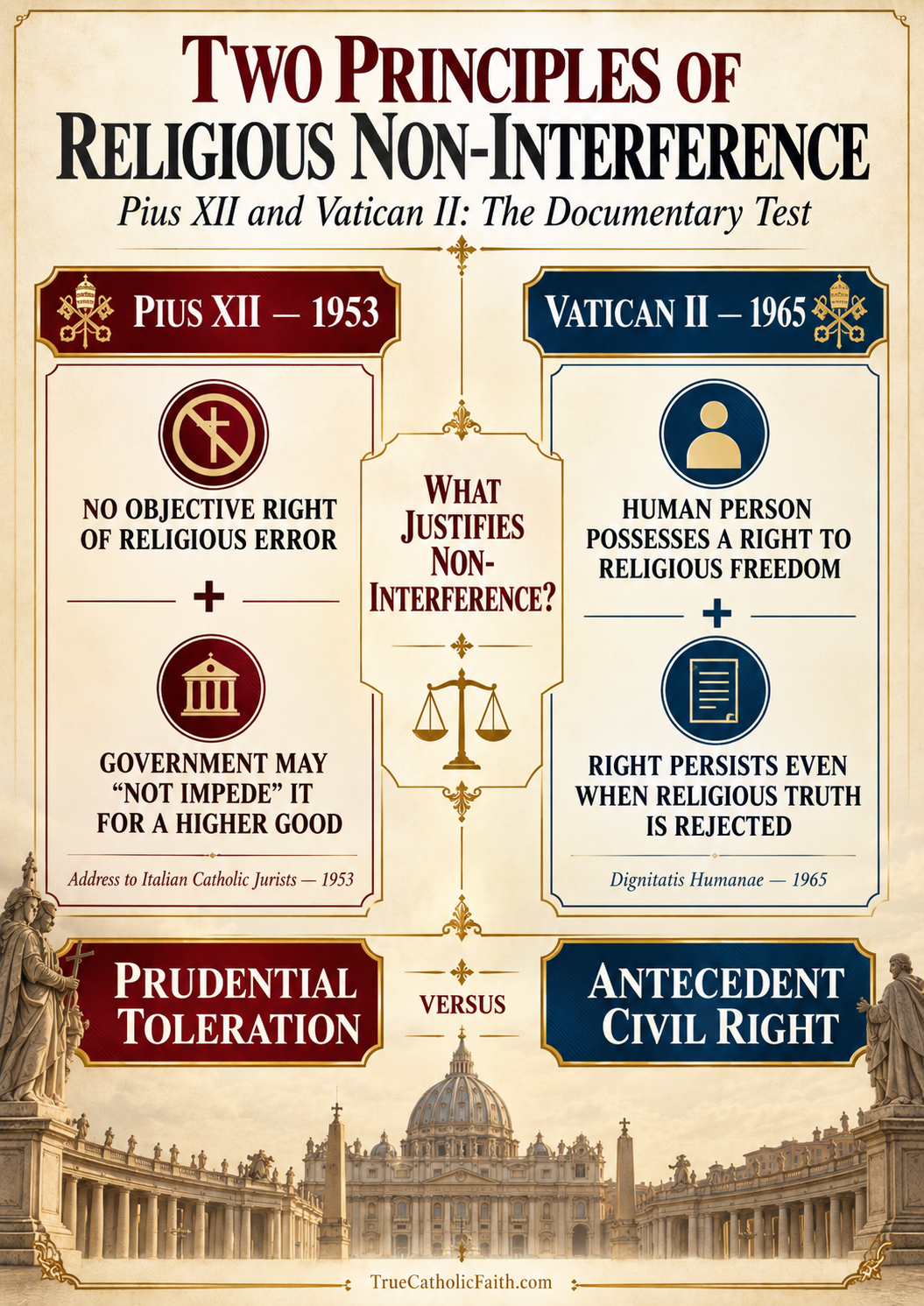
Pius XII stated the distinction with exceptional precision in 1953: what is contrary to religious truth has objectively no right to existence, propaganda or action, although government may sometimes be justified in not preventing it for the sake of a higher good.
Vatican II changed the juridical principle.
Dignitatis Humanae declared that the human person possesses a right to religious freedom grounded in his very dignity, that this right persists even when a person fails in his obligation to seek and embrace religious truth, that it extends to public and communal religious activity, and that it should be recognised in constitutional law as a civil right.
The decisive movement is therefore:
TOLERATION OF FALSE RELIGION FOR SUFFICIENT REASONS
↓
A NATURAL CIVIL RIGHT TO IMMUNITY IN THE PUBLIC PRACTICE OF RELIGION, INCLUDING FALSE RELIGION
That is not merely a change in tone, vocabulary or political circumstances. It is a change in the governing principle.
Why This Question Matters
Religious liberty is one of the most important tests of whether Vatican II represented legitimate doctrinal development or a rupture with previous Catholic teaching. The controversy is sometimes trivialised. One side is portrayed as teaching:
“People should be forced to become Catholic.”
The other:
“People should be free to believe.”
That is not the real historical dispute. Traditional Catholic doctrine had long rejected forced conversion. Faith is an act of the intellect moved by the will under grace; coercion cannot manufacture supernatural faith. Nor did the pre-Vatican II Church teach that every manifestation of false religion must always be suppressed.
She explicitly recognised toleration.
The central question is therefore considerably narrower and more precise:
Does a person possess, by virtue of human nature itself, a civil right against governmental interference when he publicly practises and propagates a religion objectively contrary to the true Faith?
Closely connected with that question is another:
Does civil society itself have an obligation toward the true religion, or should the State ordinarily refrain from distinguishing juridically between true and false religion?
Those are the questions that must be answered from the documents.
What the Catholic Church Taught Before Vatican II
1. Man Has an Objective Duty Toward Religious Truth
Traditional Catholic doctrine begins neither with unrestricted liberty nor with State power.
It begins with truth. Man was created by God and owes Him worship. Because God has revealed a religion, man does not possess moral liberty to treat contradictory religions as equally acceptable.
Leo XIII explained in Libertas that man's freedom is perfected by truth and goodness, not by mere freedom of choice. He specifically addressed what was then called liberty of worship and described the proposition that each man is free to choose any religion—or none—as incompatible with man's objective duty toward God. The traditional principle was therefore:
Man possesses freedom of will
but
he does not possess moral autonomy from truth.
This distinction is fundamental.
2. No One May Be Forced to Become Catholic
This must be stated clearly because otherwise the controversy becomes distorted. Catholicism does not teach that baptism or profession of faith should ordinarily be imposed upon unwilling non-Catholics. The act of faith requires voluntary assent.
Consequently:
freedom from forced conversion
is not the same proposition as
a natural civil right publicly to profess and propagate religious error.
The first was traditional Catholic doctrine long before Vatican II. The second is the disputed proposition. Confusing them makes serious analysis impossible.
3. Civil Society Also Has Duties Toward God
Traditional doctrine did not regard religion as merely a private affair of individuals. Leo XIII's Immortale Dei states the principle with remarkable clarity. Because civil society itself exists under God, society as society owes Him worship. The State may not legitimately behave as though God does not exist or as though religion lies entirely outside its concern.
Leo XIII teaches that civil society must worship God according to the religion He has revealed and that rulers have a duty to favour and protect that religion. This is not merely a command that individual politicians should privately be Catholics. The subject is the political community itself.
The argument runs:
God created man
↓
God created man's social nature
↓
political society exists under God's authority
↓
political society therefore has duties toward God
↓
God has revealed the true religion
↓
civil society cannot rightly behave as though truth and falsehood possess identical claims upon it
This was a central element of Catholic social doctrine.
4. The State Is Not Religiously Autonomous
Leo XIII went further. He explicitly rejected the theory that government should:
have no religious duties;
decline to determine which religion is true;
place conflicting religions on the same public footing;
treat religious profession entirely as a matter of individual preference.
In Immortale Dei he describes precisely such a political system and rejects it. He then summarises Catholic teaching by saying that it is unlawful for the State to disregard religious duty or to hold different religions in equal favour. This does not mean that every non-Catholic must be denied civil rights.
It means that the State cannot derive a principle of religious equality from supposed governmental indifference to objective religious truth.
The Social Kingship of Christ
5. Christ's Kingship Extends Over States
This doctrine was given particularly forceful expression by Pius XI in Quas Primas. Christ is not King merely of private consciences. His dominion extends over:
individuals;
families;
rulers;
political communities;
nations.
Pius XI lamented that Christ had been removed from politics and that His religion had been placed on the same level as false religions. He declared that rulers and nations owe public honour and obedience to Christ and that the State must take account of the commandments of God and Christian principles in law and public administration.
Consequently, the pre-Vatican II doctrine of Church and State cannot be understood apart from the Social Kingship of Christ. Religious liberty is therefore not merely a question about what individuals may do. It concerns what society owes to Christ.
The Crucial Distinction: Right Versus Toleration
6. The Church Did Permit False Religion to Be Tolerated
Traditional doctrine never required government mechanically to suppress every false religious act whenever it possessed the physical capacity to do so. Catholic theology recognised that authority sometimes tolerates an evil because suppressing it would cause:
greater disorder;
persecution;
civil conflict;
greater spiritual harm;
some other injury to the common good.
This is an ordinary principle of moral government. God Himself permits evils that He does not positively approve. The civil ruler may sometimes do likewise. But Catholic theology distinguished very carefully between:
PERMITTING SOMETHING
and
ACKNOWLEDGING THAT IT POSSESSES A RIGHT TO BE DONE.
That distinction is at the centre of the religious-liberty controversy.
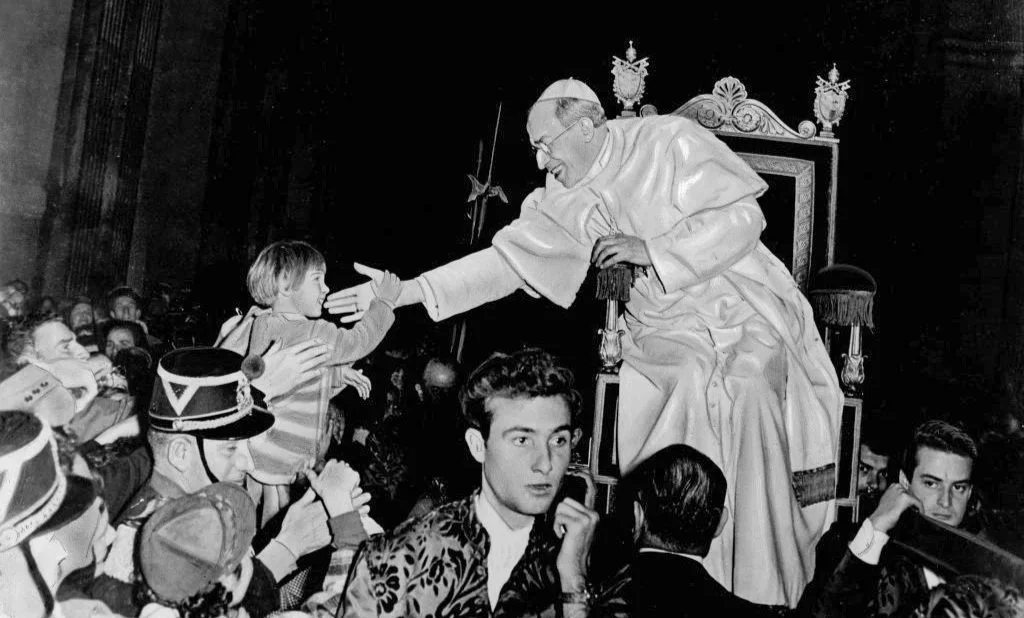
Pius XII during an audience, in the Vatican, 1953. In his 1953 address to Italian Catholic jurists, he distinguished between the absence of an objective right to religious error and the prudential toleration of such error for a higher good.
7. Pius XII Stated the Traditional Doctrine Immediately Before Vatican II
The importance of Pius XII's 1953 address to Italian Catholic jurists can scarcely be exaggerated. It was delivered only twelve years before Dignitatis Humanae. Pius XII asked whether a Catholic State or international community might refrain from suppressing religious or moral error. His answer was yes. But he explained why.
Government may sometimes “not impede” error when a higher and broader good justifies toleration. He then stated two principles.
First: what does not correspond to truth and the moral norm possesses objectively no right to existence, propaganda or action.
Second: the State may nevertheless be justified in not preventing it for the sake of a higher good.
Pius XII — Address to Italian Catholic Jurists — 1953
This gives us an extraordinarily clear preconciliar baseline. The structure is:
FALSE RELIGION
↓
NO OBJECTIVE RIGHT TO RELIGIOUS ERROR AS SUCH
↓
BUT SUPPRESSION IS NOT ALWAYS OBLIGATORY
↓
PRUDENTIAL TOLERATION MAY BE JUSTIFIED
↓
THE JUSTIFICATION DEPENDS UPON A HIGHER COMMON GOOD
That is not the same structure later adopted by Dignitatis Humanae.
Pius IX and the Liberal Claim to Religious Liberty
8. Quanta Cura
The nineteenth-century conflict over religious liberty became particularly explicit under Pius IX. In Quanta Cura of 1864 he rejected the proposition that liberty of conscience and worship is a personal right which ought to be established by law in every well-ordered society. The passage also condemns the associated claim to broad public liberty of expressing opinions free of ecclesiastical or civil restraint.
The historical context must be respected. Pius IX was confronting a liberal ideological system involving:
religious indifferentism;
secularisation;
hostility toward the Church;
unrestricted freedom of propaganda;
denial of the State's religious duties.
It would therefore be inaccurate simply to extract several words and claim that Pius IX condemned every conceivable civil immunity from coercion. But the opposite distortion is equally serious. Quanta Cura plainly concerns the proposition that religious liberty is a juridical right of man which ought to be legally established in political society.
That subject substantially overlaps the question subsequently addressed by Dignitatis Humanae.
Leo XIII and “Liberty of Worship”
9. Libertas Praestantissimum
Leo XIII developed the issue systematically. He rejected liberty of worship when understood as a natural freedom by which man may profess whatever religion he chooses. He then examined the political consequences.
If every religion possesses such liberty as a natural right, the State can no longer privilege the true religion as true. It instead tends to treat religions juridically alike. Leo XIII expressly rejected that conclusion. He taught that the State must acknowledge God and, particularly in a Catholic society, profess and protect the true religion. He nevertheless recognised toleration.
Indeed, Libertas permits certain liberties where sufficient reason exists. But Leo XIII characterises this as toleration for just cause, not as the recognition of an unconditional natural right to religious error. Again we find the same structure later stated by Pius XII:
truth possesses objective claims
falsehood may be tolerated prudentially
rather than:
every person possesses by nature a civil right to public religious activity regardless of whether that religion is true.
What Vatican II Taught
10. Dignitatis Humanae Changed the Starting Principle
On 7 December 1965 Vatican II promulgated the Declaration on Religious Freedom, Dignitatis Humanae. Its central proposition is explicit:
“The human person has a right to religious freedom.”
The Council explains that this means immunity from coercion by:
individuals;
social groups;
human authority.
No one is to be forced to act contrary to his religious convictions or prevented from acting according to them, privately or publicly, alone or in association with others, within due limits. The Council then goes further. This right is said to be grounded:
in the very dignity of the human person.
And it is to receive recognition in constitutional law as a civil right. This is the decisive doctrinal proposition.
11. The Right Exists Even When the Person Is Religiously Wrong
Dignitatis Humanae does acknowledge man's obligation to seek religious truth and to adhere to it when found. It therefore does not teach:
All religions are equally true.
Nor does it teach:
Man possesses a moral right before God to believe falsehood.
Those caricatures should be rejected. But Dignitatis Humanae then states something extremely important.
The civil right to religious immunity does not depend upon whether the person has fulfilled his duty toward religious truth.
The right continues even in those who fail to seek or adhere to the truth, provided just public order is observed.
Therefore the Council's proposition is not confined to Catholics practising the true religion. The right applies precisely to persons practising religions that Catholic doctrine regards as false.
Public, Not Merely Private, Religious Liberty
12. Dignitatis Humanae Protects Public Religious Activity
The Council's doctrine cannot be reduced to freedom of private conscience. The immunity explicitly concerns religious action:
privately;
publicly;
individually;
communally.
The declaration extends protection to religious communities in such matters as:
public worship;
internal governance;
religious instruction;
training and appointment of ministers;
religious buildings;
communication;
public witness.
Government is therefore not simply forbidden to coerce interior belief. It is required in principle to respect a sphere of external and public religious activity even when that activity embodies religious error. This is where the conflict with the earlier framework becomes most acute.
The Precise Doctrinal Comparison
13. What Changed?
The difference should be stated without caricature.
| Traditional Catholic Framework | Dignitatis Humanae Framework | Key Issue |
|---|---|---|
| Man is bound to the true religion | Man remains bound to religious truth | Continuity |
| Faith cannot legitimately be produced by coercion | No one may be forced to act against religious conviction | Substantial continuity |
| Civil society has duties toward God and the true religion | DH verbally says traditional duties toward the true religion remain intact | Claimed continuity |
| False religion has no objective right as error | The person possesses a civil right to immunity even when religiously erroneous | Major change |
| False public worship may be tolerated for sufficient reasons | Public religious activity is presumptively protected within due limits | Different juridical principle |
| Toleration depends upon a proportionate common-good reason | The right is founded in human nature itself | Major change |
| The State may privilege Catholicism because it is true | If special recognition exists, religious freedom must nevertheless be secured for all | Altered juridical framework |
| Restriction may be legitimate because false religion lacks an intrinsic claim | Restriction requires justification under the requirements of public order | Reversal of presumption |
The deepest change is not:
coercion → freedom.
The traditional Church already opposed forced faith. The deeper movement is:
PRUDENTIAL TOLERATION → NATURAL CIVIL RIGHT
14. Why the “Person, Not Error, Has Rights” Answer Does Not Settle the Question
A common defence of continuity says:
Error has no rights; persons have rights.
In itself this is true. Rights properly belong to persons. But it does not resolve the controversy. The question is:
A right to do what?
If a person is granted a legally enforceable immunity to:
conduct false worship;
propagate false doctrine;
organise a false religion;
teach it publicly;
recruit adherents;
then the object protected by the civil immunity includes objectively false religious activity.
Saying that the right belongs to the person rather than the proposition does not remove that object from consideration. Pius XII likewise spoke of concrete activity: existence, propaganda and action contrary to religious truth.
His solution was not that the erroneous person possessed an intrinsic right to that activity.
His solution was toleration for higher reasons.
That is why the personal-right distinction, although philosophically necessary, does not by itself reconcile the two doctrines.
15. “Immunity From Coercion” Does Not Eliminate the Difficulty
Another continuity argument says that Vatican II taught only an immunity from coercion, not a positive moral right to religious error. That distinction is also important. But again it does not settle the matter.
Pius XII's doctrine of toleration was itself about whether government should coercively prevent erroneous religious activity. His language was expressly:
non impedire — not to prevent.
He nevertheless distinguished such non-interference from the existence of an objective right. The question before both doctrines therefore overlaps substantially:
When may civil authority prevent erroneous religious activity?
Pius XII's answer:
It may prudentially refrain from suppression for higher reasons.
Dignitatis Humanae:
The human person possesses by nature a right to immunity from coercion, even when failing to adhere to religious truth.
Those are structurally different answers.
16. “Within Due Limits” Does Not Restore the Traditional Doctrine
Dignitatis Humanae repeatedly qualifies religious liberty by reference to due limits and a just public order. That must be acknowledged.
The Council did not advocate anarchic religious licence. But the presence of limits does not resolve the deeper question. Almost every civil right has limits. Freedom of speech, property rights and freedom of association all operate within legal boundaries. The doctrinal issue is therefore not whether Dignitatis Humanae permits restriction in extreme cases.
The issue is the presumption.
Traditional framework
Religious error possesses no objective claim to public propagation as error. Government may nevertheless tolerate it for sufficient common-good reasons.
Vatican II framework
The person possesses by nature a civil immunity in religious activity. Government must respect that immunity unless sufficient public-order reasons permit restriction. Thus the burden has moved.
Previously, toleration required justification.
Now, restriction requires justification.
That is not a minor change. It reverses the juridical presumption.
Vatican II Claimed Continuity
17. Dignitatis Humanae Says Traditional Teaching Remains Intact
A serious treatment must acknowledge this sentence. At the beginning of the declaration, Vatican II says that religious freedom concerns immunity from coercion in civil society and:
leaves intact traditional Catholic doctrine concerning the moral duty of men and societies toward the true religion and the one Church of Christ.
The Council also describes itself as developing the teaching of recent popes concerning human rights and constitutional order. This is the strongest textual argument for continuity. But an assertion of continuity is not itself a demonstration of continuity.
If document A says:
X remains intact
but then teaches a juridical principle difficult to reconcile with the previous meaning of X, the theological task is to compare the propositions themselves. The master question remains:
Can the later proposition be maintained without changing the meaning of the earlier doctrine?
The Strongest Continuity Argument
18. How Defenders of Vatican II Reconcile the Texts
The strongest continuity case normally proceeds as follows. The preconciliar popes condemned:
indifferentism;
relativism;
the supposed moral right to religious error;
unlimited freedom;
secular States denying all duties toward God;
anti-Catholic liberal regimes suppressing the Church.
Dignitatis Humanae, by contrast:
affirms man's duty to seek truth;
does not say all religions are true;
does not grant a moral right to error;
concerns civil immunity rather than theological truth;
limits the exercise of religious liberty by public order;
opposes coercion rather than objective religious obligation.
Therefore, the argument concludes, the earlier and later teachings address different propositions. This explanation identifies genuine distinctions. It should not be dismissed casually.
But it does not dispose of the principal problem.
Why the Continuity Explanation Does Not Succeed
19. The Earlier Teaching Also Addressed Civil Juridical Liberty
The older magisterium was not discussing only subjective theology. Leo XIII directly addressed:
public law;
State duties;
equality among religions;
liberty of worship;
legal protection of religious activity.
He taught that it is contrary to justice for the State to regard itself as religiously autonomous and to place conflicting religions on the same juridical footing as a matter of principle. Pius XII then addressed the exact problem of governmental non-interference in false religious activity. His justification was toleration for a higher good.
His stated principle remained that religious error possesses objectively no right to propaganda or action. Consequently, it is not sufficient to say:
The old teaching concerned moral error; Vatican II concerned civil coercion.
The old teaching concerned civil coercion too.
20. Natural Right Versus Prudential Permission
Here lies perhaps the clearest test. A merely prudential arrangement depends upon circumstances. A natural right grounded in human nature does not.
Pius XII's framework says:
circumstances may justify governmental non-interference.
Dignitatis Humanae says:
the immunity exists because of what the human person is.
The Council even specifies that the right persists despite a person's failure to seek or embrace religious truth. Therefore:
Pius XII
False religious activity
↓
No objective right as error
↓
Possible toleration
↓
Depends upon circumstances and higher good
Vatican II
Human person
↓
Dignity of human nature
↓
Right to religious immunity
↓
Persists even in religious error
↓
Must receive civil recognition
↓
Restricted only within due limits
These are not simply two formulations of the same prudential principle.
21. Can Both Principles Be True in the Same Sense?
This is the point at which the article must not retreat into vague language. If the proposition is:
Public profession and propagation of false religion possesses no natural civil claim against prohibition, although authority may prudentially tolerate it
and the later proposition is:
A person possesses by nature a civil right against governmental interference in his public religious activity even when his religion is false, subject to just public order
then the two propositions cannot both govern the same object in the same sense.
One makes governmental non-interference a matter of prudential toleration.
The other makes non-interference the fulfilment of an antecedent natural civil right.
Calling the second a “development” does not itself solve that contradiction. To demonstrate legitimate doctrinal development one would have to show that the right defined in Dignitatis Humanae was already contained—at least implicitly—in the older doctrine without reversing its principle.
The documentary comparison makes that extremely difficult.
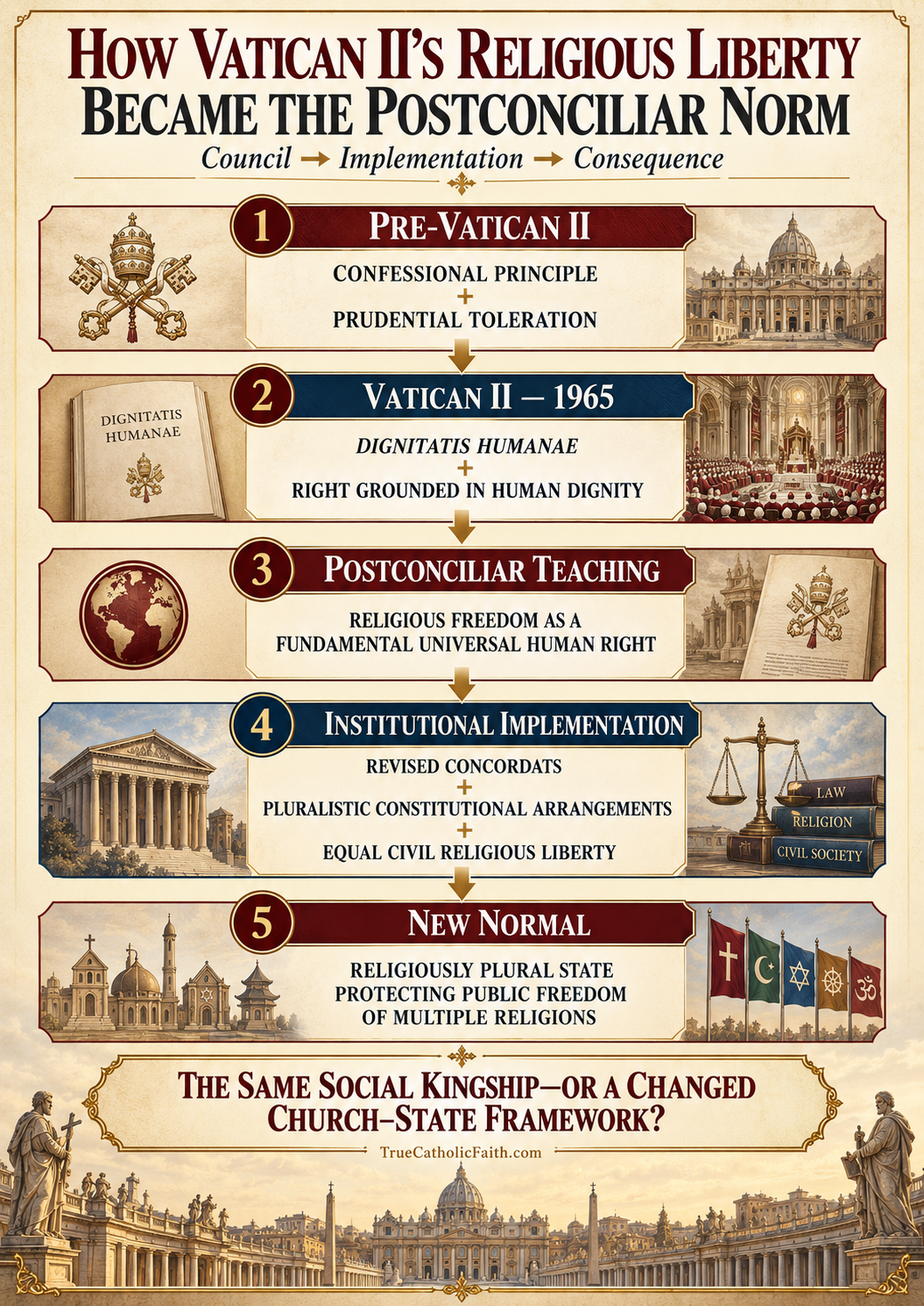
Council → Implementation → Consequence
22. Vatican II Was Not Followed by a Return to the Older Confessional Model
An important test is what happened after the Council. If Dignitatis Humanae merely restated the traditional theory of toleration in new language, one might expect postconciliar policy to continue treating the Catholic confessional State as the norm where circumstances permitted.
That is not what occurred. Religious liberty became a central postconciliar principle. John Paul II repeatedly described religious freedom as a fundamental human right belonging to individuals and religious communities.
In Indonesia in 1989 he explicitly linked this universal right to human dignity and praised constitutional protection for citizens to profess the religion of their choice and worship accordingly.
In 1999 he called religious freedom the “heart of human rights” and insisted that the right includes public manifestation of religious belief and even changing one's religion.
This is not the language of reluctant toleration. It is the language of universal right.
23. Spain Provides an Especially Clear Documentary Example
Spain makes the institutional development visible. The 1953 Concordat between Spain and the Holy See declared:
“The Catholic, Apostolic, Roman Religion continues to be the sole religion of the Spanish Nation”
and accorded Catholicism rights and prerogatives corresponding to divine and canon law. That arrangement embodied the preconciliar confessional principle. After Vatican II the Holy See participated in revising that system. The agreements concluded in 1979 expressly invoke:
civil religious liberty;
avoidance of discrimination;
equality without privilege in relevant areas.
The education agreement states that Church and State operate according to principles of religious freedom and equality, avoiding privileged situations. Political circumstances had obviously changed in Spain. That must not be ignored.
But the change cannot be explained exclusively by the death of Franco or democratisation, because the Holy See's own theological and juridical principle had changed.
The postconciliar model increasingly regarded universal religious liberty not as an unfortunate arrangement to be tolerated when unavoidable but as a positive right requiring protection.
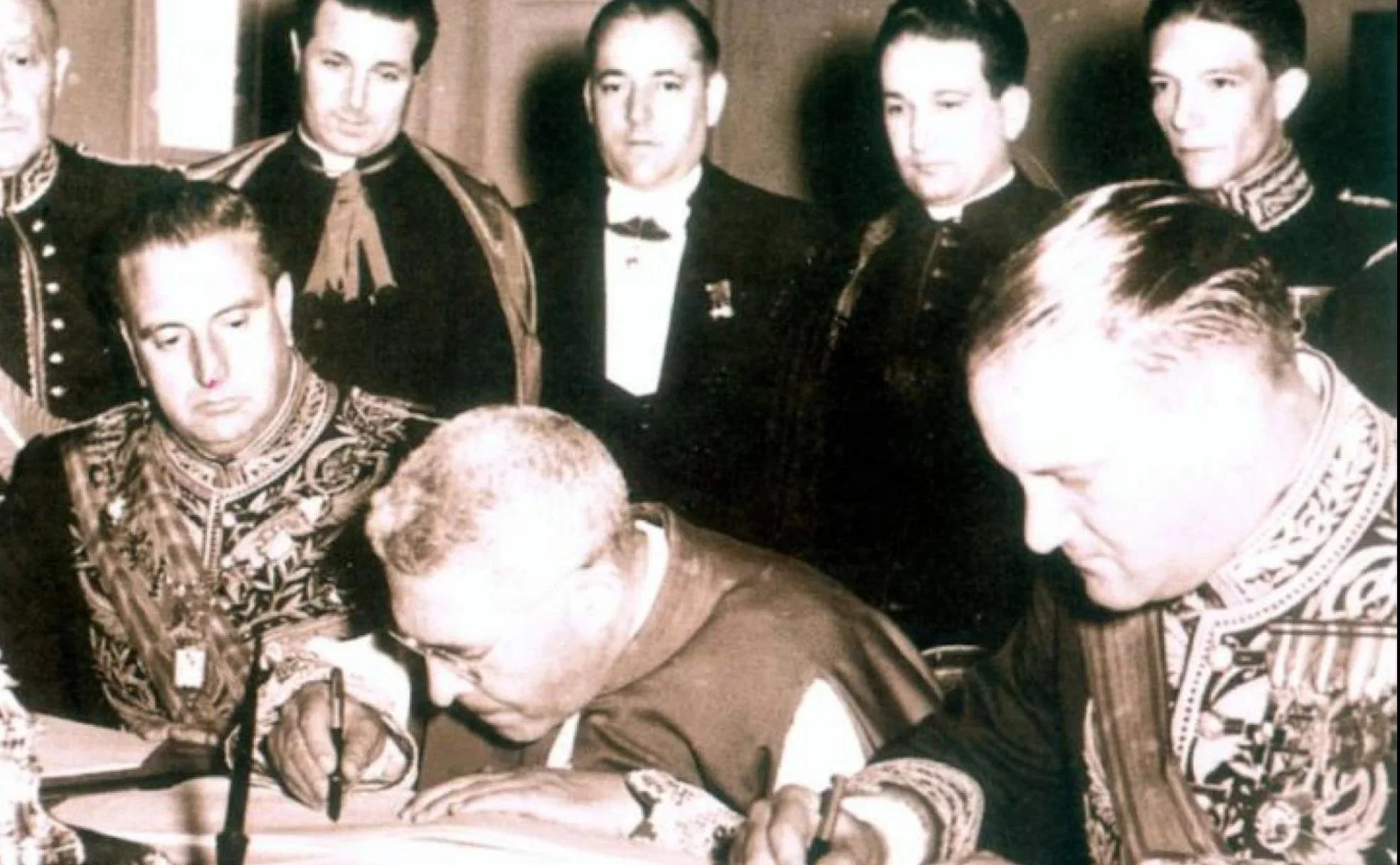
The 1953 Concordat between Spain and the Holy See being signed in Rome. The agreement reflected the preconciliar confessional framework in which Catholicism received formal public recognition from the State.
24. The Postconciliar Principle Became Universal
John Paul II's later teaching makes this particularly clear. Religious freedom was repeatedly described as:
fundamental;
inalienable;
rooted in human dignity;
applicable to every religious community;
public as well as private;
deserving constitutional and international protection.
In 2000 he called religious freedom the “first human right” and expressly said that it is not limited to the private sphere.
In 2003 he described it as connected with all other fundamental rights and grounded its importance in the person's relationship with God.
This establishes an important historical point:
The postconciliar authorities themselves did not implement Dignitatis Humanae merely as pragmatic toleration. They treated its principle as a universal human right.
Therefore the subsequent development confirms rather than diminishes the doctrinal significance of the Council.
What Happened to the Catholic Confessional State?
25. The Traditional Ideal Was Not Mere Historical Accident
It is sometimes suggested that Catholic confessional States were merely historical arrangements with no doctrinal significance. That does not correspond to the preconciliar magisterium.
Leo XIII explicitly teaches that political society has a duty to recognise the true religion.
Pius XI explicitly teaches that States owe public obedience to Christ.
Pius XII discusses the Catholic State precisely as a theological category while permitting prudential toleration within it.
The confessional principle therefore arose from doctrine:
there is one true religion
societies have duties toward God
Christ possesses social kingship = public society may formally acknowledge Catholic truth.
Specific constitutional arrangements could vary enormously. But the principle itself was not merely an accidental relic of monarchy or medieval Europe.
26. Vatican II Reversed the Normal Juridical Presumption
Dignitatis Humanae does permit a State to give special recognition to one religious body. But it immediately requires that the religious freedom of all citizens and religious communities be recognised and made effective. This substantially changes what special recognition can mean.
Catholicism may possess historical or constitutional distinction. But such recognition may no longer entail denying other religions the civil religious freedom said to belong to them by nature. Consequently, the principle that once justified a specifically Catholic legal order is fundamentally constrained by a universal right applicable equally to adherents of contradictory religions.
That is a far deeper transformation than a change in diplomatic practice.
Religious Liberty and the Social Kingship of Christ
27. Two Different Conceptions of the State
The difference can be seen graphically.
Traditional Catholic conception
CHRIST IS KING OF SOCIETY
↓
THE STATE OWES DUTY TO GOD
↓
THE TRUE RELIGION HAS A UNIQUE PUBLIC CLAIM
↓
CATHOLICISM MAY RECEIVE PUBLIC RECOGNITION AND PROTECTION
↓
FALSE RELIGION MAY BE TOLERATED FOR SUFFICIENT REASONS
Postconciliar conception
HUMAN DIGNITY GROUNDS RELIGIOUS IMMUNITY
↓
EVERY PERSON POSSESSES RELIGIOUS FREEDOM
↓
THE RIGHT CONTINUES EVEN IN RELIGIOUS ERROR
↓
PUBLIC AND COMMUNAL RELIGIOUS ACTIVITY IS PROTECTED
↓
THE STATE MUST GUARANTEE THIS CIVIL RIGHT WITHIN DUE LIMITS
The second system can verbally continue affirming that Christ is King. But the juridical consequences traditionally drawn from His Kingship have been substantially altered.
This distinction between retaining a doctrine in words and allowing it to govern the structure of public life is essential.
28. Religious Liberty Is Part of a Larger Vatican II Pattern
Religious liberty should not be examined in isolation. It sits alongside other postconciliar developments concerning:
ecumenism;
non-Christian religions;
salvation;
ecclesiology;
subsistit in;
collegiality;
synodality;
missionary activity;
interreligious dialogue.
Individually these issues must be examined according to their own evidence. But cumulatively a pattern becomes visible.
Preconciliar orientation
truth
conversion
one true Church
Christ's social Kingship
confessional public order
toleration of error when necessary
Postconciliar orientation
dialogue
religious liberty
ecumenical engagement
positive recognition of other religious communities
religiously plural civil society
equal civil immunity in religious matters
This does not prove that Vatican II simply declared all religions equal. It did not.
The change is subtler and more significant:
religious error was progressively repositioned from something that could be prudentially tolerated to something whose public exercise is protected through a right possessed by the erroneous religious adherent himself.
Institutional Continuity Versus Continuity of Religion
29. The Institutions Remained
After Vatican II there still existed:
the Vatican;
dioceses;
bishops;
parishes;
concordats;
canon law;
seminaries;
Catholic universities;
diplomatic relations;
Catholic political institutions;
the title “Catholic Church.”
Institutional continuity was extensive. But institutional continuity does not itself answer the doctrinal question. The Catholic identity of a religious body must also be examined through continuity in:
Faith;
doctrine;
worship;
ecclesiology;
moral principles;
supernatural mission;
authority.
The master FAQ method therefore correctly insists that continuity of possession must not simply be equated with continuity of religion. Religious liberty is one significant test of that distinction.
Does Religious Liberty Help Establish the “Postconciliar Religion” Thesis?
30. Not by Itself
One disputed doctrine cannot by itself prove the emergence of an entirely different religion. That conclusion must be cumulative. A careful argument therefore should not say:
Vatican II taught religious liberty, therefore a new religion unquestionably appeared overnight.
That would be inadequate. Instead the question is whether the same type of transformation appears repeatedly across independent theological domains. Religious liberty supplies one important piece of that case.
31. What the Religious-Liberty Evidence Does Establish
The documentary sequence is striking.
Before Vatican II
Pius IX
rejects the liberal claim to religious liberty as a juridical right in the political framework he condemns.
↓
Leo XIII
teaches that the State has duties toward God, should recognise the true religion, and cannot in principle place contradictory religions indiscriminately on equal footing.
↓
Pius XI
teaches that Christ's kingship extends directly to nations and rulers.
↓
Pius XII
explicitly distinguishes:
no objective right of religious error from prudential governmental toleration.
Then:
Vatican II
Dignitatis Humanae teaches:
religious immunity is a right
grounded in human dignity
possessed even when the person is religiously wrong
extending to public and communal activity
requiring civil recognition.
Then:
Postconciliar implementation
The postconciliar hierarchy:
promotes religious liberty internationally;
describes it as fundamental and universal;
supports legal protection of public religious activity;
revises earlier Church–State arrangements;
increasingly operates within a religiously plural juridical model.
That sequence is not reasonably described merely as:
“a few people misunderstood Vatican II.”
It proceeds from the conciliar text itself and was officially developed by those claiming to implement it.
Main Objection
32. Did the Church Simply Discover a Deeper Understanding of Human Dignity?
The strongest defence is that Catholic doctrine developed. According to this argument:
earlier popes defended objective religious truth;
modern circumstances revealed more clearly the dignity and rights of the human person;
Vatican II did not deny truth;
it simply recognised that truth cannot legitimately be imposed through coercion;
therefore religious liberty represents homogeneous doctrinal development rather than contradiction.
The appeal to doctrinal development is serious. Catholic doctrine genuinely develops. The Church can understand revealed or naturally knowable truths more explicitly over time. But authentic development has limits.
A later doctrine cannot reverse the meaning of an earlier doctrine while remaining the same doctrine.
Response
33. Development Must Preserve the Earlier Principle
The key question is not whether Catholic understanding can develop. It can.
The question is:
What precisely developed?
If the earlier doctrine were merely:
government should normally suppress non-Catholic worship,
and the later doctrine:
under modern circumstances government should normally tolerate it,
the change could easily be prudential.
Pius XII already supplied that framework. But Dignitatis Humanae says something further. It locates the immunity in the nature and dignity of the human person.
That makes it antecedent to the government's prudential judgment. Pius XII's toleration depends upon the common-good calculation. Vatican II's right exists before that calculation. Public order determines the limits of exercising the right, not whether the right exists in the first place.
Thus the conceptual architecture is different.
34. The Real Test
The issue can be reduced to two propositions.
Proposition A — Traditional framework
A false religion possesses no objective claim to public propagation as falsehood; government may nevertheless prudentially refrain from suppression when a greater good requires toleration.
Proposition B — Vatican II framework
The adherent of a false religion possesses by nature a civil right to immunity from governmental interference when publicly practising his religion, within the requirements of just public order.
If both refer to the same kind of public religious activity and the same civil authority, they cannot simply be pronounced identical. The second does more than broaden the practical application of the first.
It changes why government refrains from interference.
In A: because toleration is prudentially justified.
In B: because justice requires respect for an antecedent natural right.
That is the core rupture.
What We Can and Cannot Conclude
What We Can Conclude
The preconciliar Church did not teach forced conversion. Any argument based upon that caricature should be rejected.
The preconciliar Church recognised extensive religious toleration. Pius XII explicitly allowed governmental non-interference where higher goods justified it.
Toleration was not treated as equivalent to a natural right. Pius XII's distinction could scarcely be clearer: religious error objectively possesses no right to existence, propaganda or action, although it may be tolerated.
Vatican II deliberately used the language of right. Dignitatis Humanae states that the human person possesses a right to religious freedom founded in human dignity.
That right extends to persons in religious error. The Council expressly says the immunity remains even when someone fails to fulfil his obligation to seek and adhere to truth.
It extends beyond private belief. It includes public and communal religious activity.
Vatican II required legal recognition of the right. This is not merely spiritual advice concerning charity toward non-Catholics. It is a proposition concerning civil order.
The postconciliar authorities implemented the doctrine as a universal right. John Paul II repeatedly described public religious freedom as a fundamental human right belonging to individuals and religious communities.
Earlier confessional arrangements were subsequently revised according to the new framework. Spain supplies clear documentary evidence of that transformation.
The change cannot adequately be dismissed as an unauthorised “spirit of Vatican II”. The principle is in the conciliar text and was officially implemented by the subsequent hierarchy.
The traditional toleration model and the Vatican II rights model operate according to different juridical principles. One treats non-suppression of false religion as contingent toleration for sufficient reason. The other treats religious immunity as a right grounded in human nature.
That constitutes substantive doctrinal discontinuity.
What We Cannot Conclude
This article does not establish that:
Vatican II taught all religions are equally true;
Vatican II denied man's duty to embrace Catholic truth;
every religious act is immune from legitimate government regulation;
traditional Catholicism required persecution of every non-Catholic;
every confessional State in history perfectly embodied Catholic doctrine;
every modern secular constitutional arrangement is identical;
religious-liberty doctrine alone proves every aspect of the wider postconciliar crisis;
the contradiction by itself resolves all questions concerning papal office and ecclesiastical authority.
Those latter questions require further theological argument. But refusing conclusions not yet established must not be used to neutralise the conclusion that has been established.
The Ecclesiological Consequence
35. Why This Problem Cannot End With “The Teaching Changed”
If the Catholic Church is indefectible, there is a further problem. Traditional Catholic theology does not permit the conclusion that Christ's Church can simply reverse her own authoritative doctrine and become the teacher of religious error. Therefore, if genuine contradiction between the preconciliar magisterium and a purported later universal magisterium is established, the theological problem does not end with:
“Catholicism changed.”
It becomes:
Can the Catholic Church herself authoritatively promulgate a doctrine incompatible with what she previously taught?
If the answer is no, then attention necessarily turns to:
INDEFECTIBILITY
↓
TEACHING AUTHORITY
↓
VISIBLE MEMBERSHIP IN THE CHURCH
↓
PUBLIC HERESY
↓
ECCLESIASTICAL OFFICE
↓
JURISDICTION
↓
PAPAL AUTHORITY
This article does not need to settle every link in that chain. But neither should the argument be artificially stopped before reaching it.
36. Religious Liberty Within the Wider Transformation
The significance of Dignitatis Humanae becomes greater when viewed cumulatively. In other articles we must test the parallel transformations involving:
ONE TRUE CHURCH → communion ecclesiology and subsistit in
RETURN OF NON-CATHOLICS → ecumenical dialogue and convergence
FALSE RELIGIONS → positive theological appraisal and interreligious engagement
CONVERSION → dialogue and objections to “proselytism”
PAPAL AND EPISCOPAL GOVERNMENT → collegiality, episcopal conferences and synodality
CATHOLIC CONFESSIONAL SOCIETY → universal religious liberty and juridical pluralism
The question is therefore cumulative:
Are these isolated accommodations to changed historical circumstances—or interconnected elements of a different conception of the Church's relationship to religious truth, error and the modern world?
Religious liberty weighs heavily in favour of the second explanation.
Conclusion
Did Vatican II Change Catholic Teaching on Religious Liberty?
Yes. The documentary evidence permits a conclusion considerably stronger than saying Vatican II merely adopted friendlier language toward non-Catholics. Before Vatican II, Catholic doctrine distinguished between:
the objective rights of truth
and
the prudential toleration of religious error.
Civil society itself remained bound to God.
The State had duties toward the true religion.
Christ possessed sovereignty over nations.
False religion could be tolerated—sometimes extensively—but toleration remained conceptually different from recognising an intrinsic civil right to the public exercise and propagation of religious error.
Pius XII stated that framework explicitly only twelve years before Vatican II. Dignitatis Humanae introduced another juridical principle. It declared a right to religious freedom:
founded in human dignity;
possessed by every person;
remaining even when the person rejects religious truth;
extending to public and communal religious activity;
requiring recognition as a civil right;
limited principally by the requirements of just public order.
The decisive transformation therefore was:
BEFORE VATICAN II
ERROR HAS NO OBJECTIVE RIGHT
↓
BUT IT MAY BE TOLERATED FOR A HIGHER GOOD
VATICAN II
THE PERSON POSSESSES BY NATURE A RIGHT TO RELIGIOUS IMMUNITY
↓
EVEN WHILE PUBLICLY PRACTISING A FALSE RELIGION
↓
THE STATE MUST RECOGNISE AND PROTECT THAT RIGHT
The difference is not adequately explained by saying that one doctrine concerns truth and the other concerns persons. It is the person's public activity in religious error that receives juridical immunity. Nor is the difference removed merely by saying that Dignitatis Humanae concerns freedom from coercion.
Pius XII was already discussing governmental non-interference and deliberately classified it as toleration, not an antecedent natural right. Nor can the change be attributed merely to later abuses. The postconciliar authorities themselves treated religious freedom as a universal human right and restructured Church–State relations accordingly.
This is therefore one of the clearest examples of the larger Vatican II problem:
an inherited Catholic institution retained Catholic names, offices and structures while beginning to operate according to principles substantially different from those publicly taught by the preconciliar Church.
Religious liberty alone does not establish every element of the thesis that a new postconciliar religion arose within inherited Catholic structures. But it contributes powerfully to the cumulative case.
For the question is no longer merely whether Catholics became more tolerant. The Catholic Church had already taught toleration. The real question is whether something previously understood as error tolerated for sufficient reasons became something materially different:
religious activity protected as the exercise of a natural civil right.
The texts show that it did. And if an authoritative preconciliar doctrine and an allegedly authoritative postconciliar doctrine cannot both stand in the same sense, the next question cannot be avoided:
How can such a rupture be reconciled with the indefectibility and doctrinal authority of the Catholic Church?
That question leads directly into the questions of indefectibility, heresy, Church membership, ecclesiastical office, jurisdiction and papal authority.
Primary Sources
Pope Pius IX, Quanta Cura (1864) — condemns the liberal political theory of liberty of conscience and worship as a juridical right in the system under discussion.
Pope Leo XIII, Immortale Dei (1885) — major preconciliar exposition of the Christian constitution of States, including society's duties toward God and the true religion.
Pope Leo XIII, Libertas Praestantissimum (1888) — distinguishes true liberty from liberal religious liberty, rejects religious indifferentism and allows toleration for sufficient cause.
Pope Pius XI, Quas Primas (1925) — teaches the Social Kingship of Christ over rulers and nations and their public obligations toward Him.
Pope Pius XII, Address to Italian Catholic Jurists (6 December 1953) — explicitly distinguishes the absence of an objective right to religious error from permissible governmental toleration.
Second Vatican Council, Dignitatis Humanae (1965) — declares a civil right to religious freedom grounded in the dignity of the human person and extending to public and communal activity.
Holy See–Spain Concordat (1953) — example of the preconciliar confessional arrangement recognising Catholicism as the religion of the Spanish nation.
Holy See–Spain Agreements (1979) — documentary example of the postconciliar reorganisation of Church–State relations according to religious liberty and equality principles.
John Paul II, Address to Religious Leaders in Indonesia (1989) — describes religious freedom as grounded in human dignity and as a fundamental right belonging to all religious communities.
John Paul II, Message for the World Day of Peace (1999) — presents religious freedom, including public manifestation and change of religion, as central to human rights.
Further Reading
Cardinal Alfredo Ottaviani, Institutiones Iuris Publici Ecclesiastici — traditional Catholic treatment of public ecclesiastical law and Church–State relations.
Fr John Courtney Murray, S.J. — important for understanding the intellectual development of the religious-liberty position adopted at Vatican II; his work should be read in conjunction with the earlier magisterial texts rather than as their interpretive substitute.
Archbishop Marcel Lefebvre, They Have Uncrowned Him — traditionalist critique of Dignitatis Humanae in relation to Christ's social Kingship.
Michael Davies, The Second Vatican Council and Religious Liberty — extended traditionalist documentary treatment of the controversy.
Romano Amerio, Iota Unum — broader analysis of changes in Catholic thought and practice surrounding Vatican II.
Related Questions
Did Vatican II Change Catholic Teaching on the Social Kingship of Christ and Church–State Relations?
Can Vatican II Be Reconciled With the Pre-Vatican II Magisterium?
Did Vatican II Change Catholic Teaching on Ecumenism?
Did Vatican II Change Catholic Teaching About Non-Christian Religions and Salvation?
Did Vatican II Change the Catholic Understanding of the Church?
Can Catholic Doctrine Change?
What Does the Indefectibility of the Catholic Church Mean?
What Happens If a Purported Pope Publicly Teaches Heresy?