Did Vatican II Change Catholic Teaching About Non-Christian Religions and Salvation?
Short Answer
Yes—but the change must be stated precisely.
Vatican II did not invent the doctrine that a person who is visibly outside the Catholic Church might nevertheless be saved. Long before Vatican II, Catholic theology recognized that a person invincibly ignorant of the true Faith could receive supernatural grace and, through an implicit desire for the Church and cooperation with grace, be united to the Church in a manner known to God.
The traditional doctrine therefore was never:
Every person visibly outside the Catholic Church is automatically damned.
Nor did the Church teach that non-Catholics could be forced into conversion.
The crucial question is different:
Is a non-Catholic saved despite the errors of his false religion, by grace drawing him toward Christ and His Church—or can his non-Christian religious tradition itself function positively within God's economy of salvation?
Before Vatican II, the ordinary framework was clear:
there is one true religion, one Church of Christ, and one supernatural economy of salvation. Whatever truth a non-Christian possesses is true; whatever natural virtue he practices is genuinely good; and God's grace can reach a person anywhere. But religious error itself does not save. False worship is not a means of salvation. Grace draws the soul away from error and toward supernatural truth, Christ and His Church.
Vatican II retained important parts of that doctrine. It continued to affirm Christ, missionary activity, baptism and the necessity of the Church. Yet Lumen Gentium, Nostra Aetate, Ad Gentes and Gaudium et Spes introduced a markedly different theological vocabulary and framework: non-Christian peoples are described as related to the People of God; Muslims are said to “adore the one and merciful God”; other religions contain things “true and holy”; their teachings and ways of life can reflect a “ray” of divine Truth; and “truth and grace” can be found among peoples and even within their rites and cultures.
The decisive development came after the Council. Official postconciliar texts went considerably further, speaking of the Holy Spirit acting in peoples, cultures and religions; of non-Christian traditions containing “elements of grace”; of people responding to God's invitation through sincere practice of what is good in their religious traditions; and of some non-Christian prayers and rituals functioning as preparations for the Gospel.
The resulting framework is therefore not adequately described as merely a kinder way of expressing exactly the same missionary theology.
The object of theological evaluation changed.
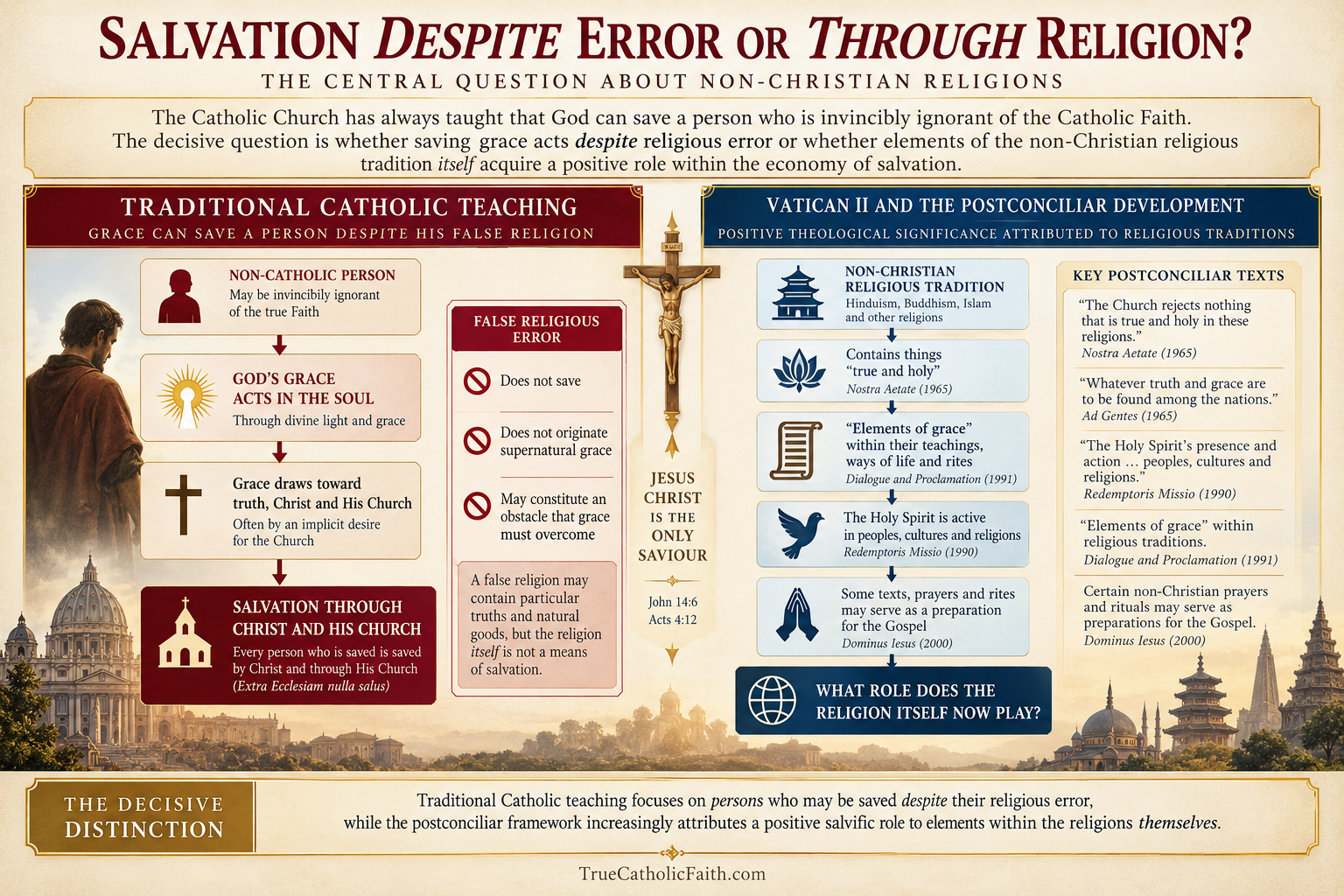
Traditional teaching concentrated upon persons outside the Church whom grace might save despite their religious errors.
The postconciliar framework increasingly attributed positive theological significance to elements within the religions themselves.
That distinction is fundamental.
Why This Question Matters
Few questions reveal the transformation produced by Vatican II more clearly.
The issue is not whether Catholics should hate Muslims, Hindus, Buddhists or adherents of other religions. They should not.
It is not whether non-Christians can possess natural virtues. They can.
It is not whether their philosophical or religious traditions can preserve individual truths. They can.
Nor is the question whether God can give grace to someone living in a false religion. He can.
The issue is whether Catholicism understands other religions principally as systems containing religious error from which souls must ultimately be converted, or whether they may themselves be regarded as possessing a positive role within God's salvific design.
That difference affects the meaning of:
evangelisation;
conversion;
missionary activity;
religious dialogue;
prayer with non-Christians;
extra Ecclesiam nulla salus;
the uniqueness of Christianity;
the necessity of the Catholic Church;
and ultimately the religious identity of the postconciliar system.
To understand the controversy, we must therefore begin before Vatican II.
What Did the Catholic Church Teach Before Vatican II?
Christ Is the Only Saviour
Catholic doctrine begins not with comparative religion but with Jesus Christ.
Our Lord declared:
“I am the way, and the truth, and the life. No man cometh to the Father, but by me.” — John 14:6
St Peter proclaimed:
“Neither is there salvation in any other. For there is no other name under heaven given to men, whereby we must be saved.” — Acts 4:12
And Christ commanded the Apostles:
“Going therefore, teach ye all nations; baptizing them in the name of the Father, and of the Son, and of the Holy Ghost.” — Matthew 28:19
The apostolic mission therefore has a definite supernatural object:
the nations are to become disciples of Christ.
Christianity is not one culturally conditioned expression of a universal religious impulse. It claims to be the supernatural revelation of God completed in Jesus Christ and entrusted to the Church He founded.
There Is One Church of Salvation
The ancient Church understood Noah's Ark as a figure of the Church.
St Cyprian of Carthage (c. 210–258) wrote in On the Unity of the Catholic Church that, just as those outside Noah's Ark perished, salvation cannot be separated from Christ's Church.
The Fourth Lateran Council declared in 1215:
“There is one Universal Church of the faithful, outside of which there is absolutely no salvation.”
This is the origin of the familiar formula: Extra Ecclesiam nulla salus
Outside the Church there is no salvation.
The doctrine does not mean that every person lacking visible canonical membership in the Church is necessarily damned. It means that every person who is saved is saved through Christ and through His Church.
There is not:
Catholic salvation + Muslim salvation + Hindu salvation + Buddhist salvation.
There is one supernatural economy of salvation established by Christ.
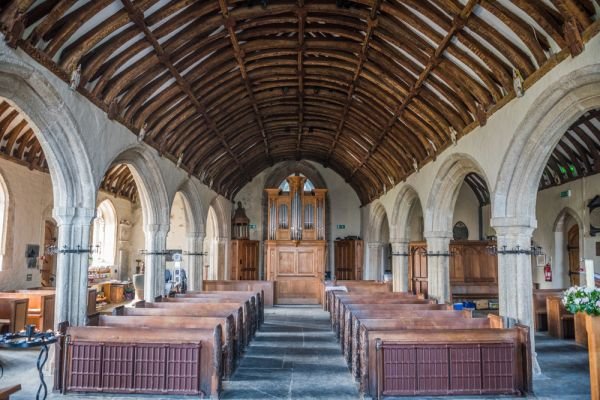
The Nave — the Ship of Salvation: The very word nave comes from the Latin navis, meaning “ship.” Here the timbered roof resembles the inverted hull of a great wooden vessel, recalling the ancient Christian image of the Church as the Ark of Salvation. As Noah’s Ark carried the faithful remnant safely through the Flood, so the Church carries souls through the dangers of this world toward their eternal salvation in Christ.
Pius IX: Invincible Ignorance Does Not Make Error Salvific
This distinction is indispensable. Pope Pius IX explicitly rejected the proposition that salvation could be attained while living in religious error as though error itself were a road to heaven.
Yet in Quanto Conficiamur Moerore (1863) he immediately acknowledged that persons suffering from invincible ignorance of the Catholic religion, sincerely observing the natural law and responding to God, could “attain eternal life” through the operation of divine light and grace.
These propositions are not contradictory. They distinguish:
the objective religious system
from
the subjective condition of the person within it.
A Muslim might be invincibly ignorant. Islam is not thereby made salvific.
A Hindu might respond to actual grace. Hinduism is not thereby transformed into a means of grace.
A Buddhist might sincerely seek truth. Buddhist doctrine is not therefore divine revelation.
The person may be saved despite the error. He is not saved by the error. That distinction is essential for understanding everything that follows.
Pius XII: Grace Can Reach Those Outside Visible Membership
Pius XII made the same distinction. In Mystici Corporis Christi (1943), he spoke of persons who did not belong visibly to the Catholic Church but who could nevertheless possess an “unconscious desire and longing” relating them to the Mystical Body.
But Pius XII did not therefore describe their non-Catholic religions as alternate paths of salvation. Instead, he warned that such persons remained deprived of many supernatural helps available in the Catholic Church and prayed that they would enter Catholic unity. The direction of movement was therefore unmistakable:
OUTSIDE VISIBLE UNITY
↓
GRACE
↓
MOVEMENT TOWARD CHRIST
↓
DESIRE FOR / RELATION TO HIS CHURCH
↓
CATHOLIC UNITY
The missionary objective remained conversion.
The Holy Office and the Feeney Controversy
This is important because otherwise the controversy can be caricatured. The pre-Vatican II Church did not teach the rigorist position associated with Fr Leonard Feeney that only those visibly incorporated into the Catholic Church could possibly be saved.
The 1949 Holy Office intervention distinguished the necessity of the Church from the manner in which a person may be related to her. An implicit desire could suffice where explicit incorporation was impossible through invincible ignorance, provided the other supernatural requirements for salvation were present.
Therefore the genuine comparison is not:
| Before Vatican II | After Vatican II |
|---|---|
| Every non-Catholic damned | Non-Catholics may be saved |
That comparison is historically false. The real question is:
| Traditional Framework | Emerging Postconciliar Framework |
|---|---|
| Grace may save a person despite his false religion | Grace may operate within the person's religious tradition |
| Error itself does not save | Elements within religions may possess a positive salvific function |
| False religion must ultimately yield to revealed truth | Religious traditions may contain “elements of grace” and preparations for the Gospel |
| Mission aims at conversion to Christ and His Church | Mission increasingly includes dialogue as an enduring activity |
| The Church possesses the true religion to which nations are called | Positive theological value is increasingly attributed to other religious traditions |
That is the comparison that must be tested.
The Traditional Missionary Principle
Leo XIII taught that Christ commissioned the Church to communicate His revelation and salvation to the entire human race. In Satis Cognitum (1896), he described the Church as continuing Christ's mission throughout history and as alone possessing the divinely instituted means of salvation in their integrity.
Pius XI similarly condemned the proposition that religions could be treated as “more or less good and praiseworthy” manifestations of humanity's common religious instinct. In Mortalium Animos (1928), he insisted that revealed religion is objectively true and that contradictory religious propositions cannot simultaneously constitute acceptable forms of divine religion.
Pius XII continued to speak explicitly of Catholic missionary work among “pagan lands.”
The tone could be charitable. Missionaries could recognise natural virtues. They could preserve legitimate cultures. They could use whatever was objectively true as a point of contact. But the supernatural destination remained:
conversion to Christ and incorporation into His Church.
Four Distinctions That Must Never Be Lost
| Distinction | Catholic Principle |
|---|---|
| Truth within another religion vs truth of that religion | A false religion may preserve particular truths without thereby becoming the true religion. |
| Grace acting in a person vs grace originating his false doctrine | The Holy Ghost may move a Muslim, Hindu or Buddhist toward truth without thereby inspiring Islam, Hinduism or Buddhism. |
| Salvation despite error vs salvation through error | God may overcome inculpable religious error. The error itself does not save. |
| Respect for persons vs approval of their religion | Catholics owe charity, justice and respect to every person without treating every religion as divinely legitimate. |
These distinctions provide the doctrinal control for evaluating Vatican II.
What Did Vatican II Say?
Lumen Gentium 16: Non-Christians and the “Plan of Salvation”
Lumen Gentium 16 states that those who have not received the Gospel are “related in various ways to the people of God.” It then states:
“The plan of salvation also includes those who acknowledge the Creator.”
Muslims are singled out as those who, “professing to hold the faith of Abraham,” together with Christians “adore the one and merciful God.”
The text proceeds to persons who, without culpability, do not know Christ or His Church but sincerely seek God and endeavour to accomplish His will under grace. That latter proposition has an obvious antecedent in Pius IX.
The novelty is therefore not simply the possibility of salvation for the invincibly ignorant.
The more significant development is the theological framework into which non-Christian peoples and religions are placed. Instead of concentrating principally upon an individual's possible implicit relationship to the Church despite his religious error, the Council speaks of whole categories of non-Christians as standing in different relationships to the People of God.
That shift becomes considerably clearer in Nostra Aetate.
Nostra Aetate: A Different Way of Speaking About False Religions
Nostra Aetate begins from the unity of mankind and asks what different religions have in common. It describes Hinduism, Buddhism and other religions in terms of humanity's search for answers to ultimate questions. Then comes its most famous statement:
“The Catholic Church rejects nothing that is true and holy in these religions.”
It says that the Church regards with “sincere reverence” their ways of life, precepts and teachings insofar as these “often reflect a ray of that Truth which enlightens all men.”
The declaration nevertheless immediately states that the Church must proclaim Christ as “the way, the truth, and the life.” This qualification matters. It would therefore be inaccurate to claim:
Vatican II explicitly taught that all religions are equally true.
It did not. Nor did Nostra Aetate expressly teach that Islam, Hinduism or Buddhism independently saves.
But something important nevertheless changed.
The subject of positive theological evaluation increasingly became the religion itself.
The Council did not merely say: A Hindu may possess some true beliefs despite Hinduism. It spoke of things “true and holy in these religions.”
It did not merely say: Buddhists may sincerely search for truth. It positively described elements of Buddhist religious aspiration.
It did not merely command Catholics to treat Muslims justly. It declared that Muslims “adore the one God” and described elements of Islamic worship with esteem.
That vocabulary would become the foundation for a much broader postconciliar theology of religions.
Ad Gentes: Truth and Grace in Rites and Cultures
The missionary decree Ad Gentes provides an especially important bridge. It says:
“whatever truth and grace are to be found among the nations, as a sort of secret presence of God”
should be purified and restored to Christ. It continues by referring to whatever good is found in the hearts and minds of men or in the rites and cultures of peoples, saying that such things are to be healed, elevated and perfected.
Again, the text preserves an important qualification. Whatever is found must be purified and perfected in Christ. This is not religious pluralism in the modern sense.
Nevertheless, the conceptual transition is visible:
PERSON RECEIVING GRACE DESPITE FALSE RELIGION
becomes increasingly
TRUTH AND GRACE DISCERNIBLE WITHIN RELIGIOUS/CULTURAL TRADITIONS
That distinction would become increasingly explicit after the Council.
Council → Implementation → Consequence
The development can now be traced historically.
Stage 1 — Traditional Catholic Doctrine
God may give grace to every human being. A person in invincible ignorance may respond to that grace. If he is saved, he is saved:
by Jesus Christ;
through supernatural grace;
through a relationship to Christ's Church;
not through religious error as such.
False religion possesses no independent salvific efficacy. Mission therefore seeks conversion.
Stage 2 — Vatican II
The Council retains Christological affirmations but introduces a positive theological vocabulary concerning non-Christian religions:
“true and holy” things within them;
“rays” of divine Truth;
Muslims who “adore the one God”;
truth and grace among nations;
goodness within rites and cultures;
dialogue and collaboration;
non-Christians related in various ways to the People of God.
Stage 3 — Paul VI
Paul VI's 1964 Ecclesiam Suam, written while Vatican II was underway, made “dialogue” a defining paradigm for the Church's relationship with the modern world and explicitly extended that framework to non-Christian religions. Paul VI still affirmed that Christianity is the “one and only true religion,” which is an important continuity marker. But he simultaneously described dialogue with other religions as a positive mode of ecclesial engagement.
By 1975, Evangelii Nuntiandi described non-Christian religions as possessing an “impressive patrimony” of religious texts and as being “impregnated” with “seeds of the Word,” even capable of constituting a “preparation for the Gospel.”
Again, Christ remained necessary. But the theological evaluation of other religions was becoming substantially more positive.
John Paul II and the Expansion of the Principle
Redemptoris Missio
John Paul II's 1990 encyclical Redemptoris Missio is especially important because it shows how Vatican II's principles were officially interpreted. It teaches that the Holy Spirit's presence and activity affect not only individuals but also:
“society and history, peoples, cultures and religions.”
It states that God makes Himself present to peoples through their “spiritual riches,” of which their religions are a “main and essential expression.” John Paul II nevertheless continued to affirm that salvation comes from Christ and that evangelisation remains necessary.
This is therefore not simple pluralism. But it is difficult to reduce this language to the older proposition:
God may secretly give grace to an invincibly ignorant individual despite his false religion.
The religion itself has now entered the theological account as a locus in which the action of the Spirit is discerned.
Dialogue and Proclamation: The Development Becomes Explicit
The 1991 Vatican document Dialogue and Proclamation goes still further. It speaks of a:
“positive evaluation of religious traditions”
and says that other traditions are approached with respect because of the spiritual and human values found within them. More significantly, it states that non-Christians may respond to God's invitation:
“in the sincere practice of what is good in their own religious traditions”
and speaks of discerning within those traditions:
“elements of grace”
capable of sustaining that response.
This is the decisive conceptual development. Compare the two formulations:
Traditional principle
God can save a non-Christian despite his religious error through grace drawing him implicitly toward Christ and His Church.
Postconciliar formulation
God's grace may be encountered and responded to through elements present within the person's own religious tradition.
These are not merely different tones. They answer a different theological question.
Dominus Iesus: An Attempt to Establish Boundaries
The Congregation for the Doctrine of the Faith issued Dominus Iesus in 2000 partly because theological pluralism had developed so extensively that the uniqueness of Christ and the Church required renewed defence. The document emphatically rejects the proposition that other religions constitute parallel or complementary ways of salvation equivalent to the Church.
That affirmation must be acknowledged. But Dominus Iesus simultaneously states that non-Christian sacred texts may contain elements functioning as instruments through which people maintain a relationship with God. It also says that the religious traditions contain elements coming from God and that certain non-Christian prayers and rituals may serve as preparations for the Gospel.
It carefully adds that such rites do not possess the sacramental ex opere operato efficacy of Christian sacraments and that some may actually constitute obstacles to salvation.
This qualification is important. But notice how far the discussion has travelled. The question is no longer simply:
Can grace save an invincibly ignorant pagan?
It has become:
What positive role might the sacred texts, prayers, rituals and religious traditions of non-Christians have within the one economy of salvation?
That is a materially different theological framework.
Assisi 1986: Theology Becomes Public Religious Practice
The 1986 World Day of Prayer for Peace at Assisi is therefore not an isolated curiosity. Representatives of numerous religions assembled at the invitation of John Paul II and prayed according to their respective religious traditions.
John Paul II explicitly denied that the event implied religious relativism or a search for doctrinal consensus. He arranged separate places of prayer and acknowledged the real differences between religions.
Those qualifications must be recorded. But the event nevertheless publicly manifested the new theological framework. John Paul II said that prayer “in the diversity of religions” expressed a relationship with a transcendent power, and later described the various religions as capable of contributing to peace. In Redemptoris Missio, he subsequently connected Assisi with his conviction that:
“every authentic prayer is prompted by the Holy Spirit.”
That is a major development in Catholic religious practice. Before Vatican II, the dominant public ecclesial symbolism was:
MISSIONARY CHURCH → NON-CHRISTIAN WORLD → CONVERSION
Assisi presented another image:
CATHOLIC LEADER + WORLD RELIGIONS → DISTINCT RELIGIOUS PRAYER → COMMON TEMPORAL OBJECTIVE
The question is not whether peace is good. It obviously is. The question is what such an event communicates about the theological status of non-Christian worship.
The Development Reaches Religious Pluralism
A striking later example appears in the 2019 Abu Dhabi Document on Human Fraternity, signed by Francis and the Grand Imam of Al-Azhar. The document states:
“The pluralism and the diversity of religions ... are willed by God in His wisdom.”
The same sentence groups religious diversity together with differences of sex, race, colour and language. That formulation creates an obvious theological problem. God positively wills the existence of male and female and the diversity of peoples. But can God positively will contradictory religious doctrines concerning Himself?
Can He positively will:
belief that Jesus Christ is God;
and denial that Jesus Christ is God?
Can He positively will:
the Trinity;
and denial of the Trinity?
Can He positively will:
the Eucharistic Sacrifice;
and religious systems rejecting it?
If “willed” means merely God's permissive will, the proposition can be reconciled with traditional theology: God permits false religions just as He permits many consequences of human error and freedom.
But the text itself did not make that distinction. Its placement of religious diversity alongside sex, race and language naturally suggested something considerably more positive. This illustrates why the history cannot adequately be explained simply as isolated postconciliar “abuses.” There is a discernible trajectory:
VATICAN II'S POSITIVE REASSESSMENT
↓
THEOLOGY OF RELIGIOUS TRADITIONS
↓
INTERRELIGIOUS DIALOGUE
↓
ASSISI
↓
SPIRIT ACTIVE IN RELIGIONS
↓
ELEMENTS OF GRACE WITHIN RELIGIOUS TRADITIONS
↓
RELIGIOUS PLURALITY DESCRIBED AS WILLED BY GOD
The later developments did not appear from nowhere. They developed concepts already authorised during and immediately after Vatican II.
Does This Mean Vatican II Taught That All Religions Are Equal?
No. That claim would weaken the argument by overstating the evidence.
Vatican II continued to proclaim Christ.
Ad Gentes continued missionary teaching.
Paul VI continued to call Christianity the one true religion.
John Paul II continued to teach that Christ alone saves.
Dominus Iesus explicitly rejected the proposition that the Church is merely one path of salvation among parallel religious paths.
The issue is subtler—and more consequential. The postconciliar system simultaneously maintains:
Christ alone ultimately saves
while increasingly asserting:
the Holy Spirit operates within other religious traditions and elements within those traditions may participate positively in preparing or mediating a person's response to grace.
The theological controversy therefore concerns inclusivism, not crude religious relativism.
Salvation Through a Religion or Despite It?
This is the decisive distinction. Imagine a Muslim who has never encountered Catholicism adequately. Traditional theology can say:
God desires his salvation.
God can give him actual grace.
He may respond sincerely to conscience.
Invincible ignorance removes culpability for what he could not know.
Grace may produce supernatural faith, hope and charity according to the requirements established by God.
He may possess an implicit desire for the Church.
If saved, he is saved by Christ and through the Church.
Nothing in that account requires Islam to become a means of salvation. Indeed, whatever Islam teaches contrary to Christ remains an obstacle that grace must overcome.
Postconciliar theology increasingly asks a different question:
Could elements within Islam itself—its monotheism, prayer, fasting, moral discipline and other religious practices—function positively in God's providence?
That is why the change is substantial. The issue is not merely who can be saved. It is:
What is the theological status of the false religion in which that person lives?
A Concrete Comparison
| Question | Traditional Catholic Framework | Vatican II / Postconciliar Framework |
|---|---|---|
| Is there one true religion? | Yes | Formally affirmed |
| Is Christ the only Saviour? | Yes | Formally affirmed |
| Is the Catholic Church necessary for salvation? | Yes | Formally affirmed, but expressed through a broader sacramental/inclusivist framework |
| Can invincibly ignorant non-Catholics be saved? | Yes, through grace and implicit relation to the Church | Yes |
| Does invincible ignorance itself save? | No | No |
| Can non-Christian persons possess truths and natural virtues? | Yes | Yes |
| Can grace act in a non-Christian person? | Yes | Yes |
| Is his false religion itself salvific? | No | Formally denied as an independent/parallel way |
| Are other religious traditions positively evaluated theologically? | Very cautiously; truth distinguished from religious error | Increasingly yes |
| Can elements within those traditions be called “elements of grace”? | Not the normal preconciliar formulation | Yes in official postconciliar theology |
| Can their prayers/rites possess a positive preparatory role? | Not ordinarily attributed to the false religion as such | Explicitly admitted in qualified form |
| Is interreligious dialogue part of the Church's mission? | Not in the postconciliar theological sense | Yes |
| Is conversion to Catholic unity the obvious institutional objective? | Yes | Still affirmed, but increasingly accompanied—and sometimes practically displaced—by permanent dialogue |
| Can representatives of different religions assemble publicly to pray according to their religions? | Traditional discipline strongly guarded against religious indifferentism | Assisi established this as an officially sponsored model |
| Can religious diversity be described as “willed by God”? | Only safely in the sense of divine permission | Explicit postconciliar formulation requires that distinction to avoid contradiction |
The continuity is real in some propositions. The transformation is equally real in the surrounding theology.
The Strongest Continuity Argument
The strongest defence of continuity should not be caricatured. It runs approximately as follows.
The Church always knew that pagans could possess natural truths.
St Paul himself recognised religious searching among the Gentiles.
The Fathers sometimes spoke of “seeds of the Word.”
Pius IX acknowledged salvation of the invincibly ignorant.
Pius XII recognised an unconscious desire relating souls to the Church.
Therefore Vatican II merely developed the same principles.
When Nostra Aetate speaks of “truth and holiness” in other religions, it does not endorse their errors.
When Redemptoris Missio speaks of the Spirit operating in religions, it means that whatever is genuinely true or good there ultimately originates in God.
When Dominus Iesus speaks positively about certain prayers and rituals, it expressly denies that other religions possess independent salvific efficacy.
On this interpretation, Vatican II did not change doctrine. It simply articulated more fully how the one grace of Christ can operate among persons who have not yet received the Gospel.
This is the strongest continuity case.
Response: Why the Continuity Explanation Is Insufficient
There is genuine continuity concerning several propositions:
Christ remains formally confessed as Saviour;
salvation ultimately comes through Christ;
non-Christians can receive grace;
religious relativism is officially rejected;
missionary proclamation is formally retained.
Those facts should not be denied. But they do not resolve the entire question. The disputed development concerns a different proposition:
What theological role belongs to the non-Christian religion itself?
Pius IX located salvation in divine light and grace overcoming invincible ignorance.
Pius XII described outsiders as related by an unconscious longing to Christ's Mystical Body and urged them to enter Catholic unity.
Postconciliar texts increasingly locate positive religious significance within:
traditions;
sacred texts;
rites;
prayers;
spiritual riches;
religious cultures;
and the sincere practice of what is good within those traditions.
That is not adequately explained by saying merely:
“The Church always believed non-Catholics could be saved.”
She did. But that is not the disputed proposition. The disputed proposition is whether a false religion as a religious tradition can possess a positive function within the supernatural economy of salvation.
Truth Within a Religion Does Not Make the Religion True
This distinction resolves much confusion.
Suppose Islam teaches: There is one Creator. That proposition is true.
Suppose Islam simultaneously denies: Jesus Christ is God the Son. That proposition is false.
The truth of the first proposition does not make Islam the true religion.
Likewise, a Buddhist may recognise the instability of material existence.
A Hindu philosophical school may correctly identify certain metaphysical truths.
A pagan philosopher may discover principles of natural law.
Truth remains truth wherever it appears. But Catholic theology traditionally distinguishes:
truth surviving within a false system
from
the false system as a divinely sanctioned religious way.
Failure to preserve that distinction creates religious indifferentism even without explicitly declaring all religions equal.
The Missionary Consequence
This is where doctrine becomes practice. If the non-Christian is principally understood as a soul living in religious error whom Christ desires to bring into His Church, missionary activity naturally seeks:
CONVERSION
↓
BAPTISM
↓
CATHOLIC FAITH
↓
SACRAMENTAL LIFE
↓
PERSEVERANCE
↓
ETERNAL SALVATION
But if his existing religion is increasingly understood as containing divine “elements of grace,” as an arena of the Spirit's activity and as something through which he may respond positively to God, missionary urgency inevitably changes. Dialogue can then cease to be merely a means of approaching someone lovingly with the truth. It becomes a religious activity possessing enduring value in itself.
This does not logically require abandonment of evangelisation. Indeed postconciliar documents repeatedly deny that it does. But it creates a profound practical tension:
If God's Spirit is already operating salvifically through elements of another religious tradition, precisely why must its adherent abandon that religion and become Catholic?
Postconciliar documents continue to supply answers. But the very need repeatedly to insist that dialogue does not eliminate proclamation demonstrates the tension created by the new framework.
From Conversion to Dialogue
This helps explain one of the most visible transformations after Vatican II. The traditional missionary vocabulary emphasised:
conversion;
baptism;
propagation of the Faith;
destruction of superstition;
rejection of idols;
entrance into the Church;
salvation of souls.
The postconciliar vocabulary increasingly emphasised:
encounter;
dialogue;
mutual understanding;
collaboration;
enrichment;
common spiritual values;
interreligious fraternity;
shared concern for humanity;
recognition of the Spirit's activity elsewhere.
Not every one of these concepts is intrinsically wrong. Catholics can certainly cooperate with non-Catholics in matters of natural justice and peace. But the cumulative shift in vocabulary reflects a shift in religious orientation.
The question is no longer merely how Catholics can most effectively convert the nations. Increasingly it becomes how religions can encounter one another while remaining religiously distinct.
Is This Merely a Change of Tone?
No. Tone certainly changed. But documents such as Dialogue and Proclamation, Redemptoris Missio and Dominus Iesus demonstrate that the development became theological, not merely rhetorical. The concepts include:
Spirit acting in religions
elements of grace in religious traditions
religious texts nourishing a relationship with God
non-Christian rites preparing for the Gospel
sincere practice of what is good within a religious tradition as the concrete context of response to grace
These are theological propositions. They concern the economy of salvation. They therefore cannot be dismissed as mere changes in diplomatic language.
Does This Help Explain the Wider Postconciliar Transformation?
Yes. This article should not alone attempt to prove the entire thesis that the postconciliar system constitutes a new or “pseudo-Catholic” religion. That conclusion requires cumulative evidence across:
ecclesiology;
ecumenism;
religious liberty;
liturgy;
sacraments;
Church membership;
mission;
Church-state doctrine;
collegiality;
synodality;
canon law;
and papal teaching and practice.
But the treatment of non-Christian religions is an important part of that cumulative case. The contrast is striking.
Traditional Catholic orientation
ONE TRUE RELIGION
↓
ONE REDEEMER
↓
ONE CHURCH OF SALVATION
↓
GRACE CAN REACH THOSE OUTSIDE
↓
ERROR ITSELF DOES NOT SAVE
↓
MISSION SEEKS CONVERSION
Postconciliar orientation
ONE CHRIST STILL FORMALLY CONFESSED
↓
SALVIFIC ACTION OF THE SPIRIT OUTSIDE VISIBLE CHURCH
↓
TRUTH + HOLINESS IN OTHER RELIGIONS
↓
ELEMENTS OF GRACE WITHIN RELIGIOUS TRADITIONS
↓
POSITIVE ROLE FOR SOME TEXTS, PRAYERS AND RITES
↓
INTERRELIGIOUS DIALOGUE AS PART OF MISSION
↓
ASSISI AND SUBSEQUENT INTERRELIGIOUS PRACTICE
↓
RELIGIOUS PLURALITY DESCRIBED AS WILLED BY GOD
This is more than a change in etiquette. It represents a substantial reconfiguration of Catholicism's practical and theological relationship with false religions.
Institutional Continuity Versus Religious Continuity
This question illustrates why institutional continuity alone cannot settle the larger Vatican II controversy. After Vatican II there remained:
the Vatican;
dioceses;
bishops;
parishes;
seminaries;
Catholic universities;
missionary organisations;
papal titles;
Catholic terminology.
But the relevant question is not merely whether the institutions remained. It is:
Did those institutions continue teaching the same understanding of false religion, conversion, mission, Church membership and salvation?
In this field, the documentary evidence demonstrates substantial change. The same institutional structures that once overwhelmingly presented non-Christian religions as errors from which peoples should be converted increasingly organised permanent dialogue with them, praised elements of their spiritual traditions, sponsored interreligious encounters and developed a theology of the Spirit's activity within their religions. Therefore:
institutional continuity cannot by itself prove continuity of religion.
Continuity must also be demonstrated at the level of doctrine, worship, mission and religious identity.
What About the Indefectibility of the Church?
This creates a much deeper problem. Catholic doctrine teaches that Christ's Church is indefectible.
Pius XI stated that the Church of Christ remains essentially the same Church through history because Christ promised that the gates of hell would not prevail against her. Therefore, if a genuine contradiction between traditional Catholic doctrine and a later religious system is established, one cannot simply conclude:
The Catholic Church changed into a false religion.
That solution would itself contradict Catholic ecclesiology. Instead the question becomes:
If the Catholic Church cannot defect from the Faith, yet authorities occupying Catholic institutions promulgate a substantially altered religious system, what does that imply about those authorities and the ecclesial identity of the system they govern?
That question leads beyond the scope of this article into:
INDEFECTIBILITY
↓
PUBLIC HERESY
↓
CHURCH MEMBERSHIP
↓
ECCLESIASTICAL OFFICE
↓
JURISDICTION
↓
PAPAL AUTHORITY
↓
SEDEVACANTISM
The gravity of that conclusion is not a reason either to assume it or to avoid examining it. It must be established separately from traditional Catholic ecclesiology.
What We Can and Cannot Conclude
What We Can Conclude
Pre-Vatican II Catholicism did not teach that every visibly non-Catholic person was necessarily damned.
Pius IX, Pius XII and the Holy Office provide clear evidence against that caricature.
Traditional theology nevertheless maintained an essential distinction between grace acting in a person and the false religion in which that person lived.
Salvation came through Christ and His Church, not through religious error.
Vatican II introduced a markedly more positive theological assessment of non-Christian religions.
Nostra Aetate, Lumen Gentium and Ad Gentes provide the documentary foundation.
Official postconciliar teaching developed those principles beyond Vatican II's exact wording.
It explicitly spoke of the Spirit acting in religions, elements of grace within traditions, and positive preparatory functions for some non-Christian religious practices.
Assisi and later interreligious activity cannot reasonably be dismissed as merely unauthorised abuses of Vatican II.
They were organised or defended by authorities who explicitly connected them with the postconciliar theology of religions.
The change concerns more than tone.
It concerns the theological status attributed to non-Christian religious traditions within the economy of salvation.
The resulting framework differs substantially from the dominant pre-Vatican II missionary framework.
That conclusion follows from comparison of the documents themselves.
What We Cannot Conclude
Vatican II explicitly taught that all religions are equally true.
It did not.
Vatican II explicitly taught that Islam, Hinduism or Buddhism independently save their adherents.
It did not.
Every true proposition or morally good practice found among non-Christians is therefore false or evil.
That would be absurd. Truth remains true wherever found.
Every non-Catholic is personally guilty of formal rejection of Christ.
Catholic theology has always distinguished objective error from subjective culpability.
Every postconciliar statement can be attributed word-for-word to Vatican II.
Later developments must be distinguished from the conciliar texts themselves.
This article by itself proves the complete sedevacantist thesis.
It does not. It establishes one important component of the broader doctrinal and ecclesiological case.
Conclusion
So, did Vatican II change Catholic teaching about non-Christian religions and salvation?
Yes, in a substantial and carefully identifiable sense.
The change was not from:
“Every non-Catholic is damned”
to:
“Some non-Catholics can be saved.”
That would falsify preconciliar Catholic teaching. The deeper change concerned the theological status of non-Christian religions themselves.
Traditional Catholic teaching allowed that divine grace could reach a person anywhere and that an invincibly ignorant person might be saved through Christ and His Church without visible membership. But this did not make his false religion a means of salvation.
Grace could operate in the person without authenticating the religion.
Vatican II began speaking more positively of the religions themselves: their truths, spiritual and moral goods, ways of life, teachings and rites.
The postconciliar Magisterium then developed this framework by speaking of the Holy Spirit's action in religions, “elements of grace” within religious traditions, positive functions of certain religious texts and rituals, and sincere practice within those traditions as the concrete setting in which people may respond to God's salvific invitation. The progression is therefore documentable:
GRACE CAN SAVE A PERSON DESPITE RELIGIOUS ERROR
↓
TRUTH AND HOLINESS RECOGNISED WITHIN OTHER RELIGIONS
↓
TRUTH AND GRACE WITHIN RITES AND CULTURES
↓
THE SPIRIT ACTIVE IN RELIGIONS
↓
ELEMENTS OF GRACE WITHIN RELIGIOUS TRADITIONS
↓
INTERRELIGIOUS DIALOGUE AS PART OF MISSION
↓
ASSISI
↓
RELIGIOUS PLURALITY DESCRIBED AS WILLED BY GOD
The later stages cannot all simply be read back into Pius IX or Pius XII. Nor can they adequately be explained as unauthorised abuses unrelated to Vatican II. They represent an identifiable theological development arising from the Council's new approach to non-Christian religions.
Whether every individual proposition constitutes formal contradiction requires proposition-by-proposition analysis. But cumulatively, the evidence establishes a substantial reorientation in doctrine, missionary purpose and religious practice.
And that is why this subject belongs within the larger investigation of whether Vatican II merely modernised Catholic terminology—or whether it supplied principles from which a substantially different postconciliar religious system subsequently developed while continuing to occupy inherited Catholic institutions.
If that larger rupture is ultimately established, Catholic indefectibility prevents us from simply saying that Christ's Church became a false religion. The investigation must then proceed to the harder question:
If the Catholic Church cannot defect, what is the ecclesial status and authority of a religious system operating under Catholic institutional forms while teaching principles incompatible with the Faith previously professed by the Church?
That question leads directly into the next stage of the crisis: indefectibility, heresy, Church membership, ecclesiastical office and papal authority.
Primary Sources
Holy Scripture — especially John 14:6; Acts 4:12; Matthew 28:18–20; Mark 16:16; 1 Timothy 2:4–5.
Fourth Lateran Council, Constitution 1, Firmiter Credimus (1215) — dogmatic affirmation of the one universal Church outside which there is no salvation.
St Cyprian of Carthage, On the Unity of the Catholic Church (c. 251) — patristic testimony concerning the Church as the Ark of salvation.
Leo XIII, Satis Cognitum (1896) — unity of Christ's Church, her universal mission and her role in salvation.
Pius XI, Mortalium Animos (1928) — condemnation of religious indifferentism and the conception of religions as alternative manifestations of a common religious impulse.
Pius XII, Mystici Corporis Christi (1943) — visible Church membership, unconscious desire and the call of those outside to enter Catholic unity.
Holy Office, Suprema Haec Sacra (1949) — clarification of extra Ecclesiam nulla salus, necessity of the Church and implicit desire.
Pius XII, Humani Generis (1950) — warning against reducing the necessity of belonging to the true Church to an empty formula.
Pius XII, Evangelii Praecones (1951) — preconciliar missionary theology and propagation of the Catholic Faith.
Pius IX, Quanto Conficiamur Moerore (1863) — invincible ignorance, divine grace and the dogma of salvation through the Catholic Church.
Paul VI, Ecclesiam Suam (1964) — emergence of dialogue as a central postconciliar missionary and ecclesial paradigm while still affirming Christianity as the one true religion.
Second Vatican Council, Lumen Gentium 16 (1964) — relationship of non-Christians to the People of God and the “plan of salvation.”
Second Vatican Council, Nostra Aetate 1–3 (1965) — positive theological evaluation of elements within Hinduism, Buddhism, Islam and other religions.
Second Vatican Council, Ad Gentes (1965) — “truth and grace” among nations and goodness found within rites and cultures.
Paul VI, Evangelii Nuntiandi 53 (1975) — positive evaluation of non-Christian religions and “seeds of the Word.”
John Paul II, Addresses at Assisi (1986) — official explanation of the World Day of Prayer for Peace and the role attributed to religious prayer.
John Paul II, Redemptoris Missio (1990) — activity of the Holy Spirit among individuals, peoples, cultures and religions; dialogue and mission.
Pontifical Council for Interreligious Dialogue / Congregation for the Evangelization of Peoples, Dialogue and Proclamation (1991) — “elements of grace” within religious traditions and the relationship between dialogue and proclamation.
Congregation for the Doctrine of the Faith, Dominus Iesus (2000) — uniqueness of Christ and the Church together with qualified recognition of positive elements in non-Christian texts, prayers and rituals.
Francis and Ahmad al-Tayyeb, Document on Human Fraternity (2019) — statement that the “pluralism and diversity of religions” are willed by God.
Further Reading
St Robert Bellarmine, De Ecclesia Militante — membership and visibility of the Church.
Cardinal Louis Billot, De Ecclesia Christi — traditional ecclesiology and Church membership.
Msgr Gerard Van Noort, Dogmatic Theology, Vol. II: Christ's Church — preconciliar theological treatment of the Church, membership and necessity for salvation.
Fr Joachim Salaverri, Sacrae Theologiae Summa: De Ecclesia Christi — traditional scholastic ecclesiology.
Archbishop Marcel Lefebvre, They Have Uncrowned Him — traditionalist critique of the conciliar transformation in religious liberty, ecumenism and relations with false religions.
Romano Amerio, Iota Unum — detailed analysis of doctrinal, linguistic and disciplinary changes following Vatican II.
Related Questions
What Did Vatican II Change About the Nature of the Church?
Did Vatican II Change Catholic Teaching on Christian Unity and Ecumenism?
What Did Vatican II Teach About Religious Liberty?
Did Vatican II Change the Catholic Understanding of Mission and Conversion?
Can a Non-Catholic Be Saved?
What Does “Outside the Church There Is No Salvation” Actually Mean?
Can the Catholic Church Teach Error or Defect from the Faith?
What Happens If a Pope Publicly Profess Heresy?