Did Protestant Pentecostal and Charismatic Influences Enter Post-Conciliar Catholic Life?
Short Answer
Yes. The modern “Catholic Charismatic Renewal” is historically derived from Protestant Pentecostal and neo-Pentecostal spirituality. Its characteristic practices did not arise organically from the traditional Catholic schools of ascetical and mystical theology.
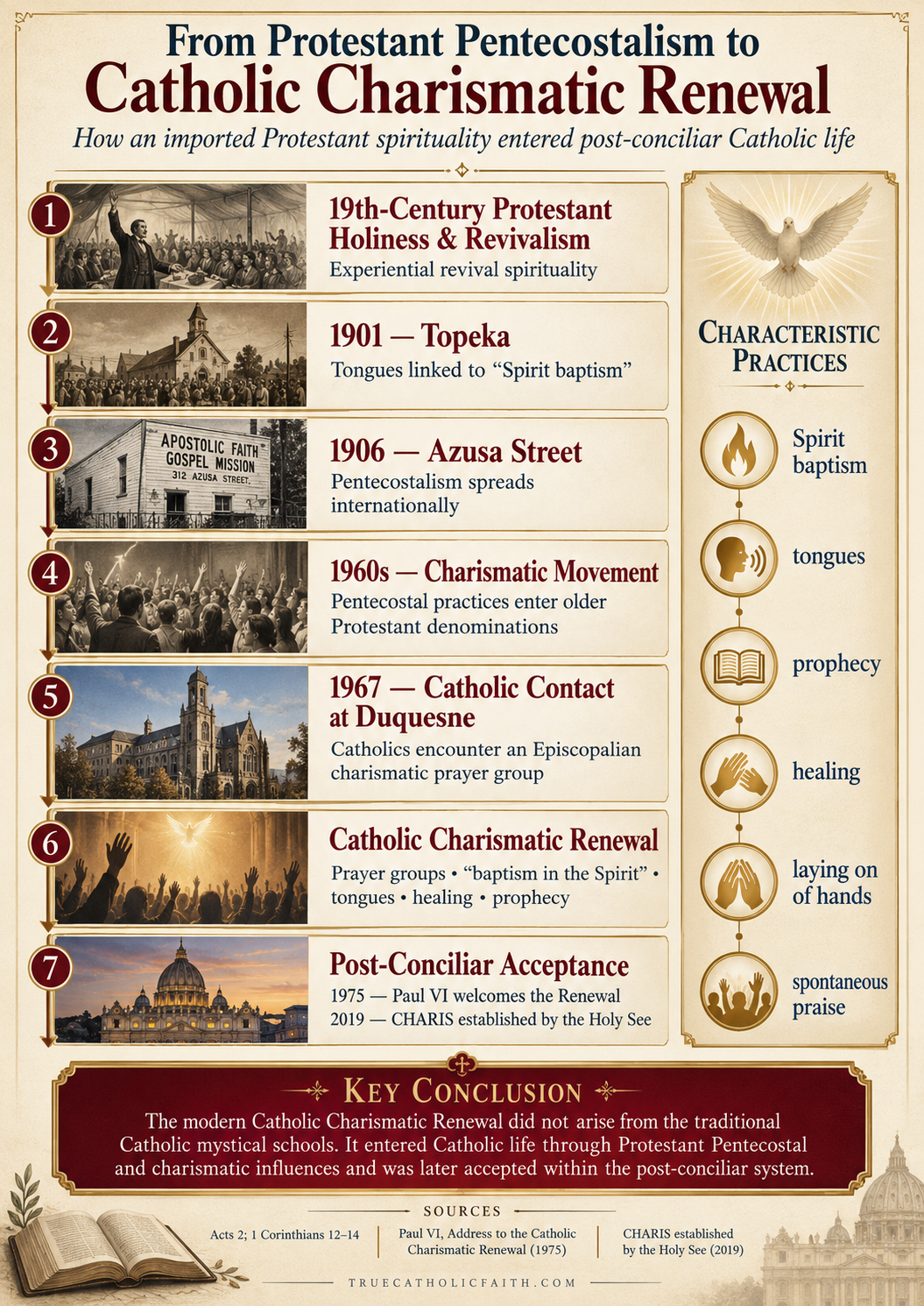
Modern Pentecostalism developed within Protestant revivalism at the beginning of the twentieth century, with particular emphasis upon an experiential “baptism in the Holy Spirit,” speaking in tongues, prophecy, supernatural healing and other manifestations regarded as evidence of the Spirit's activity. The later charismatic movement carried substantially the same religious pattern into older Protestant denominations.
The decisive Catholic development occurred in 1967, only two years after the close of Vatican II. Catholics associated with Duquesne University deliberately entered an existing Protestant charismatic environment. Historical scholarship records that early Catholic participants received what they called “baptism in the Holy Spirit” through contact with an Episcopalian charismatic prayer group. The experience then spread rapidly through Catholic universities and prayer groups.
What began as an imported Protestant spirituality was subsequently received, protected and promoted within the post-conciliar establishment.
Paul VI publicly welcomed the international Catholic Charismatic Renewal in Rome in 1975;
John Paul II praised it in 1981;
and in 2019 the Holy See established CHARIS, the Catholic Charismatic Renewal International Service. CHARIS today identifies spreading “baptism in the Holy Spirit” throughout the Church as one of its principal missions.
The conclusion should therefore be stated plainly.
This is a post-conciliar “spirituality”, not an expression of the traditional Catholic spiritual life.
Catholics seeking to preserve the traditional Faith should avoid the “Charismatic Movement” and its characteristic practices.
That conclusion does not mean that Catholicism denies prophecy, miracles, healing, tongues or other extraordinary gifts. Scripture explicitly teaches that authentic charisms exist, and traditional Catholic theology has always admitted them. Pope Pius XII stated that persons possessing miraculous gifts would never be entirely absent from the Church.
This distinction is essential because the strongest defence of charismatic spirituality comes from Scripture itself.
St Paul tells Christians to desire spiritual gifts;
Joel foretells the outpouring of the Holy Ghost;
Acts records tongues and miracles;
Mark speaks of signs following believers;
and Christ promises that His followers will perform “greater works.”
None of these passages should be avoided or explained away. They must instead be read in their full biblical and traditional Catholic context.
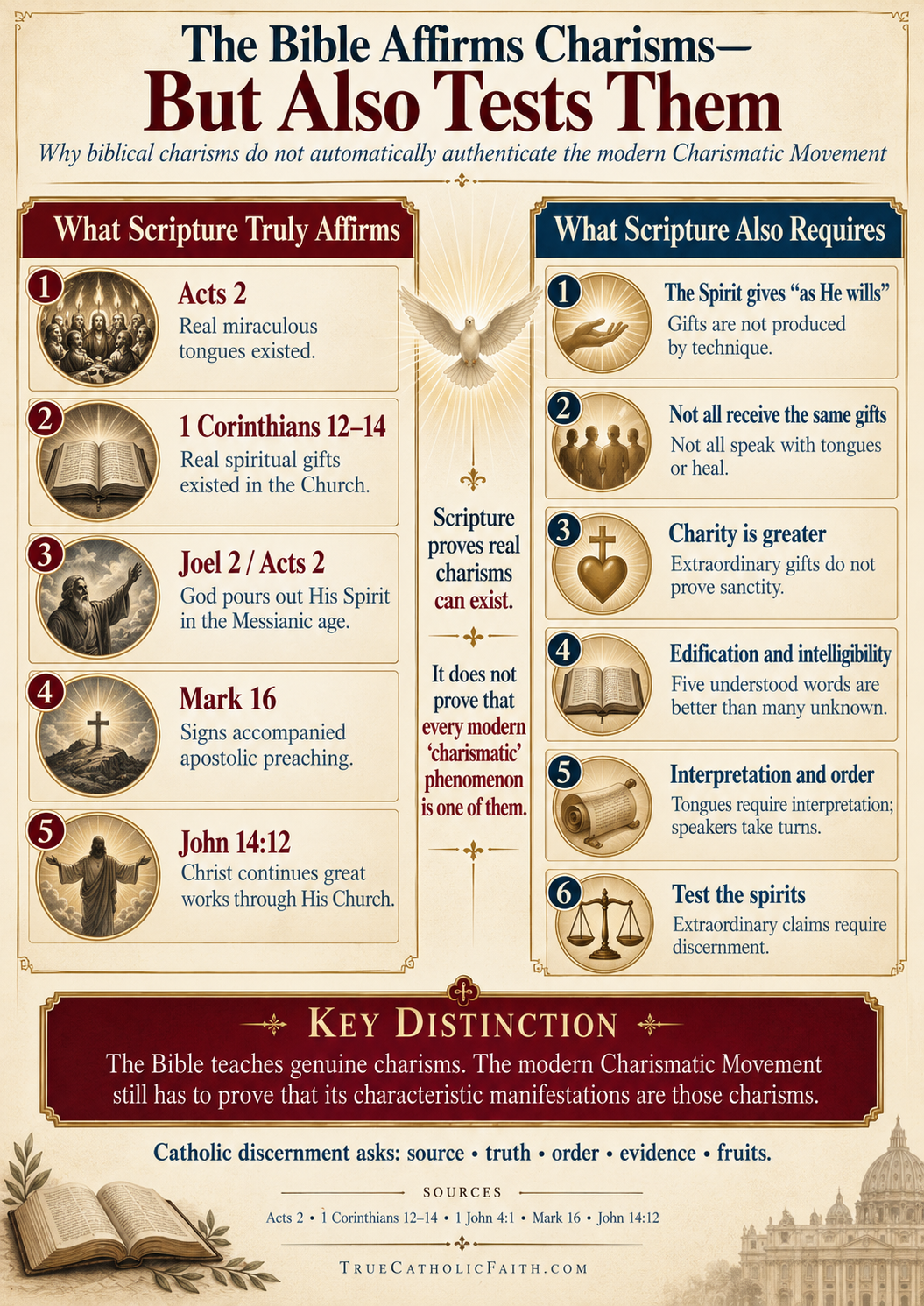
They establish that genuine supernatural charisms exist. They do not establish that the characteristic phenomena cultivated by the modern Pentecostal-Charismatic movement are those charisms. That identification still has to be proved.
The issue is something very different. Traditional Catholic spirituality teaches the Christian
not to seek extraordinary phenomena,
not to regard emotional intensity as evidence of divine action,
not to assume that an interior voice is God,
and not to identify unintelligible vocalisation automatically with the biblical gift of tongues.
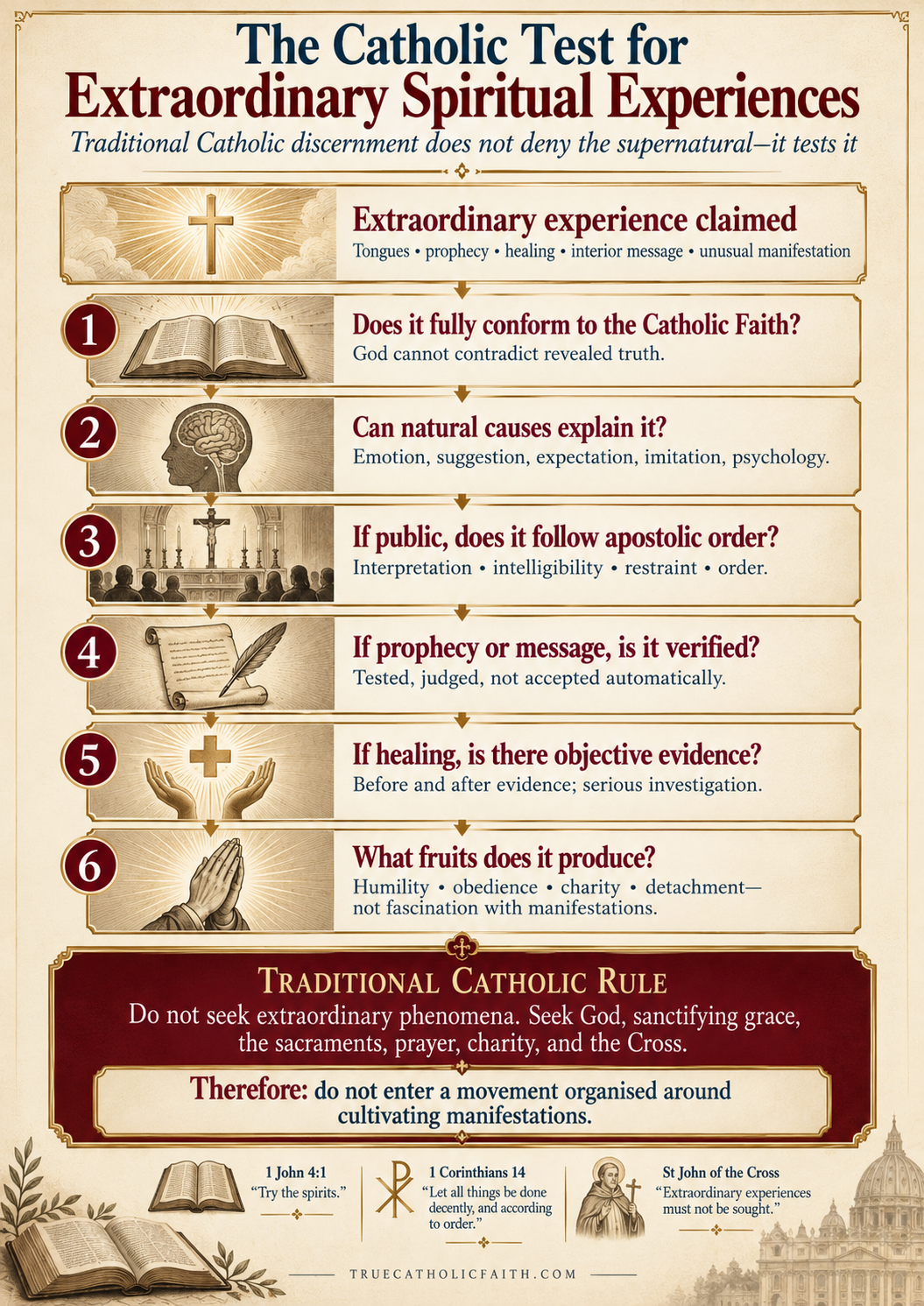
Extraordinary experiences must be judged against
revealed doctrine,
reason,
objective evidence
and the traditional discernment of spirits.
Modern Pentecostal-charismatic spirituality reverses that disposition. It encourages
expectation of extraordinary manifestations,
deliberately prepares people for them,
interprets unusual vocal,
emotional or bodily experiences as signs of the Holy Ghost,
and frequently makes the experience itself a major part of religious identity.
That reversal is spiritually dangerous.
The Catholic response should therefore not be to experiment with charismatic spirituality while hoping to retain only what appears good.
It should be avoided.
Why This Question Matters
The issue is easily misunderstood because two opposite errors must be avoided.
The first is rationalism: the assumption that miracles, prophecy and extraordinary gifts belong only to the apostolic age or that reports of supernatural phenomena should automatically be dismissed. That is not Catholic.
Christianity is supernatural from beginning to end.
Christ worked miracles.
The Apostles healed the sick.
Prophets spoke under divine inspiration.
At Pentecost the Apostles received the miraculous gift of languages.
The lives of the saints contain extraordinary phenomena which the Church sometimes judged credible after severe investigation.
The second error is credulity: the assumption that because supernatural gifts are possible, an unusual experience should therefore be attributed to the Holy Ghost.
Catholicism accepts neither position.
An extraordinary occurrence must be discerned precisely because several causes are possible. Something may truly come from God. It may also arise from imagination, emotion, expectation, suggestion, learned behaviour or other natural psychological causes. Catholic theology also recognises the possibility of preternatural deception.
The experience therefore cannot authenticate itself.
St John gives the governing principle:
“Believe not every spirit, but try the spirits if they be of God.”
The reason follows immediately: false prophets exist.
That principle becomes especially important when religious environments deliberately cultivate extraordinary expectations. If people are repeatedly told to expect tongues, healing, prophecy, interior words, physical sensations or other “manifestations,” ordinary psychological experiences can be interpreted through a supernatural framework before adequate discernment has even begun.
This is why the history of the “Charismatic Renewal” matters. The question is not merely whether some “charismatic Catholics” are sincere. Many undoubtedly are.
The question is whether the system they have entered is
Catholic in origin,
Catholic in method
and consonant with traditional Catholic spiritual theology.
The evidence points strongly in the opposite direction.
What Traditional Catholicism Teaches About Extraordinary Gifts
The traditional Catholic position begins with a fundamental distinction largely lost in popular charismatic spirituality: extraordinary gifts are not the same thing as holiness.
St Thomas Aquinas distinguishes sanctifying grace, which perfects the soul and unites it to God, from the gratiae gratis datae, extraordinary gifts given principally for the spiritual benefit of others. These latter gifts include prophecy, healing, miracles, tongues and interpretation. They may serve the Church and confirm divine truth, but their possession does not itself establish that the person receiving them is holy. St Thomas explicitly judges sanctifying grace to be the greater gift.
That theological hierarchy is crucial. A person could hypothetically possess an extraordinary charism while remaining less holy than an obscure Catholic mother faithfully living in sanctifying grace. A spectacular manifestation therefore cannot be used as a spiritual ranking system. It cannot prove that the recipient possesses superior sanctity, possesses special doctrinal authority or has received a divine mandate to instruct others.
Pius XII sets the same supernatural gifts within the ordered life of the Mystical Body. In Mystici Corporis Christi, he affirms extraordinary gifts while immediately situating Catholic supernatural life within Christ's hierarchical and sacramental Church.
Baptism gives supernatural rebirth;
Confirmation strengthens the faithful;
Penance restores those who fall;
the entire sacramental system communicates the grace of Christ.
Extraordinary gifts may exist, but they do not replace this supernatural order.
Traditional Catholicism therefore never faced a choice between an allegedly dry “institutional religion” and a vibrant experience of the Holy Ghost.
It already possessed both the Holy Ghost and the supernatural life.
It possessed
Baptism and Confirmation,
the Holy Sacrifice of the Mass,
confession,
Holy Communion,
contemplative prayer,
the Rosary,
Eucharistic devotion,
retreats,
penance,
mortification,
spiritual direction,
the religious orders
and the ascetical and mystical theology formed through centuries of Catholic experience.
Catholics did not need twentieth-century Protestant revivalism to discover the Holy Ghost.
Traditional Catholic Mysticism Does Not Teach Souls to Seek Manifestations
This becomes even clearer when the modern “charismatic” method is compared with the great Catholic mystical tradition.
St John of the Cross knew perfectly well that visions, locutions, supernatural knowledge and extraordinary spiritual experiences could occur. He did not therefore instruct Christians to cultivate them. His consistent spiritual direction is toward detachment.
The soul must not build its spiritual life upon extraordinary experiences.
It must not desire them merely because they appear supernatural.
Even phenomena that seem good may be misunderstood, exaggerated by imagination or become occasions of curiosity and pride.
The safer road is supernatural faith, obedience, humility, prayer, mortification and detachment from sensible consolation.
St John therefore directs the soul away from dependence upon visions, revelations, locutions and spiritual feelings and toward the obscurity and certainty of faith. When extraordinary things occur, he advises submission to competent spiritual judgment rather than private confidence in them.
This is almost the opposite of the charismatic mentality.
Traditional Catholic mysticism says:
Do not seek the phenomenon. Do not become attached to it. Do not assume it comes from God. Submit it to judgment. Continue along the ordinary road of faith and holiness.
Modern charismatic spirituality is repeatedly tempted toward:
Expect the manifestation. Ask for it. Prepare for it. Encourage others to experience it. Interpret its occurrence as evidence of the Holy Ghost.
The difference is not cosmetic. It concerns the basic spiritual disposition with which a Christian approaches extraordinary phenomena.
This does not contradict St Paul's instruction to “be zealous for spiritual gifts.”
The Apostle teaches Christians
to desire whatever supernatural gifts God judges useful for the edification of His Church;
he does not teach them to cultivate particular manifestations through technique, expectation or group practice.
The Holy Ghost distributes His gifts “as he will,” and St Paul immediately insists that not all possess the same gifts.
Traditional Catholic spirituality therefore distinguishes a humble desire that God provide whatever graces will serve His glory from a spiritually dangerous appetite for experiences, visions, tongues, revelations or other extraordinary phenomena.
One asks God to give what He wills; the other seeks the experience itself.
Where Did Modern Pentecostalism Come From?
Modern Pentecostalism arose outside the Catholic Church.
Its immediate roots lay in nineteenth-century Protestant Holiness and revivalist movements. Historians ordinarily identify the events at Charles Parham's Bible school in Topeka, Kansas, in 1901 as an important beginning of modern Pentecostalism. Parham connected “baptism in the Holy Spirit” with speaking in tongues as its distinctive evidence. The Azusa Street revival in Los Angeles beginning in 1906, under William Seymour, subsequently became the great international centre from which Pentecostal beliefs and practices spread widely.
The movement emphasised precisely those characteristics that remain familiar today: Spirit baptism as a distinct religious experience, glossolalia, divine healing, prophecy, highly spontaneous worship and the expectation that apostolic supernatural manifestations could be experienced directly by believers.
Pentecostalism was therefore not a Catholic renewal movement. It was a Protestant religious development.
During the twentieth century, however, its characteristic experiences began moving beyond specifically Pentecostal denominations. The resulting “charismatic movement”, sometimes described by scholars as a “second wave” of Pentecostalism, allowed Anglicans, Lutherans, Presbyterians and members of other older denominations to adopt Pentecostal-style spiritual experiences without formally becoming members of Pentecostal churches.
That development is critical to understanding what happened next.
“Charismatic” experience had become trans-denominational. A person could preserve the denominational label while adopting practices derived from Pentecostalism.
It was through this route that the phenomenon entered post-conciliar Catholic life.
1967: Pentecostal Spirituality Enters Catholic Life
The “Catholic Charismatic Renewal” did not arise because Catholic contemplatives independently rediscovered a forgotten teaching of St Teresa of Avila or St John of the Cross. It entered through direct Protestant contact.
Historical research into the movement's origins records that Catholics connected with Duquesne University sought the charismatic experience after exposure to Protestant writings and contacts. In early 1967 Catholic participants attended a charismatic prayer group conducted by Episcopalians, where they received what the group understood as “baptism in the Holy Spirit.” The practice was then transmitted to other Catholics through prayer and the laying on of hands. The famous Duquesne retreat in February 1967 became the symbolic beginning of the Catholic Charismatic Renewal, from which it spread rapidly to Notre Dame, Michigan State and other centres.
The historical sequence therefore does not require polemical reconstruction:
Protestant Holiness revivalism → Pentecostalism → interdenominational charismatic spirituality → direct Protestant-Catholic contact → Catholic Charismatic Renewal in 1967.
That is the genealogy.
It matters because one sometimes encounters the claim that the Renewal was simply the spontaneous reappearance of ancient Catholic charisms after centuries of neglect. The historical evidence is considerably more concrete. The modern Catholic movement was consciously stimulated by an already-existing Protestant religious phenomenon.
The practices arrived first. Catholic theological explanations were subsequently developed around them.
From Imported Practice to Post-Conciliar Institution
It would nevertheless be incomplete to treat 1967 as merely a private experiment by a few lay Catholics. The movement was progressively received into the post-conciliar establishment.
By the early 1970s international “charismatic” conferences were developing. In 1975 Paul VI addressed the Third International Congress of the Catholic Charismatic Renewal in Rome. John Paul II later addressed its international leaders and praised what he regarded as positive fruits while reiterating principles of discernment.
The institutional trajectory continued for decades.
In 2019 a new international structure, CHARIS — Catholic Charismatic Renewal International Service, was established by the Dicastery for Laity, Family and Life. Vatican News explained that it was established at the desire of Francis and was intended to demonstrate that the Renewal belonged fully within the post-conciliar Church.
CHARIS goes considerably further than merely tolerating private charismatic prayer. Its own material identifies sharing “baptism in the Holy Spirit” throughout the Church as a mission of the organisation. It describes this experience as having renewed millions of believers across “almost all Christian Churches,” and its Baptism in the Holy Spirit Commission exists specifically to broaden its dissemination.
The historical development is therefore unmistakable.
What entered Catholic circles from Protestant charismatic meetings in 1967 did not remain a marginal curiosity.
It became an internationally organised, institutionally protected part of the post-conciliar religious landscape.
A Post-Conciliar Spirituality, Not Traditional Catholicism
This distinction should be stated plainly.
The Catholic Charismatic Renewal arose after Vatican II, in the religious environment created immediately after the Council, and was subsequently incorporated into the post-conciliar system. It did not belong to the traditional Catholic spiritual patrimony that existed before the Council.
This does not mean that Vatican II contains a decree ordering Catholics to speak in tongues, hold Pentecostal prayer meetings or seek “baptism in the Spirit.” It does not.
Historical precision actually strengthens the case.
The point is not that the Council directly invented Pentecostalism. The point is that an already-existing Protestant spirituality entered Catholic institutions immediately after the Council and was progressively accepted, theologised, encouraged and institutionalised by the authorities of the post-conciliar religion.
Indeed, Lumen Gentium itself states that extraordinary gifts are not rashly to be sought and that their genuineness must be judged. The later rise of an organised spirituality in which people deliberately seek an identifiable “Spirit baptism” and frequently cultivate tongues and related manifestations therefore cannot simply be justified by pointing to Vatican II's acknowledgment that charisms exist.
Something different occurred. A Protestant experiential system was “Catholicised”.
When its history and characteristic method are compared with the pre-Vatican II Catholic baseline, the conclusion follows: the modern Charismatic Renewal belongs to the post-conciliar Novus Ordo religious system that received and institutionalised it. It is not a spirituality transmitted by traditional Catholicism.
The fact that it now operates in buildings bearing Catholic names does not change its origin.
Institutional adoption does not retroactively create traditional Catholic pedigree.
“Baptism in the Spirit”: What Exactly Is Being Added?
One of the most characteristic ideas of modern charismatic spirituality is “baptism in the Holy Spirit.”
Catholic Charismatics generally deny that this constitutes an eighth sacrament. Various theological explanations instead describe it as an awakening, release, activation or renewed experience of graces already received through sacramental Baptism and Confirmation.
That qualification should be acknowledged. But it does not remove the historical or spiritual difficulty.
The terminology and ritual expectation came through Pentecostalism. Participants commonly prepare for an identifiable experience, receive prayer—often accompanied by the laying on of hands—and expect a new experiential awareness of the Holy Ghost. Tongues, emotional release or other manifestations may accompany the event.
The movement's current international organisation continues to promote precisely this experience. CHARIS states that one of its principal missions is to share baptism in the Holy Spirit throughout the Church.
Traditional Catholic sacramental theology requires no such parallel initiation.
A Catholic receives supernatural regeneration in Baptism.
In Confirmation he receives the sacramental strengthening associated particularly with the Holy Ghost.
St Thomas discusses the apostolic laying on of hands within this sacramental context and relates Confirmation to the strengthening given by the Holy Ghost.
There is nothing wrong with a Catholic undergoing a profound conversion after years of tepidity. God may suddenly awaken a soul to the seriousness of religion. A retreat, sermon, confession or period of suffering may transform a person's spiritual life.
But traditional Catholicism calls that conversion, actual grace, repentance and growth in the supernatural life.
It does not require a Protestant-derived second experiential initiation.
What Was the Biblical Gift of Tongues?
No aspect of charismatic spirituality requires more careful distinction than “tongues”.
Scripture unquestionably teaches a genuine gift of tongues. The clearest biblical example is Pentecost itself. Acts 2 explicitly states that the Apostles spoke in “diverse tongues” and that foreigners from different nations heard them speaking in the languages in which they had been born. The text names the different peoples present and emphasises intelligible communication of “the great works of God.”
This is not meaningless vocalisation. It is miraculous communication.
St Thomas Aquinas understands the apostolic gift in exactly this missionary sense. Since the Apostles were commanded to teach all nations, God supplied them with knowledge of languages they had not naturally learned so that they could preach the Faith without depending upon interpreters.
The gift is therefore ordered toward the hearer and the propagation of divine truth.
That is a very different concept from the widespread modern idea of a private “prayer language” consisting of sounds incomprehensible both to the speaker and ordinarily to everyone else present.
Acts 2 is therefore decisive evidence that a genuine supernatural gift of tongues exists. It does not, however, settle every reference to tongues elsewhere in the New Testament. The most difficult material occurs in 1 Corinthians, and “charismatics” frequently appeal to several additional passages to argue that extraordinary manifestations should remain normal features of their spiritual life. Those objections deserve to be considered directly.
What About 1 Corinthians 14?
The passages concerning tongues at Corinth require more care than Acts 2. Catholic commentators and theologians have not always explained every detail of the phenomenon in exactly the same way, and it would be unwise to pretend that every exegetical question can be settled merely by pointing to Pentecost.
Nevertheless, the practical principles St Paul gives are exceptionally clear.
His overriding concern is the edification of the Church. A spiritual manifestation is not valuable merely because it appears extraordinary. If other Christians cannot understand it and therefore cannot benefit from it, its public usefulness is severely limited. This is why St Paul repeatedly prefers intelligible prophecy to uninterpreted tongues and famously says that he would rather speak five words that others can understand than ten thousand words in a tongue.
If tongues are used publicly, St Paul imposes remarkably definite restrictions. There are to be only two speakers, or at most three. They must speak one after another, not simultaneously. Someone must interpret. If no interpreter is present, the person is to remain silent in the church. Prophetic utterances are likewise to be judged by others rather than accepted simply because somebody claims divine inspiration.
The Apostle then gives two principles particularly important for evaluating modern charismatic phenomena:
“The spirits of the prophets are subject to the prophets.”
and:
“Let all things be done decently, and according to order.”
The first excludes the idea that possession of a genuine charism necessarily overwhelms rational self-government. The prophet remains capable of restraint. The second establishes that confusion and disorder cannot simply be excused by saying that “the Spirit is moving.”
St Paul even anticipates what an outsider might think if an entire congregation were speaking in tongues at once. If unbelievers or uninstructed visitors entered such an assembly, he asks, would they not say that the Christians were mad?
That warning deserves particular attention when modern gatherings contain many people simultaneously producing unintelligible vocalisations without interpretation.
Whatever precise explanation one adopts for every occurrence of “tongues” at Corinth, several facts therefore remain beyond serious dispute: genuine charisms remain subject to reason and self-control; public manifestations must edify the Church; tongues require interpretation; speakers are limited in number and must speak in turn; alleged prophecy is subject to judgment; and disorder cannot be defended merely by invoking the Holy Ghost.
But “charismatics” raise a broader objection. They argue that the New Testament does much more than regulate tongues. It positively tells Christians to desire spiritual gifts, foretells a great outpouring of the Holy Ghost, promises miraculous signs to believers and even records Christ saying that His followers would perform works greater than His own.
Those passages deserve to be examined directly.
But Doesn't the Bible Tell Christians to Seek Charisms?
The strongest biblical defence of the Charismatic Movement should be acknowledged rather than avoided.
Scripture unquestionably teaches that the Holy Ghost can bestow extraordinary gifts.
St Paul tells Christians to be zealous for spiritual gifts.
The prophet Joel foretells that God will pour out His Spirit upon all flesh.
Christ promises signs accompanying believers.
The New Testament records prophecy, miraculous healing, tongues, exorcisms and extraordinary works.
Our Lord even says that those who believe in Him will perform works greater than those performed during His earthly ministry.
None of these passages should be explained away. But neither should they be made to prove something they do not prove.
The question is not whether real charisms exist. Traditional Catholicism has always admitted that they do.
The question is whether the characteristic phenomena of modern Pentecostal and “charismatic religion” are actually those biblical charisms, and whether Scripture instructs Christians to cultivate the modern methods by which such manifestations are sought.
Those are separate propositions.
St Paul Does Tell Christians to Desire Spiritual Gifts
St Paul writes:
“Follow after charity, be zealous for spiritual gifts: but rather that you may prophesy.”
— 1 Corinthians 14:1
A Catholic therefore should not adopt a crude position according to which every desire for a supernatural gift is intrinsically wrong. St Paul plainly teaches Christians to value genuine gifts of the Holy Ghost.
Yet the surrounding chapters immediately determine what he means.
The gifts are bestowed by the Holy Ghost, “dividing to every one according as he will.”
They are gifts precisely because God distributes them sovereignly.
They are not produced by technique, acquired through imitation or guaranteed merely because someone strongly desires a particular manifestation.
St Paul then asks whether all Christians are
apostles,
prophets
or teachers,
whether all work miracles,
whether all possess gifts of healing,
whether all speak with tongues
and whether all interpret.
The structure of his questions plainly requires the answer no.
This alone creates a serious problem for the idea that tongues or some other extraordinary manifestation should be regarded as the normal evidence that every Christian has received a deeper “baptism in the Spirit.”
St Paul also insists upon the purpose of the gifts. They are given for the good of the Church. Immediately after listing spectacular charisms, he promises to show “a more excellent way,” and the following chapter is his great discourse on charity.
A person might speak with the tongues of men and angels, possess prophecy, understand mysteries, have extraordinary faith and perform heroic works; without charity, St Paul says, these things profit him nothing.
The Apostle then returns in chapter 14 to edification.
Prophecy is preferable to uninterpreted tongues because others can understand it.
Five intelligible words capable of instructing another are preferable to ten thousand words in a tongue.
Public manifestations remain subject to interpretation, judgment, restraint and order.
St Paul's instruction therefore cannot reasonably be reduced to:
“Seek extraordinary experiences.”
His complete teaching is far more demanding:
God gives the gifts as He wills; not everyone receives the same gifts; they exist for the benefit of others; they remain subordinate to charity; and their public exercise is governed by intelligibility, discernment, self-control and order.
A Catholic may certainly pray:
“Lord, give me whatever graces and gifts will best serve Your glory and the salvation of souls.”
That leaves everything to God. It is very different from cultivating a particular manifestation:
“I want tongues. I want prophetic words. I want extraordinary experiences. Pray over me until they appear.”
The first attitude submits to divine Providence. The second can easily become spiritual curiosity.
“I Will Pour Out My Spirit Upon All Flesh”
Another favourite “charismatic” text comes from the prophet Joel:
“I will pour out of my Spirit upon all flesh.” — Acts 2:16-21, Joel 2:28–32
The prophecy is unquestionably Messianic. But the New Testament itself identifies its fulfilment.
On Pentecost, when the Apostles receive the Holy Ghost and begin miraculously speaking to people of many nations, St Peter quotes Joel and declares:
“This is that which was spoken of by the prophet Joel.”
The promised outpouring therefore begins at Pentecost.
The phrase “all flesh” cannot mean that every individual Christian will personally receive every extraordinary manifestation. St Paul's teaching makes that interpretation impossible. Not all work miracles. Not all possess gifts of healing. Not all speak in tongues.
Rather,
Joel announces the extraordinary universality of the New Covenant.
The Holy Ghost is no longer manifested principally through a limited prophetic class within Israel.
The supernatural life of the Messianic kingdom is poured out across peoples, nations and conditions: men and women, young and old, servant and free, Jew and Gentile.
The prophecy therefore describes the age of the Church inaugurated at Pentecost.
It cannot simply be taken out of that biblical context and applied as automatic authentication whenever a later movement announces a new “outpouring of the Spirit.”
One must still ask whether the alleged manifestations actually come from Him.
What About the “Tongues of Angels”?
St Paul writes:
“If I speak with the tongues of men, and of angels, and have not charity…” — 1 Corinthians 13:1
This phrase is sometimes presented as proof that Christians may possess a private supernatural language unrelated to any human tongue. But the conclusion does not follow.
The opening verses of 1 Corinthians 13 deliberately employ maximal language.
St Paul speaks not only of tongues of men and angels
but of knowing all mysteries,
possessing all knowledge,
having faith capable of moving mountains
and distributing all one's possessions.
His purpose is rhetorical. Even the most extraordinary conceivable gifts would be worthless without charity.
Traditional commentators therefore allowed “tongues of angels” to be understood as hyperbolic language—the most exalted form of speech imaginable—rather than as a technical description of an audible angelic language that Christians should expect to reproduce.
There is also a basic theological difficulty with the modern interpretation. Angels are pure spirits. They do not naturally communicate by pushing air through lungs, vocal cords, mouths and physical tongues. St Thomas Aquinas treats angelic communication as an intellectual communication between spiritual beings rather than bodily vocalisation.
Consequently, the phrase “tongues of angels” cannot simply be converted into proof that streams of unintelligible syllables produced by human beings constitute a supernatural heavenly language.
Even if someone insisted upon a more literal understanding, St Paul's argument would remain unchanged. His purpose is not to exalt extraordinary speech.
It is to subordinate even the most astonishing conceivable speech to charity.
“These Signs Shall Follow Them That Believe”
Mark 16 contains another important promise. Christ says that signs will accompany believers:
they will cast out devils,
speak with new tongues,
take up serpents,
remain unharmed by deadly poison
and lay hands upon the sick.
These words should not be minimised. But they cannot mean that every individual Christian should ordinarily manifest all or even some of the signs listed. St Paul expressly teaches otherwise.
Not all work miracles.
Not all possess healing.
Not all speak in tongues.
Mark itself also identifies the purpose of the signs. The Apostles go forth preaching everywhere while the Lord works with them and confirms the word by the signs that followed.
The signs therefore serve the divine confirmation of apostolic preaching.
Traditional Catholic interpretation recognised this.
St Gregory the Great explicitly asked whether Christians who did not perform these signs should therefore be considered unbelievers.
He rejected that conclusion and explained that such extraordinary signs had a special necessity while the infant Church was being established.
This does not mean that God subsequently ceased working miracles.
Catholicism has never required such a rigid cessationist theory.
God remains free to work extraordinary signs whenever He wills.
The point is much narrower: Mark 16 does not teach that every Christian should cultivate miraculous manifestations as an ordinary part of religious life.
The reference to serpents makes the distinction especially clear. Acts records St Paul gathering sticks on Malta when a viper fastens itself to his hand. Those watching expect him to swell up or die. Instead, he shakes the creature into the fire and suffers no harm.
That provides a striking fulfilment of Christ's promise.
But Paul did not organise a snake-handling service.
He did not seek out a poisonous serpent to demonstrate his faith.
He did not deliberately expose himself to danger so that God would be forced to perform a miracle.
Divine Providence permitted the danger and God preserved him.
That distinction is essential.
Deliberately drinking poison or provoking a venomous snake in order to demand miraculous protection would risk violating Christ's own command:
“Thou shalt not tempt the Lord thy God.”
Satan himself tried to persuade Christ to throw Himself from the Temple because Scripture promised angelic protection. Christ refused.
There is therefore an enormous difference between
receiving extraordinary divine protection when God permits a danger and
manufacturing a situation in order to produce a sign.
The same principle applies to spiritual manifestations. God may bestow an extraordinary gift. That does not mean man should attempt to manufacture one.
“He That Believeth in Me… Greater Than These Shall He Do”
Christ gives another remarkable promise in John 14:
“He that believeth in me, the works that I do, he also shall do; and greater than these shall he do.” — John 14:12
If interpreted superficially, this would seem to promise that every Christian will physically surpass Christ's miracles.
But Christ raised Lazarus after four days in the tomb.
He raised Jairus's daughter.
He restored sight to the blind.
He multiplied food.
He walked upon the sea.
He commanded storms.
Christian history plainly does not consist of every believer performing physical miracles greater than these. The traditional interpretation is therefore deeper.
St Augustine considered this passage and pointed both to extraordinary apostolic miracles and, more importantly, to the immense supernatural works Christ would continue to accomplish through His believers after His Ascension.
Through the preaching of comparatively weak disciples,
nations would be converted,
sinners justified,
pagans brought into the Church
and the Gospel spread throughout the world.
Christ remains the principal agent.
The immediate context makes this especially clear.
Christ says that believers will perform such works because He goes to the Father, and then promises that whatever is asked in His name, He will do.
The Church's supernatural works remain Christ's works accomplished through His members.
The conversion and justification of a sinner should also not be underestimated because it lacks outward spectacle.
A physical resurrection restores mortal bodily life for a time.
Supernatural justification brings a soul from spiritual death into the life of grace and orders it toward eternal life.
The passage therefore does not promise every future Christian a miracle ministry exceeding the raising of Lazarus.
It announces the astonishing fruit Christ will accomplish through His glorified Church.
“But Jesus and the Apostles Healed, Prophesied and Worked Wonders”
Certainly they did. That proves the existence of genuine supernatural charisms. It does not prove every later claim to them.
The Apostles occupied a unique foundational place in the establishment of the Church. Their miracles accompanied and confirmed their preaching and apostolic authority.
Even then, supernatural healing did not operate as an unrestricted power under human control.
St Paul could work extraordinary miracles, yet Trophimus was left sick at Miletus. Timothy suffered recurring stomach problems and was given ordinary practical advice. Epaphroditus became gravely ill. Paul himself prayed repeatedly for an affliction to be removed and received instead the answer that God's grace was sufficient for him.
A genuine charism therefore never becomes a supernatural machine controlled by its possessor. God remains sovereign.
For this reason, the familiar challenge—
“If charismatic healers really possess the gift of healing, why don't they simply empty the hospitals?”
—contains an understandable intuition but should not be made the principal Catholic argument.
Christian theology does not teach that someone possessing a genuine charism can compel God to heal every sick person presented to him.
The stronger objection is evidentiary:
If repeated supernatural healings are publicly claimed, why should those particular claims not withstand rigorous objective investigation?
Belief in miracles does not require lowered standards of evidence.
If anything, the seriousness of claiming divine intervention demands greater care.
The Crucial Distinction
Once these passages are read together, the biblical question becomes considerably clearer. Scripture establishes beyond dispute that the Holy Ghost can bestow extraordinary gifts. But one crucial logical step remains.
SCRIPTURE TEACHES REAL CHARISMS
does not automatically become:
THEREFORE THESE MODERN CHARISMATIC EXPERIENCES ARE THOSE CHARISMS.
The second proposition still requires proof.
Acts 2 proves that miraculous tongues existed. It does not prove that modern non-semantic vocalisation is the same phenomenon.
St Paul tells Christians to value genuine spiritual gifts.
He also teaches that God distributes them as He wills,
that not everybody possesses them,
that they must serve the Church,
that tongues require interpretation,
that prophecy must be judged,
that speakers remain under rational self-control
and that everything must occur peacefully and in order.
Joel foretells the outpouring of the Holy Ghost.
St Peter identifies Pentecost as the beginning of its fulfilment.
St Mark promises miraculous signs accompanying the believing Church.
St Paul expressly denies that every believer possesses every sign.
Christ promises “greater works.” Traditional Christianity did not understand this as requiring every Christian physically to outperform the raising of Lazarus.
And St Paul's “tongues of angels” cannot simply be converted into proof of a private unintelligible prayer language when his entire argument places even the highest imaginable extraordinary gifts beneath charity.
The Catholic response is therefore neither rationalistic cessationism nor charismatic credulity. It is to affirm without hesitation every genuine supernatural gift God chooses to bestow while refusing to call a phenomenon divine merely because somebody can associate it with a biblical verse.
The Bible proves the reality of charisms.
It does not prove the authenticity of the “Charismatic Movement”.
And Scripture itself commands the next step:
“Try the spirits if they be of God.”
Modern Glossolalia Is Not Proven to Be the Pentecostal Gift
The biblical question and the empirical question must now be kept distinct. Scripture has established that genuine tongues can exist. It has not established that every phenomenon subsequently called “tongues” is therefore supernatural.
The next question is consequently factual:
What is modern glossolalia itself?
Scientific investigation is relevant here not because laboratory research can determine whether God ever bestows supernatural gifts, but because it can establish whether the behaviour commonly presented as miraculous necessarily requires a supernatural explanation.
Modern glossolalia has been studied linguistically, psychologically and neurologically. Researchers generally describe it as speech-like vocalisation consisting of phonetic sequences without the ordinary semantic and grammatical structure of natural human language. It may sound language-like because it draws upon sounds familiar to the speaker, but this is not equivalent to demonstrating that an unknown language is actually being spoken.
More significantly, glossolalia can be learned.
Experimental research has shown that people previously unfamiliar with speaking in tongues can learn to produce fluent glossolalic speech after listening to examples, receiving encouragement and practising the behaviour. In one frequently cited experiment, a substantial majority of trained participants were subsequently judged capable of producing fluent glossolalia.
That finding is extremely important.
It does not prove that every charismatic speaker is consciously pretending.
It establishes something more fundamental:
the behaviour itself does not require a supernatural explanation.
A sincere person may produce glossolalic speech without deliberately fabricating it. Human beings learn patterns of behaviour socially. Expectation, modelling, repetition, encouragement and group reinforcement can produce genuine subjective experiences that the person nevertheless misunderstands.
This is why the origin of the experience cannot be determined simply from the speaker's sincerity. A person may genuinely believe:
“These sounds came from the Holy Ghost.”
But sincerity establishes only that he believes the explanation. It does not establish that the explanation is true.
This distinction becomes particularly important when participants are encouraged to “let go,” begin producing sounds, avoid analysing them and continue until a more fluent vocal pattern develops. If the resulting behaviour can also be acquired through ordinary learning mechanisms, then its appearance cannot by itself demonstrate a miraculous gift.
Nor is modern glossolalia generally equivalent to the clear miracle recorded at Pentecost. Acts 2 describes foreigners recognising their own native languages. The miracle serves intelligible proclamation.
Modern glossolalia normally consists of speech that neither the speaker nor the hearers identify as an unlearned natural language. Where it is claimed instead to be a private heavenly language, that claim requires its own theological justification; it cannot merely be assumed.
The empirical evidence therefore reinforces the theological principle already established.
An unusual experience cannot authenticate itself.
If ordinary human mechanisms are sufficient to account for the observed behaviour, supernatural causation must not simply be presumed.
Is It Hypnosis, Trance or Group Hysteria?
It is tempting to describe every “charismatic” gathering as hypnosis, trance or mass hysteria. Scientific research does not warrant such a universal diagnosis. One psychological study specifically found that experienced glossolalists did not differ significantly from controls in hypnotic susceptibility and concluded against a simple “hyperaroused trance” theory. Its findings instead supported social-learning explanations.
That qualification does not rescue the charismatic claim. It makes the criticism more exact.
One does not need hypnosis to explain how unusual religious behaviour spreads through a group. Expectation, modelling, repetition, encouragement, emotional arousal, imitation, cultural interpretation and social reinforcement are entirely sufficient mechanisms.
A person can be perfectly sincere and still misunderstand what is happening. If someone enters a gathering already believing that the Holy Ghost may cause him to produce unknown syllables, watches respected people do so, is encouraged to “let go,” hears repeated vocal patterns around him and is assured that an emerging stream of sounds represents divine activity, there is no difficulty understanding how similar behaviour might develop without fraud and without miracle.
Calling every case deliberate fakery would therefore miss the more serious problem.
The danger is often not fraud.
It is sincere misattribution.
A naturally acquired behaviour can be sincerely interpreted as a supernatural gift.
Similar Phenomena Occur Among Non-Catholic Sects and Non-Christian Religions
Nor is glossolalia unique to the modern Protestant and post-conciliar charismatic movements that claim the name Christian.
Anthropological research has long documented glossolalia and related ecstatic vocal phenomena in non-Christian religious settings. A classic survey in American Anthropologist examined precisely such occurrences across non-Christian religions.
That does not prove that every instance has the same cause.
It does not prove that every charismatic speaker is possessed, fraudulent or psychologically disturbed.
What it proves is that unintelligible ecstatic vocalisation is not distinctively Catholic evidence of the action of the Holy Ghost and cannot authenticate itself merely because it occurs in a religious setting.
Human beings in very different religious environments can produce analogous phenomena.
Therefore the phenomenon cannot authenticate the religion.
The Catholic must begin somewhere else: revealed truth, objective doctrine and proper discernment.
“The Lord Told Me”: The Danger of Routine Prophecy
The same danger appears with “charismatic prophecy”.
Authentic prophecy is biblical. Catholics cannot reject prophecy simply because it is supernatural.
Yet there is an enormous difference between admitting that God may communicate exceptionally with a soul and creating a religious culture in which people routinely announce that “the Lord is telling me,” “God placed this on my heart,” or “I have a word for you.”
Human beings continuously experience impressions, emotions, memories, intuitions and spontaneous thoughts. If a person has been taught to interpret these interior events as possible divine speech, an ordinary mental impression can acquire extraordinary authority.
The person may become completely sincere in saying, “God told me.”
That sincerity does not make the statement true.
Traditional Catholic spirituality erects barriers against precisely this spiritual presumption. St John of the Cross repeatedly counsels detachment from private supernatural communications. Even an apparently favourable experience must not become the foundation of spiritual certainty.
The “charismatic” environment risks reversing the burden of proof. Instead of extraordinary claims being treated with caution until verified, an interior impression may first be treated as “a word from the Lord” and questioned only afterward.
That is dangerous. God does not become more honoured when our own thoughts are falsely attributed to Him.
Healing: Miracles Are Real, but Healing Services Prove Nothing by Themselves
Christianity cannot deny miraculous healing.
Christ healed the sick.
The Apostles healed.
Catholic history contains remarkable cures associated with saints, shrines, relics and intercession.
The biblical possibility of miraculous healing has therefore already been established. The remaining issue is not whether God can heal miraculously. It is whether a particular claimed healing has actually been shown to be miraculous.
This distinction becomes especially important in environments deliberately organised around expectations of healing. An emotionally powerful meeting may include music, testimony, intense prayer, physical contact, collective expectation and repeated assurances that God is acting. A participant who experiences temporary reduction in pain or a powerful emotional change may sincerely believe that a miracle has occurred.
But feeling different is not the same as possessing evidence of supernatural healing.
Where an objective physical cure is claimed, Catholic prudence demands more. There should ordinarily be reliable evidence of the medical condition beforehand, objective evidence of the recovery afterward, consideration of treatments already received, and reasonable exclusion of misdiagnosis, spontaneous remission, temporary symptom fluctuation and psychological effects.
The Church historically approached alleged miracles with precisely this kind of caution because attributing an event to divine intervention is a serious claim.
Even post-conciliar authorities eventually recognised difficulties created by proliferating healing gatherings. A 2000 instruction on prayers for healing acknowledged that prayer for the sick belongs naturally to Christianity while noting the comparatively recent multiplication of organised meetings at which healings were expected and proclaimed. It imposed restrictions intended to distinguish legitimate prayer from confusion, spectacle and liturgical disorder.
There is another necessary qualification. A genuine charism is never a supernatural power that its possessor controls independently of God.
For that reason, the simplistic challenge—
“If these healers are genuine, why don't they simply empty every hospital?”
—goes somewhat too far.
Christianity does not teach that a miracle worker can compel God to cure everyone on demand. The stronger Catholic challenge is more precise:
If repeated supernatural healings are publicly claimed, why should those particular claims not withstand rigorous objective investigation?
Belief in miracles does not require lowered standards of evidence. If anything, the seriousness of claiming divine intervention requires greater care.
One should therefore distinguish three very different propositions:
God can miraculously heal.
God sometimes has miraculously healed.
This particular person was miraculously healed at this particular charismatic meeting.
The first is Catholic doctrine. The second belongs to Christian history and credible testimony. The third requires evidence.
One cannot move automatically from the first proposition to the third.
Laying on of Hands: Biblical Does Not Automatically Mean Charismatic Practice Is Apostolic
The laying on of hands is thoroughly biblical.
It appears in connection with blessing, healing, sacred ministry and the communication of the Holy Ghost. Traditional Catholic sacramental rites themselves employ the imposition of hands.
The criticism can therefore never be:
Protestants lay hands on people; therefore laying on of hands is Protestant.
The real question is what a gesture means within a particular religious system.
Within “charismatic” practice, lay participants may gather around another person, lay hands upon him or extend their hands toward him, pray for “baptism in the Spirit,” healing, deliverance or another manifestation, and expect a perceptible spiritual result. CHARIS itself discusses the relationship between prayer, laying on of hands and Spirit baptism.
That ritual pattern belongs to the modern Pentecostal-charismatic genealogy.
Taking a gesture that exists in Scripture does not automatically establish continuity with Catholic sacramental theology. Context and theological meaning matter.
Praise-and-Worship Culture and Spontaneous Worship
Praise is Catholic.
Singing is Catholic.
Joy is Catholic.
Spontaneous private prayer is Catholic.
Deep emotion is not a sin.
No intelligent criticism of “charismatic spirituality” should suggest otherwise. The question concerns the construction of an environment in which emotional intensity itself becomes associated with the presence or movement of the Holy Ghost.
Modern “charismatic worship” often combines repetitive contemporary music, spontaneous vocal prayer, testimonies, bodily gestures, expectation of healing, prophecy, tongues and emotionally heightened communal participation. Anthropological research into Catholic Charismatic communities likewise describes religious environments in which glossolalia, prophecy, bodily experience and feeling function together to confirm participants' perception of the Spirit's immediate action.
Human beings are highly responsive to collective environments.
Music can move emotion.
Repetition can intensify absorption.
Crowds can heighten expectation.
Bodily actions influence emotional states.
People unconsciously imitate one another.
None of these things is necessarily sinful. None of them establishes supernatural causation either.
A concert can produce tears.
A political rally can produce intense collective enthusiasm.
A sporting crowd can experience something approaching emotional unity.
Non-Christian rituals can produce ecstasy.
Consequently, religious excitement cannot be treated as evidence that God is unusually present.
Traditional Catholic worship certainly affects emotion, often profoundly. But the objective reality of the Mass does not depend upon whether the congregation feels anything.
The Sacrifice is real even during spiritual dryness.
Grace is real when no emotional excitement occurs.
That is a radically safer foundation for spiritual life.
Liturgical Dance and Bodily Manifestations
“Liturgical dance” and bodily manifestations are not a universal characteristic of every Catholic “charismatic” group.
Nevertheless, dance and other distinctive bodily techniques have been documented within Catholic Charismatic environments. Ethnographic fieldwork in Catholic parishes in Brazil described bodily touch, laying on of hands, dance, glossolalia and “resting in the Spirit” among characteristic practices. Other research likewise identifies songs, bodily gestures and dance as components contributing to charismatic group identity.
The significance is not that movement of the body is inherently wrong. Catholic worship itself contains kneeling, standing, genuflection, processions and other bodily acts.
The difference lies in religious grammar.
Traditional Catholic bodily gestures are largely prescribed by an objective liturgical rite and directed toward realities already defined by Catholic theology.
“Charismatic” bodily expression is characteristically spontaneous, experiential and closely associated with the participant's immediate perception of spiritual activity.
That distinction parallels the broader difference between received Catholic worship and experiential “charismatic worship”.
Centering Prayer and New Age-Type Influences: A Necessary Distinction
Centering prayer, Eastern meditation methods and New Age spirituality should not simply be identified with Pentecostalism. They have different historical genealogies.
Nevertheless, they belong to a broader post-conciliar religious environment in which some Catholics became unusually receptive to spiritual methods developed outside the inherited Catholic ascetical and mystical tradition.
By 1989 the Congregation for the Doctrine of the Faith considered Catholic interest in meditation techniques associated with Eastern religions sufficiently widespread to require a major doctrinal warning. The document noted that some Christians believed their prayer could be enriched by methods previously foreign to Christian tradition and insisted that Christian prayer remain governed by Christian revelation rather than by technique.
Research into particular Catholic charismatic environments has also documented adoption of religious forms resembling New Age patterns, including reinterpretations of interior experiences and “internal locutions.” This does not justify attributing New Age practices indiscriminately to every charismatic Catholic, but it demonstrates that convergence has occurred in identifiable settings.
The underlying dangers can meet at one point.
Pentecostal-”charismatic spirituality” seeks manifestations.
Some Eastern or New Age-influenced methods seek altered consciousness, interior states or experiences produced through technique.
Traditional Catholic mysticism tells the soul something very different:
Seek God, not the experience.
That distinction is fundamental.
The Ecumenical Problem: The Same “Spirit Experience,” Contradictory Religions
Perhaps one of the most serious theological problems with “charismatic” spirituality is its extraordinary ability to cross doctrinal boundaries while leaving the contradictions between those religions substantially untouched.
Pentecostals report “baptism in the Spirit,” tongues, prophecy and healing.
Anglican charismatics report substantially the same phenomena.
Independent evangelicals report them.
So-called Catholic Charismatics report them as well.
The international “charismatic” movement itself treats this trans-denominational reach as something positive: the same alleged “outpouring of the Spirit” is said to occur among Catholics associated with the post-conciliar Charismatic Renewal and among numerous Protestant sects and other religious bodies professing Christianity outside the Catholic Church, despite their fundamentally incompatible doctrines.
The difficulty is deeper than simply saying that Protestants reject Catholic doctrines while Catholic Charismatics accept them.
Some Catholic Charismatics may indeed formally profess transubstantiation, the sacrificial nature of the Mass, sacramental priesthood, confession, Marian dogma and papal authority. Others may hold these doctrines only imperfectly, understand them through a strongly post-conciliar or Protestantised religious vocabulary, or give them far less practical emphasis than traditional Catholic spirituality did. The point, however, does not depend upon judging the orthodoxy of every individual charismatic Catholic.
The more fundamental problem is this:
The charismatic experience appears to function in essentially the same way whether the surrounding community professes traditional Catholic sacramental doctrine, substantially modifies it, or explicitly rejects it.
A traditional Catholic understands the Mass first and objectively as the true propitiatory Sacrifice of Christ made sacramentally present upon the altar.
The priest is not merely the leader or pastor of an assembly but a sacrificing priest marked by the sacrament of Holy Orders.
The Eucharist is not principally a symbol of communal fellowship but the true Body, Blood, Soul and Divinity of Christ under the appearances of bread and wine.
Yet Pentecostal and evangelical communities that explicitly deny the Sacrifice of the Mass, reject transubstantiation and possess no Catholic sacramental priesthood nevertheless report the same “Spirit baptism,” the same tongues, the same prophecies, the same healing experiences and often the same forms of praise-and-worship.
Meanwhile, within post-conciliar Catholic “charismatic” environments, even where traditional doctrines have not been formally denied, the spiritual centre of gravity can shift. The emphasis may move from altar, sacrifice, priesthood, sacrament and objective grace toward assembly, praise, fellowship, personal testimony, spontaneous prayer and immediate religious experience. The priest can increasingly appear primarily as the pastor or facilitator of the community, while the experiential gathering becomes the place in which the participant most strongly expects to “feel” the action of the Holy Ghost.
This does not mean that every “charismatic” Catholic consciously rejects Catholic Eucharistic doctrine. It means something more revealing.
The charismatic system does not require traditional Catholic sacramental doctrine in order to function.
A Protestant who rejects the Mass as a propitiatory Sacrifice can speak in tongues.
A Protestant who denies transubstantiation can receive the same supposed “baptism in the Spirit.”
A minister who possesses no Catholic priesthood can preside over a charismatic gathering in which participants report prophecy, healing and powerful manifestations.
A Catholic “charismatic” may attend essentially the same kind of prayer meeting, experience essentially the same phenomena, and conclude that the Holy Ghost is powerfully present.
The experience therefore seems remarkably indifferent to doctrines that traditional Catholicism regards as divinely revealed and essential.
That creates a major theological problem.
The Holy Ghost is the Spirit of Truth.
He cannot reveal that the Mass is a true propitiatory Sacrifice and simultaneously authenticate a religious system that denies the Sacrifice of the Mass.
He cannot reveal the necessity and reality of sacramental priesthood while equally authenticating communities that reject such a priesthood.
He cannot reveal transubstantiation while treating denial of the Real Presence as spiritually irrelevant.
Of course, God may give actual grace to a Protestant. A Protestant may genuinely be moved to repentance, greater prayer, moral conversion or eventually toward the Catholic Faith. Nothing in Catholic theology requires us to deny this.
But that is entirely different from claiming that the shared charismatic experience itself demonstrates a common supernatural “outpouring” validating the religious lives of contradictory communities.
If the same alleged manifestation of the Holy Ghost operates comfortably in religious systems teaching contradictory doctrines, then the manifestation cannot be used as evidence that those systems—or even the spiritual method producing the manifestation—have been divinely authenticated.
This is precisely where “charismatic ecumenism” becomes dangerous.
The old Catholic approach to Christian division asks:
What has God revealed, and which religion teaches it without contradiction?
Charismatic ecumenism can subtly replace that question with:
Have we experienced the same Spirit?
Once that happens, shared religious experience begins to take precedence over doctrinal unity.
The Catholic may still say that the Eucharist is truly Christ's Body and Blood. The Protestant may still deny it.
The Catholic may still formally speak of sacrifice and priesthood. The Protestant may reject both.
Yet both can stand together, raise their hands, sing the same praise songs, pray over one another, speak in tongues and conclude that the shared experience demonstrates a deeper unity “in the Spirit.”
But genuine unity in the Holy Ghost cannot be built upon contradiction in revealed truth. The Holy Ghost does not unite men by making dogma unimportant. He unites them in truth.
This is why the trans-denominational success of “charismatic spirituality” should not be regarded automatically as evidence in its favour. It may instead expose one of its deepest weaknesses:
its central experiences are sufficiently detached from Catholic doctrine, sacramental theology and ecclesiology that they can be reproduced across communities holding mutually exclusive beliefs about the very religion supposedly being confirmed by those experiences.
The result is an experiential form of ecumenism in which religious feeling can become the common denominator while doctrinal truth recedes into the background. That is not the Catholic conception of Christian unity.
Catholic unity is unity in one Faith, one sacramental religion, one priesthood and one Church.
A common experience cannot substitute for that.
If It Is the Holy Ghost, Where Does It Lead?
This produces an unavoidable question.
If the “charismatic phenomenon” represents a special supernatural intervention by the Holy Ghost, what is the religious direction of that intervention?
The Holy Ghost cannot lead one person to profess the Catholic Faith and another to remain contentedly within a community denying Catholic dogma as though doctrinal truth were secondary.
A true movement of grace may begin anywhere.
But grace is ordered toward truth, repentance, sanctification and ultimately toward God.
Consequently, a trans-denominational spirituality that can be celebrated precisely because Catholics and Protestants share the same experiences without first resolving their contradictory religions should provoke serious caution rather than enthusiasm.
The common denominator has become the experience.
That is the ecumenical power of the “charismatic movement”.
It is also one of its greatest dangers.
The Movement Changes the Standard of Religious Certainty
This brings us to the underlying spiritual transformation. Traditional Catholicism moves from objective revelation toward subjective response.
God reveals.
The Church teaches.
The sacraments objectively confer grace according to Christ's institution.
The Catholic believes, worships, repents, prays and orders his life accordingly.
“Charismatic experientialism” easily reverses that order.
The participant experiences something.
The experience feels powerful.
The experience is interpreted as spiritual.
That interpretation is then allowed to reinforce the belief that God is specially present. The result can become circular:
I know the Holy Ghost acted because I experienced something extraordinary;
I know the experience was extraordinary because it came from the Holy Ghost.
But the premise has never been established. Catholic discernment breaks that circle. The experience proves nothing by itself.
Truth comes first.
“An Evil and Adulterous Generation Seeketh a Sign”
Our Lord's warning concerning the generation that seeks signs must be understood correctly. Christ is obviously not condemning miracles as such. He Himself worked them. The warning is directed against a disordered appetite for supernatural proof and spectacle. That temptation can easily enter religious life.
The Mass seems ordinary.
The Rosary becomes repetitive.
Mental prayer becomes dry.
Confession requires humiliation.
Mortification is unpleasant.
Perseverance is difficult.
Then experiential religion promises something immediately perceptible: an outpouring, a manifestation, an anointing, a word, a healing, a tongue, a physical sensation, a moment of overwhelming emotion. The next powerful experience can become the object of pursuit.
This is precisely where traditional Catholic spirituality becomes indispensable. The saints teach perseverance when there is no consolation. The soul does not abandon prayer because it feels nothing.
It does not doubt the Sacrifice of the Mass because the liturgy does not emotionally excite it.
It does not demand that God prove His presence through bodily sensations.
Faith remains when feeling disappears. That is spiritual maturity.
The constant search for manifestations can instead train the soul to mistake religious excitement for supernatural life.
False Signs and Wonders: Why This Can Become Spiritually Dangerous
Scripture makes the need for discernment even more serious by warning explicitly that extraordinary religious signs can accompany deception.
Christ foretells false prophets who will show great signs and wonders, capable of deceiving, if possible, even the elect.
St Paul likewise warns of “power, and signs, and lying wonders” in connection with religious deception.
These texts do not justify declaring that every charismatic tongue, healing or prophecy is therefore one of the false signs associated with the final deception. That conclusion would go beyond the evidence. But they completely destroy one very dangerous principle:
“If something extraordinary happens in a religious setting, it must come from God.”
Scripture teaches precisely the opposite. An apparently extraordinary sign still requires discernment. This also answers another common response:
“Why would Satan encourage people to praise Jesus, pray or read Scripture?”
Catholic theology never teaches that every deception must consist entirely of obvious evil. A misleading spiritual phenomenon may occur within an environment containing true words, sincere devotion or objectively good actions while still causing confusion about the origin or significance of the extraordinary experience itself.
The relevant question is therefore not simply whether something good occurred somewhere in the surrounding environment. It is whether the claimed supernatural manifestation itself has been established as divine.
Scripture's warnings concerning deceptive signs would make little sense if false religious manifestations were always obviously wicked from the beginning. This is why conditioning people to treat extraordinary experiences as evidence of divine action can become spiritually dangerous.
A person trained to think:
powerful experience → manifestation → Holy Ghost
has acquired precisely the wrong instinct.
The biblical instinct is:
extraordinary claim → discernment → testing → judgment according to revealed truth.
The more impressive a phenomenon appears, the less reason there is to abandon discernment.
There is another danger. Once a person has publicly testified that God gave him a particular experience, psychological commitment can make later questioning difficult. To reconsider the phenomenon may feel like doubting God Himself. The experience becomes spiritually protected from criticism because questioning it is interpreted as “resisting the Holy Ghost.”
That is exactly why the origin must never be assumed at the beginning. The Catholic should be equally afraid of two errors:
falsely attributing a genuine work of God to natural causes;
and falsely attributing a natural or deceptive phenomenon to God.
The second can be exceptionally dangerous because it gives divine authority to something God may never have said or done.
The safest spiritual attitude is therefore not hostility toward the supernatural. It is disciplined supernatural faith.
The Catholic should be prepared to say:
Even if I witness something extraordinary, I will not allow the experience itself to determine my faith. Even if something overwhelms me emotionally, I will not automatically call it divine. Even if an apparent sign occurs, I will test it against revelation, Catholic doctrine, reason and the traditional discernment of spirits.
This is not resisting the Holy Ghost. It is obeying Scripture's command to try the spirits.
The Strongest Objection: “But Look at the Good Fruits”
The strongest defence of the Catholic Charismatic Renewal is usually not historical. Its Protestant genealogy is too well documented. The stronger defence is pastoral.
People say the movement made them pray.
Some returned to confession.
Some began reading Scripture.
Some abandoned serious sin.
Some developed devotion to Christ.
Some became enthusiastic about Catholic life after years of indifference.
Such cases should not be dismissed simply because they complicate the argument.
God can bring good out of defective circumstances.
A Protestant may receive a real grace to repent of adultery without Protestantism thereby becoming the true religion.
A lapsed Catholic may hear a genuine passage of Scripture at a “charismatic” meeting and be moved to confession without the meeting's theology of tongues being true.
Someone may begin praying sincerely because of the Charismatic Renewal while simultaneously acquiring mistaken ideas about supernatural manifestations.
The presence of a good effect therefore does not canonise the entire mechanism surrounding it.
The better question is whether Catholics needed to import Protestant Pentecostal spirituality to obtain those goods.
They did not.
Everything genuinely Catholic and spiritually beneficial that someone seeks through “charismatic religion” already exists more securely within the traditional Catholic supernatural life:
conversion, Scripture, prayer, the sacraments, Eucharistic devotion, examination of conscience, retreats, penance, spiritual direction, devotion to the Sacred Heart, the Rosary, meditation on the Passion, the writings of the saints and serious formation in Catholic doctrine.
Whatever is genuinely good can be retained. The Pentecostal system surrounding it is unnecessary.
Should Catholics Participate in the Charismatic Movement?
No. Catholics wishing to preserve the traditional Faith should avoid the Charismatic Movement and its characteristic spiritual practices.
They should not seek “baptism in the Spirit” as a distinct post-sacramental experience.
They should not attempt to cultivate glossolalia.
They should not enter laying-on-of-hands sessions intended to produce manifestations.
They should not seek private “prophecies,” routine messages supposedly spoken directly by God
or emotionally heightened meetings organised around expectations of extraordinary phenomena.
Nor does the biblical existence of authentic charisms create an obligation to enter a movement organised around seeking them. A Catholic who refuses “charismatic” meetings is not rejecting the Holy Ghost, denying Pentecost or contradicting St Paul.
He is distinguishing between
God's sovereign freedom to bestow extraordinary gifts and
a modern religious system that deliberately cultivates particular experiences and then interprets them through Pentecostal categories.
If God wishes to give a genuine extraordinary grace to a Catholic, He does not require that Catholic first enter a “charismatic” prayer meeting, learn glossolalic behaviour or submit himself to charismatic techniques.
The traditional Catholic spiritual life already provides everything ordinarily necessary for sanctification:
the true Faith;
sanctifying grace;
the sacraments;
the Holy Sacrifice of the Mass;
mental prayer;
the Rosary;
spiritual reading;
penance;
mortification;
devotion to Our Lady and the saints;
works of charity;
fidelity to one's duties;
and perseverance under the Cross.
Nothing necessary is missing. The Catholic therefore loses no supernatural good by refusing “charismatic” experimentation.
What he avoids is
unnecessary exposure to religious suggestion,
psychological misinterpretation,
false prophecy,
spiritual pride,
counterfeit manifestations
and the possibility of deeper spiritual deception.
The movement is particularly dangerous because it can alter the Christian's standard of discernment. Instead of beginning with objective revelation and judging experience by it, a person can gradually learn to begin with the experience and interpret it as revelation.
A powerful sensation becomes “the Spirit.”
An interior thought becomes “a word from the Lord.”
Unintelligible syllables become “tongues.”
Temporary relief becomes “healing.”
Emotional excitement becomes “anointing.”
Once that habit is formed, the experience begins authenticating itself. Traditional Catholic spirituality teaches exactly the opposite.
The experience proves nothing merely because it feels extraordinary. It must be judged.
There is therefore no sound spiritual reason for Catholics to experiment with “charismatic” spirituality while hoping to retain only its supposedly harmless elements.
The prudent course is avoidance.
Do not seek the experience.
Do not cultivate the manifestation.
Do not submit yourself to methods designed to produce it.
Do not enter the movement.
If God wishes to give an extraordinary grace, He is perfectly capable of doing so without Pentecostal techniques.
Remain with the Catholic spiritual tradition.
Why “Just Keep the Good Parts” Is Not a Safe Answer
Some may object that Catholics could simply attend “charismatic” gatherings while retaining traditional doctrine and rejecting anything excessive. The difficulty is that “charismatic spirituality” is not merely a neutral collection of songs and enthusiastic people.
Its method forms habits.
The repeated association of emotional intensity with divine presence forms one habit.
Expecting interior impressions and calling them “words” forms another.
Speaking unintelligible sounds and calling them supernatural prayer forms another.
Seeking bodily sensations during prayer forms another.
Watching other participants undergo manifestations and learning to interpret them as divine forms another.
The danger is cumulative. One begins not merely performing different devotional exercises but learning a different way of deciding what counts as spiritual evidence.
Traditional Catholic formation teaches:
Objective Faith → sacramental grace → prayer and virtue → cautious discernment of exceptional phenomena.
Charismatic formation can easily become:
Experience → interpretation as divine action → increased confidence in the experience → further pursuit of manifestations.
The difference reaches deeper than aesthetics. It concerns epistemology—the way a person thinks he knows that God is acting.
The Movement Belongs to the Wider Post-Conciliar Transformation
The Charismatic Renewal should therefore be understood within the broader post-Vatican II crisis rather than treated as an isolated curiosity.
After the Council, Catholics witnessed major transformations in worship, devotional life, ecumenical practice, religious identity and attitudes toward Protestant communities. Into that environment came a spirituality already flourishing among Protestants and built explicitly around trans-denominational religious experience.
Rather than being rejected as foreign to Catholic formation, it was gradually absorbed.
Its terminology was Catholicised.
Its practices spread through parishes and communities.
Its international structures gained Roman recognition.
Its “baptism in the Spirit” is now promoted through a body established by the post-conciliar Holy See itself.
This is exactly why calling the phenomenon merely an unfortunate “abuse” is insufficient. The central practices are not simply clandestine activities condemned by the post-conciliar establishment. The Renewal itself has been officially accepted.
That fact connects the issue to the wider examination of Vatican II and the postconciliar religion.
The question is no longer simply:
Are some Catholics behaving too enthusiastically?
It becomes:
How did an explicitly Protestant Pentecostal spirituality become accepted as a legitimate current of “spiritual renewal” within institutions claiming to preserve the Catholic religion?
That is a much more serious question.
What We Can and Cannot Conclude
What We Can Conclude
The historical genealogy can be established with considerable certainty.
Modern Pentecostalism arose within Protestantism.
The interdenominational “charismatic” movement transmitted substantially Pentecostal experiences into older denominations.
The Catholic Charismatic Renewal arose in 1967 through direct interaction with Protestant charismatics and then spread throughout the post-conciliar Catholic world.
It can likewise be established that the post-conciliar authorities progressively welcomed and institutionalised the movement rather than excluding it. The creation of CHARIS in 2019 provides especially clear evidence that “charismatic spirituality” is not merely a tolerated grassroots anomaly within the Novus Ordo system.
Scripture unquestionably recognises authentic supernatural gifts, so it would be false to argue that every claim to prophecy, healing or tongues must be rejected simply because such phenomena are extraordinary.
It can also be established that the clearest biblical instance of tongues, Acts 2, concerns miraculous intelligible languages;
that St Thomas understands the apostolic gift in relation to missionary preaching;
and that St Paul subjects public charismatic phenomena to interpretation, judgment, restraint and order.
Modern glossolalia, meanwhile, can be acquired through learning and modelling and commonly lacks recognisable semantic content. Its occurrence therefore cannot establish supernatural origin.
Traditional Catholic mystical theology teaches detachment and severe discernment regarding extraordinary experiences rather than their deliberate cultivation.
Taken cumulatively, these facts warrant a firm practical judgment:
Catholics should avoid “charismatic spirituality”.
What We Cannot Conclude
It would go beyond the evidence to claim that every charismatic participant is deliberately pretending, mentally ill or consciously deceptive.
It would likewise be unjustified to diagnose every charismatic gathering as literal hypnosis or clinical mass hysteria. Natural social-learning and suggestive mechanisms are sufficient to explain much behaviour without making such sweeping diagnoses.
Nor can one declare without evidence that every alleged charismatic healing is fraudulent, every interior impression demonic or every unusual occurrence natural. Individual supernatural claims require individual investigation.
Similarly, centering prayer, New Age spirituality and Pentecostalism have distinct historical origins and should not be falsely collapsed into one movement merely because experiential tendencies sometimes converge.
These qualifications do not weaken the conclusion. They remove unnecessary exaggerations and leave the central case stronger.
Conclusion
Protestant Pentecostal and “charismatic” influences unquestionably entered post-conciliar Catholic life. The historical sequence is unusually clear.
Modern Pentecostalism arose outside the Catholic Church.
Its distinctive religious system emphasised “Spirit baptism,” tongues, healing, prophecy and extraordinary manifestations.
Those practices later entered older Protestant denominations through the “charismatic” movement and then crossed directly into Catholic circles in 1967 through Protestant charismatic contacts.
Over subsequent decades, what began as an imported Protestant religious phenomenon moved from experimentation to acceptance and eventually institutionalisation within the post-conciliar establishment.
That history alone does not prove that every individual charismatic experience is false. But it establishes something important: the modern “Catholic Charismatic Renewal” did not arise from the traditional Catholic schools of spirituality.
Nothing in this conclusion requires denying a single biblical text concerning authentic charisms.
Pentecost remains true.
Joel's prophecy remains true.
St Paul's spiritual gifts remain true.
Miraculous healing remains possible.
Christ's promises concerning signs and the works of His Church remain true.
What has been rejected is a different proposition:
that because Scripture records genuine supernatural gifts, the modern Pentecostal-Charismatic system is therefore entitled to identify its characteristic manifestations with them.
That conclusion does not follow.
The Bible establishes the possibility and reality of charisms. The Charismatic Movement still has to establish that its phenomena are those charisms.
When modern glossolalia can be socially learned,
when analogous vocal phenomena occur outside Christianity,
when the same “charismatic” experiences flourish among mutually contradictory non-Catholic assemblies,
when common practices differ significantly from the apostolic regulations given by St Paul,
and when the modern movement itself arose historically from Protestant Pentecostalism rather than traditional Catholic mystical formation,
merely quoting biblical passages about genuine charisms does not settle the question.
It makes rigorous discernment more necessary. The Catholic mystical tradition recognises extraordinary gifts while warning souls against fascination with them.
“Charismatic spirituality” deliberately seeks an identifiable “baptism in the Spirit” and frequently prepares participants to expect manifestations.
Traditional Catholic spirituality treats extraordinary phenomena as exceptional and teaches detachment from them.
“Charismatic religion” risks making them a prominent part of ordinary spiritual life.
Catholic discernment begins with revealed truth and judges experience according to it.
Experiential religion constantly risks reversing that order and allowing the experience itself to become evidence that God is acting. The contrast becomes particularly striking in the case of tongues.
At Pentecost, foreigners recognise their own languages and understand the proclamation of God's works.
St Paul requires interpretation, limited speakers, turn-taking, judgment, self-control and order.
Modern “charismatic” gatherings may instead contain many people simultaneously producing unintelligible vocalisations without interpretation, while the very unintelligibility is treated as evidence of supernatural prayer. These are not insignificant differences. Nor does the ecumenical portability of charismatic experience solve the problem.
Pentecostal Protestants “speak in tongues”.
Anglicans “speak in tongues”.
Independent evangelicals “speak in tongues”.
So-called “Catholic Charismatics” “speak in tongues”.
Yet these communities continue to contradict one another concerning the Mass, the Eucharist, priesthood, confession, papal authority, Our Lady, justification and other matters regarded by Catholics as revealed truth. The Holy Ghost cannot reveal a proposition and its contradiction as simultaneously true. Consequently, the common experience cannot itself prove divine authentication of the religious system in which it occurs.
The same principle applies to prophecy, healing and other manifestations. God may genuinely work an extraordinary miracle. But the possibility of the authentic makes careful discernment more important, not less.
Scripture itself warns that signs can deceive.
Christ warns of false wonders.
St John commands Christians to test the spirits.
St Paul requires prophecy to be judged.
St John of the Cross warns against attachment to extraordinary communications.
Traditional Catholic theology places sanctifying grace and charity above spectacular gifts. The resulting spiritual principle is coherent from beginning to end:
Seek God, not manifestations. Catholics do not need Protestant Pentecostal methods to obtain the Holy Ghost. They receive supernatural life through the means Christ established.
They do not need a modern “Spirit baptism” to complete sacramental Baptism and Confirmation.
They do not need unintelligible syllables to prove that God hears them.
They do not need emotional excitement to prove that grace is present.
They do not need private prophecies to know what God has revealed.
They do not need extraordinary manifestations to trust Christ.
And they should never be trained to believe that something comes from God merely because it feels supernatural.
What entered post-conciliar Catholic life after 1967 was not a rediscovery of the traditional Catholic mystical schools. It was an imported Protestant Pentecostal spirituality that the post-conciliar Novus Ordo establishment subsequently absorbed, encouraged and institutionalised.
For Catholics seeking to preserve the traditional Faith and spiritual life, the practical conclusion should therefore be unequivocal:
Avoid it.
Not because God cannot work miracles. Not because the Holy Ghost cannot bestow extraordinary gifts. Not because Catholic religion should be cold or merely intellectual.
Avoid it because
spiritual phenomena are too serious to be cultivated experimentally;
natural suggestion and learned behaviour can imitate allegedly supernatural manifestations;
extraordinary experiences can be sincerely misinterpreted; because similar phenomena occur in contradictory religions;
Scripture warns that signs can deceive;
and because the Catholic spiritual tradition teaches detachment and discernment rather than manifestation-seeking.
The Holy Ghost does not need Pentecostal techniques to sanctify Catholics. If He chooses to give an extraordinary gift, He gives it according to His will. The Catholic's task is not to manufacture it. His task is to remain faithful.
Keep the Faith. Remain in sanctifying grace. Receive the sacraments. Pray. Do penance. Practise charity. Carry the Cross. Test extraordinary claims severely—and do not seek them.
That is not a rejection of the supernatural. It is the traditional Catholic approach to it.
Primary Sources
Holy Scripture — Acts 2; 1 Corinthians 12–14; 1 John 4:1; Matthew 12:38–40; Matthew 24:24; 2 Thessalonians 2:9–15. Acts establishes the Pentecostal miracle of languages; St Paul establishes the reality and regulation of charisms; St John commands discernment; Christ and St Paul warn that extraordinary-looking signs do not necessarily authenticate their source.
St Thomas Aquinas, Summa Theologiae, I–II, q.111; II–II, qq.176–178. These questions provide the classical theological framework for gratuitously given graces, the gift of languages and miracles, while preserving the superiority of sanctifying grace and the ordering of extraordinary gifts toward the benefit of others.
St John of the Cross, The Ascent of Mount Carmel, especially Book II. Essential traditional Catholic treatment of visions, revelations, locutions and other extraordinary spiritual phenomena, together with the need for detachment and submission to spiritual judgment.
Pope Pius XII, Mystici Corporis Christi (1943). Establishes the supernatural, hierarchical and sacramental life of Christ's Mystical Body while expressly acknowledging that miraculous gifts can exist in the Church.
Second Vatican Council, Lumen Gentium 12 (1964). Relevant because even the Council's own treatment of charisms states that extraordinary gifts are not rashly to be sought and require judgment as to their genuineness and proper use.
Congregation for the Doctrine of the Faith, Instruction on Prayers for Healing (2000). Particularly useful because it acknowledges the novelty of proliferating organised healing meetings and insists upon ecclesiastical regulation and discernment.
Congregation for the Doctrine of the Faith, Orationis Formas — On Some Aspects of Christian Meditation (1989). Relevant to the wider post-conciliar adoption of spiritual techniques drawn from non-Christian traditions and to the distinction between Christian prayer and experience-producing methods.
Further Reading
The historical development of modern Pentecostalism can be studied through serious histories tracing the movement from nineteenth-century Holiness revivalism through Topeka and Azusa Street. Modern historical scholarship on the Catholic Charismatic Renewal is especially useful because it documents rather than merely alleges the direct Protestant contacts involved in the 1967 beginnings.
For modern glossolalia, linguistic and psychological studies are particularly important because they separate theological claims from observable behaviour. Experimental work demonstrates that fluent glossolalia can be acquired through modelling and encouragement, while subsequent linguistic and neurological research describes its non-semantic character and learned structure.
For the Catholic spiritual response, St John of the Cross should be read substantially rather than through isolated quotations. His entire method of spiritual formation illustrates how far traditional Catholic mysticism stands from a spirituality organised around the deliberate pursuit of manifestations.
Related Questions
What Was Catholic Spirituality Like Before Vatican II?
Did Vatican II Change Catholic Spirituality?
What Is Modernism and Why Did the Church Condemn It?
Did Protestant Ideas Enter the Post-Conciliar Church?
Did the New Mass Change the Catholic Understanding of Worship?
How Should Catholics Judge Private Revelations and Apparitions?
Did Vatican II Produce a New Religion?