Why Do Catholics Confess Their Sins to a Priest?
Short Answer
Catholics confess their sins to a priest because Jesus Christ Himself established a sacrament in which His ministers would forgive or retain sins in His name. On the evening of His Resurrection, Our Lord appeared to the Apostles, breathed upon them, and said:
“Receive ye the Holy Ghost. Whose sins you shall forgive, they are forgiven them: and whose sins you shall retain, they are retained.” — John 20:22–23
Only God can forgive sin by His own authority. The Catholic priest does not compete with God, replace God, or forgive sins by a power belonging naturally to himself. He acts as Christ’s ordained minister, exercising a power Christ entrusted to His Church. The Council of Trent therefore taught that priestly absolution is not merely an announcement that God has already forgiven the sinner; it is a true sacramental and judicial act by which the priest, acting as Christ’s minister, absolves the properly disposed penitent.
For a valid and fruitful confession, the sinner must:
have contrition,
confess the sins that must be confessed,
intend to amend his life,
receive absolution, and
perform the satisfaction or penance imposed.
Mortal and venial sins must also be distinguished.
Mortal sin destroys sanctifying grace and must ordinarily be submitted to the Sacrament of Penance after Baptism;
venial sin does not destroy sanctifying grace and need not be individually confessed, although its confession is highly profitable.
Confession, therefore, is not a Catholic substitute for going directly to God. The penitent does turn directly to God in sorrow, prayer and repentance. But he also submits to the sacramental means established by Christ for reconciling baptized sinners to Himself.
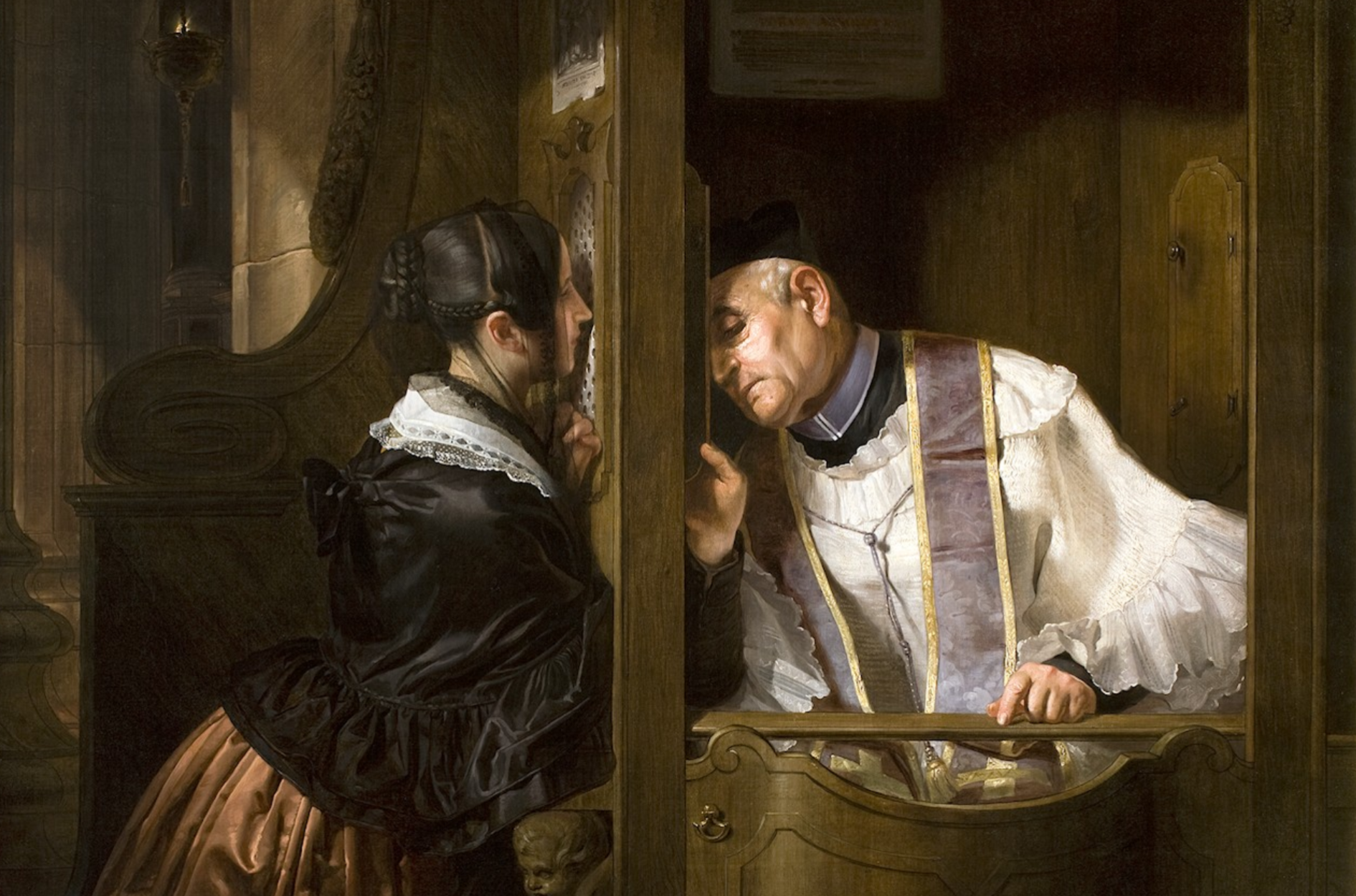
Giuseppe Molteni, The Confession (1838). A penitent kneels before a priest in the sacrament of Penance, illustrating the Catholic practice of confessing sins to Christ’s minister in order to receive sacramental absolution and reconciliation with God.
Why This Question Matters
Many Christians readily agree that sins must be confessed to God. The point of disagreement is whether Christ also established an ecclesiastical and sacramental means of reconciliation in which sins are confessed to an authorised minister who then grants or withholds absolution.
The answer affects much more than a devotional practice. It concerns the authority Christ gave His Apostles, the nature of the priesthood, the difference between mortal and venial sin, the restoration of sanctifying grace after grave sin, and the means by which a Christian prepares for a holy death.
It also prevents two opposite errors.
The first is to imagine that a priest forgives sins by his own independent power. He does not.
The second is to imagine that because God alone is the ultimate author of forgiveness, He cannot choose to dispense that forgiveness through human ministers. But Scripture repeatedly shows God using created instruments to communicate divine gifts. Baptism uses water; preaching uses human voices; Holy Orders uses the laying on of hands. In the Sacrament of Penance, Christ uses the ministry of the priest.
What the Catholic Church Teaches
Sacred Scripture
The principal text is John 20:21–23. The setting is important. Christ has risen from the dead. He appears to the Apostles and first says:
“As the Father hath sent me, I also send you.” See John 20:21–23.
He then breathes upon them, gives them the Holy Ghost, and grants the power to forgive and retain sins.
These are stronger words than a command merely to preach forgiveness. Christ does not simply say, “Tell sinners that God forgives those who believe.” He gives His ministers a twofold authority: sins may be forgiven, or sins may be retained.
That distinction is crucial. If the minister is to make a genuine judgment between forgiving and retaining, there must ordinarily be some means by which the moral condition of the penitent becomes known. This is why the Church has always understood sacramental confession as having a judicial character: the priest must know what he is absolving.
Christ had already used similar juridical language when He promised the Apostles the authority of binding and loosing:
“Whatsoever you shall bind upon earth, shall be bound also in heaven; and whatsoever you shall loose upon earth, shall be loosed also in heaven.” — Matthew 18:18
St Paul likewise speaks of an apostolic “ministry of reconciliation” and says that Christ’s ministers act as His ambassadors:
“God… hath reconciled us to himself by Christ; and hath given to us the ministry of reconciliation.” — 2 Corinthians 5:18–20
St James also places forgiveness of sins within the ministry of the Church. Immediately after directing the sick man to summon “the priests of the Church,” he speaks of sins being forgiven and then commands Christians to confess their sins.
James 5:14–16 is not by itself a complete description of sacramental confession, but it fits naturally within the wider New Testament picture of an ecclesiastical ministry concerned with reconciliation and forgiveness. See James 5:14–16.
Taken together, these passages show something more substantial than Christians merely encouraging one another to believe that God is merciful. Christ entrusts real ministerial authority to His Church.
Biblical Foreshadowing and Fulfilment
The Old Testament did not possess the Sacrament of Penance instituted by Christ. Nevertheless, it contained shadows and preparations for the fuller New Covenant reality.
Under the Mosaic Law, acknowledgement of sin was joined to acts of penance, restitution, priestly ministry and sacrificial expiation. In Numbers 5:6–8, the sinner is commanded to confess the sin and make restitution. In Leviticus 5, the sinner does penance and brings an offering to the priest, who performs the prescribed priestly action on his behalf.
These rites did not possess the efficacy of the Christian sacrament. The Epistle to the Hebrews expressly teaches that the sacrifices of the Old Law were shadows and that the blood of animals could not itself take away sins. Their fulfilment is found in the one perfect sacrifice of Jesus Christ.
The progression may therefore be expressed cautiously:
| Type or Shadow | Old Testament Reality | Greater Fulfilment in Christ |
|---|---|---|
| Acknowledgement of sin | The sinner acknowledges his guilt before God | The baptized sinner sacramentally confesses grave sins |
| Priestly involvement | The priest ministers in rites connected with atonement and purification | Christ gives His priests authority to forgive or retain sins |
| Restitution and penance | The sinner repairs harm and performs prescribed acts | The penitent performs satisfaction and repairs injustice |
| Animal sacrifice | A temporary ceremonial shadow unable of itself to remove sin | Christ’s one sacrifice supplies the grace applied through the Sacrament of Penance |
| External purification | Levitical priests judged ritual cleanness | Christian priests receive authority concerning spiritual reconciliation |
The important principle is shadow → greater fulfilment. The New Covenant does not merely repeat the Mosaic system. Christ establishes something greater: the saving fruits of His Passion are sacramentally applied to the sinner.
St John Chrysostom would later make precisely this contrast. The Jewish priest could examine bodily uncleanness; the Christian priest, he says, has authority concerning the spiritual uncleanness of sin.
The Early Church Fathers
The Sacrament of Penance did not suddenly appear in the Middle Ages. The form of ecclesiastical penance developed over time — particularly the movement from severe public penitential discipline toward the widespread use of private sacramental confession — but the underlying conviction that the Church possessed a real ministry of reconciliation is found centuries earlier.
St Cyprian of Carthage (c. AD 200–258), writing in On the Lapsed in AD 251, urged Christians guilty of grave sin to confess while they were still alive and while “the satisfaction and remission made by the priests” could be received. His immediate context concerned Christians who had denied the Faith during persecution, but his language clearly presupposes confession, priestly reconciliation and satisfaction. On the Lapsed, 29.
St Ambrose of Milan (c. AD 340–397), in On Repentance, Book I, chapter 2, written in the fourth century against the Novatians, expressly connects John 20:22–23 with priestly authority. He argues that the Church possesses the power of forgiveness because Christ entrusted it to His ministers and says that this power belongs to the priestly office.
St John Chrysostom (c. AD 347–407), in On the Priesthood, Book III, 5–6, speaks of the extraordinary authority entrusted to priests and quotes both Matthew 18:18 and John 20:23. His point is not that priests possess an independent divine power, but that God ratifies the ministerial judgment exercised through the authority Christ gave them.
These witnesses come from different parts of the ancient Church — North Africa, Milan and the Greek East. They do not prove that every disciplinary detail of later private confession already existed everywhere in identical form. They do show that priestly reconciliation of sinners was not an invention of the thirteenth century.
The Council of Trent
The most complete pre–Vatican II dogmatic exposition is found in the Council of Trent, Fourteenth Session, 25 November 1551, Doctrine on the Sacrament of Penance.
Trent teaches that Christ instituted the sacrament especially when, after His Resurrection, He breathed upon the Apostles and gave them authority to forgive and retain sins. The sacrament applies the saving benefit of Christ’s death to those who fall into sin after Baptism.
The Council identifies the three acts of the penitent as:
contrition;
confession;
satisfaction.
The sacramental form in which the efficacy chiefly consists is the priestly absolution, traditionally expressed by the words “I absolve thee.” The fruit of the sacrament is reconciliation with God and, in the properly disposed penitent, peace of conscience.
Trent therefore gives us the complete structure:
sin → contrition → confession → priestly absolution → satisfaction → reconciliation and amendment of life
Mortal Sin and Venial Sin
The distinction between mortal and venial sin is essential for understanding why confession is necessary.
A mortal sin is a grave violation of the law of God committed with sufficient knowledge and deliberate consent. Traditional catechisms commonly summarise the three requirements as grave matter, sufficient reflection and full consent of the will. Mortal sin is called “mortal” because it destroys the supernatural life of sanctifying grace in the soul.
A venial sin is a lesser offence, or a grave matter committed without the knowledge or consent required for mortal guilt. Venial sin wounds the soul and weakens charity but does not deprive the soul of sanctifying grace.
This distinction directly affects sacramental confession.
The Council of Trent teaches that all remembered mortal sins committed after Baptism and not yet directly remitted through the keys of the Church must be confessed after diligent examination. Venial sins, although profitably confessed, do not have to be individually submitted to sacramental confession.
The 1917 Code of Canon Law, canon 901, likewise required confession of all post-baptismal mortal sins not yet directly remitted through the power of the keys, insofar as they were remembered after diligent examination. Canon 902 states that previously absolved mortal sins and venial sins are sufficient but not necessary matter for confession.
This distinction protects Catholics from two errors: treating every imperfection as though it destroyed grace, and treating grave sin as though it had no serious consequence for the supernatural life of the soul.

Bartolomé Esteban Murillo, The Return of the Prodigal Son (1667–1670). The repentant son is received with mercy by his father, a powerful image of conversion, contrition and reconciliation that beautifully illustrates the spiritual reality signified and restored in the Sacrament of Penance.
The Essential Parts of a Good Confession
Contrition
Contrition is sorrow for sin together with detestation of the sin committed and a purpose of not sinning again.
Trent calls it the first of the acts of the penitent. True contrition is not merely fear of embarrassment, dislike of consequences or regret at having been caught. It is supernatural sorrow directed toward sin precisely as an offence against God.
Traditional theology distinguishes perfect contrition from imperfect contrition, or attrition.
Perfect contrition arises principally from love of God above all things. Trent teaches that perfect contrition can reconcile a sinner to God before actual reception of the sacrament, but never apart from at least the desire to receive the sacrament. Thus perfect contrition does not make confession unnecessary; it includes the intention to confess.
Imperfect contrition may arise from the ugliness of sin or fear of divine punishment. When supernatural, joined to hope of pardon, rejection of the sinful will and reception of the sacrament, it disposes the sinner to receive justification through sacramental absolution.
The Catechism of St Pius X expresses the same doctrine: contrition is indispensable, and perfect contrition includes at least the implicit intention of going to confession.
Confession
Confession is the sincere accusation of one’s sins to the authorised priest in order to obtain sacramental absolution.
For mortal sins, the confession must be integral insofar as reasonably possible. The penitent should confess all mortal sins remembered after diligent examination, together with their number as accurately as can honestly be recalled and circumstances that change the moral species of the sin.
This does not mean that a forgotten mortal sin makes an otherwise sincere confession invalid. Trent expressly teaches that sins genuinely forgotten after diligent examination are understood as included in the confession. If a previously forgotten mortal sin later returns to memory, it should be mentioned in a subsequent confession.
Deliberately concealing a known mortal sin is different. The penitent is then withholding from the sacramental judgment precisely what he knows must be submitted to it.
Confession should therefore be honest and complete without becoming an exercise in scrupulous reconstruction of every trivial detail.
Absolution
Absolution is the sacramental sentence by which the priest, acting as Christ’s minister, remits the sins of a properly disposed penitent.
Trent explicitly rejects the idea that priestly absolution is merely a sermon, reassurance or declaration that forgiveness has already happened independently. It describes absolution as a genuine judicial act.
The priest therefore does not say merely, “I believe God has forgiven you.” The traditional sacramental form is “I absolve thee…”
The distinction matters. A judge who possesses delegated authority does not act by his own sovereign power; he acts under the authority of the one who commissioned him. So too in confession: the power belongs radically to Christ, but Christ has willed to exercise it sacramentally through His ordained ministers.
The Priest as Minister
The 1917 Code of Canon Law, canon 870, describes sins committed after Baptism as being remitted through the judicial absolution of a legitimate minister to a properly disposed member of the faithful. Canon 871 states plainly that a priest alone is the minister of this sacrament. Canon 872 adds that, besides priestly ordination, jurisdiction over the penitent is required for valid absolution according to the Church’s law.
This is an important example of the distinction between validity and liceity. Whether a priest possesses the sacramental power of Orders is one question; whether he possesses the jurisdiction required for valid absolution is another. Particular emergency provisions and questions of supplied jurisdiction belong to canon law and should not be confused with the basic doctrinal truth that the minister of Penance is a priest.
As explained more generally in the related FAQ What Are the Seven Sacraments?, matter, form, minister, intention and the relevant jurisdictional requirements must be distinguished carefully when sacramental validity is discussed.
Satisfaction
Satisfaction, commonly called the sacramental penance, is the prayer, work of mercy, mortification or other good work imposed by the confessor as part of the sacrament.
It does not mean that the sinner purchases God’s forgiveness or completes something lacking in Christ’s sacrifice.
The Council of Trent teaches the opposite. Christ alone makes the superabundant satisfaction upon which Christian reconciliation depends. The works of penance performed by Christians possess value through Christ, from whom all their sufficiency comes.
Why, then, is satisfaction required?
Because forgiveness of guilt does not necessarily mean that every temporal consequence of sin has disappeared. Penance also serves a medicinal purpose: it restrains future sin, helps correct disordered habits, repairs damage insofar as possible and trains the sinner in the opposite virtues.
The Roman Catechism makes the same distinction. Christ’s satisfaction is primary, perfect and sufficient; the penitent’s satisfaction derives all its value from union with Christ and the merits of His Passion.
Satisfaction also includes real restitution where justice requires it. If a person has stolen, defrauded, damaged another’s reputation or given scandal, sacramental absolution is not permission to ignore the damage caused. The sinner must repair the wrong insofar as he reasonably can.
The Old Testament preparation in Numbers 5:7 already joins confession of sin with restitution. In the New Covenant, this moral principle remains, but all true satisfaction receives its supernatural value through Jesus Christ.
Why Must the Priest Know the Sins?
This question follows directly from Christ’s words: “whose sins you shall forgive… whose sins you shall retain.”
Forgiving and retaining are different judgments. If the priest’s role were only to announce a general Gospel promise — “everyone who believes is forgiven” — there would be no sacramental judgment concerning a particular penitent.
Trent therefore reasons that the priest cannot exercise equitable judgment if the cause is unknown. Mortal sins must consequently be manifested specifically rather than merely hidden behind a statement such as “I am sorry for everything I have ever done.”
St Thomas Aquinas develops the same reasoning. In the Summa Theologiae, Supplement, question 6, article 1, he explains that the minister cannot apply the appropriate sacramental remedy unless the sin is made known through confession.
The analogy of a physician is useful when understood properly. God already knows the disease perfectly; the disclosure is not for God’s information. The confession is made so that the sinner humbly submits his sin to the sacramental judgment Christ established.
Did the Fourth Lateran Council Invent Confession?
No. The Fourth Lateran Council in 1215, canon 21, required the faithful who had reached the age of discretion to confess their sins to their priest at least once a year and to receive Holy Communion at Easter.
That was a disciplinary precept regulating the minimum frequency of a practice already believed to be obligatory by divine law where mortal sin was concerned. It was not the institution of the Sacrament of Penance.
Trent addressed this accusation directly more than three centuries later. It explained that Lateran IV did not decree that Christians should begin confessing sins as though confession were new; it required the faithful to observe the already-existing obligation at least annually.
The testimony of St Cyprian in AD 251, St Ambrose in the fourth century and St John Chrysostom in the fourth century is sufficient by itself to show that priestly reconciliation of penitents existed many centuries before 1215.
The Main Objection
The strongest Protestant objection can be stated as follows:
Only God can forgive sins. Scripture tells Christians to confess their sins to God and promises forgiveness to those who repent and believe.
John 20:23, on this reading, gives the Apostles authority merely to proclaim the Gospel and declare that those who believe are forgiven while unbelievers remain in sin.
James 5:16 says Christians should confess “one to another,” not specifically to priests.
Furthermore, penitential discipline in the early Church often involved public confession and public penance, while obligatory annual private confession was not legislated universally until Lateran IV in 1215. Therefore, the argument concludes, private confession to a priest is a later ecclesiastical development rather than a sacrament instituted by Christ.
This objection has genuine force insofar as it correctly insists on several truths: God alone is the ultimate forgiver of sin; inward repentance is indispensable; the outward discipline of penance did develop historically; and Scripture nowhere presents the modern confessional booth as though every later disciplinary detail were already fixed in the apostolic age.
Those points, however, do not establish the Protestant conclusion.
Response
First, Catholic doctrine fully agrees that God alone forgives sin by His own authority. The question is whether God may delegate a ministerial authority by which that divine forgiveness is sacramentally applied. John 20:21–23 says that He did. The objection therefore proves too much if it argues that no human minister can absolve simply because forgiveness ultimately belongs to God.
Second, the language of forgiving and retaining is more naturally judicial than merely declaratory. Christ gives the Apostles a choice concerning particular sins and sinners. This explains why the ancient Church understood the passage as conferring ecclesiastical power rather than merely preaching authority. Trent later formally defined that interpretation.
Third, Catholics do confess directly to God. Contrition itself is an act directed toward God. A sinner should immediately repent when he becomes conscious of serious sin rather than waiting passively for the next opportunity to see a priest. Perfect contrition can even restore grace before actual confession when it includes the intention to receive the sacrament. But that truth does not abolish the sacrament Christ instituted.
Fourth, James 5:16 should not be isolated from the immediately preceding reference to “the priests of the Church.” The passage does not by itself establish every element of sacramental confession, but neither does it support the idea of a Christianity in which reconciliation from grave post-baptismal sin is purely private and detached from ecclesiastical ministry.
Fifth, development of disciplinary form is not equivalent to invention of doctrine. Public penance, private confession, the frequency of confession, the architecture of confessionals and particular canonical regulations are matters whose outward form can develop. What cannot be explained away as a medieval invention is the much earlier belief that bishops and priests exercise a ministry of reconciliation grounded in Christ’s commission.
What We Can and Cannot Conclude
Established Catholic doctrine: Jesus Christ instituted the Sacrament of Penance for sins committed after Baptism and granted the Apostles and their lawful successors a real power of forgiving and retaining sins. The proper sacramental minister is a priest.
Established Catholic doctrine: contrition, confession and satisfaction are the acts of the penitent, while priestly absolution is the sacramental form by which reconciliation is conferred upon the properly disposed sinner.
Established Catholic doctrine: mortal sins remembered after diligent examination must be confessed; venial sins may profitably be confessed but are not individually necessary matter for confession.
Established Catholic doctrine: perfect contrition can reconcile a person to God before actual reception of Penance, but only when it includes the desire for the sacrament. It therefore cannot be used as an argument that Christ’s sacrament is unnecessary.
Ecclesiastical discipline: the frequency of confession, procedures for public penance, the physical form of the confessional and many canonical regulations can change. The annual minimum imposed at Lateran IV was disciplinary legislation regulating an already-existing obligation.
Sacramental validity: priestly Orders and the jurisdiction required by traditional canon law must be distinguished from mere lawfulness or pastoral preference. The 1917 Code expressly required both priesthood and jurisdiction for valid absolution.
What Catholic teaching does not mean: a priest does not forgive independently of Christ; penance does not purchase forgiveness; satisfaction does not complete a supposedly insufficient sacrifice of Calvary; and the confession of venial sins is not obligatory in the same manner as the confession of unremitted mortal sins.
Conclusion
Catholics confess their sins to a priest because Christ chose to make priestly ministry part of His ordinary sacramental remedy for grave sins committed after Baptism.
The biblical foundation is clearest on Easter evening. The risen Christ sends His Apostles as the Father sent Him, breathes upon them, gives them the Holy Ghost and declares:
“Whose sins you shall forgive, they are forgiven them: and whose sins you shall retain, they are retained.”
The Old Testament had prepared the way through confession of guilt, restitution, priestly ministry and sacrificial rites. Those were shadows. Christ brings the greater reality: His own perfect sacrifice is the source of forgiveness, and the fruits of that sacrifice are applied through the sacramental ministry He established.
The Christian therefore approaches confession not as though a priest stood between the soul and an unwilling God, but because the merciful God Himself established the priestly ministry as a means of reconciliation.
A good confession requires more than speaking a list of faults. It requires contrition, honest confession, a genuine purpose of amendment, reception of absolution, and willingness to perform satisfaction. Mortal sin must be treated with the seriousness appropriate to the loss of sanctifying grace; venial sin should not be dismissed as harmless merely because it does not destroy that grace.
The final purpose of confession is not legal bookkeeping. It is conversion: the restoration or increase of supernatural life, hatred of sin, repair of injustice, growth in humility, and renewed friendship with God.
For the Catholic seeking holiness, the confessional is therefore not principally a place of humiliation but a tribunal of mercy — because the Judge who instituted it is the same Christ who died for the sinner and rose again for his salvation.
Primary Sources
Sacred Scripture
John 20:21–23 — Christ gives the Apostles the power to forgive and retain sins.
Matthew 18:18 — authority of binding and loosing.
2 Corinthians 5:18–20 — the apostolic “ministry of reconciliation.”
James 5:14–16 — priests of the Church, forgiveness of sins and confession.
Numbers 5:6–8 — confession and restitution under the Old Law.
Leviticus 5:5–6 — penance joined to priestly sacrificial ministry.
Hebrews 10:1–22 — Old Covenant sacrifices as shadows and Christ’s perfect sacrifice.
Councils and Magisterium
Council of Trent (1545–1563), Fourteenth Session, 25 November 1551, Doctrine on the Sacrament of Penance, especially chapters I, III–VI and VIII.
Fourth Lateran Council (1215), Canon 21, Omnis utriusque sexus — annual confession and Easter Communion.
Catechisms and Canon Law
Roman Catechism / Catechism of the Council of Trent, Part II, “The Sacrament of Penance.”
Catechism of St Pius X, “The Sacrament of Penance.”
Baltimore Catechism, questions on mortal and venial sin.
1917 Code of Canon Law, canons 870–872 and 901–907.
Early Church Fathers
St Cyprian of Carthage (c. AD 200–258), On the Lapsed (AD 251), 29.
St Ambrose of Milan (c. AD 340–397), On Repentance, Book I, chapter 2.
St John Chrysostom (c. AD 347–407), On the Priesthood, Book III, 5–6.
Further Reading
St Thomas Aquinas, Summa Theologiae, Supplement, q. 6, a. 1, “Whether confession is necessary for salvation?”
St Thomas Aquinas, Summa Theologiae, Supplement, q. 8, a. 1, “Whether it is necessary to confess to a priest?”
St Thomas Aquinas, Summa Theologiae, Supplement, q. 10, on the effect of confession.
Catechism of the Council of Trent, Part II, “Penance,” for the fullest traditional catechetical explanation of contrition, confession and satisfaction.
Related Questions
What Are the Seven Sacraments?
What Is the Difference Between Mortal and Venial Sin?
What Is Perfect Contrition, and Can Mortal Sin Be Forgiven Before Confession?
What Does Priestly Absolution Actually Do?
Why Must Catholics Do Penance After Their Sins Have Been Forgiven?
Why Did Christ Establish a Ministerial Priesthood?
Can a Priest Ever Refuse or Delay Absolution?