How Is the Mass Connected to the Worship of Heaven?
Short Answer
The Holy Mass is intimately connected with the worship of Heaven because the same Jesus Christ who offered Himself once in blood upon Calvary is the eternal High Priest and the Lamb standing as though slain before the throne of God.
At Mass, that one sacrifice is not repeated and Christ does not die again; rather, the same Victim is offered sacramentally and unbloody upon the altar. The Church on earth therefore worships through Christ in union with the Church already triumphant in Heaven.
The Apocalypse gives a remarkable vision of this heavenly worship. St John sees
the Lamb,
an altar,
incense,
the twenty-four elders or “ancients,”
angels,
saints,
hymns of praise,
prostration,
sacred acclamations and
the marriage supper of the Lamb.
The prayers of the saints rise before God like incense, angels surround the throne, and the heavenly multitude continually adores the Lamb.
The biblical movement can therefore be summarised as:
Temple → Last Supper → Calvary → Mass → heavenly worship.
The Temple and its sacrificial worship foreshadowed heavenly realities.
At the Last Supper Christ instituted the Eucharistic sacrifice immediately before accomplishing the bloody sacrifice of Calvary.
In the Mass that one sacrifice is sacramentally represented and its fruits applied. Through it, the Church militant joins the angels and saints in the worship of God and receives a foretaste of the eternal worship of Heaven.
This does not mean that the Apocalypse is simply a coded description of the Roman Missal, nor that every heavenly symbol corresponds to one particular liturgical ceremony. It means something deeper: biblical worship, the sacrifice of Christ, the traditional Catholic Mass and the worship revealed in Heaven belong to one coherent supernatural order.

Hubert and Jan van Eyck — The Adoration of the Mystic Lamb, Ghent Altarpiece, 1432.

Hubert and Jan van Eyck — The Adoration of the Mystic Lamb, Ghent Altarpiece, 1432. The central Lamb stands alive upon the altar yet pours His Blood into the chalice—almost a visual exposition of the Apocalypse's “Lamb standing as it were slain” and the Catholic doctrine that the living Christ remains the sacrificial Victim.
Why This Question Matters
Many people encounter the Mass primarily as something happening inside a parish church: a priest, an altar, candles, vestments, incense, sacred chant and a congregation. Seen only horizontally, these things may appear to be merely ecclesiastical customs.
Catholic theology sees much more.
At Mass the faithful stand sacramentally before the sacrifice of Christ.
They worship not as an isolated earthly congregation but as members of the Mystical Body of Christ, united with the angels and saints who worship God in glory.
This explains why traditional Catholic worship is deliberately sacred, hierarchical, sacrificial and oriented toward God. Its altar, incense, vestments, chant, silence and ceremonial are not intended to reproduce an ordinary social gathering. They direct the mind beyond the visible church building toward the heavenly sanctuary and the Lamb of God.
The sacrificial nature of the Mass has already been treated more fully in What Is the Holy Sacrifice of the Mass, and Why Is It the Highest Act of Catholic Worship? The present question goes a step further: how does that sacrifice connect earthly Catholic worship with Heaven itself?
What the Catholic Church Teaches
Earthly Worship Was Always Ordered Toward a Heavenly Reality
The connection begins long before the Last Supper.
When God commanded Moses to construct the Tabernacle, He insisted that it be made according to the pattern revealed on the mountain. Exodus 25:8–40
The Epistle to the Hebrews later explains the significance of this. The priests of the Old Covenant served what St Paul calls an “example and shadow of heavenly things.” Hebrews 8:1–5
The Old Covenant sanctuary contained a lampstand, sacred bread, incense, the Ark of the Covenant and cherubim. Priests entered the sanctuary and performed sacrificial service before God. Hebrews describes these things precisely because they were signs pointing beyond themselves toward the definitive priesthood and sanctuary of Christ. Hebrews 9:1–14
The Temple itself likewise possessed an altar, priesthood, sacrifice, sacred vessels, vestments, music and solemn ceremonial. At the dedication of Solomon's Temple, Scripture describes priests arrayed in sacred garments, trumpeters and singers praising God as the divine glory filled the house. 2 Paralipomenon 5:12–14
The principle is therefore biblical:
earthly sacred worship can signify and participate in realities greater than those visible to the bodily eye.
The Passover Lamb and the Manna Prepared Israel for Christ
The connection between sacrifice, sacred meal and the Eucharist begins especially clearly with the Passover.
When God prepared to deliver Israel from Egypt, each household was commanded to take a lamb without blemish, kill it, place its blood upon the doorposts and lintel of the house, and eat the lamb. The blood marked the household so that the destroying angel would pass over it. [Exodus 12:1–14]
Several features are important.
The victim had to be a lamb without blemish.
It had to be slain.
Its blood delivered from death.
But the Israelites were not merely commanded to kill the lamb or apply its blood externally: they were commanded to eat its flesh.
Thus sacrifice and sacrificial communion belonged together.
The New Testament explicitly identifies Christ with this Passover imagery. St John the Baptist announces Him as:
“Behold the Lamb of God, behold him who taketh away the sin of the world.” [John 1:29]
St Paul is still more explicit:
“Christ our pasch is sacrificed.” [1 Corinthians 5:7]
Christ therefore fulfils what the ancient Passover prefigured.
He is the spotless Lamb whose Blood delivers mankind from eternal death.
Yet the Passover typology also helps explain why Catholic doctrine cannot reduce Christ's sacrifice merely to believing intellectually that His Blood was shed. Under the Old Covenant, the lamb whose blood saved the household was also eaten by those within it. In the New Covenant Christ not only sacrifices Himself for us; He gives Himself to the faithful as supernatural food.
This becomes especially significant in John 6.
Manna: Bread From Heaven
After Israel departed from Egypt, God sustained the people in the wilderness with manna, miraculous bread that descended from heaven. [Exodus 16:4–15]
The manna was real food given by God to sustain Israel on its journey toward the Promised Land. Yet Christ later taught that it pointed toward something greater.
After multiplying the loaves, He reminded the Jews:
“Your fathers did eat manna in the desert, and are dead.”
He then declared:
“I am the living bread which came down from heaven.”
And He continued:
“The bread that I will give, is my flesh, for the life of the world.” [John 6:49–52]
When His hearers disputed among themselves—“How can this man give us his flesh to eat?”—Christ did not withdraw the statement or explain it as merely figurative. Instead He intensified it:
“Except you eat the flesh of the Son of man, and drink his blood, you shall not have life in you.”
“He that eateth my flesh, and drinketh my blood, hath everlasting life: and I will raise him up in the last day.” [John 6:53–55]
He then concluded:
“He that eateth my flesh, and drinketh my blood, abideth in me, and I in him.” [John 6:57]
The biblical sequence is therefore striking:
The Passover lamb is slain
→ its blood saves from death
→ its flesh is eaten
→ manna descends from heaven
→ Christ declares Himself the true Bread from Heaven
→ He commands men to eat His Flesh and drink His Blood
→ at the Last Supper He gives His Body and Blood sacramentally.
The Old Testament types thus prepare for both aspects of the Eucharistic mystery: sacrifice and communion.
The Passover anticipates Christ the sacrificial Lamb. The manna anticipates Christ as supernatural food. At the Last Supper the two lines converge when Christ gives His Body and Blood under the appearances of bread and wine immediately before offering Himself upon Calvary.
This also prepares us for the final biblical image in the Apocalypse. The Christ received in the Eucharist is the same Christ whom St John beholds in Heaven as “a Lamb standing as it were slain.”
Thus the biblical movement becomes even clearer:
Passover Lamb → Manna → Last Supper → Calvary → Mass → Lamb of God in heavenly glory.
The Last Supper Fulfilled the Passover and Anticipated Calvary
Christ instituted the Eucharist in the setting of the Pasch.
At the Last Supper He took bread and declared it to be His Body, then took the chalice and declared it to be the new testament in His Blood, commanding the Apostles: “Do this for a commemoration of me.” Luke 22:7–20
St Paul records the same institution and says that whenever Christians eat this bread and drink this chalice they show forth the death of the Lord until He come. 1 Corinthians 11:23–26
The Council of Trent (1545–1563) explicitly connected the ancient Pasch, the Last Supper and Calvary.
Session XXII teaches that Christ, although about to offer Himself once upon the altar of the Cross, instituted at the Last Supper a visible sacrifice by which the bloody sacrifice of Calvary would be represented, perpetually remembered and its saving effects applied. The Council further describes Christ Himself as the new Pasch. The progression is therefore deliberate:
Old Passover → Last Supper → Cross → Eucharistic Sacrifice.
Calvary Is the One Bloody Sacrifice
Christ's sacrificial death occurred once. Hebrews teaches that He entered Heaven itself and now appears before God for us; He did not have to suffer repeatedly, because He offered Himself once. Hebrews 9:24–28
Nothing in Catholic doctrine suggests that Christ dies again at every Mass.
The Council of Trent explains instead that the sacrifice of Calvary and the sacrifice of the Mass are fundamentally one sacrifice because the Victim is the same and the principal Priest is the same—Jesus Christ—while the manner of offering differs.
On Calvary Christ offered Himself in a bloody manner;
in the Mass He is offered sacramentally and unbloody through the ministry of the priest.
The Roman Catechism, promulgated following the Council of Trent, teaches the same principle: the sacrifice offered in the Mass and that offered upon Calvary are one and the same sacrifice as regards Priest and Victim, although the manner of offering differs.
Pope Pius XII, in Mediator Dei (20 November 1947), likewise taught that the Eucharistic sacrifice is a true sacrifice in which the same Christ who offered Himself upon the Cross is present as Priest and Victim, now offered in an unbloody manner.
Thus the Mass does not compete with Calvary.
It depends entirely upon Calvary and sacramentally brings its one sacrifice before the Church.
The Church on Earth Worships With the Church in Heaven
The Epistle to the Hebrews describes Christian worship in striking heavenly terms. Christians have approached:
Mount Sion;
the heavenly Jerusalem;
thousands of angels;
the Church of the firstborn;
the spirits of the just made perfect;
Jesus, Mediator of the New Testament;
and His redeeming Blood.
This is one of the clearest biblical foundations for understanding Catholic liturgy. Christian worship is not confined to the visible congregation. Through Christ, the faithful are mysteriously associated with the heavenly Jerusalem.
Pius XII consequently described the sacred liturgy as worship in which the Mystical Body joins its divine Head and, together with the angels, gives praise to God. Elsewhere in Mediator Dei he speaks of the Church militant joining the hymns of the Church triumphant and the choirs of angels.
The Biblical Progression: Temple→Passover→Mana→Last Supper→ Calvary → Mass→Heaven
The relationship can be seen at a glance:
| Stage | What Scripture Reveals | Fulfilment |
|---|---|---|
| Temple | Priesthood, altar, sacrifice, lamps, incense, sacred vessels, ceremonial worship | A shadow of heavenly realities and preparation for Christ |
| Passover and Manna | Spotless lamb slain; saving blood; lamb eaten; bread from heaven sustaining Israel | Christ the true Paschal Lamb and Bread from Heaven |
| Last Supper | Christ gives His Body and Blood and commands the Apostles to “do this” | Institution of the Eucharistic sacrifice and priesthood |
| Calvary | Christ offers Himself once in blood | The unique redemptive sacrifice |
| Mass | The Church shows forth the Lord's death until He comes | The same Christ offered sacramentally and unbloody |
| Heaven | Lamb, altar, incense, elders, angels, saints, hymns and eternal adoration | The consummation toward which earthly worship is directed |
The sequence should not be understood as though Heaven began only after the Mass was instituted. Heavenly worship is eternal in its final supernatural reality.
The point is that God gradually revealed on earth the mysteries that find their fulfilment in Christ and their consummation in Heaven.
The Apocalypse Reveals the Worship of Heaven
The Apocalypse of St John provides the fullest biblical picture of heavenly worship.
It does not present Heaven as a vague spiritual experience in which individuals privately contemplate God. It presents solemn, corporate and ordered worship centred upon God and the Lamb.
The Lamb
At the centre of the Apocalypse is Jesus Christ as the Lamb.
St John sees:
“a Lamb standing as it were slain.” Apocalypse 5:6
That expression is extraordinarily important.
The Lamb is standing: He lives and reigns.
Yet He appears as slain: His sacrificial identity has not disappeared.
Heaven therefore does not forget Calvary. The glorified Christ remains eternally the Redeemer whose Blood purchased men for God. The heavenly multitude consequently cries that the Lamb is worthy because He was slain and redeemed men by His Blood.
This gives profound meaning to the Mass. The Christ offered sacramentally upon the altar is not another Christ and not another victim. He is the same risen Lord whom Heaven worships as the Lamb who was slain.
The traditional Roman Mass makes this explicit before Holy Communion when the priest says the Agnus Dei:
“Lamb of God, who takest away the sins of the world…”
The imagery of sacrifice, redemption and heavenly glory converges upon one Person:
Jesus Christ, the Lamb of God.
The Altar
Altars appear repeatedly in the Apocalypse.
St John sees the souls of the martyrs under the altar. Apocalypse 6:9–11
Later an angel approaches the heavenly altar carrying a golden censer, and incense is offered upon the golden altar before God's throne. Apocalypse 8:1–5
The presence of an altar is significant because an altar is intrinsically associated with sacrificial worship.
It would be an exaggeration to argue that the heavenly altar is simply a physical replica of a Catholic altar on earth. The Apocalypse communicates heavenly realities through inspired symbolic imagery.
Nevertheless, the symbolism is unmistakably cultic and sacrificial.
The traditional Catholic sanctuary therefore possesses an altar not because Christianity copied pagan temples or because medieval Christians arbitrarily preferred impressive furniture, but because sacrificial worship lies at the heart of biblical religion and reaches its perfection in Christ.
At Mass the altar is the sacred place upon which the Eucharistic sacrifice is offered.
Incense
The Apocalypse gives an explicit interpretation of incense. The twenty-four elders possess golden vessels filled with odours, which St John identifies as “the prayers of saints.” Apocalypse 5:8
In Apocalypse 8 an angel stands before the altar holding a golden censer. Incense is given to him so that it may be offered together with the prayers of the saints upon the golden altar before God's throne; the smoke ascends before God.
Incense therefore symbolises prayer rising to God.
Its use in solemn Catholic worship is not an attempt to make worship theatrical. The Council of Trent expressly lists incense, lights and vestments among the sacred ceremonies by which the majesty of the sacrifice is expressed and the minds of the faithful are raised to contemplation of divine things.
A necessary distinction should be made.
Incense is a liturgical ceremony, not something required for the validity of the Eucharist.
A Low Mass without incense is still a true Mass. The theological significance of incense should therefore not be confused with the sacramental requirements for validity.
The Twenty-Four Elders
Around God's throne St John sees twenty-four ancients, commonly rendered “elders” in other English translations.
They are clothed in white and crowned. They fall before God in adoration, cast their crowns before His throne, sing hymns to the Lamb and present the golden vessels containing the prayers of the saints. Apocalypse 4 Apocalypse 5
Many interpretations have been proposed concerning their precise symbolic identity—for example, connections have been suggested with the twelve tribes and twelve Apostles or with the twenty-four priestly divisions of the Old Testament. These interpretations should not be treated as though the Church had dogmatically defined one of them.
What the inspired text unquestionably establishes is more modest but still significant:
the elders occupy an ordered place in heavenly worship and perform acts associated with adoration, praise and the presentation of the prayers of the saints.
The case for heavenly liturgy does not depend upon identifying precisely who each elder represents.
The Angels
Angels surround the throne and the Lamb. St John hears the voice of “many angels” around the throne, together with the living creatures and the elders, acclaiming the Lamb who was slain.
Earlier, the heavenly creatures continually proclaim:
“Holy, holy, holy, Lord God Almighty.” Apocalypse 4:8
The connection with the Catholic Mass is unmistakable.
At the end of the Preface, the priest declares that earthly worship joins that of the angels, archangels and heavenly hosts, and the Church sings:
Sanctus, Sanctus, Sanctus — Holy, Holy, Holy.
The congregation is not merely imitating the angels. The liturgical text presents the Church as joining their praise.
The Saints
The saints are also present in this heavenly worship.
The prayers of the saints ascend before God as incense. The martyrs appear beneath the heavenly altar. A vast multitude clothed in white stands before the throne and the Lamb, worshipping God and serving Him.
This is one reason the traditional Mass remembers the saints so prominently.
The Roman Canon invokes the memory of the Blessed Virgin Mary, Apostles, martyrs and other saints. After the Consecration the priest asks that the faithful may eventually receive a place and fellowship with God's saints.
The Council of Trent explains the principle carefully. The sacrifice is offered to God alone, not to the saints. Saints are commemorated and their heavenly intercession is sought.
Thus Catholic devotion to saints does not compete with the sacrifice offered to God. It reflects the reality that the Church is one supernatural society whose glorified members worship God in Heaven and intercede for those still on earth.
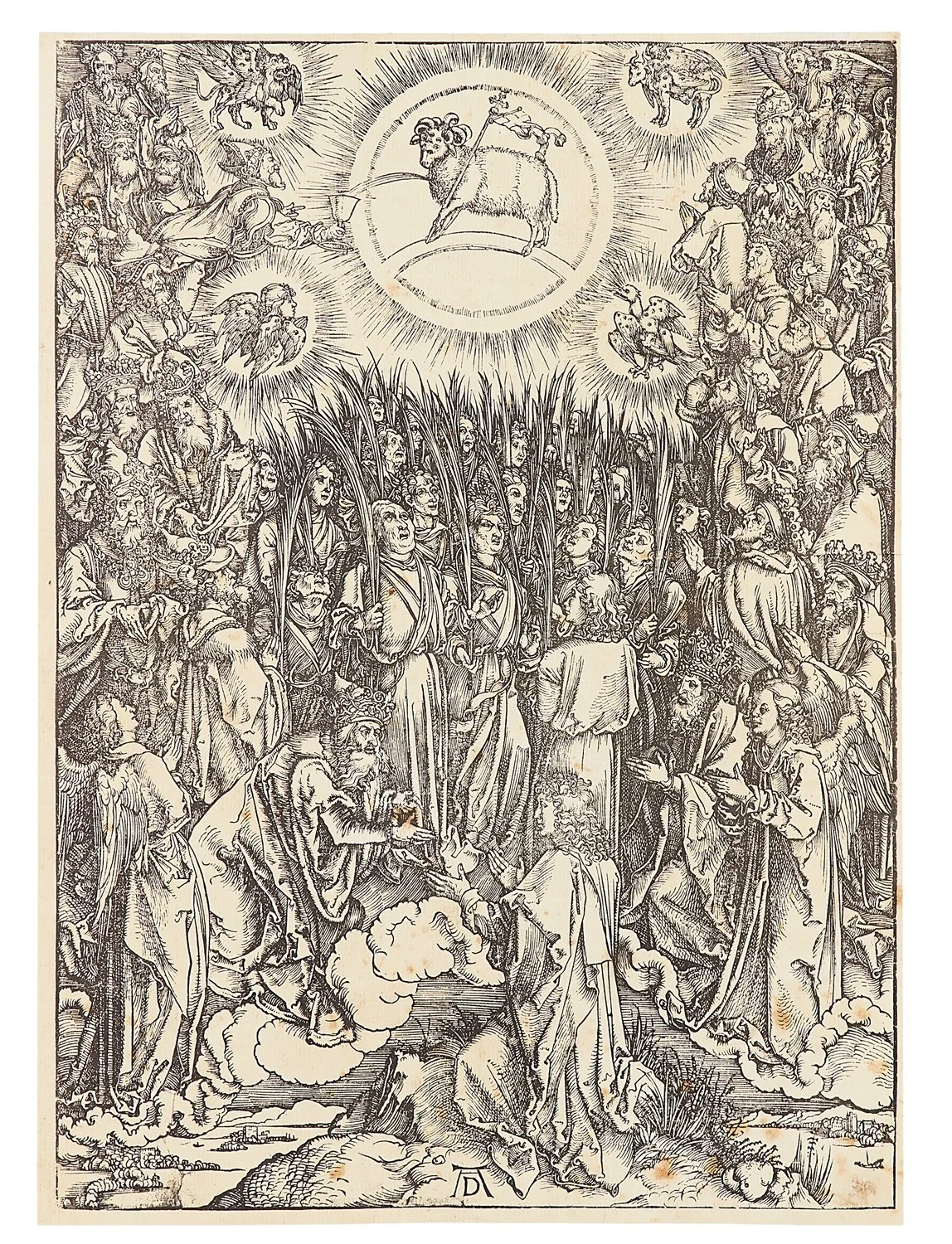
Albrecht Dürer, "The Adoration of the Lamb, from the Apocalypse series" published in 1498
Heavenly Worship Is Liturgical Worship
The Apocalypse repeatedly describes:
a throne;
a Lamb;
an altar;
incense;
sacred vessels;
elders;
angels;
saints;
hymns;
acclamations;
prostration;
ordered responses;
and a sacred banquet.
In Apocalypse 19 the heavenly multitude cries Alleluia, the elders fall down in worship, and St John hears of the marriage supper of the Lamb. Apocalypse 19:1–9
It is therefore reasonable to speak of a liturgy of Heaven, provided the phrase is understood correctly.
Heaven does not contain sacraments in precisely the earthly mode in which the Church needs them during her pilgrimage. The Blessed see God in glory; Christ is not repeatedly sacrificed or killed.
Rather, the Apocalypse depicts the eternal worship of God centred upon the victorious sacrificial Lamb, using the inspired language of altar, incense, hymn, adoration and sacred banquet.
The Mass is directed toward and participates in that heavenly worship.
The Early Church Understood the Liturgy This Way
The idea that earthly Eucharistic worship joins heavenly worship is not a modern interpretation imposed upon ancient Christianity.
St Cyril of Jerusalem
St Cyril of Jerusalem (c. AD 315–386) gave his celebrated Mystagogical Catecheses to newly baptised Christians in the fourth century.
When explaining the Eucharistic liturgy and the Sanctus, he describes the Church's commemoration of angels, archangels and heavenly powers. By singing Holy, Holy, Holy, he says, Christians become:
“partakers with the hosts of the world above in their Hymn of praise.” St Cyril of Jerusalem, Mystagogical Catechesis V / Catechetical Lecture 23 (c. AD 350), 6.
This is remarkably close to what the traditional Roman Preface still expresses.
St John Chrysostom
St John Chrysostom (c. AD 349–407) likewise speaks of the Eucharistic sanctuary in heavenly terms.
In On the Priesthood, written around AD 386–387, he describes the priestly ministry at the altar as belonging to heavenly realities and speaks of angels surrounding the Eucharistic sacrifice. In Book VI he writes that when the sacrifice is celebrated:
“angels stand by the Priest.”
He continues by describing the sanctuary as filled with heavenly powers in honour of Him who lies upon the altar. St John Chrysostom, On the Priesthood, VI.4.
Such patristic passages are not themselves solemn definitions of dogma. Their importance is historical and theological: they demonstrate that Christians of the fourth century already understood Eucharistic worship as mysteriously joined to the worship of Heaven.
How the Traditional Roman Mass Expresses Heavenly Worship
The connection is not merely something theologians later discovered. It is woven into the prayers of the Roman liturgy itself.
The Preface and Sanctus Join the Angels
Immediately before the Canon, the priest calls the faithful to lift up their hearts:
Sursum corda — Lift up your hearts.
The Preface then places earthly worship in company with the heavenly hosts before breaking into the Sanctus. This parallels the worship of Apocalypse 4, where heavenly beings continually acclaim God's holiness.
The Church at Mass is therefore consciously doing what St Cyril described centuries earlier: joining the hymn of those above.
The Roman Canon Speaks of the Heavenly Altar
After the Consecration comes one of the most striking prayers in the entire Roman Canon, the Supplices te rogamus.
The priest bows profoundly and asks God that the sacrifice be borne by His holy Angel to God's “altar on high” in the sight of the divine Majesty.
The precise interpretation of the “holy Angel” has been discussed by Catholic liturgical writers, and it would be unwise to make a disputed interpretation into doctrine. But the essential point does not depend upon identifying the Angel.
The Roman Canon itself connects the earthly Eucharistic altar with the heavenly altar before God.
This is exactly the vertical dimension of Catholic worship: what appears outwardly to be a priest standing before an altar in a church is directed toward the heavenly sanctuary.
The Saints Surround the Sacrifice
The Canon repeatedly names saints.
Before the Consecration, the Communicantes venerates the memory of the Blessed Virgin Mary, the Apostles and martyrs.
After the Consecration, the Nobis quoque peccatoribus asks God to grant the faithful fellowship with His Apostles, martyrs and all the saints. The traditional text explicitly looks beyond earthly life toward entrance into their company. This is not accidental decoration around the Eucharist.
It expresses the communion of saints: the altar stands within the worship of the whole Mystical Body, not merely the visible congregation assembled in one building.
Incense Visibly Expresses Ascending Prayer
At Solemn Mass, the altar and sacrificial gifts are incensed.
This provides a visible biblical image of prayer and sacrifice ascending toward God, analogous to the incense described in the Apocalypse.
Again, the distinction between symbolism and sacramental validity must be maintained. Incense enriches and expresses the theology of the rite; its absence does not invalidate Mass.
Holy Communion Anticipates the Marriage Supper of the Lamb
The Apocalypse culminates in the proclamation:
“Blessed are they that are called to the marriage supper of the Lamb.” Apocalypse 19:9
Holy Communion is not simply identical with the heavenly banquet. On earth Christ gives Himself sacramentally under the appearances of bread and wine; in Heaven the blessed possess Him in glory. Yet Eucharistic Communion is rightly understood as an anticipation and pledge of heavenly union with Christ.
The direction of the Mass is therefore eschatological: it looks toward man's final end in God.
The Mass Is Where Earth and Heaven Meet Sacramentally
The Mass stands at the culmination of a long biblical preparation. The Passover lamb prefigured Christ, the spotless Victim whose Blood delivers from death and whose flesh is eaten; the manna from heaven prefigured Christ as the true Bread from Heaven who gives His Flesh for the life of the world. At the Last Supper these two lines of biblical symbolism converge: the sacrificial Lamb gives Himself as food immediately before offering Himself upon Calvary. The Mass sacramentally continues that mystery until the Church enters the heavenly worship of the Lamb revealed in the Apocalypse.
1. The Temple and the Passover
God established sacred worship involving priesthood, altar and sacrifice. At the Passover, the spotless lamb was slain, its blood delivered Israel from death, and its flesh was eaten.
2. The Manna
God then fed Israel with bread from heaven during the journey through the wilderness, preparing the biblical image that Christ later applied to Himself: “I am the living bread which came down from heaven.”
3. The Last Supper
Christ brings these figures to fulfilment. The true Paschal Lamb gives His Body and Blood as supernatural food and commands the Apostles to perpetuate what He has instituted.
4. Calvary
The sacrifice prefigured by the ancient lamb is accomplished when Christ offers Himself once upon the Cross.
5. The Mass
The Church does not sacrifice another victim. The same Christ is sacramentally present and offered unbloodily, and the faithful may receive the Victim sacramentally in Holy Communion.
6. Heavenly Worship
The risen Christ appears in the Apocalypse as the victorious Lamb standing as though slain, surrounded by angels, saints and the heavenly liturgy.
The Temple and Passover foreshadow → the manna prepares → the Last Supper institutes → Calvary accomplishes → the Mass sacramentally represents → Heaven eternally glorifies the victorious Lamb.
The Main Objection
“Isn't This Just Reading the Catholic Mass Into a Symbolic Book?”
This is the strongest reasonable objection.
The Apocalypse is highly symbolic literature. Its lampstands, beasts, crowns, elders, numbers and cosmic images cannot simply be read as though St John were supplying architectural plans or liturgical rubrics. That objection is correct as far as it goes.
Catholics should not argue: “Apocalypse mentions incense; therefore every detail of Catholic liturgy is directly commanded by Apocalypse.” Nor should every object in St John's vision be arbitrarily assigned to a particular Catholic ceremony. The argument is cumulative rather than simplistic.
First, the Apocalypse undeniably uses cultic language: Lamb, sacrifice, altar, incense, sacred vessels, prostration, hymns and priestly imagery.
Second, Hebrews explicitly teaches that Old Covenant worship was a shadow of heavenly things and describes Christians as approaching the heavenly Jerusalem, angels and spirits of the just.
Third, the Eucharist was instituted by Christ in the sacrificial setting of Passover and Calvary.
Fourth, early Christians such as St Cyril and St John Chrysostom explicitly described Eucharistic worship as participation with the heavenly hosts.
Fifth, the traditional Roman liturgy itself consciously invokes angels, saints and God's heavenly altar.
Therefore the connection does not depend upon forcing every detail of the Apocalypse into a Roman liturgical mould. It arises from the whole biblical and Catholic theology of worship.
Response
The objection correctly recognises that the Apocalypse is a highly symbolic book. Catholics should therefore not argue that every detail of St John's vision corresponds directly to a particular ceremony of the Roman Mass, as though the Apocalypse were a coded set of liturgical rubrics.
The connection between the Mass and heavenly worship rests on something much broader and stronger.
First, the Old Covenant itself establishes the pattern. God instituted a visible priesthood, altar, sacrifice, sacred vessels, incense and ceremonial worship. The Epistle to the Hebrews then explains that this earthly sanctuary served as an “example and shadow of heavenly things” ([Hebrews 8:5]). Earthly sacred worship was therefore deliberately ordered toward realities existing beyond what the bodily eye could see.
Second, the Passover and manna prepare specifically for Christ. The spotless Paschal lamb was slain, its blood delivered Israel from death, and its flesh had to be eaten. Later, God fed Israel with manna, bread from heaven. Christ brings these figures together in Himself: He is “the Lamb of God” ([John 1:29]), St Paul calls Him “Christ our pasch” ([1 Corinthians 5:7]), and Christ declares Himself “the living bread which came down from heaven”, whose Flesh is given “for the life of the world” ([John 6:51–52]).
Third, at the Last Supper, immediately before Calvary, Christ gives His Body and Blood sacramentally and commands the Apostles to perpetuate what He has instituted. Thus the Passover sacrifice, sacrificial meal and bread from heaven converge in the Eucharistic mystery.
Fourth, Calvary supplies the objective reality toward which those figures pointed. Christ offers Himself once in blood. The Mass does not repeat that death. According to the Council of Trent, the same Christ who offered Himself upon the Cross is offered sacramentally and unbloodily upon the altar.
Fifth, the Apocalypse reveals that the glorified Christ remains eternally the sacrificial Lamb. St John sees not merely a triumphant king detached from Calvary, but:
“a Lamb standing as it were slain” ([Apocalypse 5:6]).
Around Him appear an altar, incense, elders, angels, saints, hymns, prostration and the worship of the heavenly multitude. The Lamb is alive and victorious, yet His sacrificial identity remains central to heavenly worship.
Sixth, the traditional Roman Mass consciously places earthly worship within this heavenly reality. In the Sanctus, the Church joins the angels in their threefold acclamation of God's holiness. In the Roman Canon, the priest asks that the sacrifice be borne to God's “altar on high.” The saints are commemorated, the angels are invoked, and Christ is addressed as the Lamb of God.
The argument, therefore, is not:
“The Apocalypse contains incense and an altar, so Catholic ceremonies must be correct.”
It is instead the cumulative biblical progression:
Temple and Passover → Manna → Last Supper → Calvary → Mass → heavenly worship of the Lamb.
The same pattern runs through the whole economy of salvation: sacrifice, priesthood, sacred worship and communion with God reach their fulfilment in Christ and ultimately their consummation in Heaven.
The Apocalypse does not prove every detail of the Roman Rite. Rather, it reveals the heavenly reality toward which Catholic liturgical worship is directed.
Another Objection: “But Hebrews Says Christ Was Sacrificed Only Once”
A serious objection comes from the Epistle to the Hebrews. Hebrews repeatedly teaches that Christ offered Himself once, in contrast with the repeated sacrifices of the Old Covenant. Christ entered the heavenly sanctuary:
“not that he should offer himself often”
and:
“now once at the end of ages, he hath appeared for the destruction of sin, by the sacrifice of himself.” [Hebrews 9:25–26]
The same argument continues:
“Christ was offered once to exhaust the sins of many.” [Hebrews 9:28]
And again:
“By the which will, we are sanctified by the oblation of the body of Jesus Christ once.” [Hebrews 10:10]
The objection therefore asks:
If Christ's sacrifice was offered once upon Calvary, how can Catholics speak of the Mass as a true sacrifice offered again and again throughout the world?
Would this not imply that the sacrifice of Calvary was somehow incomplete?
And if Christ is already risen, glorified and seated at the right hand of the Father, how can He still be described as a sacrificial Victim upon Catholic altars?
Response
Hebrews is entirely correct that Christ was sacrificed once. Catholic doctrine teaches precisely the same thing. Christ died once upon Calvary. His bloody immolation cannot and need not be repeated.
The question is therefore not whether Christ dies again at Mass. He does not. The question is whether the one sacrifice accomplished upon Calvary can be sacramentally represented and offered in the manner instituted by Christ at the Last Supper.
The Council of Trent, Session XXII, explains the distinction: the Victim is the same, and the principal Priest is the same—Jesus Christ—but the manner of offering differs. On Calvary Christ offered Himself in a bloody manner; in the Mass the same Christ is offered sacramentally and unbloodily through the ministry of the priest.
The Apocalypse actually illuminates this distinction beautifully. St John does not see Christ being killed repeatedly. He sees:
“a Lamb standing as it were slain.”
The Lamb is standing because Christ is risen and lives forever.
He is nevertheless seen as slain because His victory and heavenly glory remain inseparable from the sacrifice through which He redeemed mankind.
The Mass expresses the same mystery sacramentally. It does not produce another Calvary. It places the Church before the one sacrificial Lamb whose death occurred once in history but whose saving sacrifice remains eternally efficacious before God.
Thus:
Calvary is the once-for-all bloody sacrifice.
The Mass is its sacramental and unbloody representation.
Heaven eternally glorifies the Lamb who was slain and now lives forever.
What We Can and Cannot Conclude
Established Catholic doctrine: The Mass is a true sacrifice. Christ is the same principal Priest and Victim as at Calvary. Calvary's bloody sacrifice occurred once; the Mass is its unbloody sacramental offering. Angels and saints worship God in Heaven, and the saints intercede for the faithful.
Established biblical teaching: The Old Covenant sanctuary prefigured heavenly things; Christ is the heavenly High Priest; Christians approach the heavenly Jerusalem and innumerable angels; and the Apocalypse depicts the worship of God and the Lamb using the imagery of altar, incense, elders, angels, saints and sacred praise.
Strong theological and liturgical conclusion: The Mass is earthly participation in and anticipation of heavenly worship. The traditional liturgy itself expressly presents the Church as worshipping together with the angels and directing the Eucharistic sacrifice toward God's heavenly altar.
Patristic evidence: St Cyril of Jerusalem and St John Chrysostom provide important early testimony that Eucharistic worship was understood as involving the angels and heavenly powers.
Exegetical question: The precise identity and complete symbolism of the twenty-four elders is not defined Catholic doctrine. Their participation in heavenly worship is clear; every proposed symbolic identification is not.
Liturgical discipline: Incense, particular ceremonial gestures, numbers of candles and similar rites express Catholic theology but should not be confused with what is strictly necessary for Eucharistic validity.
What the argument does not require: It is unnecessary to claim that every ceremony of the Roman Mass was copied directly from the Apocalypse or that St John was describing the Roman Rite in coded form. The deeper connection rests upon Christ, sacrifice, Scripture, the communion of saints and the Church's understanding of her own worship.
Conclusion
The Mass is connected to the worship of Heaven because the whole biblical history of sacrifice and sacred worship reaches its fulfilment in Jesus Christ, the Lamb of God.
In the Passover, the spotless lamb was slain, its blood delivered Israel from death, and its flesh was eaten. In the wilderness, God then fed His people with manna from heaven, preparing the way for Christ to reveal Himself as the true Bread from Heaven whose Flesh is given for the life of the world.
At the Last Supper, these great Old Testament figures converge. Christ, the true Paschal Lamb and true Bread from Heaven, gives His Body and Blood sacramentally and commands the Apostles to perpetuate what He has instituted.
On Calvary, the reality prefigured by the ancient sacrifices is accomplished once and for all. Christ offers Himself in blood for the redemption of mankind.
In the Mass, that sacrifice is not repeated as another death. The same Christ, the same Priest and the same Victim are offered sacramentally and unbloodily. The faithful are brought into contact with the one sacrifice of Calvary and, in Holy Communion, may receive the very Lamb who was sacrificed for them.
Finally, in the Apocalypse, St John sees the consummation of this entire mystery. Christ appears in Heaven as:
“a Lamb standing as it were slain.”
He is alive, risen and victorious, yet His sacrificial identity remains at the centre of heavenly worship. Around Him are the throne, altar, incense, elders, angels, saints, hymns of praise and the adoration of the redeemed.
The complete biblical movement can therefore be expressed:
Passover Lamb → Manna from Heaven → Last Supper → Calvary → Mass → Lamb of God in heavenly glory.
Or, in the broader history of worship:
Temple and Passover foreshadow → manna prepares → the Last Supper institutes → Calvary accomplishes → the Mass sacramentally represents → Heaven eternally glorifies the victorious Lamb.
The Mass therefore cannot be understood merely as a religious meeting, a communal meal or an act of remembrance performed by an earthly congregation. It belongs to the great supernatural order of worship revealed throughout Scripture. At the altar, the Church on earth is directed beyond herself toward the heavenly sanctuary, where the angels and saints eternally worship God and the Lamb.
This is why the traditional liturgy repeatedly turns the soul upward. In the Sanctus, the Church joins the hymn of the angels. In the Canon, the sacrifice is directed toward God's altar on high. The saints are remembered, the Lamb of God is invoked, and the faithful are prepared for sacramental communion with the same Christ whom Heaven adores.
The practical lesson is therefore one of profound reverence. To assist at Mass is to stand within the mystery toward which the Passover, the manna, the Temple sacrifices and the whole Old Covenant were pointing. It is to approach sacramentally the sacrifice of Calvary and to anticipate the eternal worship of the Lamb.
The Mass thus draws the faithful from figure to fulfilment, from sacrifice to communion, and from earth toward Heaven.
The final goal is not merely to understand the symbolism, but to live according to what it reveals: to worship God faithfully, to receive Christ worthily, to persevere in grace, and ultimately to join forever the worship described by St John:
the redeemed before the throne, adoring God and the Lamb.
Primary Sources
Sacred Scripture:
Exodus 25:8–40 — the earthly sanctuary constructed according to the heavenly pattern.
2 Paralipomenon 5:12–14 — Temple worship, priests, sacred music and the glory of God.
Luke 22:7–20 — Passover and institution of the Eucharist.
1 Corinthians 11:23–26 — the Eucharist proclaims the Lord's death until He comes.
Hebrews 8:1–5 — earthly worship as the “shadow of heavenly things.”
Hebrews 9:1–28 — Old Covenant sanctuary and Christ's unique sacrifice.
Hebrews 12:22–24 — heavenly Jerusalem, angels, saints and Christ the Mediator.
Apocalypse 4 — throne, elders and heavenly Sanctus.
Apocalypse 5 — the Lamb as slain, elders, incense, prayers of the saints and angels.
Apocalypse 6:9–11 — martyrs beneath the heavenly altar.
Apocalypse 8:1–5 — angel, censer, incense, prayers and heavenly altar.
Apocalypse 19:1–9 — Alleluia, adoration and the marriage supper of the Lamb.
Council of Trent (1545–1563), Session XXII, 17 September 1562, Doctrine Concerning the Sacrifice of the Mass, chapters I–V. Especially chapters I–II on the relationship of the Last Supper, Calvary and Mass, and chapter V on liturgical ceremonies. Council of Trent — Session XXII
Catechism of the Council of Trent, Part II, “The Sacrament of the Eucharist,” treatment of the sacrifice of the Mass and its relationship to Calvary. Roman Catechism — The Eucharist and Sacrifice of the Mass
St Cyril of Jerusalem (c. AD 315–386), Mystagogical Catechesis V / Catechetical Lecture 23 (c. AD 350), 6 — the Eucharistic Sanctus and participation with the heavenly hosts. St Cyril of Jerusalem — Mystagogical Catechesis V
St John Chrysostom (c. AD 349–407), On the Priesthood, Books III and VI, especially VI.4 — the Eucharistic altar and the presence of the heavenly powers. St John Chrysostom — On the Priesthood, Book III
Pope Pius XII, Mediator Dei, 20 November 1947, especially §§68–75 and the passages concerning the Church militant joining the Church triumphant and the angels in divine worship. Pius XII — Mediator Dei
Missale Romanum, 1962, especially the Preface and Sanctus, the Roman Canon's Supplices te rogamus, Communicantes and Nobis quoque peccatoribus, and the Agnus Dei. 1962 Missale Romanum — scanned edition
Further Reading
Nicholas Gihr, The Holy Sacrifice of the Mass: Dogmatically, Liturgically and Ascetically Explained (St Louis: B. Herder, 1902). Particularly useful are the chapters on the relationship between the Mass and Calvary, the Christian altar, incense, the Preface, Canon and Agnus Dei. Gihr — The Holy Sacrifice of the Mass
Adrian Fortescue, The Mass: A Study of the Roman Liturgy (London: Longmans, Green and Co., 1917). A detailed pre–Vatican II historical study of the development and structure of the Roman Mass. Fortescue — The Mass: A Study of the Roman Liturgy
Adrian Fortescue, “Liturgy of the Mass,” The Catholic Encyclopedia (1910), for the historical development of the Roman Eucharistic liturgy and its ancient roots. Fortescue — Liturgy of the Mass
Adrian Fortescue, “Canon of the Mass,” The Catholic Encyclopedia (1908), for the history and theology of the Roman Canon. Fortescue — Canon of the Mass
Related Questions
What Is the Holy Sacrifice of the Mass, and Why Is It the Highest Act of Catholic Worship?
What Are the Seven Sacraments?
What Is the Real Presence of Christ in the Holy Eucharist?
Why Does the Catholic Church Worship at an Altar?
Why Does the Catholic Church Use Incense, Vestments, Candles and Sacred Ceremonies?
Why Does the Mass Invoke the Angels and Saints?
Why Is the Mass Offered for the Living and the Dead?
What Is Holy Communion, and How Should a Catholic Receive It?