Was the Catholic Church Invented by Emperor Constantine in the Fourth Century?
Short Answer
No. The claim that Constantine invented the Catholic Church is historically untenable.
The Catholic Church was already centuries old before Constantine. Long before he was born, Christians were baptising converts, celebrating the Eucharist, assembling on Sunday, recognising bishops, priests and deacons, appealing to apostolic succession, venerating martyrs, defending a defined rule of faith, and calling their worldwide communion “the Catholic Church.”
Most decisively, around AD 107–110—roughly two centuries before Constantine's rise—St Ignatius of Antioch wrote:
“Wherever Jesus Christ is, there is the Catholic Church.” —St Ignatius of Antioch
He said this while describing a Church governed by bishops, presbyters and deacons, centred upon a Eucharist celebrated under episcopal authority. New Advent
By about AD 96, Clement of Rome was already describing how Christ sent the Apostles, the Apostles appointed bishops and deacons, and provision was made for other men to succeed them in their ministry. New Advent
By about AD 150, St Justin Martyr described Christians receiving the Eucharist, which he explicitly said was not ordinary bread and drink but the flesh and blood of Jesus Christ. New Advent
By about AD 180, St Irenaeus was arguing against heretics from the apostolic succession of bishops, giving the succession of the Church of Rome and tracing it to Peter and Paul. New Advent
By the early third century, Tertullian challenged heretics to produce, if they could, the succession of their bishops from the Apostles. He pointed specifically to apostolic churches including Rome, Corinth, Philippi, Thessalonica and Ephesus. New Advent
And beneath Rome itself survive Christian cemeteries, inscriptions, symbols and paintings from before Constantine. The Catacomb of Priscilla preserves a famous Virgin-and-Child image dated approximately AD 230–240, together with other biblical paintings. Catacombe di Italia
Constantine therefore did not create Christianity or the Catholic Church.
He encountered a Church that already existed.
What changed under Constantine was not the birth of the Church, but substantially the legal position of a Church that the Roman state had previously persecuted.
That distinction destroys the Constantine-invented-Catholicism theory.
Why This Question Matters
A popular modern story runs something like this:
Jesus preached a simple spiritual message
→ His followers formed loose house churches
→ Christianity gradually changed
→ Constantine took control of it
→ the Council of Nicaea invented official Christianity
→ Catholicism emerged as the religion of the Roman Empire.
It sounds plausible if nearly three centuries of history are simply removed. Put those centuries back, and the theory collapses. There is an enormous body of Christian literature before Constantine: Clement of Rome, Ignatius of Antioch, Polycarp, Justin Martyr, Irenaeus, Tertullian, Hippolytus, Cyprian and many others.
There are pagan Roman witnesses.
There are Christian cemeteries.
There are inscriptions.
There are frescoes.
There are archaeological remains of Christian worship.
There are records of bishops.
There are lists of episcopal succession.
There are accounts of martyrs.
There are disputes over doctrine precisely because Christians believed there was an authoritative apostolic Faith that heresy could contradict.
And there are Roman imperial records showing Christians being interrogated and executed for refusing pagan worship.
You cannot persecute for centuries a Church that has not yet been invented.
Jesus Christ Founded His Church
The starting point is not Constantine. It is Jesus Christ.
Christ did not merely leave behind an assortment of religious ideas and expect individuals to construct Christianity for themselves.
He spoke explicitly of His Church:
“Thou art Peter; and upon this rock I will build my church, and the gates of hell shall not prevail against it.” — Matthew 16:18
Notice the language:
“I will build my Church.”
Not: “Constantine will build it three centuries from now.”
Christ then gives Peter the keys:
“And I will give to thee the keys of the kingdom of heaven.” — Matthew 16:19
Christ gives the Apostles
authority to bind and loose (Matthew 18:18),
commands them to celebrate the Eucharist (Luke 22:19),
gives them authority concerning sins (John 20:21–23),
and finally commands them:
“Going therefore, teach ye all nations; baptizing them in the name of the Father, and of the Son, and of the Holy Ghost.” — Matthew 28:19
And Christ promises:
“Behold I am with you all days, even to the consummation of the world.” — Matthew 28:20
The Church's own claim is therefore very specific:
CHRIST
↓
APOSTLES
↓
BISHOPS SUCCEEDING THE APOSTLES
↓
THE CATHOLIC CHURCH
Constantine does not appear anywhere in that chain.
The New Testament Already Shows an Organised Church
The institutional Church did not suddenly appear in the fourth century. The New Testament itself shows authority, offices, ordination, councils, doctrine, discipline and sacramental worship.
When Judas dies, his apostolic office is filled by Matthias (Acts 1:15–26).
The Apostles appoint ministers by prayer and the laying on of hands (Acts 6:1–6).
Paul and Barnabas appoint clergy in local churches (Acts 14:22).
The Council of Jerusalem resolves a doctrinal controversy and issues an authoritative judgment (Acts 15).
St Paul refers to bishops and deacons (Philippians 1:1).
Timothy receives a ministerial gift through the imposition of hands (1 Timothy 4:14; 2 Timothy 1:6).
Titus is instructed to establish clergy in different cities (Titus 1:5).
St Paul gives Timothy a principle of transmission:
“The things which thou hast heard of me by many witnesses, the same commend to faithful men, who shall be fit to teach others also.” — 2 Timothy 2:2
That gives four generations:
PAUL → TIMOTHY → FAITHFUL MEN → OTHERS
This is already the principle of apostolic succession.
The Documentary Evidence Before Constantine
The evidence becomes especially damaging to the Constantine theory when we leave the New Testament and examine the Christians who immediately followed the Apostolic age.
c. AD 96 — Clement of Rome
This is more than 200 years before Constantine's toleration of Christianity. Clement writes from the Church at Rome to Christians at Corinth.
He explains:
“The apostles have preached the Gospel to us from the Lord Jesus Christ; Jesus Christ has done so from God.”
Then:
“Christ therefore was sent forth by God, and the apostles by Christ.”
And the Apostles:
“appointed the first-fruits of their labours...to be bishops and deacons.”
Clement then explains that the Apostles provided for succession after their deaths. New Advent
The chain is unmistakable:
GOD → CHRIST → APOSTLES → BISHOPS → SUCCESSORS
This is not Constantinian Christianity. This is first-century Christianity.
c. AD 107–110 — Ignatius Actually Calls It “the Catholic Church”
Here the theory encounters an even more obvious problem. St Ignatius was Bishop of Antioch and was being transported to Rome for martyrdom.
Writing to the Smyrnaeans, he says:
“Wherever Jesus Christ is, there is the Catholic Church.” New Advent
This is approximately two centuries before Constantine. And look at the Church Ignatius describes:
“Follow the bishop, even as Jesus Christ does the Father, and the presbytery as you would the apostles; and reverence the deacons...”
He continues by connecting the bishop with the Eucharist:
“Let that be deemed a proper Eucharist, which is [administered] either by the bishop, or by one to whom he has entrusted it.” New Advent
So by approximately AD 110 we find together:
CATHOLIC CHURCH
BISHOP
PRESBYTERY
DEACONS
EUCHARIST
ECCLESIASTICAL AUTHORITY
This evidence alone is enough to disprove the assertion that Constantine invented the Catholic Church in the fourth century.
The Didache — Eucharistic Worship and Bishops Before Constantine
The Didache, an extremely early Christian document (AD 70–120), describes Christians assembling on the Lord's Day:
“Every Lord's day gather yourselves together, and break bread, and give thanksgiving...”
Remarkably, it calls the Christian offering a “sacrifice.” It then instructs Christians to appoint:
“bishops and deacons worthy of the Lord.” New Advent
Again:
Sunday assembly + Eucharistic breaking of bread + sacrifice + bishops + deacons
All existed long before Constantine.
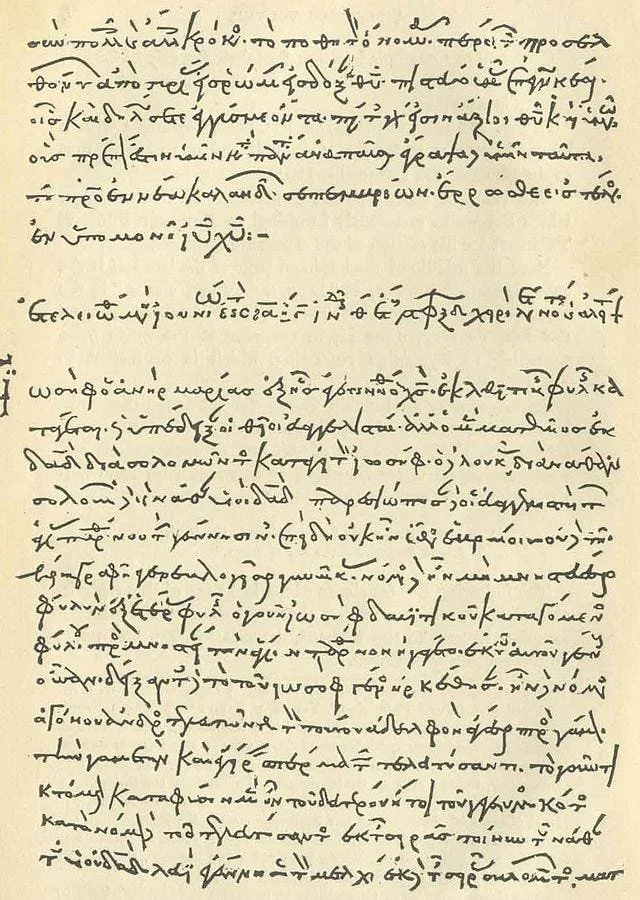
The Didache (“Teaching of the Twelve Apostles”), c. AD 70–120 — one of the earliest surviving Christian writings outside the New Testament, describing Baptism, fasting, the Eucharist, Sunday worship, and the appointment of bishops and deacons.
c. AD 150 — Justin Martyr Describes the Eucharist
Justin Martyr wrote an Apology in 150 AD explaining Christianity to the Roman emperor. His description is extraordinarily important because it tells an outsider what Christians actually did.
After prayers,
bread, wine and water are brought forward.
Thanksgiving is offered.
The people answer Amen.
Deacons distribute the Eucharistic food
and take it to those absent.
Justin then explains:
“For not as common bread and common drink do we receive these...”
He says Christians had been taught that the Eucharistic food is:
“the flesh and blood of that Jesus who was made flesh.” New Advent
This is around 160 years before Constantine's victory at the Milvian Bridge.
The Eucharistic religion did not come from Constantine. It was already there.
c. AD 180 — Irenaeus and the Succession of the Roman Church
St Irenaeus, Bishop of Lyons, was combating Gnostic sects. How did he distinguish authentic Christianity from newly invented alternatives? Not by saying everyone should independently reconstruct Christianity from private biblical interpretation. He appealed to the churches founded by the Apostles and to the succession of their bishops.
He singled out:
“the very great, the very ancient, and universally known Church founded and organized at Rome by the two most glorious apostles, Peter and Paul”
and referred to:
“the successions of the bishops.” New Advent
He then names the succession beginning with Linus.
Again, this is approximately 130 years before Constantine.
c. AD 200 — Tertullian Challenges Heretics: Show Us Your Bishops
Tertullian's argument is devastatingly simple.
Christ taught the Apostles.
The Apostles founded churches.
Those churches transmitted the apostolic Faith.
Therefore, someone claiming an alternative Christianity should demonstrate where his teaching came from.
Tertullian challenges heretics:
“Let them produce the original records of their churches; let them unfold the roll of their bishops...” New Advent
He specifically mentions apostolic succession at Smyrna and Rome and directs readers toward the historic apostolic churches of Corinth, Philippi, Thessalonica, Ephesus and Rome. New Advent
That argument only makes sense if an
identifiable,
organised,
historical Church already existed.
c. AD 250 — Cyprian Speaks Explicitly of the “Catholic Church”
St Cyprian, Bishop of Carthage, wrote amid persecution, schism and controversy. His terminology is completely incompatible with the idea of Christianity as an amorphous collection of independent congregations. He speaks explicitly of:
“the unity of the Catholic Church.” New Advent
His treatise On the Unity of the Church concerns precisely the visible unity of the Church, bishops, schism and the episcopate. New Advent
Cyprian died a martyr in AD 258.
Constantine was not even born until roughly AD 272.
The Pagan Romans Confirm That Christianity Already Existed
Perhaps someone distrusts Catholic sources. Very well. Let us ask the pagans. Their testimony is particularly valuable because these writers had absolutely no interest in inventing Catholic history.
Tacitus — Christianity Reached Rome in the First Century
The Roman historian Tacitus, writing around AD 116 about Nero's persecution following the great fire of Rome in AD 64, identifies Christians and explains that:
“Christus, the founder of the name, had undergone the death penalty in the reign of Tiberius” under Pontius Pilate.
Tacitus then says the movement spread again from Judaea to Rome itself. Penelope
This is hostile testimony. Tacitus despised Christianity. Yet his account independently confirms the basic chronology:
CHRIST
↓
PONTIUS PILATE
↓
CHRISTIAN MOVEMENT IN JUDAEA
↓
CHRISTIANS IN ROME
↓
NERONIAN PERSECUTION — AD 64
Constantine was still more than two centuries in the future.
Pliny the Younger — Christians Worshipped Christ as God c. AD 112
Around AD 112, the pagan Roman governor Pliny the Younger wrote to Emperor Trajan asking what to do with Christians. He describes interrogating them.
Christians who recanted were required to worship the Roman gods, offer incense and wine before the emperor's image, and curse Christ—something Pliny understood genuine Christians would refuse to do. Former Christians told him that believers customarily assembled on a fixed day before dawn and:
“sing responsively a hymn to Christ as to a god.” Internet History Sourcebooks
Think about the date. c. AD 112.
Christians are meeting regularly.
They worship Christ as divine.
They possess a recognisable moral code.
Roman officials know who they are.
They can be punished for refusing pagan worship.
This is approximately 200 years before the Edict of Milan.
Archaeology Makes the Case Visible
We are not dependent solely upon manuscripts. The ground itself testifies.
The Roman Catacombs
The Christian catacombs preserve tombs, inscriptions, biblical imagery and Christian symbols from the centuries before Constantine.
The Pontifical Commission for Sacred Archaeology describes inscriptions, the fish, dove, anchor, bread, lamb and other symbols found in these cemeteries. Vatican
They are physical remnants of Christians who lived and died before Christianity enjoyed imperial favour.
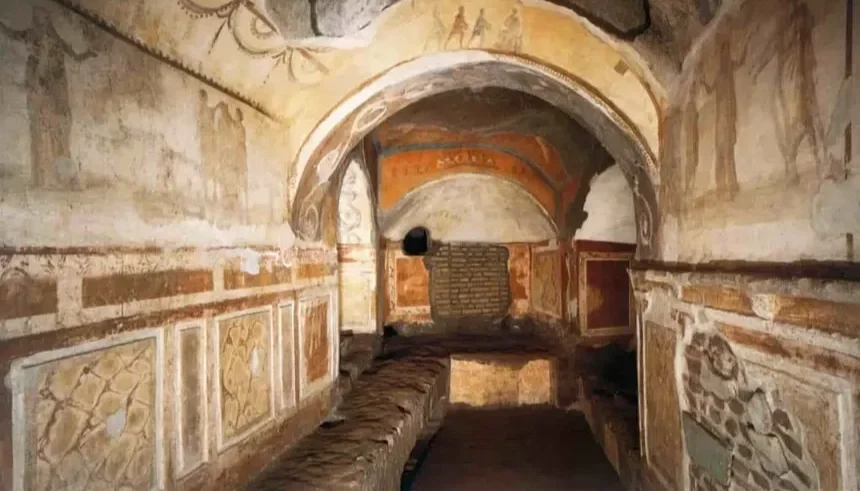
The Virgin and Child — c. AD 230–240
In the Catacomb of Priscilla survives an extraordinary fresco depicting the Virgin and Child with a prophetic figure pointing toward a star. See location.
The Pontifical Commission dates it approximately AD 230–240 and identifies it as the earliest surviving image of the Mother of God in the West. Catacombe di Italia
That is roughly 80 years before the Edict of Milan.
Whatever conclusions one draws about the precise development of Marian devotion, one thing is beyond serious dispute:
Christian sacred imagery was not invented by Constantine.
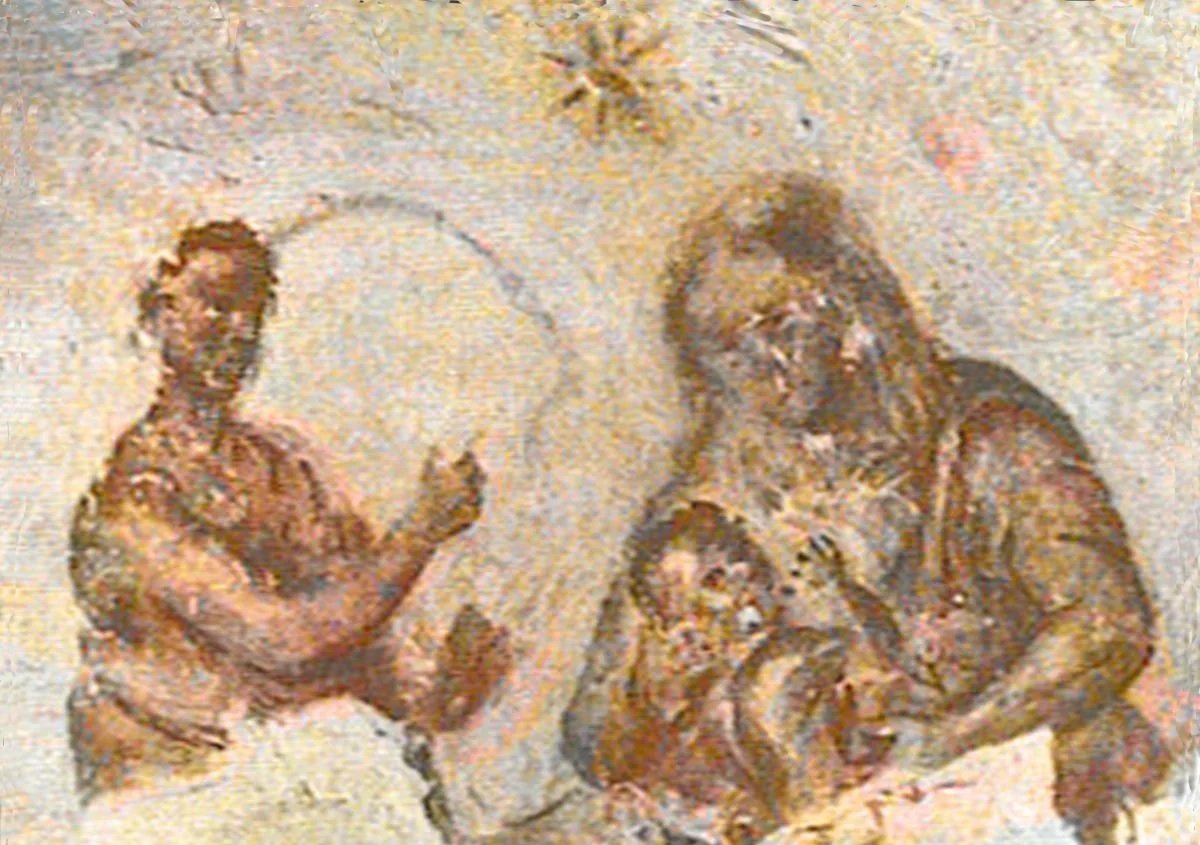
Virgin and Child with a prophetic figure, Catacomb of Priscilla, Rome, conventionally dated c. AD 230–240. The same catacomb preserves extensive early Christian biblical imagery. These paintings substantially predate Constantine's legalisation of Christianity in AD 313.
The Good Shepherd
Another enormously common image in the catacombs is Christ as the Good Shepherd, carrying the sheep upon His shoulders. The Vatican archaeological material identifies this explicitly as Christian imagery derived from Christ's parable of the lost sheep. Vatican
These were not imperial propaganda posters. They adorned Christian burial places.
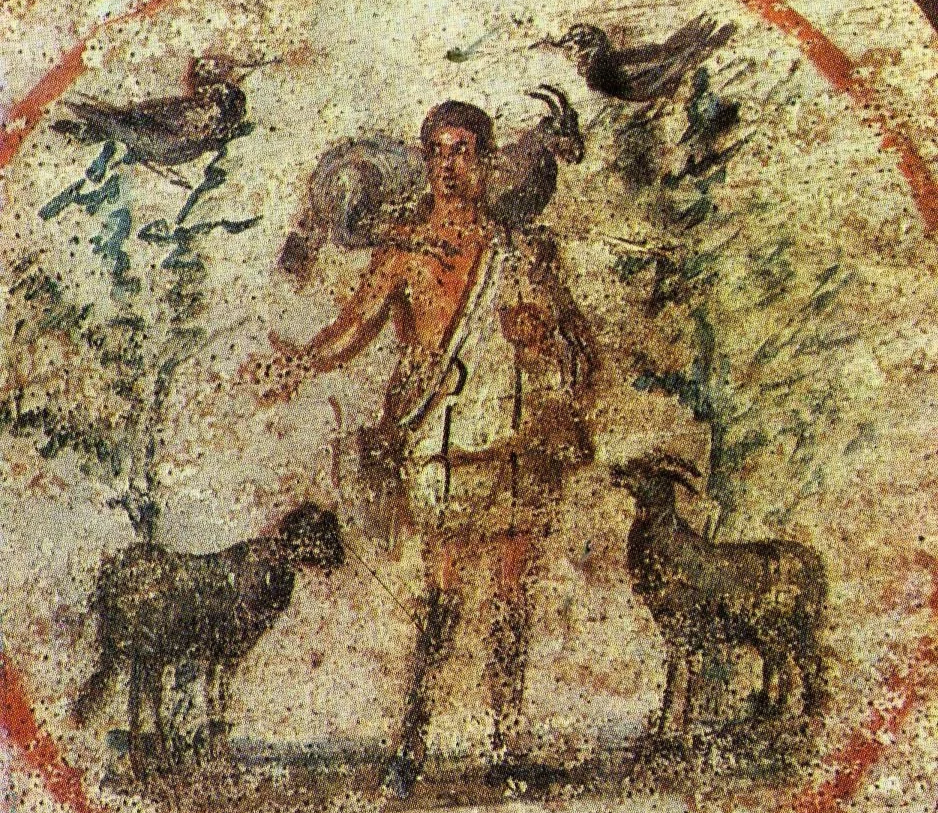
Christ as the Good Shepherd, early Christian catacomb art, Rome, c. 3rd century. The image draws on Christ’s description of Himself as the Good Shepherd who seeks and saves His sheep (John 10; Luke 15). Its presence in pre-Constantinian Christian burial places shows that Christians were already using distinctively biblical sacred imagery long before Constantine legalised Christianity in AD 313.
What Were the Catacombs?
To a modern reader, the word catacomb may suggest a secret underground city where persecuted Christians permanently lived and hid from the Romans. That is not quite correct.
The Roman catacombs were principally underground Christian cemeteries: networks of narrow galleries cut into the soft volcanic rock outside ancient Rome, with burial niches (loculi) opened into the walls and larger chambers constructed for families, martyrs and communal burials.
Christians did not normally live underground in them. They lived ordinary lives above ground in Rome and its surroundings. The catacombs were used primarily for burial, but Christians also entered them to conduct funerary rites, pray for and commemorate the dead, and especially to honour the graves of the martyrs. By the fourth and fifth centuries, pilgrims were regularly visiting the tombs of celebrated martyrs there.
When Were They Used?
The great Christian catacomb systems of Rome began developing particularly around the end of the second and beginning of the third century, although some burial sites incorporated earlier Roman or pagan underground structures. Under Pope Zephyrinus, around AD 199–217, the deacon Callixtus was placed in charge of the cemetery on the Appian Way that would become one of the principal cemeteries of the Roman Church.
This is important for the Constantine question. These underground Christian cemeteries were already developing roughly a century before Constantine legalised Christianity in AD 313.
How Large Were They?
They were not merely a few small caves. Some developed into enormous networks of galleries and burial chambers serving whole Christian communities. The Catacombs of Saints Marcellinus and Peter alone cover approximately 18,000 square metres, and Vatican archaeological information estimates that around 15,000 people may have been buried there in the third century alone.
The Catacomb of St Callixtus likewise developed from separate burial areas dating to the end of the second century into a vast interconnected community cemetery. It became a particularly important burial place of the Roman Church, containing the graves of numerous third-century popes and martyrs.
Why Did Christians Use Underground Cemeteries?
There were several practical and religious reasons. Roman law generally required burials to take place outside the inhabited city, and underground excavation allowed large numbers of burials to be placed on relatively limited land. The soft volcanic rock around Rome made extensive galleries comparatively practical to excavate.
But for Christians the cemetery also possessed a deeply religious meaning. The ancient Christian word used for such a burial place was coemeterium, derived from a Greek word meaning a “sleeping place” or “dormitory.” It expressed the Christian belief that bodily death was not the end: the dead awaited the resurrection of the body.
The catacombs therefore became filled with explicitly Christian signs of hope:
the Good Shepherd;
the fish;
the anchor;
biblical scenes;
depictions of Christ;
images of the Virgin and Child;
inscriptions invoking Christian faith and hope;
and the tombs of bishops, martyrs and ordinary faithful.
Were They Hiding Places During Persecution?
At times Christians may certainly have taken refuge or gathered discreetly in underground cemeteries, particularly during periods of persecution. But it is misleading to imagine thousands of Christians permanently living there as an underground population.
Their principal function was cemetery, memorial and sacred burial place. These were not temporary hideouts hastily constructed after Constantine. They were organised burial complexes used by substantial Christian communities before Constantine, and their walls, tombs, inscriptions and paintings preserve the physical evidence of what those Christians believed.
When we descend into the Roman catacombs today, therefore, we are not entering a medieval reconstruction or a Constantinian invention. We are entering the burial places of a Christian community that already possessed its own bishops, martyrs, sacred symbols, biblical imagery and distinctly Christian hope generations before Constantine appeared.
Dura-Europos: A Christian Church Building Before Constantine
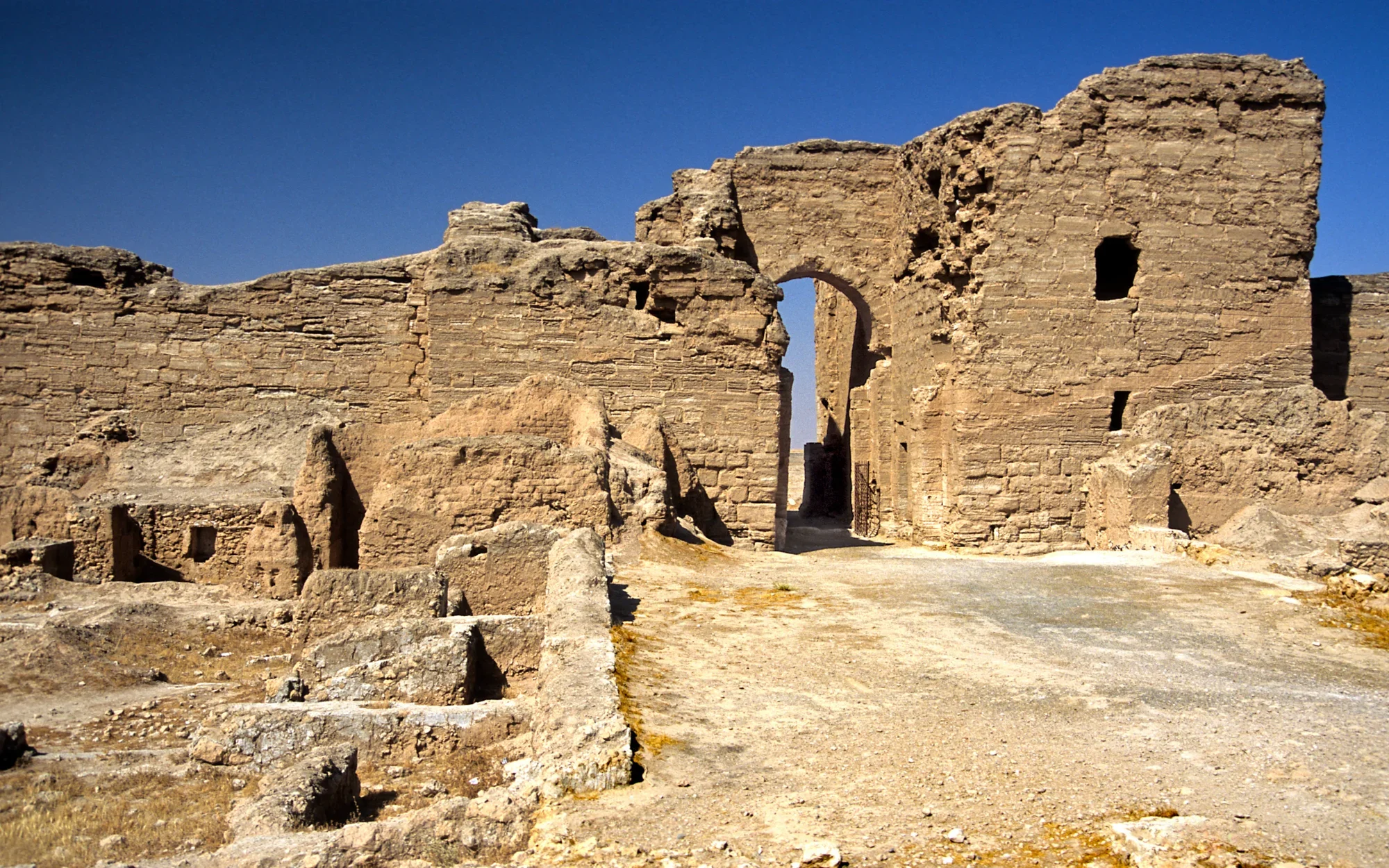
Exterior view of the Christian building at Dura-Europos, Syria, adapted from a private house in the 3rd century and used by an established Christian community before Constantine. The site contained a baptistery decorated with biblical scenes, providing archaeological evidence that organised Christian worship, Baptism, sacred imagery, and communal church life were already well established decades before Christianity was legalised in AD 313.
Even more striking archaeological evidence comes from Dura-Europos in Syria. A Christian house-church was adapted there in the third century and included a baptistery decorated with Christian paintings. See location.
The paintings included:
Christ as the Good Shepherd;
Christ healing the paralytic;
Christ walking upon the water;
the Samaritan woman;
women approaching Christ's tomb;
David and Goliath.
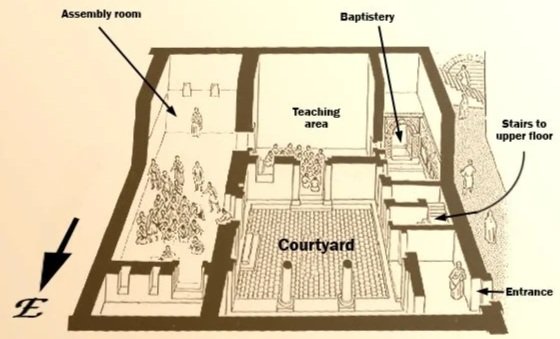
Reconstructed ground plan of the 3rd-century Christian house-church at Dura-Europos, Syria. The converted domestic building included a large assembly room, a separate teaching area, an internal courtyard, and a dedicated baptistery—evidence of an organised Christian community with distinct spaces for worship, instruction and Baptism decades before Constantine legalised Christianity in AD 313.
Yale's archaeological project explicitly notes that these murals date to more than three-quarters of a century before Constantine recognised Christianity. Dura-Europos: Excavating Antiquity
This is extraordinarily important. Long before Constantine supposedly “invented” Christian religion, Christians already had:
CHURCH BUILDING
↓
BAPTISTERY
↓
BAPTISM
↓
NEW TESTAMENT ART
↓
OLD TESTAMENT TYPOLOGY
↓
A WORSHIPPING CHRISTIAN COMMUNITY
The archaeological evidence agrees with the documentary evidence.
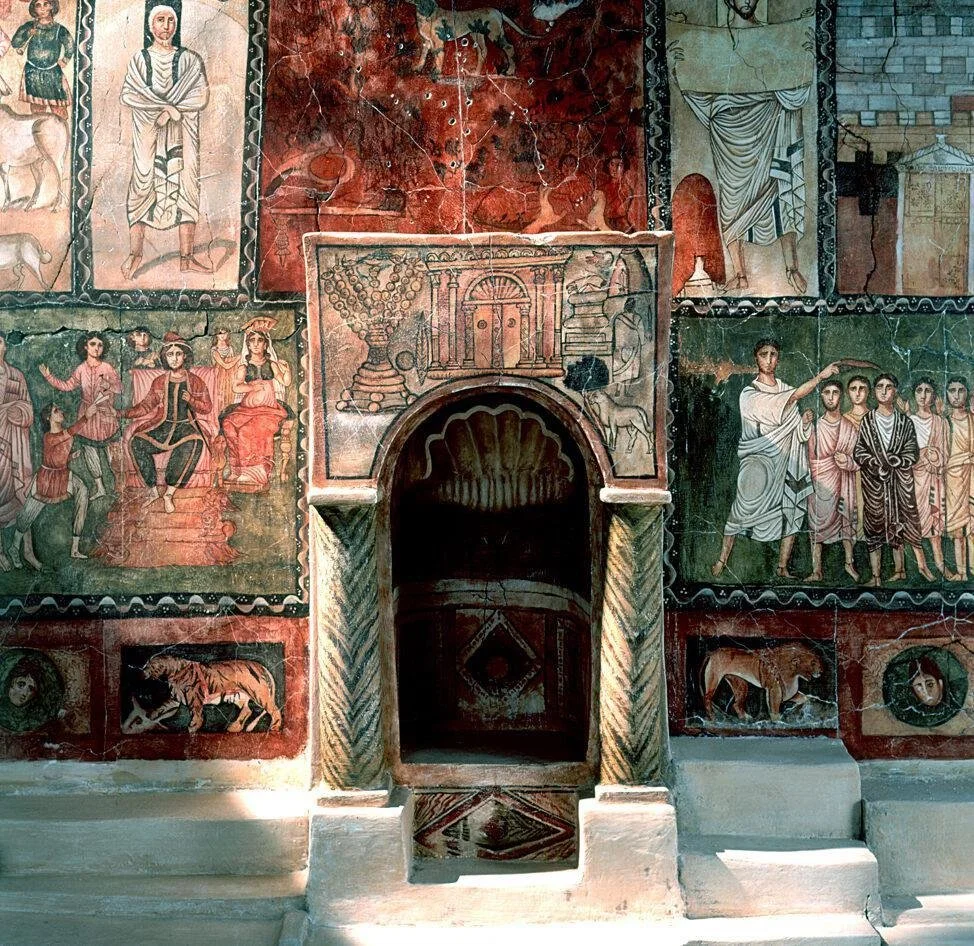
Interior of the Christian baptistery at Dura-Europos, Syria, c. AD 240s. The walls were decorated with biblical scenes surrounding the baptismal font, including early Christian imagery associated with Christ, healing, salvation and the Resurrection. This surviving worship space is important physical evidence that, decades before Constantine, Christians already possessed dedicated places of worship, sacramental rites, Baptism, and sacred biblical art.
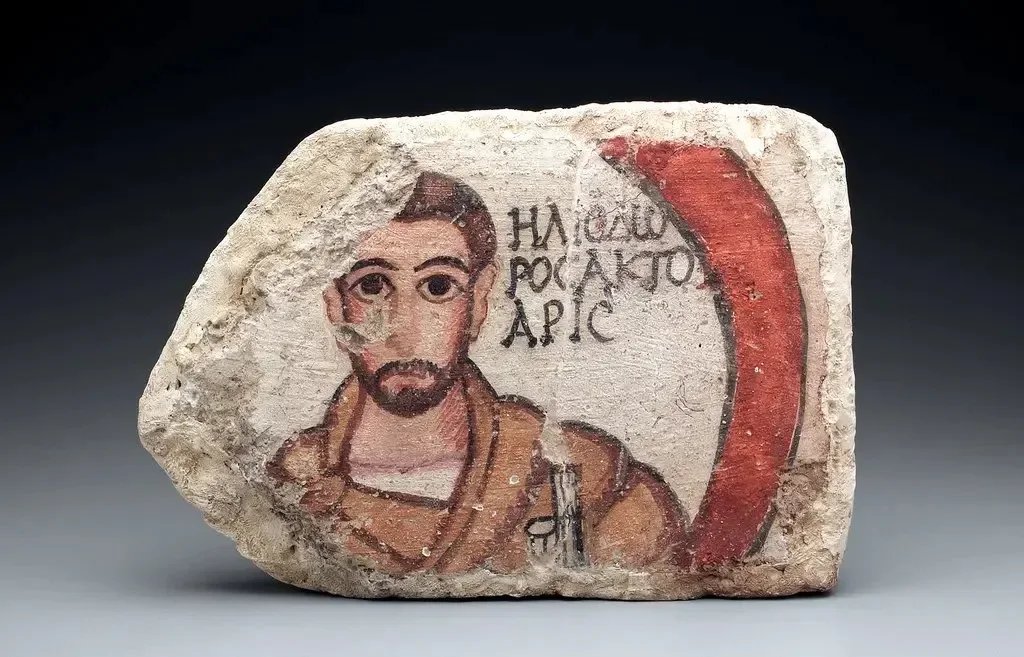
Painted ceiling tile fragment from Dura-Europos, Syria, early to mid-3rd century AD, bearing a portrait of a man identified by the Greek inscription as Heliodoros, an actuarius or administrative clerk. The fragment came from the so-called “House of the Scribes” and reflects the extraordinary cultural mixture of Dura-Europos, where Greek, Roman, Parthian, Semitic, Jewish and Christian communities lived side by side. Its importance here is contextual: the Christian house-church at Dura-Europos existed within this diverse urban world decades before Constantine, showing that Christianity was already one established religion among several in the city long before imperial toleration in AD 313.
Even Pagan Mockery Preserves Evidence of Christian Belief
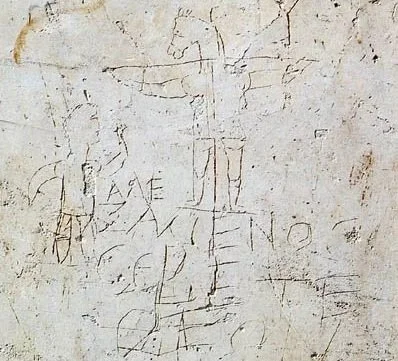
The Alexamenos graffito, Rome, probably late 2nd to early 3rd century AD. Scratched into plaster on the Palatine Hill, it mocks a Christian named Alexamenos by depicting him venerating a crucified figure and adding the taunt, “Alexamenos worships his god.” Intended as ridicule, it is valuable hostile evidence that Christians were already publicly associated with worship of the crucified Christ long before Constantine legalised Christianity in AD 313.
One of the most fascinating surviving pieces of Roman graffiti is the Alexamenos graffito, generally dated somewhere around the late second or third century.
It mocks a Christian apparently named Alexamenos by depicting him worshipping a crucified figure with an animal's head. The accompanying inscription essentially mocks:
“Alexamenos worships his god.”
The image was intended as ridicule. Yet precisely because it is hostile evidence, it is valuable. The pagan mocker understood that Christians worshipped a crucified figure as God.
Again, before Constantine.
What About St Peter's Tomb?
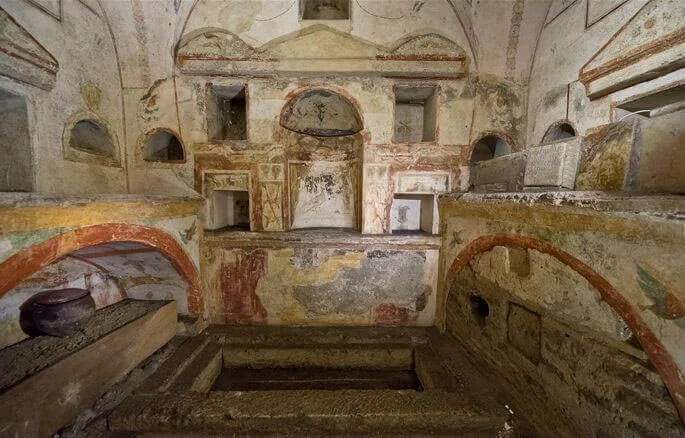
The traditional site of St Peter’s tomb beneath St Peter’s Basilica in Rome. The Vatican necropolis preserves a 1st-century Roman burial area over which a small 2nd-century memorial was constructed and later incorporated into Constantine’s 4th-century basilica. The archaeological importance is significant: Constantine did not create the tradition that Peter was buried here; he monumentalised a site already venerated by Christians before his reign. The identification of the surviving remains with St Peter is supported by tradition and archaeological context, though the bones themselves cannot be proved scientifically to belong to the Apostle with absolute certainty.
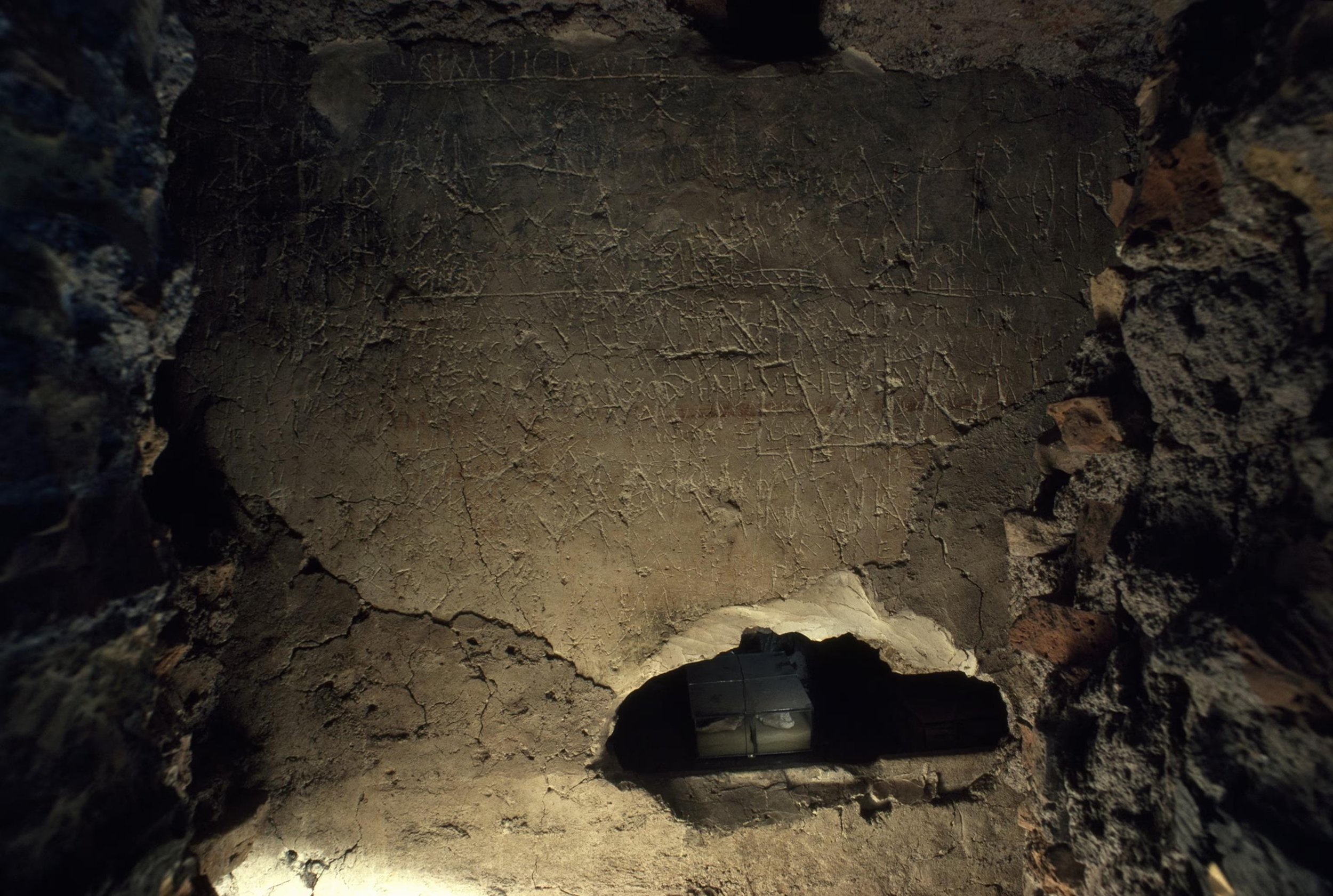
Fragment of the “Red Wall” graffito from the Vatican necropolis beneath St Peter’s Basilica, bearing the Greek letters PETR[…] ENI[…]. It has famously been interpreted as “Peter is here” or “Peter is within,” though another proposed reading is “Peter in peace.” The fragment belongs to the pre-Constantinian archaeological complex associated with the ancient memorial of St Peter, showing that veneration of Peter at this site predates Constantine’s basilica.
The archaeological case beneath St Peter's Basilica is especially significant, although precision is important. Constantine built the original basilica over a site already associated with the burial of St Peter.
Twentieth-century excavations beneath the basilica uncovered an ancient necropolis and a funerary complex associated with Peter. A wall dated to approximately the second century bears Christian graffiti, including a much-discussed Greek inscription associated with Peter. The bones recovered there have been officially regarded as reasonably attributable to the Apostle, though archaeology cannot demonstrate the identity of ancient skeletal remains with mathematical certainty. Vatican Press
The important point for our present question is simpler:
Constantine did not invent Peter's Roman association and then randomly choose a site.
He monumentalised a location already venerated by Christians. Once again, Constantine arrives after the Christian tradition.
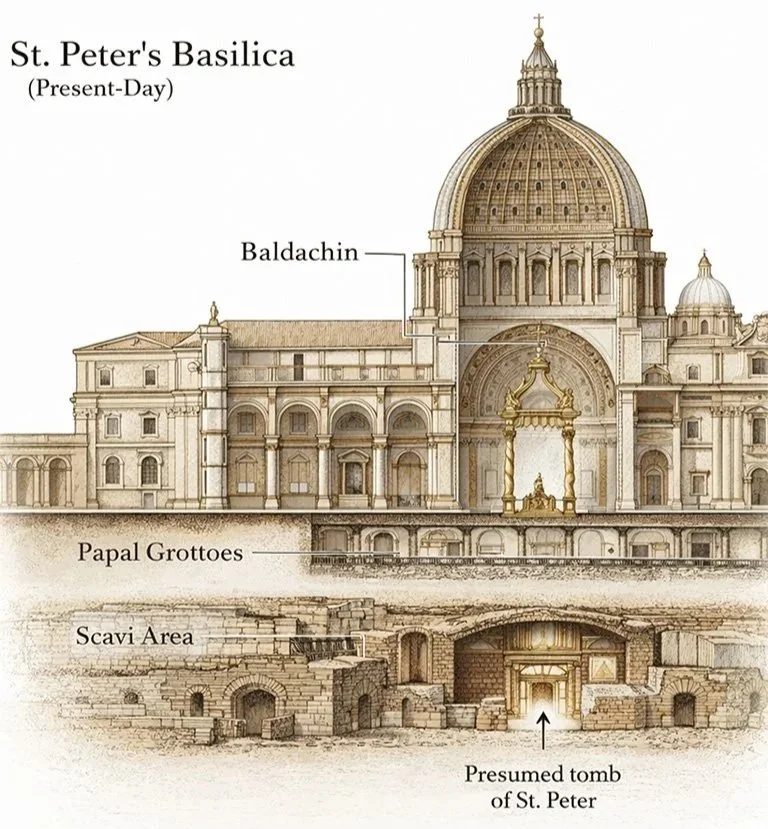
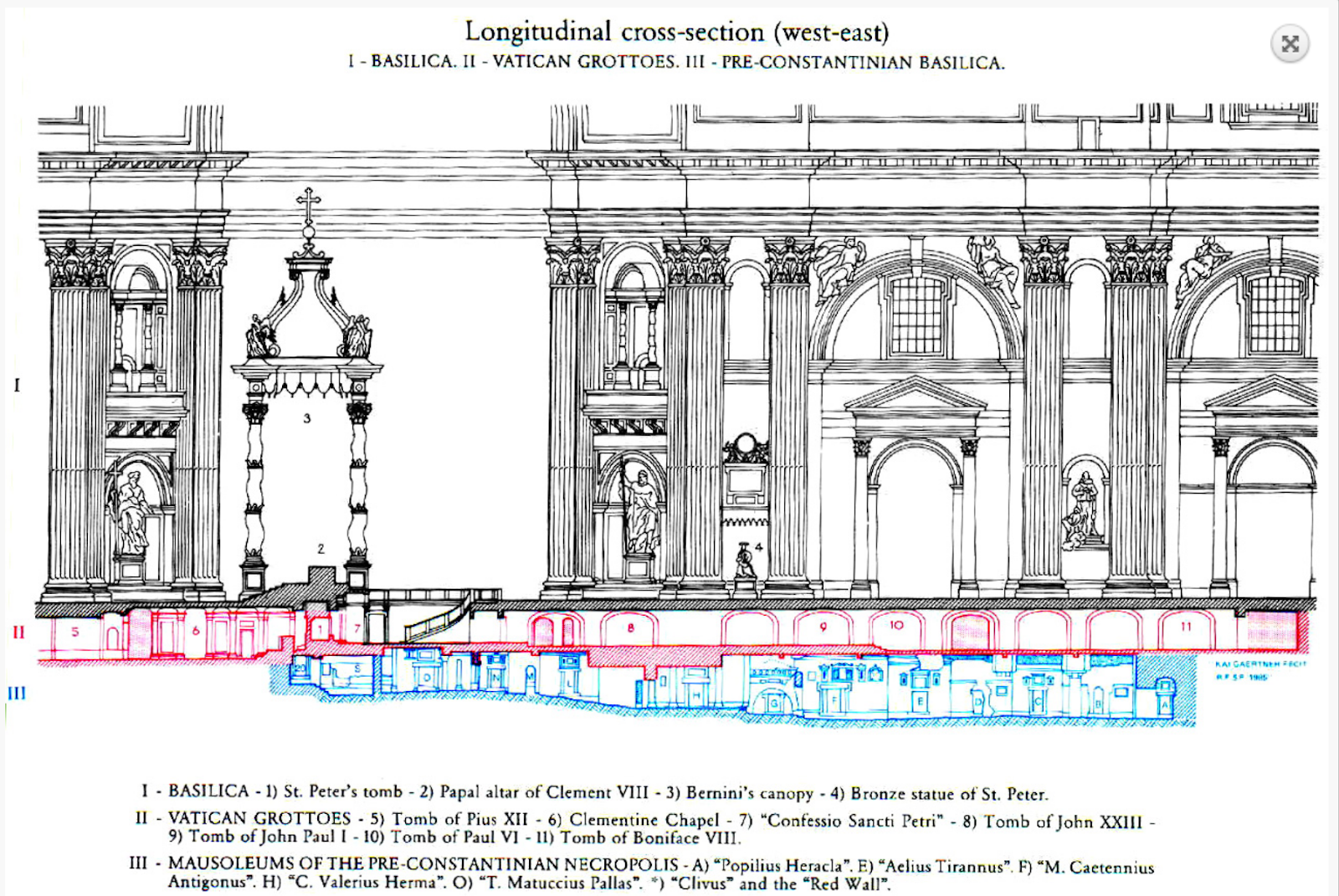
Cross-section of St Peter’s Basilica showing the traditional tomb of St Peter directly beneath the high altar, above the pre-Constantinian necropolis later uncovered by 20th-century excavations. The diagram illustrates the remarkable continuity of the site: the present basilica stands over Constantine’s 4th-century basilica, which in turn was deliberately built above an earlier Roman cemetery containing the ancient memorial associated with St Peter. The excavations did not create the tradition of Peter’s burial here; they revealed the older funerary structures lying beneath the altar and confirmed that Constantine’s basilica had been centred on a pre-existing site of Christian veneration.
What Was the Roman World That Christianity Entered?
To appreciate what happened, we must stop imagining the Roman Empire as modern secular Europe with togas.
It was profoundly pagan.
Religion permeated civic life.
Rome contained temples and cults dedicated to numerous gods. Imperial religion, civic sacrifice and loyalty to Rome were intertwined. The empire absorbed numerous religious cults, including those of Isis, Mithras and Cybele. Metropolitan Museum of Art Resources
Roman religion was not merely a private matter of personal spirituality.
Public sacrifices helped express loyalty to the political and cosmic order.
And the emperor himself occupied an increasingly sacral position.
That created an unavoidable collision with Christianity.
“Jesus Is Lord” Was Not an Innocuous Statement
Christians could pray for the emperor.
They could obey legitimate civil authority.
But they could not worship him.
They could not burn incense to the gods merely because the state demanded it.
They could not confess Caesar as divine.
There was only one God.
And Jesus Christ was Lord.
Pliny's interrogation procedure reveals the collision perfectly. To prove that someone was not genuinely Christian, he required the accused to:
invoke the Roman gods
↓
offer incense and wine before the emperor's image
↓
curse Christ
Genuine Christians, Pliny observed, could not be induced to do this. Internet History Sourcebooks
This explains why martyrdom became such a fundamental part of early Christian memory. The conflict was ultimately theological:
Rome said: Sacrifice. The Christian replied: I cannot worship a false god.
Rome said: The emperor commands it. The Christian replied: Jesus Christ is Lord.
For countless Christians, that refusal cost them their freedom, possessions, bodily integrity or lives.
The Brutality of the Persecutions
The Roman persecutions varied enormously by emperor, period and region. It would be historically inaccurate to suggest that every Christian was continuously hunted throughout the first three centuries. But when persecution came, it could be ferocious.
Tacitus' description of Nero's persecution is chilling. After the fire of Rome in AD 64, Christians were blamed. Tacitus describes their punishment with what he calls extreme cruelty. Penelope
Later persecutions under emperors such as Decius, Valerian and especially Diocletian attempted to compel Christians to conform to Roman religious requirements. The Roman catacombs themselves preserve the memory and graves of martyrs from these persecutions. Vatican archaeological material specifically records martyrs killed during persecutions under Decius, Valerian and Diocletian and the devotion that subsequently grew around their tombs. Vatican Press
This makes the Constantine theory almost absurd when put chronologically:
Rome persecutes Christians.
Christians die rather than abandon Christ.
Christian bishops govern communities.
Christian writers defend Catholic doctrine.
Christians celebrate the Eucharist.
Christians bury their martyrs.
Christians paint biblical scenes in their cemeteries.
Christians spread throughout the Empire.
And then—only after all this—
Constantine appears.
So Why Did Constantine Stop Persecuting Christians?
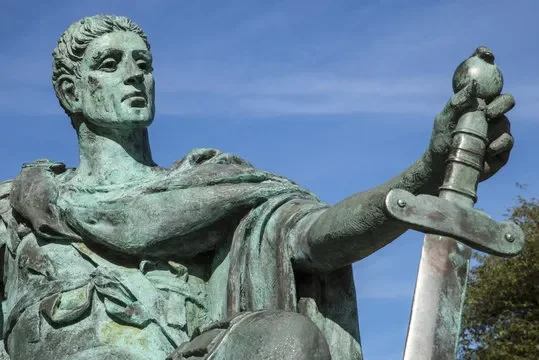
Bronze statue of Emperor Constantine the Great (c. AD 272–337). After centuries in which Christians had periodically suffered persecution under Roman rule, Constantine’s victory at the Milvian Bridge in AD 312 was followed by imperial favour toward Christianity and, with Licinius, the policy of toleration associated with the Edict of Milan in AD 313. Constantine did not found the Catholic Church; he encountered a Church already nearly three centuries old and helped end its legal persecution within the Roman Empire.
This requires some nuance because there was not a single instantaneous event by which “Constantine ended all persecution everywhere.” The great Diocletianic persecution had begun before Constantine's supremacy.
In AD 311, the pagan emperor Galerius—himself previously associated with persecution—issued an edict tolerating Christianity. The document is remarkable because it admits that earlier Roman policy had attempted to force Christians back into traditional religion, but had failed. Internet History Sourcebooks
Then came Constantine.
In AD 312, he defeated Maxentius at the Battle of the Milvian Bridge. Ancient Christian sources connect his victory with a religious experience and the Christian sign. The precise historical interpretation of Constantine's conversion and its stages continues to be debated, and we should not claim more than the sources allow. But the political consequence is indisputable.
In AD 313, Constantine and Licinius agreed upon the policy commonly called the Edict of Milan. It granted Christians—and importantly others as well—liberty to practise their religion. The surviving text declares that:
“no one whatsoever should be denied the opportunity” to observe Christianity and provides broader religious liberty. Internet History Sourcebooks
Constantine subsequently became Christianity's powerful imperial patron. But notice what the document does not say:
“We hereby create Christianity.”
It recognises Christians as an already existing religious body.
Constantine Did Not Make Christianity True—Christianity Conquered the World That Had Persecuted It
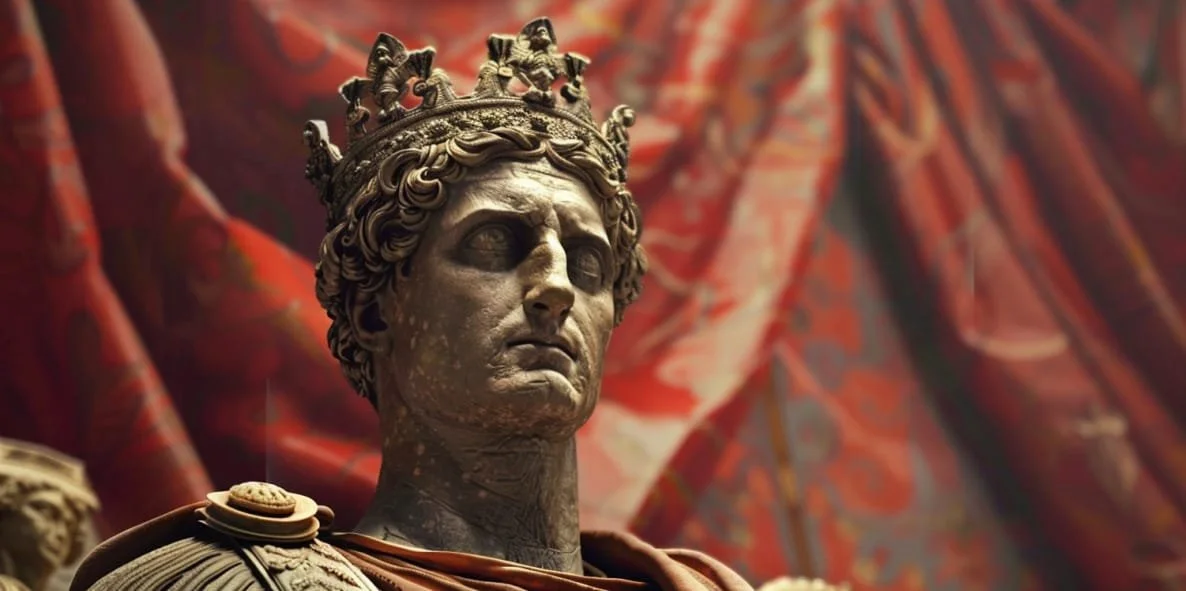
Emperor Constantine the Great (c. AD 272–337), the Roman ruler whose conversion and subsequent policies transformed Christianity’s legal position within the Empire. After his victory at the Milvian Bridge in AD 312, Constantine increasingly favoured Christianity, and in AD 313 the policy associated with the Edict of Milan granted Christians legal toleration. He did not create the Catholic Church; by his time it had already existed for nearly three centuries, with bishops, sacraments, martyrs, apostolic succession, sacred worship and a documented Catholic identity.
There is something much more remarkable here than an emperor supposedly inventing a religion. For nearly three centuries Christianity grew without commanding Roman armies.
It began with a crucified Jewish teacher and a small group of disciples.
Its founder was executed.
Peter was martyred.
Paul was martyred.
Christians were mocked.
Their religion was periodically outlawed.
Their Scriptures were attacked.
Their bishops were imprisoned or killed.
Ordinary Christians could lose everything rather than offer a handful of incense to pagan gods.
And yet Christianity continued spreading.
Jerusalem.
Antioch.
Asia Minor.
Greece.
Rome.
North Africa.
Gaul.
Spain.
Egypt.
Syria.
And eventually far beyond the Empire.
Oxford historian David Potter describes Christianity as developing gradually from the fringes of Roman intellectual society and attracting converts into the fourth century; Constantine's significance was that his conversion helped transform an already-existing Christianity from a marginal movement into a central force within the Empire. OUP Academic
That is very different from saying he invented it. Oxford scholar Mark Edwards similarly treats Constantine's conversion as occurring amid an already-existing religious transformation; Constantine's conversion was, in his formulation, as much an effect as a cause of the religious ferment of the period. OUP Academic
These are not Catholic apologetic claims. They are mainstream historical scholarship.
Christianity Ultimately Conquered Rome Without Legions
Here lies one of the extraordinary reversals of world history. The Roman Empire possessed armies, governors, courts, prisons, wealth, temples and immense political power. The early Christians possessed none of those things. They preached a crucified Christ.
And ultimately:
the Cross outlived the imperial cult.
The emperors who demanded divine honours disappeared.
The temples of the old state gods ceased functioning as the religious heart of Europe.
The Faith once practised in homes and buried in catacombs came into the daylight.
The city in which Peter and Paul were killed became one of Christianity's great centres.
The instrument by which Rome had executed criminals—the cross—became the supreme Christian sign.
The graves of men and women once condemned by imperial authorities became places of pilgrimage.
That is not the story of Constantine manufacturing Christianity. It is the story of an empire eventually being converted by the religion it had once attempted to suppress.
Did Christianity Transform the World for the Better?
Profoundly so—although a serious historical argument should not pretend that every Christian ruler, society or individual subsequently lived perfectly according to the Gospel.
Christianity's moral revolution began long before Constantine. Pliny's hostile investigation around AD 112 found Christians pledging themselves against fraud, theft, adultery and dishonesty. Internet History Sourcebooks
Christianity proclaimed something revolutionary about human worth:
The slave and emperor stood before the same God.
The rich and poor possessed souls of equal value.
The unborn and unwanted were not disposable property.
Marriage possessed a sacred moral character.
Sexual conduct was subject to God's law rather than appetite.
Forgiveness was superior to vengeance.
Charity toward strangers was a religious duty.
The sick and dying were to be cared for.
Power was subordinate to moral law.
The emperor himself was not God.
And the highest model of human greatness was not Caesar surrounded by armies. It was Christ crucified.
The transformation was not instantaneous. Pagan customs persisted for centuries. Christian societies remained populated by sinful human beings. Wars, injustices and corruption did not disappear. But the moral axis of civilisation had shifted. The ruler was no longer divine.
God stood above the ruler.
Constantine at Nicaea: Another Common Confusion
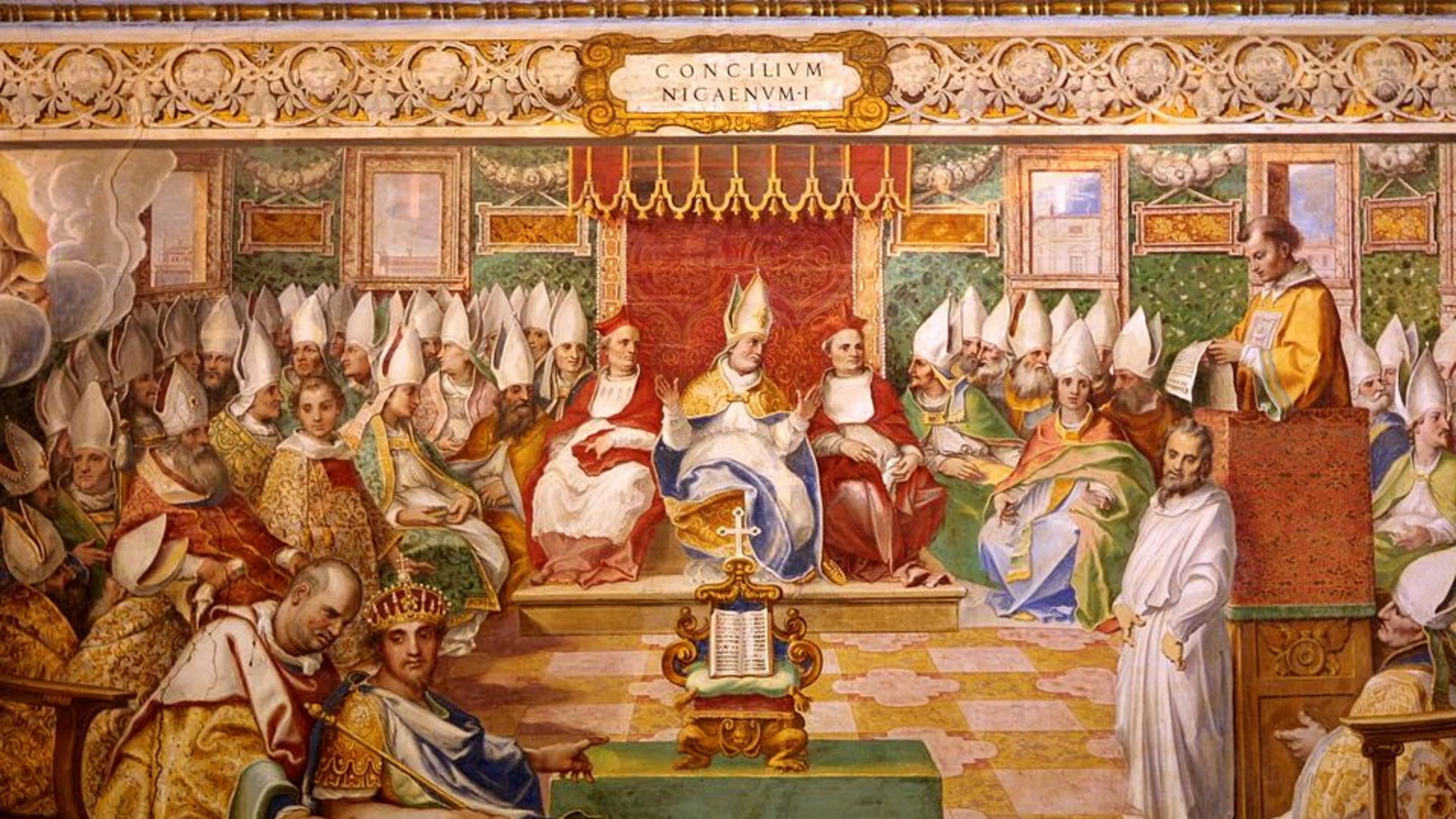
The First Council of Nicaea, AD 325, where bishops from across the Christian world gathered to condemn Arianism and affirm the true divinity of Jesus Christ. Constantine convened and supported the council politically, but he did not create the Church or invent her doctrine. The very existence of hundreds of bishops meeting in council presupposes a long-established Catholic hierarchy, sacramental life, apostolic succession and body of doctrine already in place centuries before Constantine.
Another version of the myth claims:
“Constantine created Catholic Christianity at the Council of Nicaea in AD 325.”
But the Council itself disproves that interpretation. Constantine could summon and support the bishops politically. He could not invent bishops who had already existed for centuries.
Indeed, the canons of Nicaea casually refer to an already-developed ecclesiastical world of:
bishops;
presbyters;
deacons;
diocesan structures;
established customs;
ecclesiastical jurisdiction;
the Eucharist.
Canon 18, for example, discusses the proper relationship of deacons, presbyters and bishops in administering the Eucharist. New Advent
These offices were not invented at Nicaea. Ignatius had described them approximately 215 years earlier. New Advent
Nicaea therefore did not create the Catholic Church. A council of Catholic bishops presupposes the existence of the Church whose bishops attended it.
Put the Evidence on One Timeline
| Date | Evidence | What It Establishes |
|---|---|---|
| c. AD 30–33 | Christ commissions the Apostles | Church begins with Christ, not Constantine |
| c. AD 50s | Pauline epistles | Eucharist, bishops/deacons, doctrine, ecclesial discipline |
| AD 64 | Nero persecutes Christians at Rome | Christians established at Rome in first century |
| c. AD 96 | Clement of Rome | Apostles appoint bishops/deacons and provide for succession |
| c. AD 107–110 | Ignatius of Antioch | “Catholic Church,” bishop, presbytery, deacons, Eucharist |
| c. AD 112 | Pliny to Trajan | Christians worship Christ as God and refuse pagan worship |
| c. AD 150 | Justin Martyr | Baptism, Sunday worship, Eucharist as Christ's flesh and blood |
| c. AD 180 | Irenaeus | Apostolic succession and Roman episcopal succession |
| c. AD 200 | Tertullian | Apostolic churches and episcopal succession used against heresy |
| Early 3rd century | Roman catacombs | Christian inscriptions, symbols and biblical art |
| c. AD 230–240 | Priscilla Virgin and Child | Christian sacred imagery before Constantine |
| c. AD 250 | Cyprian | Explicit Catholic Church, episcopate and visible unity |
| c. AD 250s | Dura-Europos | Christian church/baptistery with biblical paintings |
| AD 258 | Cyprian martyred | Catholic bishop dies before Constantine's birth-era |
| AD 303–311 | Great Persecution | Empire attempts to suppress already-existing Christianity |
| AD 311 | Galerius toleration | Pagan state acknowledges failure to eradicate Christians |
| AD 312 | Milvian Bridge | Constantine defeats Maxentius |
| AD 313 | Milan agreement | Christianity receives legal toleration |
| AD 325 | Nicaea | Existing bishops meet to settle doctrinal controversy |
There is no historical space in that chronology for the proposition:
“Constantine invented the Catholic Church.”
The Church is visible in the evidence generation after generation before him.
The Strongest Objection: “Christianity Existed, but Constantine Invented Catholicism”
This is a more sophisticated objection. It concedes that Christians existed before Constantine but argues that primitive Christianity was fundamentally different and that Constantine transformed it into “Roman Catholicism.” The problem is that the ante-Nicene sources already contain too many supposedly “later Catholic” features. Before Constantine we find:
Catholic Church
bishops
presbyters
deacons
apostolic succession
Roman episcopal succession
authoritative Church discipline
baptism
Sunday Eucharistic worship
Eucharistic realism
sacrificial terminology
martyrs
Christian sacred art
Church unity
heresy as objectively false doctrine
appeals to apostolic Tradition
Constantine undoubtedly changed the Church's political circumstances. Imperial favour brought advantages—and new dangers. Wealth, prestige and imperial involvement could affect ecclesiastical life. Historians are entirely justified in studying those developments critically. But that is a completely different proposition from:
Constantine invented Catholicism.
The documentary record simply does not permit that conclusion.
What We Can and Cannot Conclude
What We Can Conclude
We can conclude with very high historical confidence that:
Jesus of Nazareth and the Apostolic movement preceded Constantine by nearly three centuries.
Christians existed at Rome in the first century.
An organised ministry of bishops/deacons and provision for succession appears in very early Christian literature.
The expression “Catholic Church” is documented around AD 110.
Eucharistic, baptismal and episcopal Christianity is extensively documented during the second century.
Apostolic succession was being used to distinguish orthodox Christianity from heretical movements long before Constantine.
Christians were worshipping, writing, burying their dead, producing sacred imagery and suffering persecution before Constantine.
Pagan Roman sources independently confirm Christian belief and practice.
Constantine therefore could not have invented the Catholic Church.
What We Cannot Conclude
Archaeology alone cannot prove every Catholic dogma.
A catacomb painting by itself cannot establish the entire theology of later Marian devotion.
The archaeological evidence concerning St Peter's remains deserves appropriate qualification.
Nor should every later development in Christian civilisation simply be attributed personally to Constantine.
But none of these qualifications rescues the Constantine-invention thesis.
The chronological evidence against it is overwhelming.
Conclusion
The question can finally be reduced to something very simple. Who came first?
Jesus Christ — c. AD 30
↓
The Apostles
↓
Christian Church at Rome — first century
↓
Clement of Rome — c. AD 96
↓
Ignatius: “the Catholic Church” — c. AD 110
↓
Justin: Baptism + Eucharist + Sunday worship — c. AD 150
↓
Irenaeus: Rome + bishops + apostolic succession — c. AD 180
↓
Tertullian: apostolic churches + episcopal succession — c. AD 200
↓
Christian catacomb art — third century
↓
Cyprian: “Catholic Church” — c. AD 250
↓
Dura-Europos Christian church and baptistery — third century
↓
Great Roman Persecution — AD 303
↓
CONSTANTINE — AD 312–313
The sequence is fatal to the myth.
Constantine did not found the Catholic Church.
Jesus Christ did.
Constantine came almost three centuries later and encountered a Church that already possessed Scriptures, bishops, clergy, sacraments, martyrs, theology, ecclesiastical discipline, apostolic succession, sacred art, cemeteries, churches and a name:
THE CATHOLIC CHURCH
The extraordinary historical story is therefore not that a Roman emperor manufactured Christianity. It is almost the reverse.
The Roman Empire crucified Christ.
Rome killed Peter and Paul.
Roman authorities persecuted their followers.
Christians refused to worship Caesar as divine.
Generation after generation preserved and spread the Faith.
And eventually the Empire that had tried to destroy Christianity ceased persecuting it.
The Cross remained.
The imperial gods did not.
For the Catholic, this is more than an historical curiosity. It is a striking fulfilment of Christ's command to teach all nations and of His promise concerning the Church He Himself founded:
“Upon this rock I will build my church, and the gates of hell shall not prevail against it.” — Matthew 16:18
Primary Sources
St Clement of Rome, First Epistle to the Corinthians, chapters 42–44 — Christ sends the Apostles; the Apostles establish ministers and provide for succession.
St Ignatius of Antioch, Epistle to the Smyrnaeans, chapter 8 — bishop, presbytery, deacons, Eucharist and the explicit expression “Catholic Church.”
The Didache, chapters 14–15 — Lord's Day worship, breaking bread, sacrifice, bishops and deacons.
St Justin Martyr, First Apology, chapters 65–66 — detailed second-century description of the Eucharist.
St Irenaeus, Against Heresies III.3 — apostolic tradition, succession of bishops and the Church at Rome.
Tertullian, Prescription Against Heretics — apostolic churches and episcopal succession as tests against newly invented sects.
Tacitus, Annals XV.44 — hostile Roman testimony to Christ, Pilate and Christians at Rome under Nero.
Pliny the Younger to Trajan — pagan Roman evidence that Christians worshipped Christ as divine and refused pagan worship.
Edicts of Toleration, AD 311 and 313 — primary evidence showing an already-existing Christian religion moving from persecution toward legal toleration.