What About the Crusades and the Inquisition?
Short Answer
The Crusades and the Inquisition are frequently presented as two of the strongest arguments against the Catholic Church. Popular accounts often reduce them to a simple story:
medieval popes encouraged fanatical Christians to invade peaceful Muslim lands,
promising Heaven in exchange for killing unbelievers; later, the Church supposedly tortured and burned enormous numbers of innocent people merely for disagreeing with Catholic doctrine.
That picture is historically indefensible. The Crusades arose in a world in which Christian territories that had once extended across North Africa, Egypt, Palestine, Syria and much of Asia Minor had, over centuries, fallen under Muslim rule.
The immediate First Crusade followed a direct appeal from the Byzantine Emperor Alexios I for military assistance after Turkish expansion had devastated Byzantine control of Asia Minor. Jerusalem—the destination of Christian pilgrimage from antiquity—was under Muslim rule, while the eastern Christian world faced an acute military threat. Modern scholarship accordingly treats the First Crusade not simply as an unprovoked European colonial invasion, but as a complex combination of armed pilgrimage, penitential warfare, assistance to Eastern Christians and recovery of Christian holy places.
Nor were most crusaders simply landless thugs looking for loot.
Crusading was ruinously expensive. Research into crusading charters shows men selling or mortgaging lands and rights to finance expeditions that could cost several times their annual income.
Material gain certainly motivated some participants, but the old theory that crusading was principally an outlet for greedy younger sons has been substantially weakened by modern scholarship.
The Inquisition likewise cannot honestly be evaluated through the mythology of torture chambers and millions of victims. There was not originally one monolithic institution called “the Inquisition.” Inquisitio was fundamentally a judicial procedure—an inquiry—used within the developing medieval legal system.
People were indeed imprisoned, coerced and, in some cases, eventually executed following convictions for heresy. Those facts must not be concealed.
But executions were carried out by the secular authority, and surviving records reveal numbers radically below the enormous figures propagated by the later “Black Legend.”
The proper historical question is therefore not:
“Were medieval Catholics sometimes violent?”
Of course they were. The proper questions are:
Why did the Crusades begin?
What did the popes actually authorize?
Why did medieval society regard persistent public heresy as a crime?
How did ecclesiastical procedure compare with contemporary secular justice?
How many people were actually executed?
And do abuses committed by Catholics disprove the Catholic Faith?
Once those questions are asked historically rather than polemically, a remarkably different picture emerges.
Why This Question Matters
Few historical subjects generate stronger emotional reactions than the Crusades and the Inquisition. The words themselves have become symbols.
Crusade is often made synonymous with religious aggression.
Inquisition has become shorthand for intolerance, torture and arbitrary persecution.
Consequently, a Catholic may be confronted with an argument like this:
“How can the Catholic Church claim to be founded by Christ when it launched wars against Muslims and tortured people who disagreed with it?”
That objection deserves a serious answer. But it requires something often missing from popular discussions: historical context.
It is profoundly misleading to remove an institution from the legal, political and religious world in which it existed and then compare it directly with the assumptions of twenty-first-century liberal democracies. We must instead ask what actually happened. And we must distinguish several things that are routinely confused:
Catholic doctrine from papal policy from medieval civil law from actions of individual Catholics from crimes committed contrary to papal instructions from later legends about what supposedly happened.
Without those distinctions, history becomes propaganda.
PART I — THE CRUSADES
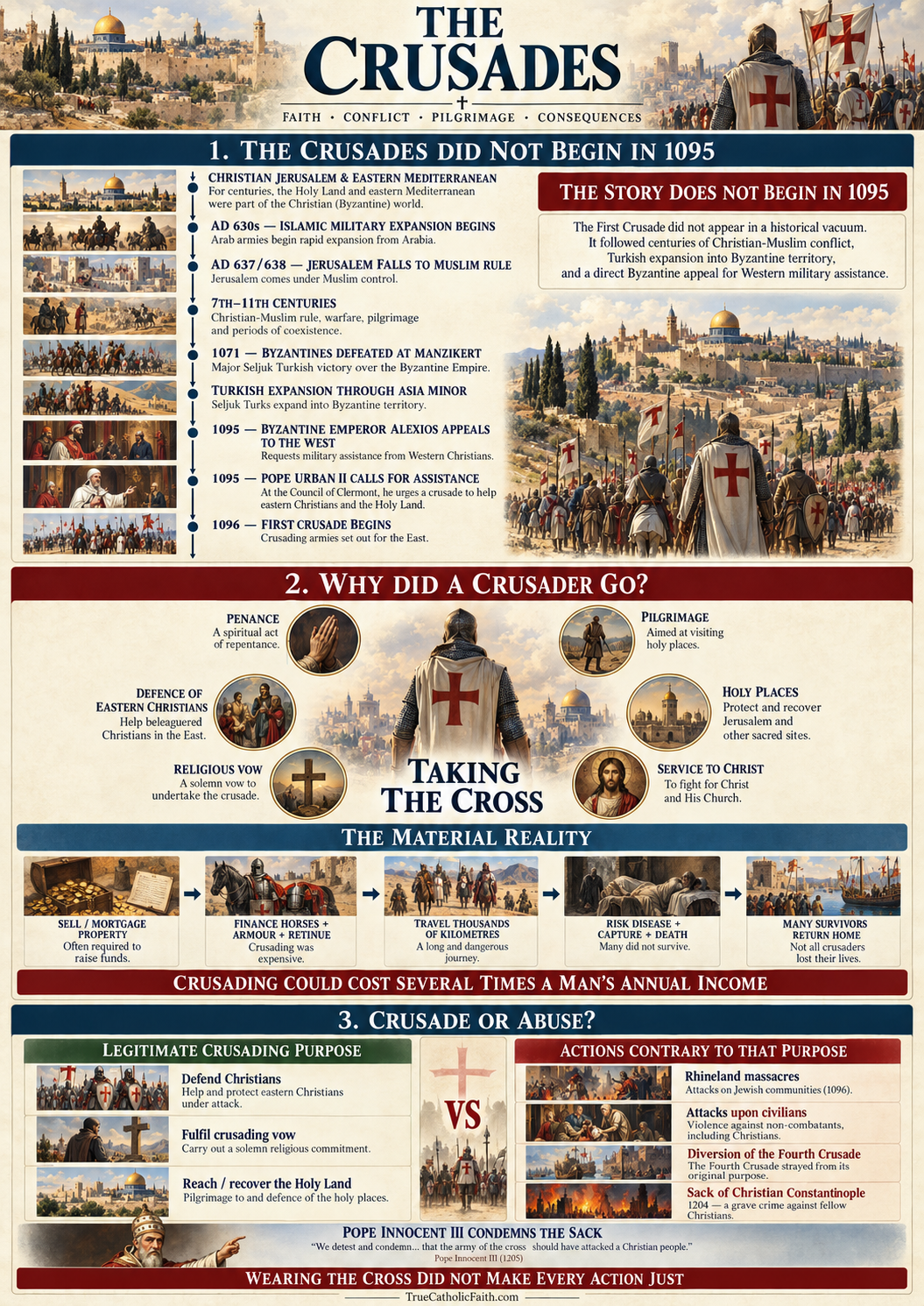
What Was a Crusade?
The medieval participants did not normally think of themselves as members of a movement called “the Crusades” in the modern textbook sense. The central concept was pilgrimage.
A crusader took the Cross, made a religious vow and undertook an extraordinarily dangerous journey in service of what the Church regarded as a legitimate Christian cause.
Jonathan Riley-Smith, one of the most influential modern historians of crusading, emphasized precisely this penitential and devotional character. Cambridge's summary of his scholarship describes Pope Urban II's innovation as joining warfare to the established Christian institution of pilgrimage, with Jerusalem as the supreme destination.
Thus the basic medieval concept was closer to:
ARMED PILGRIMAGE than to RELIGIOUS IMPERIALISM
That distinction does not make everything crusaders did morally acceptable. It tells us what institution we are actually discussing.
What Happened Before the First Crusade?
A popular version of history sometimes begins in 1095. That is already a serious distortion.
Christianity originated in the Middle East. Jerusalem was Christian centuries before Islam existed. So were many of the greatest centres of ancient Christianity:
Jerusalem;
Antioch;
Alexandria;
large parts of Syria;
Egypt;
North Africa;
much of Asia Minor.
Islam arose in the seventh century. Within decades, Muslim armies conquered enormous territories formerly belonging to Christian or Byzantine civilisation. Jerusalem fell to Muslim forces in AD 638.
For centuries thereafter relations between Christians and Muslim rulers varied enormously. There were periods of toleration, commerce and coexistence as well as periods of persecution, warfare and instability.
This qualification matters. It would be false to portray the entire period from the seventh to eleventh centuries as four centuries of uninterrupted Muslim persecution. But it is equally false to begin the history with armed Europeans suddenly arriving in lands that had always been Muslim. They had not.
The Immediate Crisis: Byzantium
By the eleventh century a new power—the Seljuk Turks—was transforming the balance of power. The Byzantine Empire suffered a catastrophic defeat at Manzikert in 1071. During the following decades Byzantine control over much of Asia Minor collapsed. Eventually Emperor Alexios I Komnenos appealed to Western Christians for military assistance.
That appeal is crucial. The First Crusade did not begin because Pope Urban II suddenly decided that Christians should conquer foreign territory for sport. The Christian Byzantine emperor had appealed to the West for military assistance against Turkish expansion.
Modern histories of the First Crusade explicitly identify Alexios's appeal as one of its immediate causes. This gives the basic sequence:
CENTURIES OF MUSLIM EXPANSION INTO FORMERLY CHRISTIAN TERRITORIES
↓
BYZANTINE CATASTROPHE AT MANZIKERT — 1071
↓
LOSS OF LARGE PARTS OF ASIA MINOR
↓
EMPEROR ALEXIOS APPEALS TO THE WEST
↓
POPE URBAN II CALLS FOR ASSISTANCE
↓
FIRST CRUSADE — 1096–1099
That context does not prove that every subsequent action was justified. But it destroys the simplistic claim that the First Crusade was an entirely unprovoked Catholic attack upon an otherwise peaceful Islamic world.
What About Christian Pilgrims?
Pilgrimage to Jerusalem had been an ancient Christian practice. The Holy Sepulchre was not merely an attractive tourist destination. For Christians it marked the place associated with the Death, Burial and Resurrection of Jesus Christ. Access to the holy places varied under different Muslim rulers. Christians were sometimes permitted considerable freedom; at other times circumstances deteriorated. Consequently, it is better not to make the entire justification for the First Crusade depend upon the claim that every Christian pilgrim was constantly being attacked.
That would be historically excessive. The stronger case is cumulative:
Muslim conquest had taken historically Christian territories;
Byzantine power in Asia Minor was collapsing;
the Byzantine emperor requested Western military assistance;
Jerusalem and the holy places were under non-Christian control;
Christian pilgrimage was vulnerable to political instability;
Eastern Christian populations faced military pressure.
Urban's appeal must be understood within that world.
Pope Urban II and Clermont
In 1095, Pope Urban II preached what became the First Crusade at Clermont. We do not possess a verbatim transcript of his speech. Several later accounts survive and differ in detail.
But Urban's purpose is also documented in correspondence. He presented the enterprise as assistance to Eastern Christians and liberation of the holy places. The First Crusade was therefore simultaneously understood as:
pilgrimage + penance + military assistance + recovery of Christian sacred territory.
Did the Pope Promise Heaven for Killing Muslims?
The crude version is false. Urban II did not simply teach:
“Kill a Muslim and you automatically go to Heaven.”
But another extreme would also be false:
“The pope offered no spiritual remission connected with crusading.”
He did. The Council of Clermont associated undertaking the Jerusalem expedition from genuine devotion with the remission of canonical penance. Scholarship on the crusading indulgence identifies the expedition explicitly as a penitential undertaking. The important Catholic distinction is between:
forgiveness of the guilt of sin and remission of temporal punishment due to forgiven sin.
An indulgence is not permission to commit murder.
It is not forgiveness for sins one intends to continue committing.
It is not a ticket purchased for Heaven.
And it does not eliminate the necessity of genuine repentance.
Indeed, the surviving formulation associated with Clermont is particularly important because it speaks of those undertaking the expedition:
from devotion rather than for honour or wealth.
That is almost the opposite of the modern caricature.
Crusading Was Penance, Not a Holiday
The reality of crusading makes the “easy route to wealth” theory particularly difficult to sustain. A crusader might have to:
sell land;
mortgage estates;
borrow heavily;
purchase armour;
obtain horses;
provide weapons;
finance retainers;
travel thousands of kilometres;
cross hostile territory;
endure hunger;
endure disease;
survive sieges;
risk captivity;
risk death.
Modern research estimates that crusading could cost roughly two to five times a participant's annual income, depending upon circumstances and rank. Numerous charters document the sale and mortgaging of property to finance crusading.
Duke Robert of Normandy famously mortgaged his duchy. Other crusaders sold mills, rights, lands and other assets.
If the primary objective had simply been easy wealth, this was an astonishingly irrational way of pursuing it.
Were Crusaders Mostly Poor, Ignorant Thugs?
No. People from many social classes participated. And here another myth requires correction.
The main First Crusade should not be confused with every disorderly crowd that attempted to reach the East. The so-called People's Crusade, for example, included poorly organized groups whose behaviour could be appalling. Some groups perpetrated massacres against Jewish communities in the Rhineland.
Those crimes must be condemned. But they should not then be projected onto every crusading army and treated as the purpose of Urban II's undertaking. The principal crusading expedition included some of the leading aristocratic families of Europe.
Crusading eventually attracted:
kings;
princes;
dukes;
counts;
knights;
clergy;
ordinary soldiers;
pilgrims;
members of military religious orders.
The idea that crusaders were predominantly landless younger sons has also been substantially challenged. Riley-Smith's research found little support for the simple economic theory and emphasized instead the extraordinary financial sacrifices made by crusading families.
Faith Was a Real Motive
Modern people sometimes have difficulty believing that medieval men could undertake enormous sacrifices because they genuinely believed in God. So another explanation is invented:
money. Or land. Or adventure.
Certainly those motives existed. Human beings rarely act from only one motive.
Some crusaders wanted wealth.
Some wanted prestige.
Some undoubtedly enjoyed warfare.
Some behaved criminally.
But historians increasingly recognize that medieval religious motivation must be taken seriously on its own terms. Many crusaders genuinely believed that they were:
performing penance;
defending Christians;
protecting sacred places;
fulfilling a vow;
serving Christ;
risking their lives for the Faith.
To dismiss these convictions automatically as propaganda is not historical sophistication. It is imposing modern secular assumptions upon medieval people.
Were the Crusaders Saints?
Some were. But we should avoid replacing one caricature with another. Crusading armies contained sinners. They contained men capable of extraordinary courage, sacrifice and devotion—and men capable of greed, cruelty and brutality.
Several prominent crusaders became canonised saints. The most famous is:
St Louis IX of France
King, husband, father, administrator, patron of the poor and twice a crusader. His participation in crusading was not an embarrassing contradiction to medieval Catholics. It formed part of what they understood as his responsibility as a Christian king. The broader point is not:
“Every crusader was holy.”
It is:
Crusading was regarded by medieval Christians as capable of being a genuinely religious vocation involving enormous personal sacrifice.
What About the Massacre of Jerusalem in 1099?
It happened. When the crusaders captured Jerusalem in July 1099, Muslim and Jewish inhabitants were killed.
Contemporary descriptions use horrific language. Catholic apologetics should not pretend otherwise. But three qualifications are essential.
First, medieval siege warfare was frequently brutal across religious boundaries. The sack of a city taken after resistance was not uniquely Catholic or uniquely crusading.
Second, medieval chroniclers regularly used biblical and rhetorical imagery that should not automatically be converted into modern demographic statistics.
Third—and most importantly—even a genuine atrocity committed by crusaders would demonstrate that crusaders committed an atrocity.
It would not demonstrate that:
Jesus Christ did not found the Catholic Church.
Nor would it establish that:
every purpose of the First Crusade was immoral.
Catholic doctrine has never taught that Christians become incapable of sin when they sew a cross onto their clothing.
What About the Rhineland Massacres?
They were crimes. Groups associated with the popular crusading movement attacked Jewish communities in cities along the Rhine. This cannot be justified by claiming that the victims were enemies in the Holy Land. They were not. They were European civilians.
Such episodes should therefore be distinguished from the legitimate question of armed defence against military enemies. Their existence also illustrates an important principle:
A RELIGIOUS MOVEMENT CAN HAVE A LEGITIMATE PURPOSE WHILE SOME PARTICIPANTS COMMIT GRAVE SINS.
Christianity does not teach that a good end sanctifies evil means.
The Major Crusades in Context
The First Crusade — 1096–1099
Immediate context
Byzantine appeal for assistance;
Turkish expansion;
collapse of Byzantine territory in Asia Minor;
concern for Eastern Christians;
Jerusalem and the holy places;
armed pilgrimage.
Result: Jerusalem was captured in 1099 and Latin Christian states were established in the East.
Important qualification: The capture involved serious bloodshed, including killings of civilians. Nevertheless, the expedition cannot accurately be reduced to an unprovoked colonial adventure.
The Second Crusade — 1147–1149
The immediate trigger was the fall of Edessa in 1144. Edessa was one of the principal Christian states established after the First Crusade. Its capture produced alarm throughout Latin Christendom. The Second Crusade therefore arose in response to a major military reversal in the East.
It ultimately failed. Its history also demonstrates that papal calls to crusade did not guarantee military success.
The Third Crusade — 1189–1192
In 1187, Saladin decisively defeated the Christian army at Hattin. Jerusalem subsequently fell.
The Third Crusade was therefore launched principally to recover territory lost in this major Muslim offensive. Its most famous Western leader was Richard I of England—Richard the Lionheart.
Jerusalem was not recovered. Nevertheless, the crusaders preserved important Christian positions along the coast and negotiated arrangements that permitted Christian pilgrims access to Jerusalem.
Even an older secular reference work such as the Encyclopaedia Britannica acknowledged that the Third Crusade preserved Antioch, Tripoli and important coastal positions despite failing to retake Jerusalem.
The Fourth Crusade — 1202–1204
This is indispensable because it demonstrates why one cannot simply attribute everything done by crusaders to the pope. The intended destination was not Constantinople. Financial and political circumstances diverted the expedition.
The crusaders eventually attacked and brutally sacked Constantinople, a Christian city. Pope Innocent III condemned what happened. His surviving correspondence rebukes the crusaders for desecrating churches, seizing sacred objects and abandoning the purpose of their pilgrimage.
This is enormously important. The Fourth Crusade cannot honestly be used to argue:
“Look what the pope ordered.”
The pope did not order the sack of Constantinople. The episode demonstrates instead something Catholic theology has always admitted:
Catholics can disobey the Pope.
Soldiers can betray the purpose for which an expedition was authorised.
Taking the Cross did not make every subsequent act morally legitimate.
The Fifth Crusade — 1217–1221
The Fifth Crusade sought to recover Jerusalem indirectly by attacking Egypt, then regarded as the strategic centre of Muslim power in the region. The campaign captured Damietta but ultimately failed.
Again the history is more complicated than the idea of successive waves of Europeans blindly attacking Muslims. Crusading strategy had become deeply connected with the geopolitical problem of sustaining the remaining Christian states.
The Sixth Crusade — 1228–1229
This crusade is particularly interesting because Jerusalem was recovered largely through diplomacy rather than battle. Emperor Frederick II negotiated an agreement with Sultan al-Kamil.
Jerusalem, Bethlehem and access to Nazareth were restored to Christian control for a period. The episode alone should make us cautious about describing crusading ideology as an indiscriminate command to slaughter Muslims. A crusading objective could be pursued through negotiation.
The Seventh Crusade — 1248–1254
This expedition was led by St Louis IX of France. Its strategic objective again centred upon Egypt. Louis was captured after the failure of the campaign and eventually ransomed.
His personal commitment demonstrates how deeply crusading could be connected with Christian kingship, penance and religious devotion.
The Eighth Crusade — 1270
St Louis undertook another expedition, this time to North Africa. He died near Tunis.
Whatever one thinks of the strategic wisdom of these later expeditions, it is difficult to portray Louis simply as a brigand seeking wealth. He already possessed one of Europe's greatest kingdoms. Crusading cost him enormously and ultimately cost him his life.
Were the Crusades “Colonialism”?
The word can obscure more than it explains. Crusaders did conquer territory and establish political states. That is indisputable. But applying nineteenth- or twentieth-century colonial categories directly to the eleventh century risks serious anachronism. The First Crusade emerged from:
Byzantine requests for military assistance;
centuries of territorial conflict;
the status of Jerusalem;
Christian pilgrimage;
religious vows;
penitential theology;
medieval concepts of just war.
It should be evaluated in that context.
Did the Church Have “No Choice”?
The Church was not forced by physical necessity to launch one particular military campaign. Human rulers always make prudential choices. But by 1095 the papacy faced a genuine question:
Should Western Christendom respond when Eastern Christians ask for military assistance against a major advancing power?
Doing nothing was also a choice. Urban II chose intervention.
Whether every strategic decision was prudent is a historical question. But intervention itself was not irrational, inexplicable or inherently immoral.
PART II — LEPANTO
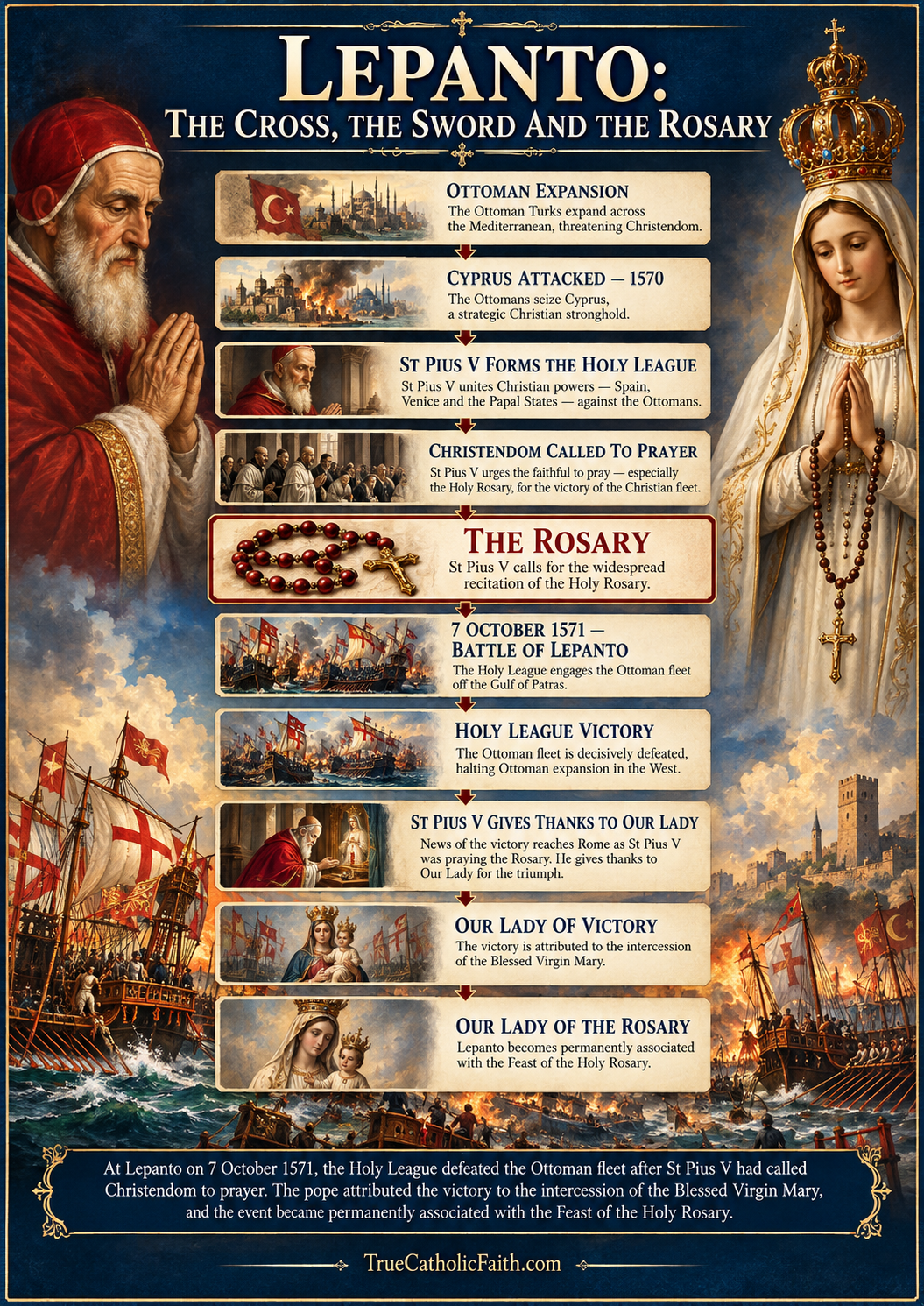
The Battle of Lepanto — 1571
Lepanto occurred centuries after the First Crusade, but it belongs naturally in this article because it destroys another modern illusion: that fear of Islamic military expansion was simply a medieval Catholic fantasy.
By the sixteenth century the Ottoman Empire had conquered Constantinople, expanded through southeastern Europe and become the dominant Muslim power in the eastern Mediterranean. In 1570 the Ottomans invaded Venetian Cyprus. Pope St Pius V laboured to assemble a Christian coalition—the Holy League. Spain, Venice, the Papal States and other Catholic forces eventually formed a fleet under Don John of Austria. On 7 October 1571, the fleets met near Lepanto.
A standard historical account describes Pius V as the principal promoter of the Holy League and identifies fear of Ottoman aggression and the conquest of Cyprus as the immediate strategic background. The battle became one of the great naval confrontations of the sixteenth century.
The Holy League won a decisive victory.
Lepanto and the Rosary
For Catholics, however, Lepanto has another dimension.
St Pius V had called Catholics to prayer.
The Rosary was prayed for the Christian fleet.
After the victory, the pope attributed the deliverance to the intercession of the Blessed Virgin Mary and established a liturgical commemoration associated with Our Lady of Victory, later connected with the Feast of the Holy Rosary. Even the 1911 Encyclopaedia Britannica recorded that members of the Rosary confraternity in Rome were praying during the battle and that Pius V ordered an annual commemoration afterward.
Later Pope Leo XIII explicitly recalled the Catholic understanding of Lepanto:
Christian victory had been obtained with the aid of Our Lady.
Catholics therefore see Lepanto on two levels.
Historically: A Catholic coalition defeated a major Ottoman fleet during an ongoing struggle for control of the Mediterranean.
Supernaturally: The Church gave thanks to God for victory through the intercession of the Blessed Virgin Mary.
The second proposition is theological rather than something secular historical methodology can prove. But the historical facts are indisputable:
the pope requested prayer; Catholics prayed the Rosary; victory followed; and the papacy formally commemorated that victory in connection with Our Lady.
That is why 7 October became inseparably associated with Our Lady of the Rosary.
PART III — THE INQUISITIONS
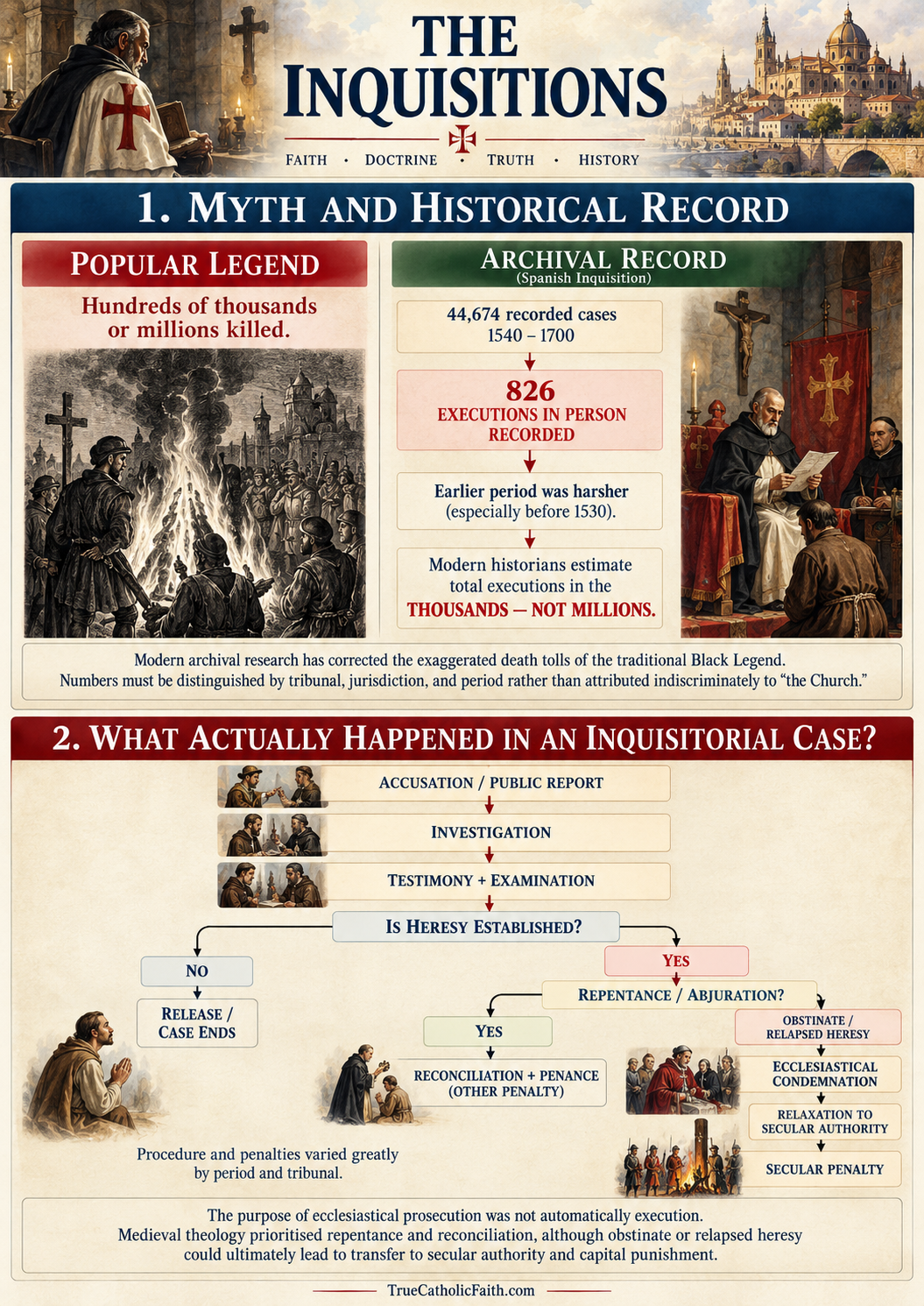
First: There Was Not Simply One “Inquisition”
The word itself causes confusion. Medieval inquisitio means essentially an inquiry or investigation. It was a method of judicial procedure.
As legal historians point out, inquisitorial procedure was not exclusively about heresy and was not originally the name of one enormous international police organisation. We must distinguish, among other things:
medieval episcopal investigations;
papally commissioned medieval inquisitors;
the Spanish Inquisition;
the Portuguese Inquisition;
the Roman Inquisition;
secular prosecutions of religious offences;
secular witch trials.
Mixing all of these together and assigning every execution to “the Catholic Inquisition” produces fictitious statistics.
When and Where Were the Inquisitions Held?
There was never one single “Inquisition” operating everywhere in Catholic Europe. Different inquisitorial systems developed at different times and in different places.
| Inquisition | Dates | Main Areas |
|---|---|---|
| Episcopal Inquisition | From 1184 | Local dioceses, especially where bishops investigated suspected heresy |
| Medieval / Papal Inquisition | From the 1230s | Especially southern France, northern and central Italy, and some parts of Germany and Spain |
| Spanish Inquisition | 1478–1834 | Spain and later parts of the Spanish Empire, including Mexico, Lima and Cartagena |
| Portuguese Inquisition | 1536–1821 | Portugal and Portuguese territories, including Goa |
| Roman Inquisition | From 1542 | Principally the Papal States and much of Italy |
The medieval Inquisition arose particularly in response to organised heretical movements such as the Cathars and Waldensians. It was most active in areas such as Languedoc in southern France and parts of Italy.
The later Spanish Inquisition, established in 1478, was a distinct institution under the Spanish monarchy.
The Portuguese Inquisition followed in 1536, while the Roman Inquisition was established in 1542 during the Protestant Reformation.
This distinction matters enormously when discussing statistics. When someone says:
“The Inquisition killed thousands of people,”
the first questions should be:
Which Inquisition? Where? During what period?
Figures from sixteenth-century Spain cannot simply be combined with medieval prosecutions in France, Roman tribunals in Italy, Portuguese Goa, secular witch trials and every other religious prosecution in Europe.
There was therefore no single universal tribunal continuously operating across Catholic Europe for six centuries. The history is regional, chronological and institutionally diverse.
Why Was Heresy Treated So Seriously?
Modern Western society generally treats religion as a private choice. Medieval Europe did not. Religion was understood as public truth. The Faith shaped:
marriage;
education;
oaths;
law;
morality;
public worship;
political legitimacy;
social obligations;
burial;
charity;
feast days;
communal identity.
Consequently, persistent organised heresy was not understood simply as:
“someone privately holding a different opinion.”
It could be perceived as a threat to both religious and social order. One does not have to adopt medieval political assumptions to understand them. But one must understand them before judging the institution built upon them.
What Did the Church Believe About Heresy?
Catholic theology regarded supernatural Faith as more valuable than temporal goods.
St Thomas Aquinas therefore made an argument startling to modern ears. If civil society could impose the death penalty for crimes such as counterfeiting—which damaged temporal society—then persistent public corruption of the Faith could be regarded as still more serious because it endangered souls.
But Aquinas also distinguished the role of the Church. He explicitly said that the Church seeks the conversion of the heretic and admonishes before finally separating an obstinate offender and handing the matter to secular authority.
Whether modern readers agree with medieval penal policy is a separate question. The point is that the policy possessed an intelligible theological and legal rationale. It was not:
“Catholics enjoyed torturing people who asked questions.”
Did the Church Execute Heretics?
Ecclesiastical courts could investigate, judge and condemn heresy. But clerics did not ordinarily perform executions.
An obstinate convicted heretic could ultimately be relaxed to the secular arm, and secular authority could impose the civil penalty—including death. It would nevertheless be misleading to use this distinction to pretend that ecclesiastical authorities had nothing to do with the resulting execution.
They knew what handing a convicted obstinate heretic to secular authority could mean. So the accurate formulation is:
The ecclesiastical tribunal judged the religious offence;
the secular authority imposed and carried out the temporal punishment.
That is stronger historically than either polemical extreme.
Was the Inquisition Uniquely Cruel?
This is where historical comparison becomes indispensable. The relevant comparison is not:
MEDIEVAL INQUISITION versus MODERN BRITISH OR AMERICAN COURT
It is:
ECCLESIASTICAL JUSTICE versus CONTEMPORARY MEDIEVAL AND EARLY-MODERN SECULAR JUSTICE.
That produces a considerably different picture. Medieval criminal justice could be extraordinarily severe. Execution was imposed for offences that modern states would punish much less severely. Physical punishments were common. Prisons were harsh. Judicial torture eventually became part of continental legal systems.
Against that background ecclesiastical procedure contained significant legal structure rather than simply arbitrary mob punishment. Modern scholarship on medieval inquisitio describes a learned Romano-canonical judicial system containing procedural rights, even though those protections could sometimes be restricted in heresy cases. That balanced conclusion is much more credible than either:
“The Inquisition invented due process.”
or:
“The Inquisition had no procedure whatsoever.”
Neither is historically adequate.
Did Criminals Prefer Church Courts?
There is a genuine historical phenomenon behind this claim, but it must be stated accurately. The medieval system recognised what became known as benefit of clergy. Certain defendants who would otherwise face secular punishment could be claimed for ecclesiastical jurisdiction.
A recent scholarly review describes “criminous clerks”—and later defendants qualifying through a literacy test—who after conviction in secular court could seek episcopal jurisdiction, potentially receiving imprisonment rather than hanging and eventually obtaining release.
That is significant evidence that ecclesiastical jurisdiction could sometimes be materially more merciful than secular criminal justice. But we should not convert that fact into the exaggerated statement:
“Criminals everywhere deliberately committed crimes so that they could be tried by the Inquisition.”
That is not established. The stronger, defensible point is:
In certain contexts defendants had powerful reasons to prefer ecclesiastical jurisdiction because secular penalties could be substantially harsher.
That fact sits very awkwardly with the popular image of Church courts as uniquely savage institutions.
Did the Inquisition Use Torture?
Yes. This should not be denied. Judicial torture entered medieval European legal procedure and could be employed under regulated circumstances.
By modern standards it is abhorrent. But again, two historical errors must be avoided.
Error One: Pretending that torture did not occur.
Error Two: Pretending that the Catholic Church invented torture and that secular Europe otherwise conducted humane criminal investigations.
Neither is true. Torture became part of the broader Romano-canonical legal culture of continental Europe. Its use varied enormously according to jurisdiction, century and tribunal.
A responsible Catholic treatment therefore does not say:
“There was no torture.”
It says:
Torture existed; it was not uniquely inquisitorial; its use was legally circumscribed in ways often omitted from popular accounts; abuses occurred; and it must be compared with contemporary judicial practice rather than anachronistically treated as something invented uniquely by Catholicism.
How Many People Did the Spanish Inquisition Execute?
Claims of hundreds of thousands or millions of victims do not survive serious archival research.
For the Spanish Inquisition, surviving central records covering 44,674 cases from 1540–1700 record 826 executions in person, with another 778 condemnations in effigy—meaning that the condemned person was absent or already dead and a representation was punished instead. Put into proportion:
826 executions over 160 years averages approximately 5 executions per year.
And:
826 executions out of 44,674 recorded cases is approximately 1.85%.
In other words:
ABOUT 98 OUT OF EVERY 100 RECORDED CASES DID NOT END IN EXECUTION IN PERSON.
That does not prove that every judgment was just, nor does it tell us whether every accused person was guilty. But it gives a very different picture from the popular image of an institution routinely sending enormous numbers of people to the stake.
Henry Kamen estimated roughly 2,000 executions for the earlier and considerably harsher period before 1530.
Different historians produce somewhat different totals because records are incomplete and methods of extrapolation vary. The defensible conclusion is therefore not an artificially precise total. It is:
THOUSANDS OVER CENTURIES — NOT HUNDREDS OF THOUSANDS OR MILLIONS.
The old enormous figures belong to polemical legend rather than modern archival historiography. That does not make the death of an innocent person unimportant. One unjust execution is an injustice. But historical truth requires the real numbers—and the real numbers are radically different from the legend.
Putting the Numbers in Perspective
Modern comparisons must be made cautiously because populations, legal systems and crimes differ enormously. Nevertheless, scale matters.
The surviving Spanish Inquisition records for 1540–1700 average roughly 5 executions per year.
By comparison, Amnesty International recorded at least 2,707 executions worldwide in 2025 alone, excluding thousands believed to have occurred in China and incomplete figures from several other countries.
The United States alone carried out 47 executions in 2025.
This comparison does not prove that medieval executions were justified, nor does modern capital punishment excuse historical injustice. It serves a narrower purpose:
to put the popular image of the Spanish Inquisition as a continuously operating mass-execution machine into numerical proportion.
Was the Inquisition a Mass-Killing Machine?
No. The archival numbers make that description unsustainable. Most people appearing before inquisitorial tribunals were not executed. Penalties could include:
prayer;
pilgrimage;
fines;
public penance;
wearing penitential garments;
confiscation;
imprisonment;
other ecclesiastical penalties.
Execution represented the extreme end of the system. That does not remove legitimate moral questions about coercion, imprisonment, confiscation or capital punishment. But it places the institution back into historical proportion.
What About the Death Penalty?
The reader is left with an obvious unanswered question:
“Even if the numbers were exaggerated, how could Catholics ever believe heretics could be executed?”
The first distinction is that the death penalty itself is not intrinsically evil according to traditional Catholic doctrine. Holy Scripture recognises the civil authority's coercive power. St Paul writes concerning temporal authority:
“For he beareth not the sword in vain.” — Romans 13:4
Traditional Catholic theology consequently recognised that legitimate public authority could impose capital punishment for sufficiently grave crimes when required for the common good. St Thomas Aquinas explicitly defended this principle. The historical dispute therefore cannot simply be:
“Did medieval Catholics accept capital punishment?”
They did. So did virtually every major European legal system for centuries afterward. The more difficult questions are:
Which offences warrant it?
Under what authority?
With what evidentiary safeguards?
Was a particular defendant actually guilty?
Was execution necessary or proportionate?
Were medieval laws against public heresy just?
Those questions can be debated. But they are different from claiming that the Catholic Church uniquely invented judicial killing.
“But Heresy Is Only an Opinion”
That objection assumes precisely the modern worldview that medieval society did not share.
Catholics believed revealed religion was objectively true. They also believed religious truth was connected with the eternal salvation of souls. Consequently, publicly organising to draw people away from the Faith was regarded as more serious than merely expressing an eccentric private thought.
Again, understanding that reasoning does not require a modern secular reader to accept the medieval penal conclusion. But it does require him to stop pretending that medieval people punished heretics because they had never heard of intellectual disagreement.
Their premise was different. They believed eternal truth and eternal salvation were real.
The Inquisition Also Sought Confession and Reconciliation
This is another important difference between ecclesiastical and purely punitive conceptions of justice.
The object was not simply to identify someone and kill him. The Church sought repentance. Confession of error, abjuration and reconciliation could fundamentally alter the outcome.
Aquinas's own explanation stresses this ecclesiastical desire for conversion before the final separation of the obstinate offender. This makes sense only if we understand the supernatural worldview involved. The Church's first objective was supposed to be:
CONVERSION not EXECUTION.
Whether every inquisitor lived up to that ideal is another question. Catholic doctrine never claims every churchman is virtuous.
Were There Abuses?
Of course. There were:
incompetent judges;
political manipulation;
excessive punishments;
misuse of procedure;
false accusations;
coercion;
local fanaticism;
unjust decisions;
human cruelty.
No serious Catholic historical argument requires denying these things. The Catholic claim is not:
EVERYTHING EVER DONE BY A CATHOLIC INSTITUTION WAS PERFECT.
It is:
THE CHURCH'S DIVINE CONSTITUTION AND DOCTRINE ARE NOT DISPROVED BY THE SINS, errors OR BAD JUDGMENTS OF HER MEMBERS.
This distinction is fundamental.
PART IV — THE BLACK LEGEND
How Did the Popular Image Develop?
The modern image of the Inquisition did not emerge solely from neutral archival research. Religious and political conflict profoundly influenced its development.
Protestant polemicists had obvious reasons to depict Catholic Spain and Rome as embodiments of religious tyranny. Spain's political enemies likewise had reasons to portray Spanish rule as uniquely barbarous. Enlightenment writers later employed the Inquisition as a symbol of religion supposedly suppressing reason. Nineteenth-century literature added gothic imagery:
dungeons • racks • flames • secret tribunals • sadistic monks.
Some genuine historical events lay behind these images. But they were amplified into a cultural mythology. Modern archival scholarship has dismantled many of the enormous numerical claims that accompanied it.
The Same Problem Occurred With the Crusades
A similar historiographical transformation occurred with crusading. The crusader became a stock character:
ignorant
greedy
fanatical
violent
manipulated by priests
eager to steal Muslim land
Yet modern scholarship has repeatedly complicated that picture. Crusaders frequently incurred immense financial losses. They undertook terrifying journeys. Many died. Many survivors returned home rather than remaining to enjoy supposedly easy colonial estates.
Their charters reveal intense concern with:
penance;
family;
salvation;
vows;
religious obligation.
That does not make every motive pure. It means religion must be allowed to count as a real historical motive.
A Useful Comparison
| Popular Myth | Historical Reality |
|---|---|
| The Crusades began as an unprovoked Catholic invasion of peaceful Muslim lands | They followed centuries of Muslim territorial expansion and an immediate Byzantine appeal for military assistance |
| Crusaders were mostly poor thugs seeking land | Major crusaders included Europe's aristocracy; crusading was extremely expensive and often required selling or mortgaging property |
| The pope promised automatic Heaven for killing Muslims | Crusading was conceived as penitential armed pilgrimage; indulgence theology presupposed the Catholic framework of repentance and remission |
| Every crusader atrocity was authorised by the pope | Popes could condemn crusader misconduct; Innocent III's reaction to Constantinople is a major example |
| Christians alone committed atrocities | Medieval warfare across religious and political boundaries could be extremely brutal |
| “The Inquisition” was one giant torture organisation | Several different inquisitorial institutions existed; inquisitio was fundamentally a judicial procedure |
| Millions were executed | Modern archival estimates are orders of magnitude lower |
| The Church personally burned everyone it condemned | Ecclesiastical courts judged heresy; capital sentences were imposed and executed by secular authority |
| Ecclesiastical courts were uniquely cruel | Contemporary secular criminal justice could be extremely harsh; ecclesiastical jurisdiction could sometimes offer substantially milder outcomes |
| The Inquisition invented torture | Judicial torture belonged to the wider development of medieval and early-modern European law |
| The sole objective was execution | Repentance, abjuration and reconciliation were central objectives of ecclesiastical prosecution |
The Strongest Objection
“Even After All Those Qualifications, Christians Still Killed People in the Name of Religion.”
Yes. No historical argument should evade that fact.
Crusaders killed.
Muslim armies killed.
Christian rulers executed criminals.
Muslim rulers executed criminals.
Catholic societies punished religious offences.
Protestant societies later punished religious offences.
Medieval and early-modern governments routinely imposed punishments modern Western societies regard as severe.
The question therefore cannot be resolved merely by saying:
“People died.”
The historical and moral questions concern authority, justice, cause, intention, proportionality and individual acts.
Response
Christianity has never taught pacifism as an absolute obligation upon states. Christ told individuals to forgive their enemies. That does not mean a ruler must allow an invading army to massacre his subjects.
St Paul explicitly recognises the coercive authority of the civil ruler in Romans 13:1–4.
St Augustine developed Christian just-war reasoning.
St Thomas Aquinas later formulated the classical requirements of legitimate authority, just cause and right intention.
Consequently: WAR IS NOT INTRINSICALLY EVIL.
An unjust war is evil.
Likewise: PUNISHMENT IS NOT INTRINSICALLY EVIL.
An unjust punishment is evil.
And: CAPITAL PUNISHMENT WAS NOT REGARDED BY TRADITIONAL CATHOLIC TEACHING AS INTRINSICALLY EVIL.
The historical question must therefore descend from slogans to particulars.
Was this war just?
Was this killing justified?
Was this person guilty?
Was this punishment proportionate?
Was this action authorised?
Only then can moral judgment begin.
What the Crusades Actually Demonstrate
Properly understood, the Crusades reveal something almost opposite to the modern caricature. They reveal a civilisation in which people took Christianity with extraordinary seriousness.
Kings could leave kingdoms behind.
Nobles could mortgage estates.
Knights could abandon families for years.
Men knew that disease might kill them before they ever saw Jerusalem.
They went anyway.
Some went for mixed motives.
Some committed terrible sins.
Some undoubtedly sought wealth.
But many believed deeply enough in:
Christ
penance
pilgrimage
the Holy Sepulchre
the defence of fellow Christians
and eternal life
to risk everything. That religious conviction should not be romanticised. Neither should it be explained away merely because modern secular culture finds it difficult to understand.
And Lepanto Shows Something More
By 1571 the geopolitical danger from Ottoman expansion was no medieval fantasy. Constantinople had fallen. The Ottoman Empire controlled enormous Christian territories. Cyprus was under attack. The Mediterranean balance of power was at stake.
St Pius V did what a pope in such circumstances might reasonably be expected to do:
he attempted to unite Christian princes in defence of Christendom.
And simultaneously:
he called Christians to prayer.
The Holy League fought.
Catholics prayed the Rosary.
The Christian fleet won at Lepanto on 7 October 1571.
The Church gave thanks to God and honoured the Blessed Virgin.
That combination is profoundly Catholic:
HUMAN ACTION
DEPENDENCE UPON DIVINE PROVIDENCE
THE INTERCESSION OF OUR LADY
Lepanto therefore deserves a prominent place in Catholic historical memory.
What We Can and Cannot Conclude
What We Can Conclude
We can conclude that
the common caricature of the Crusades as an inexplicable Catholic invasion of peaceful Muslim territory beginning in 1095 is historically false.
the First Crusade must be understood against centuries of Muslim-Christian conflict, Turkish expansion, Byzantine territorial collapse and Emperor Alexios's appeal for assistance.
crusading possessed a genuine penitential and pilgrimage character.
serious modern scholarship does not support reducing crusader motivation principally to greed, land hunger or the ambitions of younger sons.
crusading was financially ruinous for many participants.
genuine atrocities occurred.
those atrocities were not necessarily authorised by the papacy and that popes could condemn crusader misconduct.
Lepanto arose in the context of genuine Ottoman military expansion and that St Pius V deliberately connected the Christian response with prayer and Marian intercession.
the popular image of the Inquisition has frequently been exaggerated.
there was no single undifferentiated historical institution corresponding to everything popularly called “the Inquisition.”
inquisitorial procedure belonged to a broader medieval legal culture.
ecclesiastical justice must be compared with contemporary secular justice.
benefit of clergy could make ecclesiastical jurisdiction preferable to secular punishment in certain criminal cases.
modern scholarship does not support claims of millions—or even hundreds of thousands—executed by the Spanish Inquisition.
the Catholic Church's divine claims cannot logically be disproved merely by demonstrating that Catholics committed sins.
What We Cannot Conclude
We cannot conclude that every
Crusade was strategically wise.
war called a crusade satisfied every requirement of a just war.
crusader possessed pure motives.
We cannot excuse
the Rhineland massacres.
crimes against civilians merely because medieval warfare was brutal.
We cannot justify
the sack of Constantinople by calling it a crusade.
We cannot claim that
ecclesiastical tribunals never used torture.
everyone convicted of heresy received perfect justice.
every inquisitor was merciful.
We cannot reduce
every medieval punishment to Catholic doctrine.
And historical evidence by itself cannot prove that Our Lady miraculously caused the victory at Lepanto. That final judgment belongs to Faith and Catholic interpretation of providence.
Historical evidence can establish that Catholics prayed for her intercession, victory followed, and the Church formally commemorated that victory in her honour.
Conclusion
The Crusades and the Inquisition should not embarrass Catholics into silence. Neither should Catholics defend them by pretending nothing bad ever happened. The historical case is considerably stronger than that.
The First Crusade did not emerge from nowhere. It followed centuries of geopolitical transformation, the loss of formerly Christian territories, Turkish expansion and a direct Byzantine appeal for Western assistance.
The crusaders were not simply hordes of ignorant brigands bribed with promises of Heaven. Crusading was understood as armed pilgrimage and penance. It demanded immense sacrifice. Men sold and mortgaged property, abandoned security and crossed thousands of kilometres knowing they might never return.
Some crusaders committed grave crimes. That proves they were sinners—not that Catholicism is false.
The Fourth Crusade makes the distinction particularly clear: when crusaders devastated Christian Constantinople, Pope Innocent III himself condemned their actions.
Nor was the Inquisition the gigantic extermination machine of popular legend.
Real coercion existed.
Real torture existed.
Real executions occurred.
Real abuses occurred.
But serious history replaces mythology with records. The Spanish Inquisition's executions numbered in the thousands (over 160 years) rather than the fantastic hundreds of thousands or millions of later legend. Ecclesiastical tribunals operated within a wider legal civilisation in which secular punishment was often extremely severe. In some contexts ecclesiastical jurisdiction could actually offer a defendant a substantially better prospect than secular justice.
And then there is Lepanto. On 7 October 1571, a Catholic coalition assembled principally through the efforts of St Pius V defeated the Ottoman fleet.
The pope had called Christendom to prayer.
The Rosary was prayed.
Victory came.
And Catholic Europe gave thanks not principally to military technology or political genius, but to Almighty God through the intercession of His Blessed Mother.
The Church remembered the victory liturgically. That is why Lepanto should not be treated as an embarrassing relic of a supposedly intolerant Catholic past. For Catholics it remains an extraordinary image of Christendom as it once understood itself:
FAITHFUL IN PRAYER
UNITED IN DEFENCE
CONFIDENT IN DIVINE PROVIDENCE
AND SEEKING THE INTERCESSION OF THE BLESSED VIRGIN MARY.
The legends surrounding the Crusades and Inquisition therefore do not constitute a refutation of Catholicism. They constitute an invitation to do something much more dangerous to historical mythology: read the evidence.
Primary Sources
Holy Scripture, Romans 13:1–4 — traditional biblical foundation concerning legitimate civil authority and the sword.
Pope Urban II / Council of Clermont (1095) — surviving accounts and canonical material concerning the First Crusade and its penitential character. The precise wording of Urban's speech must be treated cautiously because surviving narratives differ.
Pope Innocent III, correspondence concerning the Fourth Crusade (1204) — especially valuable for demonstrating papal condemnation of crusader excesses at Constantinople.
St Thomas Aquinas, Summa Theologiae, II-II, q. 40 — classical Catholic treatment of just war.
St Thomas Aquinas, Summa Theologiae, II-II, q. 11, a. 3 — traditional theological treatment of persistent heresy, ecclesiastical admonition and secular punishment.
Pope St Pius V — documents and historical material concerning the Rosary and the Catholic response to the Ottoman threat.
Pope Leo XIII, Supremi Apostolatus Officio (1883) — recalls Lepanto and explicitly associates the Christian victory with the assistance of the Blessed Virgin through the Rosary.
Further Reading
Jonathan Riley-Smith, The First Crusade and the Idea of Crusading — fundamental modern scholarship on crusading motivation and religious ideology.
Jonathan Riley-Smith, “The Motives of the Earliest Crusaders and the Settlement of Latin Palestine, 1095–1100” — particularly useful against simplistic economic explanations of crusader motivation.
Thomas Asbridge, The First Crusade: A New History and The Crusades: The Authoritative History of the War for the Holy Land — extensive modern narrative treatment.
Christopher Tyerman, God's War: A New History of the Crusades — major modern scholarly synthesis.
Edward Peters, Inquisition — important historical treatment of the development of inquisitorial institutions and their later mythology.
Henry Kamen, The Spanish Inquisition: A Historical Revision — major revisionist archival study challenging many traditional Black Legend claims.
Henry Ansgar Kelly, Criminal-Inquisitorial Trials in English Church Courts — particularly valuable for understanding inquisitio as judicial procedure rather than simply a synonym for heresy persecution.
Related Questions
Did the Catholic Church Cause the “Dark Ages”?
Did the Catholic Church Oppose Science?
What About Galileo?
Did the Catholic Church Persecute Protestants?
Can the Church Be Holy If Catholics Commit Terrible Sins?
What Is a Just War?
Can the State Legitimately Use the Death Penalty?
Why Should We Trust the Catholic Church Despite Bad Popes and Corrupt Clergy?